"031373f479d9561a"{"id":"1000244","slug":"asian-animal-tiger","title":"Asian Animal - Tiger","category":"Animals","engine":"4.26+,5.0+","assetVersion":"","engineVersion":"Engine Version: 4.26+,5.0+","tag":"Animals","accent":"blue","visual":"mech","summary":"A highly detailed 3D tiger model featuring three LOD variations, 4K textures, a 37-bone rig, and 53 unique animations for realistic wildlife environments.","platform":"Unreal Engine","publishedAt":"2026-06-30T19:57:16.638Z","updatedAt":"2026-06-30T19:57:16.638Z","sourceNotes":[],"fileContents":[],"compatibility":["Unreal Engine","Engine Version: 4.26+,5.0+"],"featuredImage":{"alt":"Asian Animal - Tiger","src":"/wp-content/uploads/published/2026/06/88b3fb6ce8d3-9bce027c-37b2-4452-a053-04a73a2eff55-838ca9c79f.webp"},"hasDownloadLink":true,"downloads":0,"terms":[{"taxonomy":"category","slug":"animals","name":"Animals"}],"galleryImages":[{"src":"/wp-content/uploads/published/2026/06/9c2f2370471c-95fb3f83-94c2-4b79-ba03-a282ba5a7328-4c1dd5f048.webp","alt":"Asian Animal - Tiger"},{"src":"/wp-content/uploads/published/2026/06/a5315dd00302-27b46dfc-148a-493f-84f4-6b1808633f1a-b900ea3c97.webp","alt":"Asian Animal - Tiger"}],"accessPanel":{"kind":"resource","title":"Download this resource","eyebrow":"Free Download","message":"Log in or create a free account to start your download.","fileName":"Content.7z","safetyNote":"Resources are manually reviewed before listing to improve quality and reduce obvious risks.","actionLabel":"Download Free","resourceType":"Resource archive"},"contentHtml":"\u003ch2\u003ePopulating Digital Ecosystems with Apex Predators\u003c/h2\u003e\n\u003cp\u003eCreating immersive natural environments requires wildlife that looks authentic and behaves realistically within the world. The Asian Animal - Tiger package provides a comprehensive foundation for introducing a fully articulated apex predator into dense jungle biomes, hunting simulations, or interactive digital zoos. Rather than relying on static meshes or limited movement sets, this asset is built to support deep behavioral scripting. Equipped with a vast library of animations, varied texture maps, and multiple mesh resolutions, the tiger is prepared for complex integration via animation blueprints and custom visual scripts.\u003c/p\u003e \u003ch2\u003ePolygonal Scaling for Optimal Performance\u003c/h2\u003e\n\u003cp\u003eBalancing visual fidelity with runtime performance is a central challenge when deploying complex biological models. To address varying hardware constraints and camera distances, the tiger asset is separated into three distinct optimization levels. \u003c/p\u003e\n\u003cp\u003eFor cinematic close-ups, portfolio renders, or main menu showcases where geometric detail is paramount, developers can utilize the Super High Poly (SHP) variant, which consists of 21,130 triangles. When the animal is active in standard gameplay scenarios, the High Poly (HP) version reduces the geometry to 8,800 triangles, maintaining a strong silhouette while significantly reducing the rendering overhead. Finally, for background population or mobile platform deployment, the Low Poly (LP) mesh drops the count to 3,926 triangles. This lightest mesh allows multiple tigers to be rendered simultaneously in a single scene without aggressively bottlenecking system resources.\u003c/p\u003e \u003ch2\u003eSurface Details and 4K Texturing\u003c/h2\u003e\n\u003cp\u003eThe visual identity of the model is driven by a specialized suite of 4K resolution texture maps. Operating at 4K ensures that the fine details of the fur patterns and muscular definition remain crisp, even when the virtual camera tracks closely alongside the animal. \u003c/p\u003e\n\u003cp\u003eThe package includes three separate Color Textures, allowing developers to introduce visual variety if a project requires a territory populated by multiple tigers with distinct coat variations. To simulate realistic lighting interactions across the animal's body, the asset utilizes a Normal Map to generate the illusion of depth within the fur and skin folds. A Specular Map is provided to control light reflection, ensuring that elements like the eyes or the sleekness of the coat react appropriately to environmental lighting. Finally, an Ambient Occlusion (AO) Map grounds the model in the scene by accurately darkening crevices, muscle recesses, and areas where light naturally struggles to penetrate.\u003c/p\u003e \u003ch2\u003eSkeletal Framework and Animation Blueprints\u003c/h2\u003e\n\u003cp\u003eBeneath the textured surface, the tiger is driven by a custom 37-bone skeletal rig. This framework is specifically constructed to accommodate the complex anatomical movements of a large feline, from the curvature of its spine during a leap to the precise placement of its paws while creeping. \u003c/p\u003e\n\u003cp\u003eThis skeleton supports a massive library of 53 unique animations. Crucially for technical animators and programmers, these animations are supplied in both In-Position and Root Motion formats. Root motion ensures that the animation itself drives the physical capsule's movement through the world space, effectively eliminating the immersion-breaking foot-sliding that often occurs during complex maneuvers like turning, attacking, or stealthy approaches.\u003c/p\u003e \u003ch2\u003eLocomotion, Traversal, and Combat Mechanics\u003c/h2\u003e\n\u003cp\u003eThe locomotion suite offers granular control over how the tiger navigates its digital habitat. Basic movement routines include standard walking, walking backward, and walking while turning left or right. When the animal needs to close the distance, the animation list steps up to a standard run, a fast run, and directional running turns. The tiger can also perform tight pivots with specific Turn Left and Turn Right animations, or strafe side-to-side. For uneven terrain, the asset includes a complete jumping sequence featuring Jump Up, Jump Down, and standard Jumping actions. A dedicated Swimming animation further expands the types of environments the tiger can interact with.\u003c/p\u003e\n\u003cp\u003eWhen an encounter turns hostile, the combat animations provide a robust set of strikes and reactions. The tiger can perform an Attack Jaw sequence, an Attack Right Paw strike, and a specialized Sitting Attack Paw maneuver. It can transition into a Fight Idle stance or adopt a Lurking posture before striking. Intimidation tactics are covered by Start Roaring, Roaring, and End Roaring states. To handle incoming damage from players or other AI entities, the animation set includes four directional hit reactions—Hit Front, Hit Back, Hit Left, and Hit Right—ensuring accurate physical responses to impacts. If defeated, the model can trigger one of two distinct death sequences (Death or Death 01).\u003c/p\u003e \u003ch2\u003eBuilding Autonomous Biological Routines\u003c/h2\u003e\n\u003cp\u003eWhat separates a standard enemy asset from a believable wildlife entity is its behavior when completely undisturbed. The tiger model excels in ambient simulation by providing a deep roster of survival and biological animations. Developers can build complex AI daily schedules using the resting transitions, moving the animal from an Idle or Idle Sitting state through a Go To Sleep From Rest transition, into a Sleeping state, and eventually triggering an End Sleeping To Rest sequence.\u003c/p\u003e\n\u003cp\u003eFeeding routines are similarly detailed. The model can utilize a Trapping animation to secure its prey, followed by Start Eating, a standard Eating loop, an Aggressive Eating variant for contested kills, or a Lying Eating posture, before finally concluding with End Eating. A separate Drinking animation is included for hydration routines at water sources. \u003c/p\u003e\n\u003cp\u003eTo push the boundaries of documentary-style realism, the package includes highly specific biological functions. AI programmers can script complete elimination cycles using the Defecating Start, Defecating, and Defecating End animations, alongside a parallel Urinating Start, Urinating, and Urinating End sequence. These granular behavioral states provide all the necessary components for building an autonomous, living apex predator capable of reacting dynamically to a complex digital ecosystem.\u003c/p\u003e\n\n\u003ch2\u003eContinue Browsing Similar Packs\u003c/h2\u003e\n\u003cul\u003e\n\u003cli\u003e\u003ca href=\"https://3dcghub.com/panthers-pack/\" title=\"Panthers pack\"\u003ePanthers pack\u003c/a\u003e\u003c/li\u003e\n\u003cli\u003e\u003ca href=\"https://3dcghub.com/bones-vol-1-animal-bones-1-nanite-low-poly/\" title=\"Bones VOL.1 - Animal Bones 1 (Nanite + Low Poly)\"\u003eBones VOL.1 - Animal Bones 1 (Nanite + Low Poly)\u003c/a\u003e\u003c/li\u003e\n\u003cli\u003e\u003ca href=\"https://3dcghub.com/spixs-macaw-ararinha-azul/\" title=\"Spix\u0026#039;s Macaw - Ararinha Azul\"\u003eSpix\u0026#039;s Macaw - Ararinha Azul\u003c/a\u003e\u003c/li\u003e\n\u003cli\u003e\u003ca href=\"https://3dcghub.com/sea-animals-12-meshes/\" title=\"Sea Animals / 12 Meshes\"\u003eSea Animals / 12 Meshes\u003c/a\u003e\u003c/li\u003e\n\u003cli\u003e\u003ca href=\"https://3dcghub.com/animal-pack-ultra-2/\" title=\"Animal Pack Ultra 2\"\u003eAnimal Pack Ultra 2\u003c/a\u003e\u003c/li\u003e\n\u003c/ul\u003e","contentTextLength":6427,"navigation":{"current":1105,"total":3223,"previous":{"id":"1000245","slug":"biomass-cover","title":"Biomass Cover","category":"Dungeon","platform":"Unreal Engine","updatedAt":"2026-06-30T20:03:31.110Z"},"next":{"id":"1000243","slug":"abandoned-chapel","title":"Abandoned Chapel","category":"Abandoned","platform":"Unreal Engine","updatedAt":"2026-06-30T19:50:40.071Z"}},"relatedResources":[{"id":"1000268","slug":"african-animal-camel-dromedary","title":"African Animal - Camel (Dromedary)","category":"Animals","engine":"4.27,5.0+","assetVersion":"","engineVersion":"Engine Version: 4.27,5.0+","tag":"Animals","accent":"blue","visual":"mech","summary":"A fully rigged, high-poly Dromedary Camel 3D model featuring 35 bones, 1k/2k textures, and 36 total animations split across In-Place and Root Motion FBX files.","platform":"Unreal Engine","publishedAt":"2026-07-02T15:37:29.441Z","updatedAt":"2026-07-02T15:37:29.441Z","sourceNotes":[],"fileContents":[],"compatibility":["Unreal Engine","Engine Version: 4.27,5.0+"],"featuredImage":{"alt":"African Animal - Camel (Dromedary)","src":"/wp-content/uploads/published/2026/07/230d71b719a9-9a229666-007e-423d-93b2-68c88c60db0f-abb345eefd.webp"},"hasDownloadLink":true,"downloads":0},{"id":"1616","slug":"panthers-pack","title":"Panthers pack","category":"Animals","engine":"4.26+,5.0+","assetVersion":"Engine version: 4.26+,5.0+","engineVersion":"4.25","tag":"Animals","accent":"blue","visual":"character","summary":"Enhance your game with this professional panther asset pack. Includes realistic and fantasy skins, 4K PBR textures, and 16 animations for game developers.","platform":"Unreal Engine","publishedAt":"2026-02-06T20:08:21.000Z","updatedAt":"2026-04-19T15:58:07.000Z","sourceNotes":[],"fileContents":[],"compatibility":["Unreal Engine","Engine version: 4.26+,5.0+"],"featuredImage":{"alt":"Panthers pack","src":"https://3dcghub.com/wp-content/uploads/2026/02/5ade6ad0-a129-49ee-b9b2-cee2c6aedff0.webp"},"hasDownloadLink":true,"downloads":0},{"id":"1001065","slug":"raptor-dinosaur-animated","title":"Raptor Dinosaur Animated","category":"Animals","engine":"4.26+,5.0+","assetVersion":"","engineVersion":"Engine Version: 4.26+,5.0+","tag":"Animals","accent":"blue","visual":"mech","summary":"Dromaeosaurus animated model with 150+ animations, 5 LOD stages, 4096-pixel textures, UE4 ragdoll, and HumanIK FBX files for retargeting.","platform":"Unreal Engine","publishedAt":"2026-09-03T16:02:56.829Z","updatedAt":"2026-09-03T16:02:56.829Z","sourceNotes":[],"fileContents":[],"compatibility":["Unreal Engine","Engine Version: 4.26+,5.0+"],"featuredImage":{"alt":"Raptor Dinosaur Animated","src":"/wp-content/uploads/published/2026/09/b2c8cf21982a-6c8db538-21ee-4c01-aed5-6eb7cbbd1ba5-03c2b8519d.webp"},"hasDownloadLink":true,"downloads":1}]}
Animals
Asian Animal - Tiger
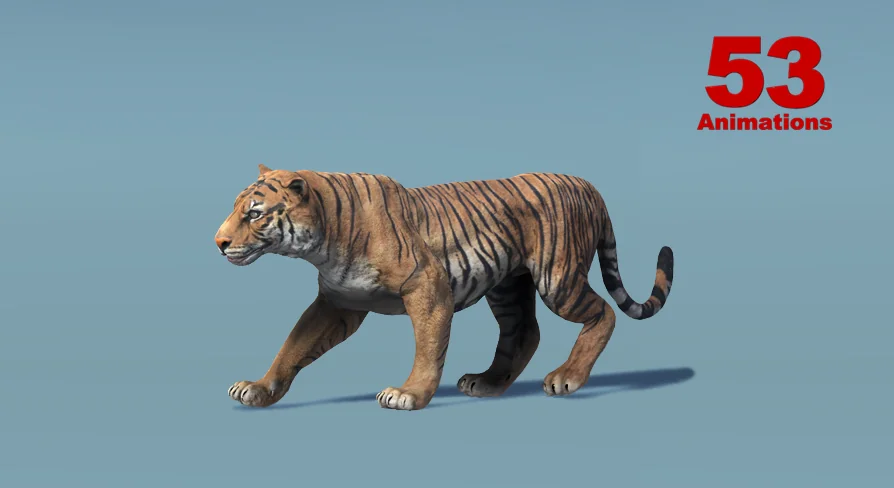
A highly detailed 3D tiger model featuring three LOD variations, 4K textures, a 37-bone rig, and 53 unique animations for realistic wildlife environments.
Category:Unreal Engine,AnimalsPlatform: Unreal EngineEngine Version: 4.26+,5.0+Published: Jun 30, 2026
Animals
Resource overview
Populating Digital Ecosystems with Apex Predators
Creating immersive natural environments requires wildlife that looks authentic and behaves realistically within the world. The Asian Animal - Tiger package provides a comprehensive foundation for introducing a fully articulated apex predator into dense jungle biomes, hunting simulations, or interactive digital zoos. Rather than relying on static meshes or limited movement sets, this asset is built to support deep behavioral scripting. Equipped with a vast library of animations, varied texture maps, and multiple mesh resolutions, the tiger is prepared for complex integration via animation blueprints and custom visual scripts.
Polygonal Scaling for Optimal Performance
Balancing visual fidelity with runtime performance is a central challenge when deploying complex biological models. To address varying hardware constraints and camera distances, the tiger asset is separated into three distinct optimization levels.
For cinematic close-ups, portfolio renders, or main menu showcases where geometric detail is paramount, developers can utilize the Super High Poly (SHP) variant, which consists of 21,130 triangles. When the animal is active in standard gameplay scenarios, the High Poly (HP) version reduces the geometry to 8,800 triangles, maintaining a strong silhouette while significantly reducing the rendering overhead. Finally, for background population or mobile platform deployment, the Low Poly (LP) mesh drops the count to 3,926 triangles. This lightest mesh allows multiple tigers to be rendered simultaneously in a single scene without aggressively bottlenecking system resources.
Surface Details and 4K Texturing
The visual identity of the model is driven by a specialized suite of 4K resolution texture maps. Operating at 4K ensures that the fine details of the fur patterns and muscular definition remain crisp, even when the virtual camera tracks closely alongside the animal.
The package includes three separate Color Textures, allowing developers to introduce visual variety if a project requires a territory populated by multiple tigers with distinct coat variations. To simulate realistic lighting interactions across the animal's body, the asset utilizes a Normal Map to generate the illusion of depth within the fur and skin folds. A Specular Map is provided to control light reflection, ensuring that elements like the eyes or the sleekness of the coat react appropriately to environmental lighting. Finally, an Ambient Occlusion (AO) Map grounds the model in the scene by accurately darkening crevices, muscle recesses, and areas where light naturally struggles to penetrate.
Skeletal Framework and Animation Blueprints
Beneath the textured surface, the tiger is driven by a custom 37-bone skeletal rig. This framework is specifically constructed to accommodate the complex anatomical movements of a large feline, from the curvature of its spine during a leap to the precise placement of its paws while creeping.
This skeleton supports a massive library of 53 unique animations. Crucially for technical animators and programmers, these animations are supplied in both In-Position and Root Motion formats. Root motion ensures that the animation itself drives the physical capsule's movement through the world space, effectively eliminating the immersion-breaking foot-sliding that often occurs during complex maneuvers like turning, attacking, or stealthy approaches.
Locomotion, Traversal, and Combat Mechanics
The locomotion suite offers granular control over how the tiger navigates its digital habitat. Basic movement routines include standard walking, walking backward, and walking while turning left or right. When the animal needs to close the distance, the animation list steps up to a standard run, a fast run, and directional running turns. The tiger can also perform tight pivots with specific Turn Left and Turn Right animations, or strafe side-to-side. For uneven terrain, the asset includes a complete jumping sequence featuring Jump Up, Jump Down, and standard Jumping actions. A dedicated Swimming animation further expands the types of environments the tiger can interact with.
When an encounter turns hostile, the combat animations provide a robust set of strikes and reactions. The tiger can perform an Attack Jaw sequence, an Attack Right Paw strike, and a specialized Sitting Attack Paw maneuver. It can transition into a Fight Idle stance or adopt a Lurking posture before striking. Intimidation tactics are covered by Start Roaring, Roaring, and End Roaring states. To handle incoming damage from players or other AI entities, the animation set includes four directional hit reactions—Hit Front, Hit Back, Hit Left, and Hit Right—ensuring accurate physical responses to impacts. If defeated, the model can trigger one of two distinct death sequences (Death or Death 01).
Building Autonomous Biological Routines
What separates a standard enemy asset from a believable wildlife entity is its behavior when completely undisturbed. The tiger model excels in ambient simulation by providing a deep roster of survival and biological animations. Developers can build complex AI daily schedules using the resting transitions, moving the animal from an Idle or Idle Sitting state through a Go To Sleep From Rest transition, into a Sleeping state, and eventually triggering an End Sleeping To Rest sequence.
Feeding routines are similarly detailed. The model can utilize a Trapping animation to secure its prey, followed by Start Eating, a standard Eating loop, an Aggressive Eating variant for contested kills, or a Lying Eating posture, before finally concluding with End Eating. A separate Drinking animation is included for hydration routines at water sources.
To push the boundaries of documentary-style realism, the package includes highly specific biological functions. AI programmers can script complete elimination cycles using the Defecating Start, Defecating, and Defecating End animations, alongside a parallel Urinating Start, Urinating, and Urinating End sequence. These granular behavioral states provide all the necessary components for building an autonomous, living apex predator capable of reacting dynamically to a complex digital ecosystem.
 Animals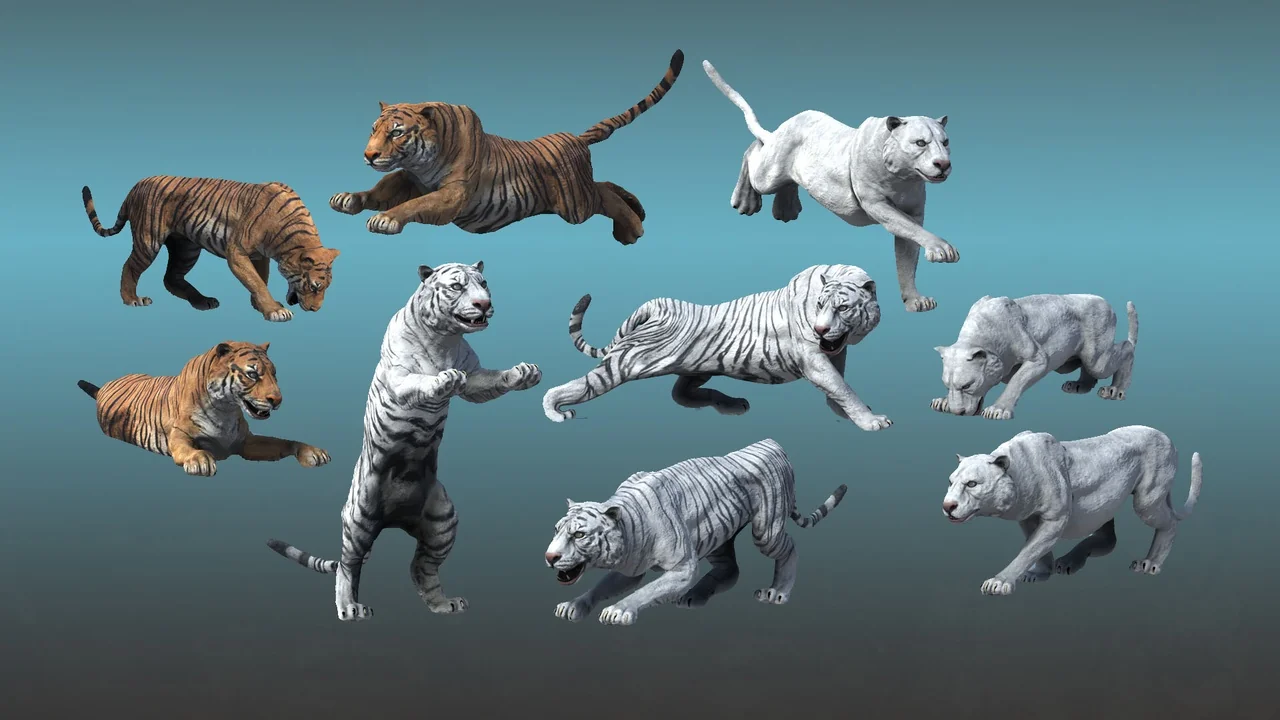
 Animals
 Animals
 Animals