"1a0e4ac4dc71d030"{"id":"1000202","slug":"sea-animals-12-meshes","title":"Sea Animals / 12 Meshes","category":"Animals","engine":"4.26+,5.0+","assetVersion":"","engineVersion":"Engine Version: 4.26+,5.0+","tag":"Animals","accent":"blue","visual":"mech","summary":"A collection of 12 rigged, lowpoly sea animal meshes built in a PBR pipeline, optimized for realistic underwater marine scenes and Lumen integration.","platform":"Unreal Engine","publishedAt":"2026-06-23T18:56:26.879Z","updatedAt":"2026-06-23T18:56:26.879Z","sourceNotes":[],"fileContents":[],"compatibility":["Unreal Engine","Engine Version: 4.26+,5.0+"],"featuredImage":{"alt":"Sea Animals / 12 Meshes","src":"/wp-content/uploads/published/2026/06/d7ecd8939494-26e8c1ce-b2ab-4e06-8ca6-e3bc4c415165-63f7cfd68a.webp"},"hasDownloadLink":true,"downloads":0,"terms":[{"taxonomy":"category","slug":"animals","name":"Animals"}],"galleryImages":[{"src":"/wp-content/uploads/published/2026/06/d3e4822fd88f-5c0cd55b-1d11-4f94-80d5-857b61e044dc-d9849c3193.webp","alt":"Sea Animals / 12 Meshes"},{"src":"/wp-content/uploads/published/2026/06/2966d4071ea9-7ddd5048-70dc-476a-9087-64615181c4aa-cb848eb32c.webp","alt":"Sea Animals / 12 Meshes"},{"src":"/wp-content/uploads/published/2026/06/40cfabac5200-3b7afd27-0653-4251-b284-696e88ca3e93-33fc948a7d.webp","alt":"Sea Animals / 12 Meshes"},{"src":"/wp-content/uploads/published/2026/06/7fe26125c5bb-4ca57acd-2eb2-4041-8ea4-6163b6b734c8-3d55847872.webp","alt":"Sea Animals / 12 Meshes"},{"src":"/wp-content/uploads/published/2026/06/a2120de8b3ab-9179a6b5-84d9-4c71-ae8d-259ed0a951e2-a8d54c594a.webp","alt":"Sea Animals / 12 Meshes"},{"src":"/wp-content/uploads/published/2026/06/27c6229b684a-fe218163-24d9-4a43-bd1a-ca50ed0ba9d7-03245c1c46.webp","alt":"Sea Animals / 12 Meshes"},{"src":"/wp-content/uploads/published/2026/06/272eaa2f8018-52c58fc7-19b4-4e16-aa38-0e3444838c5b-f31be06883.webp","alt":"Sea Animals / 12 Meshes"},{"src":"/wp-content/uploads/published/2026/06/f682bd437340-5c55a008-bba2-44c7-bb08-c11795e4403e-d2a67f268a.webp","alt":"Sea Animals / 12 Meshes"},{"src":"/wp-content/uploads/published/2026/06/c397e73b942d-705d7217-40d7-4b43-b8e5-92d67031713b-7dcdc0c415.webp","alt":"Sea Animals / 12 Meshes"},{"src":"/wp-content/uploads/published/2026/06/d8047c0ae985-593d075c-3bc1-41c0-89d4-ae46c10cb05b-f71dc3806d.webp","alt":"Sea Animals / 12 Meshes"}],"accessPanel":{"kind":"resource","title":"Download this resource","eyebrow":"Free Download","message":"Log in or create a free account to start your download.","fileName":"Content.7z","safetyNote":"Resources are manually reviewed before listing to improve quality and reduce obvious risks.","actionLabel":"Download Free","resourceType":"Resource archive"},"contentHtml":"\u003ch2\u003ePopulating Marine and Underwater Scenes\u003c/h2\u003e\n\u003cp\u003eBuilding convincing underwater environments requires populating empty aquatic spaces with recognizable and diverse lifeforms. Projects set in marine locations, whether shallow reefs or deep ocean trenches, rely on a variety of species to establish a believable ecosystem. The Sea Animals / 12 Meshes package provides a structural foundation for these scenarios, delivering a targeted roster of creatures built for direct implementation into aquatic levels. Focused on filling both open water and detailed seabed areas, the collection equips developers with the necessary assets to transform static water volumes into active marine scenes.\u003c/p\u003e \u003ch2\u003eThe 12-Mesh Ecosystem: From Seabed to Open Ocean\u003c/h2\u003e\n\u003cp\u003eThe specific selection of marine life within the package allows developers to address different spatial zones within an underwater level. The 12 meshes cover a broad spectrum of aquatic species. For ground-level interactions along the seabed, the crab and frog meshes provide ideal low-level detail, populating the sand and rock formations where cameras might closely investigate. Moving slightly higher into reef environments, the clownfish and seahorse meshes introduce smaller, detailed focal points that fit naturally into complex marine structures.\u003c/p\u003e\n\u003cp\u003eFor the broader ocean space, the package scales up to larger or more structurally complex creatures. The inclusion of a shark and a turtle offers highly recognizable silhouettes for open-water navigation or ambient scene cruising. An octopus and a jellyfish provide distinct, unique shapes that break up standard fish profiles, adding visual variety to the mid-water areas. A general fish mesh rounds out the roster, serving as a versatile asset that can be instanced to create optimized schools of fish filling the background of the marine environment.\u003c/p\u003e \u003ch2\u003eRigged Geometry for Dynamic Implementation\u003c/h2\u003e\n\u003cp\u003eA central technical feature of this prop package is that the animals are fully rigged. In game development and 3D scene creation, rigged meshes are essential for bringing static models to life. Because the skeletal framework is already established for the shark, turtle, octopus, and other creatures, developers can bypass the initial character setup phase and move directly to animation and posing.\u003c/p\u003e\n\u003cp\u003eThis rigged status means the assets are prepared for custom movement cycles. A development team can apply a pulsing animation to the jellyfish, a crawling cycle to the crab, or a smooth swimming sequence to the clownfish. For scenes requiring complex interactions, the rigged octopus allows for precise posing of its tentacles across the seabed. By providing the underlying skeleton, the package ensures that the realistic visual representations can be matched with realistic physical behaviors, a strict requirement for immersive underwater projects.\u003c/p\u003e \u003ch2\u003ePBR Pipeline and Visual Realism\u003c/h2\u003e\n\u003cp\u003eAchieving a realistic aesthetic in marine environments heavily depends on how surface materials react to light. This package is constructed entirely within a PBR (Physically Based Rendering) pipeline, ensuring it meets the visual standards required for AAA quality projects. The PBR workflow guarantees that the material properties of each animal—such as the roughness of a turtle shell, the slight translucency of a jellyfish, or the specific specular highlights on a fish scale—are physically accurate.\u003c/p\u003e\n\u003cp\u003eThis detailed approach to materials is especially critical underwater, where lighting conditions are often complex and heavily filtered. The realistic textures ensure that as light passes through the ocean volume and strikes the models, they maintain their visual integrity. The PBR setup allows the meshes to seamlessly integrate into environments with advanced shading, ensuring the creatures look grounded and authentic whether they are in shallow, brightly lit water or dark, deep-sea environments.\u003c/p\u003e \u003ch2\u003eIntegration with Lumen Lighting Systems\u003c/h2\u003e\n\u003cp\u003eThe package’s specific compatibility with Lumen further enhances its visual implementation. Lumen, the dynamic global illumination and reflections system utilized in modern real-time engines, relies on accurate geometry and PBR materials to calculate how light bounces around a scene. When deployed in a Lumen-enabled project, these marine assets react dynamically to environmental lighting changes.\u003c/p\u003e\n\u003cp\u003eIf a light source filters down from the ocean surface and reflects off a bright sandy seabed, that secondary bounce light will correctly illuminate the underside of the shark or turtle models. The Lumen tag indicates that the assets are structured to support these real-time lighting calculations without visual artifacting. This integration ensures that the detailed, realistic aesthetic of the 12 meshes is fully leveraged by modern rendering technologies.\u003c/p\u003e \u003ch2\u003eBalancing Lowpoly Optimization and AAA Quality\u003c/h2\u003e\n\u003cp\u003eOne of the primary challenges in populating underwater scenes is managing performance. Oceans often require dozens, if not hundreds, of visible creatures to feel appropriately dense. This package directly addresses this by focusing heavily on optimization and performance through lowpoly construction. By keeping the polygon count of the meshes low, the assets minimize the rendering strain on the hardware.\u003c/p\u003e\n\u003cp\u003eThis lowpoly optimization allows developers to instance the general fish mesh into massive schools, or place multiple crabs and seahorses across a vast seabed, without causing severe frame rate drops. Crucially, the package balances this optimization with its AAA quality target. Because the visual detail is largely driven by the high-quality PBR textures rather than dense geometry, the lowpoly nature of the models does not compromise their realistic appearance. Developers can maintain a strict focus on performance while still achieving the high-end look required for dense projects.\u003c/p\u003e\n\u003cp\u003eProjects requiring a populated ocean environment benefit directly from assets that combine skeletal readiness with rendering efficiency. The collection delivers a highly focused set of tools for marine environments. With an ecosystem ranging from seabed-dwelling crabs and frogs to open-water sharks and turtles, the package provides the necessary variety for comprehensive scene building. By delivering these creatures as rigged, lowpoly models within a strict PBR pipeline, development teams can achieve highly detailed, Lumen-ready realism while maintaining the strict performance budgets required for expansive underwater projects.\u003c/p\u003e\n\n\u003ch2\u003eRelated Resources Worth Checking\u003c/h2\u003e\n\u003cul\u003e\n\u003cli\u003e\u003ca href=\"https://3dcghub.com/bones-vol-1-animal-bones-1-nanite-low-poly/\" title=\"Bones VOL.1 - Animal Bones 1 (Nanite + Low Poly)\"\u003eBones VOL.1 - Animal Bones 1 (Nanite + Low Poly)\u003c/a\u003e\u003c/li\u003e\n\u003cli\u003e\u003ca href=\"https://3dcghub.com/animal-pack-ultra-2/\" title=\"Animal Pack Ultra 2\"\u003eAnimal Pack Ultra 2\u003c/a\u003e\u003c/li\u003e\n\u003cli\u003e\u003ca href=\"https://3dcghub.com/panthers-pack/\" title=\"Panthers pack\"\u003ePanthers pack\u003c/a\u003e\u003c/li\u003e\n\u003cli\u003e\u003ca href=\"https://3dcghub.com/animalia-starter-kit/\" title=\"Animalia - Starter Kit\"\u003eAnimalia - Starter Kit\u003c/a\u003e\u003c/li\u003e\n\u003cli\u003e\u003ca href=\"https://3dcghub.com/spixs-macaw-ararinha-azul/\" title=\"Spix\u0026#039;s Macaw - Ararinha Azul\"\u003eSpix\u0026#039;s Macaw - Ararinha Azul\u003c/a\u003e\u003c/li\u003e\n\u003c/ul\u003e","contentTextLength":6622,"navigation":{"current":1100,"total":3200,"previous":{"id":"1000203","slug":"seaside-docks-vol-2-boats-nanite-low-poly","title":"Seaside Docks VOL.2 - Boats (Nanite + Low Poly)","category":"Boats","platform":"Unreal Engine","updatedAt":"2026-06-23T19:20:38.557Z"},"next":{"id":"1000201","slug":"scl-restaurant-002","title":"SCL Restaurant 002","category":"Buildings \u0026 Architecture","platform":"Unreal Engine","updatedAt":"2026-06-23T18:50:46.932Z"}},"relatedResources":[{"id":"1579","slug":"bones-vol-1-animal-bones-1-nanite-low-poly","title":"Bones VOL.1 - Animal Bones 1 (Nanite + Low Poly)","category":"Animals","engine":"5.0+","assetVersion":"Engine version: 5.0+","engineVersion":"5.0","tag":"Animals","accent":"blue","visual":"character","summary":"Enhance your game environments with 56 realistic animal bone meshes. Features Nanite support, 4K textures, and optimized low-poly versions for Unreal Engine.","platform":"Unreal Engine","publishedAt":"2026-02-06T19:51:21.000Z","updatedAt":"2026-04-19T15:58:08.000Z","sourceNotes":[],"fileContents":[],"compatibility":["Unreal Engine","Engine version: 5.0+"],"featuredImage":{"alt":"Bones VOL.1 - Animal Bones 1 (Nanite + Low Poly)","src":"https://3dcghub.com/wp-content/uploads/2026/02/6050220a-fd41-4d5f-8d79-4a7276034f1c.webp"},"hasDownloadLink":true,"downloads":1},{"id":"1000945","slug":"critters-vol-2-crows-and-seagulls-nanite-and-low-poly-w-particle","title":"Critters VOL.2 - Crows \u0026 Seagulls (Nanite and Low Poly w/Particle)","category":"Animals","engine":"5.2+","assetVersion":"","engineVersion":"Engine Version: 5.2+","tag":"Animals","accent":"blue","visual":"mech","summary":"Nanite and low poly crows \u0026 seagulls for Unreal Engine with 20 meshes, 4k textures, dead and posed versions, and Niagara particles for overhead flocks.","platform":"Unreal Engine","publishedAt":"2026-08-13T04:04:31.810Z","updatedAt":"2026-08-13T04:04:31.810Z","sourceNotes":[],"fileContents":[],"compatibility":["Unreal Engine","Engine Version: 5.2+"],"featuredImage":{"alt":"Critters VOL.2 - Crows \u0026 Seagulls (Nanite and Low Poly w/Particle)","src":"/wp-content/uploads/published/2026/08/a574ec954490-e13c35d6-fb8b-4abe-baef-294201d38aca-427538c056.webp"},"hasDownloadLink":true,"downloads":0},{"id":"1000972","slug":"animal-pack-ultra","title":"Animal Pack Ultra","category":"Animals","engine":"4.26+,5.0+","assetVersion":"","engineVersion":"Engine Version: 4.26+,5.0+","tag":"Animals","accent":"blue","visual":"mech","summary":"Explore Animal Pack Ultra, a collection of 32 rigged and animated animals across biomes. Realistic style with animation blueprints, built for PC-based projects.","platform":"Unreal Engine","publishedAt":"2026-08-17T15:56:09.648Z","updatedAt":"2026-08-17T15:56:09.648Z","sourceNotes":[],"fileContents":[],"compatibility":["Unreal Engine","Engine Version: 4.26+,5.0+"],"featuredImage":{"alt":"Animal Pack Ultra","src":"/wp-content/uploads/published/2026/08/32fe7ded880f-90ffa083-3d2a-4199-a2e3-a6755f941b13-b84df94caa.webp"},"hasDownloadLink":true,"downloads":1}]}
Animals
Sea Animals / 12 Meshes
A collection of 12 rigged, lowpoly sea animal meshes built in a PBR pipeline, optimized for realistic underwater marine scenes and Lumen integration.
Category:Unreal Engine, AnimalsPlatform: Unreal EngineEngine Version: 4.26+,5.0+Published: Jun 23, 2026
Animals
Resource overview
Populating Marine and Underwater Scenes
Building convincing underwater environments requires populating empty aquatic spaces with recognizable and diverse lifeforms. Projects set in marine locations, whether shallow reefs or deep ocean trenches, rely on a variety of species to establish a believable ecosystem. The Sea Animals / 12 Meshes package provides a structural foundation for these scenarios, delivering a targeted roster of creatures built for direct implementation into aquatic levels. Focused on filling both open water and detailed seabed areas, the collection equips developers with the necessary assets to transform static water volumes into active marine scenes.
The 12-Mesh Ecosystem: From Seabed to Open Ocean
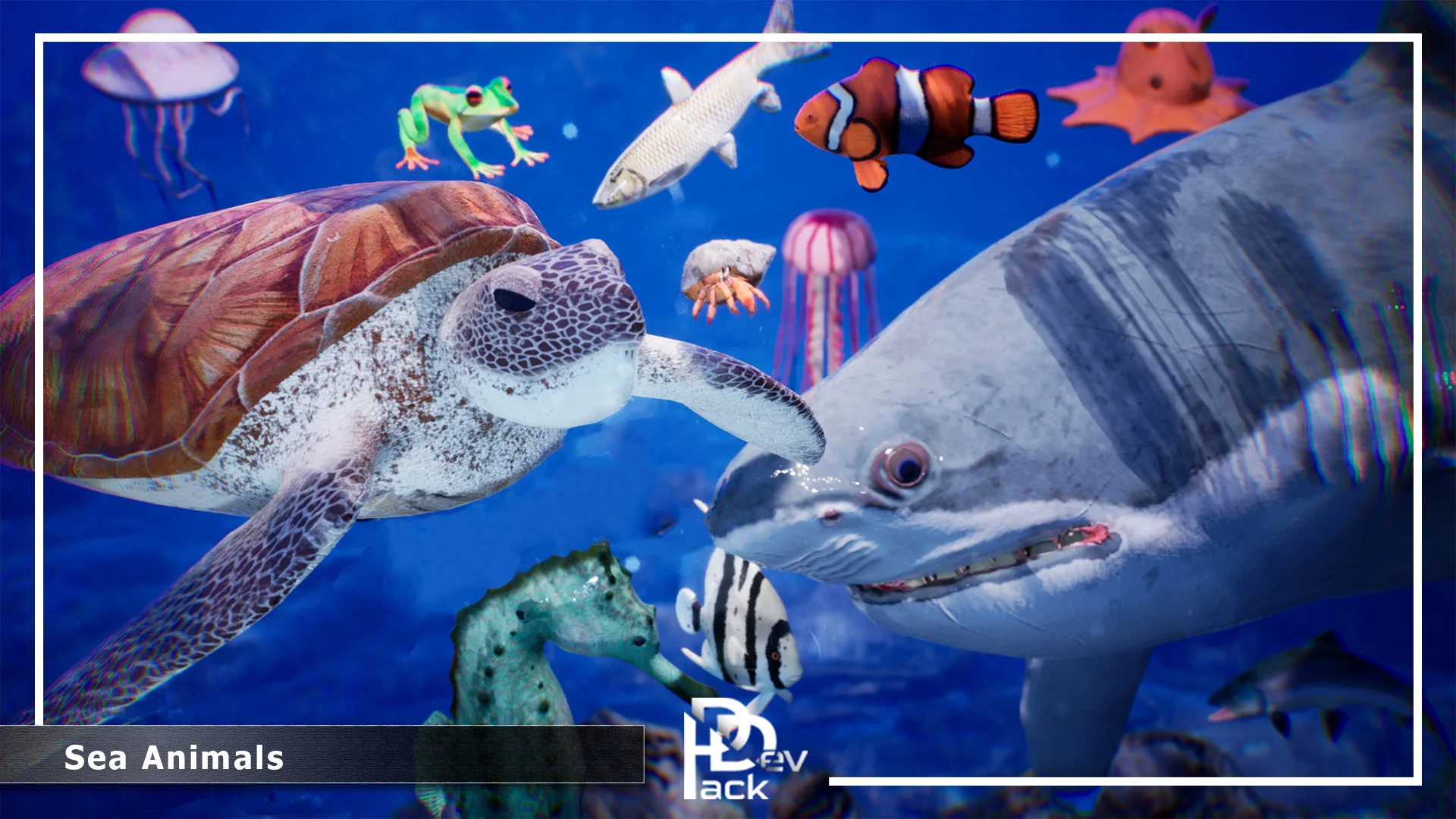
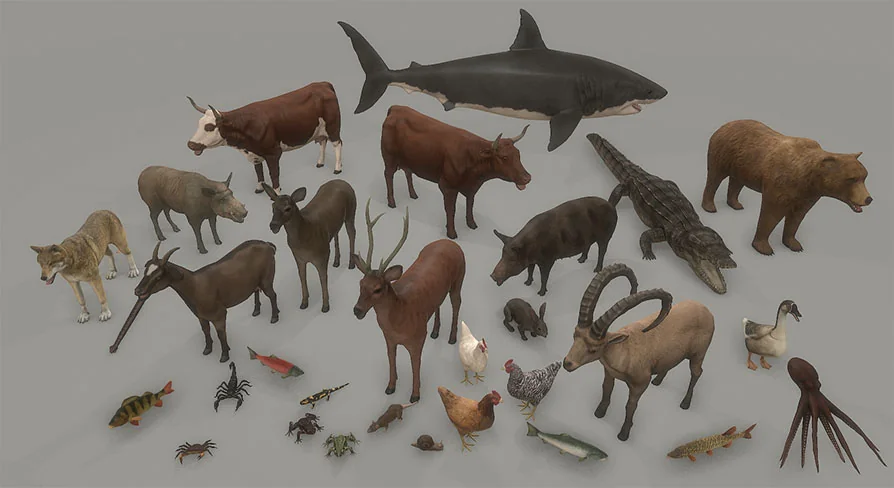
The specific selection of marine life within the package allows developers to address different spatial zones within an underwater level. The 12 meshes cover a broad spectrum of aquatic species. For ground-level interactions along the seabed, the crab and frog meshes provide ideal low-level detail, populating the sand and rock formations where cameras might closely investigate. Moving slightly higher into reef environments, the clownfish and seahorse meshes introduce smaller, detailed focal points that fit naturally into complex marine structures.
For the broader ocean space, the package scales up to larger or more structurally complex creatures. The inclusion of a shark and a turtle offers highly recognizable silhouettes for open-water navigation or ambient scene cruising. An octopus and a jellyfish provide distinct, unique shapes that break up standard fish profiles, adding visual variety to the mid-water areas. A general fish mesh rounds out the roster, serving as a versatile asset that can be instanced to create optimized schools of fish filling the background of the marine environment.
Rigged Geometry for Dynamic Implementation
A central technical feature of this prop package is that the animals are fully rigged. In game development and 3D scene creation, rigged meshes are essential for bringing static models to life. Because the skeletal framework is already established for the shark, turtle, octopus, and other creatures, developers can bypass the initial character setup phase and move directly to animation and posing.
This rigged status means the assets are prepared for custom movement cycles. A development team can apply a pulsing animation to the jellyfish, a crawling cycle to the crab, or a smooth swimming sequence to the clownfish. For scenes requiring complex interactions, the rigged octopus allows for precise posing of its tentacles across the seabed. By providing the underlying skeleton, the package ensures that the realistic visual representations can be matched with realistic physical behaviors, a strict requirement for immersive underwater projects.
PBR Pipeline and Visual Realism
Achieving a realistic aesthetic in marine environments heavily depends on how surface materials react to light. This package is constructed entirely within a PBR (Physically Based Rendering) pipeline, ensuring it meets the visual standards required for AAA quality projects. The PBR workflow guarantees that the material properties of each animal—such as the roughness of a turtle shell, the slight translucency of a jellyfish, or the specific specular highlights on a fish scale—are physically accurate.
This detailed approach to materials is especially critical underwater, where lighting conditions are often complex and heavily filtered. The realistic textures ensure that as light passes through the ocean volume and strikes the models, they maintain their visual integrity. The PBR setup allows the meshes to seamlessly integrate into environments with advanced shading, ensuring the creatures look grounded and authentic whether they are in shallow, brightly lit water or dark, deep-sea environments.
Integration with Lumen Lighting Systems
The package’s specific compatibility with Lumen further enhances its visual implementation. Lumen, the dynamic global illumination and reflections system utilized in modern real-time engines, relies on accurate geometry and PBR materials to calculate how light bounces around a scene. When deployed in a Lumen-enabled project, these marine assets react dynamically to environmental lighting changes.
If a light source filters down from the ocean surface and reflects off a bright sandy seabed, that secondary bounce light will correctly illuminate the underside of the shark or turtle models. The Lumen tag indicates that the assets are structured to support these real-time lighting calculations without visual artifacting. This integration ensures that the detailed, realistic aesthetic of the 12 meshes is fully leveraged by modern rendering technologies.
Balancing Lowpoly Optimization and AAA Quality
One of the primary challenges in populating underwater scenes is managing performance. Oceans often require dozens, if not hundreds, of visible creatures to feel appropriately dense. This package directly addresses this by focusing heavily on optimization and performance through lowpoly construction. By keeping the polygon count of the meshes low, the assets minimize the rendering strain on the hardware.
This lowpoly optimization allows developers to instance the general fish mesh into massive schools, or place multiple crabs and seahorses across a vast seabed, without causing severe frame rate drops. Crucially, the package balances this optimization with its AAA quality target. Because the visual detail is largely driven by the high-quality PBR textures rather than dense geometry, the lowpoly nature of the models does not compromise their realistic appearance. Developers can maintain a strict focus on performance while still achieving the high-end look required for dense projects.
Projects requiring a populated ocean environment benefit directly from assets that combine skeletal readiness with rendering efficiency. The collection delivers a highly focused set of tools for marine environments. With an ecosystem ranging from seabed-dwelling crabs and frogs to open-water sharks and turtles, the package provides the necessary variety for comprehensive scene building. By delivering these creatures as rigged, lowpoly models within a strict PBR pipeline, development teams can achieve highly detailed, Lumen-ready realism while maintaining the strict performance budgets required for expansive underwater projects.
 Animals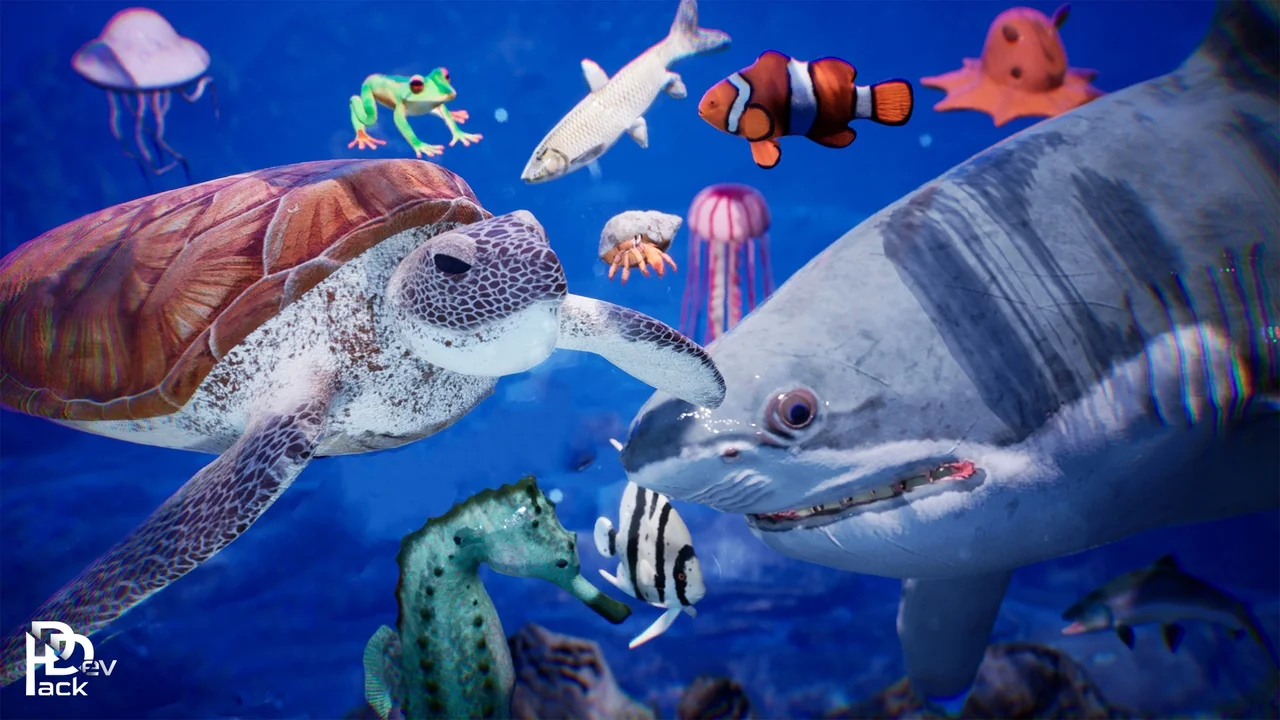
 Animals
 Animals
 Animals