"1a0e4ac4dc71d030"{"id":"1000203","slug":"seaside-docks-vol-2-boats-nanite-low-poly","title":"Seaside Docks VOL.2 - Boats (Nanite + Low Poly)","category":"Boats","engine":"5.0+","assetVersion":"","engineVersion":"Engine Version: 5.0+","tag":"Boats","accent":"blue","visual":"mech","summary":"A high-fidelity collection of 27 nautical meshes featuring both Nanite and low poly geometry, 4K channel-packed textures, and UE5 Lumen support.","platform":"Unreal Engine","publishedAt":"2026-06-23T19:20:38.557Z","updatedAt":"2026-06-23T19:20:38.557Z","sourceNotes":[],"fileContents":[],"compatibility":["Unreal Engine","Engine Version: 5.0+"],"featuredImage":{"alt":"Seaside Docks VOL.2 - Boats (Nanite + Low Poly)","src":"/wp-content/uploads/published/2026/06/d684f0e4f9c1-22285801-a327-4f53-9831-d2f8c0ca6177-e06f28898e.webp"},"hasDownloadLink":true,"downloads":0,"terms":[{"taxonomy":"category","slug":"boats","name":"Boats"}],"galleryImages":[{"src":"/wp-content/uploads/published/2026/06/4401e3a055fe-d717f666-53be-418a-8556-e3c942e6d5df-35bd86c52e.webp","alt":"Seaside Docks VOL.2 - Boats (Nanite + Low Poly)"},{"src":"/wp-content/uploads/published/2026/06/985d9a5590b9-6eff7245-ba0e-454f-9ab7-41ad16f4a252-c777f4e6de.webp","alt":"Seaside Docks VOL.2 - Boats (Nanite + Low Poly)"},{"src":"/wp-content/uploads/published/2026/06/a24ba0496871-d0fb5a32-ef46-4f71-a05b-f39730795d2c-c5250c8759.webp","alt":"Seaside Docks VOL.2 - Boats (Nanite + Low Poly)"},{"src":"/wp-content/uploads/published/2026/06/b5077494cfeb-eddaddbe-be53-4ba6-a4fc-1d54f2a1c872-6139423fe9.webp","alt":"Seaside Docks VOL.2 - Boats (Nanite + Low Poly)"},{"src":"/wp-content/uploads/published/2026/06/b229ef6d7dee-69d29485-f808-48cc-b176-12dc56782091-23f3cb51c1.webp","alt":"Seaside Docks VOL.2 - Boats (Nanite + Low Poly)"},{"src":"/wp-content/uploads/published/2026/06/047af6bc4230-da7ed80b-97ec-428a-b5ee-42ad10a7c5e9-b29e020663.webp","alt":"Seaside Docks VOL.2 - Boats (Nanite + Low Poly)"},{"src":"/wp-content/uploads/published/2026/06/0327f5e300eb-bdf22596-647c-4554-b1bc-cbeab94b81ce-b2ead3411d.webp","alt":"Seaside Docks VOL.2 - Boats (Nanite + Low Poly)"},{"src":"/wp-content/uploads/published/2026/06/4b35740c92f4-af4cc811-4a2f-42e6-99e5-0020d814c3f0-86114e8540.webp","alt":"Seaside Docks VOL.2 - Boats (Nanite + Low Poly)"},{"src":"/wp-content/uploads/published/2026/06/e6832fda6282-d6acd60c-1dee-40a0-be35-546cb39a6e49-1acdde0532.webp","alt":"Seaside Docks VOL.2 - Boats (Nanite + Low Poly)"},{"src":"/wp-content/uploads/published/2026/06/2020cc39181c-9e310cad-2260-478a-ad2d-e64539282a33-154a4a8c85.webp","alt":"Seaside Docks VOL.2 - Boats (Nanite + Low Poly)"}],"accessPanel":{"kind":"resource","title":"Download this resource","eyebrow":"Free Download","message":"Log in or create a free account to start your download.","fileName":"Content.7z","safetyNote":"Resources are manually reviewed before listing to improve quality and reduce obvious risks.","actionLabel":"Download Free","resourceType":"Resource archive"},"contentHtml":"Building realistic maritime environments often involves balancing visual fidelity with performance budgets, particularly when dealing with complex, curved geometry like boat hulls and nautical gear. Seaside Docks VOL.2 - Boats (Nanite + Low Poly) provides a structured set of watercraft and dockside props specifically authored for Unreal Engine. By integrating both high-density virtualized geometry and traditional meshes alongside scalable materials, this collection fits directly into modern AAA production pipelines ranging from realistic ocean simulations to coastal horror scenes. \u003ch2\u003eDual-Mesh Workflow: Nanite and Low Poly Geometry\u003c/h2\u003e This package delivers 27 distinct meshes, encompassing a variety of nautical equipment such as canoes, ship components, paddles, sails, and boat motors. Rather than forcing a single rendering paradigm, the collection effectively doubles its utility by providing two complete sets of geometry for every prop. The primary set is constructed utilizing Unreal Engine's Nanite virtualized geometry system. This allows the models to retain extremely high-fidelity polycounts, ensuring that the smooth curves of a boat hull or the intricate mechanical details of a motor remain perfectly crisp regardless of camera distance, without the severe performance penalties traditionally associated with dense meshes. For projects that cannot rely on virtualized geometry, a complete low poly counterpart is provided for every single one of the 27 meshes. Having a dedicated low poly variant ensures that developers building for specific hardware targets, mobile platforms, or traditional rendering pipelines can still utilize the exact same boat and dockside models. This dual approach accommodates both cutting-edge Unreal Engine 5 environments and projects requiring stricter, conventional polygon budgets. The transition between the high-poly Nanite versions and the optimized low-poly meshes allows teams to scale their environments based on their specific performance requirements. \u003ch2\u003e4K Textures and Channel Packed Materials\u003c/h2\u003e Surface detailing across the wooden ships, metal motors, and canvas sails relies on high-quality 4K texture sets. To keep memory overhead in check while maintaining this strict resolution, the texture maps utilize standardized channel packing. Specifically, the roughness, metalness, and ambient occlusion data are combined into a single RMA texture asset. This optimization significantly reduces the number of texture samplers required per material, ensuring that the realistic wood grains, rusted metals, and painted surfaces render as efficiently as possible during runtime. A comprehensive master material setup drives the vast majority of the props and models within the collection. This central material architecture gives environment artists granular control over the final look of the assets. Through the material instances, users can adjust additional parameters for roughness, albedo, and normals. This flexibility makes it possible to tweak the weathering on a wooden paddle, shift the base color of a canoe, or alter the gloss on a boat hull to match the specific environmental conditions of a given scene, whether it is a sun-drenched harbor or a damp, overcast dock. \u003ch2\u003eEnvironmental Integration with Paintable Barnacles\u003c/h2\u003e Because the assets are modeled and fully detailed from all sides, they can be placed freely within an environment without worrying about exposing unfinished backfaces or hollow geometry. A flipped canoe or a capsized sailboat will hold up to tight camera scrutiny just as well as a vessel floating upright. This full-coverage detailing is critical for dynamic scenes where players or cinematic cameras might view the assets from unpredictable angles, such as underwater shots or physics-driven events where boats are tossed by ocean waves. To further customize the appearance of the nautical props and ground them in their environment, the project includes a system for paintable barnacles. This feature allows environment artists to manually apply organic marine growth directly to the hulls of ships, dock supports, or floating debris. Adding these barnacles breaks up the silhouette and surface repetition of the models, embedding them more firmly into a realistic ocean or harbor setting. By painting this growth exactly where the water line would sit, developers can achieve a highly localized, weathered look that static textures cannot provide. \u003ch2\u003eLumen Support and Dynamic Lighting Testing\u003c/h2\u003e The collection is built to fully support Lumen, Unreal Engine's dynamic global illumination and reflections system, specifically for UE 5.0 and newer versions. The inclusion of Lumen support means that light bouncing off the ocean surface or dockside lamps will accurately interact with the 4K textures, picking up the subtle roughness variations on the wood and the metallic reflections on the boat motors. This real-time lighting response ensures that the assets sit naturally within dynamic daylight cycles or complex, artificially lit horror environments. To help artists evaluate these interactions immediately, the project includes a dedicated test dynamic lighting scene. This pre-configured environment provides a baseline for seeing how the assets respond to realistic lighting conditions before they are migrated into a main production level. Alongside the lighting setup, a realistic post-process configuration is applied within the test scene, establishing a clear benchmark for the intended AAA visual style and demonstrating how the meshes and materials behave under targeted color grading and exposure settings. \u003ch2\u003eProduction Readiness and Custom Branding\u003c/h2\u003e Navigating copyright and trademark issues is a common hurdle when populating realistic environments with manufactured goods like boat motors, fuel tanks, or branded nautical equipment. In this package, all branding and labels are completely custom-made by the studio. This ensures the assets are entirely free of legal issues and require no additional clearance or texture modification before being used in commercial titles. Environment artists can place these props directly into their scenes knowing the fictional branding is safe for widespread distribution. Developed by artists at Dekogon Studios and supported by an Epic Games MegaGrant, the collection provides a rigid technical foundation for scene assembly. Whether the models are being deployed to dress a tranquil wooden dock, a bustling harbor, or a dark coastal setting, the combination of Nanite meshes, channel-packed textures, and scalable material controls offers a flexible toolkit for maritime environment design.\n\n\u003ch2\u003eExplore Similar Assets\u003c/h2\u003e\n\u003cul\u003e\n\u003cli\u003e\u003ca href=\"https://3dcghub.com/boatyard-vol-2-old-boats-nanite/\" title=\"Boatyard VOL.2 - Old Boats (Nanite)\"\u003eBoatyard VOL.2 - Old Boats (Nanite)\u003c/a\u003e\u003c/li\u003e\n\u003cli\u003e\u003ca href=\"https://3dcghub.com/suburbs-vol-2-couches-and-sofas-nanite-and-low-poly/\" title=\"Suburbs VOL.2 - Couches and Sofas (Nanite and Low Poly)\"\u003eSuburbs VOL.2 - Couches and Sofas (Nanite and Low Poly)\u003c/a\u003e\u003c/li\u003e\n\u003cli\u003e\u003ca href=\"https://3dcghub.com/foliage-vol-24-farming-plants-low-poly/\" title=\"Foliage VOL.24 - Farming Plants (Low Poly)\"\u003eFoliage VOL.24 - Farming Plants (Low Poly)\u003c/a\u003e\u003c/li\u003e\n\u003cli\u003e\u003ca href=\"https://3dcghub.com/foliage-vol-6-broom-bushes-nanite-and-low-poly/\" title=\"Foliage VOL.6 - Broom Bushes (Nanite and Low Poly)\"\u003eFoliage VOL.6 - Broom Bushes (Nanite and Low Poly)\u003c/a\u003e\u003c/li\u003e\n\u003cli\u003e\u003ca href=\"https://3dcghub.com/foliage-vol-13-southern-oak-trees-nanite-and-low-poly/\" title=\"Foliage VOL.13 - Southern Oak Trees (Nanite and Low Poly)\"\u003eFoliage VOL.13 - Southern Oak Trees (Nanite and Low Poly)\u003c/a\u003e\u003c/li\u003e\n\u003c/ul\u003e","contentTextLength":6896,"navigation":{"current":1099,"total":3200,"previous":{"id":"1000204","slug":"stone-age-characters-pack","title":"Stone Age Characters Pack","category":"Characters \u0026 Creatures","platform":"Unreal Engine","updatedAt":"2026-06-23T19:25:17.021Z"},"next":{"id":"1000202","slug":"sea-animals-12-meshes","title":"Sea Animals / 12 Meshes","category":"Animals","platform":"Unreal Engine","updatedAt":"2026-06-23T18:56:26.879Z"}},"relatedResources":[{"id":"1000151","slug":"boatyard-vol-2-old-boats-nanite","title":"Boatyard VOL.2 - Old Boats (Nanite)","category":"Boats","engine":"5.1+","assetVersion":"","engineVersion":"Engine Version: 5.1+","tag":"Boats","accent":"blue","visual":"mech","summary":"A 14-mesh Unreal Engine old boat set with 4K textures, Nanite meshes, master materials, Lumen support, and realistic post-process tools.","platform":"Unreal Engine","publishedAt":"2026-06-18T21:31:42.047Z","updatedAt":"2026-06-18T21:31:42.047Z","sourceNotes":[],"fileContents":[],"compatibility":["Unreal Engine","Engine Version: 5.1+"],"featuredImage":{"alt":"Boatyard VOL.2 - Old Boats (Nanite)","src":"/wp-content/uploads/published/2026/06/37f132c80c9e-6e6cd26c-84b8-43ea-9f12-22a13d00740f-fc7415cf33.webp"},"hasDownloadLink":true,"downloads":1},{"id":"1001066","slug":"roadside-vol-1-blockades-nanite-and-low-poly-versions-2","title":"Roadside VOL.1 - Blockades (Nanite and Low Poly Versions)","category":"Rocks \u0026 Stones","engine":"5.1+","assetVersion":"","engineVersion":"Engine Version: 5.1+","tag":"Rocks \u0026 Stones","accent":"blue","visual":"mech","summary":"32 roadside blockades in nanite and low poly builds, 4k textures, master materials, tintable paint, and Lumen support for UE5.","platform":"Unreal Engine","publishedAt":"2026-09-03T16:20:18.807Z","updatedAt":"2026-09-03T16:20:18.807Z","sourceNotes":[],"fileContents":[],"compatibility":["Unreal Engine","Engine Version: 5.1+"],"featuredImage":{"alt":"Roadside VOL.1 - Blockades (Nanite and Low Poly Versions)","src":"/wp-content/uploads/published/2026/09/7e32db5224fe-4e57f163-4d06-4444-ac91-032f3e20b6ac-0c5421b26d.webp"},"hasDownloadLink":true,"downloads":1},{"id":"1000825","slug":"fences-vol-4-old-fences-modular-nanite-and-low-poly","title":"Fences VOL.4 - Old Fences Modular (Nanite and Low Poly)","category":"Railings \u0026 Fences","engine":"5.1+","assetVersion":"","engineVersion":"Engine Version: 5.1+","tag":"Railings \u0026 Fences","accent":"blue","visual":"mech","summary":"Modular old fence pack for Unreal Engine 5.0+ with 114 Nanite and low poly meshes, 4k textures, tintable materials, and Lumen support for AAA scenes.","platform":"Unreal Engine","publishedAt":"2026-08-01T13:32:42.101Z","updatedAt":"2026-08-01T13:32:42.101Z","sourceNotes":[],"fileContents":[],"compatibility":["Unreal Engine","Engine Version: 5.1+"],"featuredImage":{"alt":"Fences VOL.4 - Old Fences Modular (Nanite and Low Poly)","src":"/wp-content/uploads/published/2026/08/75b50f7705c0-f4b7406f-4829-4ec1-af8b-e83a8ca55bcb-c48e128b97.webp"},"hasDownloadLink":true,"downloads":1}]}
Boats
Seaside Docks VOL.2 - Boats (Nanite + Low Poly)
A high-fidelity collection of 27 nautical meshes featuring both Nanite and low poly geometry, 4K channel-packed textures, and UE5 Lumen support.
Category:Unreal Engine, BoatsPlatform: Unreal EngineEngine Version: 5.0+Published: Jun 23, 2026
Boats
Resource overview
Building realistic maritime environments often involves balancing visual fidelity with performance budgets, particularly when dealing with complex, curved geometry like boat hulls and nautical gear. Seaside Docks VOL.2 - Boats (Nanite + Low Poly) provides a structured set of watercraft and dockside props specifically authored for Unreal Engine. By integrating both high-density virtualized geometry and traditional meshes alongside scalable materials, this collection fits directly into modern AAA production pipelines ranging from realistic ocean simulations to coastal horror scenes.
Dual-Mesh Workflow: Nanite and Low Poly Geometry
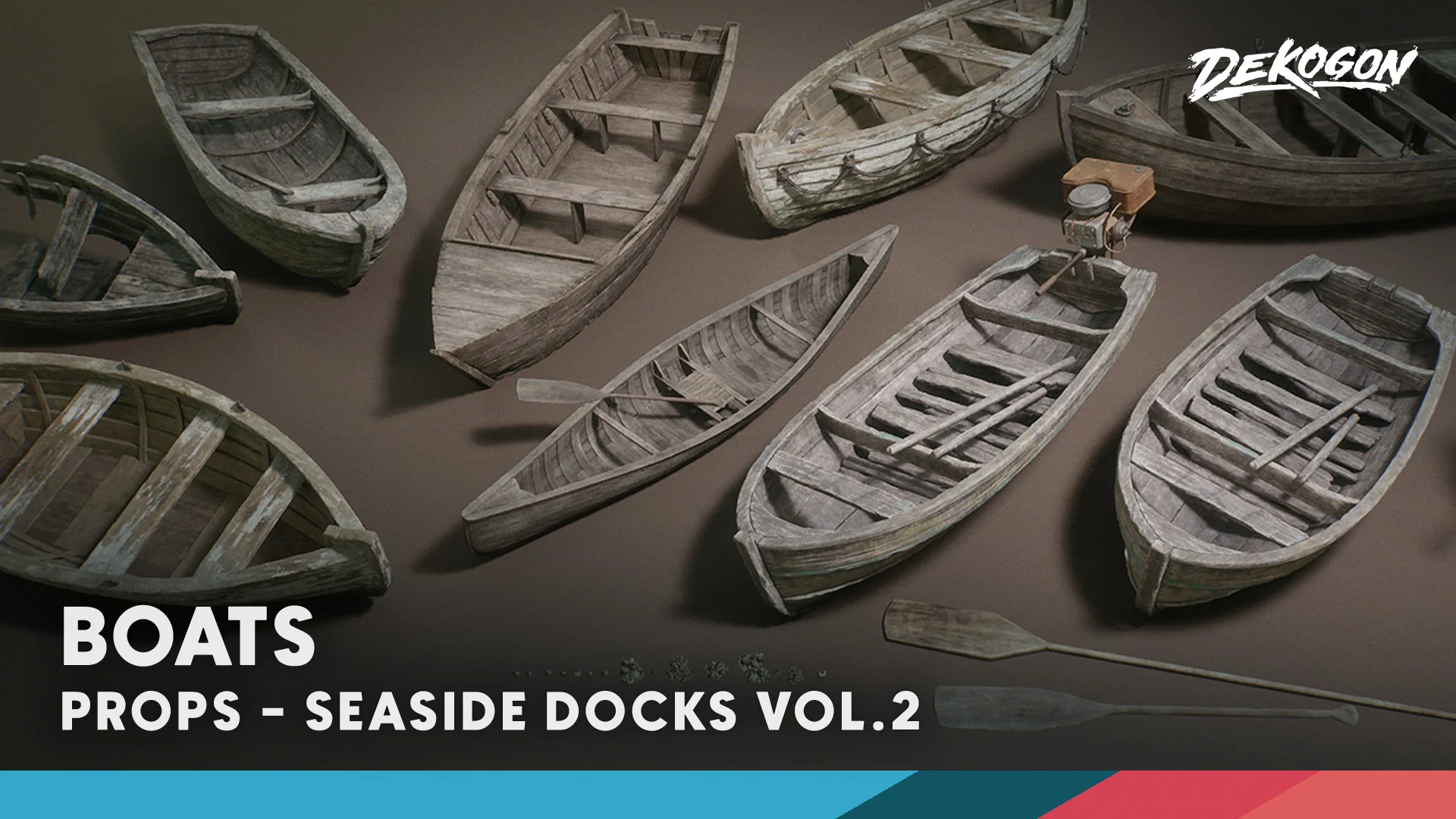
This package delivers 27 distinct meshes, encompassing a variety of nautical equipment such as canoes, ship components, paddles, sails, and boat motors. Rather than forcing a single rendering paradigm, the collection effectively doubles its utility by providing two complete sets of geometry for every prop. The primary set is constructed utilizing Unreal Engine's Nanite virtualized geometry system. This allows the models to retain extremely high-fidelity polycounts, ensuring that the smooth curves of a boat hull or the intricate mechanical details of a motor remain perfectly crisp regardless of camera distance, without the severe performance penalties traditionally associated with dense meshes. For projects that cannot rely on virtualized geometry, a complete low poly counterpart is provided for every single one of the 27 meshes. Having a dedicated low poly variant ensures that developers building for specific hardware targets, mobile platforms, or traditional rendering pipelines can still utilize the exact same boat and dockside models. This dual approach accommodates both cutting-edge Unreal Engine 5 environments and projects requiring stricter, conventional polygon budgets. The transition between the high-poly Nanite versions and the optimized low-poly meshes allows teams to scale their environments based on their specific performance requirements.
4K Textures and Channel Packed Materials
Surface detailing across the wooden ships, metal motors, and canvas sails relies on high-quality 4K texture sets. To keep memory overhead in check while maintaining this strict resolution, the texture maps utilize standardized channel packing. Specifically, the roughness, metalness, and ambient occlusion data are combined into a single RMA texture asset. This optimization significantly reduces the number of texture samplers required per material, ensuring that the realistic wood grains, rusted metals, and painted surfaces render as efficiently as possible during runtime. A comprehensive master material setup drives the vast majority of the props and models within the collection. This central material architecture gives environment artists granular control over the final look of the assets. Through the material instances, users can adjust additional parameters for roughness, albedo, and normals. This flexibility makes it possible to tweak the weathering on a wooden paddle, shift the base color of a canoe, or alter the gloss on a boat hull to match the specific environmental conditions of a given scene, whether it is a sun-drenched harbor or a damp, overcast dock.
Environmental Integration with Paintable Barnacles
Because the assets are modeled and fully detailed from all sides, they can be placed freely within an environment without worrying about exposing unfinished backfaces or hollow geometry. A flipped canoe or a capsized sailboat will hold up to tight camera scrutiny just as well as a vessel floating upright. This full-coverage detailing is critical for dynamic scenes where players or cinematic cameras might view the assets from unpredictable angles, such as underwater shots or physics-driven events where boats are tossed by ocean waves. To further customize the appearance of the nautical props and ground them in their environment, the project includes a system for paintable barnacles. This feature allows environment artists to manually apply organic marine growth directly to the hulls of ships, dock supports, or floating debris. Adding these barnacles breaks up the silhouette and surface repetition of the models, embedding them more firmly into a realistic ocean or harbor setting. By painting this growth exactly where the water line would sit, developers can achieve a highly localized, weathered look that static textures cannot provide.
Lumen Support and Dynamic Lighting Testing
The collection is built to fully support Lumen, Unreal Engine's dynamic global illumination and reflections system, specifically for UE 5.0 and newer versions. The inclusion of Lumen support means that light bouncing off the ocean surface or dockside lamps will accurately interact with the 4K textures, picking up the subtle roughness variations on the wood and the metallic reflections on the boat motors. This real-time lighting response ensures that the assets sit naturally within dynamic daylight cycles or complex, artificially lit horror environments. To help artists evaluate these interactions immediately, the project includes a dedicated test dynamic lighting scene. This pre-configured environment provides a baseline for seeing how the assets respond to realistic lighting conditions before they are migrated into a main production level. Alongside the lighting setup, a realistic post-process configuration is applied within the test scene, establishing a clear benchmark for the intended AAA visual style and demonstrating how the meshes and materials behave under targeted color grading and exposure settings.
Production Readiness and Custom Branding
Navigating copyright and trademark issues is a common hurdle when populating realistic environments with manufactured goods like boat motors, fuel tanks, or branded nautical equipment. In this package, all branding and labels are completely custom-made by the studio. This ensures the assets are entirely free of legal issues and require no additional clearance or texture modification before being used in commercial titles. Environment artists can place these props directly into their scenes knowing the fictional branding is safe for widespread distribution. Developed by artists at Dekogon Studios and supported by an Epic Games MegaGrant, the collection provides a rigid technical foundation for scene assembly. Whether the models are being deployed to dress a tranquil wooden dock, a bustling harbor, or a dark coastal setting, the combination of Nanite meshes, channel-packed textures, and scalable material controls offers a flexible toolkit for maritime environment design.
 Boats
Boats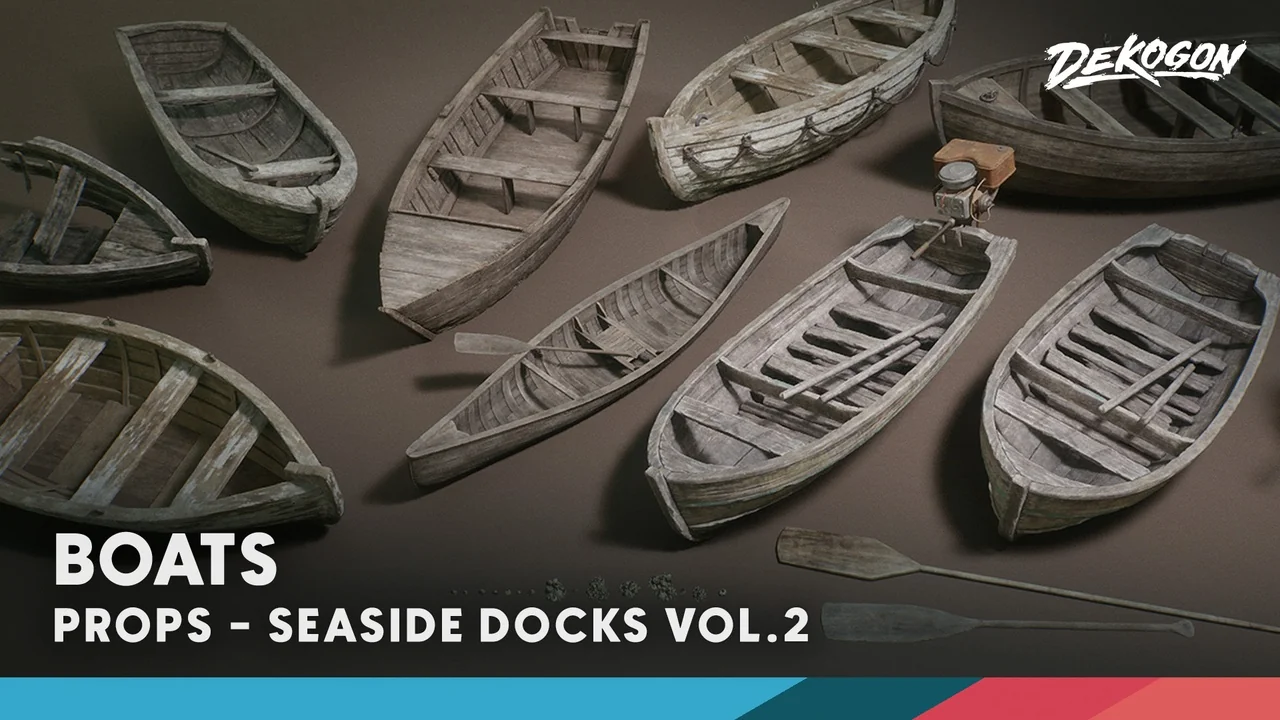
 Boats
Boats Rocks & Stones
 Railings & Fences