"c68a05d5e51405b3"{"id":"1000706","slug":"realistic-rock-set-01-nanite-and-low-poly","title":"Realistic Rock Set 01(Nanite and Low Poly)","category":"Rocks \u0026 Stones","engine":"5.0+","assetVersion":"","engineVersion":"Engine Version: 5.0+","tag":"Rocks \u0026 Stones","accent":"blue","visual":"mech","summary":"10 realistic Nanite and low-poly rocks with shader-driven subsurface blending, RVT support, and high-quality PBR textures for game, VR, and cinematic scenes.","platform":"Unreal Engine","publishedAt":"2026-07-24T01:44:31.024Z","updatedAt":"2026-07-24T01:50:37.535Z","sourceNotes":[],"fileContents":[],"compatibility":["Unreal Engine","Engine Version: 5.0+"],"featuredImage":{"alt":"Realistic Rock Set 01(Nanite and Low Poly)","src":"/wp-content/uploads/published/2026/07/0323084ddd3b-082365da-31dc-429c-bb6c-38a2b32299d8-319d401913.webp"},"hasDownloadLink":true,"downloads":1,"terms":[{"taxonomy":"category","slug":"rocks-and-stones","name":"Rocks \u0026 Stones"}],"galleryImages":[{"src":"/wp-content/uploads/published/2026/07/467c632b8695-b30036a8-a0f4-4754-83cb-9cde7916369b-bdd51aa541.webp","alt":"Realistic Rock Set 01(Nanite and Low Poly)"},{"src":"/wp-content/uploads/published/2026/07/00adf4ab4c92-98b526a1-7462-4af2-b786-e890174d6392-867a7b891d.webp","alt":"Realistic Rock Set 01(Nanite and Low Poly)"},{"src":"/wp-content/uploads/published/2026/07/bd5ebd27da1c-31a2b086-e410-4f1b-a6c5-27b3b1a7de30-945f67836b.webp","alt":"Realistic Rock Set 01(Nanite and Low Poly)"},{"src":"/wp-content/uploads/published/2026/07/9776e2eac84f-295974ac-1a2b-4279-86a6-5c5509a66238-7da6faf2d9.webp","alt":"Realistic Rock Set 01(Nanite and Low Poly)"},{"src":"/wp-content/uploads/published/2026/07/512f244f76ac-929fffc9-94a6-4a0a-a410-4425430ef03d-5d1b221457.webp","alt":"Realistic Rock Set 01(Nanite and Low Poly)"},{"src":"/wp-content/uploads/published/2026/07/5c42f3677c76-1b327713-f02b-4cd4-934a-9455f1b72510-1f8923fb93.webp","alt":"Realistic Rock Set 01(Nanite and Low Poly)"},{"src":"/wp-content/uploads/published/2026/07/0a11c9dd5ac9-82271602-0776-4ee0-be89-a5b774283787-f98011b337.webp","alt":"Realistic Rock Set 01(Nanite and Low Poly)"},{"src":"/wp-content/uploads/published/2026/07/be7e1961221c-309acc22-134a-443d-9094-424c2219c46a-cd6bfc8291.webp","alt":"Realistic Rock Set 01(Nanite and Low Poly)"},{"src":"/wp-content/uploads/published/2026/07/353e1e246e5c-d85bca83-ccbc-48eb-887a-b99342f3d6fa-13592386b4.webp","alt":"Realistic Rock Set 01(Nanite and Low Poly)"},{"src":"/wp-content/uploads/published/2026/07/e313a097ebdf-e502c3cd-bfa1-45c3-9cb3-f32230727d75-4d6486acb4.webp","alt":"Realistic Rock Set 01(Nanite and Low Poly)"}],"accessPanel":{"kind":"resource","title":"Download this resource","eyebrow":"Free Download","message":"Log in or create a free account to start your download.","fileName":"Content.7z","safetyNote":"Resources are manually reviewed before listing to improve quality and reduce obvious risks.","actionLabel":"Download Free","resourceType":"Resource archive"},"contentHtml":"\u003ch2\u003eDropping Ten Realistic Rocks into a Scene\u003c/h2\u003e\n\u003cp\u003eBuilding believable rocky terrain often starts with a handful of shapes that read as natural stone rather than generic primitives. Realistic Rock Set 01 (Nanite and Low Poly) gives artists ten rock meshes at a 6000-polycount level, making them usable across a range of scene scales. Whether scattered as foreground detail in a mountain pass or massed into a cliff base, the set is built to slot into production pipelines that need both Nanite support and a low-poly fallback.\u003c/p\u003e\n\n\n\u003cp\u003eThe tag pool attached to the set signals where it is designed to live: PBR, Stone, Rock, Modular, Low-Poly, Material, Fantasy, Mountain, Realistic, Optimized, Nanite, and Cliff. Those descriptors map directly to the intended use cases—game environments, filmmaking, and VR experiences—where the same mesh might need to serve as a hero prop in one shot and as instanced background dressing in another.\u003c/p\u003e\n\n\n\u003ch2\u003eShader Features That Shape How Rocks Read on Screen\u003c/h2\u003e\n\u003cp\u003eStatic rock textures tend to flatten out when repeated across many meshes, especially when those meshes vary in size. The material approach in this set targets that problem directly. Color variation is driven by movement, so repositioning a rock instance shifts its tint without manual paint work. Size-dependent tiling adjusts how surface detail maps onto the mesh based on its scale, keeping small stones from looking like shrunk-down boulders.\u003c/p\u003e\n\n\u003cp\u003eTwo subsurface textures are blended together using masks, which gives the rock skin a layered, mineral look rather than a single flat albedo. The shader also adjusts textures specifically within the ambient occlusion (AO) areas of the mesh, adding and modifying detail in the subsurface AO regions so crevices and contact points pick up refined surface information. Edge adjustment lets artists sharpen or soften rock silhouettes, while detail normal tiling keeps fine surface bump consistent across different object scales.\u003c/p\u003e\n\n\n\u003cp\u003eRuntime Virtual Texture (RVT) functionality rounds out the feature set. With RVT enabled, the rocks can blend into larger terrain layers—useful for mountainsides and cliff environments where rock formations meet ground-cover textures. The combination of these shader systems means the set is built for modularity and repetition without the textural uniformity that usually accompanies instanced rocks.\u003c/p\u003e\n\n\u003ch2\u003eHow Texture Content Supports Per-Rock Variation\u003c/h2\u003e\n\u003cp\u003eThe set separates surface textures from per-object textures. Seven surface textures are provided, including detail normal maps that feed into the tiling and edge workflows described above. These are the textures intended to be shared across rocks, forming the base material language of the set.\u003c/p\u003e\n\n\u003cp\u003eTwenty object textures accompany the surface set: ten normal maps and ten mask maps. With ten rocks in the set, this gives each mesh its own paired normal and mask combination. The masks drive the subsurface blending and AO-area modifications, while the per-object normals ensure each rock carries distinct high-frequency detail. This split allows the material system to produce variation across instances while keeping the shared surface textures lightweight enough to repeat without drawing attention.\u003c/p\u003e\n\n\u003ch2\u003eOne Master Material, Ten Instances\u003c/h2\u003e\n\u003cp\u003eThe set is structured around a single master material with ten instance materials and thirteen material functions. The function-level architecture is where the shader complexity lives—each of the features like color variation, subsurface blending, AO adjustment, edge handling, detail tiling, and RVT is modularized so individual systems can be toggled or dialed without diving into the master material itself.\u003c/p\u003e\n\n\u003ch2\u003eFitting into Game, Film, and VR Pipelines\u003c/h2\u003e\n\u003cp\u003eThe set is explicitly aimed at three production contexts: game environments, filmmaking, and VR experiences. In a game context, the 6000-polycount level combined with Nanite support means the rocks can be used in scenes where high geometric detail is needed without forcing hard LOD-based popping or manual optimization passes. For filmmaking, the shader features—particularly the subsurface blending, edge adjustment, and AO-area modification—are the controls that help rocks hold up under close framing and varied lighting setups.\u003c/p\u003e\n\n\n\u003cp\u003eVR introduces its own constraints around texture density and fill rate. The size-dependent tiling and detail normal systems let artists balance perceived detail against performance by scaling surface information to match the object, rather than relying on uniformly high-resolution maps across every instance. The low-poly designation also means the meshes remain usable in contexts where Nanite is not enabled.\u003c/p\u003e\n\n\u003ch3\u003eWhere This Set Lands in a Production Environment\u003c/h3\u003e\n\u003cp\u003eThe combination of ten distinct rock shapes, a layered material system structured through subsurface and AO workflows, and RVT integration positions this set as a foundational rock library rather than a single-purpose prop pack. Artists responsible for mountain, cliff, and fantasy-tinged stone environments can treat the ten meshes as modular building blocks, using the instance materials and material functions to derive variation without reaching for external sculpting tools or bespoke textures.\u003c/p\u003e\n\n\n\u003cp\u003eSince the set shares its structural and material approach with Realistic Rock Set 02 (Nanite and Low Poly), teams already working with the companion set can extend their rock library without switching material conventions. The shader logic, texture organization, and instance structure carry over, so a production can adopt both sets as a unified rock pipeline and scale scene density as needed.\u003c/p\u003e\n\n\u003ch2\u003eRelated Resources Worth Checking\u003c/h2\u003e\n\u003cul\u003e\n\u003cli\u003e\u003ca href=\"https://3dcghub.com/roadside-vol-3-rural-props-nanite-and-low-poly-versions/\" title=\"Roadside VOL.3 - Rural Props (Nanite and Low Poly Versions)\"\u003eRoadside VOL.3 - Rural Props (Nanite and Low Poly Versions)\u003c/a\u003e\u003c/li\u003e\n\u003cli\u003e\u003ca href=\"https://3dcghub.com/black-beach-iceland/\" title=\"BLACK BEACH - ICELAND\"\u003eBLACK BEACH - ICELAND\u003c/a\u003e\u003c/li\u003e\n\u003cli\u003e\u003ca href=\"https://3dcghub.com/scans-vol-2-clothes-nanite-and-low-poly/\" title=\"Scans VOL.2 - Clothes (Nanite \u0026amp; Low Poly)\"\u003eScans VOL.2 - Clothes (Nanite \u0026amp; Low Poly)\u003c/a\u003e\u003c/li\u003e\n\u003cli\u003e\u003ca href=\"https://3dcghub.com/suburbs-vol-23-garden-boxes-nanite-and-low-poly/\" title=\"Suburbs VOL.23 - Garden Boxes (Nanite and Low Poly)\"\u003eSuburbs VOL.23 - Garden Boxes (Nanite and Low Poly)\u003c/a\u003e\u003c/li\u003e\n\u003cli\u003e\u003ca href=\"https://3dcghub.com/restaurant-vol-3-dining-decor-nanite-and-low-poly/\" title=\"Restaurant VOL.3 - Dining Decor (Nanite and Low Poly)\"\u003eRestaurant VOL.3 - Dining Decor (Nanite and Low Poly)\u003c/a\u003e\u003c/li\u003e\n\u003c/ul\u003e","contentTextLength":5836,"navigation":{"current":1297,"total":3860,"previous":{"id":"1000707","slug":"vehicles-vol-4-retro-cars-low-poly","title":"Vehicles VOL.4 - Retro Cars (Low Poly)","category":"Vehicles \u0026 Transportation","platform":"Unreal Engine","updatedAt":"2026-07-24T01:51:03.278Z"},"next":{"id":"1000705","slug":"hyper-outliner-and-symbol-system-v4","title":"Hyper Outliner and Symbol System v4","category":"Gameplay Features","platform":"Unreal Engine","updatedAt":"2026-07-24T01:34:23.942Z"}},"relatedResources":[{"id":"1001841","slug":"stone-sculptures-vol-l-modular-urns-and-stand-nanite-low-poly","title":"Stone Sculptures VOL.l - Modular Urns \u0026 Stand (Nanite + Low Poly)","category":"Rocks \u0026 Stones","engine":"5.0+","assetVersion":"","engineVersion":"Engine Version: 5.0+","tag":"Rocks \u0026 Stones","accent":"blue","visual":"mech","summary":"Modular stone urns, stands, and classical sculptures for Unreal Engine 5, featuring Nanite high-poly meshes, baked low-poly assets, and layered PBR materials.","platform":"Unreal Engine","publishedAt":"2026-10-21T08:32:10.905Z","updatedAt":"2026-10-21T08:32:10.905Z","sourceNotes":[],"fileContents":[],"compatibility":["Unreal Engine","Engine Version: 5.0+"],"featuredImage":{"alt":"Stone Sculptures VOL.l - Modular Urns \u0026 Stand (Nanite + Low Poly)","src":"/wp-content/uploads/published/2026/10/7fda953a1ceb-851bfb7b-7664-49aa-a07e-4d0399fa211d-56bbcb9c58.webp"},"hasDownloadLink":true,"downloads":0},{"id":"1001066","slug":"roadside-vol-1-blockades-nanite-and-low-poly-versions-2","title":"Roadside VOL.1 - Blockades (Nanite and Low Poly Versions)","category":"Rocks \u0026 Stones","engine":"5.1+","assetVersion":"","engineVersion":"Engine Version: 5.1+","tag":"Rocks \u0026 Stones","accent":"blue","visual":"mech","summary":"32 roadside blockades in nanite and low poly builds, 4k textures, master materials, tintable paint, and Lumen support for UE5.","platform":"Unreal Engine","publishedAt":"2026-09-03T16:20:18.807Z","updatedAt":"2026-09-03T16:20:18.807Z","sourceNotes":[],"fileContents":[],"compatibility":["Unreal Engine","Engine Version: 5.1+"],"featuredImage":{"alt":"Roadside VOL.1 - Blockades (Nanite and Low Poly Versions)","src":"/wp-content/uploads/published/2026/09/7e32db5224fe-4e57f163-4d06-4444-ac91-032f3e20b6ac-0c5421b26d.webp"},"hasDownloadLink":true,"downloads":1},{"id":"1000479","slug":"roadside-vol-3-rural-props-nanite-and-low-poly-versions","title":"Roadside VOL.3 - Rural Props (Nanite and Low Poly Versions)","category":"Rocks \u0026 Stones","engine":"5.1+","assetVersion":"","engineVersion":"Engine Version: 5.1+","tag":"Rocks \u0026 Stones","accent":"blue","visual":"mech","summary":"Unreal Engine blockade pack with 16 meshes in Nanite and low-poly variants, 4K textures, channel-packed masks, tintable paint, Lumen support, and custom brandin","platform":"Unreal Engine","publishedAt":"2026-07-11T19:20:57.746Z","updatedAt":"2026-07-11T20:18:42.987Z","sourceNotes":[],"fileContents":[],"compatibility":["Unreal Engine","Engine Version: 5.1+"],"featuredImage":{"alt":"Roadside VOL.3 - Rural Props (Nanite and Low Poly Versions)","src":"/wp-content/uploads/published/2026/07/ca4df3e813dc-77a94b26-c0fa-4247-ac4a-05a0f9a13227-f4e3f5a855.webp"},"hasDownloadLink":true,"downloads":0}]}
Rocks & Stones
Realistic Rock Set 01(Nanite and Low Poly)
10 realistic Nanite and low-poly rocks with shader-driven subsurface blending, RVT support, and high-quality PBR textures for game, VR, and cinematic scenes.
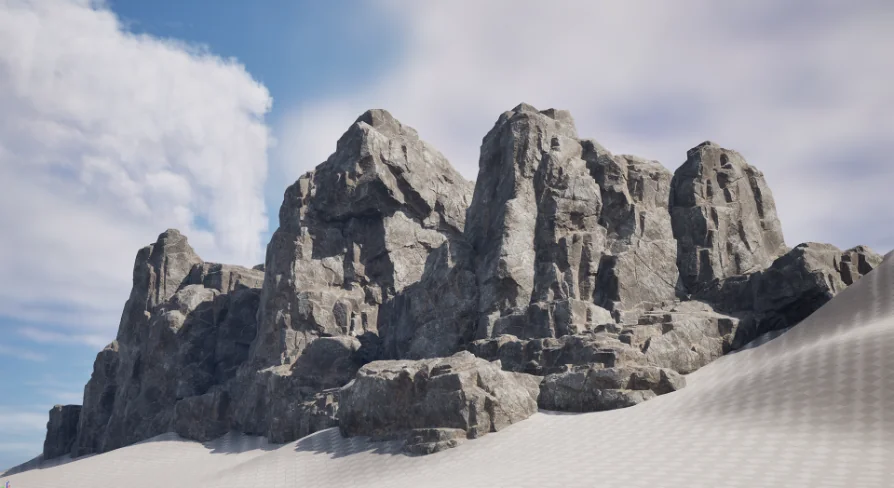
Building believable rocky terrain often starts with a handful of shapes that read as natural stone rather than generic primitives. Realistic Rock Set 01 (Nanite and Low Poly) gives artists ten rock meshes at a 6000-polycount level, making them usable across a range of scene scales. Whether scattered as foreground detail in a mountain pass or massed into a cliff base, the set is built to slot into production pipelines that need both Nanite support and a low-poly fallback.
The tag pool attached to the set signals where it is designed to live: PBR, Stone, Rock, Modular, Low-Poly, Material, Fantasy, Mountain, Realistic, Optimized, Nanite, and Cliff. Those descriptors map directly to the intended use cases—game environments, filmmaking, and VR experiences—where the same mesh might need to serve as a hero prop in one shot and as instanced background dressing in another.
Shader Features That Shape How Rocks Read on Screen
Static rock textures tend to flatten out when repeated across many meshes, especially when those meshes vary in size. The material approach in this set targets that problem directly. Color variation is driven by movement, so repositioning a rock instance shifts its tint without manual paint work. Size-dependent tiling adjusts how surface detail maps onto the mesh based on its scale, keeping small stones from looking like shrunk-down boulders.
Two subsurface textures are blended together using masks, which gives the rock skin a layered, mineral look rather than a single flat albedo. The shader also adjusts textures specifically within the ambient occlusion (AO) areas of the mesh, adding and modifying detail in the subsurface AO regions so crevices and contact points pick up refined surface information. Edge adjustment lets artists sharpen or soften rock silhouettes, while detail normal tiling keeps fine surface bump consistent across different object scales.
Runtime Virtual Texture (RVT) functionality rounds out the feature set. With RVT enabled, the rocks can blend into larger terrain layers—useful for mountainsides and cliff environments where rock formations meet ground-cover textures. The combination of these shader systems means the set is built for modularity and repetition without the textural uniformity that usually accompanies instanced rocks.
How Texture Content Supports Per-Rock Variation
The set separates surface textures from per-object textures. Seven surface textures are provided, including detail normal maps that feed into the tiling and edge workflows described above. These are the textures intended to be shared across rocks, forming the base material language of the set.
Twenty object textures accompany the surface set: ten normal maps and ten mask maps. With ten rocks in the set, this gives each mesh its own paired normal and mask combination. The masks drive the subsurface blending and AO-area modifications, while the per-object normals ensure each rock carries distinct high-frequency detail. This split allows the material system to produce variation across instances while keeping the shared surface textures lightweight enough to repeat without drawing attention.
One Master Material, Ten Instances
The set is structured around a single master material with ten instance materials and thirteen material functions. The function-level architecture is where the shader complexity lives—each of the features like color variation, subsurface blending, AO adjustment, edge handling, detail tiling, and RVT is modularized so individual systems can be toggled or dialed without diving into the master material itself.
Fitting into Game, Film, and VR Pipelines
The set is explicitly aimed at three production contexts: game environments, filmmaking, and VR experiences. In a game context, the 6000-polycount level combined with Nanite support means the rocks can be used in scenes where high geometric detail is needed without forcing hard LOD-based popping or manual optimization passes. For filmmaking, the shader features—particularly the subsurface blending, edge adjustment, and AO-area modification—are the controls that help rocks hold up under close framing and varied lighting setups.
VR introduces its own constraints around texture density and fill rate. The size-dependent tiling and detail normal systems let artists balance perceived detail against performance by scaling surface information to match the object, rather than relying on uniformly high-resolution maps across every instance. The low-poly designation also means the meshes remain usable in contexts where Nanite is not enabled.
Where This Set Lands in a Production Environment
The combination of ten distinct rock shapes, a layered material system structured through subsurface and AO workflows, and RVT integration positions this set as a foundational rock library rather than a single-purpose prop pack. Artists responsible for mountain, cliff, and fantasy-tinged stone environments can treat the ten meshes as modular building blocks, using the instance materials and material functions to derive variation without reaching for external sculpting tools or bespoke textures.
Since the set shares its structural and material approach with Realistic Rock Set 02 (Nanite and Low Poly), teams already working with the companion set can extend their rock library without switching material conventions. The shader logic, texture organization, and instance structure carry over, so a production can adopt both sets as a unified rock pipeline and scale scene density as needed.
 Rocks & Stones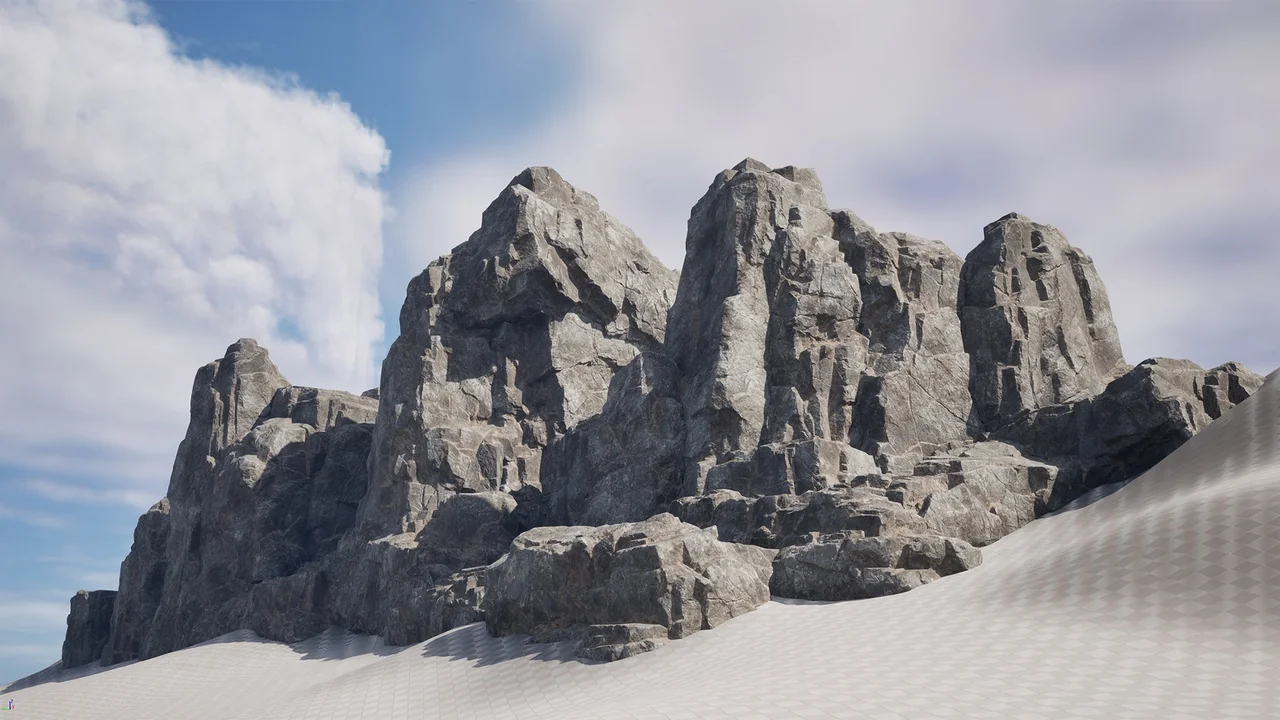
 Rocks & Stones
 Rocks & Stones
 Rocks & Stones