"4481da9c895ef786"{"id":"1000281","slug":"black-beach-iceland","title":"BLACK BEACH - ICELAND","category":"Rocks \u0026 Stones","engine":"5.5+","assetVersion":"","engineVersion":"Engine Version: 5.5+","tag":"Rocks \u0026 Stones","accent":"blue","visual":"mech","summary":"Construct photorealistic Icelandic coastlines and caves using high-poly volcanic rocks, landscape layers, and atmospheric debris designed for Unreal Engine.","platform":"Unreal Engine","publishedAt":"2026-07-03T05:48:30.876Z","updatedAt":"2026-07-03T05:48:30.876Z","sourceNotes":[],"fileContents":[],"compatibility":["Unreal Engine","Engine Version: 5.5+"],"featuredImage":{"alt":"BLACK BEACH - ICELAND","src":"/wp-content/uploads/published/2026/07/255c3cf595f4-ed9173e8-f787-4e4a-bfc1-32b9c87dd07f-98d7710a18.webp"},"hasDownloadLink":true,"downloads":0,"terms":[{"taxonomy":"category","slug":"rocks-and-stones","name":"Rocks \u0026 Stones"}],"galleryImages":[{"src":"/wp-content/uploads/published/2026/07/9512c5baacfc-6d37738b-5e43-450f-ac5b-4495428b6176-ed9894f14f.webp","alt":"BLACK BEACH - ICELAND"},{"src":"/wp-content/uploads/published/2026/07/1a4185ff9b29-1470a17d-fa90-42ff-b970-809c1f6dc7c1-329489d755.webp","alt":"BLACK BEACH - ICELAND"},{"src":"/wp-content/uploads/published/2026/07/0918d86842dc-b5f1eaaa-4894-4a97-b917-1084016fa3f6-0133dfe65f.webp","alt":"BLACK BEACH - ICELAND"},{"src":"/wp-content/uploads/published/2026/07/30f4320d4963-d2889fb6-32de-42d9-a644-74b168887f6b-fa162f51fe.webp","alt":"BLACK BEACH - ICELAND"},{"src":"/wp-content/uploads/published/2026/07/bde5e84d20a1-3b2fe5d4-9d99-46e0-a24a-7f8cd3a94952-8fd06088a4.webp","alt":"BLACK BEACH - ICELAND"},{"src":"/wp-content/uploads/published/2026/07/54581a2426da-7979769b-2f99-4e76-8204-4fb283ae4122-82ba33c5b9.webp","alt":"BLACK BEACH - ICELAND"},{"src":"/wp-content/uploads/published/2026/07/8579de48665e-d3bc8438-09f5-47f3-b3c4-57f7bf540e60-811599a2ac.webp","alt":"BLACK BEACH - ICELAND"},{"src":"/wp-content/uploads/published/2026/07/a11813e5b44c-960fae2b-d0dc-4447-a4dd-1135b5b16aac-a076c7ba72.webp","alt":"BLACK BEACH - ICELAND"},{"src":"/wp-content/uploads/published/2026/07/c69f0aa11d85-1f464d68-565f-4a51-9470-aa10a03e33f8-f7a549a983.webp","alt":"BLACK BEACH - ICELAND"},{"src":"/wp-content/uploads/published/2026/07/f19164c674fe-914749b9-98ae-41eb-878d-262deed72b95-bda946e8a2.webp","alt":"BLACK BEACH - ICELAND"}],"accessPanel":{"kind":"resource","title":"Download this resource","eyebrow":"Free Download","message":"Log in or create a free account to start your download.","fileName":"Black Beach - Iceland.7z","safetyNote":"Resources are manually reviewed before listing to improve quality and reduce obvious risks.","actionLabel":"Download Free","resourceType":"Resource archive"},"contentHtml":"\u003ch2\u003eConstructing Minimalist Coastal Environments\u003c/h2\u003e\n\u003cp\u003eBuilding stark, photorealistic coastal environments requires a specific balance of rugged geometry and atmospheric subtlety. BLACK BEACH - ICELAND provides the foundational elements needed to construct towering cliffs, deep coastal caves, and minimalist shorelines. The aesthetic leans heavily into the dark, volcanic stone and sand characteristic of Icelandic geology. Because the included components are suited to extreme realism, they fit naturally into cinematic productions, modern architectural visualizations, or high-end game environments. The stark contrast between dark stone and ocean water also makes these elements highly adaptable for post-apocalyptic or sci-fi landscapes where a desolate, rugged atmosphere is required.\u003c/p\u003e\n\u003cp\u003eBecause the geometry is physically accurate, it interacts beautifully with Lumen global illumination to produce highly realistic shadows within deep crevices and cave overhangs. This allows lighting artists to create moody, dramatic scenes where the harsh angles of the volcanic rock dictate the flow of light across the beach.\u003c/p\u003e\n\u003ch2\u003eManaging Dense Geometry and Loading Workflows\u003c/h2\u003e\n\u003cp\u003eThe core of this environment package relies on exceptionally dense geometry. The individual rocks and cliff formations range from 5 million to 22 million triangles each. This massive polygon count ensures that every crevice, boulder, and stone surface retains its structural integrity even under close cinematic scrutiny. Working with meshes of this density requires understanding how Unreal Engine handles heavy assets during the initial setup phase.\u003c/p\u003e\n\u003cp\u003eWhen an environment artist drags a 22-million-polygon cliff face into the viewport for the first time, the engine must calculate the complex spatial data. This initial computation takes time to load and heavily utilizes processing power. However, by caching this data directly to the local disk, the workflow remains fluid after the initial setup. Subsequent project launches and map loads will be significantly faster, allowing for rapid iteration during the level design phase. These high-poly structures are built to utilize Nanite virtualized geometry, ensuring that the heavy triangle counts translate seamlessly into the viewport without bottlenecking the real-time rendering of the scene.\u003c/p\u003e\n\u003ch2\u003eAssembling the Volcanic Shoreline\u003c/h2\u003e\n\u003cp\u003eConstructing the beach and cliff environments relies on a focused library of 14 distinct rock and cliff meshes. These core pieces act as the heavy building blocks for both towering coastal walls and deep, cavernous interiors. By rotating and scaling these 14 boulders and cliff sections, environment artists can shape complex geological formations that look entirely distinct from multiple angles.\u003c/p\u003e\n\u003cp\u003eTo ground these massive structures, the package includes four specific landscape layers. These layers are essential for breaking up the visual repetition of the terrain. By painting these distinct layers across the environment, developers can define wet sand near the shoreline, dry ground further inland, and rocky debris clusters near the bases of the cliffs. Integrating the landscape layers allows the high-poly rocks to transition naturally into the terrain.\u003c/p\u003e\n\u003cp\u003eComplementing the rocky shore is a dedicated water material. This single material handles the ocean element, providing the necessary reflective surface to contrast against the rough, light-absorbing volcanic stone and completing the coastal ecosystem.\u003c/p\u003e\n\u003ch2\u003eApplying Experimental Tessellation for Maximum Detail\u003c/h2\u003e\n\u003cp\u003eWhile the dense geometry of the rocks provides substantial silhouette detail, tessellation can be enabled across the scene to push the micro-details of the surfaces even further. However, implementing tessellation requires careful attention to Unreal Engine 5's current rendering capabilities.\u003c/p\u003e\n\u003cp\u003eFor the ground, landscape tessellation can be enabled safely. The terrain materials will displace cleanly, resulting in a crack-free surface that adds physical depth to the sand and stony ground. This allows the flat landscape layers to match the visual fidelity of the multi-million-polygon boulders resting on top of them.\u003c/p\u003e\n\u003cp\u003eApplying tessellation to the 14 rock and cliff meshes requires a different consideration. Because tessellation in UE5 remains an experimental feature, enabling it on these specific high-poly assets can lead to visible rendering artifacts. Developers may notice cracks appearing along the UV seams of the rocks. When setting up close-up cinematic shots, environment artists must weigh the benefits of enhanced micro-detail against the potential for these UV seam cracks. If tessellation is strictly required, developers will need to carefully frame the camera to avoid the seams, or simply lean on the massive raw polygon count of the assets, which provides enough physical depth on its own.\u003c/p\u003e\n\u003ch2\u003eScattering Debris and Atmospheric Elements\u003c/h2\u003e\n\u003cp\u003eA photorealistic environment requires secondary details to break up the uniformity of massive stone structures and flat sand. To support the primary geometry, the package includes a small selection of scatter elements and atmospheric effects. Six distinct twig and branch meshes are provided to act as washed-up debris along the shoreline. Placing these branches among the boulders adds a sense of scale and history to the desolate beach.\u003c/p\u003e\n\u003cp\u003eTwo decal materials are also included to add localized surface variations, helping to blend the intersection points between the massive cliff meshes and the flat landscape layers. To finalize the scene's mood, a single particle system is provided to simulate blowing dust. When placed along the ridges of the cliffs or sweeping across the flat landscape layers, the dust particle catches the light, creating a dynamic, windswept atmosphere that brings the static geometry to life.\u003c/p\u003e\n\u003ch2\u003eReference Maps and Final Implementation\u003c/h2\u003e\n\u003cp\u003eTo demonstrate how the high-poly meshes, landscape layers, and water material interact, the package includes a Demonstration Map. This pre-assembled level serves as a practical example of how to balance the massive triangle assets alongside the ocean surface and atmospheric dust. An Overview Map is also provided, laying out all 14 rocks, 6 twigs, and other individual assets in a neutral lighting environment for easy inspection and selection.\u003c/p\u003e\n\u003cp\u003eUltimately, this set of assets is built for environment artists and virtual production teams who prioritize absolute geometric fidelity over lightweight optimization. The extreme polygon counts and minimalist texturing make it highly effective for anyone needing to construct a striking, realistic Icelandic beach or a desolate, rocky sci-fi landscape.\u003c/p\u003e\n\n\u003ch2\u003eMore From The Same Workflow\u003c/h2\u003e\n\u003cul\u003e\n\u003cli\u003e\u003ca href=\"https://3dcghub.com/beach-boys-2/\" title=\"Beach Boys\"\u003eBeach Boys\u003c/a\u003e\u003c/li\u003e\n\u003cli\u003e\u003ca href=\"https://3dcghub.com/stylized-tropical-beach-environment/\" title=\"Stylized tropical beach environment\"\u003eStylized tropical beach environment\u003c/a\u003e\u003c/li\u003e\n\u003cli\u003e\u003ca href=\"https://3dcghub.com/niagara-black-and-white/\" title=\"Niagara Black And White\"\u003eNiagara Black And White\u003c/a\u003e\u003c/li\u003e\n\u003cli\u003e\u003ca href=\"https://3dcghub.com/beach-girls/\" title=\"Beach Girls\"\u003eBeach Girls\u003c/a\u003e\u003c/li\u003e\n\u003cli\u003e\u003ca href=\"https://3dcghub.com/black-kit-modular/\" title=\"Black Kit Modular\"\u003eBlack Kit Modular\u003c/a\u003e\u003c/li\u003e\n\u003c/ul\u003e","contentTextLength":6745,"navigation":{"current":1123,"total":3269,"previous":{"id":"1000283","slug":"black-forest-pcg-environment","title":"Black Forest PCG Environment","category":"Forest \u0026 Jungle","platform":"Unreal Engine","updatedAt":"2026-07-03T07:08:47.294Z"},"next":{"id":"1000280","slug":"battle-tank-military-pack","title":"Battle Tank Military Pack","category":"Military","platform":"Unreal Engine","updatedAt":"2026-07-03T05:22:07.290Z"}},"relatedResources":[{"id":"1001066","slug":"roadside-vol-1-blockades-nanite-and-low-poly-versions-2","title":"Roadside VOL.1 - Blockades (Nanite and Low Poly Versions)","category":"Rocks \u0026 Stones","engine":"5.1+","assetVersion":"","engineVersion":"Engine Version: 5.1+","tag":"Rocks \u0026 Stones","accent":"blue","visual":"mech","summary":"32 roadside blockades in nanite and low poly builds, 4k textures, master materials, tintable paint, and Lumen support for UE5.","platform":"Unreal Engine","publishedAt":"2026-09-03T16:20:18.807Z","updatedAt":"2026-09-03T16:20:18.807Z","sourceNotes":[],"fileContents":[],"compatibility":["Unreal Engine","Engine Version: 5.1+"],"featuredImage":{"alt":"Roadside VOL.1 - Blockades (Nanite and Low Poly Versions)","src":"/wp-content/uploads/published/2026/09/7e32db5224fe-4e57f163-4d06-4444-ac91-032f3e20b6ac-0c5421b26d.webp"},"hasDownloadLink":true,"downloads":1},{"id":"1000706","slug":"realistic-rock-set-01-nanite-and-low-poly","title":"Realistic Rock Set 01(Nanite and Low Poly)","category":"Rocks \u0026 Stones","engine":"5.0+","assetVersion":"","engineVersion":"Engine Version: 5.0+","tag":"Rocks \u0026 Stones","accent":"blue","visual":"mech","summary":"10 realistic Nanite and low-poly rocks with shader-driven subsurface blending, RVT support, and high-quality PBR textures for game, VR, and cinematic scenes.","platform":"Unreal Engine","publishedAt":"2026-07-24T01:44:31.024Z","updatedAt":"2026-07-24T01:50:37.535Z","sourceNotes":[],"fileContents":[],"compatibility":["Unreal Engine","Engine Version: 5.0+"],"featuredImage":{"alt":"Realistic Rock Set 01(Nanite and Low Poly)","src":"/wp-content/uploads/published/2026/07/0323084ddd3b-082365da-31dc-429c-bb6c-38a2b32299d8-319d401913.webp"},"hasDownloadLink":true,"downloads":1},{"id":"1000479","slug":"roadside-vol-3-rural-props-nanite-and-low-poly-versions","title":"Roadside VOL.3 - Rural Props (Nanite and Low Poly Versions)","category":"Rocks \u0026 Stones","engine":"5.1+","assetVersion":"","engineVersion":"Engine Version: 5.1+","tag":"Rocks \u0026 Stones","accent":"blue","visual":"mech","summary":"Unreal Engine blockade pack with 16 meshes in Nanite and low-poly variants, 4K textures, channel-packed masks, tintable paint, Lumen support, and custom brandin","platform":"Unreal Engine","publishedAt":"2026-07-11T19:20:57.746Z","updatedAt":"2026-07-11T20:18:42.987Z","sourceNotes":[],"fileContents":[],"compatibility":["Unreal Engine","Engine Version: 5.1+"],"featuredImage":{"alt":"Roadside VOL.3 - Rural Props (Nanite and Low Poly Versions)","src":"/wp-content/uploads/published/2026/07/ca4df3e813dc-77a94b26-c0fa-4247-ac4a-05a0f9a13227-f4e3f5a855.webp"},"hasDownloadLink":true,"downloads":0}]}
Rocks & Stones
BLACK BEACH - ICELAND
Construct photorealistic Icelandic coastlines and caves using high-poly volcanic rocks, landscape layers, and atmospheric debris designed for Unreal Engine.
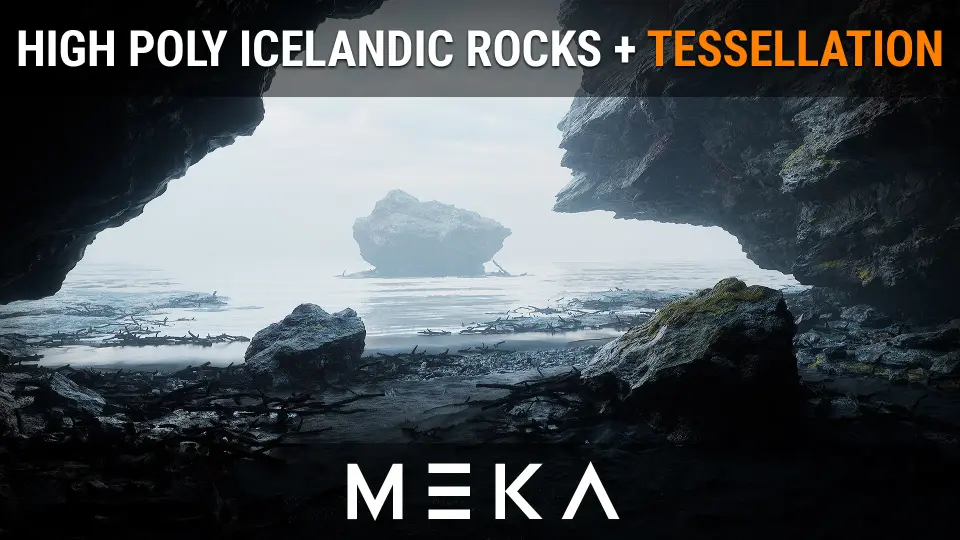
Building stark, photorealistic coastal environments requires a specific balance of rugged geometry and atmospheric subtlety. BLACK BEACH - ICELAND provides the foundational elements needed to construct towering cliffs, deep coastal caves, and minimalist shorelines. The aesthetic leans heavily into the dark, volcanic stone and sand characteristic of Icelandic geology. Because the included components are suited to extreme realism, they fit naturally into cinematic productions, modern architectural visualizations, or high-end game environments. The stark contrast between dark stone and ocean water also makes these elements highly adaptable for post-apocalyptic or sci-fi landscapes where a desolate, rugged atmosphere is required.
Because the geometry is physically accurate, it interacts beautifully with Lumen global illumination to produce highly realistic shadows within deep crevices and cave overhangs. This allows lighting artists to create moody, dramatic scenes where the harsh angles of the volcanic rock dictate the flow of light across the beach.
Managing Dense Geometry and Loading Workflows
The core of this environment package relies on exceptionally dense geometry. The individual rocks and cliff formations range from 5 million to 22 million triangles each. This massive polygon count ensures that every crevice, boulder, and stone surface retains its structural integrity even under close cinematic scrutiny. Working with meshes of this density requires understanding how Unreal Engine handles heavy assets during the initial setup phase.
When an environment artist drags a 22-million-polygon cliff face into the viewport for the first time, the engine must calculate the complex spatial data. This initial computation takes time to load and heavily utilizes processing power. However, by caching this data directly to the local disk, the workflow remains fluid after the initial setup. Subsequent project launches and map loads will be significantly faster, allowing for rapid iteration during the level design phase. These high-poly structures are built to utilize Nanite virtualized geometry, ensuring that the heavy triangle counts translate seamlessly into the viewport without bottlenecking the real-time rendering of the scene.
Assembling the Volcanic Shoreline
Constructing the beach and cliff environments relies on a focused library of 14 distinct rock and cliff meshes. These core pieces act as the heavy building blocks for both towering coastal walls and deep, cavernous interiors. By rotating and scaling these 14 boulders and cliff sections, environment artists can shape complex geological formations that look entirely distinct from multiple angles.
To ground these massive structures, the package includes four specific landscape layers. These layers are essential for breaking up the visual repetition of the terrain. By painting these distinct layers across the environment, developers can define wet sand near the shoreline, dry ground further inland, and rocky debris clusters near the bases of the cliffs. Integrating the landscape layers allows the high-poly rocks to transition naturally into the terrain.
Complementing the rocky shore is a dedicated water material. This single material handles the ocean element, providing the necessary reflective surface to contrast against the rough, light-absorbing volcanic stone and completing the coastal ecosystem.
Applying Experimental Tessellation for Maximum Detail
While the dense geometry of the rocks provides substantial silhouette detail, tessellation can be enabled across the scene to push the micro-details of the surfaces even further. However, implementing tessellation requires careful attention to Unreal Engine 5's current rendering capabilities.
For the ground, landscape tessellation can be enabled safely. The terrain materials will displace cleanly, resulting in a crack-free surface that adds physical depth to the sand and stony ground. This allows the flat landscape layers to match the visual fidelity of the multi-million-polygon boulders resting on top of them.
Applying tessellation to the 14 rock and cliff meshes requires a different consideration. Because tessellation in UE5 remains an experimental feature, enabling it on these specific high-poly assets can lead to visible rendering artifacts. Developers may notice cracks appearing along the UV seams of the rocks. When setting up close-up cinematic shots, environment artists must weigh the benefits of enhanced micro-detail against the potential for these UV seam cracks. If tessellation is strictly required, developers will need to carefully frame the camera to avoid the seams, or simply lean on the massive raw polygon count of the assets, which provides enough physical depth on its own.
Scattering Debris and Atmospheric Elements
A photorealistic environment requires secondary details to break up the uniformity of massive stone structures and flat sand. To support the primary geometry, the package includes a small selection of scatter elements and atmospheric effects. Six distinct twig and branch meshes are provided to act as washed-up debris along the shoreline. Placing these branches among the boulders adds a sense of scale and history to the desolate beach.
Two decal materials are also included to add localized surface variations, helping to blend the intersection points between the massive cliff meshes and the flat landscape layers. To finalize the scene's mood, a single particle system is provided to simulate blowing dust. When placed along the ridges of the cliffs or sweeping across the flat landscape layers, the dust particle catches the light, creating a dynamic, windswept atmosphere that brings the static geometry to life.
Reference Maps and Final Implementation
To demonstrate how the high-poly meshes, landscape layers, and water material interact, the package includes a Demonstration Map. This pre-assembled level serves as a practical example of how to balance the massive triangle assets alongside the ocean surface and atmospheric dust. An Overview Map is also provided, laying out all 14 rocks, 6 twigs, and other individual assets in a neutral lighting environment for easy inspection and selection.
Ultimately, this set of assets is built for environment artists and virtual production teams who prioritize absolute geometric fidelity over lightweight optimization. The extreme polygon counts and minimalist texturing make it highly effective for anyone needing to construct a striking, realistic Icelandic beach or a desolate, rocky sci-fi landscape.
 Rocks & Stones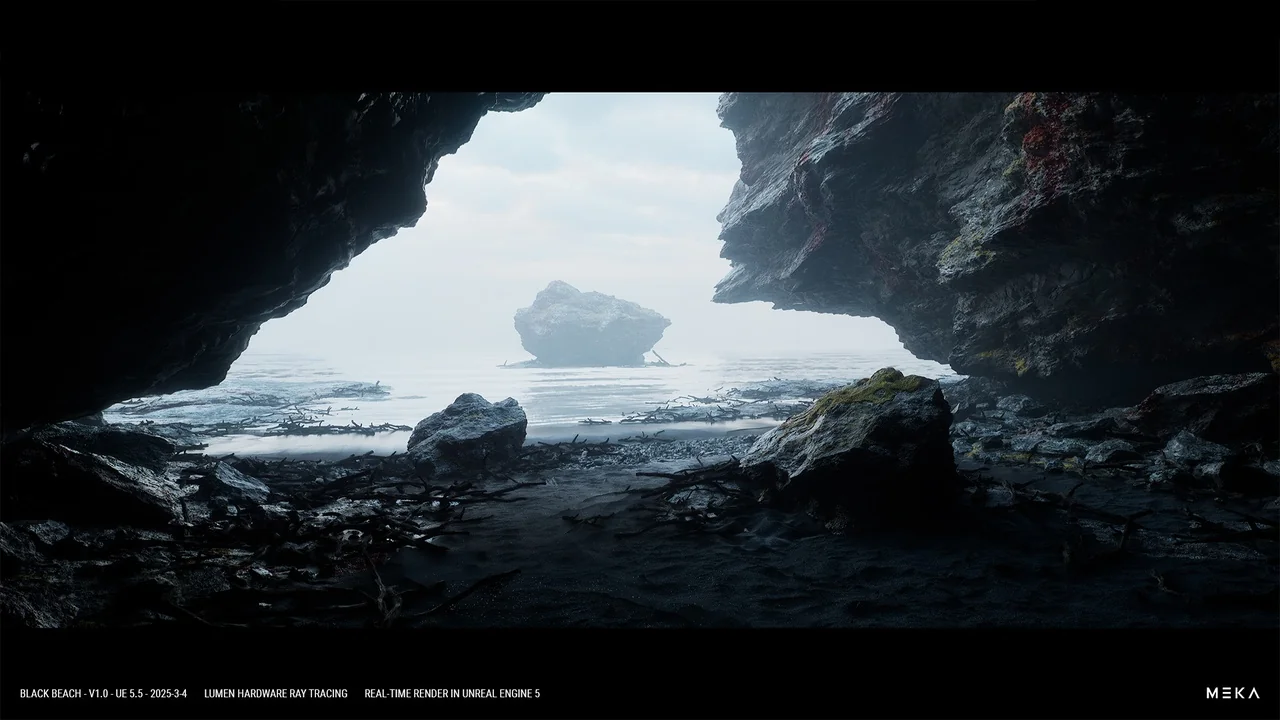
 Rocks & Stones
 Rocks & Stones
 Rocks & Stones