"fa182e0cd0a6ea73"{"id":"1000608","slug":"foliage-vol-27-beach-grass-low-poly","title":"Foliage VOL.27 - Beach Grass (Low Poly)","category":"Plants","engine":"5.1+","assetVersion":"","engineVersion":"Engine Version: 5.1+","tag":"Plants","accent":"blue","visual":"mech","summary":"Dekogon's low poly beach grass pack for Unreal Engine with 29 meshes, 4K PBR textures, Lumen support, master material controls, channel-packed maps, and custom","platform":"Unreal Engine","publishedAt":"2026-07-20T19:27:39.017Z","updatedAt":"2026-07-20T19:27:39.017Z","sourceNotes":[],"fileContents":[],"compatibility":["Unreal Engine","Engine Version: 5.1+"],"featuredImage":{"alt":"Foliage VOL.27 - Beach Grass (Low Poly)","src":"/wp-content/uploads/published/2026/07/585184be544b-e59ccc63-80f2-4ec8-8da4-644f8f7edddd-1ab93aa92e.webp"},"hasDownloadLink":true,"downloads":0,"terms":[{"taxonomy":"category","slug":"plants","name":"Plants"}],"galleryImages":[{"src":"/wp-content/uploads/published/2026/07/00c911d4199d-6af558c1-8b1c-4e45-a971-dd1777b68d72-6de0047900.webp","alt":"Foliage VOL.27 - Beach Grass (Low Poly)"},{"src":"/wp-content/uploads/published/2026/07/020fe6d129ce-2aaf27fe-1abe-4692-8837-cd1c736e4dfe-7561a4c669.webp","alt":"Foliage VOL.27 - Beach Grass (Low Poly)"},{"src":"/wp-content/uploads/published/2026/07/d9bfd52b416a-0a43f6f8-cb0a-478f-b9e0-efb122a31f77-d3d3d04a01.webp","alt":"Foliage VOL.27 - Beach Grass (Low Poly)"},{"src":"/wp-content/uploads/published/2026/07/1080bcebd53d-b59798f4-31be-4a15-81f1-b8bdfec77d8f-56838c6ed5.webp","alt":"Foliage VOL.27 - Beach Grass (Low Poly)"},{"src":"/wp-content/uploads/published/2026/07/268ed66fbcbd-ea07f20b-bf88-4ff9-a381-c73080f9751c-d2a290a02c.webp","alt":"Foliage VOL.27 - Beach Grass (Low Poly)"},{"src":"/wp-content/uploads/published/2026/07/57a22a6bf122-e0195982-9113-4938-b129-6fb2a2f8f853-c7222112a4.webp","alt":"Foliage VOL.27 - Beach Grass (Low Poly)"},{"src":"/wp-content/uploads/published/2026/07/f626f14a5b2f-d315b0c0-aee1-47c8-b43d-e3c6be194931-419d9a929c.webp","alt":"Foliage VOL.27 - Beach Grass (Low Poly)"},{"src":"/wp-content/uploads/published/2026/07/bcc2c3392b75-1752d948-586c-4442-971a-144b0285fdc9-40e8f119ad.webp","alt":"Foliage VOL.27 - Beach Grass (Low Poly)"},{"src":"/wp-content/uploads/published/2026/07/5e0ed116c702-f6b2289d-a4e4-4dbc-ac58-e1e7ae37cade-0b4c9bb829.webp","alt":"Foliage VOL.27 - Beach Grass (Low Poly)"},{"src":"/wp-content/uploads/published/2026/07/7c538b33cbce-fb09ec38-e49a-49c8-b1ef-0e2afe47d3b2-e34145e2d4.webp","alt":"Foliage VOL.27 - Beach Grass (Low Poly)"}],"accessPanel":{"kind":"resource","title":"Download this resource","eyebrow":"Free Download","message":"Log in or create a free account to start your download.","fileName":"Content.7z","safetyNote":"Resources are manually reviewed before listing to improve quality and reduce obvious risks.","actionLabel":"Download Free","resourceType":"Resource archive"},"contentHtml":"\u003cp\u003eFoliage VOL.27 - Beach Grass (Low Poly) delivers a focused vegetation package shaped by a 29-mesh collection created entirely in Unreal Engine. The project bundles the mesh assets together with their corresponding maps and materials so that what is shown in the visual documentation is what lands in the content browser on import. Every asset was produced toward realistic-quality visuals while keeping a style-conscious and budget-aware approach to geometry density, which is where the low-poly designation does its work: enough silhouette detail and surface fidelity to hold up in a realistic frame, but tuned to stay manageable in a game environment.\u003c/p\u003e \u003ch2\u003eMesh Collection and Full-Side Detailing\u003c/h2\u003e\n\u003cp\u003eThe pack contains 29 individual meshes, which is the entire scope of included geometry. There is no mention of separate LOD tiers or skeletal-foliage variants—the focus is on static mesh assets suited to foliage scattering, ecosystem dressing, and sand-and-beach scene composition. The tags attached to the product reinforce the intended placement: grass, plant, stem, flower, tree, beach, sand, and ecosystem. That range suggests the mesh set goes beyond a single blade type and includes enough structural variety—likely blades, clumps, stems, and accompanying plants—to support organic distribution across a terrain layer.\u003c/p\u003e\n\u003cp\u003eEvery asset is fully detailed on all sides. That stated property matters for foliage work because instances are rotated, scattered, and viewed from multiple camera angles during gameplay. Meshes built with only a front-facing facade break when placed away from the key light or when vegetation clusters are viewed from above. Full-sided geometry means the same asset can populate a dune ridge without requiring manual orientation adjustments or careful two-sided material checks to hide backfaces.\u003c/p\u003e \u003ch2\u003eMaterial System and Per-Asset Controls\u003c/h2\u003e\n\u003cp\u003eA single master material setup controls the majority of the props and models in the pack. This consolidating approach reduces the number of material instances scattered across a foliage system, which directly affects draw calls and foliage-type management inside Unreal. Instead of authoring bespoke materials for each grass element, the master setup routes most of the mesh collection through shared shading logic while still allowing per-instance customization through exposed parameters.\u003c/p\u003e\n\u003cp\u003eThe master material adds controls for roughness, albedo, normals, and additional properties. Those parameters give artists adjustment range without opening the material graph or recompiling shaders. For a coastal grass environment where prevailing wind direction, time-of-day lighting, and weather conditions vary, dialing albedo brightness or roughness intensity directly inside the material instance editor keeps iteration fast. The normal control path matters when blending the same grass assets into different biomes—pushing detail up for a foreground hero shot or pulling it down for background populating.\u003c/p\u003e \u003ch3\u003eChannel-Packed Texture Masks\u003c/h3\u003e\n\u003cp\u003eTexture data arrives as high-fidelity 4K sets, and the packing scheme follows a Roughness | Metalness | Ambient Occlusion convention. Channel packing consolidates three mask-driven properties into a single texture file, which saves sampling overhead inside the shader and keeps texture streaming budgets lean. For foliage specifically, ambient occlusion packed alongside roughness means the master material can read subsurface-style deep-shadowing data from the AO channel while the roughness channel governs how each blade or stem catches specular hits under bright sun.\u003c/p\u003e\n\u003cp\u003eThe metalness channel presence is worth noting even though grass is non-metallic. Having the channel available means the same master material framework can extend to props beyond the foliage set—fencing, signage, or accessories—that might share a scene with the beach grass ecosystem. The channel-packed convention makes that coexistence cheaper because the material logic does not need to branch between packed and unpacked inputs.\u003c/p\u003e \u003ch2\u003eLumen Support and UE 5.0+ Compatibility\u003c/h2\u003e\n\u003cp\u003eThe project explicitly supports Lumen for Unreal Engine 5.0 and above. Lumen's dynamic global illumination reacts to surface albedo, roughness, and geometric thickness, so the full-sided mesh detail and 4K roughness-mapped surfaces feed directly into how light bounces through a grass cluster. Beach grass in particular benefits because scattered stems create complex micro-shadow regions that static baked lighting would struggle to capture cleanly across time-of-day cycles.\u003c/p\u003e\n\u003cp\u003eUnreal Engine 5.0+ support also frames the package as current-generation. The editor-side documentation references Unreal Documentation for Lumen workflows, which keeps environmental artists anchored to the engine's own guidance rather than relying solely on asset-store notes for GI configuration. The realistic post-process and Look Up Table included in the project provide a rendered starting point for color grading that can be adapted or stripped back depending on project tone.\u003c/p\u003e \u003ch2\u003eCustom Branding and Legal Clearance\u003c/h2\u003e\n\u003cp\u003eBranding and labels inside the pack are custom-made by the studio, which removes trademark concerns from production. For environment teams shipping commercial titles, that clearance avoids the common problem of stock-texture libraries hiding logos, signage, or background text inside diffuse maps or packaging labels. The foliage itself is organic and unlikely to carry graphics, but the note extends across all included assets and materials, covering any prop or accessory that ships alongside the grasses and stems.\u003c/p\u003e \u003ch2\u003eFoliage Variant Tags and Scene Application\u003c/h2\u003e\n\u003cp\u003eThe tagging for this pack points to a wide but connected application range: Open, PBR, Grass, Tree, Plant, Lowpoly, Foliage, Ecosystem, Beach, Fantasy, Flower, Stem, Realistic, Sand, World. Several of those tags—Open, Ecosystem, World—indicate the grass is intended for wide-environment placement rather than isolated decorative use. The Fantasy tag widens the style application beyond strict photogrammetry-era realism, meaning the same meshes can serve stylized realistic environments where geometry is believable but not measured against CAD-precision reference. Beach and Sand narrow the aesthetic baseline toward coastal biome dressing, while Flower and Stem open the set beyond simple blade coverage.\u003c/p\u003e \u003ch2\u003eThe Set in Practice\u003c/h2\u003e\n\u003cp\u003eBeach grass picked from this pack works by compositing multiple mesh variants across terrain layers within Unreal's foliage painter or another external scattering solution compatible with the engine. The 29-mesh count provides enough variation to prevent visible repetition across a sizable dune field without forcing texture-flip tricks or aggressive wind-material motion to hide instancing artifacts. The low-poly designation keeps each instance cheap, which matters because foliage density on shorelines often runs high to mask hard terrain transitions between sand layers and underlying ground structures.\u003c/p\u003e\n\u003cp\u003eThe master material with roughness, albedo, and normal controls gives artists the ability to tune one batch of grass for a wet, stormy coastline—lower albedo, higher roughness, flatter normals—and another batch for a bright midday beach—brighter albedo, tighter roughness, stronger normal definition—using the same 29 meshes under distinct material instances. Channel-packed masks keep that variation economical on texture memory.\u003c/p\u003e\n\u003cp\u003eLumen integration handles the rest during framing. Because the models are fully detailed on all sides, scattering does not require manual orientation management to keep stems looking believable when the camera moves through a grass cluster at near-ground level. The post-processing and LUT setup included in the project provide a ready-made look-dev bench for testing those adjustments before committing to final lighting bakes or runtime exposure parameters.\u003c/p\u003e \u003ch2\u003eFinal Configuration Note\u003c/h2\u003e\n\u003cp\u003eThe pack arrives with all assets, maps, and materials built inside Unreal Engine, meaning the import workflow is native rather than requiring intermediate format conversion or external tool authoring. Documentation is maintained externally and references standard Unreal Documentation for Lumen functionality, keeping configuration aligned with engine-settings guidance rather than asset-specific overrides. The package is structured to support realistic beach and coastal foliage environments on Unreal Engine 5.0+ while maintaining game-optimized performance through mesh count, material centralization, and channel-packed texture delivery.\u003c/p\u003e\n\n\u003ch2\u003eExplore Similar Assets\u003c/h2\u003e\n\u003cul\u003e\n\u003cli\u003e\u003ca href=\"https://3dcghub.com/foliage-vol-22-wild-grass-low-poly/\" title=\"Foliage VOL.22 - Wild Grass (Low Poly)\"\u003eFoliage VOL.22 - Wild Grass (Low Poly)\u003c/a\u003e\u003c/li\u003e\n\u003cli\u003e\u003ca href=\"https://3dcghub.com/foliage-vol-25-sunflowers-low-poly/\" title=\"Foliage VOL.25 - Sunflowers (Low Poly)\"\u003eFoliage VOL.25 - Sunflowers (Low Poly)\u003c/a\u003e\u003c/li\u003e\n\u003cli\u003e\u003ca href=\"https://3dcghub.com/foliage-vol-15-corn-field-nanite-and-low-poly/\" title=\"Foliage VOL.15 - Corn Field (Nanite and Low Poly)\"\u003eFoliage VOL.15 - Corn Field (Nanite and Low Poly)\u003c/a\u003e\u003c/li\u003e\n\u003cli\u003e\u003ca href=\"https://3dcghub.com/foliage-vol-12-grass-low-poly/\" title=\"Foliage VOL.12 - Grass (Low Poly)\"\u003eFoliage VOL.12 - Grass (Low Poly)\u003c/a\u003e\u003c/li\u003e\n\u003cli\u003e\u003ca href=\"https://3dcghub.com/foliage-vol-8-dead-trees-nanite-and-low-poly/\" title=\"Foliage VOL.8 - Dead Trees (Nanite and Low Poly)\"\u003eFoliage VOL.8 - Dead Trees (Nanite and Low Poly)\u003c/a\u003e\u003c/li\u003e\n\u003c/ul\u003e","contentTextLength":8720,"navigation":{"current":1326,"total":3789,"previous":{"id":"1000609","slug":"foliage-vol-37-tree-stumps-nanite-low-poly","title":"Foliage VOL.37- Tree Stumps (NANITE + LOW POLY)","category":"Trees","platform":"Unreal Engine","updatedAt":"2026-07-20T19:45:12.049Z"},"next":{"id":"1000607","slug":"foliage-vol-26-dead-birch-trees-nanite-low-poly","title":"Foliage VOL.26 - Dead Birch Trees (Nanite + Low Poly)","category":"Nature \u0026 Plants","platform":"Unreal Engine","updatedAt":"2026-07-20T19:17:05.693Z"}},"relatedResources":[{"id":"1001441","slug":"foliage-vol-23-ivy-low-poly","title":"Foliage VOL.23 - Ivy (Low Poly)","category":"Plants","engine":"5.1+","assetVersion":"","engineVersion":"Engine Version: 5.1+","tag":"Plants","accent":"blue","visual":"mech","summary":"Deploy and optimize Foliage VOL.23 - Ivy (Low Poly) in Unreal Engine with 49 meshes, Lumen support, modular branching, and vertex paint wall textures.","platform":"Unreal Engine","publishedAt":"2026-10-07T08:34:14.081Z","updatedAt":"2026-10-07T08:34:14.081Z","sourceNotes":[],"fileContents":[],"compatibility":["Unreal Engine","Engine Version: 5.1+"],"featuredImage":{"alt":"Foliage VOL.23 - Ivy (Low Poly)","src":"/wp-content/uploads/published/2026/10/ab74fe532ca8-53fce03b-c635-4bb2-ba66-1d26d6d4c521-0b026bd542.webp"},"hasDownloadLink":true,"downloads":2},{"id":"1001460","slug":"suburbs-vol-12-interior-decor-nanite-and-low-poly","title":"Suburbs VOL.12 - Interior Decor (Nanite and Low Poly)","category":"Plants","engine":"5.1+","assetVersion":"","engineVersion":"Engine Version: 5.1+","tag":"Plants","accent":"blue","visual":"mech","summary":"Examine Suburbs VOL.12 - Interior Decor, featuring 200 Nanite and low-poly meshes, 4K channel-packed textures, and Unreal Engine 5 Lumen support.","platform":"Unreal Engine","publishedAt":"2026-10-08T01:05:12.025Z","updatedAt":"2026-10-08T01:05:12.025Z","sourceNotes":[],"fileContents":[],"compatibility":["Unreal Engine","Engine Version: 5.1+"],"featuredImage":{"alt":"Suburbs VOL.12 - Interior Decor (Nanite and Low Poly)","src":"/wp-content/uploads/published/2026/10/498abc41b643-26d01b59-9156-4273-90eb-446ee8171d9c-366d9cfbce.webp"},"hasDownloadLink":true,"downloads":1},{"id":"1000690","slug":"suburbs-vol-23-garden-boxes-nanite-and-low-poly","title":"Suburbs VOL.23 - Garden Boxes (Nanite and Low Poly)","category":"Plants","engine":"5.1+","assetVersion":"","engineVersion":"Engine Version: 5.1+","tag":"Plants","accent":"blue","visual":"mech","summary":"Unreal Engine 5 asset pack of 60 Nanite and low poly garden box meshes with 4K textures, channel-packed PBR maps, Lumen support, and custom branding by Dekogon","platform":"Unreal Engine","publishedAt":"2026-07-23T08:27:50.024Z","updatedAt":"2026-07-23T08:27:50.024Z","sourceNotes":[],"fileContents":[],"compatibility":["Unreal Engine","Engine Version: 5.1+"],"featuredImage":{"alt":"Suburbs VOL.23 - Garden Boxes (Nanite and Low Poly)","src":"/wp-content/uploads/published/2026/07/3d757fad2e7b-feb5c7c3-beeb-459b-9c7c-801d03a585ce-1201b80cc1.webp"},"hasDownloadLink":true,"downloads":0}]}
Plants
Foliage VOL.27 - Beach Grass (Low Poly)
Dekogon's low poly beach grass pack for Unreal Engine with 29 meshes, 4K PBR textures, Lumen support, master material controls, channel-packed maps, and custom
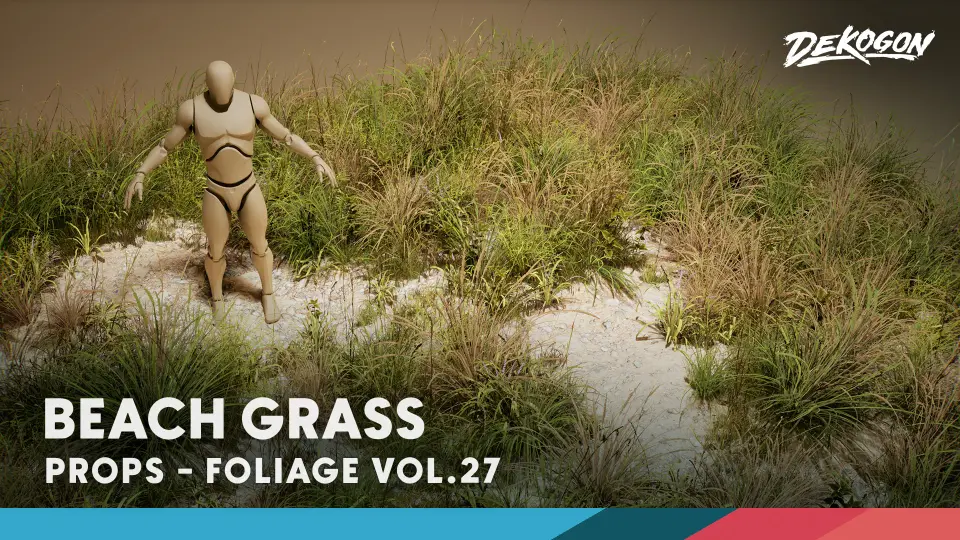
Foliage VOL.27 - Beach Grass (Low Poly) delivers a focused vegetation package shaped by a 29-mesh collection created entirely in Unreal Engine. The project bundles the mesh assets together with their corresponding maps and materials so that what is shown in the visual documentation is what lands in the content browser on import. Every asset was produced toward realistic-quality visuals while keeping a style-conscious and budget-aware approach to geometry density, which is where the low-poly designation does its work: enough silhouette detail and surface fidelity to hold up in a realistic frame, but tuned to stay manageable in a game environment.
Mesh Collection and Full-Side Detailing
The pack contains 29 individual meshes, which is the entire scope of included geometry. There is no mention of separate LOD tiers or skeletal-foliage variants—the focus is on static mesh assets suited to foliage scattering, ecosystem dressing, and sand-and-beach scene composition. The tags attached to the product reinforce the intended placement: grass, plant, stem, flower, tree, beach, sand, and ecosystem. That range suggests the mesh set goes beyond a single blade type and includes enough structural variety—likely blades, clumps, stems, and accompanying plants—to support organic distribution across a terrain layer.
Every asset is fully detailed on all sides. That stated property matters for foliage work because instances are rotated, scattered, and viewed from multiple camera angles during gameplay. Meshes built with only a front-facing facade break when placed away from the key light or when vegetation clusters are viewed from above. Full-sided geometry means the same asset can populate a dune ridge without requiring manual orientation adjustments or careful two-sided material checks to hide backfaces.
Material System and Per-Asset Controls
A single master material setup controls the majority of the props and models in the pack. This consolidating approach reduces the number of material instances scattered across a foliage system, which directly affects draw calls and foliage-type management inside Unreal. Instead of authoring bespoke materials for each grass element, the master setup routes most of the mesh collection through shared shading logic while still allowing per-instance customization through exposed parameters.
The master material adds controls for roughness, albedo, normals, and additional properties. Those parameters give artists adjustment range without opening the material graph or recompiling shaders. For a coastal grass environment where prevailing wind direction, time-of-day lighting, and weather conditions vary, dialing albedo brightness or roughness intensity directly inside the material instance editor keeps iteration fast. The normal control path matters when blending the same grass assets into different biomes—pushing detail up for a foreground hero shot or pulling it down for background populating.
Channel-Packed Texture Masks
Texture data arrives as high-fidelity 4K sets, and the packing scheme follows a Roughness | Metalness | Ambient Occlusion convention. Channel packing consolidates three mask-driven properties into a single texture file, which saves sampling overhead inside the shader and keeps texture streaming budgets lean. For foliage specifically, ambient occlusion packed alongside roughness means the master material can read subsurface-style deep-shadowing data from the AO channel while the roughness channel governs how each blade or stem catches specular hits under bright sun.
The metalness channel presence is worth noting even though grass is non-metallic. Having the channel available means the same master material framework can extend to props beyond the foliage set—fencing, signage, or accessories—that might share a scene with the beach grass ecosystem. The channel-packed convention makes that coexistence cheaper because the material logic does not need to branch between packed and unpacked inputs.
Lumen Support and UE 5.0+ Compatibility
The project explicitly supports Lumen for Unreal Engine 5.0 and above. Lumen's dynamic global illumination reacts to surface albedo, roughness, and geometric thickness, so the full-sided mesh detail and 4K roughness-mapped surfaces feed directly into how light bounces through a grass cluster. Beach grass in particular benefits because scattered stems create complex micro-shadow regions that static baked lighting would struggle to capture cleanly across time-of-day cycles.
Unreal Engine 5.0+ support also frames the package as current-generation. The editor-side documentation references Unreal Documentation for Lumen workflows, which keeps environmental artists anchored to the engine's own guidance rather than relying solely on asset-store notes for GI configuration. The realistic post-process and Look Up Table included in the project provide a rendered starting point for color grading that can be adapted or stripped back depending on project tone.
Custom Branding and Legal Clearance
Branding and labels inside the pack are custom-made by the studio, which removes trademark concerns from production. For environment teams shipping commercial titles, that clearance avoids the common problem of stock-texture libraries hiding logos, signage, or background text inside diffuse maps or packaging labels. The foliage itself is organic and unlikely to carry graphics, but the note extends across all included assets and materials, covering any prop or accessory that ships alongside the grasses and stems.
Foliage Variant Tags and Scene Application
The tagging for this pack points to a wide but connected application range: Open, PBR, Grass, Tree, Plant, Lowpoly, Foliage, Ecosystem, Beach, Fantasy, Flower, Stem, Realistic, Sand, World. Several of those tags—Open, Ecosystem, World—indicate the grass is intended for wide-environment placement rather than isolated decorative use. The Fantasy tag widens the style application beyond strict photogrammetry-era realism, meaning the same meshes can serve stylized realistic environments where geometry is believable but not measured against CAD-precision reference. Beach and Sand narrow the aesthetic baseline toward coastal biome dressing, while Flower and Stem open the set beyond simple blade coverage.
The Set in Practice
Beach grass picked from this pack works by compositing multiple mesh variants across terrain layers within Unreal's foliage painter or another external scattering solution compatible with the engine. The 29-mesh count provides enough variation to prevent visible repetition across a sizable dune field without forcing texture-flip tricks or aggressive wind-material motion to hide instancing artifacts. The low-poly designation keeps each instance cheap, which matters because foliage density on shorelines often runs high to mask hard terrain transitions between sand layers and underlying ground structures.
The master material with roughness, albedo, and normal controls gives artists the ability to tune one batch of grass for a wet, stormy coastline—lower albedo, higher roughness, flatter normals—and another batch for a bright midday beach—brighter albedo, tighter roughness, stronger normal definition—using the same 29 meshes under distinct material instances. Channel-packed masks keep that variation economical on texture memory.
Lumen integration handles the rest during framing. Because the models are fully detailed on all sides, scattering does not require manual orientation management to keep stems looking believable when the camera moves through a grass cluster at near-ground level. The post-processing and LUT setup included in the project provide a ready-made look-dev bench for testing those adjustments before committing to final lighting bakes or runtime exposure parameters.
Final Configuration Note
The pack arrives with all assets, maps, and materials built inside Unreal Engine, meaning the import workflow is native rather than requiring intermediate format conversion or external tool authoring. Documentation is maintained externally and references standard Unreal Documentation for Lumen functionality, keeping configuration aligned with engine-settings guidance rather than asset-specific overrides. The package is structured to support realistic beach and coastal foliage environments on Unreal Engine 5.0+ while maintaining game-optimized performance through mesh count, material centralization, and channel-packed texture delivery.
 Plants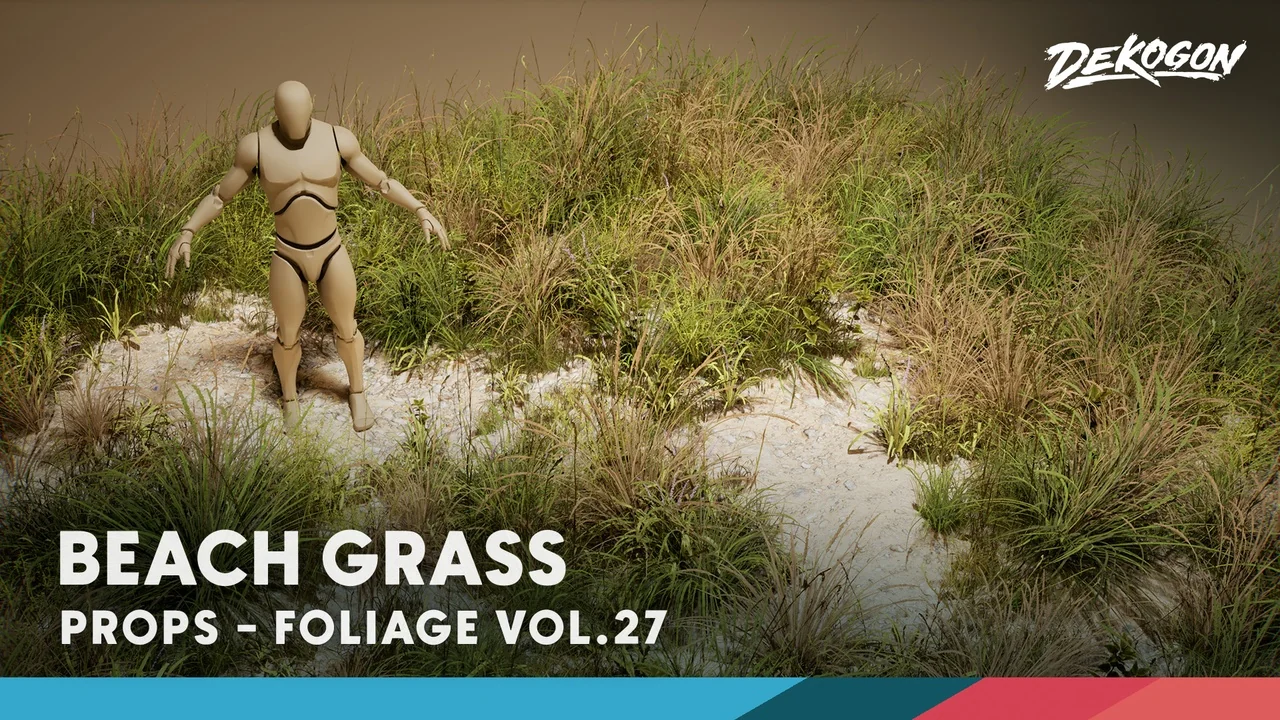
 Plants
 Plants
 Plants