"fa182e0cd0a6ea73"{"id":"1000609","slug":"foliage-vol-37-tree-stumps-nanite-low-poly","title":"Foliage VOL.37- Tree Stumps (NANITE + LOW POLY)","category":"Trees","engine":"5.3+","assetVersion":"","engineVersion":"Engine Version: 5.3+","tag":"Trees","accent":"blue","visual":"mech","summary":"Unreal Engine tree stump foliage pack with 20 Nanite and low poly meshes, 4K textures, master material controls, channel-packed maps, and Lumen support.","platform":"Unreal Engine","publishedAt":"2026-07-20T19:45:12.049Z","updatedAt":"2026-07-20T19:45:12.049Z","sourceNotes":[],"fileContents":[],"compatibility":["Unreal Engine","Engine Version: 5.3+"],"featuredImage":{"alt":"Foliage VOL.37- Tree Stumps (NANITE + LOW POLY)","src":"/wp-content/uploads/published/2026/07/eb55bb3c1eab-f8ea7966-29a2-41b9-9c11-23bf42af068d-995cff7b57.webp"},"hasDownloadLink":true,"downloads":0,"terms":[{"taxonomy":"category","slug":"trees","name":"Trees"}],"galleryImages":[{"src":"/wp-content/uploads/published/2026/07/647e681eb567-cd125f36-9220-466f-a5f4-b2fe7fceadc8-578113028b.webp","alt":"Foliage VOL.37- Tree Stumps (NANITE + LOW POLY)"},{"src":"/wp-content/uploads/published/2026/07/28aaae29da60-815e763e-84a3-476c-abd0-21a73775de60-cef8538609.webp","alt":"Foliage VOL.37- Tree Stumps (NANITE + LOW POLY)"},{"src":"/wp-content/uploads/published/2026/07/6dc010c1339d-584e5caa-511e-4236-ad75-37c1a5fd3349-dcd887c613.webp","alt":"Foliage VOL.37- Tree Stumps (NANITE + LOW POLY)"},{"src":"/wp-content/uploads/published/2026/07/133963cc7bec-b13ba01d-a3bd-48cc-bce8-8e4db7be116e-4447eff61b.webp","alt":"Foliage VOL.37- Tree Stumps (NANITE + LOW POLY)"},{"src":"/wp-content/uploads/published/2026/07/c5f2eccad462-adf327ea-795f-45be-a252-52777a639dc4-7d477441e6.webp","alt":"Foliage VOL.37- Tree Stumps (NANITE + LOW POLY)"},{"src":"/wp-content/uploads/published/2026/07/277c386481a7-0fdd5c30-fc40-48a9-9a7c-259847c1d9ef-016d9c0a01.webp","alt":"Foliage VOL.37- Tree Stumps (NANITE + LOW POLY)"},{"src":"/wp-content/uploads/published/2026/07/7eeadf318b5e-edc6d3af-dc0f-4c12-926f-5f4fe8ea7d2d-5876748f70.webp","alt":"Foliage VOL.37- Tree Stumps (NANITE + LOW POLY)"},{"src":"/wp-content/uploads/published/2026/07/bf411cf9d783-5410867b-160f-48c9-a648-a0fec3b5a6aa-d5c1bd9400.webp","alt":"Foliage VOL.37- Tree Stumps (NANITE + LOW POLY)"},{"src":"/wp-content/uploads/published/2026/07/ba621588d868-b297b74d-9bfc-4385-945e-158db482d9d8-fc360dc825.webp","alt":"Foliage VOL.37- Tree Stumps (NANITE + LOW POLY)"},{"src":"/wp-content/uploads/published/2026/07/c330d9f15d98-6b3d651d-29a1-4d3a-9b59-ee7075bc3553-554aef9b8d.webp","alt":"Foliage VOL.37- Tree Stumps (NANITE + LOW POLY)"}],"accessPanel":{"kind":"resource","title":"Download this resource","eyebrow":"Free Download","message":"Log in or create a free account to start your download.","fileName":"Content.7z","safetyNote":"Resources are manually reviewed before listing to improve quality and reduce obvious risks.","actionLabel":"Download Free","resourceType":"Resource archive"},"contentHtml":"\u003cp\u003eScattered tree stumps across a postapocalyptic forest floor demand assets that hold up from every camera angle while still performing inside a real-time scene. The pack delivers exactly that kind of flexibility by providing each stump in two fidelity tiers: a Nanite version for high-poly detail and a low poly counterpart for lighter deployments. Because every asset was built in Unreal Engine from the ground up, the models, maps, and materials arrive ready to drop into an existing project rather than requiring a conversion pipeline.\u003c/p\u003e \u003ch2\u003eDual Fidelity Workflow: Nanite and Low Poly Stumps\u003c/h2\u003e \u003cp\u003eThe core of the pack is a deliberate split in mesh density. Ten distinct tree stump assets are included, and each one ships as two separate meshes — one constructed using Nanite for high-quality fidelity polycounts and one as a low poly version. That gives twenty meshes total, organized so that teams can match visual budget to hardware target without losing the same silhouettes and proportions.\u003c/p\u003e \u003cp\u003eNanite handles the heavy lifting when a scene needs a stump to read with full surface detail at close range. The low poly versions step in for situations where draw calls or memory pressure matter more than micro-detail, or where Nanite is not in use. Since both variants share the same art direction, swapping between them during optimization does not break visual continuity.\u003c/p\u003e \u003cp\u003eEvery model is fully detailed from all sides. That matters for stumps specifically because they sit low to the ground, often on uneven terrain, and players or cameras can approach them from any direction. A stump placed on a slope or partially obscured by grass needs to hold up whether the viewer sees the root flare, the cut top, or the bark texture wrapping around the trunk base.\u003c/p\u003e \u003ch2\u003eMaster Material and Channel-Packed Texture Controls\u003c/h2\u003e \u003cp\u003eA single master material setup controls the majority of props and models in the pack. Rather than managing individual material instances per stump, artists work from one entry point and adjust parameters to reach the desired look for each placement. The material exposes additional controls for roughness, albedo, normals, and more, giving fine-grained tuning without needing to open a graph or create custom shaders.\u003c/p\u003e \u003cp\u003eTexture sets are delivered at 4K resolution with high fidelity. The maps use channel packing to combine Roughness, Metalness, and Ambient Occlusion into a single texture, which reduces the number of samplers needed per material and keeps memory overhead tighter. Channel-packed maps are a standard optimization in modern engine workflows, and their inclusion here means the stumps fit cleanly into projects already using that convention.\u003c/p\u003e \u003ch3\u003ePost Process and Look Up Table Integration\u003c/h3\u003e \u003cp\u003eThe pack includes a realistic post process setup and a Look Up Table (LUT). These work together to establish a consistent color grade across the stumps and the broader environment, ensuring that the muted browns, grays, and organic tones of dead or decaying wood read with a cohesive atmosphere. Post process settings can be particularly important in postapocalyptic scenes, where desaturation and contrast shape the mood as much as the models themselves.\u003c/p\u003e \u003ch2\u003eLumen Support and Engine Compatibility\u003c/h2\u003e \u003cp\u003eThe assets support Lumen for Unreal Engine 5.0 and later. Lumen's dynamic global illumination reacts to the surfaces and shapes of the stumps in real time, which is especially visible on the rough bark surfaces and the flat cut tops where light catches differently. A stump partially shaded by surrounding foliage will receive bounced light and shadow gradients without needing baked lighting.\u003c/p\u003e \u003cp\u003eBecause the pack was created entirely within Unreal Engine, the materials, textures, and mesh settings are already aligned with the engine's rendering pipeline. The assets are optimized for games and carry no legal complications — all branding and labels are custom made by the studio, so there are no third-party trademarks or copyrighted markings embedded in the textures or geometry.\u003c/p\u003e \u003ch2\u003eThematic Placement in Postapocalyptic Environments\u003c/h2\u003e \u003cp\u003eThe stumps are tagged across a spectrum of environment descriptors: Postapocalyptic, Post, Abandoned, Tree, Plant, Stump, Foliage, Flower, Bush, Axe, Prop, Forest. The presence of an axe tag in particular suggests these stumps read as freshly cut or deliberately felled rather than purely natural decay, which opens placement options in scenes where logging, survival, or human impact on the landscape is part of the narrative.\u003c/p\u003e \u003cp\u003eA forest that has been abandoned or altered by catastrophe can use these stumps as ground-level storytelling elements — the remains of trees that were cut, burned, or left to rot. The postapocalyptic and abandoned tags frame the art direction toward weathered, desaturated surfaces that sit comfortably alongside crumbling structures and overgrown terrain.\u003c/p\u003e \u003ch2\u003eIntegration with Meridian 1988: Cedar Point School\u003c/h2\u003e \u003cp\u003eFrom a project pipeline perspective, this foliage pack is compatible with Meridian 1988: Cedar Point School — Modular Environment (VOL 57). That compatibility means the stumps can populate the grounds, edges, and overgrown areas of that modular environment without clashing in art style or technical setup. When environment art packs share visual language and material conventions, the combined scene avoids the patchwork look that comes from mixing assets built under different quality standards.\u003c/p\u003e \u003cp\u003eFor teams assembling a larger postapocalyptic scene, having tree stumps that already match the material workflow and visual tone of a modular building kit reduces the integration work. The stumps can fill gaps between buildings, cluster along fence lines, or break up flat ground around a school structure to add organic detail and visual variety.\u003c/p\u003e \u003ch2\u003eWhat Teams Gain from the Nanite and Low Poly Duo\u003c/h2\u003e \u003cp\u003eThe strongest advantage here is choice under constraint. A scene can use the Nanite stumps for hero shots and foreground placement, then switch to low poly versions for background coverage or for platforms where Nanite is disabled. Because both versions share the same master material and 4K texture sets, the visual drop-off when moving to low poly is controlled by polygon density rather than by a loss of material quality.\u003c/p\u003e \u003cp\u003eThe combination of Lumen support, channel-packed textures, a unified master material, and the dual mesh fidelity gives environment teams a self-contained stump system that scales from detailed cinematics to broader game environments without rebuilding assets. The custom branding and legal clearance remove one more step from the production checklist, letting the stumps go straight into a scene and start doing their work as ground-level environmental storytelling.\u003c/p\u003e\n\n\u003ch2\u003eRelated Resources Worth Checking\u003c/h2\u003e\n\u003cul\u003e\n\u003cli\u003e\u003ca href=\"https://3dcghub.com/foliage-vol-8-dead-trees-nanite-and-low-poly/\" title=\"Foliage VOL.8 - Dead Trees (Nanite and Low Poly)\"\u003eFoliage VOL.8 - Dead Trees (Nanite and Low Poly)\u003c/a\u003e\u003c/li\u003e\n\u003cli\u003e\u003ca href=\"https://3dcghub.com/foliage-vol-24-farming-plants-low-poly/\" title=\"Foliage VOL.24 - Farming Plants (Low Poly)\"\u003eFoliage VOL.24 - Farming Plants (Low Poly)\u003c/a\u003e\u003c/li\u003e\n\u003cli\u003e\u003ca href=\"https://3dcghub.com/foliage-vol-11-bushes-nanite-and-low-poly/\" title=\"Foliage VOL.11 - Bushes (Nanite and Low Poly)\"\u003eFoliage VOL.11 - Bushes (Nanite and Low Poly)\u003c/a\u003e\u003c/li\u003e\n\u003cli\u003e\u003ca href=\"https://3dcghub.com/foliage-vol-10-yard-plants-nanite-and-low-poly/\" title=\"Foliage VOL.10 - Yard Plants (Nanite and Low Poly)\"\u003eFoliage VOL.10 - Yard Plants (Nanite and Low Poly)\u003c/a\u003e\u003c/li\u003e\n\u003cli\u003e\u003ca href=\"https://3dcghub.com/foliage-vol-7-ash-trees-nanite-and-low-poly/\" title=\"Foliage VOL.7 - Ash Trees (Nanite and Low Poly)\"\u003eFoliage VOL.7 - Ash Trees (Nanite and Low Poly)\u003c/a\u003e\u003c/li\u003e\n\u003c/ul\u003e","contentTextLength":6920,"navigation":{"current":1325,"total":3789,"previous":{"id":"1000610","slug":"forest-guardian","title":"Forest Guardian","category":"Characters \u0026 Creatures","platform":"Unreal Engine","updatedAt":"2026-07-20T20:04:16.119Z"},"next":{"id":"1000608","slug":"foliage-vol-27-beach-grass-low-poly","title":"Foliage VOL.27 - Beach Grass (Low Poly)","category":"Plants","platform":"Unreal Engine","updatedAt":"2026-07-20T19:27:39.017Z"}},"relatedResources":[{"id":"1001778","slug":"foliage-vol-3-oak-trees-nanite-and-low-poly","title":"Foliage VOL.3 - Oak Trees (Nanite and Low Poly)","category":"Trees","engine":"5.1+","assetVersion":"","engineVersion":"Engine Version: 5.1+","tag":"Trees","accent":"blue","visual":"mech","summary":"Explore Foliage VOL.3 - Oak Trees (Nanite and Low Poly) featuring 22 meshes, 4K channel-packed textures, master materials, and Unreal Engine 5 Lumen support.","platform":"Unreal Engine","publishedAt":"2026-10-20T03:26:11.644Z","updatedAt":"2026-10-20T03:26:11.644Z","sourceNotes":[],"fileContents":[],"compatibility":["Unreal Engine","Engine Version: 5.1+"],"featuredImage":{"alt":"Foliage VOL.3 - Oak Trees (Nanite and Low Poly)","src":"/wp-content/uploads/published/2026/10/76cc3069015a-cf088094-d3eb-4e1d-9e68-3e23a2161532-65dcdb07a2.webp"},"hasDownloadLink":true,"downloads":0},{"id":"1000999","slug":"landscaping-small-trees-1","title":"Landscaping Small Trees 1","category":"Trees","engine":"5.1+","assetVersion":"","engineVersion":"Engine Version: 5.1+","tag":"Trees","accent":"blue","visual":"mech","summary":"Landscaping Small Trees 1 uses Pivot Painter 2.0 for natural movement and Nanite for detailed geometry, with editable PBR materials and Unreal Engine 5.0+ suppo","platform":"Unreal Engine","publishedAt":"2026-08-19T16:12:52.291Z","updatedAt":"2026-08-19T16:12:52.291Z","sourceNotes":[],"fileContents":[],"compatibility":["Unreal Engine","Engine Version: 5.1+"],"featuredImage":{"alt":"Landscaping Small Trees 1","src":"/wp-content/uploads/published/2026/08/0fe73543c779-ec1d14ee-4e9f-40fa-81ed-9e692d0837c9-a4cd999d22.webp"},"hasDownloadLink":true,"downloads":1},{"id":"1000829","slug":"foliage-vol-19-scraggly-bushes-nanite-and-low-poly","title":"Foliage VOL.19 - Scraggly Bushes (Nanite and Low Poly)","category":"Trees","engine":"5.1+","assetVersion":"","engineVersion":"Engine Version: 5.1+","tag":"Trees","accent":"blue","visual":"mech","summary":"A foliage pack of 20 scraggly bush meshes built for Unreal Engine 5.0+, featuring Nanite and low poly variants, 4k textures, Lumen support, and master material","platform":"Unreal Engine","publishedAt":"2026-08-03T12:04:08.713Z","updatedAt":"2026-08-03T12:04:08.713Z","sourceNotes":[],"fileContents":[],"compatibility":["Unreal Engine","Engine Version: 5.1+"],"featuredImage":{"alt":"Foliage VOL.19 - Scraggly Bushes (Nanite and Low Poly)","src":"/wp-content/uploads/published/2026/08/4b3cc7f7b16f-c9417b0e-a1e6-4c4c-b734-092e1fe4283a-e6bdcf0441.webp"},"hasDownloadLink":true,"downloads":1}]}
Trees
Foliage VOL.37- Tree Stumps (NANITE + LOW POLY)
Unreal Engine tree stump foliage pack with 20 Nanite and low poly meshes, 4K textures, master material controls, channel-packed maps, and Lumen support.
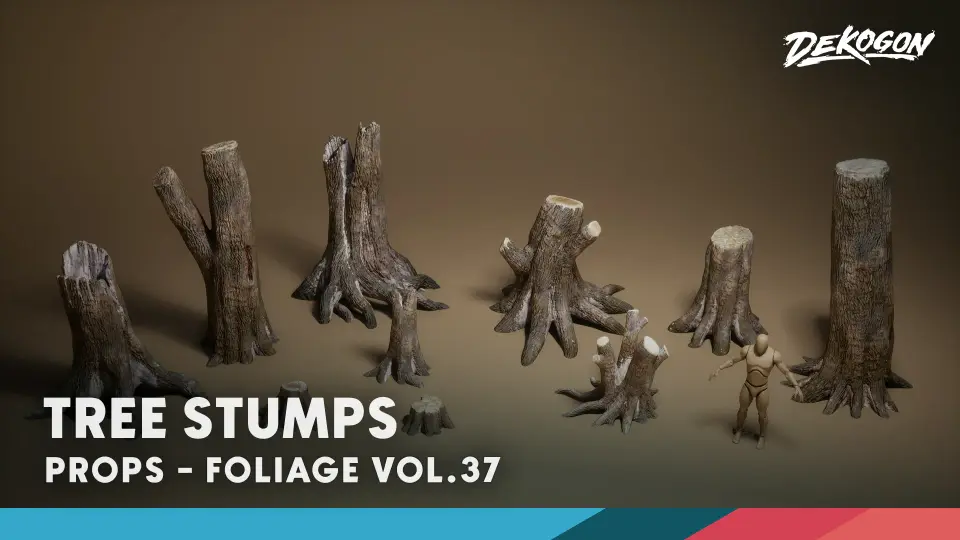
Scattered tree stumps across a postapocalyptic forest floor demand assets that hold up from every camera angle while still performing inside a real-time scene. The pack delivers exactly that kind of flexibility by providing each stump in two fidelity tiers: a Nanite version for high-poly detail and a low poly counterpart for lighter deployments. Because every asset was built in Unreal Engine from the ground up, the models, maps, and materials arrive ready to drop into an existing project rather than requiring a conversion pipeline.
Dual Fidelity Workflow: Nanite and Low Poly Stumps
The core of the pack is a deliberate split in mesh density. Ten distinct tree stump assets are included, and each one ships as two separate meshes — one constructed using Nanite for high-quality fidelity polycounts and one as a low poly version. That gives twenty meshes total, organized so that teams can match visual budget to hardware target without losing the same silhouettes and proportions.
Nanite handles the heavy lifting when a scene needs a stump to read with full surface detail at close range. The low poly versions step in for situations where draw calls or memory pressure matter more than micro-detail, or where Nanite is not in use. Since both variants share the same art direction, swapping between them during optimization does not break visual continuity.
Every model is fully detailed from all sides. That matters for stumps specifically because they sit low to the ground, often on uneven terrain, and players or cameras can approach them from any direction. A stump placed on a slope or partially obscured by grass needs to hold up whether the viewer sees the root flare, the cut top, or the bark texture wrapping around the trunk base.
Master Material and Channel-Packed Texture Controls
A single master material setup controls the majority of props and models in the pack. Rather than managing individual material instances per stump, artists work from one entry point and adjust parameters to reach the desired look for each placement. The material exposes additional controls for roughness, albedo, normals, and more, giving fine-grained tuning without needing to open a graph or create custom shaders.
Texture sets are delivered at 4K resolution with high fidelity. The maps use channel packing to combine Roughness, Metalness, and Ambient Occlusion into a single texture, which reduces the number of samplers needed per material and keeps memory overhead tighter. Channel-packed maps are a standard optimization in modern engine workflows, and their inclusion here means the stumps fit cleanly into projects already using that convention.
Post Process and Look Up Table Integration
The pack includes a realistic post process setup and a Look Up Table (LUT). These work together to establish a consistent color grade across the stumps and the broader environment, ensuring that the muted browns, grays, and organic tones of dead or decaying wood read with a cohesive atmosphere. Post process settings can be particularly important in postapocalyptic scenes, where desaturation and contrast shape the mood as much as the models themselves.
Lumen Support and Engine Compatibility
The assets support Lumen for Unreal Engine 5.0 and later. Lumen's dynamic global illumination reacts to the surfaces and shapes of the stumps in real time, which is especially visible on the rough bark surfaces and the flat cut tops where light catches differently. A stump partially shaded by surrounding foliage will receive bounced light and shadow gradients without needing baked lighting.
Because the pack was created entirely within Unreal Engine, the materials, textures, and mesh settings are already aligned with the engine's rendering pipeline. The assets are optimized for games and carry no legal complications — all branding and labels are custom made by the studio, so there are no third-party trademarks or copyrighted markings embedded in the textures or geometry.
Thematic Placement in Postapocalyptic Environments
The stumps are tagged across a spectrum of environment descriptors: Postapocalyptic, Post, Abandoned, Tree, Plant, Stump, Foliage, Flower, Bush, Axe, Prop, Forest. The presence of an axe tag in particular suggests these stumps read as freshly cut or deliberately felled rather than purely natural decay, which opens placement options in scenes where logging, survival, or human impact on the landscape is part of the narrative.
A forest that has been abandoned or altered by catastrophe can use these stumps as ground-level storytelling elements — the remains of trees that were cut, burned, or left to rot. The postapocalyptic and abandoned tags frame the art direction toward weathered, desaturated surfaces that sit comfortably alongside crumbling structures and overgrown terrain.
Integration with Meridian 1988: Cedar Point School
From a project pipeline perspective, this foliage pack is compatible with Meridian 1988: Cedar Point School — Modular Environment (VOL 57). That compatibility means the stumps can populate the grounds, edges, and overgrown areas of that modular environment without clashing in art style or technical setup. When environment art packs share visual language and material conventions, the combined scene avoids the patchwork look that comes from mixing assets built under different quality standards.
For teams assembling a larger postapocalyptic scene, having tree stumps that already match the material workflow and visual tone of a modular building kit reduces the integration work. The stumps can fill gaps between buildings, cluster along fence lines, or break up flat ground around a school structure to add organic detail and visual variety.
What Teams Gain from the Nanite and Low Poly Duo
The strongest advantage here is choice under constraint. A scene can use the Nanite stumps for hero shots and foreground placement, then switch to low poly versions for background coverage or for platforms where Nanite is disabled. Because both versions share the same master material and 4K texture sets, the visual drop-off when moving to low poly is controlled by polygon density rather than by a loss of material quality.
The combination of Lumen support, channel-packed textures, a unified master material, and the dual mesh fidelity gives environment teams a self-contained stump system that scales from detailed cinematics to broader game environments without rebuilding assets. The custom branding and legal clearance remove one more step from the production checklist, letting the stumps go straight into a scene and start doing their work as ground-level environmental storytelling.
 Trees
Trees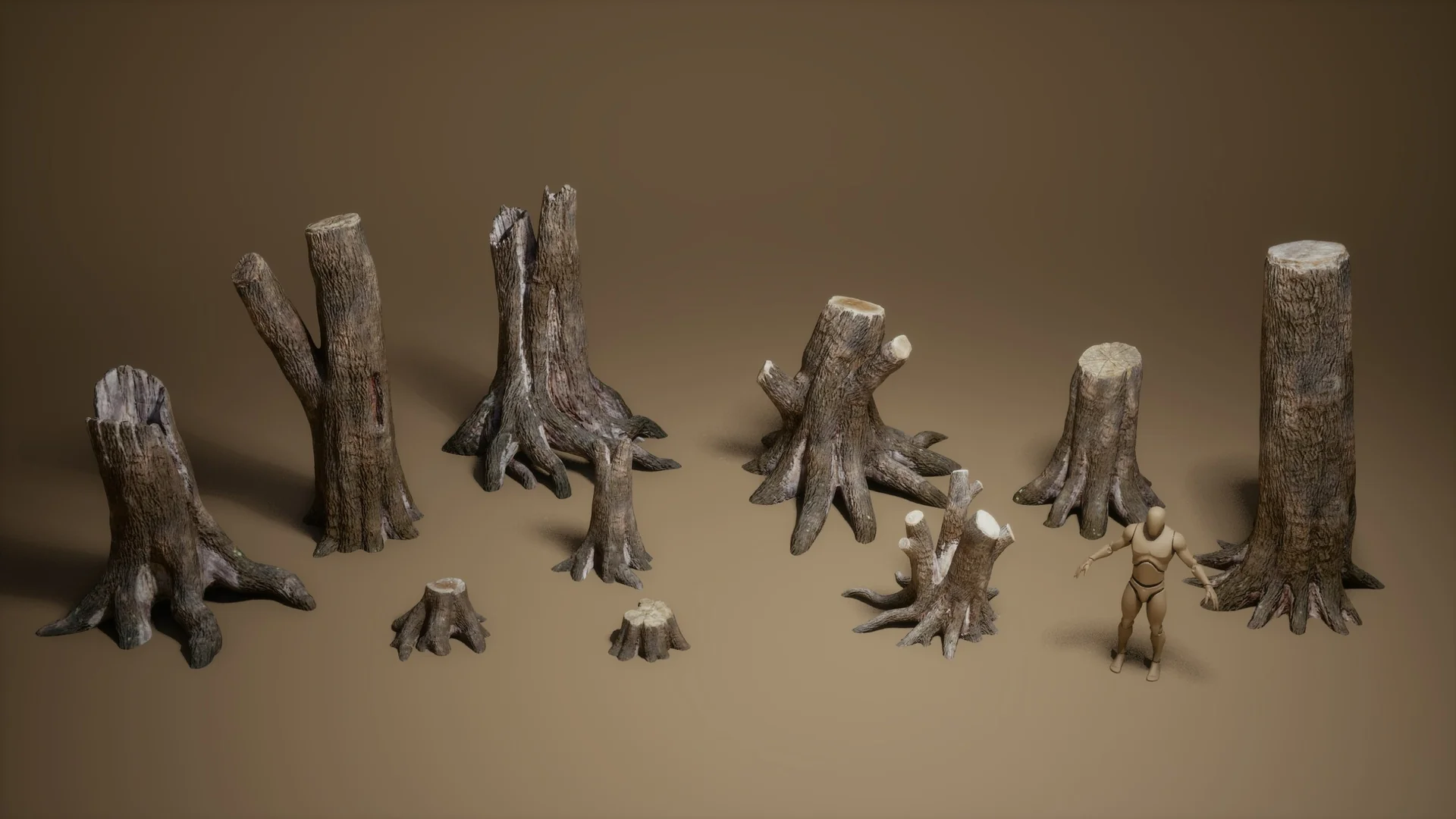
 Trees
Trees Trees
Trees Trees
Trees