"a338a1d501976271"{"id":"1000999","slug":"landscaping-small-trees-1","title":"Landscaping Small Trees 1","category":"Trees","engine":"5.1+","assetVersion":"","engineVersion":"Engine Version: 5.1+","tag":"Trees","accent":"blue","visual":"mech","summary":"Landscaping Small Trees 1 uses Pivot Painter 2.0 for natural movement and Nanite for detailed geometry, with editable PBR materials and Unreal Engine 5.0+ suppo","platform":"Unreal Engine","publishedAt":"2026-08-19T16:12:52.291Z","updatedAt":"2026-08-19T16:12:52.291Z","sourceNotes":[],"fileContents":[],"compatibility":["Unreal Engine","Engine Version: 5.1+"],"featuredImage":{"alt":"Landscaping Small Trees 1","src":"/wp-content/uploads/published/2026/08/0fe73543c779-ec1d14ee-4e9f-40fa-81ed-9e692d0837c9-a4cd999d22.webp"},"hasDownloadLink":true,"downloads":0,"terms":[{"taxonomy":"category","slug":"trees","name":"Trees"}],"galleryImages":[{"src":"/wp-content/uploads/published/2026/08/4fd2b65f3e6b-b33f08f0-0530-4192-a93c-e3bf761af95f-59cbdf819a.webp","alt":"Landscaping Small Trees 1"},{"src":"/wp-content/uploads/published/2026/08/b39bc9cc0f01-d493b0f1-5e44-4ebf-82e6-65558c81f7b5-0d924d2838.webp","alt":"Landscaping Small Trees 1"},{"src":"/wp-content/uploads/published/2026/08/0aaae893a8f6-440c7543-80b0-4d7b-9d7e-ec463a1e0c08-dbdf2fc44e.webp","alt":"Landscaping Small Trees 1"},{"src":"/wp-content/uploads/published/2026/08/129a5290e7c9-61140225-c8bd-4a2a-8180-822ed4c1a04b-3588f61fbc.webp","alt":"Landscaping Small Trees 1"},{"src":"/wp-content/uploads/published/2026/08/e384fb6d2abf-94780e1a-de82-431a-8028-67a6f5884a43-d2789cdaf1.webp","alt":"Landscaping Small Trees 1"},{"src":"/wp-content/uploads/published/2026/08/20f5604aac10-af882f0f-e8ef-4795-86d6-92241102e710-7013e99cb7.webp","alt":"Landscaping Small Trees 1"},{"src":"/wp-content/uploads/published/2026/08/ab41f585ff9a-dfc9b38d-87c0-466e-86ea-39f4d32f22e3-4914d2648a.webp","alt":"Landscaping Small Trees 1"},{"src":"/wp-content/uploads/published/2026/08/4482dca81000-5b443782-53ce-44fd-8976-045251d2daec-f09a34c89a.webp","alt":"Landscaping Small Trees 1"},{"src":"/wp-content/uploads/published/2026/08/e48f9688cae4-663d7dbf-d42a-4b4c-93a8-584dc413332c-3864b03ee9.webp","alt":"Landscaping Small Trees 1"},{"src":"/wp-content/uploads/published/2026/08/e3b6daf829dd-650c3b01-f1cf-4fb3-bc90-4bf453df29b6-b38ed682cd.webp","alt":"Landscaping Small Trees 1"}],"accessPanel":{"kind":"resource","title":"Download this resource","eyebrow":"Free Download","message":"Log in or create a free account to start your download.","fileName":"Content.7z","safetyNote":"Resources are manually reviewed before listing to improve quality and reduce obvious risks.","actionLabel":"Download Free","resourceType":"Resource archive"},"contentHtml":"\u003cp\u003eIt usually starts with a still frame. The architecture looks sharp, the lighting is warm, and the tree near the entrance provides a welcome sense of scale. Then the camera starts moving, and that same tree becomes a problem. In animations, cinematics, or virtual tours, many plant models appear motionless, or worse, they move in ways that look stiff and unnatural. Landscaping Small Trees 1 was created to address that gap. The pack doesn't just place a few branches on a trunk; it builds a hierarchy into every element—leaf, branch, and trunk—so each part can move in a way that feels grounded in physics.\u003c/p\u003e\n\u003ch2\u003ePivot Painter 2.0: Each Leaf, Branch, and Trunk in Motion\u003c/h2\u003e\n\u003cp\u003ePivot Painter 2.0 is the technology behind the fluid motion. With this, every leaf and branch gets its own pivot point, which allows the tree to react to wind and camera movement without producing the rubbery, uniform bends you see when a whole mesh is simply rotated. The process of selecting hierarchies is deliberate. The pack treats each leaf and each branch as a separate moving part, and then connects them to the trunk in a way that mimics real plant behavior.\u003c/p\u003e\n\u003cp\u003eThat hierarchy is what keeps the motion believable. When a gust of wind passes through, outer leaves move first, then the branch flexes, and the trunk responds in kind. Because the pivots are assigned individually, the tree can also bend naturally when the camera pushes past it in a virtual tour. The other win is performance. Pivot Painter 2.0 is known for being lightweight; that it consumes a minimum of resources. That matters when you're filling a scene with multiple trees. You don't want to sacrifice animated foliage for framerate, and you don't want to spend hours cleaning up heavy simulation data.\u003c/p\u003e\n\u003ch2\u003eNanite and Unreal Engine 5.0+ Without Compromise\u003c/h2\u003e\n\u003cp\u003eNot every tree pack is ready for the demands of Unreal Engine 5, but this one is. Every asset in Landscaping Small Trees 1 is built with Nanite. Nanite allows the engine to handle incredibly detailed geometry by streaming only the necessary level of detail for each frame. In practice, that means you can place these small trees in the background and then move the camera in for a close-up without seeing a sudden drop in quality. The product page states that the pack supports Nanite for Unreal Engine 5.0+, and the same goes for Lumen.\u003c/p\u003e\n\u003cp\u003eLumen support means the trees also respond to the engine's dynamic global illumination. When the sun angle changes or artificial lights bounce off nearby walls, the foliage and bark react accordingly. That's a significant advantage for cinematic work. Instead of baking shadows and lighting into the texture, you get a tree that lives within the scene's lighting. The combination of Nanite and Lumen is about preserving quality while maintaining performance, which is exactly what an architectural visualization project needs when the camera is moving through a space.\u003c/p\u003e\n\u003ch2\u003eEditable PBR Materials and Small Imperfections\u003c/h2\u003e\n\u003cp\u003eRealism comes from the details no one notices consciously. The slight discoloration on a leaf, the rough patches on bark, the subtle variations in color across a crown—these are the things that make a tree feel alive. Landscaping Small Trees 1 is modeled and textured with that in mind. The PBR materials are editable, so you can adjust roughness, color, or even swap in your own textures if you need the trees to match a specific environment. The small imperfections are part of the texturing, keeping the assets from looking sanitized or too obvious.\u003c/p\u003e\n\u003cp\u003eThe tagging suggests a wide range of placement: Landscape, Garden, Tree, Plant, Foliage, Industrial, Architecture, Backyard, Park. These are small trees, so they work well alongside structural elements, as softeners for hardscapes, or as individual specimens in a courtyard. For production, the fact that they're small means you can cluster them without overwhelming the scene. And if you need a broader variety of small tree shapes, the pack is part of a numbered series (Small Trees 1, 2, 3, 4, and 5), so you can mix and match to avoid repetition in larger environments.\u003c/p\u003e\n\u003cp\u003eFor artists and designers working in Unreal Engine 5.0+, Landscaping Small Trees 1 offers a practical answer to a common problem. The motion is handled by Pivot Painter 2.0, the geometry is Nanite-ready, and the materials are open for customization. Whether the project is a short cinematic, a real-time architectural walkthrough, or a virtual tour that changes with the seasons, these trees are made to hold up when the camera starts moving.\u003c/p\u003e\n\n\u003ch2\u003eMore From The Same Workflow\u003c/h2\u003e\n\u003cul\u003e\n\u003cli\u003e\u003ca href=\"https://3dcghub.com/huge-tree-pack-internal-trees/\" title=\"Huge Tree Pack ( Internal Trees )\"\u003eHuge Tree Pack ( Internal Trees )\u003c/a\u003e\u003c/li\u003e\n\u003cli\u003e\u003ca href=\"https://3dcghub.com/foliage-vol-8-dead-trees-nanite-and-low-poly/\" title=\"Foliage VOL.8 - Dead Trees (Nanite and Low Poly)\"\u003eFoliage VOL.8 - Dead Trees (Nanite and Low Poly)\u003c/a\u003e\u003c/li\u003e\n\u003cli\u003e\u003ca href=\"https://3dcghub.com/foliage-vol-4-spruce-trees-nanite-and-low-poly/\" title=\"Foliage VOL.4 - Spruce Trees (Nanite and Low Poly)\"\u003eFoliage VOL.4 - Spruce Trees (Nanite and Low Poly)\u003c/a\u003e\u003c/li\u003e\n\u003cli\u003e\u003ca href=\"https://3dcghub.com/foliage-vol-37-tree-stumps-nanite-low-poly/\" title=\"Foliage VOL.37- Tree Stumps (NANITE + LOW POLY)\"\u003eFoliage VOL.37- Tree Stumps (NANITE + LOW POLY)\u003c/a\u003e\u003c/li\u003e\n\u003cli\u003e\u003ca href=\"https://3dcghub.com/foliage-vol-7-ash-trees-nanite-and-low-poly/\" title=\"Foliage VOL.7 - Ash Trees (Nanite and Low Poly)\"\u003eFoliage VOL.7 - Ash Trees (Nanite and Low Poly)\u003c/a\u003e\u003c/li\u003e\n\u003c/ul\u003e","contentTextLength":4774,"navigation":{"current":455,"total":3338,"previous":{"id":"1001000","slug":"lens-and-film-post-process","title":"Lens and Film Post Process","category":"Shaders","platform":"Unreal Engine","updatedAt":"2026-08-20T09:55:15.932Z"},"next":{"id":"1000998","slug":"landscape-pro-2-0-auto-generated-material","title":"Landscape Pro 2.0 Auto-Generated Material","category":"Nature \u0026 Terrain","platform":"Unreal Engine","updatedAt":"2026-08-19T15:49:37.825Z"}},"relatedResources":[{"id":"1001030","slug":"norway-spruce-tree-pack-picea-abies","title":"Norway Spruce Tree Pack, Picea Abies","category":"Trees","engine":"5.1+","assetVersion":"","engineVersion":"Engine Version: 5.1+","tag":"Trees","accent":"blue","visual":"mech","summary":"A complete Norway spruce pack for Unreal Engine: 13 Picea abies trees, custom wind and LODs, forest clutter, landscape shaders, example level, and weather bluep","platform":"Unreal Engine","publishedAt":"2026-08-23T12:18:43.875Z","updatedAt":"2026-08-23T12:18:43.875Z","sourceNotes":[],"fileContents":[],"compatibility":["Unreal Engine","Engine Version: 5.1+"],"featuredImage":{"alt":"Norway Spruce Tree Pack, Picea Abies","src":"/wp-content/uploads/published/2026/08/eaffbdc1ec2a-22e26d0c-6898-4320-8559-16d1ad8de155-f8250ac003.webp"},"hasDownloadLink":true,"downloads":1},{"id":"1000772","slug":"huge-tree-pack-internal-trees","title":"Huge Tree Pack ( Internal Trees )","category":"Trees","engine":"5.1+","assetVersion":"","engineVersion":"Engine Version: 5.1+","tag":"Trees","accent":"blue","visual":"mech","summary":"Twenty walk-in realistic game trees with PBR leaf and bark textures, simple grass wind, and Lumen support for Unreal Engine 5.1+ forest and fantasy projects.","platform":"Unreal Engine","publishedAt":"2026-07-28T17:50:49.502Z","updatedAt":"2026-07-28T17:50:49.502Z","sourceNotes":[],"fileContents":[],"compatibility":["Unreal Engine","Engine Version: 5.1+"],"featuredImage":{"alt":"Huge Tree Pack ( Internal Trees )","src":"/wp-content/uploads/published/2026/07/e212a468f16f-95b25a85-709f-4491-bbe1-f2dedb0dd9fa-a28869f7bf.webp"},"hasDownloadLink":true,"downloads":0},{"id":"1000609","slug":"foliage-vol-37-tree-stumps-nanite-low-poly","title":"Foliage VOL.37- Tree Stumps (NANITE + LOW POLY)","category":"Trees","engine":"5.3+","assetVersion":"","engineVersion":"Engine Version: 5.3+","tag":"Trees","accent":"blue","visual":"mech","summary":"Unreal Engine tree stump foliage pack with 20 Nanite and low poly meshes, 4K textures, master material controls, channel-packed maps, and Lumen support.","platform":"Unreal Engine","publishedAt":"2026-07-20T19:45:12.049Z","updatedAt":"2026-07-20T19:45:12.049Z","sourceNotes":[],"fileContents":[],"compatibility":["Unreal Engine","Engine Version: 5.3+"],"featuredImage":{"alt":"Foliage VOL.37- Tree Stumps (NANITE + LOW POLY)","src":"/wp-content/uploads/published/2026/07/eb55bb3c1eab-f8ea7966-29a2-41b9-9c11-23bf42af068d-995cff7b57.webp"},"hasDownloadLink":true,"downloads":0}]}
Trees
Landscaping Small Trees 1
Landscaping Small Trees 1 uses Pivot Painter 2.0 for natural movement and Nanite for detailed geometry, with editable PBR materials and Unreal Engine 5.0+ suppo
Category:Unreal Engine,TreesPlatform: Unreal EngineEngine Version: 5.1+Published: Aug 19, 2026
Trees
Resource overview
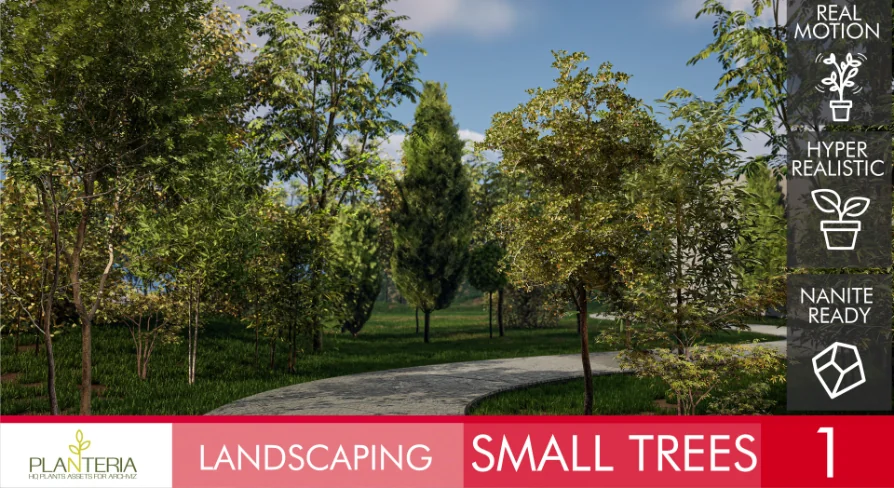
It usually starts with a still frame. The architecture looks sharp, the lighting is warm, and the tree near the entrance provides a welcome sense of scale. Then the camera starts moving, and that same tree becomes a problem. In animations, cinematics, or virtual tours, many plant models appear motionless, or worse, they move in ways that look stiff and unnatural. Landscaping Small Trees 1 was created to address that gap. The pack doesn't just place a few branches on a trunk; it builds a hierarchy into every element—leaf, branch, and trunk—so each part can move in a way that feels grounded in physics.
Pivot Painter 2.0: Each Leaf, Branch, and Trunk in Motion
Pivot Painter 2.0 is the technology behind the fluid motion. With this, every leaf and branch gets its own pivot point, which allows the tree to react to wind and camera movement without producing the rubbery, uniform bends you see when a whole mesh is simply rotated. The process of selecting hierarchies is deliberate. The pack treats each leaf and each branch as a separate moving part, and then connects them to the trunk in a way that mimics real plant behavior.
That hierarchy is what keeps the motion believable. When a gust of wind passes through, outer leaves move first, then the branch flexes, and the trunk responds in kind. Because the pivots are assigned individually, the tree can also bend naturally when the camera pushes past it in a virtual tour. The other win is performance. Pivot Painter 2.0 is known for being lightweight; that it consumes a minimum of resources. That matters when you're filling a scene with multiple trees. You don't want to sacrifice animated foliage for framerate, and you don't want to spend hours cleaning up heavy simulation data.
Nanite and Unreal Engine 5.0+ Without Compromise
Not every tree pack is ready for the demands of Unreal Engine 5, but this one is. Every asset in Landscaping Small Trees 1 is built with Nanite. Nanite allows the engine to handle incredibly detailed geometry by streaming only the necessary level of detail for each frame. In practice, that means you can place these small trees in the background and then move the camera in for a close-up without seeing a sudden drop in quality. The product page states that the pack supports Nanite for Unreal Engine 5.0+, and the same goes for Lumen.
Lumen support means the trees also respond to the engine's dynamic global illumination. When the sun angle changes or artificial lights bounce off nearby walls, the foliage and bark react accordingly. That's a significant advantage for cinematic work. Instead of baking shadows and lighting into the texture, you get a tree that lives within the scene's lighting. The combination of Nanite and Lumen is about preserving quality while maintaining performance, which is exactly what an architectural visualization project needs when the camera is moving through a space.
Editable PBR Materials and Small Imperfections
Realism comes from the details no one notices consciously. The slight discoloration on a leaf, the rough patches on bark, the subtle variations in color across a crown—these are the things that make a tree feel alive. Landscaping Small Trees 1 is modeled and textured with that in mind. The PBR materials are editable, so you can adjust roughness, color, or even swap in your own textures if you need the trees to match a specific environment. The small imperfections are part of the texturing, keeping the assets from looking sanitized or too obvious.
The tagging suggests a wide range of placement: Landscape, Garden, Tree, Plant, Foliage, Industrial, Architecture, Backyard, Park. These are small trees, so they work well alongside structural elements, as softeners for hardscapes, or as individual specimens in a courtyard. For production, the fact that they're small means you can cluster them without overwhelming the scene. And if you need a broader variety of small tree shapes, the pack is part of a numbered series (Small Trees 1, 2, 3, 4, and 5), so you can mix and match to avoid repetition in larger environments.
For artists and designers working in Unreal Engine 5.0+, Landscaping Small Trees 1 offers a practical answer to a common problem. The motion is handled by Pivot Painter 2.0, the geometry is Nanite-ready, and the materials are open for customization. Whether the project is a short cinematic, a real-time architectural walkthrough, or a virtual tour that changes with the seasons, these trees are made to hold up when the camera starts moving.
 Trees
Trees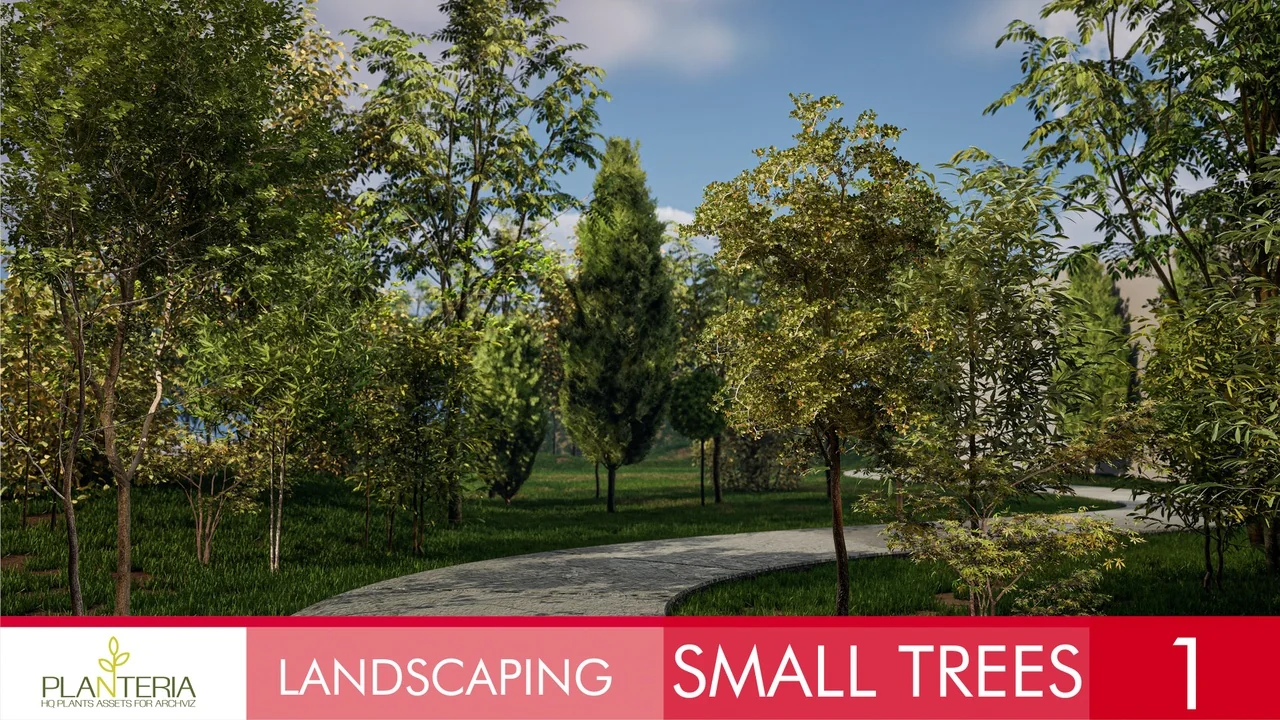
 Trees
Trees Trees
Trees Trees
Trees