"fa182e0cd0a6ea73"{"id":"1001841","slug":"stone-sculptures-vol-l-modular-urns-and-stand-nanite-low-poly","title":"Stone Sculptures VOL.l - Modular Urns \u0026 Stand (Nanite + Low Poly)","category":"Rocks \u0026 Stones","engine":"5.0+","assetVersion":"","engineVersion":"Engine Version: 5.0+","tag":"Rocks \u0026 Stones","accent":"blue","visual":"mech","summary":"Modular stone urns, stands, and classical sculptures for Unreal Engine 5, featuring Nanite high-poly meshes, baked low-poly assets, and layered PBR materials.","platform":"Unreal Engine","publishedAt":"2026-10-21T08:32:10.905Z","updatedAt":"2026-10-21T08:32:10.905Z","sourceNotes":[],"fileContents":[],"compatibility":["Unreal Engine","Engine Version: 5.0+"],"featuredImage":{"alt":"Stone Sculptures VOL.l - Modular Urns \u0026 Stand (Nanite + Low Poly)","src":"/wp-content/uploads/published/2026/10/7fda953a1ceb-851bfb7b-7664-49aa-a07e-4d0399fa211d-56bbcb9c58.webp"},"hasDownloadLink":true,"downloads":0,"terms":[{"taxonomy":"category","slug":"rocks-and-stones","name":"Rocks \u0026 Stones"}],"galleryImages":[{"src":"/wp-content/uploads/published/2026/10/66995e3ac207-b767886c-abab-4723-9537-e16d48aefa3e-0e989aa7a4.webp","alt":"Stone Sculptures VOL.l - Modular Urns \u0026 Stand (Nanite + Low Poly)"},{"src":"/wp-content/uploads/published/2026/10/bea10f2bdb35-c64a7756-a417-4dae-87a8-7d18fefd4808-70a72b361d.webp","alt":"Stone Sculptures VOL.l - Modular Urns \u0026 Stand (Nanite + Low Poly)"},{"src":"/wp-content/uploads/published/2026/10/7e5b30347103-71a4e734-25da-4147-96aa-9408b738e26a-ab93fc9254.webp","alt":"Stone Sculptures VOL.l - Modular Urns \u0026 Stand (Nanite + Low Poly)"},{"src":"/wp-content/uploads/published/2026/10/3769aa7b0085-7c5c0b26-d144-438a-9bd8-b0a2d3d47dbb-54c5e50a2f.webp","alt":"Stone Sculptures VOL.l - Modular Urns \u0026 Stand (Nanite + Low Poly)"},{"src":"/wp-content/uploads/published/2026/10/261ff7f26aa4-a188ac24-8623-4c23-aa96-c0601251c3b1-4893efd46a.webp","alt":"Stone Sculptures VOL.l - Modular Urns \u0026 Stand (Nanite + Low Poly)"},{"src":"/wp-content/uploads/published/2026/10/cf1918d6f47d-1319d905-5ecd-476d-a09f-7ca438000824-3431c5e59c.webp","alt":"Stone Sculptures VOL.l - Modular Urns \u0026 Stand (Nanite + Low Poly)"},{"src":"/wp-content/uploads/published/2026/10/4a9ef7bcff46-61f1a985-bc9e-4ea7-a6b1-72c0aa431d21-615d1ab1c6.webp","alt":"Stone Sculptures VOL.l - Modular Urns \u0026 Stand (Nanite + Low Poly)"},{"src":"/wp-content/uploads/published/2026/10/ce3407df9f4f-5f991ce2-970a-412b-b504-f207e1c53627-47ca72806e.webp","alt":"Stone Sculptures VOL.l - Modular Urns \u0026 Stand (Nanite + Low Poly)"},{"src":"/wp-content/uploads/published/2026/10/83c6e3914c4b-88ef3e34-b7df-40e7-a211-440d40cf9c8c-0baa8282d7.webp","alt":"Stone Sculptures VOL.l - Modular Urns \u0026 Stand (Nanite + Low Poly)"},{"src":"/wp-content/uploads/published/2026/10/eae71192badc-7e5b1c95-7dd1-459a-8a39-e5254871647d-2a7b384dac.webp","alt":"Stone Sculptures VOL.l - Modular Urns \u0026 Stand (Nanite + Low Poly)"}],"accessPanel":{"kind":"resource","title":"Download this resource","eyebrow":"Free Download","message":"Log in or create a free account to start your download.","fileName":"Content.7z","safetyNote":"Resources are manually reviewed before listing to improve quality and reduce obvious risks.","actionLabel":"Download Free","resourceType":"Resource archive"},"contentHtml":"\u003cp\u003eExterior set dressing often demands a difficult compromise between micro-surface detail and rendering performance. Decorative stone elements—such as classical urns, heavy concrete pedestals, and weathered cemetery plinths—feature deep relief carving, edge chipping, and subtle surface grain that collapse into muddy normal-map artifacts when viewed up close. Stone Sculptures VOL.l - Modular Urns \u0026 Stand solves this production bottleneck by offering two distinct asset pipelines in a single Unreal Engine project: dense, high-poly geometry built for Nanite alongside fully baked, optimized low-poly meshes.\u003c/p\u003e \u003ch2\u003eDual Geometry Paths: Nanite Sculptures and Optimized Low-Poly Meshes\u003c/h2\u003e\n\u003cp\u003eThe library provides 38 individual meshes engineered to meet differing technical constraints across modern game development. Rather than locking teams into a single rendering philosophy, each sculptural element exists in two structural configurations.\u003c/p\u003e \u003cp\u003eThe Nanite variations maintain uncapped geometric fidelity. Complex lip profiles on urns, fluted stone pedestal stems, and heavy sculpted decorative moldings carry their form directly in polygons. When cameras sweep close to these assets in cinematic sequences or third-person exploration, silhouettes remain round and physically accurate without popping through traditional level-of-detail transitions. Because every model is fully authored on all sides, environment artists can place them away from boundary walls, elevate them on ledges, or knock them over in ruined spaces without exposing unmodeled backs or hollow geometry.\u003c/p\u003e \u003cp\u003eParallel to the high-density meshes, the collection provides dedicated low-poly renditions of every sculpt. These meshes bypass Nanite requirements entirely, utilizing flat-baked texture sets made for conventional real-time rendering pipelines. For background set dressing, mobile deployment, or platforms bound by tight primitive counts, these lightweight variants reproduce the silhouette and primary surface volumes of the high-poly originals while maintaining predictable, minimal overhead.\u003c/p\u003e \u003ch2\u003eLayered PBR Materials and 4K Texture Packing\u003c/h2\u003e\n\u003cp\u003eRealistic stone requires nuanced material behavior that responds accurately to grazing light angles, grime accumulation, and weathering. To preserve texture sharpness at extreme close-up distances, the project implements a material layering workflow developed by Clinton Crumpler, working with texture masks and sculpt meshes created by Daniela Ontiveros and Celia Delago.\u003c/p\u003e \u003cp\u003eInstead of relying entirely on static, singular baked texture sheets that stretch across large surface areas, the master material graph blends high-resolution tileable stone and concrete textures through custom-authored masks. This structure allows fine grain, surface pitting, and porosity to hold crisp resolution even when an urn dominates the viewport. Artists retain pinpoint control over edge wear, surface color, moss or moisture gradients, and roughness balance without needing to repaint unique 4K maps externally.\u003c/p\u003e \u003cp\u003eFor runtime memory efficiency, the project organizes surface data through channel-packed textures. Roughness, metalness, and ambient occlusion are combined into unified texture channels (RMA). This channel packing minimizes texture sampler usage in the engine's shading stages and reduces runtime memory footprints. For instances where shader complexity must be reduced to absolute minimums, simpler baked material setups are also provided, bypassing complex layering in favor of straightforward, direct texture assignments.\u003c/p\u003e \u003ch2\u003eModular Urns and Stands in Exterior Environments\u003c/h2\u003e\n\u003cp\u003eThe individual components are organized as modular building blocks suitable for classical, historical, and post-classical architectural contexts. Courtyards, formal palace gardens, municipal squares, neoclassical entranceways, and overgrown cemeteries rely heavily on repeatable stonework that can be assembled without creating noticeable visual duplication.\u003c/p\u003e \u003cp\u003eBecause urns, pottery vessels, and supporting stands are decoupled into individual modular meshes, artists can combine different vessels with varying plinth heights and profiles. A wide, shallow stone basin can rest on a short square block or be elevated on an ornate classical pedestal to demarcate patio boundaries. In municipal or academic settings, such as environments built alongside the Meridian 1988: Cedar Point School modular collection, these urns function as formal landscaping boundaries, flanking exterior stairwells or anchoring central walkways.\u003c/p\u003e \u003cp\u003eAll decorative emblems, crests, and surface markings across the collection are custom-designed by the studio. By eliminating real-world architectural trademarks, institutional crests, and copyrighted iconography, the assets are clean of legal entanglements and ready for direct commercial deployment.\u003c/p\u003e \u003ch2\u003eLumen Dynamic Lighting Scene and Production Setup\u003c/h2\u003e\n\u003cp\u003eEvaluating how stone responds to natural bounce light is critical during environment assembly. The collection ships with a preconfigured dynamic lighting scene built to showcase the assets under Unreal Engine 5.0+ illumination systems, with native support for Lumen dynamic global illumination and reflections.\u003c/p\u003e \u003cp\u003eIntricate stone carvings present unique challenges for global illumination solvers; deep crevices must self-shadow accurately without muddy light leaks, while upward-facing stone lips should catch and bounce indirect sky light into lower basin curves. The included dynamic test scene demonstrates these exact lighting interactions alongside a tuned post-process volume. Artists can inspect the interaction between Lumen bounce rays, dynamic directional sunlight, and the micro-roughness of the concrete surfaces before integrating the props into larger level builds.\u003c/p\u003e \u003cp\u003eSupported by Epic Games MegaGrants, the asset pack delivers a complete, production-tested pipeline that unifies high-end Nanite geometry, layered PBR shaders, and performant low-poly fallbacks across a tightly focused library of classical architectural props.\u003c/p\u003e\n\n\u003ch2\u003eExplore Similar Assets\u003c/h2\u003e\n\u003cul\u003e\n\u003cli\u003e\u003ca href=\"https://3dcghub.com/roadside-vol-1-blockades-nanite-and-low-poly-versions-2/\" title=\"Roadside VOL.1 - Blockades (Nanite and Low Poly Versions)\"\u003eRoadside VOL.1 - Blockades (Nanite and Low Poly Versions)\u003c/a\u003e\u003c/li\u003e\n\u003cli\u003e\u003ca href=\"https://3dcghub.com/realistic-rock-set-01-nanite-and-low-poly/\" title=\"Realistic Rock Set 01(Nanite and Low Poly)\"\u003eRealistic Rock Set 01(Nanite and Low Poly)\u003c/a\u003e\u003c/li\u003e\n\u003cli\u003e\u003ca href=\"https://3dcghub.com/roadside-vol-3-rural-props-nanite-and-low-poly-versions/\" title=\"Roadside VOL.3 - Rural Props (Nanite and Low Poly Versions)\"\u003eRoadside VOL.3 - Rural Props (Nanite and Low Poly Versions)\u003c/a\u003e\u003c/li\u003e\n\u003cli\u003e\u003ca href=\"https://3dcghub.com/black-beach-iceland/\" title=\"BLACK BEACH - ICELAND\"\u003eBLACK BEACH - ICELAND\u003c/a\u003e\u003c/li\u003e\n\u003cli\u003e\u003ca href=\"https://3dcghub.com/vehicles-vol-9-future-cars-low-poly/\" title=\"Vehicles VOL.9- Future Cars (Low Poly)\"\u003eVehicles VOL.9- Future Cars (Low Poly)\u003c/a\u003e\u003c/li\u003e\n\u003c/ul\u003e","contentTextLength":6224,"navigation":{"current":15,"total":3789,"previous":{"id":"1001842","slug":"styled-characters-pack-military-male-female","title":"Styled Characters Pack: Military Male/Female","category":"Characters \u0026 Creatures","platform":"Unreal Engine","updatedAt":"2026-10-21T08:33:25.353Z"},"next":{"id":"1001840","slug":"steampunk-parts-machines-gear-industry","title":"STEAMPUNK-PARTS-MACHINES-GEAR-INDUSTRY","category":"Tools, Objects \u0026 Decor","platform":"Unreal Engine","updatedAt":"2026-10-21T08:31:18.965Z"}},"relatedResources":[{"id":"1001066","slug":"roadside-vol-1-blockades-nanite-and-low-poly-versions-2","title":"Roadside VOL.1 - Blockades (Nanite and Low Poly Versions)","category":"Rocks \u0026 Stones","engine":"5.1+","assetVersion":"","engineVersion":"Engine Version: 5.1+","tag":"Rocks \u0026 Stones","accent":"blue","visual":"mech","summary":"32 roadside blockades in nanite and low poly builds, 4k textures, master materials, tintable paint, and Lumen support for UE5.","platform":"Unreal Engine","publishedAt":"2026-09-03T16:20:18.807Z","updatedAt":"2026-09-03T16:20:18.807Z","sourceNotes":[],"fileContents":[],"compatibility":["Unreal Engine","Engine Version: 5.1+"],"featuredImage":{"alt":"Roadside VOL.1 - Blockades (Nanite and Low Poly Versions)","src":"/wp-content/uploads/published/2026/09/7e32db5224fe-4e57f163-4d06-4444-ac91-032f3e20b6ac-0c5421b26d.webp"},"hasDownloadLink":true,"downloads":1},{"id":"1000706","slug":"realistic-rock-set-01-nanite-and-low-poly","title":"Realistic Rock Set 01(Nanite and Low Poly)","category":"Rocks \u0026 Stones","engine":"5.0+","assetVersion":"","engineVersion":"Engine Version: 5.0+","tag":"Rocks \u0026 Stones","accent":"blue","visual":"mech","summary":"10 realistic Nanite and low-poly rocks with shader-driven subsurface blending, RVT support, and high-quality PBR textures for game, VR, and cinematic scenes.","platform":"Unreal Engine","publishedAt":"2026-07-24T01:44:31.024Z","updatedAt":"2026-07-24T01:50:37.535Z","sourceNotes":[],"fileContents":[],"compatibility":["Unreal Engine","Engine Version: 5.0+"],"featuredImage":{"alt":"Realistic Rock Set 01(Nanite and Low Poly)","src":"/wp-content/uploads/published/2026/07/0323084ddd3b-082365da-31dc-429c-bb6c-38a2b32299d8-319d401913.webp"},"hasDownloadLink":true,"downloads":1},{"id":"1000479","slug":"roadside-vol-3-rural-props-nanite-and-low-poly-versions","title":"Roadside VOL.3 - Rural Props (Nanite and Low Poly Versions)","category":"Rocks \u0026 Stones","engine":"5.1+","assetVersion":"","engineVersion":"Engine Version: 5.1+","tag":"Rocks \u0026 Stones","accent":"blue","visual":"mech","summary":"Unreal Engine blockade pack with 16 meshes in Nanite and low-poly variants, 4K textures, channel-packed masks, tintable paint, Lumen support, and custom brandin","platform":"Unreal Engine","publishedAt":"2026-07-11T19:20:57.746Z","updatedAt":"2026-07-11T20:18:42.987Z","sourceNotes":[],"fileContents":[],"compatibility":["Unreal Engine","Engine Version: 5.1+"],"featuredImage":{"alt":"Roadside VOL.3 - Rural Props (Nanite and Low Poly Versions)","src":"/wp-content/uploads/published/2026/07/ca4df3e813dc-77a94b26-c0fa-4247-ac4a-05a0f9a13227-f4e3f5a855.webp"},"hasDownloadLink":true,"downloads":0}]}
Rocks & Stones
Stone Sculptures VOL.l - Modular Urns & Stand (Nanite + Low Poly)
Modular stone urns, stands, and classical sculptures for Unreal Engine 5, featuring Nanite high-poly meshes, baked low-poly assets, and layered PBR materials.
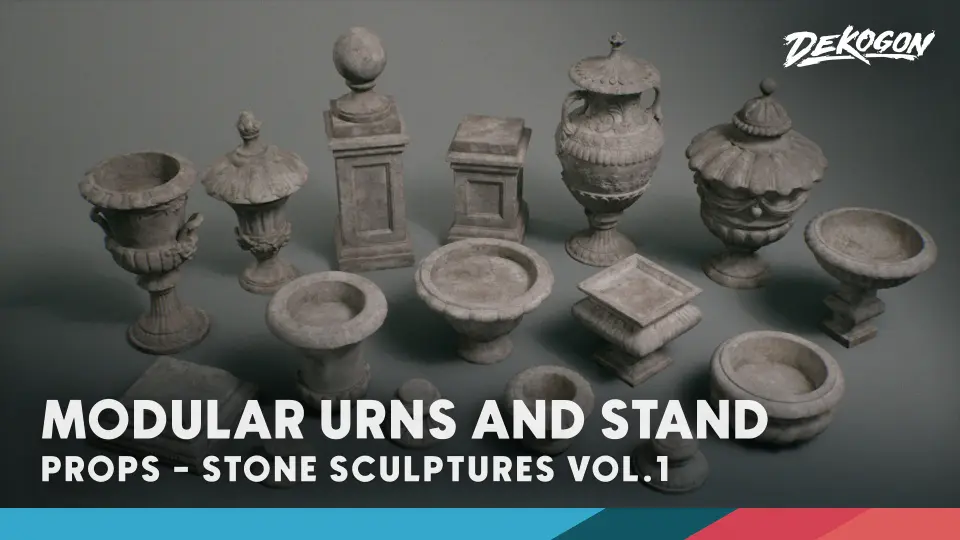
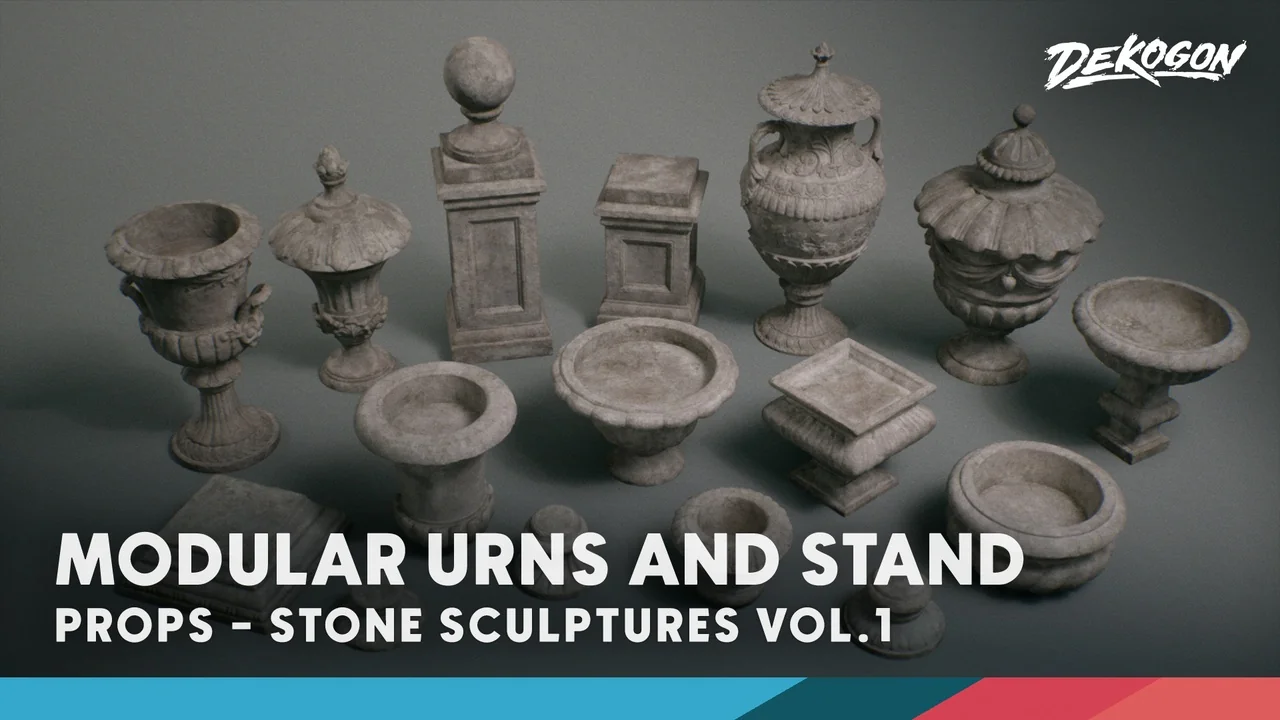
Exterior set dressing often demands a difficult compromise between micro-surface detail and rendering performance. Decorative stone elements—such as classical urns, heavy concrete pedestals, and weathered cemetery plinths—feature deep relief carving, edge chipping, and subtle surface grain that collapse into muddy normal-map artifacts when viewed up close. Stone Sculptures VOL.l - Modular Urns & Stand solves this production bottleneck by offering two distinct asset pipelines in a single Unreal Engine project: dense, high-poly geometry built for Nanite alongside fully baked, optimized low-poly meshes.
Dual Geometry Paths: Nanite Sculptures and Optimized Low-Poly Meshes
The library provides 38 individual meshes engineered to meet differing technical constraints across modern game development. Rather than locking teams into a single rendering philosophy, each sculptural element exists in two structural configurations.
The Nanite variations maintain uncapped geometric fidelity. Complex lip profiles on urns, fluted stone pedestal stems, and heavy sculpted decorative moldings carry their form directly in polygons. When cameras sweep close to these assets in cinematic sequences or third-person exploration, silhouettes remain round and physically accurate without popping through traditional level-of-detail transitions. Because every model is fully authored on all sides, environment artists can place them away from boundary walls, elevate them on ledges, or knock them over in ruined spaces without exposing unmodeled backs or hollow geometry.
Parallel to the high-density meshes, the collection provides dedicated low-poly renditions of every sculpt. These meshes bypass Nanite requirements entirely, utilizing flat-baked texture sets made for conventional real-time rendering pipelines. For background set dressing, mobile deployment, or platforms bound by tight primitive counts, these lightweight variants reproduce the silhouette and primary surface volumes of the high-poly originals while maintaining predictable, minimal overhead.
Layered PBR Materials and 4K Texture Packing
Realistic stone requires nuanced material behavior that responds accurately to grazing light angles, grime accumulation, and weathering. To preserve texture sharpness at extreme close-up distances, the project implements a material layering workflow developed by Clinton Crumpler, working with texture masks and sculpt meshes created by Daniela Ontiveros and Celia Delago.
Instead of relying entirely on static, singular baked texture sheets that stretch across large surface areas, the master material graph blends high-resolution tileable stone and concrete textures through custom-authored masks. This structure allows fine grain, surface pitting, and porosity to hold crisp resolution even when an urn dominates the viewport. Artists retain pinpoint control over edge wear, surface color, moss or moisture gradients, and roughness balance without needing to repaint unique 4K maps externally.
For runtime memory efficiency, the project organizes surface data through channel-packed textures. Roughness, metalness, and ambient occlusion are combined into unified texture channels (RMA). This channel packing minimizes texture sampler usage in the engine's shading stages and reduces runtime memory footprints. For instances where shader complexity must be reduced to absolute minimums, simpler baked material setups are also provided, bypassing complex layering in favor of straightforward, direct texture assignments.
Modular Urns and Stands in Exterior Environments
The individual components are organized as modular building blocks suitable for classical, historical, and post-classical architectural contexts. Courtyards, formal palace gardens, municipal squares, neoclassical entranceways, and overgrown cemeteries rely heavily on repeatable stonework that can be assembled without creating noticeable visual duplication.
Because urns, pottery vessels, and supporting stands are decoupled into individual modular meshes, artists can combine different vessels with varying plinth heights and profiles. A wide, shallow stone basin can rest on a short square block or be elevated on an ornate classical pedestal to demarcate patio boundaries. In municipal or academic settings, such as environments built alongside the Meridian 1988: Cedar Point School modular collection, these urns function as formal landscaping boundaries, flanking exterior stairwells or anchoring central walkways.
All decorative emblems, crests, and surface markings across the collection are custom-designed by the studio. By eliminating real-world architectural trademarks, institutional crests, and copyrighted iconography, the assets are clean of legal entanglements and ready for direct commercial deployment.
Lumen Dynamic Lighting Scene and Production Setup
Evaluating how stone responds to natural bounce light is critical during environment assembly. The collection ships with a preconfigured dynamic lighting scene built to showcase the assets under Unreal Engine 5.0+ illumination systems, with native support for Lumen dynamic global illumination and reflections.
Intricate stone carvings present unique challenges for global illumination solvers; deep crevices must self-shadow accurately without muddy light leaks, while upward-facing stone lips should catch and bounce indirect sky light into lower basin curves. The included dynamic test scene demonstrates these exact lighting interactions alongside a tuned post-process volume. Artists can inspect the interaction between Lumen bounce rays, dynamic directional sunlight, and the micro-roughness of the concrete surfaces before integrating the props into larger level builds.
Supported by Epic Games MegaGrants, the asset pack delivers a complete, production-tested pipeline that unifies high-end Nanite geometry, layered PBR shaders, and performant low-poly fallbacks across a tightly focused library of classical architectural props.
 Rocks & Stones
 Rocks & Stones
 Rocks & Stones
 Rocks & Stones