"6c6413bef81af556"{"id":"1000825","slug":"fences-vol-4-old-fences-modular-nanite-and-low-poly","title":"Fences VOL.4 - Old Fences Modular (Nanite and Low Poly)","category":"Railings \u0026 Fences","engine":"5.1+","assetVersion":"","engineVersion":"Engine Version: 5.1+","tag":"Railings \u0026 Fences","accent":"blue","visual":"mech","summary":"Modular old fence pack for Unreal Engine 5.0+ with 114 Nanite and low poly meshes, 4k textures, tintable materials, and Lumen support for AAA scenes.","platform":"Unreal Engine","publishedAt":"2026-08-01T13:32:42.101Z","updatedAt":"2026-08-01T13:32:42.101Z","sourceNotes":[],"fileContents":[],"compatibility":["Unreal Engine","Engine Version: 5.1+"],"featuredImage":{"alt":"Fences VOL.4 - Old Fences Modular (Nanite and Low Poly)","src":"/wp-content/uploads/published/2026/08/75b50f7705c0-f4b7406f-4829-4ec1-af8b-e83a8ca55bcb-c48e128b97.webp"},"hasDownloadLink":true,"downloads":1,"terms":[{"taxonomy":"category","slug":"railings-and-fences","name":"Railings \u0026 Fences"}],"galleryImages":[{"src":"/wp-content/uploads/published/2026/08/e16918d3bdd8-467b7f6b-47bb-42d8-85bf-e737f1fd7e61-b3df2a0fd5.webp","alt":"Fences VOL.4 - Old Fences Modular (Nanite and Low Poly)"},{"src":"/wp-content/uploads/published/2026/08/2de9445f427a-938c82c4-4fbe-42e1-a58f-954601feaad7-9c6d7ef4d7.webp","alt":"Fences VOL.4 - Old Fences Modular (Nanite and Low Poly)"},{"src":"/wp-content/uploads/published/2026/08/057688ca8947-9878d3a8-7bf8-49a9-becc-4ce5154f5ddf-143cbd3541.webp","alt":"Fences VOL.4 - Old Fences Modular (Nanite and Low Poly)"},{"src":"/wp-content/uploads/published/2026/08/68135aff34bb-8c3947c9-5f1e-4beb-befd-39c7e7707dd6-86e26f5df7.webp","alt":"Fences VOL.4 - Old Fences Modular (Nanite and Low Poly)"},{"src":"/wp-content/uploads/published/2026/08/0f14b6842cf8-f8d6b7f2-238b-41da-99ed-681aa0b31fea-4e3d535ba5.webp","alt":"Fences VOL.4 - Old Fences Modular (Nanite and Low Poly)"},{"src":"/wp-content/uploads/published/2026/08/851312785983-05ba0228-8639-4db6-a107-24a227e34a88-7132f666c4.webp","alt":"Fences VOL.4 - Old Fences Modular (Nanite and Low Poly)"},{"src":"/wp-content/uploads/published/2026/08/5891d4adc580-14c5b77e-69fc-45cc-8d30-556124492fe6-c559c1ea97.webp","alt":"Fences VOL.4 - Old Fences Modular (Nanite and Low Poly)"},{"src":"/wp-content/uploads/published/2026/08/3e81df404bf5-fd97b03a-3d9d-45e0-bf90-c36ace609070-8d3a360861.webp","alt":"Fences VOL.4 - Old Fences Modular (Nanite and Low Poly)"},{"src":"/wp-content/uploads/published/2026/08/1a5ea870f50e-28fa6251-974d-40ae-b19e-ee65a45a3569-66b98e2939.webp","alt":"Fences VOL.4 - Old Fences Modular (Nanite and Low Poly)"},{"src":"/wp-content/uploads/published/2026/08/4f29fbe1ef4a-456d2090-1134-4c44-a31f-3e597b149651-518c28290e.webp","alt":"Fences VOL.4 - Old Fences Modular (Nanite and Low Poly)"}],"accessPanel":{"kind":"resource","title":"Download this resource","eyebrow":"Free Download","message":"Log in or create a free account to start your download.","fileName":"Content.7z","safetyNote":"Resources are manually reviewed before listing to improve quality and reduce obvious risks.","actionLabel":"Download Free","resourceType":"Resource archive"},"contentHtml":"\u003cp\u003eEnvironments that lean into age and disrepair need boundary structures that do the heavy lifting visually without forcing an artist to hand-place every plank. A weathered property line, a makeshift blockade, or a chain-link perimeter separating a suburban lot from an abandoned urban corridor can quickly tell a story before a single character enters the frame. \u003cem\u003eFences VOL.4 - Old Fences Modular (Nanite and Low Poly)\u003c/em\u003e supplies exactly that layer of environmental dressing for creators working in Unreal Engine.\u003c/p\u003e\n\n\u003cp\u003eThe pack carries a tag set that reads as a map of suitable contexts: \u003cem\u003ePostapocalyptic\u003c/em\u003e, \u003cem\u003eSuburban\u003c/em\u003e, \u003cem\u003eBlockade\u003c/em\u003e, \u003cem\u003eMetal\u003c/em\u003e, \u003cem\u003eTown\u003c/em\u003e, \u003cem\u003eOld\u003c/em\u003e, \u003cem\u003eWooden\u003c/em\u003e, \u003cem\u003eUrban\u003c/em\u003e, \u003cem\u003eProp\u003c/em\u003e, \u003cem\u003eFence\u003c/em\u003e, \u003cem\u003eDebris\u003c/em\u003e, and \u003cem\u003eCity\u003c/em\u003e. Those labels point toward scene types where edges and borders carry the tension. A suburban street quietly falling into ruin needs fences that look like they have stood through decades of exposure. An urban blockade requires metalwork and debris-strewn barriers. The asset set is built to slide into those visual contexts comfortably because the structural identity of the meshes is tied to age and wear rather than a singular theme.\u003c/p\u003e\n\n\u003ch2\u003eScene Composition with 114 Modular Fence Meshes\u003c/h2\u003e\n\u003cp\u003eThe functional core of the project is its adherence to grid-based modularity. Every mesh snaps to a standard grid measurement, which means a creator can assemble perimeter runs of arbitrary length, configure corner connections, and build custom enclosures without battling geometry misalignment. Because the pack is fully modular on the grid, a single artist can block out a large residential or municipal area quickly using the same repeated pieces and still arrive at a layout that does not obviously repeat itself.\u003c/p\u003e\n\n\u003cp\u003eThe mesh count totals 114 pieces. That number breaks down evenly into 57 low-poly meshes and 57 Nanite counterparts. Each piece has a paired low-fidelity version for distant rendering or performance-saving deployment, and a Nanite version for instances where extreme close-up fidelity is a priority. The low-poly versions can stand in for background geometry in large open-world layouts, while the Nanite variants serve hero shots or scenes where the camera moves close to the fencing.\u003c/p\u003e\n\n\u003cp\u003eBeing fully detailed from all sides is a property that matters more than it initially seems. Fences are typically positioned along the edges of a playable area or a camera frustum. Characters, vehicles, or cameras can easily end up viewing a fence from an unintended angle. While many modular kits only detail the outward-facing side of a structure, ensuring these models are sculpted to look correct from any viewing angle prevents breaking immersion during gameplay.\u003c/p\u003e\n\n\u003ch3\u003eRealistic Materials and Channel-Packed Texture Workflows\u003c/h3\u003e\n\u003cp\u003eBeyond the geometry, the visual weight of aging metal and worn wood is carried by the material system. The pack includes high-quality and high-fidelity 4K texture sets, providing the detail density demanded for realistic rendering in tight scenes. The Master Material setup is built to control the majority of the included props and models. Instead of handling every fence segment as a unique shader with fixed parameters, a centralized Master Material drives the surface response across the set.\u003c/p\u003e\n\n\u003cp\u003eExposing controls for Roughness, Albedo, Normals, and other surface traits allows technical artists to dial in the look of a barrier to its surroundings. A fence catching harsh midday sun in a dry location can have its roughness adjusted to gleam slightly differently than the same mesh placed in a damp, overgrown alleyway. The shader handles a channel-packed map combining Roughness, Metallic, and Ambient Occlusion (AO), which streamlines the texturing pipeline by keeping related data in a single sampler space.\u003c/p\u003e\n\n\u003cp\u003eFor fences that feature painted surfaces, the shader includes tinting controls accessible through the Material Instance for each corresponding part. A painted metal panel can be shifted from a faded municipal red to a peeling institutional green, giving an environment artist the freedom to color-code zones without needing entirely new texture files. Because the branding and labels included in the pack are custom-made by the studio, entirely custom in-house artwork keeps the assets free of legal complications regarding copyrighted or trademarked logos.\u003c/p\u003e\n\n\u003ch2\u003eTechnical Integration in Unreal Engine 5.0+\u003c/h2\u003e\n\u003cp\u003eThe project is explicitly engineered for Unreal Engine 5.0+, leaning heavily into the modern rendering features of the engine. Nanite support means the high-fidelity versions of the meshes are capable of handling immense polygon counts directly in-engine without overwhelming the rendering thread. This system is completely compatible with the Lumen Global Illumination system as well. Fences built with Nanite can capture bounce lighting from their surroundings in real time, meaning the grimy shadows cast by a metal grating or the light spilling through broken wooden slats reacts dynamically to the environment's changing light conditions.\u003c/p\u003e\n\n\u003cp\u003eBecause Nanite handles one part of the pipeline, the included low-poly versions ensure compatibility and performance in scenarios where Nanite might not be the desired workflow for a specific project or platform. Having both versions gives a developer the option to use the high poly counts for cinematic shots or specialized scenes, while swapping to the low-poly models for intensive gameplay sequences or distant world streaming.\u003c/p\u003e\n\n\u003cp\u003eShipping with a realistic Post-Process and Look-Up Table (LUT) setup included in the pack provides a starting point for color grading a scene. This is particularly useful when attempting to match the mood of a post-apocalyptic or decaying urban boundary to the rest of a level. Optimization for games is maintained throughout the asset construction, ensuring the models and materials are not simply high-quality render showpieces but functional elements inside a real-time environment.\u003c/p\u003e\n\n\u003ch3\u003eExpanding Environments with Dekogon Studios Assets\u003c/h3\u003e\n\u003cp\u003eThe visual identity of the set traces back to Dekogon Studios, a studio operation known for creating coherent asset libraries compatible with Unreal Engine projects. The fences here are part of a broader modular catalog, noted for fitting neatly with related modular environments like \u003cem\u003eMeridian 1988: Cedar Point School - Modular Environment\u003c/em\u003e. A creator building out a large decaying world can use these boundaries to wrap around or section off larger architectural kits without encountering clashes in scale or art direction.\u003c/p\u003e\n\n\u003cp\u003eThe connection to larger modular building sets extends the utility of the fence pack significantly. Rather than solely acting as standalone prop additions, the grid-snapping boundaries are meant to scale directly alongside other architectural elements. Fencing can be run alongside suburban building footprints, enclosing yards and empty lots adjacent to school structures or town buildings. Because the art style of the fences is grounded in realistic AAA quality rather than a stylized approach, they blend invisibly into large-scale realistic urban or suburban decay projects.\u003c/p\u003e\n\n\u003ch2\u003ePractical Use of Tintable Painted Surfaces\u003c/h2\u003e\n\u003cp\u003eThe tintable nature of painted assets via the Material Instances opens up quick prototyping paths for level designers making distinct gameplay zones. Color in environment design often serves a functional purpose beyond aesthetics. A specific tint on a boundary fence can subliminally communicate to a player that an area is off-limits, dangerous, or controlled by a specific faction. Using the Material Instances provided with the set, changing colors across a row of fences to differentiate zones is a fast, non-destructive workflow.\u003c/p\u003e\n\n\u003ch3\u003eProject Fit and Pipeline Considerations\u003c/h3\u003e\n\u003cp\u003eWhen deciding if this pack fits a specific project, the core question comes down to the scene's visual language. Projects requiring the realistic staging of dilapidated boundaries and worn barriers in Unreal Engine 5.0+ will find the mesh count and texture resolution directly aligned with those needs. Ensuring both Nanite and low-poly variants exist enables teams to upscale or downscale performance on the fly. The standardized Master Material setup means integrating these into existing scenes requires less bespoke shader work. For anyone constructing suburban ruins, abandoned city blocks, or structured post-apocalyptic perimeters, having an organized library of weathered boundaries built for Lumen and Nanite is a solid foundation to build a scene perimeter with.\u003c/p\u003e\n\n\u003ch2\u003eMore From The Same Workflow\u003c/h2\u003e\n\u003cul\u003e\n\u003cli\u003e\u003ca href=\"https://3dcghub.com/realistic-rock-set-01-nanite-and-low-poly/\" title=\"Realistic Rock Set 01(Nanite and Low Poly)\"\u003eRealistic Rock Set 01(Nanite and Low Poly)\u003c/a\u003e\u003c/li\u003e\n\u003cli\u003e\u003ca href=\"https://3dcghub.com/vehicles-vol-9-future-cars-low-poly/\" title=\"Vehicles VOL.9- Future Cars (Low Poly)\"\u003eVehicles VOL.9- Future Cars (Low Poly)\u003c/a\u003e\u003c/li\u003e\n\u003cli\u003e\u003ca href=\"https://3dcghub.com/foliage-vol-27-beach-grass-low-poly/\" title=\"Foliage VOL.27 - Beach Grass (Low Poly)\"\u003eFoliage VOL.27 - Beach Grass (Low Poly)\u003c/a\u003e\u003c/li\u003e\n\u003cli\u003e\u003ca href=\"https://3dcghub.com/scans-vol-2-clothes-nanite-and-low-poly/\" title=\"Scans VOL.2 - Clothes (Nanite \u0026amp; Low Poly)\"\u003eScans VOL.2 - Clothes (Nanite \u0026amp; Low Poly)\u003c/a\u003e\u003c/li\u003e\n\u003cli\u003e\u003ca href=\"https://3dcghub.com/restaurant-vol-3-dining-decor-nanite-and-low-poly/\" title=\"Restaurant VOL.3 - Dining Decor (Nanite and Low Poly)\"\u003eRestaurant VOL.3 - Dining Decor (Nanite and Low Poly)\u003c/a\u003e\u003c/li\u003e\n\u003c/ul\u003e","contentTextLength":8680,"navigation":{"current":399,"total":3140,"previous":{"id":"1000826","slug":"fighter-template","title":"Fighter Template","category":"Fighting","platform":"Unreal Engine","updatedAt":"2026-08-01T14:23:21.048Z"},"next":{"id":"1000824","slug":"fences-and-gates-vol-2","title":"Fences and Gates - VOL.2","category":"Walls","platform":"Unreal Engine","updatedAt":"2026-08-01T13:22:40.513Z"}},"relatedResources":[{"id":"1001066","slug":"roadside-vol-1-blockades-nanite-and-low-poly-versions-2","title":"Roadside VOL.1 - Blockades (Nanite and Low Poly Versions)","category":"Rocks \u0026 Stones","engine":"5.1+","assetVersion":"","engineVersion":"Engine Version: 5.1+","tag":"Rocks \u0026 Stones","accent":"blue","visual":"mech","summary":"32 roadside blockades in nanite and low poly builds, 4k textures, master materials, tintable paint, and Lumen support for UE5.","platform":"Unreal Engine","publishedAt":"2026-09-03T16:20:18.807Z","updatedAt":"2026-09-03T16:20:18.807Z","sourceNotes":[],"fileContents":[],"compatibility":["Unreal Engine","Engine Version: 5.1+"],"featuredImage":{"alt":"Roadside VOL.1 - Blockades (Nanite and Low Poly Versions)","src":"/wp-content/uploads/published/2026/09/7e32db5224fe-4e57f163-4d06-4444-ac91-032f3e20b6ac-0c5421b26d.webp"},"hasDownloadLink":true,"downloads":1},{"id":"1000709","slug":"vehicles-vol-9-future-cars-low-poly","title":"Vehicles VOL.9- Future Cars (Low Poly)","category":"Cars \u0026 Trucks","engine":"5.3+","assetVersion":"","engineVersion":"Engine Version: 5.3+","tag":"Cars \u0026 Trucks","accent":"blue","visual":"mech","summary":"Seven futuristic low-poly car props with 4K textures, channel-packed maps, tintable paint, and Lumen support for Unreal Engine 5.0+.","platform":"Unreal Engine","publishedAt":"2026-07-24T02:11:02.648Z","updatedAt":"2026-07-24T02:11:02.648Z","sourceNotes":[],"fileContents":[],"compatibility":["Unreal Engine","Engine Version: 5.3+"],"featuredImage":{"alt":"Vehicles VOL.9- Future Cars (Low Poly)","src":"/wp-content/uploads/published/2026/07/1299c7959656-ce73ca95-e379-4b7d-9098-f38abd0ef20e-72885a4f92.webp"},"hasDownloadLink":true,"downloads":1},{"id":"1000706","slug":"realistic-rock-set-01-nanite-and-low-poly","title":"Realistic Rock Set 01(Nanite and Low Poly)","category":"Rocks \u0026 Stones","engine":"5.0+","assetVersion":"","engineVersion":"Engine Version: 5.0+","tag":"Rocks \u0026 Stones","accent":"blue","visual":"mech","summary":"10 realistic Nanite and low-poly rocks with shader-driven subsurface blending, RVT support, and high-quality PBR textures for game, VR, and cinematic scenes.","platform":"Unreal Engine","publishedAt":"2026-07-24T01:44:31.024Z","updatedAt":"2026-07-24T01:50:37.535Z","sourceNotes":[],"fileContents":[],"compatibility":["Unreal Engine","Engine Version: 5.0+"],"featuredImage":{"alt":"Realistic Rock Set 01(Nanite and Low Poly)","src":"/wp-content/uploads/published/2026/07/0323084ddd3b-082365da-31dc-429c-bb6c-38a2b32299d8-319d401913.webp"},"hasDownloadLink":true,"downloads":1}]}
Railings & Fences
Fences VOL.4 - Old Fences Modular (Nanite and Low Poly)
Modular old fence pack for Unreal Engine 5.0+ with 114 Nanite and low poly meshes, 4k textures, tintable materials, and Lumen support for AAA scenes.
Environments that lean into age and disrepair need boundary structures that do the heavy lifting visually without forcing an artist to hand-place every plank. A weathered property line, a makeshift blockade, or a chain-link perimeter separating a suburban lot from an abandoned urban corridor can quickly tell a story before a single character enters the frame. Fences VOL.4 - Old Fences Modular (Nanite and Low Poly) supplies exactly that layer of environmental dressing for creators working in Unreal Engine.
The pack carries a tag set that reads as a map of suitable contexts: Postapocalyptic, Suburban, Blockade, Metal, Town, Old, Wooden, Urban, Prop, Fence, Debris, and City. Those labels point toward scene types where edges and borders carry the tension. A suburban street quietly falling into ruin needs fences that look like they have stood through decades of exposure. An urban blockade requires metalwork and debris-strewn barriers. The asset set is built to slide into those visual contexts comfortably because the structural identity of the meshes is tied to age and wear rather than a singular theme.
Scene Composition with 114 Modular Fence Meshes
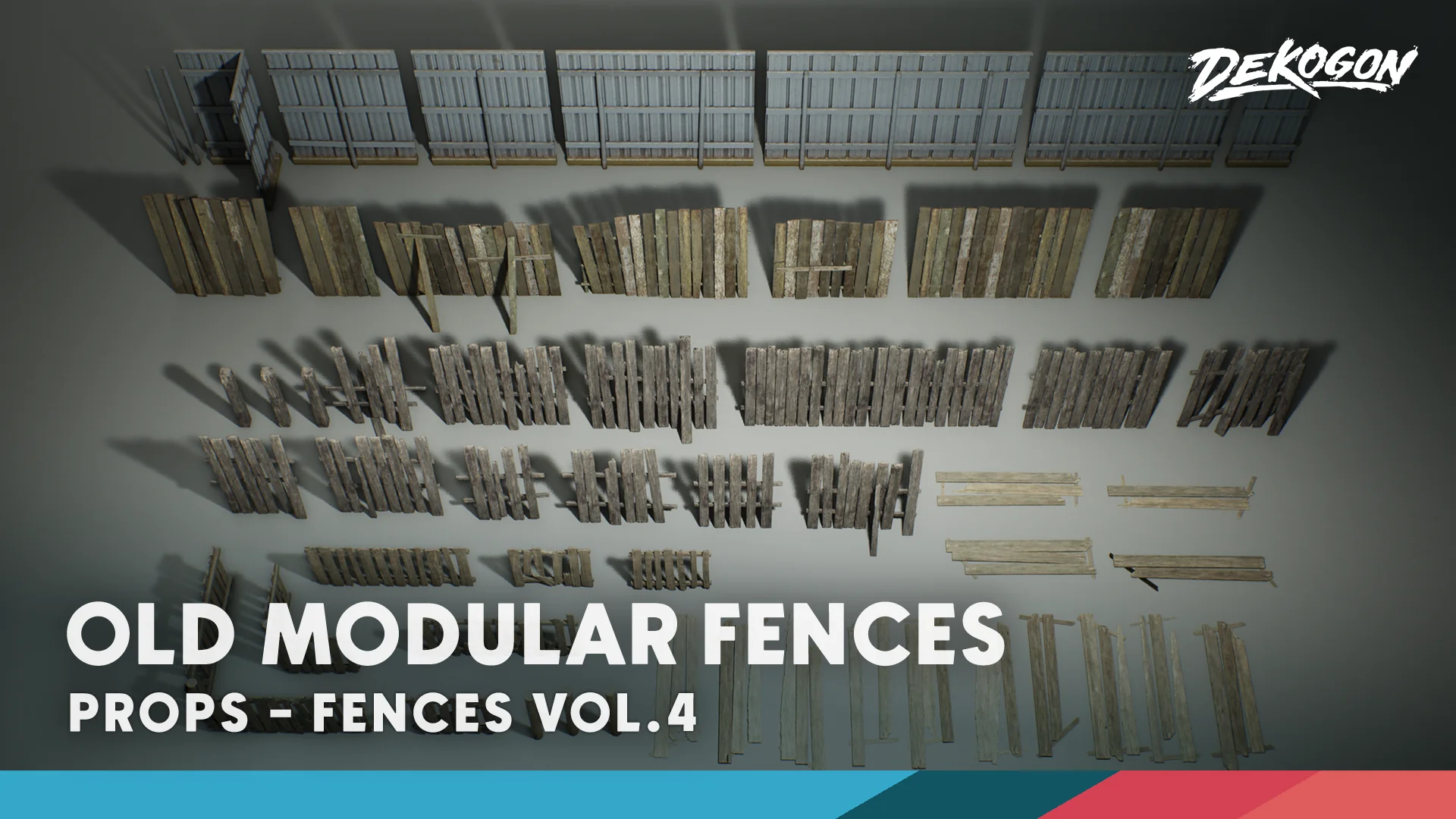
The functional core of the project is its adherence to grid-based modularity. Every mesh snaps to a standard grid measurement, which means a creator can assemble perimeter runs of arbitrary length, configure corner connections, and build custom enclosures without battling geometry misalignment. Because the pack is fully modular on the grid, a single artist can block out a large residential or municipal area quickly using the same repeated pieces and still arrive at a layout that does not obviously repeat itself.
The mesh count totals 114 pieces. That number breaks down evenly into 57 low-poly meshes and 57 Nanite counterparts. Each piece has a paired low-fidelity version for distant rendering or performance-saving deployment, and a Nanite version for instances where extreme close-up fidelity is a priority. The low-poly versions can stand in for background geometry in large open-world layouts, while the Nanite variants serve hero shots or scenes where the camera moves close to the fencing.
Being fully detailed from all sides is a property that matters more than it initially seems. Fences are typically positioned along the edges of a playable area or a camera frustum. Characters, vehicles, or cameras can easily end up viewing a fence from an unintended angle. While many modular kits only detail the outward-facing side of a structure, ensuring these models are sculpted to look correct from any viewing angle prevents breaking immersion during gameplay.
Realistic Materials and Channel-Packed Texture Workflows
Beyond the geometry, the visual weight of aging metal and worn wood is carried by the material system. The pack includes high-quality and high-fidelity 4K texture sets, providing the detail density demanded for realistic rendering in tight scenes. The Master Material setup is built to control the majority of the included props and models. Instead of handling every fence segment as a unique shader with fixed parameters, a centralized Master Material drives the surface response across the set.
Exposing controls for Roughness, Albedo, Normals, and other surface traits allows technical artists to dial in the look of a barrier to its surroundings. A fence catching harsh midday sun in a dry location can have its roughness adjusted to gleam slightly differently than the same mesh placed in a damp, overgrown alleyway. The shader handles a channel-packed map combining Roughness, Metallic, and Ambient Occlusion (AO), which streamlines the texturing pipeline by keeping related data in a single sampler space.
For fences that feature painted surfaces, the shader includes tinting controls accessible through the Material Instance for each corresponding part. A painted metal panel can be shifted from a faded municipal red to a peeling institutional green, giving an environment artist the freedom to color-code zones without needing entirely new texture files. Because the branding and labels included in the pack are custom-made by the studio, entirely custom in-house artwork keeps the assets free of legal complications regarding copyrighted or trademarked logos.
Technical Integration in Unreal Engine 5.0+
The project is explicitly engineered for Unreal Engine 5.0+, leaning heavily into the modern rendering features of the engine. Nanite support means the high-fidelity versions of the meshes are capable of handling immense polygon counts directly in-engine without overwhelming the rendering thread. This system is completely compatible with the Lumen Global Illumination system as well. Fences built with Nanite can capture bounce lighting from their surroundings in real time, meaning the grimy shadows cast by a metal grating or the light spilling through broken wooden slats reacts dynamically to the environment's changing light conditions.
Because Nanite handles one part of the pipeline, the included low-poly versions ensure compatibility and performance in scenarios where Nanite might not be the desired workflow for a specific project or platform. Having both versions gives a developer the option to use the high poly counts for cinematic shots or specialized scenes, while swapping to the low-poly models for intensive gameplay sequences or distant world streaming.
Shipping with a realistic Post-Process and Look-Up Table (LUT) setup included in the pack provides a starting point for color grading a scene. This is particularly useful when attempting to match the mood of a post-apocalyptic or decaying urban boundary to the rest of a level. Optimization for games is maintained throughout the asset construction, ensuring the models and materials are not simply high-quality render showpieces but functional elements inside a real-time environment.
Expanding Environments with Dekogon Studios Assets
The visual identity of the set traces back to Dekogon Studios, a studio operation known for creating coherent asset libraries compatible with Unreal Engine projects. The fences here are part of a broader modular catalog, noted for fitting neatly with related modular environments like Meridian 1988: Cedar Point School - Modular Environment. A creator building out a large decaying world can use these boundaries to wrap around or section off larger architectural kits without encountering clashes in scale or art direction.
The connection to larger modular building sets extends the utility of the fence pack significantly. Rather than solely acting as standalone prop additions, the grid-snapping boundaries are meant to scale directly alongside other architectural elements. Fencing can be run alongside suburban building footprints, enclosing yards and empty lots adjacent to school structures or town buildings. Because the art style of the fences is grounded in realistic AAA quality rather than a stylized approach, they blend invisibly into large-scale realistic urban or suburban decay projects.
Practical Use of Tintable Painted Surfaces
The tintable nature of painted assets via the Material Instances opens up quick prototyping paths for level designers making distinct gameplay zones. Color in environment design often serves a functional purpose beyond aesthetics. A specific tint on a boundary fence can subliminally communicate to a player that an area is off-limits, dangerous, or controlled by a specific faction. Using the Material Instances provided with the set, changing colors across a row of fences to differentiate zones is a fast, non-destructive workflow.
Project Fit and Pipeline Considerations
When deciding if this pack fits a specific project, the core question comes down to the scene's visual language. Projects requiring the realistic staging of dilapidated boundaries and worn barriers in Unreal Engine 5.0+ will find the mesh count and texture resolution directly aligned with those needs. Ensuring both Nanite and low-poly variants exist enables teams to upscale or downscale performance on the fly. The standardized Master Material setup means integrating these into existing scenes requires less bespoke shader work. For anyone constructing suburban ruins, abandoned city blocks, or structured post-apocalyptic perimeters, having an organized library of weathered boundaries built for Lumen and Nanite is a solid foundation to build a scene perimeter with.
 Railings & Fences
 Rocks & Stones
 Cars & Trucks
 Rocks & Stones