"6ac84fdb0bd06614"{"id":"1000148","slug":"animalia-starter-kit","title":"Animalia - Starter Kit","category":"Animals","engine":"4.26+,5.0+","assetVersion":"","engineVersion":"Engine Version: 4.26+,5.0+","tag":"Animals","accent":"blue","visual":"mech","summary":"A realistic animal collection with wolf, bear, deer, bison, fox, raccoon, rat, and spider, plus 60 fps animations, LODs, rigs, and ragdoll setup.","platform":"Unreal Engine","publishedAt":"2026-06-18T06:51:43.125Z","updatedAt":"2026-06-18T06:51:43.125Z","sourceNotes":[],"fileContents":[],"compatibility":["Unreal Engine","Engine Version: 4.26+,5.0+"],"featuredImage":{"alt":"Animalia - Starter Kit","src":"/wp-content/uploads/published/2026/06/90300ad7fb09-4fd5f68f-b049-4ce5-817f-9329d0fa1a81-c5c9da4cfa.webp"},"hasDownloadLink":true,"downloads":0,"terms":[{"taxonomy":"category","slug":"animals","name":"Animals"}],"galleryImages":[{"src":"/wp-content/uploads/published/2026/06/669e01059771-25dc0547-d5d3-4bb8-8b53-35b1356a7720-3feeb22b8b.webp","alt":"Animalia - Starter Kit"},{"src":"/wp-content/uploads/published/2026/06/333f7b7c81ec-dea19325-9cac-4d28-a08e-1d4c743046b1-c43d65f306.webp","alt":"Animalia - Starter Kit"},{"src":"/wp-content/uploads/published/2026/06/88569af8f170-56d84d57-58c6-4d10-b79d-852f16b18662-d5037ffd1e.webp","alt":"Animalia - Starter Kit"},{"src":"/wp-content/uploads/published/2026/06/3e9fca664cd2-9c5a714a-2dfb-4ed3-a48b-853fb8a5f646-15e0285b77.webp","alt":"Animalia - Starter Kit"},{"src":"/wp-content/uploads/published/2026/06/adc74809009b-67ed0101-aa8a-456c-95fa-59c6d474fad7-e594ac5543.webp","alt":"Animalia - Starter Kit"},{"src":"/wp-content/uploads/published/2026/06/78f5e718a3d2-c97926d5-c738-49e7-96e8-faa8462f046c-ca87acc175.webp","alt":"Animalia - Starter Kit"},{"src":"/wp-content/uploads/published/2026/06/06fe05f1f250-c32c1c01-4e72-4059-a8dc-974533c20220-a5523676ac.webp","alt":"Animalia - Starter Kit"},{"src":"/wp-content/uploads/published/2026/06/ea2adf664cfa-59909d05-e0e3-4699-ac2c-f202e2638280-31c6d4510e.webp","alt":"Animalia - Starter Kit"},{"src":"/wp-content/uploads/published/2026/06/c92feb1687a5-5eb0c45e-5791-4eb7-beee-7b880af01fc3-f133ccd0b8.webp","alt":"Animalia - Starter Kit"},{"src":"/wp-content/uploads/published/2026/06/df5754e7e2fb-3c588f76-9fc6-417c-8370-fed87ddeff2f-0dfe25384e.webp","alt":"Animalia - Starter Kit"}],"accessPanel":{"kind":"resource","title":"Download this resource","eyebrow":"Free Download","message":"Log in or create a free account to start your download.","fileName":"Content.7z","safetyNote":"Resources are manually reviewed before listing to improve quality and reduce obvious risks.","actionLabel":"Download Free","resourceType":"Resource archive"},"contentHtml":"\u003cp\u003eAnimalia - Starter Kit suits projects that need wildlife to feel like part of the world rather than background decoration. With a realistic Gray Wolf, Brown Bear, Red Deer, American Bison, Fox, Raccoon, Rat, and Spider, it gives artists and developers a spread of animals that can shape very different kinds of scenes: a quiet woodland path, a tense encounter in brushland, a scavenger-filled camp perimeter, or a more stylized survival setup where animal presence drives atmosphere as much as gameplay.\u003c/p\u003e\n\u003cp\u003eThe set leans into variety without leaving realism behind. Large animals such as the wolf, bear, deer, and bison can define the visual identity of a level on their own, while the fox, raccoon, rat, and spider bring smaller points of motion and detail that help environments feel inhabited. That contrast is one of the pack’s strongest creative advantages. It supports the broad silhouette and weight of major wildlife alongside smaller creatures that can add unease, opportunism, or subtle life to the edges of a scene.\u003c/p\u003e \u003ch2\u003eGray Wolf, Brown Bear, Red Deer, and American Bison\u003c/h2\u003e\n\u003cp\u003eThe larger half of the collection is especially useful for scene-building because each animal suggests a different kind of presence. The male Gray Wolf reads as a predator and can anchor moments of pursuit, territorial movement, or watchful distance. The male Brown Bear brings mass and threat, which makes it effective when a scene needs something heavier and slower but still dangerous. The male Red Deer offers a different tone, more aligned with natural movement and open-ground visibility. The male American Bison adds bulk on an even larger scale, giving plains, forest clearings, or frontier-style spaces an animal that feels imposing before it even moves.\u003c/p\u003e\n\u003cp\u003eThose four animals also share the highest listed texture resolution in the set, with 4K textures for the wolf, bear, deer, and bison. They are also the animals that include bone meshes. Taken together, those details make them the most fully emphasized creatures in the pack, and they are the easiest place to start when a project needs hero wildlife that can hold up in closer views while still functioning as active animated characters.\u003c/p\u003e\n\u003cp\u003eBecause these animals sit in a realistic style, they can serve more than one role inside the same project. One scene might treat them as environmental storytelling, while another uses them as direct gameplay actors. A deer can establish calm or vulnerability in a landscape. A wolf can shift that same space toward tension. A bison can become the visual center of an open area, while a bear can turn an ordinary route into a hazard zone. The value here is not just the model list itself, but the way the list spans several recognizable wildlife roles without drifting away from a coherent visual direction.\u003c/p\u003e \u003ch2\u003eFox, Raccoon, Rat, and Spider in quieter or more uneasy spaces\u003c/h2\u003e\n\u003cp\u003eThe smaller creatures expand the set’s usefulness in a different direction. The male Fox and male Raccoon suit scenes that need animal activity without the weight of a major confrontation. They can make a level feel watched, foraged through, or naturally occupied. The rat pushes the pack toward tighter spaces and more neglected corners, while the spider brings a very different kind of creature presence, one that can shift a scene from simply natural to slightly unsettling.\u003c/p\u003e\n\u003cp\u003eThese four use 2K textures: fox, raccoon, rat, and spider. That gives the collection a clear split between the larger flagship mammals and the smaller supporting creatures. In practice, that makes sense for projects that want to populate a world with layers of life rather than repeating one kind of animal everywhere. A forest route can carry distant deer or bison presence, then gain local texture through a fox crossing, a raccoon near structures, a rat in lower-ground clutter, or a spider in darker interior or cave-like spaces.\u003c/p\u003e\n\u003cp\u003eThe creature selection also helps level pacing. Not every wildlife moment needs to be an encounter with a large quadruped. Smaller animals can be used to maintain movement and mood between bigger beats. That makes Animalia - Starter Kit useful not only for dramatic wilderness setups, but for slower environmental storytelling where animal behavior and placement help define the tone of a location.\u003c/p\u003e \u003ch2\u003e60 fps animation, root motion, and ragdoll setup\u003c/h2\u003e\n\u003cp\u003eAnimation support is one of the details that turns the pack from a collection of models into something more production-ready. Animations are authored at 60 fps, which gives movement a clear emphasis on fluid playback. For wildlife, that matters. Creatures are often judged less by static appearance than by the believability of their locomotion and body response. A realistic animal can lose impact quickly if its motion feels stiff or undersampled, so the 60 fps animation detail is a meaningful part of the kit’s identity.\u003c/p\u003e\n\u003cp\u003eAll animations are available with and without root motion. That gives developers a practical choice in how animal movement is integrated into a project. Some scenes benefit from movement driven directly through root motion, especially when the goal is to preserve a specific physical feel in traversal or attack timing. Other setups work better without it, particularly when animation needs to adapt to game logic or AI movement systems in a different way. Having both versions widens how the same creatures can be staged, from more cinematic pathing to gameplay-controlled movement.\u003c/p\u003e\n\u003cp\u003eThe pack also includes ragdoll setup. That matters most when animals are not just decorative but reactive. Whether a project is focused on encounters, simulation, or environmental interaction, ragdoll setup helps the animals participate in the world with a more complete physical response than a purely animated loop would allow. It is a support feature, but it changes how these creatures can be used in action scenes, aftermath moments, or systems that rely on physical state changes.\u003c/p\u003e \u003ch2\u003eGFur support, Maya and 3ds Max rigs, and LODs\u003c/h2\u003e\n\u003cp\u003eAnimalia - Starter Kit includes gFur support, which is especially relevant for a collection where fur-bearing animals make up most of the roster. Wolf, bear, deer, bison, fox, raccoon, and rat all benefit from that support in ways that connect directly to the pack’s realistic intent. Even without expanding beyond the stated detail, it is clear that fur handling is part of the workflow conversation here rather than an afterthought.\u003c/p\u003e\n\u003cp\u003eThe inclusion of Maya and 3ds Max animation rigs adds another practical layer. This is not only a set for dropping creatures into a level and leaving them untouched. It also speaks to teams or solo creators who want room to work with the animation side of the animals in established DCC pipelines. When a resource includes rigs for Maya and 3ds Max, it becomes easier to place it inside a broader character workflow instead of treating it as a closed package.\u003c/p\u003e\n\u003cp\u003eLODs are part of the set as well, which supports use across wider environments and varying camera distances. Wildlife often appears in scenes at more than one scale: very close during an encounter, mid-range while moving through terrain, or farther away as living set dressing. LODs help that range feel more manageable inside a project. For a kit anchored in multiple animals instead of one hero creature, that detail matters because it supports population and distance rather than only showcase framing.\u003c/p\u003e \u003ch2\u003eAnimalia - Starter Kit in Unreal Engine projects\u003c/h2\u003e\n\u003cp\u003eThe current changelog entry is version 2.5.0 for UE 4.24 and up, described as revamped for the latest standards. That places the pack within an Unreal Engine workflow while also indicating that it has been updated rather than left in an older state. Combined with gFur support, Animation Blueprint tagging, root motion options, rigs, and ragdoll setup, the collection reads as a wildlife-focused package that can contribute to both visual worldbuilding and interactive creature behavior.\u003c/p\u003e\n\u003cp\u003eThe tag set around buffalo, deer, raccoon, spider, wolf, rat, fox, fur, bear, animal, quadruped, creature, realistic, script, and Animation Blueprint gives a clear picture of where the resource sits. It is not a fantasy beast pack or an exaggerated stylized set. It is grounded wildlife with a mix of major quadrupeds and smaller supporting creatures, positioned for developers who want realistic animal presence and animation-ready characters inside Unreal Engine scenes.\u003c/p\u003e\n\u003cp\u003eFor projects that need one creature type only, this pack may still be useful because the major animals are distinct enough to stand on their own. For projects that need an ecosystem feel, the broader roster is where it becomes most effective. The combination of male Gray Wolf, male Brown Bear, male Red Deer, male American Bison, male Fox, male Raccoon, rat, and spider gives enough range to build spaces that feel occupied at different scales, from open wildlife territory to tighter, more uneasy corners.\u003c/p\u003e\n\u003cp\u003eIf the goal is to populate a realistic game world with animals that do more than idle in place, Animalia - Starter Kit fits best in scenes where movement, variety, and creature presence all matter at once.\u003c/p\u003e\n\n\u003ch2\u003eMore From The Same Workflow\u003c/h2\u003e\n\u003cul\u003e\n\u003cli\u003e\u003ca href=\"https://3dcghub.com/top-down-starter-kit-swvictoria/\" title=\"Top-Down Starter Kit [SWVictoria]\"\u003eTop-Down Starter Kit [SWVictoria]\u003c/a\u003e\u003c/li\u003e\n\u003cli\u003e\u003ca href=\"https://3dcghub.com/thief-simulator-starter-kit/\" title=\"Thief Simulator Starter Kit\"\u003eThief Simulator Starter Kit\u003c/a\u003e\u003c/li\u003e\n\u003cli\u003e\u003ca href=\"https://3dcghub.com/fps-game-starter-kit/\" title=\"FPS Game Starter Kit\"\u003eFPS Game Starter Kit\u003c/a\u003e\u003c/li\u003e\n\u003cli\u003e\u003ca href=\"https://3dcghub.com/space-game-starter-kit/\" title=\"Space Game Starter kit\"\u003eSpace Game Starter kit\u003c/a\u003e\u003c/li\u003e\n\u003cli\u003e\u003ca href=\"https://3dcghub.com/animal-pack-ultra-2/\" title=\"Animal Pack Ultra 2\"\u003eAnimal Pack Ultra 2\u003c/a\u003e\u003c/li\u003e\n\u003c/ul\u003e","contentTextLength":9228,"navigation":{"current":1137,"total":3181,"previous":{"id":"1000149","slug":"apocalypse-bundle","title":"Apocalypse - Bundle","category":"Military","platform":"Unreal Engine","updatedAt":"2026-06-18T07:52:08.720Z"},"next":{"id":"1000147","slug":"animalia-leopard-young","title":"Animalia - Leopard (young)","category":"Characters \u0026 Creatures","platform":"Unreal Engine","updatedAt":"2026-06-18T06:44:20.152Z"}},"relatedResources":[{"id":"1000912","slug":"animalia-raccoon","title":"Animalia - Raccoon","category":"Characters \u0026 Creatures","engine":"4.26+,5.0+","assetVersion":"","engineVersion":"Engine Version: 4.26+,5.0+","tag":"Characters","accent":"blue","visual":"character","summary":"Realistic raccoon with 60fps animations, 2K textures, gFur support, LODs, ragdoll setup, and a 3ds Max rig. Works with UE 4.24+ and the Animalia Starter Kit.","platform":"Unreal Engine","publishedAt":"2026-08-07T17:04:40.260Z","updatedAt":"2026-08-07T17:04:40.260Z","sourceNotes":[],"fileContents":[],"compatibility":["Unreal Engine","Engine Version: 4.26+,5.0+"],"featuredImage":{"alt":"Animalia - Raccoon","src":"/wp-content/uploads/published/2026/08/2674d40980b0-8799a4c5-7e67-49ed-88a6-836893685cf5-b83809c831.webp"},"hasDownloadLink":true,"downloads":0},{"id":"8044","slug":"top-down-starter-kit-swvictoria","title":"Top-Down Starter Kit [SWVictoria]","category":"Fantasy","engine":"4.26+,5.0+","assetVersion":"Engine version: 4.26+,5.0+","engineVersion":"4.22","tag":"Fantasy","accent":"blue","visual":"city","summary":"Jumpstart your game development journey with this comprehensive stylized environment kit. It features high-quality 3D models and interactive elements designed specifically for top-down RPG and RTS projects.","platform":"Unreal Engine","publishedAt":"2026-02-22T16:35:52.000Z","updatedAt":"2026-04-19T15:55:36.000Z","sourceNotes":[],"fileContents":[],"compatibility":["Unreal Engine","Engine version: 4.26+,5.0+"],"featuredImage":{"alt":"Top-Down Starter Kit [SWVictoria]","src":"https://3dcghub.com/wp-content/uploads/2026/02/7af10873-930d-482d-9504-21cd40863ffd.webp"},"hasDownloadLink":true,"downloads":0},{"id":"1001097","slug":"zombie-shooter-kit-v2-12-unreal-engine-5-starter-pack","title":"Zombie Shooter Kit v2.12 - UNREAL ENGINE 5 Starter Pack","category":"Shooter","engine":"5.7+","assetVersion":"Asset Version: 2.11","engineVersion":"Engine Version: 5.7+","tag":"Shooter","accent":"blue","visual":"mech","summary":"Blueprint-based UE5 starter for survival shooters: replicated multiplayer, zombies and human AI, jigsaw inventory, crafting, vehicles, weather, and G.A.S.P. Loc","platform":"Unreal Engine","publishedAt":"2026-09-06T02:45:34.766Z","updatedAt":"2026-09-06T02:45:34.766Z","sourceNotes":[],"fileContents":[],"compatibility":["Unreal Engine","Asset Version: 2.11","Engine Version: 5.7+"],"featuredImage":{"alt":"Zombie Shooter Kit v2.12 - UNREAL ENGINE 5 Starter Pack","src":"/wp-content/uploads/published/2026/09/1d7d8e00baab-vqwonz-9f5e01b28f.webp"},"hasDownloadLink":true,"downloads":7}]}
Animals
Animalia - Starter Kit
A realistic animal collection with wolf, bear, deer, bison, fox, raccoon, rat, and spider, plus 60 fps animations, LODs, rigs, and ragdoll setup.
Category:Unreal Engine, AnimalsPlatform: Unreal EngineEngine Version: 4.26+,5.0+Published: Jun 18, 2026
Animals
Resource overview
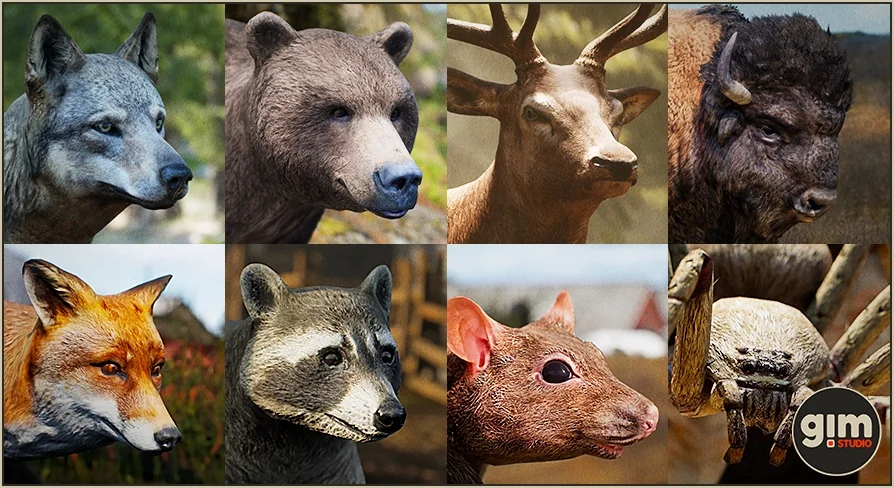
Animalia - Starter Kit suits projects that need wildlife to feel like part of the world rather than background decoration. With a realistic Gray Wolf, Brown Bear, Red Deer, American Bison, Fox, Raccoon, Rat, and Spider, it gives artists and developers a spread of animals that can shape very different kinds of scenes: a quiet woodland path, a tense encounter in brushland, a scavenger-filled camp perimeter, or a more stylized survival setup where animal presence drives atmosphere as much as gameplay.
The set leans into variety without leaving realism behind. Large animals such as the wolf, bear, deer, and bison can define the visual identity of a level on their own, while the fox, raccoon, rat, and spider bring smaller points of motion and detail that help environments feel inhabited. That contrast is one of the pack’s strongest creative advantages. It supports the broad silhouette and weight of major wildlife alongside smaller creatures that can add unease, opportunism, or subtle life to the edges of a scene.
Gray Wolf, Brown Bear, Red Deer, and American Bison
The larger half of the collection is especially useful for scene-building because each animal suggests a different kind of presence. The male Gray Wolf reads as a predator and can anchor moments of pursuit, territorial movement, or watchful distance. The male Brown Bear brings mass and threat, which makes it effective when a scene needs something heavier and slower but still dangerous. The male Red Deer offers a different tone, more aligned with natural movement and open-ground visibility. The male American Bison adds bulk on an even larger scale, giving plains, forest clearings, or frontier-style spaces an animal that feels imposing before it even moves.
Those four animals also share the highest listed texture resolution in the set, with 4K textures for the wolf, bear, deer, and bison. They are also the animals that include bone meshes. Taken together, those details make them the most fully emphasized creatures in the pack, and they are the easiest place to start when a project needs hero wildlife that can hold up in closer views while still functioning as active animated characters.
Because these animals sit in a realistic style, they can serve more than one role inside the same project. One scene might treat them as environmental storytelling, while another uses them as direct gameplay actors. A deer can establish calm or vulnerability in a landscape. A wolf can shift that same space toward tension. A bison can become the visual center of an open area, while a bear can turn an ordinary route into a hazard zone. The value here is not just the model list itself, but the way the list spans several recognizable wildlife roles without drifting away from a coherent visual direction.
Fox, Raccoon, Rat, and Spider in quieter or more uneasy spaces
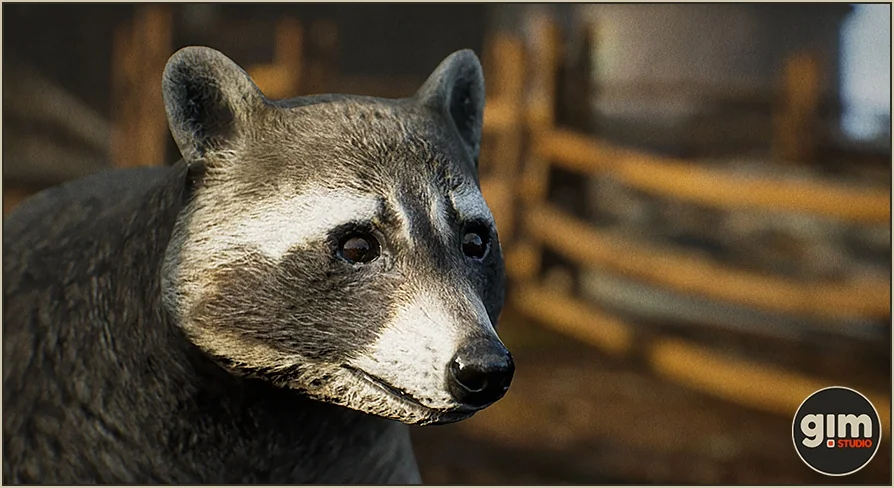
The smaller creatures expand the set’s usefulness in a different direction. The male Fox and male Raccoon suit scenes that need animal activity without the weight of a major confrontation. They can make a level feel watched, foraged through, or naturally occupied. The rat pushes the pack toward tighter spaces and more neglected corners, while the spider brings a very different kind of creature presence, one that can shift a scene from simply natural to slightly unsettling.
These four use 2K textures: fox, raccoon, rat, and spider. That gives the collection a clear split between the larger flagship mammals and the smaller supporting creatures. In practice, that makes sense for projects that want to populate a world with layers of life rather than repeating one kind of animal everywhere. A forest route can carry distant deer or bison presence, then gain local texture through a fox crossing, a raccoon near structures, a rat in lower-ground clutter, or a spider in darker interior or cave-like spaces.
The creature selection also helps level pacing. Not every wildlife moment needs to be an encounter with a large quadruped. Smaller animals can be used to maintain movement and mood between bigger beats. That makes Animalia - Starter Kit useful not only for dramatic wilderness setups, but for slower environmental storytelling where animal behavior and placement help define the tone of a location.
60 fps animation, root motion, and ragdoll setup
Animation support is one of the details that turns the pack from a collection of models into something more production-ready. Animations are authored at 60 fps, which gives movement a clear emphasis on fluid playback. For wildlife, that matters. Creatures are often judged less by static appearance than by the believability of their locomotion and body response. A realistic animal can lose impact quickly if its motion feels stiff or undersampled, so the 60 fps animation detail is a meaningful part of the kit’s identity.
All animations are available with and without root motion. That gives developers a practical choice in how animal movement is integrated into a project. Some scenes benefit from movement driven directly through root motion, especially when the goal is to preserve a specific physical feel in traversal or attack timing. Other setups work better without it, particularly when animation needs to adapt to game logic or AI movement systems in a different way. Having both versions widens how the same creatures can be staged, from more cinematic pathing to gameplay-controlled movement.
The pack also includes ragdoll setup. That matters most when animals are not just decorative but reactive. Whether a project is focused on encounters, simulation, or environmental interaction, ragdoll setup helps the animals participate in the world with a more complete physical response than a purely animated loop would allow. It is a support feature, but it changes how these creatures can be used in action scenes, aftermath moments, or systems that rely on physical state changes.
GFur support, Maya and 3ds Max rigs, and LODs
Animalia - Starter Kit includes gFur support, which is especially relevant for a collection where fur-bearing animals make up most of the roster. Wolf, bear, deer, bison, fox, raccoon, and rat all benefit from that support in ways that connect directly to the pack’s realistic intent. Even without expanding beyond the stated detail, it is clear that fur handling is part of the workflow conversation here rather than an afterthought.
The inclusion of Maya and 3ds Max animation rigs adds another practical layer. This is not only a set for dropping creatures into a level and leaving them untouched. It also speaks to teams or solo creators who want room to work with the animation side of the animals in established DCC pipelines. When a resource includes rigs for Maya and 3ds Max, it becomes easier to place it inside a broader character workflow instead of treating it as a closed package.
LODs are part of the set as well, which supports use across wider environments and varying camera distances. Wildlife often appears in scenes at more than one scale: very close during an encounter, mid-range while moving through terrain, or farther away as living set dressing. LODs help that range feel more manageable inside a project. For a kit anchored in multiple animals instead of one hero creature, that detail matters because it supports population and distance rather than only showcase framing.
Animalia - Starter Kit in Unreal Engine projects
The current changelog entry is version 2.5.0 for UE 4.24 and up, described as revamped for the latest standards. That places the pack within an Unreal Engine workflow while also indicating that it has been updated rather than left in an older state. Combined with gFur support, Animation Blueprint tagging, root motion options, rigs, and ragdoll setup, the collection reads as a wildlife-focused package that can contribute to both visual worldbuilding and interactive creature behavior.
The tag set around buffalo, deer, raccoon, spider, wolf, rat, fox, fur, bear, animal, quadruped, creature, realistic, script, and Animation Blueprint gives a clear picture of where the resource sits. It is not a fantasy beast pack or an exaggerated stylized set. It is grounded wildlife with a mix of major quadrupeds and smaller supporting creatures, positioned for developers who want realistic animal presence and animation-ready characters inside Unreal Engine scenes.
For projects that need one creature type only, this pack may still be useful because the major animals are distinct enough to stand on their own. For projects that need an ecosystem feel, the broader roster is where it becomes most effective. The combination of male Gray Wolf, male Brown Bear, male Red Deer, male American Bison, male Fox, male Raccoon, rat, and spider gives enough range to build spaces that feel occupied at different scales, from open wildlife territory to tighter, more uneasy corners.
If the goal is to populate a realistic game world with animals that do more than idle in place, Animalia - Starter Kit fits best in scenes where movement, variety, and creature presence all matter at once.
 Animals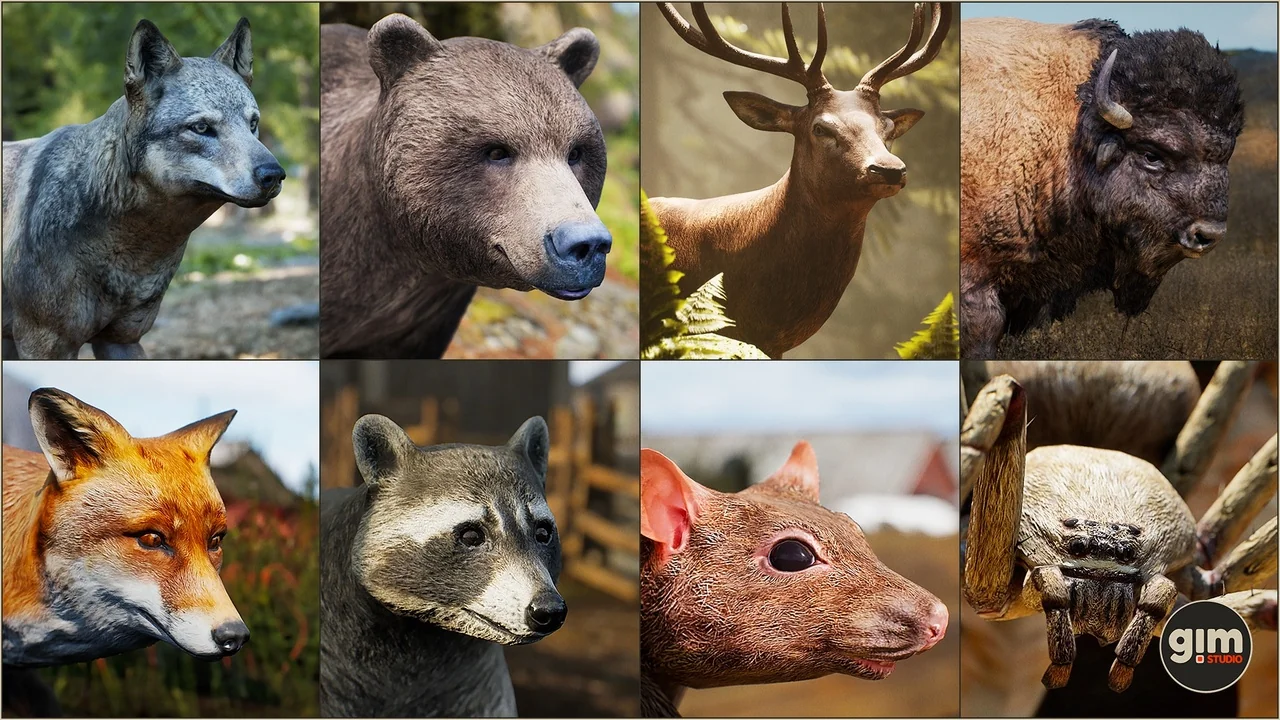
 Characters
![Top-Down Starter Kit [SWVictoria]](https://3dcghub.com/wp-content/uploads/2026/02/7af10873-930d-482d-9504-21cd40863ffd.webp) Fantasy
Fantasy Shooter