"c68a05d5e51405b3"{"id":"1001881","slug":"flying-monster","title":"Flying Monster","category":"Characters \u0026 Creatures","engine":"4.16+,5.0+","assetVersion":"","engineVersion":"Engine Version: 4.16+,5.0+","tag":"Characters","accent":"blue","visual":"character","summary":"A technical breakdown of the Flying Monster 3D model, detailing its 20 custom animations, articulated wing and tail rig, 4K PBR textures, and engine setup.","platform":"Unreal Engine","publishedAt":"2026-10-22T11:21:21.822Z","updatedAt":"2026-10-22T11:21:21.822Z","sourceNotes":[],"fileContents":[],"compatibility":["Unreal Engine","Engine Version: 4.16+,5.0+"],"featuredImage":{"alt":"Flying Monster","src":"/wp-content/uploads/published/2026/10/3bf1d0dd8142-af29d240-15a1-4bdb-be5e-163e18173dd7-8c05f00877.webp"},"hasDownloadLink":true,"downloads":0,"terms":[{"taxonomy":"category","slug":"characters-and-creatures","name":"Characters \u0026 Creatures"}],"galleryImages":[{"src":"/wp-content/uploads/published/2026/10/9e793ee1d95a-7bef1ceb-3eec-47c8-bda1-11038d572e58-62a9f4476e.webp","alt":"Flying Monster"},{"src":"/wp-content/uploads/published/2026/10/aad6a69c4cbd-50e66a0c-bf14-42d8-a629-4e496731eba4-4ebc444319.webp","alt":"Flying Monster"},{"src":"/wp-content/uploads/published/2026/10/39aa904f21e4-d52d290e-e23d-4161-b398-9f2884acf9d6-44570fc700.webp","alt":"Flying Monster"},{"src":"/wp-content/uploads/published/2026/10/44353d3d0f50-43525585-0184-4f17-8b32-3bb3d5094399-2303876487.webp","alt":"Flying Monster"},{"src":"/wp-content/uploads/published/2026/10/75263bf1da7e-beb0c7f7-4992-4ec6-b9d7-7a00096b8931-21577f9a2d.webp","alt":"Flying Monster"},{"src":"/wp-content/uploads/published/2026/10/6ac743ede740-291f4061-386a-483d-abf0-fb7efb792786-7947380350.webp","alt":"Flying Monster"},{"src":"/wp-content/uploads/published/2026/10/bdebe3793d49-d7072418-e586-42d0-b398-cafc3f349285-d3994494b5.webp","alt":"Flying Monster"},{"src":"/wp-content/uploads/published/2026/10/72a29c80198c-a00cec8b-9721-493f-8fb7-0cdc3658dfe1-48039c0c9a.webp","alt":"Flying Monster"},{"src":"/wp-content/uploads/published/2026/10/dc6c25549c4f-4305571e-5afd-4e51-a370-dfab9ecba7d1-aade4a0387.webp","alt":"Flying Monster"}],"accessPanel":{"kind":"resource","title":"Download this resource","eyebrow":"Free Download","message":"Log in or create a free account to start your download.","fileName":"Content.7z","safetyNote":"Resources are manually reviewed before listing to improve quality and reduce obvious risks.","actionLabel":"Download Free","resourceType":"Resource archive"},"contentHtml":"\u003cp\u003eShifting seamlessly between predatory aerial flight and heavy ground-based combat defines the operational profile of the Flying Monster. Designed as a real-time creature asset for interactive games and real-time cinematics, the character is structured to resolve the mechanical challenge of handling winged beasts that must fight convincingly in wide-open airspace as well as constricted corridors. Rather than confining the mesh to hovering flight loops, the setup supplies explicit logic states for grounded locomotion, directional air maneuvering, and multi-stage physical impacts.\u003c/p\u003e \u003ch2\u003eLocomotion States: Flight and Ground Animation Sets\u003c/h2\u003e\n\u003cp\u003eCombat encounters demand responsive blending between distinct behavioral modes. The model features 20 custom animations divided between elevated flight and surface-level stalking. In the air, directional mobility is handled through isolated directional clips, allowing clean four-way locomotion setups:\u003c/p\u003e\n\u003cul\u003e\n\u003cli\u003e\u003ccode\u003eFlying_Monster_Fly_Forward\u003c/code\u003e\u003c/li\u003e\n\u003cli\u003e\u003ccode\u003eFlying_Monster_Fly_Back\u003c/code\u003e\u003c/li\u003e\n\u003cli\u003e\u003ccode\u003eFlying_Monster_Fly_Left\u003c/code\u003e\u003c/li\u003e\n\u003cli\u003e\u003ccode\u003eFlying_Monster_Fly_Right\u003c/code\u003e\u003c/li\u003e\n\u003c/ul\u003e\n\u003cp\u003eHovering and aerial behavioral beats are governed by \u003ccode\u003eFlying_Monster_Idle_01\u003c/code\u003e, \u003ccode\u003eFlying_Monster_Idle_02\u003c/code\u003e, alongside targeted physical threat gestures including \u003ccode\u003eFlying_Monster_Aggression_01\u003c/code\u003e And \u003ccode\u003eFlying_Monster_Aggression_02\u003c/code\u003e. Offensive engagement in mid-air utilizes two strike variations—\u003ccode\u003eFlying_Monster_Attack_01\u003c/code\u003e And \u003ccode\u003eFlying_Monster_Attack_02\u003c/code\u003e—balanced by responsive flinch states via \u003ccode\u003eFlying_Monster_Take_Damage_01\u003c/code\u003e And \u003ccode\u003eFlying_Monster_Take_Damage_02\u003c/code\u003e, with terminal aerial failures resolving through \u003ccode\u003eFlying_Monster_Dead_01\u003c/code\u003e And \u003ccode\u003eFlying_Monster_Dead_02\u003c/code\u003e.\u003c/p\u003e\n\u003cp\u003eWhen driven to ground level, the asset shifts out of flight mechanics into a distinct terrestrial stance. Surface navigation relies on \u003ccode\u003eFlying_Monster_On_Ground_Move_Forward\u003c/code\u003e, accompanied by two resting postures: \u003ccode\u003eFlying_Monster_On_Ground_Idle_01\u003c/code\u003e And \u003ccode\u003eFlying_Monster_On_Ground_Idle_02\u003c/code\u003e. Ground skirmishes are sustained by a dedicated melee strike (\u003ccode\u003eFlying_Monster_On_Ground_Attack_01\u003c/code\u003e), a specific terrestrial damage reaction (\u003ccode\u003eFlying_Monster_On_Ground_Take_Damag\u003c/code\u003e), and a separate grounded expiration sequence (\u003ccode\u003eFlying_Monster_On_Ground_Dead_01\u003c/code\u003e). This separation of aerial and grounded animation trees prevents unnatural foot sliding and eliminates the awkward pose snapping typical of single-state flying enemies.\u003c/p\u003e \u003ch2\u003eArticulated Rigging: Wing Fingers, Tail Segments, and Jaw Bones\u003c/h2\u003e\n\u003cp\u003eDeformation fidelity across complex creature forms depends on how secondary extremities are weighted. The Flying Monster utilizes an expansive array of extra bones dedicated to organic secondary motion across the head, tail, and expansive wing membranes.\u003c/p\u003e\n\u003cp\u003eCephalic articulation is supported by dual jaw joints (\u003ccode\u003eJaw\u003c/code\u003e And \u003ccode\u003eJaw1\u003c/code\u003e) to control gaping bite motions, while the internal oral structure is weighted across a five-stage articulation chain: \u003ccode\u003eTongue1\u003c/code\u003e, \u003ccode\u003eTongue2\u003c/code\u003e, \u003ccode\u003eTongue3\u003c/code\u003e, \u003ccode\u003eTongue4\u003c/code\u003e, and \u003ccode\u003eTongue5\u003c/code\u003e. This deep skeletal subdivision allows dynamic, whipping tongue motions and convincing anatomical reactions during aggression gestures and vocal attacks.\u003c/p\u003e\n\u003cp\u003eSpinal extension into the tail is organized into an eight-stage serial chain spanning from \u003ccode\u003eTail\u003c/code\u003e Through \u003ccode\u003eTail1\u003c/code\u003e Up to \u003ccode\u003eTail8\u003c/code\u003e. These nine total bone references maintain smooth curvature throughout dynamic directional turns, banking maneuvers, and grounded rests, avoiding angular creasing or harsh volume collapse.\u003c/p\u003e\n\u003cp\u003eThe wing membranes and flight limbs carry the most intricate bone infrastructure on the asset. Each wing is driven by structural base bones (\u003ccode\u003eWing_l\u003c/code\u003e Through \u003ccode\u003eWing_l3\u003c/code\u003e On the left, paired symmetrically with \u003ccode\u003eWing_r\u003c/code\u003e Through \u003ccode\u003eWing_r3\u003c/code\u003e On the right) accompanied by deeply segmented digitation:\u003c/p\u003e\n\u003cul\u003e\n\u003cli\u003e\u003cstrong\u003eThumb:\u003c/strong\u003e \u003ccode\u003eWing_thumb_l\u003c/code\u003e Through \u003ccode\u003eWing_thumb_l4\u003c/code\u003e, mirrored on the right side with \u003ccode\u003eWing_thumb_r\u003c/code\u003e Through \u003ccode\u003eWing_thumb_r4\u003c/code\u003e.\u003c/li\u003e\n\u003cli\u003e\u003cstrong\u003eIndex Digits:\u003c/strong\u003e Nine continuous articulation points per side, stretching from \u003ccode\u003eWing_index_l\u003c/code\u003e To \u003ccode\u003eWing_index_l8\u003c/code\u003e And \u003ccode\u003eWing_index_r\u003c/code\u003e To \u003ccode\u003eWing_index_r8\u003c/code\u003e.\u003c/li\u003e\n\u003cli\u003e\u003cstrong\u003eMiddle Digits:\u003c/strong\u003e Six joints per side covering \u003ccode\u003eWing_middle_l\u003c/code\u003e Through \u003ccode\u003eWing_middle_l5\u003c/code\u003e And \u003ccode\u003eWing_middle_r\u003c/code\u003e Through \u003ccode\u003eWing_middle_r5\u003c/code\u003e.\u003c/li\u003e\n\u003cli\u003e\u003cstrong\u003ePinky Digits:\u003c/strong\u003e Five joints per wing covering \u003ccode\u003eWing_pinky_l\u003c/code\u003e Through \u003ccode\u003eWing_pinky_l4\u003c/code\u003e And \u003ccode\u003eWing_pinky_r\u003c/code\u003e Through \u003ccode\u003eWing_pinky_r4\u003c/code\u003e.\u003c/li\u003e\n\u003c/ul\u003e\n\u003cp\u003eBy articulating every individual digit along the wing span, the rig provides the structural deformation needed to fold the wings tight against the torso on the ground, or flare individual wing struts outward to catch drag during aggressive braking animations.\u003c/p\u003e \u003ch2\u003eShading Architecture and the Three Monster Skins\u003c/h2\u003e\n\u003cp\u003eTexturing is configured through 10 distinct texture maps rendered at 4096 x 4096 resolution, delivering sharp surface fidelity up close in cinematic sequences without pixel swimming or blurry seam lines. The surface workflow is authored around standard physically based channels: BaseColor, Normal, Emissive, and a packed OcclusionRoughnessMetallic map. Channel-packing ambient occlusion, roughness, and metalness into a single texture asset cuts down sample calls in the rendering pipeline, maintaining low draw overhead during action-heavy combat encounters.\u003c/p\u003e\n\u003cp\u003eThe asset ships with three separate visual skin treatments, allowing teams to deploy the creature across varied environments or mark out combat ranks without needing custom texture repaints. The underlying shading system is maintained by six master materials and six material instances, allowing quick material overrides for parameters such as emissive glow intensity or surface roughness responses directly within engine instances.\u003c/p\u003e \u003ch2\u003ePolygon Density and Unreal Engine Scene Integration\u003c/h2\u003e\n\u003cp\u003eGeometrically, the creature balances high visual detail against real-time performance constraints. The mesh is built with 21,700 vertices, 22,026 faces, and 42,874 triangles. This polygon density allows fine anatomical contours around the muscular limbs, ribbed wing membranes, and horn structures while fitting comfortably inside standard enemy budgets for modern action and shooter projects.\u003c/p\u003e\n\u003cp\u003eThe base scene was assembled in Unreal Engine 4 (version 4.19), making it native to older pipelines while remaining fully operational in higher engine versions, including Unreal Engine 5. When opening the project, the asset is delivered as a clean, isolated character. Demonstrations showing the creature inhabiting subterranean environments utilize external scene kits—specifically the Fantasy Cave Environment Set—which are strictly background demonstration assets and are not bundled with this creature model. The package delivers the self-contained monster asset, ready to drop into custom level environments, set up in behavior trees, or drive through Sequencer cinematic tracks.\u003c/p\u003e\n\n\u003ch2\u003eContinue Browsing Similar Packs\u003c/h2\u003e\n\u003cul\u003e\n\u003cli\u003e\u003ca href=\"https://3dcghub.com/worms-complete-pack/\" title=\"Worms Complete Pack\"\u003eWorms Complete Pack\u003c/a\u003e\u003c/li\u003e\n\u003cli\u003e\u003ca href=\"https://3dcghub.com/dinosaur-megalodon-sea-monster-series-5/\" title=\"Dinosaur MEGALODON - Sea Monster Series 5\"\u003eDinosaur MEGALODON - Sea Monster Series 5\u003c/a\u003e\u003c/li\u003e\n\u003cli\u003e\u003ca href=\"https://3dcghub.com/big-zombie/\" title=\"Big Zombie\"\u003eBig Zombie\u003c/a\u003e\u003c/li\u003e\n\u003cli\u003e\u003ca href=\"https://3dcghub.com/sci-fi-quick-sand-worm/\" title=\"SCI FI: QUICK SAND WORM\"\u003eSCI FI: QUICK SAND WORM\u003c/a\u003e\u003c/li\u003e\n\u003cli\u003e\u003ca href=\"https://3dcghub.com/forest-golems/\" title=\"Forest Golems\"\u003eForest Golems\u003c/a\u003e\u003c/li\u003e\n\u003c/ul\u003e","contentTextLength":6688,"navigation":{"current":44,"total":3860,"previous":{"id":"1001882","slug":"gaia-s-21-nature-materials-photorealistic","title":"Gaia's 21 Nature Materials / Photorealistic","category":"Stone","platform":"Unreal Engine","updatedAt":"2026-10-22T11:22:15.099Z"},"next":{"id":"1001880","slug":"flying-drones-with-blueprints","title":"Flying Drones With Blueprints","category":"Military","platform":"Unreal Engine","updatedAt":"2026-10-22T11:20:40.615Z"}},"relatedResources":[{"id":"1001462","slug":"worms-complete-pack","title":"Worms Complete Pack","category":"Characters \u0026 Creatures","engine":"4.16+,5.0+","assetVersion":"","engineVersion":"Engine Version: 4.16+,5.0+","tag":"Characters","accent":"blue","visual":"character","summary":"Examine Worms Complete Pack, featuring sized worms, clawed variants, specialized leeches, a Flying Monster, and Animationblueprint implementation.","platform":"Unreal Engine","publishedAt":"2026-10-08T01:07:36.891Z","updatedAt":"2026-10-08T01:07:36.891Z","sourceNotes":[],"fileContents":[],"compatibility":["Unreal Engine","Engine Version: 4.16+,5.0+"],"featuredImage":{"alt":"Worms Complete Pack","src":"/wp-content/uploads/published/2026/10/d83ce3189266-8138210b-36d8-45ce-9f7c-2c51fd09b631-d952dcb119.webp"},"hasDownloadLink":true,"downloads":0},{"id":"1001596","slug":"dinosaur-megalodon-sea-monster-series-5","title":"Dinosaur MEGALODON - Sea Monster Series 5","category":"Characters \u0026 Creatures","engine":"4.26+,5.0+","assetVersion":"","engineVersion":"Engine Version: 4.26+,5.0+","tag":"Characters","accent":"blue","visual":"character","summary":"Detailed look at the 20-meter Dinosaur MEGALODON model, featuring 18 Maya swim animations, 39k polygon mesh, 8K PBR textures, and Unreal Engine setup.","platform":"Unreal Engine","publishedAt":"2026-10-10T16:18:43.454Z","updatedAt":"2026-10-10T16:18:43.454Z","sourceNotes":[],"fileContents":[],"compatibility":["Unreal Engine","Engine Version: 4.26+,5.0+"],"featuredImage":{"alt":"Dinosaur MEGALODON - Sea Monster Series 5","src":"/wp-content/uploads/published/2026/10/3ead9ead6d83-75fe9bfc-3625-463d-b709-410aaa403dfb-12800b49cd.webp"},"hasDownloadLink":true,"downloads":0},{"id":"1774","slug":"big-zombie","title":"Big Zombie","category":"Characters \u0026 Creatures","engine":"4.26+,5.0+","assetVersion":"Engine version: 4.26+,5.0+","engineVersion":"4.19","tag":"Characters","accent":"blue","visual":"character","summary":"Enhance your horror game with this modular Big Zombie boss model. Featuring 4K textures, dismemberment support, and Epic Skeleton compatibility for UE4 and UE5.","platform":"Unreal Engine","publishedAt":"2026-02-06T21:50:27.000Z","updatedAt":"2026-04-19T15:58:29.000Z","sourceNotes":[],"fileContents":[],"compatibility":["Unreal Engine","Engine version: 4.26+,5.0+"],"featuredImage":{"alt":"Big Zombie","src":"https://3dcghub.com/wp-content/uploads/2026/02/008aa7bf-894c-45d8-947a-4f0e7817b9ee.webp"},"hasDownloadLink":true,"downloads":4}]}
Characters
Flying Monster
A technical breakdown of the Flying Monster 3D model, detailing its 20 custom animations, articulated wing and tail rig, 4K PBR textures, and engine setup.
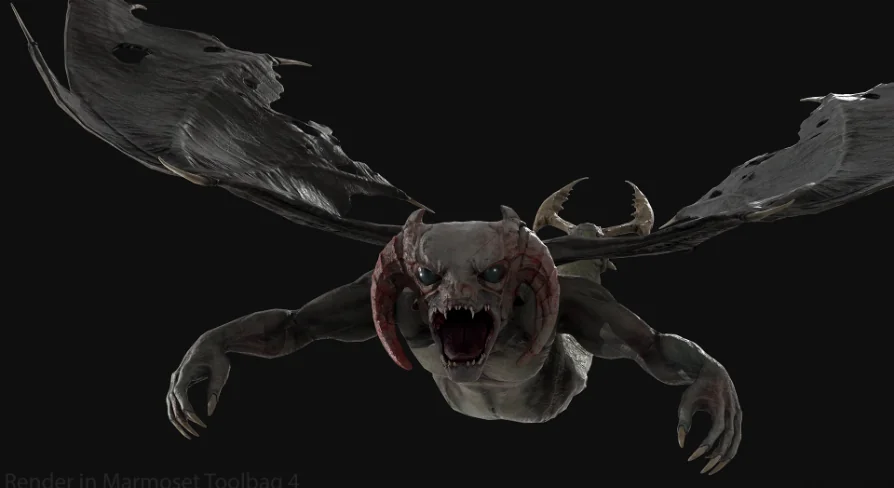
Shifting seamlessly between predatory aerial flight and heavy ground-based combat defines the operational profile of the Flying Monster. Designed as a real-time creature asset for interactive games and real-time cinematics, the character is structured to resolve the mechanical challenge of handling winged beasts that must fight convincingly in wide-open airspace as well as constricted corridors. Rather than confining the mesh to hovering flight loops, the setup supplies explicit logic states for grounded locomotion, directional air maneuvering, and multi-stage physical impacts.
Locomotion States: Flight and Ground Animation Sets
Combat encounters demand responsive blending between distinct behavioral modes. The model features 20 custom animations divided between elevated flight and surface-level stalking. In the air, directional mobility is handled through isolated directional clips, allowing clean four-way locomotion setups:
Flying_Monster_Fly_Forward
Flying_Monster_Fly_Back
Flying_Monster_Fly_Left
Flying_Monster_Fly_Right
Hovering and aerial behavioral beats are governed by Flying_Monster_Idle_01, Flying_Monster_Idle_02, alongside targeted physical threat gestures including Flying_Monster_Aggression_01 And Flying_Monster_Aggression_02. Offensive engagement in mid-air utilizes two strike variations—Flying_Monster_Attack_01 And Flying_Monster_Attack_02—balanced by responsive flinch states via Flying_Monster_Take_Damage_01 And Flying_Monster_Take_Damage_02, with terminal aerial failures resolving through Flying_Monster_Dead_01 And Flying_Monster_Dead_02.
When driven to ground level, the asset shifts out of flight mechanics into a distinct terrestrial stance. Surface navigation relies on Flying_Monster_On_Ground_Move_Forward, accompanied by two resting postures: Flying_Monster_On_Ground_Idle_01 And Flying_Monster_On_Ground_Idle_02. Ground skirmishes are sustained by a dedicated melee strike (Flying_Monster_On_Ground_Attack_01), a specific terrestrial damage reaction (Flying_Monster_On_Ground_Take_Damag), and a separate grounded expiration sequence (Flying_Monster_On_Ground_Dead_01). This separation of aerial and grounded animation trees prevents unnatural foot sliding and eliminates the awkward pose snapping typical of single-state flying enemies.
Articulated Rigging: Wing Fingers, Tail Segments, and Jaw Bones
Deformation fidelity across complex creature forms depends on how secondary extremities are weighted. The Flying Monster utilizes an expansive array of extra bones dedicated to organic secondary motion across the head, tail, and expansive wing membranes.
Cephalic articulation is supported by dual jaw joints (Jaw And Jaw1) to control gaping bite motions, while the internal oral structure is weighted across a five-stage articulation chain: Tongue1, Tongue2, Tongue3, Tongue4, and Tongue5. This deep skeletal subdivision allows dynamic, whipping tongue motions and convincing anatomical reactions during aggression gestures and vocal attacks.
Spinal extension into the tail is organized into an eight-stage serial chain spanning from Tail Through Tail1 Up to Tail8. These nine total bone references maintain smooth curvature throughout dynamic directional turns, banking maneuvers, and grounded rests, avoiding angular creasing or harsh volume collapse.
The wing membranes and flight limbs carry the most intricate bone infrastructure on the asset. Each wing is driven by structural base bones (Wing_l Through Wing_l3 On the left, paired symmetrically with Wing_r Through Wing_r3 On the right) accompanied by deeply segmented digitation:
Thumb:Wing_thumb_l Through Wing_thumb_l4, mirrored on the right side with Wing_thumb_r Through Wing_thumb_r4.
Index Digits: Nine continuous articulation points per side, stretching from Wing_index_l To Wing_index_l8 And Wing_index_r To Wing_index_r8.
Middle Digits: Six joints per side covering Wing_middle_l Through Wing_middle_l5 And Wing_middle_r Through Wing_middle_r5.
Pinky Digits: Five joints per wing covering Wing_pinky_l Through Wing_pinky_l4 And Wing_pinky_r Through Wing_pinky_r4.
By articulating every individual digit along the wing span, the rig provides the structural deformation needed to fold the wings tight against the torso on the ground, or flare individual wing struts outward to catch drag during aggressive braking animations.
Shading Architecture and the Three Monster Skins
Texturing is configured through 10 distinct texture maps rendered at 4096 x 4096 resolution, delivering sharp surface fidelity up close in cinematic sequences without pixel swimming or blurry seam lines. The surface workflow is authored around standard physically based channels: BaseColor, Normal, Emissive, and a packed OcclusionRoughnessMetallic map. Channel-packing ambient occlusion, roughness, and metalness into a single texture asset cuts down sample calls in the rendering pipeline, maintaining low draw overhead during action-heavy combat encounters.
The asset ships with three separate visual skin treatments, allowing teams to deploy the creature across varied environments or mark out combat ranks without needing custom texture repaints. The underlying shading system is maintained by six master materials and six material instances, allowing quick material overrides for parameters such as emissive glow intensity or surface roughness responses directly within engine instances.
Polygon Density and Unreal Engine Scene Integration
Geometrically, the creature balances high visual detail against real-time performance constraints. The mesh is built with 21,700 vertices, 22,026 faces, and 42,874 triangles. This polygon density allows fine anatomical contours around the muscular limbs, ribbed wing membranes, and horn structures while fitting comfortably inside standard enemy budgets for modern action and shooter projects.
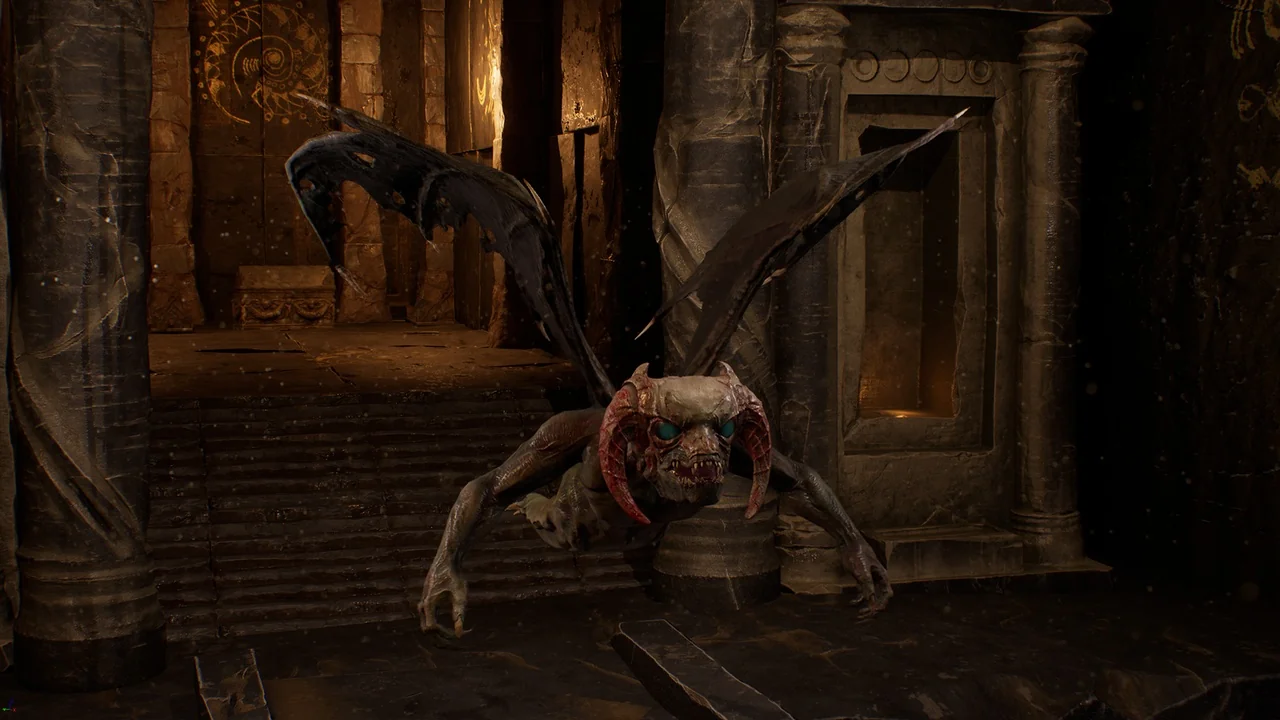
The base scene was assembled in Unreal Engine 4 (version 4.19), making it native to older pipelines while remaining fully operational in higher engine versions, including Unreal Engine 5. When opening the project, the asset is delivered as a clean, isolated character. Demonstrations showing the creature inhabiting subterranean environments utilize external scene kits—specifically the Fantasy Cave Environment Set—which are strictly background demonstration assets and are not bundled with this creature model. The package delivers the self-contained monster asset, ready to drop into custom level environments, set up in behavior trees, or drive through Sequencer cinematic tracks.
 Characters
 Characters
 Characters
 Characters