"07a32e720bd988c8"{"id":"1002486","slug":"modern-character","title":"Modern character","category":"Characters \u0026 Creatures","engine":"4.18+,5.0+","assetVersion":"","engineVersion":"Engine Version: 4.18+,5.0+","tag":"Characters","accent":"blue","visual":"character","summary":"A low-poly male character asset with an Epic skeleton, firearm mesh, modular outfit textures, and two-sided shader support for multiple game genres.","platform":"Unreal Engine","indexPolicy":"index","publishedAt":"2026-11-12T03:51:41.314Z","updatedAt":"2026-11-12T03:51:41.314Z","sourceNotes":[],"fileContents":[],"compatibility":["Unreal Engine","Engine Version: 4.18+,5.0+"],"featuredImage":{"alt":"Modern character","src":"/wp-content/uploads/published/2026/11/12f2b0e8163d-3ca52942-b1a7-4fc0-8362-a5915c0b2c24-c02fa3d7d6.webp"},"hasDownloadLink":true,"downloads":0,"terms":[{"taxonomy":"category","slug":"characters-and-creatures","name":"Characters \u0026 Creatures"}],"galleryImages":[{"src":"/wp-content/uploads/published/2026/11/c7d58a15b12c-9ecd6448-cae7-4483-8048-d81b1eab485f-67e940547f.webp","alt":"Modern character"},{"src":"/wp-content/uploads/published/2026/11/d8ad52b9015d-3b91ee07-c81c-4b40-bb30-810f99e098e3-116d3cec22.webp","alt":"Modern character"},{"src":"/wp-content/uploads/published/2026/11/418b96cb0c52-b23dd49e-65c4-4d82-829e-0da8bea3f08b-ad5032b582.webp","alt":"Modern character"},{"src":"/wp-content/uploads/published/2026/11/62d27d07f038-1756e479-8a63-4758-975c-9d80ff4672e2-85022928f7.webp","alt":"Modern character"},{"src":"/wp-content/uploads/published/2026/11/3a395f9756ef-1bb53d78-4a20-42b7-8265-fd47bfd8ddc0-db2c0994d9.webp","alt":"Modern character"},{"src":"/wp-content/uploads/published/2026/11/e9ccdb5dd77f-627822ee-0619-43ff-8a23-b9745a55824f-9d6752ef10.webp","alt":"Modern character"},{"src":"/wp-content/uploads/published/2026/11/351040dc62e7-8daa72fd-e017-480e-87a6-2540e5d6b0db-beea2b09bc.webp","alt":"Modern character"},{"src":"/wp-content/uploads/published/2026/11/c9556b43c103-477263d4-0835-4ea8-95c8-72ef9cd00366-32f5d0379b.webp","alt":"Modern character"},{"src":"/wp-content/uploads/published/2026/11/3bf6972c54d3-4db8f82e-b02f-4506-aafa-b5f9ad3759a3-b32524620c.webp","alt":"Modern character"},{"src":"/wp-content/uploads/published/2026/11/7f98334d7811-dced2558-bf28-485a-8b00-987838603498-a7db66baf1.webp","alt":"Modern character"}],"accessPanel":{"kind":"resource","title":"Get this resource","eyebrow":"Free resource","message":"Download this resource in your browser.","fileName":"Content.7z","safetyNote":"Resources are manually reviewed before listing to improve quality and reduce obvious risks.","actionLabel":"Get this resource","resourceType":"Resource archive","versions":[]},"contentHtml":"\u003cp\u003eContemporary urban environments, abandoned districts, and skirmish compounds require believable human models capable of handling distinct narrative duties. Whether staging a sudden street encounter, setting up an insurgent camp, or populating a narrative-driven district, having a flexible male figure grounds the scene in realistic modern conflict. This low-poly male model bridges the gap between everyday civilian streetwear and tactical readiness, giving developers a multipurpose base that functions equally well as an armed hero, a roaming enemy, or a generic street bandit.\u003c/p\u003e \u003ch2\u003eUrban Archetypes and the Modern Character in Combat Roles\u003c/h2\u003e\n\u003cp\u003eFinding a balance between ordinary civilian costuming and combat capability is essential for modern titles. This asset centers on a male character styled in casual, real-world garments suited for varied scenarios. The model adapts easily across diverse character archetypes, allowing it to serve as a gritty protagonist, a member of an opposing faction, or background hostile forces. Because the design avoids hyper-specialized military gear in favor of street clothing, it fits naturally into civil unrest encounters, survival scenarios, and underground tactical scenes.\u003c/p\u003e\n\u003cp\u003eThe character includes an accompanying firearm mesh, providing an immediate weapon option for combat encounters. This inclusion allows the asset to transition seamlessly between passive exploration scenes and active combat sequences. Rather than requiring developers to source an external sidearm that matches the visual fidelity and scale of the model, the dedicated gun mesh is integrated directly into the character package. Having matching gear ready out of the box accelerates scene blocking, prototyping of combat mechanics, and final level staging for modern-day conflicts.\u003c/p\u003e \u003ch2\u003eOutfit Variations Across the Modern Character Design\u003c/h2\u003e\n\u003cp\u003eRepetition breaks immersion quickly, especially in games that spawn multiple encounters using the same general character archetype. To counter visual fatigue, the package incorporates an extensive selection of textures and modular clothing options. Developers can configure the figure using three distinct t-shirt options, two styles of jeans, two cap variations, and four unique bag setups. These alternatives make it possible to generate distinct loadouts and appearances from a unified core mesh, preventing enemy groups or squad mates from looking like carbon copies of one another.\u003c/p\u003e\n\u003cp\u003eIn addition to modular clothing variants, the asset includes three distinct skin options. These surface treatments alter the character's presentation across different thematic needs, whether distinguishing between faction ranks, environmental grime levels, or basic visual diversity among non-player characters. The texture maps are provided in high-resolution formats ranging from 4096x4096 down to 2048x2048 pixels. For productions targeting mobile devices, handheld platforms, or distant camera positions, these texture maps can be reduced to any desired dimension without sacrificing clarity or surface coherence.\u003c/p\u003e \u003ch2\u003ePolygon Distribution for the Character Body and Firearm\u003c/h2\u003e\n\u003cp\u003eReal-time performance relies heavily on disciplined polygonal budgets, particularly in action titles where physics, artificial intelligence, and lighting systems compete for frame time. The main character body is constructed with clean, low-poly geometry that remains efficient without sacrificing anatomic form or clothing silhouettes:\u003c/p\u003e\n\u003cul\u003e \u003cli\u003eFaces: 9,138\u003c/li\u003e \u003cli\u003eTriangles: 17,838\u003c/li\u003e \u003cli\u003eVertices: 14,072\u003c/li\u003e\n\u003c/ul\u003e\n\u003cp\u003eAt under 18,000 triangles, the body mesh is lightweight enough to be deployed in high density across real-time scenes while maintaining sufficient edge loops around joints for natural deformation during movement. The dedicated gun mesh follows a similarly restrained polygon budget, ensuring crisp sightlines during close-up weapon handling without wasting performance resources:\u003c/p\u003e\n\u003cul\u003e \u003cli\u003eFaces: 1,288\u003c/li\u003e \u003cli\u003eTriangles: 2,454\u003c/li\u003e \u003cli\u003eVertices: 2,770\u003c/li\u003e\n\u003c/ul\u003e\n\u003cp\u003eThis compact footprint keeps the firearm sharp enough for weapon-swapping mechanics, holster attachments, and combat states while keeping total draw-call weights low.\u003c/p\u003e \u003ch2\u003eEpic Skeleton Rigging and Two-Sided Shading Requirements\u003c/h2\u003e\n\u003cp\u003eThe character model is built upon the industry-standard Epic skeleton hierarchy. This foundational structure ensures rapid setup when incorporating the model into existing animation pipelines. Locomotion sets, tactical aim offsets, sprint cycles, hit reactions, and death animations built for standard Epic rigs can be retargeted or shared directly with this character. This rigging setup also facilitates smooth integration with Animation Blueprints and gameplay scripts, minimizing technical friction when linking input commands to skeletal playback.\u003c/p\u003e\n\u003cp\u003eStructurally, the model includes several folding parts across its clothing elements and accessories. Because thin fabric edges and layered accessories can introduce visual artifacts if rendered with single-sided culling, applying a material shader with two-sided polygon mapping is recommended. Using a two-sided shader prevents backface invisibility on folded fabric folds, collars, bag straps, or cap edges, preserving solid visual depth from every camera angle without requiring redundant interior polygon loops that would unnecessarily inflate the triangle count.\u003c/p\u003e \u003ch2\u003eCamera Perspectives from First-Person to Strategy Overviews\u003c/h2\u003e\n\u003cp\u003eGame design dictates specific demands on character assets depending on the camera system in use. Because of its flexible geometry and modular texture structure, this package adapts cleanly across four primary genres:\u003c/p\u003e\n\u003cul\u003e \u003cli\u003e\u003cstrong\u003eFirst-Person Encounters:\u003c/strong\u003e When functioning as an adversary, ally, or bandit in first-person titles, the detailed texture maps provide crisp visual fidelity during face-to-face dialogues, close-quarters gunfights, and scripted takedowns.\u003c/li\u003e \u003cli\u003e\u003cstrong\u003eThird-Person Adventures:\u003c/strong\u003e The low-poly topology deforms smoothly through running, crouching, and vaulting actions, making it well suited for over-the-shoulder narrative role-playing games or action titles.\u003c/li\u003e \u003cli\u003e\u003cstrong\u003eStrategy and Top-Down Titles:\u003c/strong\u003e In tactical strategy or isometric games, the ability to downscale textures to compact memory footprints ensures that dozens of individual units can occupy the screen simultaneously without straining rendering budgets.\u003c/li\u003e \u003cli\u003e\u003cstrong\u003eRole-Playing Games:\u003c/strong\u003e The combination of three skins, swappable caps, multiple bags, and alternate shirts provides the customization foundation required for player progression, hostile faction varieties, or wandering non-player characters.\u003c/li\u003e\n\u003c/ul\u003e\n\u003cp\u003eThis functional flexibility across camera distances, paired with robust rigging and varied gear, makes the model an adaptable asset for modern urban scenarios across multiple production formats.\u003c/p\u003e\n\n\u003ch2\u003eContinue Browsing Similar Packs\u003c/h2\u003e\n\u003cul\u003e\n\u003cli\u003e\u003ca href=\"https://3dcghub.com/visai-companion-modern-ai-framework/\" rel=\"noopener noreferrer\"\u003eVisAI - Companion - Modern AI Framework\u003c/a\u003e\u003c/li\u003e\n\u003cli\u003e\u003ca href=\"https://3dcghub.com/f3-modern-girl-ashley/\" rel=\"noopener noreferrer\"\u003eF3 Modern Girl Ashley\u003c/a\u003e\u003c/li\u003e\n\u003cli\u003e\u003ca href=\"https://3dcghub.com/parasite-zombie-04-game-assets-extra/\" rel=\"noopener noreferrer\"\u003eParasite Zombie 04 - Game Assets + Extra\u003c/a\u003e\u003c/li\u003e\n\u003cli\u003e\u003ca href=\"https://3dcghub.com/defender-girl/\" rel=\"noopener noreferrer\"\u003eDefender Girl\u003c/a\u003e\u003c/li\u003e\n\u003cli\u003e\u003ca href=\"https://3dcghub.com/dystopia-mech-and-pilot/\" rel=\"noopener noreferrer\"\u003eDystopia Mech and Pilot\u003c/a\u003e\u003c/li\u003e\n\u003c/ul\u003e","contentTextLength":6833,"navigation":{"current":13,"total":4421,"previous":{"id":"1002487","slug":"modern-male-pack","title":"Modern Male Pack","category":"Characters \u0026 Creatures","platform":"Unreal Engine","updatedAt":"2026-11-12T03:52:34.691Z"},"next":{"id":"1002485","slug":"medieval-infantry","title":"Medieval Infantry","category":"Characters \u0026 Creatures","platform":"Unreal Engine","updatedAt":"2026-11-12T03:49:48.304Z"}},"relatedResources":[{"id":"1002487","slug":"modern-male-pack","title":"Modern Male Pack","category":"Characters \u0026 Creatures","engine":"4.24+,5.0+","assetVersion":"","engineVersion":"Engine Version: 4.24+,5.0+","tag":"Characters","accent":"blue","visual":"character","summary":"Explore the Modern Male Pack, featuring modular body parts, Epic skeleton animation compatibility, customizable materials, and military character setups.","platform":"Unreal Engine","indexPolicy":"index","publishedAt":"2026-11-12T03:52:34.691Z","updatedAt":"2026-11-12T03:52:34.691Z","sourceNotes":[],"fileContents":[],"compatibility":["Unreal Engine","Engine Version: 4.24+,5.0+"],"featuredImage":{"alt":"Modern Male Pack","src":"/wp-content/uploads/published/2026/11/e7522bfe2457-3bbf7789-3d97-45b5-a9a1-cf6982a8b594-0bc3232e1a.webp"},"hasDownloadLink":true,"downloads":0},{"id":"1000904","slug":"visai-companion-modern-ai-framework","title":"VisAI - Companion - Modern AI Framework","category":"Characters \u0026 Creatures","engine":"4.26+,5.0+","assetVersion":"","engineVersion":"Engine Version: 4.26+,5.0+","tag":"Characters","accent":"blue","visual":"character","summary":"Modern multiplayer-ready AI framework for RPGs with relationship-driven companion behavior, command UI, interaction system, and detailed example map.","platform":"Unreal Engine","indexPolicy":"index","publishedAt":"2026-08-06T05:14:19.512Z","updatedAt":"2026-08-06T05:14:19.512Z","sourceNotes":[],"fileContents":[],"compatibility":["Unreal Engine","Engine Version: 4.26+,5.0+"],"featuredImage":{"alt":"VisAI - Companion - Modern AI Framework","src":"/wp-content/uploads/published/2026/08/f36621fe8598-3cb25636-0a21-4666-aa5a-30c1a53d8a4a-1dee5f108d.webp"},"hasDownloadLink":true,"downloads":0},{"id":"1000457","slug":"f3-modern-girl-ashley","title":"F3 Modern Girl Ashley","category":"Characters \u0026 Creatures","engine":"4.27,5.0+","assetVersion":"","engineVersion":"Engine Version: 4.27,5.0+","tag":"Characters","accent":"blue","visual":"character","summary":"F3 Modern Girl Ashley is a modular, customizable Unreal Engine character rigged to the Epic Skeleton with ARkit Live-Link, runtime blueprint creation, and Xandr","platform":"Unreal Engine","indexPolicy":"index","publishedAt":"2026-07-11T02:20:15.381Z","updatedAt":"2026-07-11T02:20:15.381Z","sourceNotes":[],"fileContents":[],"compatibility":["Unreal Engine","Engine Version: 4.27,5.0+"],"featuredImage":{"alt":"F3 Modern Girl Ashley","src":"/wp-content/uploads/published/2026/07/2129ea642188-0ec78e93-e763-45aa-b41d-c04ad5428407-8d8369a974.webp"},"hasDownloadLink":true,"downloads":1}]}
Characters
Modern character
A low-poly male character asset with an Epic skeleton, firearm mesh, modular outfit textures, and two-sided shader support for multiple game genres.
Contemporary urban environments, abandoned districts, and skirmish compounds require believable human models capable of handling distinct narrative duties. Whether staging a sudden street encounter, setting up an insurgent camp, or populating a narrative-driven district, having a flexible male figure grounds the scene in realistic modern conflict. This low-poly male model bridges the gap between everyday civilian streetwear and tactical readiness, giving developers a multipurpose base that functions equally well as an armed hero, a roaming enemy, or a generic street bandit.
Urban Archetypes and the Modern Character in Combat Roles
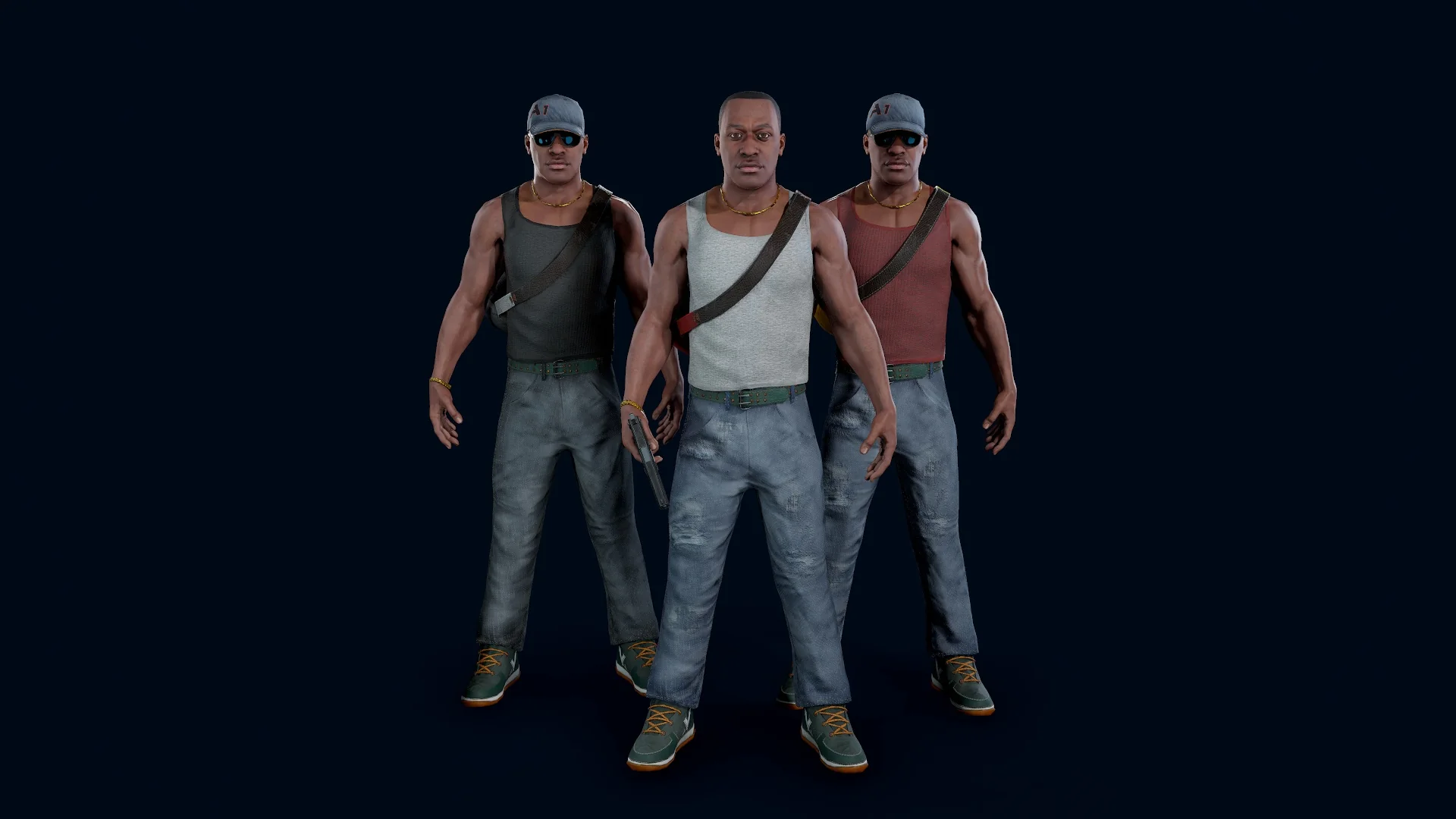
Finding a balance between ordinary civilian costuming and combat capability is essential for modern titles. This asset centers on a male character styled in casual, real-world garments suited for varied scenarios. The model adapts easily across diverse character archetypes, allowing it to serve as a gritty protagonist, a member of an opposing faction, or background hostile forces. Because the design avoids hyper-specialized military gear in favor of street clothing, it fits naturally into civil unrest encounters, survival scenarios, and underground tactical scenes.
The character includes an accompanying firearm mesh, providing an immediate weapon option for combat encounters. This inclusion allows the asset to transition seamlessly between passive exploration scenes and active combat sequences. Rather than requiring developers to source an external sidearm that matches the visual fidelity and scale of the model, the dedicated gun mesh is integrated directly into the character package. Having matching gear ready out of the box accelerates scene blocking, prototyping of combat mechanics, and final level staging for modern-day conflicts.
Outfit Variations Across the Modern Character Design
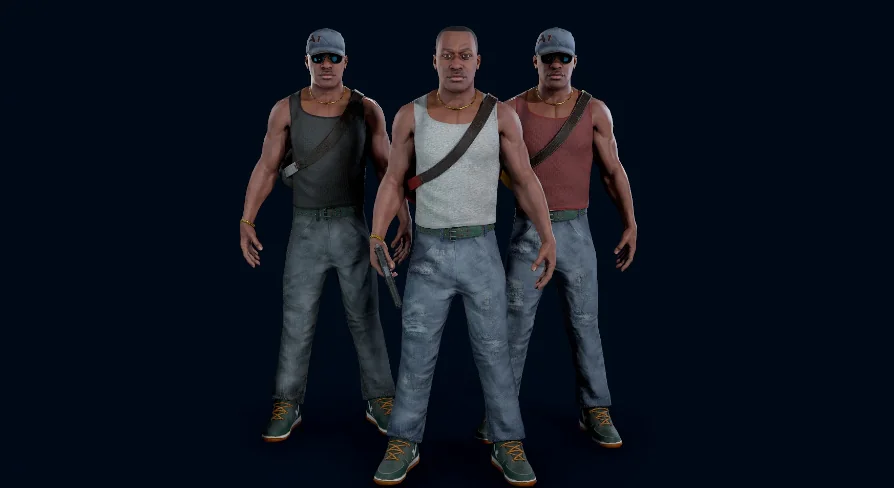
Repetition breaks immersion quickly, especially in games that spawn multiple encounters using the same general character archetype. To counter visual fatigue, the package incorporates an extensive selection of textures and modular clothing options. Developers can configure the figure using three distinct t-shirt options, two styles of jeans, two cap variations, and four unique bag setups. These alternatives make it possible to generate distinct loadouts and appearances from a unified core mesh, preventing enemy groups or squad mates from looking like carbon copies of one another.
In addition to modular clothing variants, the asset includes three distinct skin options. These surface treatments alter the character's presentation across different thematic needs, whether distinguishing between faction ranks, environmental grime levels, or basic visual diversity among non-player characters. The texture maps are provided in high-resolution formats ranging from 4096x4096 down to 2048x2048 pixels. For productions targeting mobile devices, handheld platforms, or distant camera positions, these texture maps can be reduced to any desired dimension without sacrificing clarity or surface coherence.
Polygon Distribution for the Character Body and Firearm
Real-time performance relies heavily on disciplined polygonal budgets, particularly in action titles where physics, artificial intelligence, and lighting systems compete for frame time. The main character body is constructed with clean, low-poly geometry that remains efficient without sacrificing anatomic form or clothing silhouettes:
Faces: 9,138
Triangles: 17,838
Vertices: 14,072
At under 18,000 triangles, the body mesh is lightweight enough to be deployed in high density across real-time scenes while maintaining sufficient edge loops around joints for natural deformation during movement. The dedicated gun mesh follows a similarly restrained polygon budget, ensuring crisp sightlines during close-up weapon handling without wasting performance resources:
Faces: 1,288
Triangles: 2,454
Vertices: 2,770
This compact footprint keeps the firearm sharp enough for weapon-swapping mechanics, holster attachments, and combat states while keeping total draw-call weights low.
Epic Skeleton Rigging and Two-Sided Shading Requirements
The character model is built upon the industry-standard Epic skeleton hierarchy. This foundational structure ensures rapid setup when incorporating the model into existing animation pipelines. Locomotion sets, tactical aim offsets, sprint cycles, hit reactions, and death animations built for standard Epic rigs can be retargeted or shared directly with this character. This rigging setup also facilitates smooth integration with Animation Blueprints and gameplay scripts, minimizing technical friction when linking input commands to skeletal playback.
Structurally, the model includes several folding parts across its clothing elements and accessories. Because thin fabric edges and layered accessories can introduce visual artifacts if rendered with single-sided culling, applying a material shader with two-sided polygon mapping is recommended. Using a two-sided shader prevents backface invisibility on folded fabric folds, collars, bag straps, or cap edges, preserving solid visual depth from every camera angle without requiring redundant interior polygon loops that would unnecessarily inflate the triangle count.
Camera Perspectives from First-Person to Strategy Overviews
Game design dictates specific demands on character assets depending on the camera system in use. Because of its flexible geometry and modular texture structure, this package adapts cleanly across four primary genres:
First-Person Encounters: When functioning as an adversary, ally, or bandit in first-person titles, the detailed texture maps provide crisp visual fidelity during face-to-face dialogues, close-quarters gunfights, and scripted takedowns.
Third-Person Adventures: The low-poly topology deforms smoothly through running, crouching, and vaulting actions, making it well suited for over-the-shoulder narrative role-playing games or action titles.
Strategy and Top-Down Titles: In tactical strategy or isometric games, the ability to downscale textures to compact memory footprints ensures that dozens of individual units can occupy the screen simultaneously without straining rendering budgets.
Role-Playing Games: The combination of three skins, swappable caps, multiple bags, and alternate shirts provides the customization foundation required for player progression, hostile faction varieties, or wandering non-player characters.
This functional flexibility across camera distances, paired with robust rigging and varied gear, makes the model an adaptable asset for modern urban scenarios across multiple production formats.
 Characters
 Characters
 Characters
 Characters