"cadbdd4ea746864c"{"id":"1002963","slug":"undertaker","title":"Undertaker","category":"Characters \u0026 Creatures","engine":"4.26+,5.0+","assetVersion":"","engineVersion":"Engine Version: 4.26+,5.0+","tag":"Characters","accent":"blue","visual":"character","summary":"Examine the Undertaker creature asset featuring an 18 Ktri mesh, 81-bone rig, 3 dedicated materials, and 18 animations for dark fantasy production.","platform":"Unreal Engine","indexPolicy":"index","publishedAt":"2026-11-22T12:52:58.979Z","updatedAt":"2026-11-22T12:52:58.979Z","sourceNotes":[],"fileContents":[],"compatibility":["Unreal Engine","Engine Version: 4.26+,5.0+"],"featuredImage":{"alt":"Undertaker","src":"/wp-content/uploads/published/2026/11/6696ec7cd1d8-81f66d82-12c4-4fe8-8b51-0441babee0db-3bd795c1c9.webp"},"hasDownloadLink":true,"downloads":0,"terms":[{"taxonomy":"category","slug":"characters-and-creatures","name":"Characters \u0026 Creatures"}],"galleryImages":[{"src":"/wp-content/uploads/published/2026/11/a2fb016089db-209735c8-a3ec-4b83-a41d-5bd57be1ffb2-743f4e51b5.webp","alt":"Undertaker"},{"src":"/wp-content/uploads/published/2026/11/cd648f36844f-f13c7423-74f2-4525-b96d-ce267413e358-bd789f48df.webp","alt":"Undertaker"},{"src":"/wp-content/uploads/published/2026/11/f4f96b1ab7af-e9b97684-9cc2-48bc-ba55-8399c55f94e1-63f79af34a.webp","alt":"Undertaker"},{"src":"/wp-content/uploads/published/2026/11/2c3269c6b23d-71a98215-182a-4b51-8f04-5c57ec1b99be-52e5b27caa.webp","alt":"Undertaker"},{"src":"/wp-content/uploads/published/2026/11/109b7979de50-08e0659f-7e09-4a06-818e-8abc3e983621-d4112ee1b8.webp","alt":"Undertaker"}],"accessPanel":{"kind":"resource","title":"Get this resource","safetyNote":"Resources are manually reviewed before listing to improve quality and reduce obvious risks.","fileName":"Content.7z","resourceType":"Resource archive","versions":[]},"contentHtml":"\u003cp\u003eWar-torn landscapes, ruined fortresses, and neglected burial grounds frequently require specialized fauna to establish an atmosphere of decay. Rather than relying on generic undead tropes or standard human soldiers, setting designers often turn to specialized carrion beasts to communicate the grim reality of an aftermath. The Undertaker fulfills this exact environmental need, operating as a repulsive scavenger designed to stalk desolate battlefields and graveyard scenes in search of dead flesh.\u003c/p\u003e \u003ch2\u003eEnvironmental Roles for the Undertaker Scavenger\u003c/h2\u003e\n\u003cp\u003eIn dark fantasy narratives, the transition between active warfare and prolonged ruin is defined by the scavengers that occupy the space. A creature whose primary biological imperative is consuming post-battle casualties introduces a specific behavioral rhythm to a level. Instead of standing in place waiting for combat initiation, a scavenger of this nature fits naturally into patrol loops through corpse-strewn trenches, circling ruined catacombs, or brooding over fresh graves.\u003c/p\u003e\n\u003cp\u003eBecause the creature is conceptually tied to feeding on remnants left behind after violence, encounter design can focus heavily on ecological storytelling. Placing such an entity over a pile of remains signals immediate narrative weight to an exploring player. Its presence informs the player about the condition of the surrounding world: this is an ecosystem adapted to endless war, where opportunistic beasts thrive directly on the carnage left behind by armies.\u003c/p\u003e\n\u003cp\u003eCombining grotesque biological features with a realistic artistic execution allows the beast to function in multiple level archetypes. It works equally well as a solitary wandering predator in secluded cemetery clearings or as part of a distributed swarm picking through large-scale siege grounds. The thematic focus on opportunistic scavenging lets developers present combat encounters that feel reactionary rather than militarily organized.\u003c/p\u003e \u003ch2\u003ePolygon Distribution and Mesh Structure\u003c/h2\u003e\n\u003cp\u003eReal-time level performance depends heavily on keeping character geometry restrained without degrading silhouette definition. The asset carries a polygon budget of 18 Ktris, landing in a low-poly optimization bracket while maintaining enough structural density to support realistic deformations. Eighteen thousand triangles offer sufficient surface curvature to define leathery muscle groups, bony protrusions, and the jagged, asymmetric contours typical of a scavenger.\u003c/p\u003e\n\u003cp\u003eManaging organic forms within this triangle budget prevents the model from burdening deformation passes in crowded encounters. In scenes containing several of these beasts alongside landscape elements and environmental effects, keeping each instance at 18 Ktris helps preserve rendering headrooms. Edge flow can concentrate around vital bending regions, preventing pinching across joint junctions while retaining hard anatomical landmarks like rib cages, facial features, and claw structures.\u003c/p\u003e\n\u003cp\u003eThe mesh optimization also ensures that LOD chains can drop cleanly into simplified distances when the creature operates as background set dressing. When players observe a cemetery from high vantage points, an 18 Ktri baseline transitions cleanly across distance stages without collapsing fine structural components.\u003c/p\u003e \u003ch2\u003eSkeletal Articulation Across the Undertaker Rig\u003c/h2\u003e\n\u003cp\u003eArticulating a creature that possesses both terrestrial and aerial anatomy requires an extensive skeletal infrastructure. The asset features an 81-bone rig, providing the mechanical support necessary to drive expressive joint movement across its entire body plan. A bone count of this size indicates thorough control over specialized appendages, allowing independent articulation for complex biological appendages alongside basic locomotive limbs.\u003c/p\u003e\n\u003cp\u003eThe creature is equipped with wings, which demand significant joint investment to look natural. Folding, extending, and hovering require progressive bone chains through the wing roots, elbows, and individual digits to avoid stretching the skinning during broad flapping arcs. An 81-bone skeleton provides the technical leeway needed to separate wing motion from the spine and shoulder areas, letting the scavenger react to hits or change movement directions without unnatural rigidity.\u003c/p\u003e\n\u003cp\u003eBone distribution also accommodates secondary motion across decorative and physiological components. By isolating skeletal chains for structural sections like the head, jaw, spine, extremities, and lower garments, the rig prevents visual clipping during dynamic poses. This bone density forms a robust platform for procedural physics blending, letting developers layer ragdoll responses or secondary dynamic sway over existing joint transforms.\u003c/p\u003e \u003ch2\u003eMaterial Tiering Across Body, Wings, and Loincloth\u003c/h2\u003e\n\u003cp\u003eSurface detail is managed through three dedicated materials, each assigned an independent texture resolution that reflects its surface area and visual priority on screen. Distributing maps across separate shaders gives creators direct control over rendering pipelines and memory budgeting.\u003c/p\u003e\n\u003cp\u003eThe primary body uses a 4096\u0026times;4096 texture map, dedicating the highest pixel density to the flesh, head, torso, and legs. Because the core anatomy captures the player's primary attention during close-up encounters, a 4K resolution retains crisp details across sores, sinew, scales, and biological decay. This resolution ensures that close-camera perspectives during execution sequences or dialogue encounters reveal tactile surface definitions without noticeable map blur.\u003c/p\u003e\n\u003cp\u003eThe wings are split into a dedicated 2048\u0026times;2048 texture pass. Isolating the wings into a separate 2K material is a sensible architectural choice for membrane rendering. Wing surfaces often require unique shader setups, such as custom subsurface scattering or dual-sided lighting equations, to simulate thin, translucent leathery tissue. By separating this geometry from the main body material, graphics programmers can apply specialized shading logic exclusively to the wings without executing costly instruction passes over the entire creature.\u003c/p\u003e\n\u003cp\u003eThe loincloth is mapped to a 1024\u0026times;1024 texture sheet. Garments and accessory cloth cover substantially less visual area than the torso or appendages, making a 1K map completely adequate for capturing fabric weave, fraying edges, and bloodstains. This tiered allocation of 4K, 2K, and 1K maps demonstrates a practical approach to texel distribution, ensuring memory is concentrated where visible surface area is greatest.\u003c/p\u003e \u003ch2\u003eIntegrating the 18 Animations into Blueprint Logic\u003c/h2\u003e\n\u003cp\u003eMotion completes the believability of any creature, and this package supplies an 18-animation suite configured for engine implementation. Paired with scripting tools and animation blueprints, these motion clips provide the raw states needed to build an autonomous scavenger behavioral tree.\u003c/p\u003e\n\u003cp\u003eEighteen individual animations establish enough state coverage to support locomotion cycles, idle variations, investigative movements, and combat states. A scavenger asset needs more than simple run-and-strike clips; it requires posturing that communicates hesitation, alertness, and aggressive feeding. Transitions between grounded movement, carcass gnawing, and aerial posturing rely on these clips to prevent abrupt visual snapping inside state machines.\u003c/p\u003e\n\u003cp\u003eThe connection to animation blueprints allows direct blending between parametric values and discrete animation playback. Programmers can hook navigation speed variables into locomotion blend spaces, smooth transitions from idle feeding to high-alert combat postures, and trigger montage attacks based on distance tracking. The underlying animation data works in tandem with the 81-bone rig to maintain clean silhouettes regardless of how quickly the AI switches tactical directives.\u003c/p\u003e \u003ch2\u003eProduction Utility\u003c/h2\u003e\n\u003cp\u003eGames building dark fantasy realms, post-apocalyptic ruins, or grim medieval survival scenarios benefit directly from an asset with this anatomical balance. The Undertaker does not require downsampling or complex re-rigging to run cleanly in standard game loops; its 18 Ktri count, specialized 3-tier material breakdown, and complete 81-bone skeleton provide an immediate, functional asset ready for AI scripting and animation logic.\u003c/p\u003e\n\n\u003ch2\u003eExplore Similar Assets\u003c/h2\u003e\n\u003cul\u003e\n\u003cli\u003e\u003ca href=\"https://3dcghub.com/heroic-fantasy-bosses-reaper/\" rel=\"noopener noreferrer\"\u003eHeroic Fantasy Bosses: Reaper\u003c/a\u003e\u003c/li\u003e\n\u003cli\u003e\u003ca href=\"https://3dcghub.com/phoenix/\" rel=\"noopener noreferrer\"\u003ePhoenix\u003c/a\u003e\u003c/li\u003e\n\u003cli\u003e\u003ca href=\"https://3dcghub.com/darkness-spider/\" rel=\"noopener noreferrer\"\u003eDarkness Spider\u003c/a\u003e\u003c/li\u003e\n\u003cli\u003e\u003ca href=\"https://3dcghub.com/black-dragon/\" rel=\"noopener noreferrer\"\u003eBlack Dragon\u003c/a\u003e\u003c/li\u003e\n\u003cli\u003e\u003ca href=\"https://3dcghub.com/dark-knight/\" rel=\"noopener noreferrer\"\u003eDark Knight\u003c/a\u003e\u003c/li\u003e\n\u003c/ul\u003e","contentTextLength":8321,"navigation":{"current":5,"total":4889,"previous":{"id":"1002964","slug":"unka-the-dragon","title":"Unka the Dragon","category":"Characters \u0026 Creatures","platform":"Unreal Engine","updatedAt":"2026-11-22T12:54:21.216Z"},"next":{"id":"1002962","slug":"twig-people","title":"Twig People","category":"Characters \u0026 Creatures","platform":"Unreal Engine","updatedAt":"2026-11-22T12:52:18.960Z"}},"relatedResources":[{"id":"1002533","slug":"heroic-fantasy-bosses-reaper","title":"Heroic Fantasy Bosses: Reaper","category":"Characters \u0026 Creatures","engine":"4.26+,5.0+","assetVersion":"","engineVersion":"Engine Version: 4.26+,5.0+","tag":"Characters","accent":"blue","visual":"character","summary":"Examine Heroic Fantasy Bosses: Reaper, a 34.5 Ktris dark fantasy boss model featuring an 80-bone rig, 5 materials, specular PBR textures, and 15 animations.","platform":"Unreal Engine","indexPolicy":"index","publishedAt":"2026-11-13T09:35:58.663Z","updatedAt":"2026-11-13T09:35:58.663Z","sourceNotes":[],"fileContents":[],"compatibility":["Unreal Engine","Engine Version: 4.26+,5.0+"],"featuredImage":{"alt":"Heroic Fantasy Bosses: Reaper","src":"/wp-content/uploads/published/2026/11/3928d8596d26-d6e08623-66be-4cd8-97d0-b96cb6afebff-88afe8a010.webp"},"fileSizeBytes":173184659,"hasDownloadLink":true,"downloads":0},{"id":"1002559","slug":"phoenix","title":"Phoenix","category":"Characters \u0026 Creatures","engine":"4.26+,5.0+","assetVersion":"","engineVersion":"Engine Version: 4.26+,5.0+","tag":"Characters","accent":"blue","visual":"character","summary":"Technical implementation of the Phoenix asset, featuring a 25.1 Ktris mesh, 53-bone rig, 34 animations, and panner-driven scrolling fire materials.","platform":"Unreal Engine","indexPolicy":"index","publishedAt":"2026-11-13T10:52:24.146Z","updatedAt":"2026-11-13T10:52:24.146Z","sourceNotes":[],"fileContents":[],"compatibility":["Unreal Engine","Engine Version: 4.26+,5.0+"],"featuredImage":{"alt":"Phoenix","src":"/wp-content/uploads/published/2026/11/fa07ea4e20a2-3b9ad987-2db9-4a5f-a078-bcb8a687bc26-14c152644b.webp"},"fileSizeBytes":113258823,"hasDownloadLink":true,"downloads":0},{"id":"1002430","slug":"darkness-spider","title":"Darkness Spider","category":"Characters \u0026 Creatures","engine":"4.26+,5.0+","assetVersion":"","engineVersion":"Engine Version: 4.26+,5.0+","tag":"Characters","accent":"blue","visual":"character","summary":"Technical review of Darkness Spider, featuring 6.2 Ktris geometry, a 61-bone rig, 4K textures, 22 animations, and AnimationBlueprint integration.","platform":"Unreal Engine","indexPolicy":"index","publishedAt":"2026-11-10T18:26:38.496Z","updatedAt":"2026-11-10T18:26:38.496Z","sourceNotes":[],"fileContents":[],"compatibility":["Unreal Engine","Engine Version: 4.26+,5.0+"],"featuredImage":{"alt":"Darkness Spider","src":"/wp-content/uploads/published/2026/11/f3b879ba1cb8-f32667a7-e261-4eb4-b45b-4e66c1f5b187-98451b7b38.webp"},"fileSizeBytes":128525649,"hasDownloadLink":true,"downloads":0}]}[{"id":4225,"sourceId":4225,"taxonomyId":4225,"taxonomy":"category","slug":"asset-library","name":"Asset Library","parentId":null,"count":4743,"hasChildren":true,"href":"/","seoTitle":"Free Game Assets Library | 3DCGHUB","seoDescription":"Browse free Unreal Engine, Unity, Blender assets and game development tutorials on 3DCGHUB with previews, compatibility notes, and secure downloads.","sitemapEnabled":true,"children":[{"id":4227,"sourceId":4227,"taxonomyId":4227,"taxonomy":"category","slug":"blender-add-ons-plugins","name":"Blender Add-ons \u0026 Plugins","parentId":4225,"count":10,"hasChildren":false,"href":"/category/blender-add-ons-plugins/","seoTitle":"Free Blender Add-ons \u0026 Plugins | 3DCGHUB","seoDescription":"Browse free Blender Add-ons \u0026 Plugins tools for Blender on 3DCGHUB: curated downloads with preview images, compatibility notes and secure download access.","sitemapEnabled":true},{"id":514,"sourceId":514,"taxonomyId":514,"taxonomy":"category","slug":"unity-2","name":"Unity","parentId":4225,"count":453,"hasChildren":true,"href":"/category/unity-2/","seoTitle":"Free Unity Assets | 3DCGHUB","seoDescription":"Browse free Unity resources on 3DCGHUB: curated downloads with preview images, compatibility notes and secure download access.","sitemapEnabled":true,"children":[{"id":523,"sourceId":523,"taxonomyId":523,"taxonomy":"category","slug":"2d","name":"2D","parentId":514,"count":1,"hasChildren":true,"href":"/category/2d/","seoTitle":"Free Unity 2D | 3DCGHUB","seoDescription":"Browse free 2D assets for Unity on 3DCGHUB: curated downloads with preview images, compatibility notes and secure download access.","sitemapEnabled":true},{"id":515,"sourceId":515,"taxonomyId":515,"taxonomy":"category","slug":"3d-unity-2","name":"3D","parentId":514,"count":162,"hasChildren":true,"href":"/category/3d-unity-2/","seoTitle":"Free Unity 3D Assets | 3DCGHUB","seoDescription":"Browse free 3D assets for Unity on 3DCGHUB: curated downloads with preview images, compatibility notes and secure download access.","sitemapEnabled":true},{"id":565,"sourceId":565,"taxonomyId":565,"taxonomy":"category","slug":"add-ons","name":"Add-Ons","parentId":514,"count":2,"hasChildren":false,"href":"/category/add-ons/","seoTitle":"Free Unity Add-Ons | 3DCGHUB","seoDescription":"Browse free Add-Ons assets for Unity on 3DCGHUB: curated downloads with preview images, compatibility notes and secure download access.","sitemapEnabled":true},{"id":529,"sourceId":529,"taxonomyId":529,"taxonomy":"category","slug":"audio-unity-2","name":"Audio","parentId":514,"count":1,"hasChildren":true,"href":"/category/audio-unity-2/","seoTitle":"Free Unity Audio | 3DCGHUB","seoDescription":"Browse free Audio for Unity on 3DCGHUB: curated downloads with preview images, compatibility notes and secure download access.","sitemapEnabled":true},{"id":557,"sourceId":557,"taxonomyId":557,"taxonomy":"category","slug":"templates","name":"Templates","parentId":514,"count":36,"hasChildren":true,"href":"/category/templates/","seoTitle":"Free Unity Templates | 3DCGHUB","seoDescription":"Browse free Unity project templates on 3DCGHUB. Starter kits with previews, compatibility notes, and secure download access.","sitemapEnabled":true},{"id":533,"sourceId":533,"taxonomyId":533,"taxonomy":"category","slug":"tools-unity-2","name":"Tools","parentId":514,"count":0,"hasChildren":true,"href":"/category/tools-unity-2/","sitemapEnabled":true},{"id":554,"sourceId":554,"taxonomyId":554,"taxonomy":"category","slug":"vfx-unity-2","name":"VFX","parentId":514,"count":4,"hasChildren":true,"href":"/category/vfx-unity-2/","seoTitle":"Free Unity VFX | 3DCGHUB","seoDescription":"Browse free VFX for Unity on 3DCGHUB: curated downloads with preview images, compatibility notes and secure download access.","sitemapEnabled":true}]},{"id":511,"sourceId":511,"taxonomyId":511,"taxonomy":"category","slug":"unreal-engine-2","name":"Unreal Engine","parentId":4225,"count":4281,"hasChildren":true,"href":"/category/unreal-engine-2/","seoTitle":"Free Unreal Engine Assets | 3DCGHUB","seoDescription":"Browse free Unreal Engine resources on 3DCGHUB: curated downloads with preview images, compatibility notes and secure download access.","sitemapEnabled":true,"children":[{"id":54,"sourceId":54,"taxonomyId":54,"taxonomy":"category","slug":"3d","name":"3D","parentId":511,"count":2427,"hasChildren":true,"href":"/category/3d/","seoTitle":"Free Unreal Engine 3D | 3DCGHUB","seoDescription":"Browse free 3D assets for Unreal Engine on 3DCGHUB: curated downloads with preview images, compatibility notes and secure download access.","sitemapEnabled":true},{"id":441,"sourceId":441,"taxonomyId":441,"taxonomy":"category","slug":"animations","name":"Animations","parentId":511,"count":245,"hasChildren":true,"href":"/category/animations/","seoTitle":"Free Unreal Engine Animations | 3DCGHUB","seoDescription":"Browse free Animations for Unreal Engine on 3DCGHUB: curated downloads with preview images, compatibility notes and secure download access.","sitemapEnabled":true},{"id":446,"sourceId":446,"taxonomyId":446,"taxonomy":"category","slug":"audio","name":"Audio","parentId":511,"count":63,"hasChildren":true,"href":"/category/audio/","seoTitle":"Free Unreal Engine Audio Resources | 3DCGHUB","seoDescription":"Browse free Unreal Engine audio resources including sound effects, voices, dialogue, and ambient sounds. Curated free downloads on 3DCGHUB.","sitemapEnabled":true},{"id":466,"sourceId":466,"taxonomyId":466,"taxonomy":"category","slug":"game-systems","name":"Game Systems","parentId":511,"count":356,"hasChildren":true,"href":"/category/game-systems/","seoTitle":"Free Unreal Engine Game Systems | 3DCGHUB","seoDescription":"Browse free Game Systems tools for Unreal Engine on 3DCGHUB: curated downloads with preview images, compatibility notes and secure download access.","sitemapEnabled":true},{"id":478,"sourceId":478,"taxonomyId":478,"taxonomy":"category","slug":"game-templates","name":"Game Templates","parentId":511,"count":150,"hasChildren":true,"href":"/category/game-templates/","seoTitle":"Free Unreal Engine Game Templates | 3DCGHUB","seoDescription":"Browse free Game Templates for Unreal Engine on 3DCGHUB: curated downloads with preview images, compatibility notes and secure download access.","sitemapEnabled":true},{"id":432,"sourceId":432,"taxonomyId":432,"taxonomy":"category","slug":"hdri","name":"HDRI","parentId":511,"count":6,"hasChildren":true,"href":"/category/hdri/","seoTitle":"Free Unreal Engine HDRI | 3DCGHUB","seoDescription":"Browse free Unreal Engine HDRI skies and lighting maps on 3DCGHUB. Environment lighting with previews and secure downloads.","sitemapEnabled":true},{"id":228,"sourceId":228,"taxonomyId":228,"taxonomy":"category","slug":"material-and-textures","name":"Material \u0026 Textures","parentId":511,"count":172,"hasChildren":true,"href":"/category/material-and-textures/","seoTitle":"Free Unreal Engine Material \u0026 Textures | 3DCGHUB","seoDescription":"Browse free Material \u0026 Textures for Unreal Engine on 3DCGHUB: curated downloads with preview images, compatibility notes and secure download access.","sitemapEnabled":true},{"id":298,"sourceId":298,"taxonomyId":298,"taxonomy":"category","slug":"sprites-and-flipbooks","name":"Sprites \u0026 Flipbooks","parentId":511,"count":17,"hasChildren":true,"href":"/category/sprites-and-flipbooks/","seoTitle":"Free Unreal Engine Sprites \u0026 Flipbooks | 3DCGHUB","seoDescription":"Browse free Sprites \u0026 Flipbooks assets for Unreal Engine on 3DCGHUB: curated downloads with preview images, compatibility notes and secure download access.","sitemapEnabled":true},{"id":489,"sourceId":489,"taxonomyId":489,"taxonomy":"category","slug":"tools-and-plugins","name":"Tools \u0026 Plugins","parentId":511,"count":390,"hasChildren":true,"href":"/category/tools-and-plugins/","seoTitle":"Free Unreal Engine Tools \u0026 Plugins | 3DCGHUB","seoDescription":"Browse free Tools \u0026 Plugins for Unreal Engine on 3DCGHUB: curated downloads with preview images, compatibility notes and secure download access.","sitemapEnabled":true},{"id":459,"sourceId":459,"taxonomyId":459,"taxonomy":"category","slug":"ui","name":"UI","parentId":511,"count":43,"hasChildren":true,"href":"/category/ui/","seoTitle":"Free Unreal Engine UI | 3DCGHUB","seoDescription":"Browse free UI for Unreal Engine on 3DCGHUB: curated downloads with preview images, compatibility notes and secure download access.","sitemapEnabled":true},{"id":450,"sourceId":450,"taxonomyId":450,"taxonomy":"category","slug":"vfx","name":"VFX","parentId":511,"count":412,"hasChildren":true,"href":"/category/vfx/","seoTitle":"Free Unreal Engine VFX | 3DCGHUB","seoDescription":"Browse free VFX for Unreal Engine on 3DCGHUB: curated downloads with preview images, compatibility notes and secure download access.","sitemapEnabled":true}]}]},{"id":4222,"sourceId":4222,"taxonomyId":4222,"taxonomy":"category","slug":"tutorial-library","name":"Tutorial Library","parentId":null,"count":117,"hasChildren":false,"href":"/tutorials/","seoTitle":"Free Game Development Tutorial Library | 3DCGHUB","seoDescription":"Browse free game development tutorials for Unreal Engine, Unity, Blender, and more on 3DCGHUB with practical workflows and secure downloads.","sitemapEnabled":true}]
Resource screenshots
1 / 5
Join our channel
Follow 3DCGHUB on Telegram for new resource drops, migration updates, and community notices.
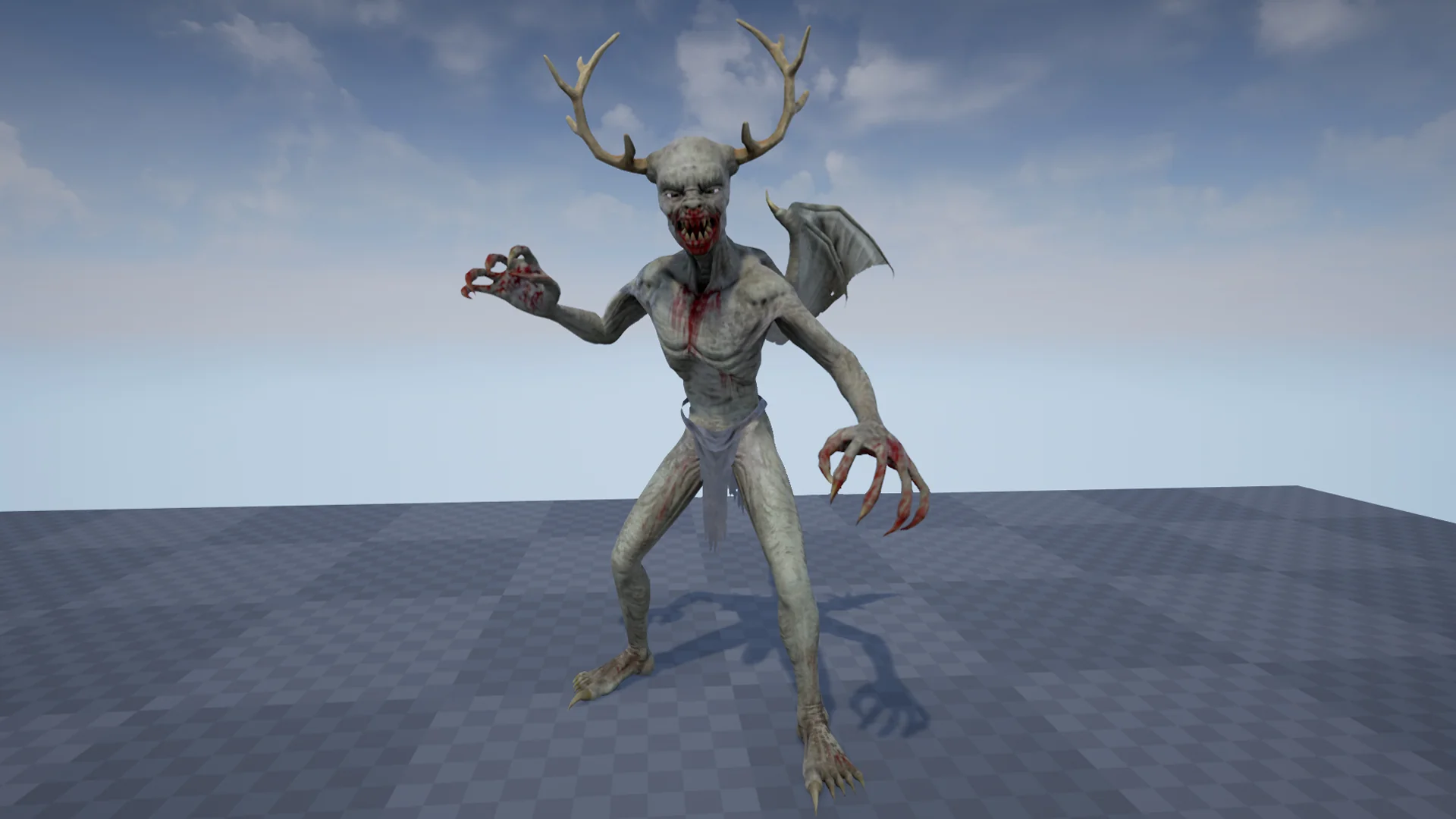
War-torn landscapes, ruined fortresses, and neglected burial grounds frequently require specialized fauna to establish an atmosphere of decay. Rather than relying on generic undead tropes or standard human soldiers, setting designers often turn to specialized carrion beasts to communicate the grim reality of an aftermath. The Undertaker fulfills this exact environmental need, operating as a repulsive scavenger designed to stalk desolate battlefields and graveyard scenes in search of dead flesh.
Environmental Roles for the Undertaker Scavenger
In dark fantasy narratives, the transition between active warfare and prolonged ruin is defined by the scavengers that occupy the space. A creature whose primary biological imperative is consuming post-battle casualties introduces a specific behavioral rhythm to a level. Instead of standing in place waiting for combat initiation, a scavenger of this nature fits naturally into patrol loops through corpse-strewn trenches, circling ruined catacombs, or brooding over fresh graves.
Because the creature is conceptually tied to feeding on remnants left behind after violence, encounter design can focus heavily on ecological storytelling. Placing such an entity over a pile of remains signals immediate narrative weight to an exploring player. Its presence informs the player about the condition of the surrounding world: this is an ecosystem adapted to endless war, where opportunistic beasts thrive directly on the carnage left behind by armies.
Combining grotesque biological features with a realistic artistic execution allows the beast to function in multiple level archetypes. It works equally well as a solitary wandering predator in secluded cemetery clearings or as part of a distributed swarm picking through large-scale siege grounds. The thematic focus on opportunistic scavenging lets developers present combat encounters that feel reactionary rather than militarily organized.
Polygon Distribution and Mesh Structure
Real-time level performance depends heavily on keeping character geometry restrained without degrading silhouette definition. The asset carries a polygon budget of 18 Ktris, landing in a low-poly optimization bracket while maintaining enough structural density to support realistic deformations. Eighteen thousand triangles offer sufficient surface curvature to define leathery muscle groups, bony protrusions, and the jagged, asymmetric contours typical of a scavenger.
Managing organic forms within this triangle budget prevents the model from burdening deformation passes in crowded encounters. In scenes containing several of these beasts alongside landscape elements and environmental effects, keeping each instance at 18 Ktris helps preserve rendering headrooms. Edge flow can concentrate around vital bending regions, preventing pinching across joint junctions while retaining hard anatomical landmarks like rib cages, facial features, and claw structures.
The mesh optimization also ensures that LOD chains can drop cleanly into simplified distances when the creature operates as background set dressing. When players observe a cemetery from high vantage points, an 18 Ktri baseline transitions cleanly across distance stages without collapsing fine structural components.
Skeletal Articulation Across the Undertaker Rig
Articulating a creature that possesses both terrestrial and aerial anatomy requires an extensive skeletal infrastructure. The asset features an 81-bone rig, providing the mechanical support necessary to drive expressive joint movement across its entire body plan. A bone count of this size indicates thorough control over specialized appendages, allowing independent articulation for complex biological appendages alongside basic locomotive limbs.
The creature is equipped with wings, which demand significant joint investment to look natural. Folding, extending, and hovering require progressive bone chains through the wing roots, elbows, and individual digits to avoid stretching the skinning during broad flapping arcs. An 81-bone skeleton provides the technical leeway needed to separate wing motion from the spine and shoulder areas, letting the scavenger react to hits or change movement directions without unnatural rigidity.
Bone distribution also accommodates secondary motion across decorative and physiological components. By isolating skeletal chains for structural sections like the head, jaw, spine, extremities, and lower garments, the rig prevents visual clipping during dynamic poses. This bone density forms a robust platform for procedural physics blending, letting developers layer ragdoll responses or secondary dynamic sway over existing joint transforms.
Material Tiering Across Body, Wings, and Loincloth
Surface detail is managed through three dedicated materials, each assigned an independent texture resolution that reflects its surface area and visual priority on screen. Distributing maps across separate shaders gives creators direct control over rendering pipelines and memory budgeting.
The primary body uses a 4096×4096 texture map, dedicating the highest pixel density to the flesh, head, torso, and legs. Because the core anatomy captures the player's primary attention during close-up encounters, a 4K resolution retains crisp details across sores, sinew, scales, and biological decay. This resolution ensures that close-camera perspectives during execution sequences or dialogue encounters reveal tactile surface definitions without noticeable map blur.
The wings are split into a dedicated 2048×2048 texture pass. Isolating the wings into a separate 2K material is a sensible architectural choice for membrane rendering. Wing surfaces often require unique shader setups, such as custom subsurface scattering or dual-sided lighting equations, to simulate thin, translucent leathery tissue. By separating this geometry from the main body material, graphics programmers can apply specialized shading logic exclusively to the wings without executing costly instruction passes over the entire creature.
The loincloth is mapped to a 1024×1024 texture sheet. Garments and accessory cloth cover substantially less visual area than the torso or appendages, making a 1K map completely adequate for capturing fabric weave, fraying edges, and bloodstains. This tiered allocation of 4K, 2K, and 1K maps demonstrates a practical approach to texel distribution, ensuring memory is concentrated where visible surface area is greatest.
Integrating the 18 Animations into Blueprint Logic
Motion completes the believability of any creature, and this package supplies an 18-animation suite configured for engine implementation. Paired with scripting tools and animation blueprints, these motion clips provide the raw states needed to build an autonomous scavenger behavioral tree.
Eighteen individual animations establish enough state coverage to support locomotion cycles, idle variations, investigative movements, and combat states. A scavenger asset needs more than simple run-and-strike clips; it requires posturing that communicates hesitation, alertness, and aggressive feeding. Transitions between grounded movement, carcass gnawing, and aerial posturing rely on these clips to prevent abrupt visual snapping inside state machines.
The connection to animation blueprints allows direct blending between parametric values and discrete animation playback. Programmers can hook navigation speed variables into locomotion blend spaces, smooth transitions from idle feeding to high-alert combat postures, and trigger montage attacks based on distance tracking. The underlying animation data works in tandem with the 81-bone rig to maintain clean silhouettes regardless of how quickly the AI switches tactical directives.
Production Utility
Games building dark fantasy realms, post-apocalyptic ruins, or grim medieval survival scenarios benefit directly from an asset with this anatomical balance. The Undertaker does not require downsampling or complex re-rigging to run cleanly in standard game loops; its 18 Ktri count, specialized 3-tier material breakdown, and complete 81-bone skeleton provide an immediate, functional asset ready for AI scripting and animation logic.
 Characters
 Characters
 Characters