"7ad89cffa44984cf"{"id":"1002559","slug":"phoenix","title":"Phoenix","category":"Characters \u0026 Creatures","engine":"4.26+,5.0+","assetVersion":"","engineVersion":"Engine Version: 4.26+,5.0+","tag":"Characters","accent":"blue","visual":"character","summary":"Technical implementation of the Phoenix asset, featuring a 25.1 Ktris mesh, 53-bone rig, 34 animations, and panner-driven scrolling fire materials.","platform":"Unreal Engine","indexPolicy":"index","publishedAt":"2026-11-13T10:52:24.146Z","updatedAt":"2026-11-13T10:52:24.146Z","sourceNotes":[],"fileContents":[],"compatibility":["Unreal Engine","Engine Version: 4.26+,5.0+"],"featuredImage":{"alt":"Phoenix","src":"/wp-content/uploads/published/2026/11/fa07ea4e20a2-3b9ad987-2db9-4a5f-a078-bcb8a687bc26-14c152644b.webp"},"hasDownloadLink":true,"downloads":0,"terms":[{"taxonomy":"category","slug":"characters-and-creatures","name":"Characters \u0026 Creatures"}],"galleryImages":[{"src":"/wp-content/uploads/published/2026/11/fc01b0a7ec0e-fd86e9fc-387f-4dfb-8f64-179440d3b784-801bf96b2b.webp","alt":"Phoenix"},{"src":"/wp-content/uploads/published/2026/11/e2cf4959463d-69cedc04-4849-4dc1-b13e-8be0ab4ffa85-fc92f6ae8b.webp","alt":"Phoenix"},{"src":"/wp-content/uploads/published/2026/11/9474b1092d47-52095d43-788a-4077-976a-f71e48bcfb9a-9114ba0445.webp","alt":"Phoenix"},{"src":"/wp-content/uploads/published/2026/11/9dc68a72e921-36fb1fef-4ebb-44d0-93e2-f8d4eaf2c4dd-50a16f5fb0.webp","alt":"Phoenix"},{"src":"/wp-content/uploads/published/2026/11/5cf6c2685574-301ac832-bb18-4473-ac40-b49da82c8f09-1ba0ee0bc0.webp","alt":"Phoenix"}],"accessPanel":{"kind":"resource","title":"Get this resource","eyebrow":"Free resource","message":"Download this resource in your browser.","fileName":"Content.7z","safetyNote":"Resources are manually reviewed before listing to improve quality and reduce obvious risks.","actionLabel":"Get this resource","resourceType":"Resource archive","versions":[]},"contentHtml":"\u003ch2\u003eResolving Aerial Creature Integration in Action Projects\u003c/h2\u003e\u003cp\u003eConstructing a mythical flying antagonist or companion often forces a difficult choice between excessive polygon counts and visual impact.\u003c/p\u003e\u003cp\u003eThe Phoenix resolves this challenge by establishing a balanced geometry profile that sits at 25.1 Ktris, blending realistic anatomical stylization with fantasy design elements. Rather than burdening game scenes with dense, unoptimized sculpts, the model relies on clean edge flow that supports aggressive aerial combat maneuvers, swooping dives, and wide-span wing flaps. The asset provides game developers with an out-of-the-box solution for formidable creature encounters, designed to deploy rapid attacks against opponents without requiring a rebuild of baseline flight physics or deformation meshes.\u003c/p\u003e\u003ch2\u003eConstructing the Phoenix Skeletal Rig and Motion States\u003c/h2\u003e\u003cp\u003eArticulating large-winged avians requires a skeleton capable of driving broad wing surfaces alongside sharp, articulated talons.\u003c/p\u003e\u003cp\u003eA dedicated rig of 53 bones forms the internal structure of the Phoenix, providing the precise pivot distribution needed for multi-jointed feather controls, arched neck movements, and dynamic leg poses. That bone count maintains enough granular control to avoid mesh stretching during extreme wing flexes while remaining efficient during batch skeletal evaluations. Paired with this skeleton is a comprehensive library of 34 animations suited for diverse combat environments. The roster includes grounded behavior, airborne navigation, aggressive strikes, and recovery cycles, giving developers broad coverage for complex combat encounters.\u003c/p\u003e\u003cp\u003eAmong the 34 included motion clips, 4 feature root motion variations.\u003c/p\u003e\u003cp\u003eRoot motion implementation allows the creature's forward translation, lunges, and tactical dashes to be driven directly by the animation data rather than solely through capsule velocity scripts. This separation ensures that heavy combat strikes carry weight and physical presence, eliminating foot-sliding artifacts when the creature touches down or executes sweeping low-altitude charges. The remaining 30 standard in-place clips provide smooth transitions for classic directional locomotion blends, banking flight paths, and hover sequences.\u003c/p\u003e\u003ch2\u003eDual Material Layering and the Panner Flame Effect\u003c/h2\u003e\u003cp\u003eSimulating perpetual fire across an organic, moving creature often incurs severe processing spikes when handled solely through unoptimized particle emitters.\u003c/p\u003e\u003cp\u003eTo combat this, the character utilizes a two-material setup that divides rendering tasks cleanly between physical flesh and elemental fire. The main avian body is textured at a crisp 4096\u0026sup2; resolution, providing high-frequency surface details across feathers, talons, and facial structures. This high-density map guarantees visual clarity even during close-range camera sweeps, cinematic boss reveals, or dramatic finishing sequences where high-resolution geometry and texture definition are necessary.\u003c/p\u003e\u003cp\u003eThe secondary material manages the flame effects across the body through a dedicated 1024\u0026sup2; texture map.\u003c/p\u003e\u003cp\u003eIntegrated directly within the flame material graph is a panner node, configured to scroll the fire texture continuously across the creature's UV layout. This approach generates dynamic, flowing visual fire that ripples across the crest, wings, and tail without generating heavy fill-rate bottlenecks. By utilizing a panner shader instead of stacking dozens of overlapping particle cards, the asset sustains the illusion of a blazing mythical beast while keeping shader complexity tightly bounded across dense scene compositions.\u003c/p\u003e\u003ch2\u003eHarnessing Phoenix Animationblueprint Systems and Script Support\u003c/h2\u003e\u003cp\u003eSetting up character logic for flying entities typically demands a complex web of transition logic between aerial states and terrestrial locomotion.\u003c/p\u003e\u003cp\u003eThe asset incorporates Animationblueprint logic alongside script functionality, offering a pre-configured architecture for blending its 34 animation cycles. The state machine logic easily handles the blend transitions between soaring idle poses, high-velocity flap cycles, hit reactions, and sudden attack bursts. Developers can tie standard gameplay inputs or AI behavior trees directly into the locomotion state machine, switching smoothly between standard in-place flight networks and root-motion-driven offensive maneuvers with predictable frame-to-frame interpolation.\u003c/p\u003e\u003cp\u003eProject continuity is maintained through structural compatibility with the Farm Animals Pack.\u003c/p\u003e\u003cp\u003eThis compatibility guarantees that naming conventions, socket designations, and character logic structures align seamlessly with broader animal packs in the same project ecosystem. Developers scaling up their creature rosters can drop the Phoenix into existing state machines and companion systems without rewriting foundational animal navigation logic or rebuilding AI behavioral trees from scratch.\u003c/p\u003e\u003ch2\u003ePlatform Target Profiles and Hardware Efficiency\u003c/h2\u003e\u003cp\u003eBalancing visual fidelity against rigid frame-time budgets is a mandatory phase of technical art pipelines.\u003c/p\u003e\u003cp\u003eThe Phoenix is engineered for deployment on PC, Mac, and latest-generation console platforms, targeting systems capable of handling modern multi-pass lighting and high-resolution texture streaming. The 25.1 Ktris budget functions as a sweet spot on modern hardware: light enough to run concurrently in scenes containing complex environments and high actor counts, yet sufficiently detailed to avoid geometric silhouette degradation when viewed against dynamic skyboxes or close to the player's viewport.\u003c/p\u003e\u003cp\u003eMemory allocation follows a lean, disciplined structure across the entire asset.\u003c/p\u003e\u003cp\u003eThe dual-texture configuration—pairing a 4K body texture with a lightweight 1K flame texture—ensures that VRAM footprint remains predictable during gameplay. The 53-bone skeleton minimizes skinning performance costs on the CPU and GPU, ensuring the model fits comfortably into large-scale boss arenas, dynamic raid sequences, or open-world aerial encounters where frame stability is paramount.\u003c/p\u003e\n\n\u003ch2\u003eRelated Resources Worth Checking\u003c/h2\u003e\n\u003cul\u003e\n\u003cli\u003e\u003ca href=\"https://3dcghub.com/darkness-spider/\" rel=\"noopener noreferrer\"\u003eDarkness Spider\u003c/a\u003e\u003c/li\u003e\n\u003cli\u003e\u003ca href=\"https://3dcghub.com/black-dragon/\" rel=\"noopener noreferrer\"\u003eBlack Dragon\u003c/a\u003e\u003c/li\u003e\n\u003cli\u003e\u003ca href=\"https://3dcghub.com/crocodile/\" rel=\"noopener noreferrer\"\u003eCROCODILE\u003c/a\u003e\u003c/li\u003e\n\u003cli\u003e\u003ca href=\"https://3dcghub.com/heroic-fantasy-bosses-reaper/\" rel=\"noopener noreferrer\"\u003eHeroic Fantasy Bosses: Reaper\u003c/a\u003e\u003c/li\u003e\n\u003cli\u003e\u003ca href=\"https://3dcghub.com/giant-viper/\" rel=\"noopener noreferrer\"\u003eGiant Viper\u003c/a\u003e\u003c/li\u003e\n\u003c/ul\u003e","contentTextLength":6127,"navigation":{"current":18,"total":4499,"previous":{"id":"1002560","slug":"polygon-city-zombies-low-poly-urban-zombie-character-pack","title":"POLYGON - City Zombies - Low Poly Urban Zombie Character Pack","category":"Characters \u0026 Creatures","platform":"Unreal Engine","updatedAt":"2026-11-13T10:56:06.391Z"},"next":{"id":"1002558","slug":"pbr-creature","title":"PBR Creature","category":"Characters \u0026 Creatures","platform":"Unreal Engine","updatedAt":"2026-11-13T10:50:56.597Z"}},"relatedResources":[{"id":"1002430","slug":"darkness-spider","title":"Darkness Spider","category":"Characters \u0026 Creatures","engine":"4.26+,5.0+","assetVersion":"","engineVersion":"Engine Version: 4.26+,5.0+","tag":"Characters","accent":"blue","visual":"character","summary":"Technical review of Darkness Spider, featuring 6.2 Ktris geometry, a 61-bone rig, 4K textures, 22 animations, and AnimationBlueprint integration.","platform":"Unreal Engine","indexPolicy":"index","publishedAt":"2026-11-10T18:26:38.496Z","updatedAt":"2026-11-10T18:26:38.496Z","sourceNotes":[],"fileContents":[],"compatibility":["Unreal Engine","Engine Version: 4.26+,5.0+"],"featuredImage":{"alt":"Darkness Spider","src":"/wp-content/uploads/published/2026/11/f3b879ba1cb8-f32667a7-e261-4eb4-b45b-4e66c1f5b187-98451b7b38.webp"},"hasDownloadLink":true,"downloads":0},{"id":"1002508","slug":"black-dragon","title":"Black Dragon","category":"Characters \u0026 Creatures","engine":"4.15+,5.0+","assetVersion":"","engineVersion":"Engine Version: 4.15+,5.0+","tag":"Characters","accent":"blue","visual":"character","summary":"A technical breakdown of the Black Dragon asset, examining its 32 Ktris geometry, 105-bone rig, dual-material setup, 4K textures, and 22 animations.","platform":"Unreal Engine","indexPolicy":"index","publishedAt":"2026-11-13T08:22:50.098Z","updatedAt":"2026-11-13T08:22:50.098Z","sourceNotes":[],"fileContents":[],"compatibility":["Unreal Engine","Engine Version: 4.15+,5.0+"],"featuredImage":{"alt":"Black Dragon","src":"/wp-content/uploads/published/2026/11/57ed55afd22d-4b325e15-b03d2a6228.webp"},"hasDownloadLink":true,"downloads":0},{"id":"1002425","slug":"crocodile","title":"CROCODILE","category":"Characters \u0026 Creatures","engine":"4.15+,5.0+","assetVersion":"","engineVersion":"Engine Version: 4.15+,5.0+","tag":"Characters","accent":"blue","visual":"character","summary":"Technical implementation details for the realistic Crocodile asset, featuring 3 LOD levels, a 48-bone rig, 4K textures, and 16 animations.","platform":"Unreal Engine","indexPolicy":"index","publishedAt":"2026-11-10T18:18:15.717Z","updatedAt":"2026-11-10T18:18:15.717Z","sourceNotes":[],"fileContents":[],"compatibility":["Unreal Engine","Engine Version: 4.15+,5.0+"],"featuredImage":{"alt":"CROCODILE","src":"/wp-content/uploads/published/2026/11/585e29a0fb4b-80b1994a-20db5d498a.webp"},"hasDownloadLink":true,"downloads":0}]}
Characters
Phoenix
Technical implementation of the Phoenix asset, featuring a 25.1 Ktris mesh, 53-bone rig, 34 animations, and panner-driven scrolling fire materials.
Resolving Aerial Creature Integration in Action Projects
Constructing a mythical flying antagonist or companion often forces a difficult choice between excessive polygon counts and visual impact.
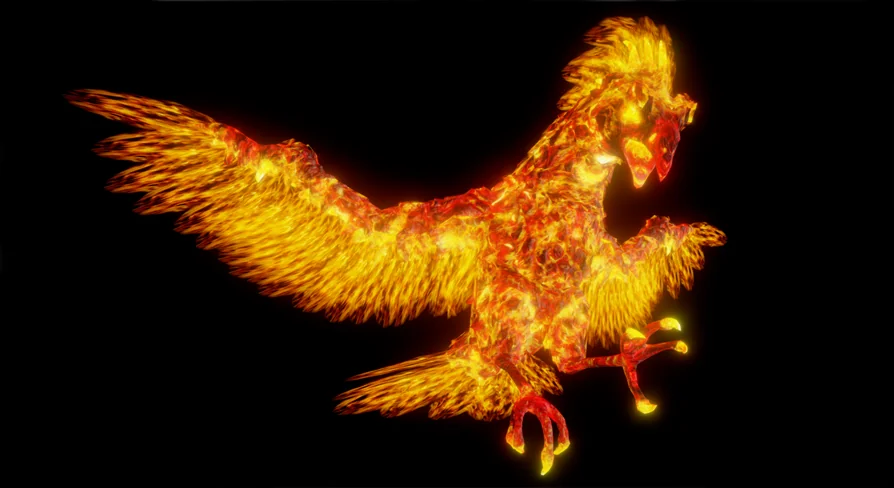
The Phoenix resolves this challenge by establishing a balanced geometry profile that sits at 25.1 Ktris, blending realistic anatomical stylization with fantasy design elements. Rather than burdening game scenes with dense, unoptimized sculpts, the model relies on clean edge flow that supports aggressive aerial combat maneuvers, swooping dives, and wide-span wing flaps. The asset provides game developers with an out-of-the-box solution for formidable creature encounters, designed to deploy rapid attacks against opponents without requiring a rebuild of baseline flight physics or deformation meshes.
Constructing the Phoenix Skeletal Rig and Motion States
Articulating large-winged avians requires a skeleton capable of driving broad wing surfaces alongside sharp, articulated talons.
A dedicated rig of 53 bones forms the internal structure of the Phoenix, providing the precise pivot distribution needed for multi-jointed feather controls, arched neck movements, and dynamic leg poses. That bone count maintains enough granular control to avoid mesh stretching during extreme wing flexes while remaining efficient during batch skeletal evaluations. Paired with this skeleton is a comprehensive library of 34 animations suited for diverse combat environments. The roster includes grounded behavior, airborne navigation, aggressive strikes, and recovery cycles, giving developers broad coverage for complex combat encounters.
Among the 34 included motion clips, 4 feature root motion variations.
Root motion implementation allows the creature's forward translation, lunges, and tactical dashes to be driven directly by the animation data rather than solely through capsule velocity scripts. This separation ensures that heavy combat strikes carry weight and physical presence, eliminating foot-sliding artifacts when the creature touches down or executes sweeping low-altitude charges. The remaining 30 standard in-place clips provide smooth transitions for classic directional locomotion blends, banking flight paths, and hover sequences.
Dual Material Layering and the Panner Flame Effect
Simulating perpetual fire across an organic, moving creature often incurs severe processing spikes when handled solely through unoptimized particle emitters.
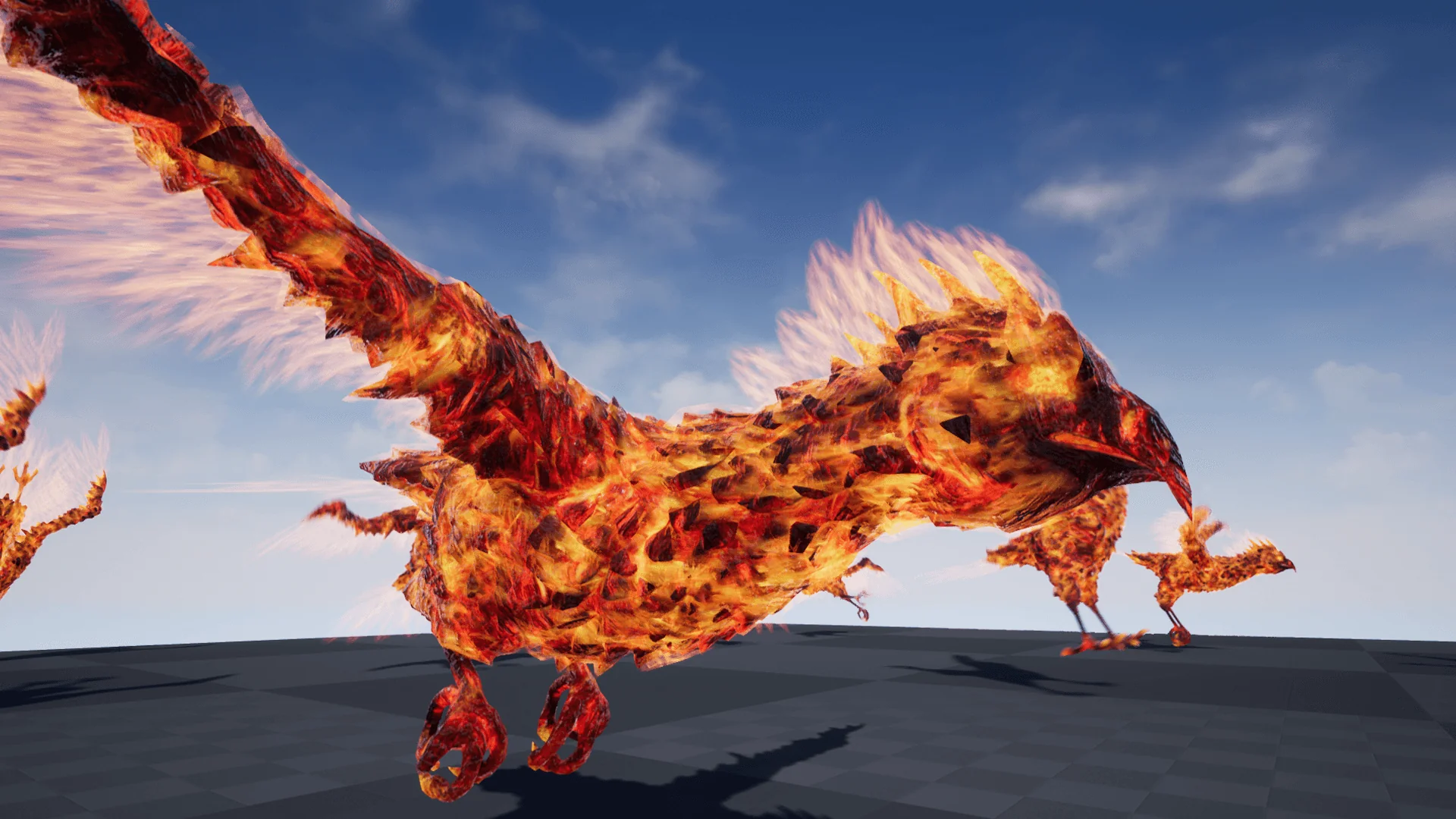
To combat this, the character utilizes a two-material setup that divides rendering tasks cleanly between physical flesh and elemental fire. The main avian body is textured at a crisp 4096² resolution, providing high-frequency surface details across feathers, talons, and facial structures. This high-density map guarantees visual clarity even during close-range camera sweeps, cinematic boss reveals, or dramatic finishing sequences where high-resolution geometry and texture definition are necessary.
The secondary material manages the flame effects across the body through a dedicated 1024² texture map.
Integrated directly within the flame material graph is a panner node, configured to scroll the fire texture continuously across the creature's UV layout. This approach generates dynamic, flowing visual fire that ripples across the crest, wings, and tail without generating heavy fill-rate bottlenecks. By utilizing a panner shader instead of stacking dozens of overlapping particle cards, the asset sustains the illusion of a blazing mythical beast while keeping shader complexity tightly bounded across dense scene compositions.
Harnessing Phoenix Animationblueprint Systems and Script Support
Setting up character logic for flying entities typically demands a complex web of transition logic between aerial states and terrestrial locomotion.
The asset incorporates Animationblueprint logic alongside script functionality, offering a pre-configured architecture for blending its 34 animation cycles. The state machine logic easily handles the blend transitions between soaring idle poses, high-velocity flap cycles, hit reactions, and sudden attack bursts. Developers can tie standard gameplay inputs or AI behavior trees directly into the locomotion state machine, switching smoothly between standard in-place flight networks and root-motion-driven offensive maneuvers with predictable frame-to-frame interpolation.
Project continuity is maintained through structural compatibility with the Farm Animals Pack.
This compatibility guarantees that naming conventions, socket designations, and character logic structures align seamlessly with broader animal packs in the same project ecosystem. Developers scaling up their creature rosters can drop the Phoenix into existing state machines and companion systems without rewriting foundational animal navigation logic or rebuilding AI behavioral trees from scratch.
Platform Target Profiles and Hardware Efficiency
Balancing visual fidelity against rigid frame-time budgets is a mandatory phase of technical art pipelines.
The Phoenix is engineered for deployment on PC, Mac, and latest-generation console platforms, targeting systems capable of handling modern multi-pass lighting and high-resolution texture streaming. The 25.1 Ktris budget functions as a sweet spot on modern hardware: light enough to run concurrently in scenes containing complex environments and high actor counts, yet sufficiently detailed to avoid geometric silhouette degradation when viewed against dynamic skyboxes or close to the player's viewport.
Memory allocation follows a lean, disciplined structure across the entire asset.
The dual-texture configuration—pairing a 4K body texture with a lightweight 1K flame texture—ensures that VRAM footprint remains predictable during gameplay. The 53-bone skeleton minimizes skinning performance costs on the CPU and GPU, ensuring the model fits comfortably into large-scale boss arenas, dynamic raid sequences, or open-world aerial encounters where frame stability is paramount.
 Characters
 Characters
 Characters
 Characters