"82ee98b2ee2793f1"{"id":"1002434","slug":"giant-viper","title":"Giant Viper","category":"Characters \u0026 Creatures","engine":"4.15+,5.0+","assetVersion":"","engineVersion":"Engine Version: 4.15+,5.0+","tag":"Characters","accent":"blue","visual":"character","summary":"Low-poly Giant Viper creature model featuring 4.52 Ktris, 31 bones, 21 animations with root motion, single-material 2048x2048 textures, and 5 color variations.","platform":"Unreal Engine","indexPolicy":"index","publishedAt":"2026-11-10T18:30:25.159Z","updatedAt":"2026-11-10T18:30:25.159Z","sourceNotes":[],"fileContents":[],"compatibility":["Unreal Engine","Engine Version: 4.15+,5.0+"],"featuredImage":{"alt":"Giant Viper","src":"/wp-content/uploads/published/2026/11/653d1d24cc6d-6894143a-3e33-401f-a8b8-281b4d825fb0-7a645d247c.webp"},"hasDownloadLink":true,"downloads":0,"terms":[{"taxonomy":"category","slug":"characters-and-creatures","name":"Characters \u0026 Creatures"}],"galleryImages":[{"src":"/wp-content/uploads/published/2026/11/f306f50d28f0-42d44ebd-a764-4649-ae9d-2b38fdfdb7ac-6698fbfbd3.webp","alt":"Giant Viper"},{"src":"/wp-content/uploads/published/2026/11/f591db1dc219-9f790057-f1e9-4da7-a5a3-5fbc74acd1e8-bdf625938a.webp","alt":"Giant Viper"},{"src":"/wp-content/uploads/published/2026/11/50b3ed14f0ae-bd3844d2-4016-4768-b6ac-257aa7caa1f8-2dcf46e93c.webp","alt":"Giant Viper"},{"src":"/wp-content/uploads/published/2026/11/d2debb18b1da-1deef0ab-d25f-423f-994a-1dfe39278352-bd10229d7b.webp","alt":"Giant Viper"},{"src":"/wp-content/uploads/published/2026/11/c289ebf8b28c-1468f692-f5a2-4b5f-99bf-7f161e52ec21-3aa82f292b.webp","alt":"Giant Viper"}],"accessPanel":{"kind":"resource","title":"Get this resource","eyebrow":"Free resource","message":"Download this resource in your browser.","fileName":"Content.7z","safetyNote":"Resources are manually reviewed before listing to improve quality and reduce obvious risks.","actionLabel":"Get this resource","resourceType":"Resource archive","versions":[]},"contentHtml":"\u003cp\u003eSlithering across the ground to intercept nearby targets and strike with lethal force defines the core presence of the Giant Viper in an interactive scene. Rather than standing idle as a decorative prop, the creature functions as an immediate threat designed to actively close distances on approaching players. Hostile encounters rely heavily on the visual rhythm of predatory reptiles, where smooth undulating travel transitions suddenly into rapid lunges and lethal bites. Delivering that kind of creature behavior in real-time requires tightly coordinated motion systems, clean skeletal articulation, and a balanced geometric footprint that keeps performance stable even when multiple serpents share the screen.\u003c/p\u003e \u003ch2\u003eLocomotion Logic and the Giant Viper Animation Blueprint\u003c/h2\u003e \u003cp\u003eSerpentine movement presents unique challenges in game engines because snakes lack limbs to anchor locomotion through traditional foot-planting. The Giant Viper handles movement and combat through a full suite of 21 animations, engineered to support both scripted encounters and dynamic pathfinding. Seven of these clips are designated root motion variations, which drive character displacement directly through the root transform of the rig. Root motion avoids the unnatural visual sliding often seen when relying purely on linear capsule movement, allowing the viper's coils to propel it across uneven ground with authentic weight and momentum.\u003c/p\u003e \u003cp\u003eThe remaining 14 animations serve standard in-place locomotion, combat transitions, and ambient actions. By pairing these motions with an included script and Animationblueprint, the asset establishes a reliable logic tree for handling state changes. The setup permits quick transitions between resting coils, tracking movement, and aggressive biting sequences triggered as soon as an intruder enters proximity. Having dedicated root motion and in-place variants side by side gives developers the freedom to choose whether the physics capsule should follow the mesh or whether custom navigation code should dictate position during complex pursuit sequences.\u003c/p\u003e \u003ch2\u003eArticulating the Thirty-One Bone Serpentine Rig\u003c/h2\u003e \u003cp\u003eUnderneath the skin, a 31-bone skeletal structure drives the viper's body deformation. Without legs, arms, or wings, all thirty-one bones are concentrated where they matter most: along the extended spine, through the tail, and inside the skull. Distributing this bone count along the central axis gives the mesh enough flexible nodes to execute convincing S-curves and curling postures without pinching or severe volume loss.\u003c/p\u003e \u003cp\u003eAt the anterior end, the rig dedicates specific bone transforms to the head and jaw. This enables wide, sudden biting actions that open the mouth cleanly to snap shut on targets. The bone count remains compact enough to avoid heavy transform evaluation costs on the CPU, making the skeleton easy to blend within dynamic aim offsets, procedural look-at targets, or hit-reaction nodes without bottlenecking real-time animation pipelines.\u003c/p\u003e \u003ch2\u003ePolygon Budget and Realism in the Giant Viper Mesh\u003c/h2\u003e \u003cp\u003eWith an exact geometry count of 4.52 Ktris (4,520 triangles), the Giant Viper sits firmly in the low-poly bracket while maintaining a realistic aesthetic style. Sculpting an organic, scaly reptile at this density requires careful poly distribution along the silhouette. The edge loops support bending across the body's natural curvature during tight slithering arcs without breaking the illusion of smooth, continuous anatomy.\u003c/p\u003e \u003cp\u003eBecause the triangle budget is held to 4.52 Ktris, the asset fits naturally into environments where creature density must remain high. Encounter designs that spawn nests, ambushes, or clusters of snakes can leverage this lightweight geometry to preserve high frame rates on lower-spec hardware or dense open-world levels. The geometry strikes an effective middle ground: it avoids the coarse, blocky outlines typical of minimal stylized assets while steering clear of heavy multi-subdivision meshes that demand aggressive level-of-detail management.\u003c/p\u003e \u003ch2\u003eTexturing Surface Detail Through Five Color Variations\u003c/h2\u003e \u003cp\u003eSurfacing for the Giant Viper relies on a single material assignment utilizing 2048\u0026times;2048 textures. Restricting the entire creature to one material slot limits the draw call cost to a single pass per instance, which significantly streamlines rendering in multi-enemy battles. The 2048\u0026times;2048 texture resolution provides sufficient pixel density across the elongated UV space, ensuring that scale patterns, belly plates, and facial features stay crisp during close-up camera angles and bite sequences.\u003c/p\u003e \u003cp\u003eFive distinct color variations are included, offering instant visual diversity across different biomes or encounter tiers. Developers can assign alternate palettes to distinguish regional variants—such as jungle, desert, or swamp serpents—or to indicate differing threat levels among enemies sharing the same base geometry. Swapping between the five patterns requires no adjustments to the underlying mesh or rigging, keeping character variation modular and quick to configure across varied level designs.\u003c/p\u003e \u003ch2\u003eEcosystem Compatibility and Production Deployment\u003c/h2\u003e \u003cp\u003eBeyond isolated combat usage, the Giant Viper carries compatibility with the Farm Animals Pack, fitting alongside a wider ecosystem of creatures built on common conventions. The combined categorization across fantasy and realistic genres allows the asset to operate across differing creative goals. It can serve equally well as an authentic wild predator stalking through tall grass or as a dangerous beast guarding forgotten ruins in a fantasy campaign.\u003c/p\u003e \u003cp\u003eDeploying the asset into an active project takes advantage of the ready-made script logic and Animationblueprint, minimizing the setup work needed to bring a fully functioning reptile from the content browser into runtime gameplay. For projects seeking an optimized, animated serpent that crawls forward and attacks without complex setup hurdles, the Giant Viper delivers a balanced, production-ready creature built to strike hard right out of the box.\u003c/p\u003e\n\n\u003ch2\u003eContinue Browsing Similar Packs\u003c/h2\u003e\n\u003cul\u003e\n\u003cli\u003e\u003ca href=\"https://3dcghub.com/giant-scorpion/\" rel=\"noopener noreferrer\"\u003eGiant Scorpion\u003c/a\u003e\u003c/li\u003e\n\u003cli\u003e\u003ca href=\"https://3dcghub.com/z-mech-robot-giant/\" rel=\"noopener noreferrer\"\u003eZ-Mech Robot Giant\u003c/a\u003e\u003c/li\u003e\n\u003cli\u003e\u003ca href=\"https://3dcghub.com/crocodile/\" rel=\"noopener noreferrer\"\u003eCROCODILE\u003c/a\u003e\u003c/li\u003e\n\u003cli\u003e\u003ca href=\"https://3dcghub.com/darkness-spider/\" rel=\"noopener noreferrer\"\u003eDarkness Spider\u003c/a\u003e\u003c/li\u003e\n\u003cli\u003e\u003ca href=\"https://3dcghub.com/bird-band/\" rel=\"noopener noreferrer\"\u003eBird Band\u003c/a\u003e\u003c/li\u003e\n\u003c/ul\u003e","contentTextLength":6144,"navigation":{"current":16,"total":4372,"previous":{"id":"1002435","slug":"mosquitos-pack","title":"Mosquitos pack","category":"Insects","platform":"Unreal Engine","updatedAt":"2026-11-10T18:31:05.012Z"},"next":{"id":"1002433","slug":"flamingo-animated","title":"Flamingo Animated","category":"Birds","platform":"Unreal Engine","updatedAt":"2026-11-10T18:29:46.252Z"}},"relatedResources":[{"id":"1001093","slug":"giant-scorpion","title":"Giant Scorpion","category":"Characters \u0026 Creatures","engine":"4.26+,5.0+","assetVersion":"","engineVersion":"Engine Version: 4.26+,5.0+","tag":"Characters","accent":"blue","visual":"character","summary":"Meet the Giant Scorpion: a 19.9K-tris fantasy creature with 66 bones, 4K textures, and 31 quality animations, including 8 root motion variants.","platform":"Unreal Engine","indexPolicy":"index","publishedAt":"2026-09-06T01:44:11.719Z","updatedAt":"2026-09-06T01:44:11.719Z","sourceNotes":[],"fileContents":[],"compatibility":["Unreal Engine","Engine Version: 4.26+,5.0+"],"featuredImage":{"alt":"Giant Scorpion","src":"/wp-content/uploads/published/2026/09/e8762bf85bc7-b1ed6d72-b3c0-48de-a7fd-aa90ce42c951-44d013474e.webp"},"hasDownloadLink":true,"downloads":0},{"id":"1002401","slug":"z-mech-robot-giant","title":"Z-Mech Robot Giant","category":"Characters \u0026 Creatures","engine":"4.26+,5.0+","assetVersion":"","engineVersion":"Engine Version: 4.26+,5.0+","tag":"Characters","accent":"blue","visual":"character","summary":"Examine the Z-Mech Robot Giant character mesh, its Epic skeleton integration, animation blueprint setup, and Combat Missile Pack compatibility.","platform":"Unreal Engine","indexPolicy":"index","publishedAt":"2026-11-10T04:31:06.426Z","updatedAt":"2026-11-10T04:31:06.426Z","sourceNotes":[],"fileContents":[],"compatibility":["Unreal Engine","Engine Version: 4.26+,5.0+"],"featuredImage":{"alt":"Z-Mech Robot Giant","src":"/wp-content/uploads/published/2026/11/a82c9967c4ca-d8a647fc-dded-41f7-8fdd-5727d7de6f38-2dfc2f2420.webp"},"hasDownloadLink":true,"downloads":0},{"id":"1002425","slug":"crocodile","title":"CROCODILE","category":"Characters \u0026 Creatures","engine":"4.15+,5.0+","assetVersion":"","engineVersion":"Engine Version: 4.15+,5.0+","tag":"Characters","accent":"blue","visual":"character","summary":"Technical implementation details for the realistic Crocodile asset, featuring 3 LOD levels, a 48-bone rig, 4K textures, and 16 animations.","platform":"Unreal Engine","indexPolicy":"index","publishedAt":"2026-11-10T18:18:15.717Z","updatedAt":"2026-11-10T18:18:15.717Z","sourceNotes":[],"fileContents":[],"compatibility":["Unreal Engine","Engine Version: 4.15+,5.0+"],"featuredImage":{"alt":"CROCODILE","src":"/wp-content/uploads/published/2026/11/585e29a0fb4b-80b1994a-20db5d498a.webp"},"hasDownloadLink":true,"downloads":0}]}
Characters
Giant Viper
Low-poly Giant Viper creature model featuring 4.52 Ktris, 31 bones, 21 animations with root motion, single-material 2048x2048 textures, and 5 color variations.
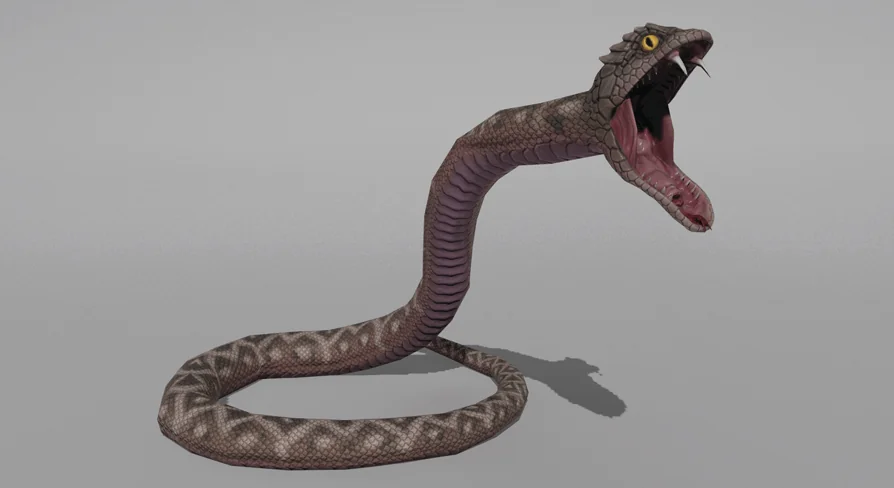
Slithering across the ground to intercept nearby targets and strike with lethal force defines the core presence of the Giant Viper in an interactive scene. Rather than standing idle as a decorative prop, the creature functions as an immediate threat designed to actively close distances on approaching players. Hostile encounters rely heavily on the visual rhythm of predatory reptiles, where smooth undulating travel transitions suddenly into rapid lunges and lethal bites. Delivering that kind of creature behavior in real-time requires tightly coordinated motion systems, clean skeletal articulation, and a balanced geometric footprint that keeps performance stable even when multiple serpents share the screen.
Locomotion Logic and the Giant Viper Animation Blueprint
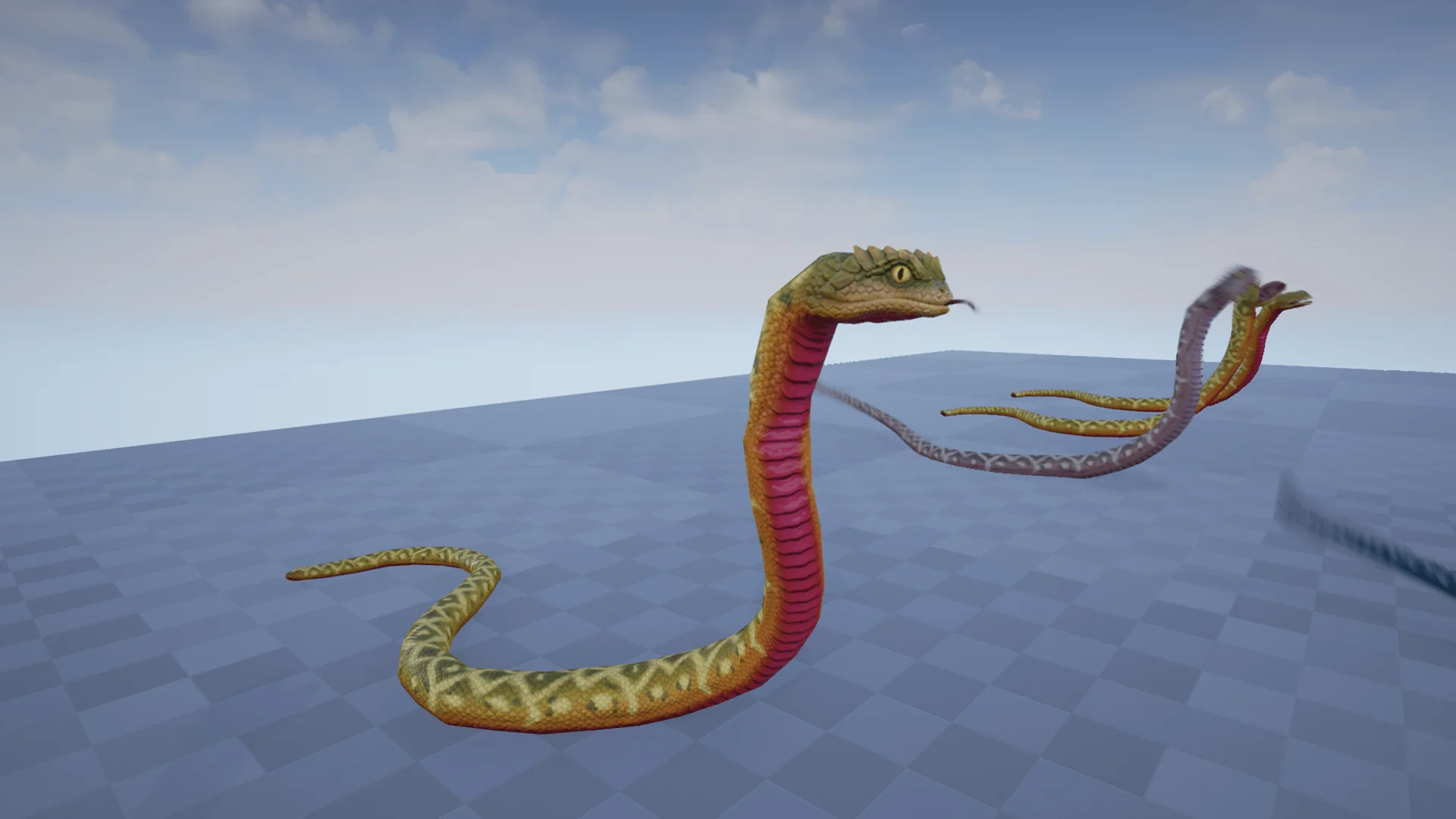
Serpentine movement presents unique challenges in game engines because snakes lack limbs to anchor locomotion through traditional foot-planting. The Giant Viper handles movement and combat through a full suite of 21 animations, engineered to support both scripted encounters and dynamic pathfinding. Seven of these clips are designated root motion variations, which drive character displacement directly through the root transform of the rig. Root motion avoids the unnatural visual sliding often seen when relying purely on linear capsule movement, allowing the viper's coils to propel it across uneven ground with authentic weight and momentum.
The remaining 14 animations serve standard in-place locomotion, combat transitions, and ambient actions. By pairing these motions with an included script and Animationblueprint, the asset establishes a reliable logic tree for handling state changes. The setup permits quick transitions between resting coils, tracking movement, and aggressive biting sequences triggered as soon as an intruder enters proximity. Having dedicated root motion and in-place variants side by side gives developers the freedom to choose whether the physics capsule should follow the mesh or whether custom navigation code should dictate position during complex pursuit sequences.
Articulating the Thirty-One Bone Serpentine Rig
Underneath the skin, a 31-bone skeletal structure drives the viper's body deformation. Without legs, arms, or wings, all thirty-one bones are concentrated where they matter most: along the extended spine, through the tail, and inside the skull. Distributing this bone count along the central axis gives the mesh enough flexible nodes to execute convincing S-curves and curling postures without pinching or severe volume loss.
At the anterior end, the rig dedicates specific bone transforms to the head and jaw. This enables wide, sudden biting actions that open the mouth cleanly to snap shut on targets. The bone count remains compact enough to avoid heavy transform evaluation costs on the CPU, making the skeleton easy to blend within dynamic aim offsets, procedural look-at targets, or hit-reaction nodes without bottlenecking real-time animation pipelines.
Polygon Budget and Realism in the Giant Viper Mesh
With an exact geometry count of 4.52 Ktris (4,520 triangles), the Giant Viper sits firmly in the low-poly bracket while maintaining a realistic aesthetic style. Sculpting an organic, scaly reptile at this density requires careful poly distribution along the silhouette. The edge loops support bending across the body's natural curvature during tight slithering arcs without breaking the illusion of smooth, continuous anatomy.
Because the triangle budget is held to 4.52 Ktris, the asset fits naturally into environments where creature density must remain high. Encounter designs that spawn nests, ambushes, or clusters of snakes can leverage this lightweight geometry to preserve high frame rates on lower-spec hardware or dense open-world levels. The geometry strikes an effective middle ground: it avoids the coarse, blocky outlines typical of minimal stylized assets while steering clear of heavy multi-subdivision meshes that demand aggressive level-of-detail management.
Texturing Surface Detail Through Five Color Variations
Surfacing for the Giant Viper relies on a single material assignment utilizing 2048×2048 textures. Restricting the entire creature to one material slot limits the draw call cost to a single pass per instance, which significantly streamlines rendering in multi-enemy battles. The 2048×2048 texture resolution provides sufficient pixel density across the elongated UV space, ensuring that scale patterns, belly plates, and facial features stay crisp during close-up camera angles and bite sequences.
Five distinct color variations are included, offering instant visual diversity across different biomes or encounter tiers. Developers can assign alternate palettes to distinguish regional variants—such as jungle, desert, or swamp serpents—or to indicate differing threat levels among enemies sharing the same base geometry. Swapping between the five patterns requires no adjustments to the underlying mesh or rigging, keeping character variation modular and quick to configure across varied level designs.
Ecosystem Compatibility and Production Deployment
Beyond isolated combat usage, the Giant Viper carries compatibility with the Farm Animals Pack, fitting alongside a wider ecosystem of creatures built on common conventions. The combined categorization across fantasy and realistic genres allows the asset to operate across differing creative goals. It can serve equally well as an authentic wild predator stalking through tall grass or as a dangerous beast guarding forgotten ruins in a fantasy campaign.
Deploying the asset into an active project takes advantage of the ready-made script logic and Animationblueprint, minimizing the setup work needed to bring a fully functioning reptile from the content browser into runtime gameplay. For projects seeking an optimized, animated serpent that crawls forward and attacks without complex setup hurdles, the Giant Viper delivers a balanced, production-ready creature built to strike hard right out of the box.
 Characters
 Characters
 Characters
 Characters