"82ee98b2ee2793f1"{"id":"1002435","slug":"mosquitos-pack","title":"Mosquitos pack","category":"Insects","engine":"4.26+,5.0+","assetVersion":"","engineVersion":"Engine Version: 4.26+,5.0+","tag":"Insects","accent":"blue","visual":"mech","summary":"Explore the Mosquitos pack, featuring two low-poly giant insect models, dual texture options, and fifteen animations for fantasy and horror projects.","platform":"Unreal Engine","indexPolicy":"index","publishedAt":"2026-11-10T18:31:05.012Z","updatedAt":"2026-11-10T18:31:05.012Z","sourceNotes":[],"fileContents":[],"compatibility":["Unreal Engine","Engine Version: 4.26+,5.0+"],"featuredImage":{"alt":"Mosquitos pack","src":"/wp-content/uploads/published/2026/11/49421058b755-3b17dba1-0476-490f-8688-4c59f19f3831-9f2af67047.webp"},"hasDownloadLink":true,"downloads":0,"terms":[{"taxonomy":"category","slug":"insects","name":"Insects"}],"galleryImages":[{"src":"/wp-content/uploads/published/2026/11/71864c99b839-9b292d40-eefd-49df-9d42-f7b033f79872-9455a6296f.webp","alt":"Mosquitos pack"},{"src":"/wp-content/uploads/published/2026/11/60473f4be693-1ae965ff-c3ca-4921-9e2a-7b5e4c1ca3b5-c172e3c8d9.webp","alt":"Mosquitos pack"},{"src":"/wp-content/uploads/published/2026/11/2669f8422b9e-dca23e0c-333f-46d9-994a-990572eda00f-0deb2aa4d3.webp","alt":"Mosquitos pack"},{"src":"/wp-content/uploads/published/2026/11/29a520ba687a-6a3e6f5b-7bc4-4be1-b36c-65743a048d0f-2b463f0712.webp","alt":"Mosquitos pack"},{"src":"/wp-content/uploads/published/2026/11/361990775b98-d5039ab1-5364-48c7-b930-8e0ff9f1e9af-0ce69e31a8.webp","alt":"Mosquitos pack"}],"accessPanel":{"kind":"resource","title":"Get this resource","eyebrow":"Free resource","message":"Download this resource in your browser.","fileName":"Content.7z","safetyNote":"Resources are manually reviewed before listing to improve quality and reduce obvious risks.","actionLabel":"Get this resource","resourceType":"Resource archive","versions":[]},"contentHtml":"\u003cp\u003eSubterranean dungeons, stagnant swamp basins, and overgrown jungle valleys thrive on threats that deny characters safe ground. When an airborne predator stalks from above, traditional environmental cover quickly loses its defensive value. Mosquitos pack introduces massive, parasitic flying monsters built to disrupt exploration across fantasy, horror, and adventure settings. These creatures are not modest ambient insects; they are portrayed as dangerous, merciless beasts equipped with sharp stings and strong claws, intent on draining both the blood and the souls of careless adventurers. Bringing predatory airborne vermin into a project fundamentally shifts how players scan their surroundings, compelling them to look toward damp cavern ceilings and tangled jungle branches rather than watching only the stone flagstones or mud underfoot.\u003c/p\u003e \u003ch2\u003eStaging Aerial Horror Across Dungeons and Swamps with Mosquitos\u003c/h2\u003e \u003cp\u003eHostile creature design often leans heavily toward humanoid opponents or grounded beasts, leaving the vertical layer of combat spaces underutilized. Giant mosquitoes occupy this aerial band naturally. In swamp biomes, murky water and thick reeds obscure low-lying hazards, making a swarm of hovering bloodsuckers an immediate spatial danger. The narrative framing of these monsters—creatures that drink souls alongside blood—opens up distinct encounter opportunities within fantasy dungeons and crypts where lingering dark magic or vampiric curses hold sway.\u003c/p\u003e \u003cp\u003eBecause these monsters are merciless and relentless, encounter encounters benefit from positioning them as sudden ambushers. Dropping a pair of giant stingers out of the fog above a marsh or unleashing a swarm from a darkened ruin vault immediately ratchets up pressure. Players cannot simply kite them along standard navigational meshes, as flying adversaries ignore floor-bound obstacles that would impede ordinary beasts. Their presence forces characters to reconsider defensive perimeters, manage line of sight against elevated targets, and react quickly when an insect lunges down with sharp stings and claws bared.\u003c/p\u003e \u003ch2\u003eMesh Structure and Textures in the Mosquitos Pack\u003c/h2\u003e \u003cp\u003eVisual variety and geometry control are critical when fielding enemy types that commonly appear in packs or swarms. Mosquitos pack addresses this need by providing two separate mosquito variations, each paired with distinct polygon budgets suited for real-time applications:\u003c/p\u003e \u003cul\u003e \u003cli\u003eMosquito 1: 2,661 polygons\u003c/li\u003e \u003cli\u003eMosquito 2: 2,492 polygons\u003c/li\u003e\n\u003c/ul\u003e \u003cp\u003eBoth models remain comfortably within low-poly thresholds while preserving the sharp silhouettes and segmented anatomy essential for realistic giant insect horror. Keeping polygon counts under 2,700 triangles allows developers to deploy several specimens concurrently without overloading rendering budgets or skeletal processing pipelines. This level of optimization fits mob encounters where multiple buzzing enemies harass the player at once.\u003c/p\u003e \u003cp\u003eTo prevent uniform repetition across multiple enemies, each mosquito model includes two different texture variations. Swapping between these texture schemes enables creators to establish distinct caste structures or biological variations within an encounter. A developer might assign one texture scheme to standard scouts encountered in outer jungle perimeters, while reserving the alternate texture variant for deadlier soul-draining variants inhabiting deep dungeon chambers. Distributing the two meshes and their accompanying textures across a single scene breaks visual monotony and gives swarms an organic, chaotic look.\u003c/p\u003e \u003ch2\u003eThe Mosquitos Pack Motion Set and Combat States\u003c/h2\u003e \u003cp\u003eMechanical responsiveness in action-oriented creature design depends entirely on the underlying animation library. Mosquitos pack includes a comprehensive suite of fifteen animations designed to handle locomotion, offensive actions, and defensive reactions across dynamic gameplay loops.\u003c/p\u003e \u003cp\u003eLocomotion covers both flight mechanics and ground interactions. The package supplies an idle state alongside a run animation, allowing the monster to scuttle across surfaces when grounded or cornered. Transitioning into the air is managed via dedicated flying start and flying end clips, which cleanly bridge ground contact and airborne patrolling. Once airborne, two distinct flight profiles give developers options for different operational velocities, such as slow, predatory hovering during search phases and aggressive forward flight when closing the distance on an intruder.\u003c/p\u003e \u003cp\u003eOffensive actions center on the creature's natural weaponry. Three separate sting variations are included, providing a selection of attack profiles. These distinct animations allow creators to alternate between quick probing stings, deep puncture strikes, or heavier attacks intended to represent the extraction of vitality and soul essence. By alternating between the three sting animations, combat encounters avoid repetitive attack telegraphing, forcing players to read different wind-ups and react with timely dodges or parries.\u003c/p\u003e \u003cp\u003eDamage feedback is equally thorough. The pack features directional hit reactions from four sides—front, back, left, and right. Having directional hit animations ensures that the mosquito visibly flinches in accordance with incoming projectile angles, melee swings, or spell impacts. When lethal damage is dealt, two death animations accommodate final down states, allowing the giant creature to collapse convincingly whether engaged on the ground or swatted out of the air.\u003c/p\u003e \u003ch2\u003eEnvironmental Alignment and Implementation Scope\u003c/h2\u003e \u003cp\u003eThe visual identity of these monsters aligns closely with fantasy, horror, swamp, and dungeon tags, making them versatile foes across diverse biome types. Whether serving as minions in a necromancer's crypt, apex predators in a festering mire, or sudden airborne surprises in a dense jungle canopy, their low-poly structure and realistic detailing support sustained combat encounters. The asset also notes White castle compatibility, facilitating integration within supported pipeline ecosystems.\u003c/p\u003e \u003cp\u003eDeploying the package into a project provides a ready-made enemy archetype that bridges aerial mobility with specialized predatory attacks. With two distinct models, four total texture options, and fifteen dedicated animation states covering everything from directional impacts to varied sting deliveries, the pack equips developers with the functional components needed to populate treacherous wilderness and subterranean levels with relentless, soul-drinking horrors.\u003c/p\u003e\n\n\u003ch2\u003eMore From The Same Workflow\u003c/h2\u003e\n\u003cul\u003e\n\u003cli\u003e\u003ca href=\"https://3dcghub.com/armored-beetle-pack/\" rel=\"noopener noreferrer\"\u003eArmored Beetle Pack\u003c/a\u003e\u003c/li\u003e\n\u003cli\u003e\u003ca href=\"https://3dcghub.com/dangerous-fly/\" rel=\"noopener noreferrer\"\u003eDangerous Fly\u003c/a\u003e\u003c/li\u003e\n\u003cli\u003e\u003ca href=\"https://3dcghub.com/natural-and-insects-p1/\" rel=\"noopener noreferrer\"\u003eNatural And Insects P1\u003c/a\u003e\u003c/li\u003e\n\u003cli\u003e\u003ca href=\"https://3dcghub.com/wasps-pack/\" rel=\"noopener noreferrer\"\u003eWasps pack\u003c/a\u003e\u003c/li\u003e\n\u003cli\u003e\u003ca href=\"https://3dcghub.com/bloodthirsty-beetle/\" rel=\"noopener noreferrer\"\u003eBloodthirsty Beetle\u003c/a\u003e\u003c/li\u003e\n\u003c/ul\u003e","contentTextLength":6596,"navigation":{"current":15,"total":4372,"previous":{"id":"1002436","slug":"mutant-rat-mouse","title":"Mutant Rat Mouse","category":"Characters \u0026 Creatures","platform":"Unreal Engine","updatedAt":"2026-11-10T18:31:52.675Z"},"next":{"id":"1002434","slug":"giant-viper","title":"Giant Viper","category":"Characters \u0026 Creatures","platform":"Unreal Engine","updatedAt":"2026-11-10T18:30:25.159Z"}},"relatedResources":[{"id":"1000219","slug":"armored-beetle-pack","title":"Armored Beetle Pack","category":"Insects","engine":"4.26+,5.0+","assetVersion":"","engineVersion":"Engine Version: 4.26+,5.0+","tag":"Insects","accent":"blue","visual":"mech","summary":"A detailed breakdown of the Armored Beetle Pack, featuring dual UE4/UE5 rigging setups, custom bone hierarchies, and extensive combat animation libraries.","platform":"Unreal Engine","indexPolicy":"index","publishedAt":"2026-06-26T13:37:10.021Z","updatedAt":"2026-06-26T13:37:10.021Z","sourceNotes":[],"fileContents":[],"compatibility":["Unreal Engine","Engine Version: 4.26+,5.0+"],"featuredImage":{"alt":"Armored Beetle Pack","src":"/wp-content/uploads/published/2026/06/6f1d5060365e-9f32e83f-b5a2-44f4-8822-b569c203d353-d5e3808fc7.webp"},"hasDownloadLink":true,"downloads":0},{"id":"2810","slug":"dangerous-fly","title":"Dangerous Fly","category":"Insects","engine":"4.26+,5.0+","assetVersion":"Engine version: 4.26+,5.0+","engineVersion":"4.20","tag":"Insects","accent":"blue","visual":"character","summary":"Enhance your game with this high-quality low poly fly model. Perfect for RPGs and horror games, it features an animation blueprint for easy integration.","platform":"Unreal Engine","indexPolicy":"noindex","publishedAt":"2026-02-07T15:28:09.000Z","updatedAt":"2026-04-19T15:57:58.000Z","sourceNotes":[],"fileContents":[],"compatibility":["Unreal Engine","Engine version: 4.26+,5.0+"],"featuredImage":{"alt":"Dangerous Fly","src":"https://3dcghub.com/wp-content/uploads/2026/02/cc503ff2-1303-4a05-a93d-ed99ec7f224b.webp"},"hasDownloadLink":true,"downloads":1},{"id":"17639","slug":"natural-and-insects-p1","title":"Natural And Insects P1","category":"Weather","engine":"4.26+,5.0+","assetVersion":"Engine version: 4.26+,5.0+","engineVersion":"4.26","tag":"Weather","accent":"blue","visual":"audio","summary":"Enhance your digital environments with Natural And Insects P1, a collection featuring animated insects and dynamic Niagara effects. This pack includes everything from attacking bees to interactive autumn leaves for realistic nature scenes.","platform":"Unreal Engine","indexPolicy":"index","publishedAt":"2026-03-13T15:02:38.000Z","updatedAt":"2026-04-19T15:43:29.000Z","sourceNotes":[],"fileContents":[],"compatibility":["Unreal Engine","Engine version: 4.26+,5.0+"],"featuredImage":{"alt":"Natural And Insects P1","src":"https://3dcghub.com/wp-content/uploads/2026/03/1078180b-3406-4eb6-8e6b-e18b002a3002.webp"},"hasDownloadLink":true,"downloads":0}]}
Insects
Mosquitos pack
Explore the Mosquitos pack, featuring two low-poly giant insect models, dual texture options, and fifteen animations for fantasy and horror projects.
Category:Unreal Engine,InsectsPlatform: Unreal EngineEngine Version: 4.26+,5.0+Published: Nov 10, 2026
Insects
Resource overview
Subterranean dungeons, stagnant swamp basins, and overgrown jungle valleys thrive on threats that deny characters safe ground. When an airborne predator stalks from above, traditional environmental cover quickly loses its defensive value. Mosquitos pack introduces massive, parasitic flying monsters built to disrupt exploration across fantasy, horror, and adventure settings. These creatures are not modest ambient insects; they are portrayed as dangerous, merciless beasts equipped with sharp stings and strong claws, intent on draining both the blood and the souls of careless adventurers. Bringing predatory airborne vermin into a project fundamentally shifts how players scan their surroundings, compelling them to look toward damp cavern ceilings and tangled jungle branches rather than watching only the stone flagstones or mud underfoot.
Staging Aerial Horror Across Dungeons and Swamps with Mosquitos
Hostile creature design often leans heavily toward humanoid opponents or grounded beasts, leaving the vertical layer of combat spaces underutilized. Giant mosquitoes occupy this aerial band naturally. In swamp biomes, murky water and thick reeds obscure low-lying hazards, making a swarm of hovering bloodsuckers an immediate spatial danger. The narrative framing of these monsters—creatures that drink souls alongside blood—opens up distinct encounter opportunities within fantasy dungeons and crypts where lingering dark magic or vampiric curses hold sway.
Because these monsters are merciless and relentless, encounter encounters benefit from positioning them as sudden ambushers. Dropping a pair of giant stingers out of the fog above a marsh or unleashing a swarm from a darkened ruin vault immediately ratchets up pressure. Players cannot simply kite them along standard navigational meshes, as flying adversaries ignore floor-bound obstacles that would impede ordinary beasts. Their presence forces characters to reconsider defensive perimeters, manage line of sight against elevated targets, and react quickly when an insect lunges down with sharp stings and claws bared.
Mesh Structure and Textures in the Mosquitos Pack
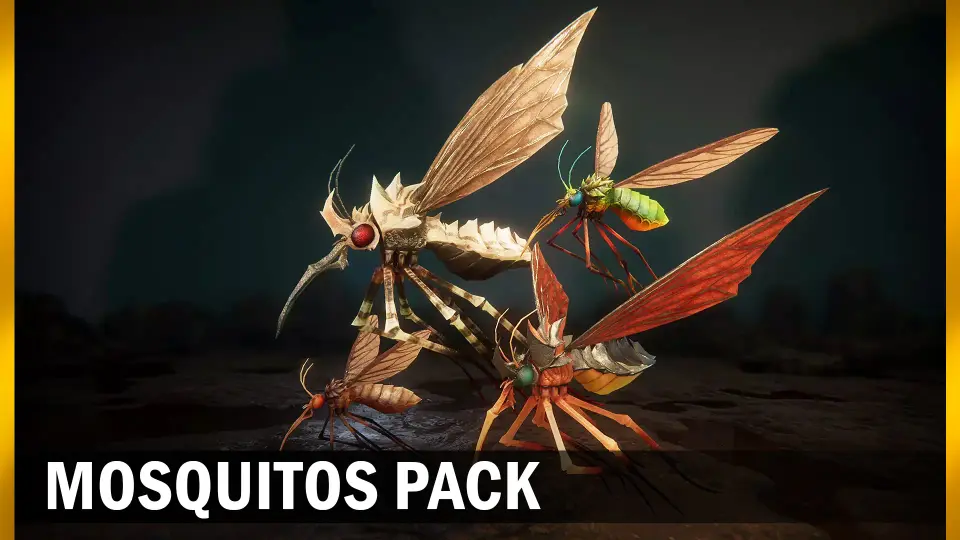
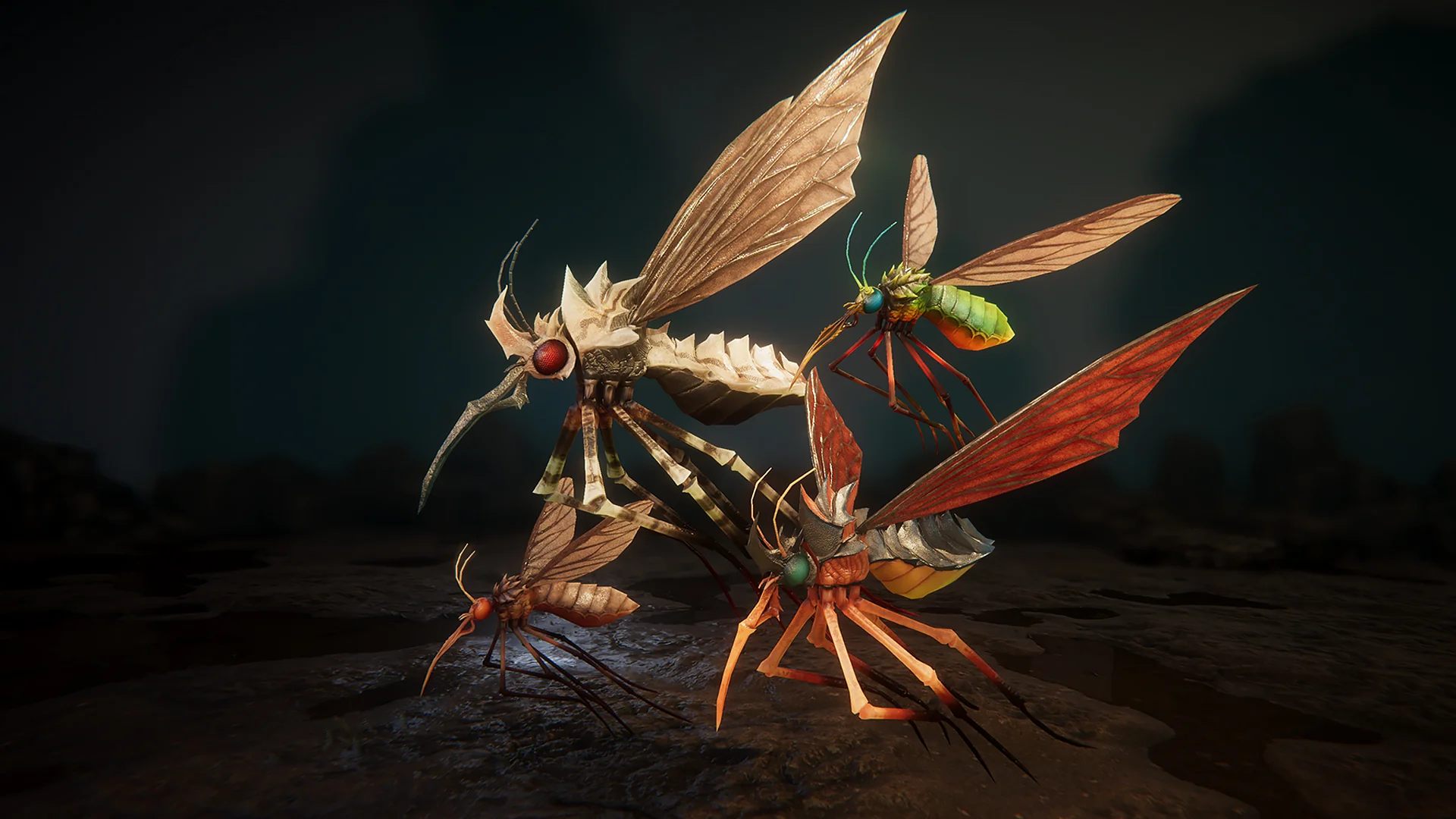
Visual variety and geometry control are critical when fielding enemy types that commonly appear in packs or swarms. Mosquitos pack addresses this need by providing two separate mosquito variations, each paired with distinct polygon budgets suited for real-time applications:
Mosquito 1: 2,661 polygons
Mosquito 2: 2,492 polygons
Both models remain comfortably within low-poly thresholds while preserving the sharp silhouettes and segmented anatomy essential for realistic giant insect horror. Keeping polygon counts under 2,700 triangles allows developers to deploy several specimens concurrently without overloading rendering budgets or skeletal processing pipelines. This level of optimization fits mob encounters where multiple buzzing enemies harass the player at once.
To prevent uniform repetition across multiple enemies, each mosquito model includes two different texture variations. Swapping between these texture schemes enables creators to establish distinct caste structures or biological variations within an encounter. A developer might assign one texture scheme to standard scouts encountered in outer jungle perimeters, while reserving the alternate texture variant for deadlier soul-draining variants inhabiting deep dungeon chambers. Distributing the two meshes and their accompanying textures across a single scene breaks visual monotony and gives swarms an organic, chaotic look.
The Mosquitos Pack Motion Set and Combat States
Mechanical responsiveness in action-oriented creature design depends entirely on the underlying animation library. Mosquitos pack includes a comprehensive suite of fifteen animations designed to handle locomotion, offensive actions, and defensive reactions across dynamic gameplay loops.
Locomotion covers both flight mechanics and ground interactions. The package supplies an idle state alongside a run animation, allowing the monster to scuttle across surfaces when grounded or cornered. Transitioning into the air is managed via dedicated flying start and flying end clips, which cleanly bridge ground contact and airborne patrolling. Once airborne, two distinct flight profiles give developers options for different operational velocities, such as slow, predatory hovering during search phases and aggressive forward flight when closing the distance on an intruder.
Offensive actions center on the creature's natural weaponry. Three separate sting variations are included, providing a selection of attack profiles. These distinct animations allow creators to alternate between quick probing stings, deep puncture strikes, or heavier attacks intended to represent the extraction of vitality and soul essence. By alternating between the three sting animations, combat encounters avoid repetitive attack telegraphing, forcing players to read different wind-ups and react with timely dodges or parries.
Damage feedback is equally thorough. The pack features directional hit reactions from four sides—front, back, left, and right. Having directional hit animations ensures that the mosquito visibly flinches in accordance with incoming projectile angles, melee swings, or spell impacts. When lethal damage is dealt, two death animations accommodate final down states, allowing the giant creature to collapse convincingly whether engaged on the ground or swatted out of the air.
Environmental Alignment and Implementation Scope
The visual identity of these monsters aligns closely with fantasy, horror, swamp, and dungeon tags, making them versatile foes across diverse biome types. Whether serving as minions in a necromancer's crypt, apex predators in a festering mire, or sudden airborne surprises in a dense jungle canopy, their low-poly structure and realistic detailing support sustained combat encounters. The asset also notes White castle compatibility, facilitating integration within supported pipeline ecosystems.
Deploying the package into a project provides a ready-made enemy archetype that bridges aerial mobility with specialized predatory attacks. With two distinct models, four total texture options, and fifteen dedicated animation states covering everything from directional impacts to varied sting deliveries, the pack equips developers with the functional components needed to populate treacherous wilderness and subterranean levels with relentless, soul-drinking horrors.
 Insects
 Insects
 Insects
 Weather