"82ee98b2ee2793f1"{"id":"1002425","slug":"crocodile","title":"CROCODILE","category":"Characters \u0026 Creatures","engine":"4.15+,5.0+","assetVersion":"","engineVersion":"Engine Version: 4.15+,5.0+","tag":"Characters","accent":"blue","visual":"character","summary":"Technical implementation details for the realistic Crocodile asset, featuring 3 LOD levels, a 48-bone rig, 4K textures, and 16 animations.","platform":"Unreal Engine","indexPolicy":"index","publishedAt":"2026-11-10T18:18:15.717Z","updatedAt":"2026-11-10T18:18:15.717Z","sourceNotes":[],"fileContents":[],"compatibility":["Unreal Engine","Engine Version: 4.15+,5.0+"],"featuredImage":{"alt":"CROCODILE","src":"/wp-content/uploads/published/2026/11/585e29a0fb4b-80b1994a-20db5d498a.webp"},"hasDownloadLink":true,"downloads":0,"terms":[{"taxonomy":"category","slug":"characters-and-creatures","name":"Characters \u0026 Creatures"}],"galleryImages":[{"src":"/wp-content/uploads/published/2026/11/0ee52974ffe9-984238fa-071837e927.webp","alt":"CROCODILE"},{"src":"/wp-content/uploads/published/2026/11/e1c912e0d786-06f2a996-5e5a9e688c.webp","alt":"CROCODILE"},{"src":"/wp-content/uploads/published/2026/11/e5fe27bd56c4-84e2d022-fc09ad8fcc.webp","alt":"CROCODILE"},{"src":"/wp-content/uploads/published/2026/11/4e22ef258454-f32f6e33-d3df12a31e.webp","alt":"CROCODILE"},{"src":"/wp-content/uploads/published/2026/11/d10a9d73deb0-e06bc841-67c7d1c075.webp","alt":"CROCODILE"}],"accessPanel":{"kind":"resource","title":"Get this resource","eyebrow":"Free resource","message":"Download this resource in your browser.","fileName":"Content.7z","safetyNote":"Resources are manually reviewed before listing to improve quality and reduce obvious risks.","actionLabel":"Get this resource","resourceType":"Resource archive","versions":[]},"contentHtml":"\u003cp\u003ePopulating aquatic hazards and natural water systems requires animal models that balance visual density with predictable runtime performance. Representing a dangerous predator intended for swamp, river, and savanna biomes, this crocodile asset provides real-time projects with an optimized creature setup. Packaged as part of the African Animals Pack and maintaining direct compatibility with the Farm Animals Pack, the asset supplies dedicated animation blueprints, scripting hooks, and layered LOD meshes built for PC, Mac, and current-generation consoles.\u003c/p\u003e\u003ch2\u003eRiver and Savanna Wetland Implementation\u003c/h2\u003e\u003cp\u003eReptilian predators in digital ecosystems operate under distinct behavioral demands. Swamps, muddy riverbanks, and savanna watering holes rely on realistic animal behavior to establish ecological immersion or active gameplay threats. Because river areas often feature dense foliage, water surface shaders, and translucent materials, wildlife assets placed along shorelines must maintain a restrained technical footprint to avoid compounding rendering bottlenecks.\u003c/p\u003e\u003cp\u003eThis crocodile asset addresses those scene constraints by pairing a realistic visual style with low-poly construction standards. By structuring the mesh to function cleanly within dynamic water setups, the asset works equally well when idling half-submerged along shallow riverbeds or patrolling open savanna waterways. The underlying design accommodates scripted AI encounters, systemic wildlife behaviors, or direct encounter scripting where a dangerous presence is required near water hazards.\u003c/p\u003e\u003ch2\u003eLOD Stepping and Mesh Optimization for the Crocodile Model\u003c/h2\u003e\u003cp\u003eThe geometric budget of the crocodile is divided across three explicit Level of Detail (LOD) steps. These gradations allow graphics pipelines to throttle polygon counts based on camera proximity, preserving skeletal silhouette integrity at close range while shedding dense topology over distance.\u003c/p\u003e\u003cp\u003eThe base mesh, LOD0, is built at 8.12 thousand triangles (8.12 Ktris). This baseline level provides enough edge loops to support realistic muscle flexion along the flanks, snout curvature, claw definition, and the jagged dorsal scutes running down the spine and tail. When viewed up close during encounter sequences, the mesh retains sharp profile definition without collapsing into geometric faceting.\u003c/p\u003e\u003cp\u003eLOD1 steps down to 7.89 thousand triangles (7.89 Ktris). This intermediate stage executes an initial reduction pass, targeting micro-facets along less prominent areas while sustaining the primary skeletal deformations needed for mid-range viewing. The transition avoids dramatic silhouette popping when transitioning between the first two stages.\u003c/p\u003e\u003cp\u003eLOD2 reduces the geometry further to 5.95 thousand triangles (5.95 Ktris). At this distance, fine surface subdivisions on the underbelly, extremities, and tail are collapsed into broader polygonal forms. This final tier allows multiple instances of the creature to populate large river expanses or savanna wetlands simultaneously without overwhelming draw calls or vertex processing on target hardware.\u003c/p\u003e\u003ch2\u003eCrocodile Rigging Architecture Across 48 Bones\u003c/h2\u003e\u003cp\u003eDeforming a heavy, elongated reptilian body requires a skeleton that can handle extreme horizontal curves, undulating tail movement, and grounded limb placement. The crocodile features a dedicated rig constructed from 48 bones. This bone count delivers a focused structural framework without the overhead of overly complex secondary deformer chains.\u003c/p\u003e\u003cp\u003eWithin a 48-bone layout, skeletal weighting is allocated to capture the signature motion of crocodilians. Multiple spine segments run from the pelvic girdle through the dorsal region to the neck, allowing the torso to twist naturally as the animal navigates terrain contours. The tail requires successive bone links to achieve smooth lateral propulsion during swimming sequences and whip-like ground adjustments.\u003c/p\u003e\u003cp\u003eThe cranial and jaw rigging provides articulate mouth control, essential for snapping attacks, defensive threat postures, and feeding interactions. Limb hierarchies account for the low-slung, sprawling gait typical of river predators, ensuring the shoulders, elbows, wrists, hips, and foot clusters rotate cleanly without pinching surface vertices around the joints.\u003c/p\u003e\u003ch2\u003eSingle-Material Shading and 4096x4096 Texture Mapping\u003c/h2\u003e\u003cp\u003eDraw call management is critical when rendering multiple dynamic characters in outdoor environments. The crocodile utilizes a single material setup, consolidating all surface instructions into a unified shader call. By avoiding multi-material splits across the head, body, and teeth, the renderer processes the animal in a single pass per mesh instance.\u003c/p\u003e\u003cp\u003eSurface fidelity is driven by high-resolution 4096\u0026times;4096 (4K) textures. Mapping an entire quadruped onto a single 4K texture sheet preserves high texel density across every surface quadrant. Fine details—such as the rough texture of individual scales, leathery skin creases along the lateral folds, smooth ventral plates, and the reflective moisture characteristic of river predators—are preserved without stepping down to smaller, blurry maps.\u003c/p\u003e\u003cp\u003eThis unified high-resolution texture map balances clean rendering on large 4K displays with efficient asset streaming. Because only one material needs to be bound, graphics memory bandwidth remains stable even during complex swamp scenes where post-processing, volumetric fog, and planar water reflections compete for GPU resources.\u003c/p\u003e\u003ch2\u003eAnimation Blueprint Setup and Locomotion Behaviors\u003c/h2\u003e\u003cp\u003eCharacter motion is supported through an included suite of 16 animations, accompanied by an Animation Blueprint and script structure intended for rapid character controller integration. The library contains the fundamental motions necessary to drive a predatory reptile across both land and aquatic surfaces.\u003c/p\u003e\u003cp\u003eAmong the 16 included animation sequences, 3 clips are built specifically as root motion variations. Root motion locks the physical movement of the character capsule directly to the underlying bone displacement authored in the animation data. This prevents foot sliding during heavy turns, sudden forward lunges, or directional water strikes, anchoring the 48-bone skeleton realistically against the terrain.\u003c/p\u003e\u003cp\u003eThe remaining in-place animations integrate directly into standard state machines within the Animation Blueprint. These sequences allow blend spaces to calculate locomotion speeds dynamically, interpolating smoothly between idling, crawling, swimming, and aggressive responses based on variables passed by gameplay scripts. Having dedicated script and blueprint assets ready out of the box minimizes technical setup time when wiring the crocodile into custom AI navigation systems.\u003c/p\u003e\u003ch2\u003eCross-Pack Integration and Target Platforms\u003c/h2\u003e\u003cp\u003eThe asset fits directly into broader wildlife ecosystems, being included as part of the African Animals Pack while retaining explicit structural compatibility with the Farm Animals Pack. This shared design philosophy guarantees that skeletal conventions, animation paradigms, and material scales remain aligned when mixing assets across regional biomes. Developers can transition assets between exotic wilderness reserves and domestic river boundary scenarios without encountering conflicting technical configurations.\u003c/p\u003e\u003cp\u003eDeployment profiles are aligned with modern interactive standards. The asset is configured for deployment on PC, Mac, and latest-generation consoles. Across these platforms, the 8.12 Ktris maximum budget, 48-bone hierarchy, single 4K material, and 16-clip animation set deliver dependable performance, making the crocodile a solid component for demanding swamp, river, and savanna productions.\u003c/p\u003e\n\n\u003ch2\u003eExplore Similar Assets\u003c/h2\u003e\n\u003cul\u003e\n\u003cli\u003e\u003ca href=\"https://3dcghub.com/realistic-crocodile/\" rel=\"noopener noreferrer\"\u003eRealistic Crocodile\u003c/a\u003e\u003c/li\u003e\n\u003cli\u003e\u003ca href=\"https://3dcghub.com/android-robot/\" rel=\"noopener noreferrer\"\u003eAndroid Robot\u003c/a\u003e\u003c/li\u003e\n\u003cli\u003e\u003ca href=\"https://3dcghub.com/flying-monster/\" rel=\"noopener noreferrer\"\u003eFlying Monster\u003c/a\u003e\u003c/li\u003e\n\u003cli\u003e\u003ca href=\"https://3dcghub.com/cyberpunk-girl-2/\" rel=\"noopener noreferrer\"\u003eCyberpunk Girl\u003c/a\u003e\u003c/li\u003e\n\u003cli\u003e\u003ca href=\"https://3dcghub.com/npc-blacksmith/\" rel=\"noopener noreferrer\"\u003eNPC Blacksmith\u003c/a\u003e\u003c/li\u003e\n\u003c/ul\u003e","contentTextLength":7747,"navigation":{"current":25,"total":4372,"previous":{"id":"1002426","slug":"cute-kitten","title":"Cute Kitten","category":"Characters \u0026 Creatures","platform":"Unreal Engine","updatedAt":"2026-11-10T18:20:17.778Z"},"next":{"id":"1002424","slug":"cats-pack","title":"Cats Pack","category":"Animals","platform":"Unreal Engine","updatedAt":"2026-11-10T18:17:42.387Z"}},"relatedResources":[{"id":"1000396","slug":"realistic-crocodile","title":"Realistic Crocodile","category":"Characters \u0026 Creatures","engine":"5.2+","assetVersion":"","engineVersion":"Engine Version: 5.2+","tag":"Characters","accent":"blue","visual":"character","summary":"A highly customizable 3D crocodile asset featuring scalable bones, blendshapes, AAA animations, and a stylized Poly Art version for diverse environments.","platform":"Unreal Engine","indexPolicy":"index","publishedAt":"2026-07-07T15:23:45.665Z","updatedAt":"2026-07-07T15:23:45.665Z","sourceNotes":[],"fileContents":[],"compatibility":["Unreal Engine","Engine Version: 5.2+"],"featuredImage":{"alt":"Realistic Crocodile","src":"/wp-content/uploads/published/2026/07/1b55b470afa5-eedc8feb-f2c9-4cad-bcb7-db06151b4742-eeb2adf2ac.webp"},"hasDownloadLink":true,"downloads":1},{"id":"1002434","slug":"giant-viper","title":"Giant Viper","category":"Characters \u0026 Creatures","engine":"4.15+,5.0+","assetVersion":"","engineVersion":"Engine Version: 4.15+,5.0+","tag":"Characters","accent":"blue","visual":"character","summary":"Low-poly Giant Viper creature model featuring 4.52 Ktris, 31 bones, 21 animations with root motion, single-material 2048x2048 textures, and 5 color variations.","platform":"Unreal Engine","indexPolicy":"index","publishedAt":"2026-11-10T18:30:25.159Z","updatedAt":"2026-11-10T18:30:25.159Z","sourceNotes":[],"fileContents":[],"compatibility":["Unreal Engine","Engine Version: 4.15+,5.0+"],"featuredImage":{"alt":"Giant Viper","src":"/wp-content/uploads/published/2026/11/653d1d24cc6d-6894143a-3e33-401f-a8b8-281b4d825fb0-7a645d247c.webp"},"hasDownloadLink":true,"downloads":0},{"id":"1002378","slug":"android-robot","title":"Android Robot","category":"Characters \u0026 Creatures","engine":"4.17+,5.0+","assetVersion":"","engineVersion":"Engine Version: 4.17+,5.0+","tag":"Characters","accent":"blue","visual":"character","summary":"Examine the technical details of the Android Robot, featuring three LOD levels, four 4K PBR texture sets, full skeletal rigging, and sixteen animations.","platform":"Unreal Engine","indexPolicy":"index","publishedAt":"2026-11-10T03:54:44.127Z","updatedAt":"2026-11-10T03:54:44.127Z","sourceNotes":[],"fileContents":[],"compatibility":["Unreal Engine","Engine Version: 4.17+,5.0+"],"featuredImage":{"alt":"Android Robot","src":"/wp-content/uploads/published/2026/11/e52ed5e4e773-5786987b-f513-4126-ac35-0fbf86d982e0-165186e3c3.webp"},"hasDownloadLink":true,"downloads":0}]}
Characters
CROCODILE
Technical implementation details for the realistic Crocodile asset, featuring 3 LOD levels, a 48-bone rig, 4K textures, and 16 animations.
Populating aquatic hazards and natural water systems requires animal models that balance visual density with predictable runtime performance. Representing a dangerous predator intended for swamp, river, and savanna biomes, this crocodile asset provides real-time projects with an optimized creature setup. Packaged as part of the African Animals Pack and maintaining direct compatibility with the Farm Animals Pack, the asset supplies dedicated animation blueprints, scripting hooks, and layered LOD meshes built for PC, Mac, and current-generation consoles.
River and Savanna Wetland Implementation
Reptilian predators in digital ecosystems operate under distinct behavioral demands. Swamps, muddy riverbanks, and savanna watering holes rely on realistic animal behavior to establish ecological immersion or active gameplay threats. Because river areas often feature dense foliage, water surface shaders, and translucent materials, wildlife assets placed along shorelines must maintain a restrained technical footprint to avoid compounding rendering bottlenecks.
This crocodile asset addresses those scene constraints by pairing a realistic visual style with low-poly construction standards. By structuring the mesh to function cleanly within dynamic water setups, the asset works equally well when idling half-submerged along shallow riverbeds or patrolling open savanna waterways. The underlying design accommodates scripted AI encounters, systemic wildlife behaviors, or direct encounter scripting where a dangerous presence is required near water hazards.
LOD Stepping and Mesh Optimization for the Crocodile Model
The geometric budget of the crocodile is divided across three explicit Level of Detail (LOD) steps. These gradations allow graphics pipelines to throttle polygon counts based on camera proximity, preserving skeletal silhouette integrity at close range while shedding dense topology over distance.
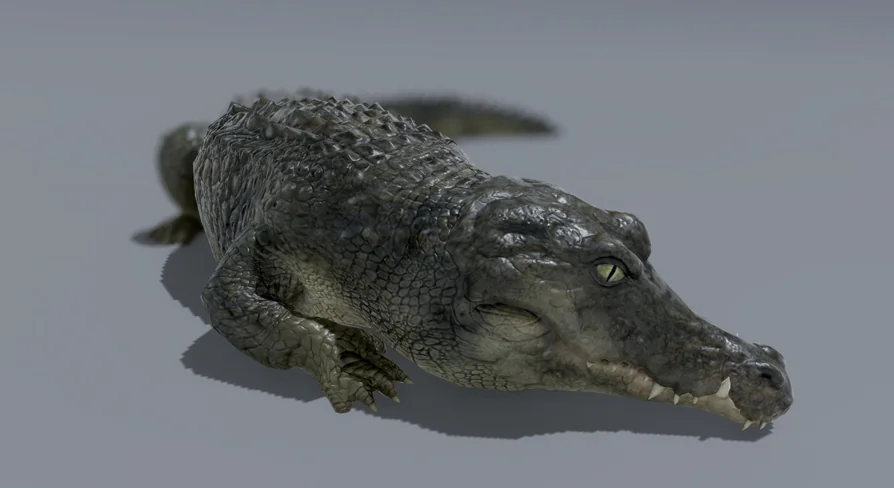
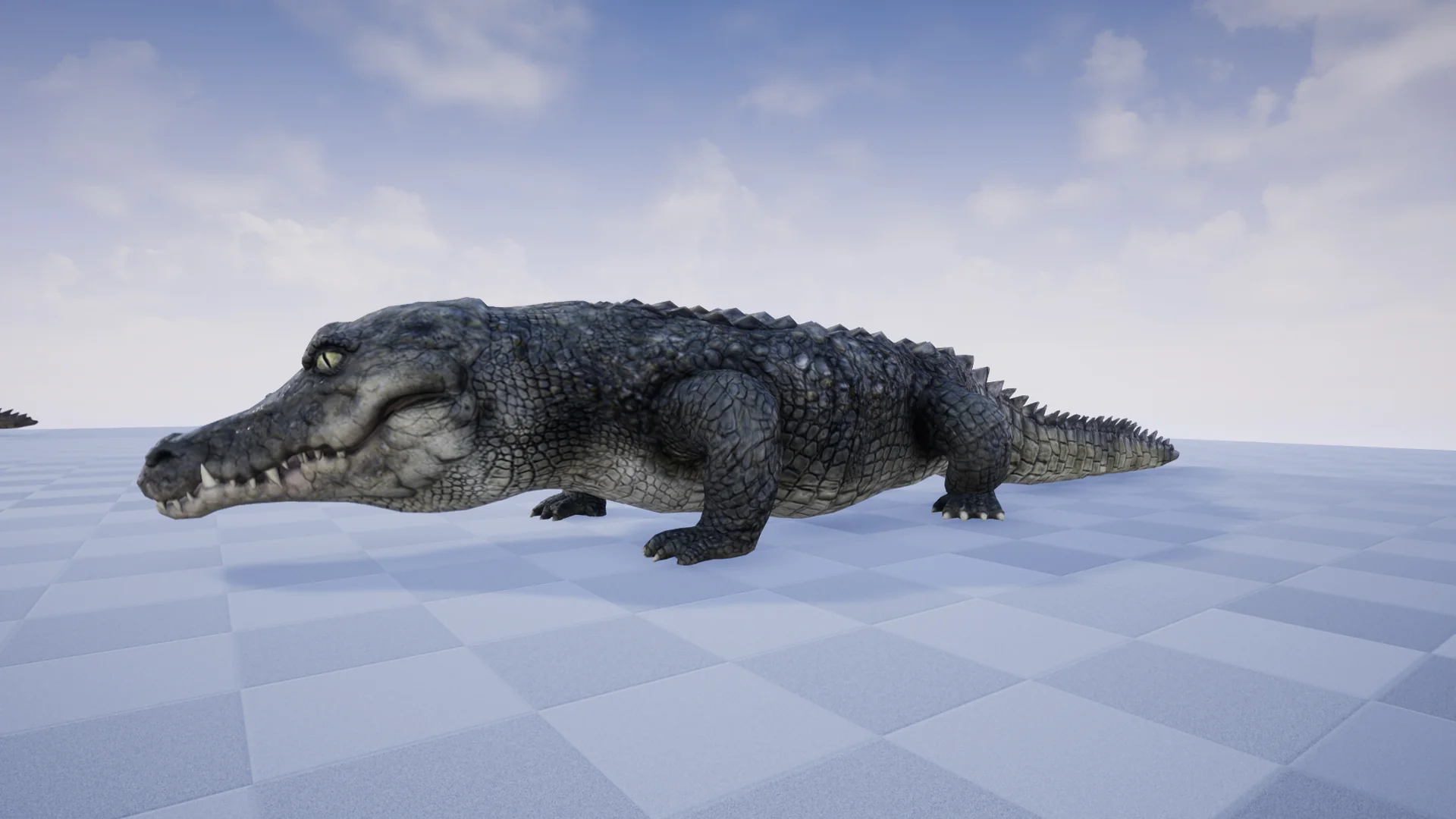
The base mesh, LOD0, is built at 8.12 thousand triangles (8.12 Ktris). This baseline level provides enough edge loops to support realistic muscle flexion along the flanks, snout curvature, claw definition, and the jagged dorsal scutes running down the spine and tail. When viewed up close during encounter sequences, the mesh retains sharp profile definition without collapsing into geometric faceting.
LOD1 steps down to 7.89 thousand triangles (7.89 Ktris). This intermediate stage executes an initial reduction pass, targeting micro-facets along less prominent areas while sustaining the primary skeletal deformations needed for mid-range viewing. The transition avoids dramatic silhouette popping when transitioning between the first two stages.
LOD2 reduces the geometry further to 5.95 thousand triangles (5.95 Ktris). At this distance, fine surface subdivisions on the underbelly, extremities, and tail are collapsed into broader polygonal forms. This final tier allows multiple instances of the creature to populate large river expanses or savanna wetlands simultaneously without overwhelming draw calls or vertex processing on target hardware.
Crocodile Rigging Architecture Across 48 Bones
Deforming a heavy, elongated reptilian body requires a skeleton that can handle extreme horizontal curves, undulating tail movement, and grounded limb placement. The crocodile features a dedicated rig constructed from 48 bones. This bone count delivers a focused structural framework without the overhead of overly complex secondary deformer chains.
Within a 48-bone layout, skeletal weighting is allocated to capture the signature motion of crocodilians. Multiple spine segments run from the pelvic girdle through the dorsal region to the neck, allowing the torso to twist naturally as the animal navigates terrain contours. The tail requires successive bone links to achieve smooth lateral propulsion during swimming sequences and whip-like ground adjustments.
The cranial and jaw rigging provides articulate mouth control, essential for snapping attacks, defensive threat postures, and feeding interactions. Limb hierarchies account for the low-slung, sprawling gait typical of river predators, ensuring the shoulders, elbows, wrists, hips, and foot clusters rotate cleanly without pinching surface vertices around the joints.
Single-Material Shading and 4096x4096 Texture Mapping
Draw call management is critical when rendering multiple dynamic characters in outdoor environments. The crocodile utilizes a single material setup, consolidating all surface instructions into a unified shader call. By avoiding multi-material splits across the head, body, and teeth, the renderer processes the animal in a single pass per mesh instance.
Surface fidelity is driven by high-resolution 4096×4096 (4K) textures. Mapping an entire quadruped onto a single 4K texture sheet preserves high texel density across every surface quadrant. Fine details—such as the rough texture of individual scales, leathery skin creases along the lateral folds, smooth ventral plates, and the reflective moisture characteristic of river predators—are preserved without stepping down to smaller, blurry maps.
This unified high-resolution texture map balances clean rendering on large 4K displays with efficient asset streaming. Because only one material needs to be bound, graphics memory bandwidth remains stable even during complex swamp scenes where post-processing, volumetric fog, and planar water reflections compete for GPU resources.
Animation Blueprint Setup and Locomotion Behaviors
Character motion is supported through an included suite of 16 animations, accompanied by an Animation Blueprint and script structure intended for rapid character controller integration. The library contains the fundamental motions necessary to drive a predatory reptile across both land and aquatic surfaces.
Among the 16 included animation sequences, 3 clips are built specifically as root motion variations. Root motion locks the physical movement of the character capsule directly to the underlying bone displacement authored in the animation data. This prevents foot sliding during heavy turns, sudden forward lunges, or directional water strikes, anchoring the 48-bone skeleton realistically against the terrain.
The remaining in-place animations integrate directly into standard state machines within the Animation Blueprint. These sequences allow blend spaces to calculate locomotion speeds dynamically, interpolating smoothly between idling, crawling, swimming, and aggressive responses based on variables passed by gameplay scripts. Having dedicated script and blueprint assets ready out of the box minimizes technical setup time when wiring the crocodile into custom AI navigation systems.
Cross-Pack Integration and Target Platforms
The asset fits directly into broader wildlife ecosystems, being included as part of the African Animals Pack while retaining explicit structural compatibility with the Farm Animals Pack. This shared design philosophy guarantees that skeletal conventions, animation paradigms, and material scales remain aligned when mixing assets across regional biomes. Developers can transition assets between exotic wilderness reserves and domestic river boundary scenarios without encountering conflicting technical configurations.
Deployment profiles are aligned with modern interactive standards. The asset is configured for deployment on PC, Mac, and latest-generation consoles. Across these platforms, the 8.12 Ktris maximum budget, 48-bone hierarchy, single 4K material, and 16-clip animation set deliver dependable performance, making the crocodile a solid component for demanding swamp, river, and savanna productions.
 Characters
 Characters
 Characters
 Characters