"82ee98b2ee2793f1"{"id":"1002424","slug":"cats-pack","title":"Cats Pack","category":"Animals","engine":"4.20+,5.0+","assetVersion":"","engineVersion":"Engine Version: 4.20+,5.0+","tag":"Animals","accent":"blue","visual":"mech","summary":"Detailed breakdown of the Cats Pack featuring four anatomical cat models, 100+ animations, props, and mobile LOD configurations.","platform":"Unreal Engine","indexPolicy":"index","publishedAt":"2026-11-10T18:17:42.387Z","updatedAt":"2026-11-10T18:17:42.387Z","sourceNotes":[],"fileContents":[],"compatibility":["Unreal Engine","Engine Version: 4.20+,5.0+"],"featuredImage":{"alt":"Cats Pack","src":"/wp-content/uploads/published/2026/11/d131360e682d-b3f5563e-f56e-4281-9970-96add73b4e04-436010b686.webp"},"hasDownloadLink":true,"downloads":0,"terms":[{"taxonomy":"category","slug":"animals","name":"Animals"}],"galleryImages":[{"src":"/wp-content/uploads/published/2026/11/180d52036cb8-9c1f1ff3-dd6b-4a1d-af16-2520edff70f9-ee14bb43ab.webp","alt":"Cats Pack"},{"src":"/wp-content/uploads/published/2026/11/48c4c590a0ff-8322c88a-30fb-4a56-b892-bbd2fd86c8bd-4b719b78c8.webp","alt":"Cats Pack"},{"src":"/wp-content/uploads/published/2026/11/d5b7ec57e469-141b96a3-00d4-42f3-a23b-00264b32de8e-54f10a04aa.webp","alt":"Cats Pack"},{"src":"/wp-content/uploads/published/2026/11/3ba1f2b34b57-ed6300cc-d678-4820-b953-1c28aa4115f3-569d684c07.webp","alt":"Cats Pack"},{"src":"/wp-content/uploads/published/2026/11/8e7e15829868-22dbcb27-8315-4947-8426-2fd4a8a3548e-41453c4de3.webp","alt":"Cats Pack"},{"src":"/wp-content/uploads/published/2026/11/5c5bca14f2a9-a8861dee-9c66-4054-9715-428cbe493826-8603f0f818.webp","alt":"Cats Pack"},{"src":"/wp-content/uploads/published/2026/11/ab29c10300a5-17d3e83e-4ae9-4233-80cd-aede7cbd8d61-64ed7f0e70.webp","alt":"Cats Pack"},{"src":"/wp-content/uploads/published/2026/11/66fbf2e467dc-99fbaccc-b299-4510-9031-dad52e78f732-623db2c52d.webp","alt":"Cats Pack"},{"src":"/wp-content/uploads/published/2026/11/23125278636b-e33ea46c-4cce-44ad-970b-c427b24c26a2-657e398e0b.webp","alt":"Cats Pack"},{"src":"/wp-content/uploads/published/2026/11/dd489f84c97c-9e02aa7c-4200-4c83-af6e-4337ec7393a0-617ce525fd.webp","alt":"Cats Pack"}],"accessPanel":{"kind":"resource","title":"Get this resource","eyebrow":"Free resource","message":"Download this resource in your browser.","fileName":"Content.7z","safetyNote":"Resources are manually reviewed before listing to improve quality and reduce obvious risks.","actionLabel":"Get this resource","resourceType":"Resource archive","versions":[]},"contentHtml":"\u003cp\u003ePopulating a digital environment with realistic domestic animals requires balancing anatomical accuracy, mesh deformation, and expansive animation sets. The Cats Pack addresses this need by providing four distinct feline physical builds: a thin cat, an ordinary cat, a stray cat, and a fat cat. Rather than relying on simple geometric scaling, each variant features unique body geometry that reflects different physical conditions, from slender or malnourished frames to heavier domestic profiles. To expand visual variety across crowds or distinct pet entities, each of the four physical builds includes five separate color texture variants, yielding twenty direct character permutations straight out of the box.\u003c/p\u003e \u003ch2\u003eSkeletal Setup and Mesh Variants in the Cats Pack\u003c/h2\u003e\n\u003cp\u003eUniformity in skeletal rigging simplifies the implementation of complex character behaviors across diverse models. Every geometric variant within the pack shares an identical 50-bone skeleton. This unified rigging approach means that all movement data, combat reactions, and ambient states can be shared directly between the thin cat, the ordinary cat, the stray cat, and the fat cat without requiring separate retargeting passes or bone mapping adjustments.\u003c/p\u003e\n\u003cp\u003eThe standard character geometry is authored at 12,000 triangles, capturing natural muscle contours, facial features, and paw definition suitable for third-person cameras, first-person close-ups, and cinematic sequences. To manage rendering budgets in scenes with multiple wandering animals, the asset includes four configured and enabled levels of detail (LODs). For resource-constrained platforms or high-density background animal deployment, the package includes an independent mobile-optimized model reduced to 2,500 triangles, maintaining silhouette readability while sharply cutting geometric processing load.\u003c/p\u003e \u003ch2\u003eLocomotion, Jumping, and Swimming Dynamics\u003c/h2\u003e\n\u003cp\u003eMovement within the asset spans more than 100 animations available in both in-place (IP) and root motion (RM) configurations. This dual format accommodates dynamic physics-driven capsule movement as well as precision root-driven animation blending where root displacement governs character location directly in world space.\u003c/p\u003e\n\u003cp\u003eGround locomotion features continuous directional coverage across four distinct speed gates:\u003c/p\u003e\n\u003cul\u003e \u003cli\u003e\u003cstrong\u003eWalk:\u003c/strong\u003e Omnidirectional movement including forward, left, right, backward, back-left, and back-right vectors.\u003c/li\u003e \u003cli\u003e\u003cstrong\u003eTrot:\u003c/strong\u003e Intermediate gait supported by forward, left, and right trajectories.\u003c/li\u003e \u003cli\u003e\u003cstrong\u003eRun:\u003c/strong\u003e Standard bounding run moving forward, left, and right.\u003c/li\u003e \u003cli\u003e\u003cstrong\u003eFast Run:\u003c/strong\u003e High-speed sprint cycles covering forward, left, and right directions.\u003c/li\u003e \u003cli\u003e\u003cstrong\u003eCrouch Locomotion:\u003c/strong\u003e Low-profile stalking movement covering forward, left, right, backward, back-left, and back-right paths, complemented by stationary crouch idle variations and crouch-turn movements.\u003c/li\u003e \u003cli\u003e\u003cstrong\u003eTurning:\u003c/strong\u003e Stationary directional turns to the left and right, alongside dedicated 180-degree turnarounds in both directions.\u003c/li\u003e\n\u003c/ul\u003e\n\u003cp\u003eVerticality is handled by a dedicated fifteen-stage jump structure that breaks aerial movement into modular, queryable states. Rather than relying on a single canned leaping clip, the sequence splits into distinct phases: jump start, forward start, vertical ascent (fly up), horizontal flight, low descent (fly down low and fly down low forward), and high-altitude descent (fly down high and fly down high forward). Touchdown is handled via stationary landing or forward landing motions. Edge-fall detection routines and obstacle mounting are directly supported by edge-falling animations alongside three separate hooked-and-climbed stages. Standard jumping variations from a standstill, during running cycles, or straight forward are also available for straightforward platforming logic.\u003c/p\u003e\n\u003cp\u003eAquatic environments are supported through dedicated water movement clips. The cat can execute a fluid entry into water bodies, transition into forward swimming, adjust direction using left and right swimming strokes, back up, or paddle along diagonal reverse vectors such as back-left and back-right.\u003c/p\u003e \u003ch2\u003eComplex State Transitions and Interactive Behaviors\u003c/h2\u003e\n\u003cp\u003eAmbient behaviors form a major portion of the animation library, structured with dedicated start, looping, and exit frames to prevent abrupt visual popping when interacting with scene elements. Essential maintenance tasks such as eating and drinking transition smoothly into their active cycles and return cleanly to standard poses. Resting patterns are split across several postures, including multiple upright lying poses, three belly-down lying variations, a curled sleep pose, and a belly sleep animation.\u003c/p\u003e\n\u003cp\u003eSeven unique standard idle cycles ensure the animal does not appear frozen when stationary. Seated postures are broken into three distinct sitting idles, which can blend into characteristic feline grooming habits such as body licking, ear scratching, and carpet scratching.\u003c/p\u003e\n\u003cp\u003eFor confrontational encounters or hazard scenarios, the character features a robust combat and injury set. Offensive moves include single bites, front strikes, directional left and right swipes, and multi-hit attack series. Combat posture has its own entrance transition, persistent cycle, exit transition, four distinct attack motions, two combat-specific hits, and two combat death sequences. Standard non-combat injury states accommodate frontal, middle, and rear impact hits, with directional fatalities handling left-side and right-side falls.\u003c/p\u003e \u003ch2\u003eCats Pack Accessories and Environmental Props\u003c/h2\u003e\n\u003cp\u003eTo ground the characters in residential, urban, or veterinary environments, the asset delivers a selection of themed props and functional accessories. Everyday domestic props include wearable collars, standard food and water bowls, an automated bowl unit, a cat litter tray, and decorative cat ears. Play and activity items include loose toy balls, small cat toys, and a full-height scratching post designed to pair with the cat's scratching animation loops.\u003c/p\u003e\n\u003cp\u003eFor shelter, relaxation, and containment scenes, the item selection includes a cat sofa, a large multi-tier cat house, and an enclosed animal carrier. These meshes match the scale of the four body variations, making it straightforward to construct indoor pet areas, alleyway feeding spots, or interactive pet care hubs.\u003c/p\u003e \u003ch2\u003eSurface Material Pipeline and Texture Handling\u003c/h2\u003e\n\u003cp\u003eTexture treatment relies on 2048x2048 texture maps built for contemporary physically based rendering. The standard texture layout includes an albedo map containing an alpha mask, a composite map packing ambient occlusion (AO), metallic, and roughness into individual color channels, and a tangent-space normal map. For projects seeking to avoid the performance costs or sorting artifacts associated with alpha testing or transparency blending on character fur, the pack also includes alternative cat models authored entirely without alpha channels.\u003c/p\u003e\n\u003cp\u003eBetween the modular four-tier LOD setups, the 2,500-triangle mobile base mesh, the flexible alpha and opaque material workflows, and the unified 50-bone animation hierarchy, the pack scales reliably from high-fidelity narrative simulations to performance-critical background crowds.\u003c/p\u003e\n\n\u003ch2\u003eContinue Browsing Similar Packs\u003c/h2\u003e\n\u003cul\u003e\n\u003cli\u003e\u003ca href=\"https://3dcghub.com/cute-hamsters/\" rel=\"noopener noreferrer\"\u003eCute Hamsters\u003c/a\u003e\u003c/li\u003e\n\u003cli\u003e\u003ca href=\"https://3dcghub.com/rog-creatures-mammoth/\" rel=\"noopener noreferrer\"\u003eROG Creatures: Mammoth\u003c/a\u003e\u003c/li\u003e\n\u003cli\u003e\u003ca href=\"https://3dcghub.com/yippy-kawaii/\" rel=\"noopener noreferrer\"\u003eYippy Kawaii\u003c/a\u003e\u003c/li\u003e\n\u003cli\u003e\u003ca href=\"https://3dcghub.com/raptor-dinosaur-animated/\" rel=\"noopener noreferrer\"\u003eRaptor Dinosaur Animated\u003c/a\u003e\u003c/li\u003e\n\u003cli\u003e\u003ca href=\"https://3dcghub.com/spiders-pack/\" rel=\"noopener noreferrer\"\u003eSpiders pack\u003c/a\u003e\u003c/li\u003e\n\u003c/ul\u003e","contentTextLength":7246,"navigation":{"current":26,"total":4372,"previous":{"id":"1002425","slug":"crocodile","title":"CROCODILE","category":"Characters \u0026 Creatures","platform":"Unreal Engine","updatedAt":"2026-11-10T18:18:15.717Z"},"next":{"id":"1002423","slug":"bird-band","title":"Bird Band","category":"Characters \u0026 Creatures","platform":"Unreal Engine","updatedAt":"2026-11-10T18:16:01.307Z"}},"relatedResources":[{"id":"1002432","slug":"dog-husky","title":"Dog - Husky","category":"Animals","engine":"4.20+,5.0+","assetVersion":"","engineVersion":"Engine Version: 4.20+,5.0+","tag":"Animals","accent":"blue","visual":"mech","summary":"Technical breakdown of the Dog - Husky asset, covering its 57-bone rig, LOD structure, 100+ animations, texture maps, and scene environment props.","platform":"Unreal Engine","indexPolicy":"index","publishedAt":"2026-11-10T18:29:06.959Z","updatedAt":"2026-11-10T18:29:06.959Z","sourceNotes":[],"fileContents":[],"compatibility":["Unreal Engine","Engine Version: 4.20+,5.0+"],"featuredImage":{"alt":"Dog - Husky","src":"/wp-content/uploads/published/2026/11/dfe64ae98f6e-5dc5b208-f9fe-4ace-96fe-36d17c81699c-9aab47c05a.webp"},"hasDownloadLink":true,"downloads":0},{"id":"1002313","slug":"cute-hamsters","title":"Cute Hamsters","category":"Animals","engine":"4.20+,5.0+","assetVersion":"","engineVersion":"Engine Version: 4.20+,5.0+","tag":"Animals","accent":"blue","visual":"mech","summary":"Cute Hamsters packs 31 hamster characters and 12 animations, with a Unity3D animation example and a UE version that omits the script and Toon shader.","platform":"Unreal Engine","indexPolicy":"index","publishedAt":"2026-11-06T06:15:37.558Z","updatedAt":"2026-11-06T06:15:37.558Z","sourceNotes":[],"fileContents":[],"compatibility":["Unreal Engine","Engine Version: 4.20+,5.0+"],"featuredImage":{"alt":"Cute Hamsters","src":"/wp-content/uploads/published/2026/11/cd85b9463262-766c2630-3b0e-416b-a94d-4f2be305d982-f7b99950c0.webp"},"hasDownloadLink":true,"downloads":0},{"id":"1002177","slug":"rog-creatures-mammoth","title":"ROG Creatures: Mammoth","category":"Animals","engine":"4.25+,5.0+","assetVersion":"","engineVersion":"Engine Version: 4.25+,5.0+","tag":"Animals","accent":"blue","visual":"character","summary":"Technical breakdown of ROG Creatures: Mammoth, covering polygonal fur layers, cascading LOD setups, animation blueprint rigs, and version 2.0 updates.","platform":"Unreal Engine","indexPolicy":"index","publishedAt":"2026-10-29T14:18:52.336Z","updatedAt":"2026-10-29T14:18:52.336Z","sourceNotes":[],"fileContents":[],"compatibility":["Unreal Engine","Engine Version: 4.25+,5.0+"],"featuredImage":{"alt":"ROG Creatures: Mammoth","src":"/wp-content/uploads/published/2026/10/48f07fffde79-9a9179b3-e2e9-4b9e-aab1-f4dea2d7f9c9-af92119166.webp"},"hasDownloadLink":true,"downloads":0}]}
Animals
Cats Pack
Detailed breakdown of the Cats Pack featuring four anatomical cat models, 100+ animations, props, and mobile LOD configurations.
Category:Unreal Engine,AnimalsPlatform: Unreal EngineEngine Version: 4.20+,5.0+Published: Nov 10, 2026
Animals
Resource overview
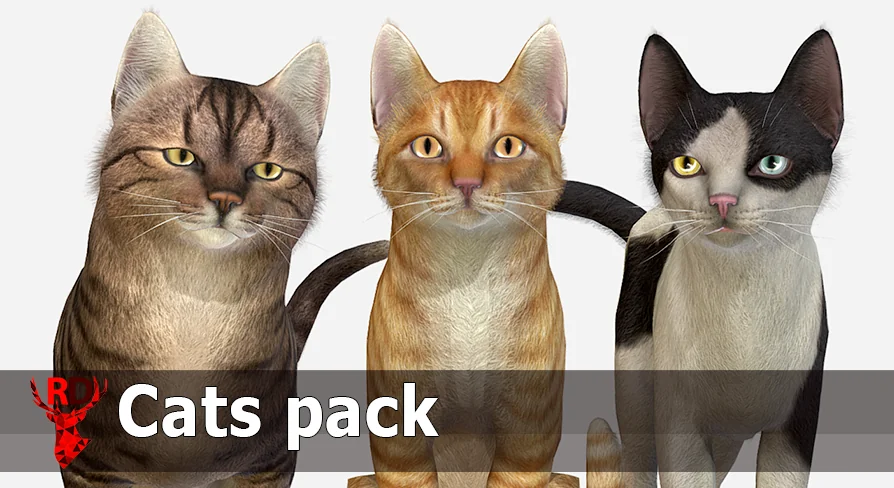
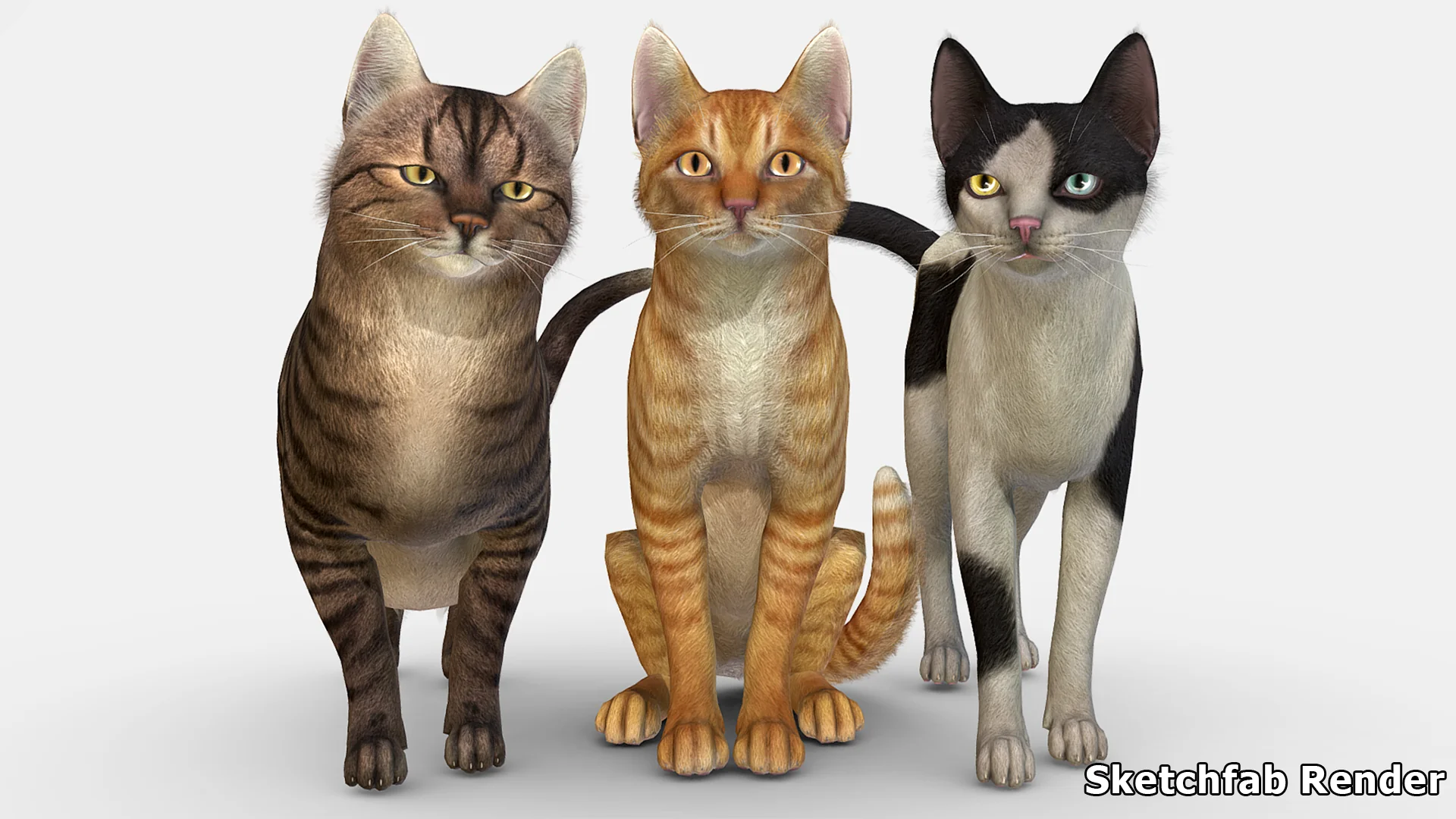
Populating a digital environment with realistic domestic animals requires balancing anatomical accuracy, mesh deformation, and expansive animation sets. The Cats Pack addresses this need by providing four distinct feline physical builds: a thin cat, an ordinary cat, a stray cat, and a fat cat. Rather than relying on simple geometric scaling, each variant features unique body geometry that reflects different physical conditions, from slender or malnourished frames to heavier domestic profiles. To expand visual variety across crowds or distinct pet entities, each of the four physical builds includes five separate color texture variants, yielding twenty direct character permutations straight out of the box.
Skeletal Setup and Mesh Variants in the Cats Pack
Uniformity in skeletal rigging simplifies the implementation of complex character behaviors across diverse models. Every geometric variant within the pack shares an identical 50-bone skeleton. This unified rigging approach means that all movement data, combat reactions, and ambient states can be shared directly between the thin cat, the ordinary cat, the stray cat, and the fat cat without requiring separate retargeting passes or bone mapping adjustments.
The standard character geometry is authored at 12,000 triangles, capturing natural muscle contours, facial features, and paw definition suitable for third-person cameras, first-person close-ups, and cinematic sequences. To manage rendering budgets in scenes with multiple wandering animals, the asset includes four configured and enabled levels of detail (LODs). For resource-constrained platforms or high-density background animal deployment, the package includes an independent mobile-optimized model reduced to 2,500 triangles, maintaining silhouette readability while sharply cutting geometric processing load.
Locomotion, Jumping, and Swimming Dynamics
Movement within the asset spans more than 100 animations available in both in-place (IP) and root motion (RM) configurations. This dual format accommodates dynamic physics-driven capsule movement as well as precision root-driven animation blending where root displacement governs character location directly in world space.
Ground locomotion features continuous directional coverage across four distinct speed gates:
Walk: Omnidirectional movement including forward, left, right, backward, back-left, and back-right vectors.
Trot: Intermediate gait supported by forward, left, and right trajectories.
Run: Standard bounding run moving forward, left, and right.
Fast Run: High-speed sprint cycles covering forward, left, and right directions.
Crouch Locomotion: Low-profile stalking movement covering forward, left, right, backward, back-left, and back-right paths, complemented by stationary crouch idle variations and crouch-turn movements.
Turning: Stationary directional turns to the left and right, alongside dedicated 180-degree turnarounds in both directions.
Verticality is handled by a dedicated fifteen-stage jump structure that breaks aerial movement into modular, queryable states. Rather than relying on a single canned leaping clip, the sequence splits into distinct phases: jump start, forward start, vertical ascent (fly up), horizontal flight, low descent (fly down low and fly down low forward), and high-altitude descent (fly down high and fly down high forward). Touchdown is handled via stationary landing or forward landing motions. Edge-fall detection routines and obstacle mounting are directly supported by edge-falling animations alongside three separate hooked-and-climbed stages. Standard jumping variations from a standstill, during running cycles, or straight forward are also available for straightforward platforming logic.
Aquatic environments are supported through dedicated water movement clips. The cat can execute a fluid entry into water bodies, transition into forward swimming, adjust direction using left and right swimming strokes, back up, or paddle along diagonal reverse vectors such as back-left and back-right.
Complex State Transitions and Interactive Behaviors
Ambient behaviors form a major portion of the animation library, structured with dedicated start, looping, and exit frames to prevent abrupt visual popping when interacting with scene elements. Essential maintenance tasks such as eating and drinking transition smoothly into their active cycles and return cleanly to standard poses. Resting patterns are split across several postures, including multiple upright lying poses, three belly-down lying variations, a curled sleep pose, and a belly sleep animation.
Seven unique standard idle cycles ensure the animal does not appear frozen when stationary. Seated postures are broken into three distinct sitting idles, which can blend into characteristic feline grooming habits such as body licking, ear scratching, and carpet scratching.
For confrontational encounters or hazard scenarios, the character features a robust combat and injury set. Offensive moves include single bites, front strikes, directional left and right swipes, and multi-hit attack series. Combat posture has its own entrance transition, persistent cycle, exit transition, four distinct attack motions, two combat-specific hits, and two combat death sequences. Standard non-combat injury states accommodate frontal, middle, and rear impact hits, with directional fatalities handling left-side and right-side falls.
Cats Pack Accessories and Environmental Props
To ground the characters in residential, urban, or veterinary environments, the asset delivers a selection of themed props and functional accessories. Everyday domestic props include wearable collars, standard food and water bowls, an automated bowl unit, a cat litter tray, and decorative cat ears. Play and activity items include loose toy balls, small cat toys, and a full-height scratching post designed to pair with the cat's scratching animation loops.
For shelter, relaxation, and containment scenes, the item selection includes a cat sofa, a large multi-tier cat house, and an enclosed animal carrier. These meshes match the scale of the four body variations, making it straightforward to construct indoor pet areas, alleyway feeding spots, or interactive pet care hubs.
Surface Material Pipeline and Texture Handling
Texture treatment relies on 2048x2048 texture maps built for contemporary physically based rendering. The standard texture layout includes an albedo map containing an alpha mask, a composite map packing ambient occlusion (AO), metallic, and roughness into individual color channels, and a tangent-space normal map. For projects seeking to avoid the performance costs or sorting artifacts associated with alpha testing or transparency blending on character fur, the pack also includes alternative cat models authored entirely without alpha channels.
Between the modular four-tier LOD setups, the 2,500-triangle mobile base mesh, the flexible alpha and opaque material workflows, and the unified 50-bone animation hierarchy, the pack scales reliably from high-fidelity narrative simulations to performance-critical background crowds.
 Animals
 Animals
 Animals
 Animals