"82ee98b2ee2793f1"{"id":"1002433","slug":"flamingo-animated","title":"Flamingo Animated","category":"Birds","engine":"4.26+,5.0+","assetVersion":"","engineVersion":"Engine Version: 4.26+,5.0+","tag":"Birds","accent":"blue","visual":"mech","summary":"Technical review of Flamingo Animated for Unreal Engine, covering low-poly quad geometry, 2048x2048 textures, and 10 dual-format animations.","platform":"Unreal Engine","indexPolicy":"index","publishedAt":"2026-11-10T18:29:46.252Z","updatedAt":"2026-11-10T18:29:46.252Z","sourceNotes":[],"fileContents":[],"compatibility":["Unreal Engine","Engine Version: 4.26+,5.0+"],"featuredImage":{"alt":"Flamingo Animated","src":"/wp-content/uploads/published/2026/11/6269a1e37b5d-c09f3df5-b55a-4754-83e5-9f78c13cfc73-cbcccaaab4.webp"},"hasDownloadLink":true,"downloads":0,"terms":[{"taxonomy":"category","slug":"birds","name":"Birds"}],"galleryImages":[{"src":"/wp-content/uploads/published/2026/11/c79f5254d4a5-0f109a3c-686d-4fce-a5f7-f927df3239e6-82806e8de8.webp","alt":"Flamingo Animated"},{"src":"/wp-content/uploads/published/2026/11/b7c31f7b8d5f-7c51c030-6714-4722-a907-b33e6ef12d95-ddde7b27e1.webp","alt":"Flamingo Animated"},{"src":"/wp-content/uploads/published/2026/11/a655ca0b5edc-de894a5b-076b-4a8a-b2bf-512138b449ea-c500bd4828.webp","alt":"Flamingo Animated"},{"src":"/wp-content/uploads/published/2026/11/09bae0e433d1-e4f4f290-2314-4e6f-a8f2-e3fe8389b157-3ac0966ea5.webp","alt":"Flamingo Animated"},{"src":"/wp-content/uploads/published/2026/11/d308ab4ce786-1208f678-feec-40c3-8b4f-3e4ccd2f8ed9-7c4dd77c59.webp","alt":"Flamingo Animated"},{"src":"/wp-content/uploads/published/2026/11/6c58751899d5-be29e99f-3f73-496d-b18e-8ba02b92ca02-9fd59c1e3c.webp","alt":"Flamingo Animated"},{"src":"/wp-content/uploads/published/2026/11/447ca85770c0-c85b3009-f06a-4f07-bdbf-e9b3cc797ef2-ad0e192b3c.webp","alt":"Flamingo Animated"},{"src":"/wp-content/uploads/published/2026/11/fe0350d8e847-020e1a62-37d1-4d1b-9634-3c463b77b3bf-681ba8f960.webp","alt":"Flamingo Animated"},{"src":"/wp-content/uploads/published/2026/11/47116a392736-509451ab-d31c-4db3-bdcb-97bbf86f70ec-d1976de2b1.webp","alt":"Flamingo Animated"},{"src":"/wp-content/uploads/published/2026/11/a3adbf5414dc-3a05ce52-c2f4-4493-9c8d-b29d7c37bfa5-782cefa731.webp","alt":"Flamingo Animated"}],"accessPanel":{"kind":"resource","title":"Get this resource","eyebrow":"Free resource","message":"Download this resource in your browser.","fileName":"Content.7z","safetyNote":"Resources are manually reviewed before listing to improve quality and reduce obvious risks.","actionLabel":"Get this resource","resourceType":"Resource archive","versions":[]},"contentHtml":"\u003ch2\u003ePopulating Wetlands with the Flamingo Animated Asset\u003c/h2\u003e\n\u003cp\u003ePopulating digital wetlands, riverbanks, and coastal preserves with believable wildlife often runs into trade-offs between visual fidelity and skeletal performance. Long-legged, slender-necked birds present distinct rigging and deformation challenges that can quickly produce unnatural creasing or visual stuttering if the mesh edge loops and animation curves are not calibrated together.\u003c/p\u003e\n\u003cp\u003eFlamingo Animated addresses these practical scene-building needs by providing a dedicated low-poly bird model built natively for Unreal Engine. Stored in native.uasset format, the asset avoids the conversion hurdles and skeleton remapping issues that often accompany imported external rigs. The asset targets nature simulations, wetland recreations, interactive visualizations, and educational fauna titles, delivering clean biological motion without demanding high computational overhead from real-time systems.\u003c/p\u003e \u003ch2\u003eMesh Topology and Flamingo Feather Texture Setup\u003c/h2\u003e\n\u003cp\u003eGeometry efficiency dictates how many animated entities can safely inhabit an open-world wetland or flocking simulation without degrading frame times.\u003c/p\u003e\n\u003cp\u003eThe mesh contains 4,876 triangles and 2,971 vertices, maintaining a lightweight profile suitable for real-time rendering. The geometry is constructed from 100% quads, establishing a clean quad-only topology. This structural consistency is critical for avian anatomy, where dramatic neck curvature, wing tucks, and knee bends occur during locomotion and resting poses. Quad topology ensures that skin weights distribute smoothly across joints, preventing volume loss or hard creasing when the bird lowers its head or settles to the ground.\u003c/p\u003e\n\u003cp\u003eSurface texturing is handled through dedicated 2048x2048 texture maps that preserve crisp plumage details while remaining performant in multi-agent scenes. The texture set includes T_Flamingo_D for standard diffuse coloring and T_Flamingo_N for normal map surface relief. To support natural visual variation among flock members, two separate feather diffuse maps are included: T_Flamingo_feather_rose_D and T_Flamingo_feather_red_D. Applying these color maps across different instances enables varied plumage saturation across a single flock, helping developers distinguish individual birds across nature preserves and educational exhibits without modifying mesh geometry.\u003c/p\u003e \u003ch2\u003eLocomotion Architecture Across Root Motion and In-Place Tracks\u003c/h2\u003e\n\u003cp\u003eMovement controllers require different animation delivery methods depending on whether a game uses physics-driven pawn movement components or relies entirely on animation transforms to drive world position.\u003c/p\u003e\n\u003cp\u003eEvery locomotion state in the asset is supplied in both Root Motion and In-Place formats. This dual structure allows developers to plug the clips directly into an Animation Blueprint using traditional velocity-based blend spaces, or deploy Root Motion tracks for scripted cinematics and precise simulation pathways. The motion library includes dedicated directional movements that prevent unnatural sliding when a bird pivots or navigates around shoreline obstacles.\u003c/p\u003e\n\u003cp\u003eThe locomotion clips use explicit frame ranges made for seamless looping and state transitions:\u003c/p\u003e\n\u003cul\u003e\n\u003cli\u003eWalk spans frames 0 to 24, providing a steady cadence suited for wading through shallow water environments.\u003c/li\u003e\n\u003cli\u003eRun spans frames 25 to 41, increasing stride speed for rapid retreats or panicked flock dispersal.\u003c/li\u003e\n\u003cli\u003eTurn Left spans frames 832 to 856, capturing gradual rotational movement to the left.\u003c/li\u003e\n\u003cli\u003eTurn Right spans frames 859 to 883, handling clockwise directional changes.\u003c/li\u003e\n\u003cli\u003eRun Left spans frames 886 to 902, combining lateral banking with running momentum.\u003c/li\u003e\n\u003cli\u003eRun Right spans frames 905 to 921, supplying mirrored rightward running turns.\u003c/li\u003e\n\u003c/ul\u003e\n\u003cp\u003eHaving isolated directional turns for both normal walking and rapid running states gives developers the building blocks needed to construct responsive state machines that react dynamically to player proximity or AI navigation goals.\u003c/p\u003e \u003ch2\u003eStationary Behaviors, Ground Transitions, and Sample Testing\u003c/h2\u003e\n\u003cp\u003eBelievable animal AI in wildlife titles depends heavily on ambient idle variety, as stationary creatures spend more time observing and foraging than actively sprinting across a map.\u003c/p\u003e\n\u003cp\u003eThe asset provides long stationary clips to break up the visual repetition typical of brief looping cycles. The central Idle animation runs from frame 295 to 775, giving the skeletal mesh an extended timeline to exhibit subtle body balance, natural head movements, and stable standing posture. Feeding behavior is covered by the Eat animation, running from frame 44 to 292. This sequence covers the full arc of lowering the curved beak down to ground or water level, foraging, and lifting back into an alert standing state.\u003c/p\u003e\n\u003cp\u003eVertical state transitions between standing and resting poses are handled through paired mechanical clips. The Sit Down animation covers frames 776 to 802, folding the elongated legs beneath the body smoothly. The Stand Up sequence covers frames 803 to 829, lifting the torso back onto full footing without abrupt popping. To help teams inspect these transitions and verify material links immediately, the package includes a preconfigured sample level, allowing direct evaluation of animation playback and mesh deformation directly inside the editor.\u003c/p\u003e \u003ch2\u003eIntegrating the Flamingo Model into Real-Time Wildlife Projects\u003c/h2\u003e\n\u003cp\u003eSourcing animal models with native engine packaging removes pipeline bottlenecks, letting developers focus directly on behavior scripting and environment layout.\u003c/p\u003e\n\u003cp\u003eBecause the package is built exclusively for Unreal Engine, its.uasset components slot directly into native engine systems. The asset pairs well with projects demanding realistic animal behaviors, educational biology presentations, or stylized nature simulations where biological accuracy and runtime optimization must coexist. With its 4,876-triangle quad mesh, flexible 2048x2048 diffuse options, and comprehensive 10-animation locomotion library in both Root Motion and In-Place configurations, the asset provides a complete, drop-in avian solution for dynamic outdoor environments.\u003c/p\u003e\n\n\u003ch2\u003eContinue Browsing Similar Packs\u003c/h2\u003e\n\u003cul\u003e\n\u003cli\u003e\u003ca href=\"https://3dcghub.com/barn-swallow/\" rel=\"noopener noreferrer\"\u003eBarn Swallow\u003c/a\u003e\u003c/li\u003e\n\u003cli\u003e\u003ca href=\"https://3dcghub.com/medhue-parrot/\" rel=\"noopener noreferrer\"\u003eMedhue Parrot\u003c/a\u003e\u003c/li\u003e\n\u003cli\u003e\u003ca href=\"https://3dcghub.com/magpie/\" rel=\"noopener noreferrer\"\u003eMagpie\u003c/a\u003e\u003c/li\u003e\n\u003cli\u003e\u003ca href=\"https://3dcghub.com/low-poly-bird-mallard-duck/\" rel=\"noopener noreferrer\"\u003eLow Poly Bird: Mallard Duck\u003c/a\u003e\u003c/li\u003e\n\u003cli\u003e\u003ca href=\"https://3dcghub.com/redshank/\" rel=\"noopener noreferrer\"\u003eRedshank\u003c/a\u003e\u003c/li\u003e\n\u003c/ul\u003e","contentTextLength":6196,"navigation":{"current":17,"total":4372,"previous":{"id":"1002434","slug":"giant-viper","title":"Giant Viper","category":"Characters \u0026 Creatures","platform":"Unreal Engine","updatedAt":"2026-11-10T18:30:25.159Z"},"next":{"id":"1002432","slug":"dog-husky","title":"Dog - Husky","category":"Animals","platform":"Unreal Engine","updatedAt":"2026-11-10T18:29:06.959Z"}},"relatedResources":[{"id":"1002422","slug":"barn-swallow","title":"Barn Swallow","category":"Birds","engine":"5.1+","assetVersion":"","engineVersion":"Engine Version: 5.1+","tag":"Birds","accent":"blue","visual":"mech","summary":"Explore the Barn Swallow low poly animated 3D model for Unreal Engine, featuring 17 animations, 4K textures, quad geometry, and sample level assets.","platform":"Unreal Engine","indexPolicy":"index","publishedAt":"2026-11-10T18:15:16.962Z","updatedAt":"2026-11-10T18:15:16.962Z","sourceNotes":[],"fileContents":[],"compatibility":["Unreal Engine","Engine Version: 5.1+"],"featuredImage":{"alt":"Barn Swallow","src":"/wp-content/uploads/published/2026/11/1c57b560516c-225a469c-c35d-4407-88a0-e1bd3360b5d1-1d9bf79f8e.webp"},"hasDownloadLink":true,"downloads":0},{"id":"1000951","slug":"medhue-parrot","title":"Medhue Parrot","category":"Birds","engine":"4.26+,5.0+","assetVersion":"","engineVersion":"Engine Version: 4.26+,5.0+","tag":"Birds","accent":"blue","visual":"mech","summary":"A 3,279-triangle Macaw parrot for Unreal Engine with PBR textures, 34 animations, and a drop-in AI system using Parrot_NPC, Parrot_Blueprint, and more.","platform":"Unreal Engine","indexPolicy":"index","publishedAt":"2026-08-14T05:21:18.505Z","updatedAt":"2026-08-14T05:21:18.505Z","sourceNotes":[],"fileContents":[],"compatibility":["Unreal Engine","Engine Version: 4.26+,5.0+"],"featuredImage":{"alt":"Medhue Parrot","src":"/wp-content/uploads/published/2026/08/0f82efba6954-72553a02-7195-4786-b274-eb7d7edfcad0-a88cb632c3.webp"},"hasDownloadLink":true,"downloads":0},{"id":"1001351","slug":"magpie","title":"Magpie","category":"Birds","engine":"5.1+","assetVersion":"","engineVersion":"Engine Version: 5.1+","tag":"Birds","accent":"blue","visual":"mech","summary":"Magpie brings low-poly, 100% quad-based bird modeling and 14 dual-format animations with 4K textures directly into Unreal Engine projects.","platform":"Unreal Engine","indexPolicy":"index","publishedAt":"2026-10-04T10:21:05.327Z","updatedAt":"2026-10-04T10:21:05.327Z","sourceNotes":[],"fileContents":[],"compatibility":["Unreal Engine","Engine Version: 5.1+"],"featuredImage":{"alt":"Magpie","src":"/wp-content/uploads/published/2026/10/0fba3ca79940-54f59c30-b379-4b2f-8dbf-1502f48c5e21-5615c086ac.webp"},"hasDownloadLink":true,"downloads":0}]}
Birds
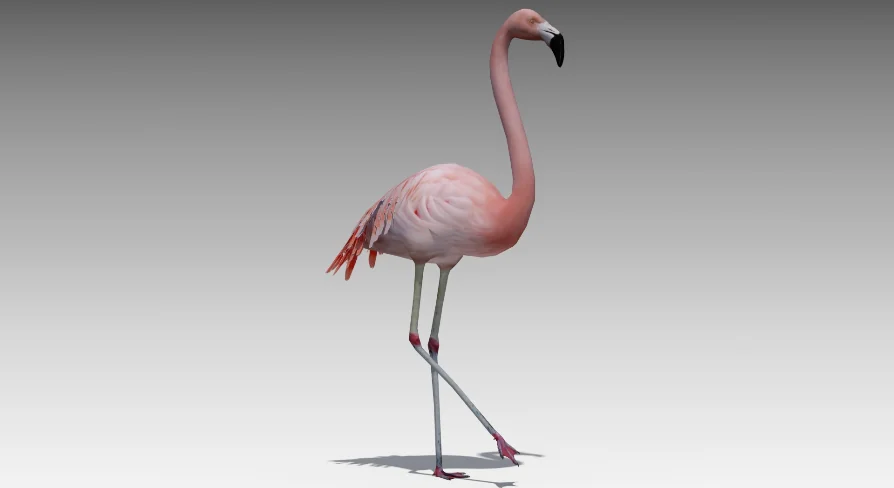
Flamingo Animated
Technical review of Flamingo Animated for Unreal Engine, covering low-poly quad geometry, 2048x2048 textures, and 10 dual-format animations.
Category:Unreal Engine,BirdsPlatform: Unreal EngineEngine Version: 4.26+,5.0+Published: Nov 10, 2026
Birds
Resource overview
Populating Wetlands with the Flamingo Animated Asset
Populating digital wetlands, riverbanks, and coastal preserves with believable wildlife often runs into trade-offs between visual fidelity and skeletal performance. Long-legged, slender-necked birds present distinct rigging and deformation challenges that can quickly produce unnatural creasing or visual stuttering if the mesh edge loops and animation curves are not calibrated together.
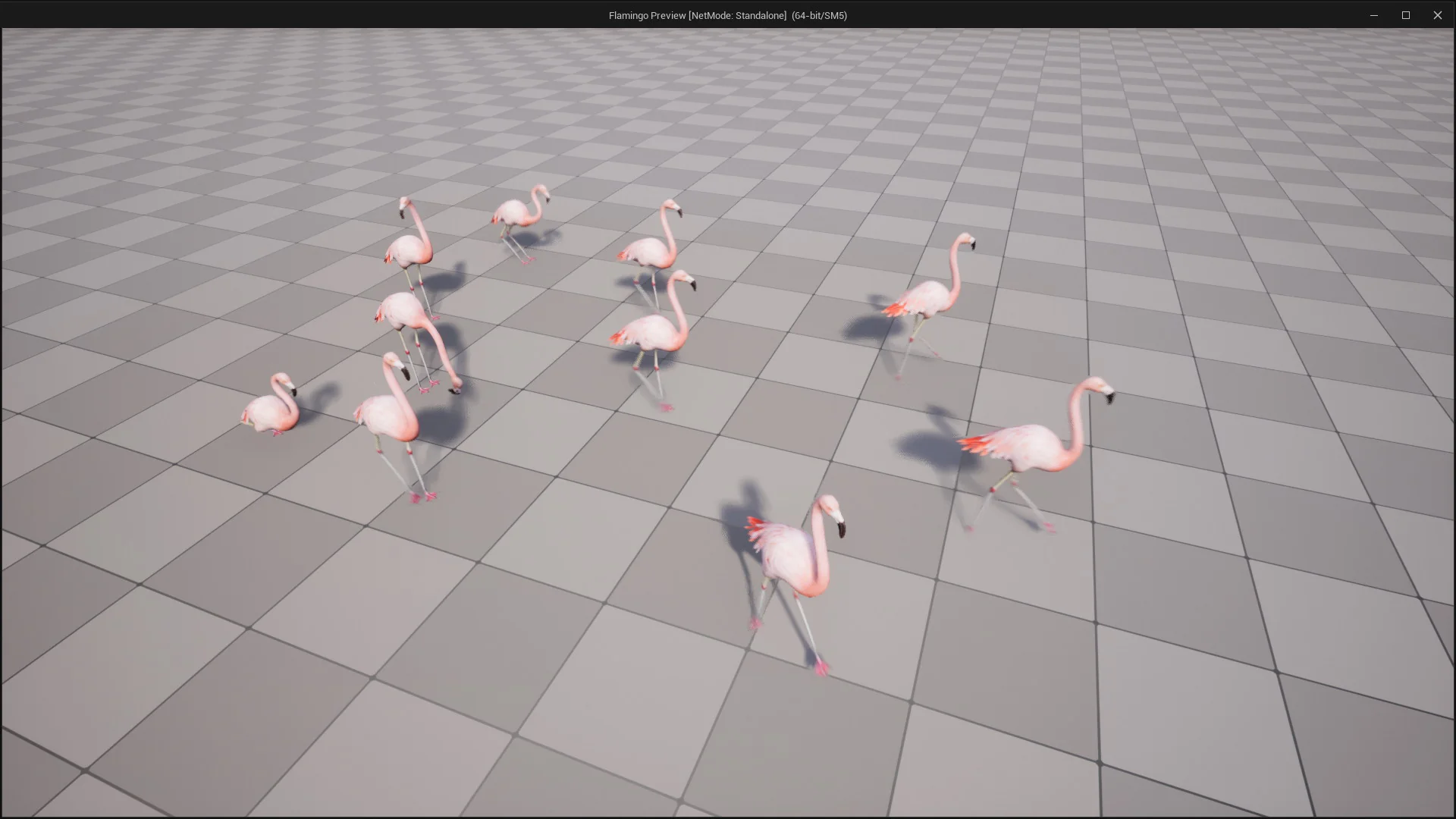
Flamingo Animated addresses these practical scene-building needs by providing a dedicated low-poly bird model built natively for Unreal Engine. Stored in native.uasset format, the asset avoids the conversion hurdles and skeleton remapping issues that often accompany imported external rigs. The asset targets nature simulations, wetland recreations, interactive visualizations, and educational fauna titles, delivering clean biological motion without demanding high computational overhead from real-time systems.
Mesh Topology and Flamingo Feather Texture Setup
Geometry efficiency dictates how many animated entities can safely inhabit an open-world wetland or flocking simulation without degrading frame times.
The mesh contains 4,876 triangles and 2,971 vertices, maintaining a lightweight profile suitable for real-time rendering. The geometry is constructed from 100% quads, establishing a clean quad-only topology. This structural consistency is critical for avian anatomy, where dramatic neck curvature, wing tucks, and knee bends occur during locomotion and resting poses. Quad topology ensures that skin weights distribute smoothly across joints, preventing volume loss or hard creasing when the bird lowers its head or settles to the ground.
Surface texturing is handled through dedicated 2048x2048 texture maps that preserve crisp plumage details while remaining performant in multi-agent scenes. The texture set includes T_Flamingo_D for standard diffuse coloring and T_Flamingo_N for normal map surface relief. To support natural visual variation among flock members, two separate feather diffuse maps are included: T_Flamingo_feather_rose_D and T_Flamingo_feather_red_D. Applying these color maps across different instances enables varied plumage saturation across a single flock, helping developers distinguish individual birds across nature preserves and educational exhibits without modifying mesh geometry.
Locomotion Architecture Across Root Motion and In-Place Tracks
Movement controllers require different animation delivery methods depending on whether a game uses physics-driven pawn movement components or relies entirely on animation transforms to drive world position.
Every locomotion state in the asset is supplied in both Root Motion and In-Place formats. This dual structure allows developers to plug the clips directly into an Animation Blueprint using traditional velocity-based blend spaces, or deploy Root Motion tracks for scripted cinematics and precise simulation pathways. The motion library includes dedicated directional movements that prevent unnatural sliding when a bird pivots or navigates around shoreline obstacles.
The locomotion clips use explicit frame ranges made for seamless looping and state transitions:
Walk spans frames 0 to 24, providing a steady cadence suited for wading through shallow water environments.
Run spans frames 25 to 41, increasing stride speed for rapid retreats or panicked flock dispersal.
Turn Left spans frames 832 to 856, capturing gradual rotational movement to the left.
Turn Right spans frames 859 to 883, handling clockwise directional changes.
Run Left spans frames 886 to 902, combining lateral banking with running momentum.
Run Right spans frames 905 to 921, supplying mirrored rightward running turns.
Having isolated directional turns for both normal walking and rapid running states gives developers the building blocks needed to construct responsive state machines that react dynamically to player proximity or AI navigation goals.
Stationary Behaviors, Ground Transitions, and Sample Testing
Believable animal AI in wildlife titles depends heavily on ambient idle variety, as stationary creatures spend more time observing and foraging than actively sprinting across a map.
The asset provides long stationary clips to break up the visual repetition typical of brief looping cycles. The central Idle animation runs from frame 295 to 775, giving the skeletal mesh an extended timeline to exhibit subtle body balance, natural head movements, and stable standing posture. Feeding behavior is covered by the Eat animation, running from frame 44 to 292. This sequence covers the full arc of lowering the curved beak down to ground or water level, foraging, and lifting back into an alert standing state.
Vertical state transitions between standing and resting poses are handled through paired mechanical clips. The Sit Down animation covers frames 776 to 802, folding the elongated legs beneath the body smoothly. The Stand Up sequence covers frames 803 to 829, lifting the torso back onto full footing without abrupt popping. To help teams inspect these transitions and verify material links immediately, the package includes a preconfigured sample level, allowing direct evaluation of animation playback and mesh deformation directly inside the editor.
Integrating the Flamingo Model into Real-Time Wildlife Projects
Sourcing animal models with native engine packaging removes pipeline bottlenecks, letting developers focus directly on behavior scripting and environment layout.
Because the package is built exclusively for Unreal Engine, its.uasset components slot directly into native engine systems. The asset pairs well with projects demanding realistic animal behaviors, educational biology presentations, or stylized nature simulations where biological accuracy and runtime optimization must coexist. With its 4,876-triangle quad mesh, flexible 2048x2048 diffuse options, and comprehensive 10-animation locomotion library in both Root Motion and In-Place configurations, the asset provides a complete, drop-in avian solution for dynamic outdoor environments.
 Birds