"148d1066ed74e216"{"id":"1002950","slug":"sport-car-aunardi-multiplayer-ue5","title":"🏆 Sport Car Aunardi 🚥 Multiplayer 🚥 UE5","category":"Cars \u0026 Trucks","engine":"5.0+","assetVersion":"","engineVersion":"Engine Version: 5.0+","tag":"Cars \u0026 Trucks","accent":"blue","visual":"mech","summary":"Examine the fully replicated Sport Car Aunardi for Unreal Engine 5, featuring Metasounds, customization menus, dual-occupancy logic, and dynamic VFX.","platform":"Unreal Engine","indexPolicy":"index","publishedAt":"2026-11-22T06:31:35.188Z","updatedAt":"2026-11-22T06:31:35.188Z","sourceNotes":[],"fileContents":[],"compatibility":["Unreal Engine","Engine Version: 5.0+"],"featuredImage":{"alt":"🏆 Sport Car Aunardi 🚥 Multiplayer 🚥 UE5","src":"/wp-content/uploads/published/2026/11/e39eb731fe6e-14d0e996-1b50-4651-8312-9df1b8c7c0fa-51cad9495d.webp"},"fileSizeBytes":144899458,"hasDownloadLink":true,"downloads":0,"terms":[{"taxonomy":"category","slug":"cars-and-trucks","name":"Cars \u0026 Trucks"}],"galleryImages":[{"src":"/wp-content/uploads/published/2026/11/eaa82dd26284-82a110aa-17ba-4a00-a0fb-37cede310119-b9abb41e3f.webp","alt":"🏆 Sport Car Aunardi 🚥 Multiplayer 🚥 UE5"},{"src":"/wp-content/uploads/published/2026/11/c8a76c1fdab0-6548b3e2-c012-4e04-8431-7b565a1f6a98-6990d8245b.webp","alt":"🏆 Sport Car Aunardi 🚥 Multiplayer 🚥 UE5"},{"src":"/wp-content/uploads/published/2026/11/22bca26d1183-cfb63c85-7982-4fe9-b0b3-5c0a31a2dd0e-2262803c5b.webp","alt":"🏆 Sport Car Aunardi 🚥 Multiplayer 🚥 UE5"},{"src":"/wp-content/uploads/published/2026/11/f7f1b9ec7906-21efbbc1-2198-441c-bd25-76c978982bc4-7b3429ddab.webp","alt":"🏆 Sport Car Aunardi 🚥 Multiplayer 🚥 UE5"},{"src":"/wp-content/uploads/published/2026/11/c04966acac09-9a78712e-2890-4ba8-97a1-f388b2f30828-5142c3eb3e.webp","alt":"🏆 Sport Car Aunardi 🚥 Multiplayer 🚥 UE5"},{"src":"/wp-content/uploads/published/2026/11/05831575b25f-c64c33fa-cf29-4018-9023-40f4da166c01-b9d1f8f5dc.webp","alt":"🏆 Sport Car Aunardi 🚥 Multiplayer 🚥 UE5"},{"src":"/wp-content/uploads/published/2026/11/a6bd25241e93-4d2d2824-cc7f-4f14-af5e-f66fabb7a2ca-2a1dc80b46.webp","alt":"🏆 Sport Car Aunardi 🚥 Multiplayer 🚥 UE5"},{"src":"/wp-content/uploads/published/2026/11/e38ec3d3c490-9eacb0a1-9a23-48f7-a755-61c87cb554e1-c410d3c746.webp","alt":"🏆 Sport Car Aunardi 🚥 Multiplayer 🚥 UE5"},{"src":"/wp-content/uploads/published/2026/11/711781ae976f-c7935573-e094-44b3-9f6e-6a2d7177131a-e0a765abc8.webp","alt":"🏆 Sport Car Aunardi 🚥 Multiplayer 🚥 UE5"},{"src":"/wp-content/uploads/published/2026/11/4b307ce821a1-efd3015d-ae9d-4198-80e7-134aae3d7a9d-15fc07b1fa.webp","alt":"🏆 Sport Car Aunardi 🚥 Multiplayer 🚥 UE5"}],"accessPanel":{"kind":"resource","title":"Get this resource","safetyNote":"Resources are manually reviewed before listing to improve quality and reduce obvious risks.","fileName":"Content.7z","resourceType":"Resource archive","versions":[]},"contentHtml":"\u003ch2\u003eIntegrating the Aunardi Blueprint and Input Architecture\u003c/h2\u003e\u003cp\u003eDeploying the drivable platform into an active Unreal Engine 5 project begins with a consolidated implementation footprint. The vehicle operates from a single core blueprint, which contains the mechanical behavior, visual bindings, and state transitions needed to control the car immediately upon placement. Control schemes are mapped to keyboard and mouse inputs, establishing direct handling for steering, acceleration, and braking without demanding elaborate input reconfiguration scripts.\u003c/p\u003e\u003cp\u003ePhysics recovery is solved out of the box through a dedicated flip car feature. When collisions, track debris, or aggressive cornering cause the chassis to invert, triggering the flip system resets vehicle orientation cleanly onto its tires. This eliminates common physics dead-ends in testing environments or gameplay sessions. Exterior lights are pre-configured to toggle into active states, enabling immediate transitions between brightly lit test environments and darker race scenarios.\u003c/p\u003e\u003ch2\u003eMultiplayer Synchronization and Aunardi Passenger Roles\u003c/h2\u003e\u003cp\u003eNetwork replication is integrated directly into the mechanics of the vehicle, bypassing the common hurdle of converting single-player driving logic for online servers. State changes, wheel rotations, speed indicators, and positioning data replicate reliably between host instances and connected clients. This networked framework supports concurrent vehicle interactions without positional desynchronization.\u003c/p\u003e\u003cp\u003eCabin occupancy extends beyond a lone driver. The blueprint includes a complete driver and passenger system, allowing multiple player pawns to board the same vehicle instance. The passenger system tracks seating logic natively across the network, synchronizing entry, ride-along camera positions, and passenger states. For project managers looking to implement gameplay constraints, an integrated fuel system is present and can be toggled on or off depending on whether the game requires resource management or purely arcade-style laps.\u003c/p\u003e\u003ch2\u003eAunardi Cockpit Readouts and Display Controls\u003c/h2\u003e\u003cp\u003eDriver instrumentation accommodates both immersive first-person setups and third-person racing layouts. The vehicle provides dual speedometers: an integrated interior dashboard display embedded within the model geometry and a screen-space head-up display (HUD). Drivers can switch their speed readout unit between KMH and MPH on the fly to suit local racing standards or user preferences.\u003c/p\u003e\u003cp\u003eSpeedometer styling is adaptable, featuring changeable digital colors that allow the readouts to match the dashboard aesthetics or user selection. The HUD contains a dedicated, toggleable HUD rear-view mirror to track trailing opponents without looking backward. If an interface-free cockpit view or clean cinematics are preferred, the entire HUD system can be switched off through a single toggle function.\u003c/p\u003e\u003ch2\u003eAunardi Visual FX, Exhaust Profiles, and Surface Dynamics\u003c/h2\u003e\u003cp\u003eAcoustic output uses Unreal Engine 5.3+ Metasound assets for engine audio, generating adaptive sound curves that respond dynamically to throttle pressure and gear states. Complementary audio design covers tire scrub, wheel slide effects, and exhaust backfire SFX, generating cohesive acoustic feedback across distinct road conditions.\u003c/p\u003e\u003cp\u003eVisual effects pair closely with audio triggers. Exhaust emitters produce smoke and combustion VFX under heavy throttle, while tire friction produces visible surface smoke. Ground skidmarks utilize surface validation logic: the skidmark VFX and SFX suppress mark generation while the tires are off the ground, ensuring that airborne jumps do not paint floating tire decals across empty air. Heavy braking events trigger an emissive heat glow effect across the brake disks, visualizing thermal buildup inside the wheel wells. For stylized or arcade presentations, a toggleable stylized trailing effect inspired by modern street racing titles spawns vivid white and red trails behind the rear quarter panels as the vehicle accelerates.\u003c/p\u003e\u003ch2\u003eStyling Systems, Wheel Sets, and Bonus Race Track Props\u003c/h2\u003e\u003cp\u003eVisual customization is managed through a runtime menu equipped with auto-save and load serialization. Players can cycle vehicle aesthetics and store modifications between sessions. The vehicle exterior includes car paint materials alongside three distinct pre-configured skins. Individual body components and wheels can be painted separately via the styling menu to generate custom color blocking.\u003c/p\u003e\u003cp\u003eExterior accessories and silhouettes can be altered quickly:\u003cul\u003e\u003cli\u003eSpoiler visibility toggles dynamically to strip down or accentuate the rear aerodynamics.\u003c/li\u003e\u003cli\u003eTwo editable number plates (white and yellow plate variants) support custom alphanumeric plate text configured directly inside the menu.\u003c/li\u003e\u003cli\u003eTire setups include two different sport tire materials paired with high-quality wheels, supplemented by a bonus high-quality sport wheel set gift asset.\u003c/li\u003e\u003c/ul\u003e\u003cp\u003eVisual staging is bolstered by additional environment assets packed alongside the vehicle. The package includes bonus race track props to establish course borders, an animated text material for digital signage, and a dedicated sharpen post-process material to refine overall edge clarity and scene sharpness.\u003c/p\u003e\u003ch2\u003eCamera Perspective Suite and Drive-Feel Tuning\u003c/h2\u003e\u003cp\u003ePerspective handling combines responsive chases with dynamic cinematic shifts. The main third-person driving camera incorporates smooth zoom in and out behaviors, accompanied by a speed perspective effect that expands the field of view under acceleration to enhance the sensation of velocity. An auto-centering feature pulls the lens back to alignment behind the vehicle vector once manual orbit inputs cease.\u003c/p\u003e\u003cp\u003eIn-cockpit perspectives place the viewer behind the wheel with full line of sight across the interior speedometer. Transitioning between angles is handled smoothly, with fluid crossing cameras moving between side profiles, corner viewpoints, and the interior dashboard. Whether navigating tight corners in cockpit mode or orchestrating high-speed overtakes from chase views, the multi-camera array provides steady orientation and immediate visual context across all driving situations.\u003c/p\u003e\n\n\u003ch2\u003eRelated Resources Worth Checking\u003c/h2\u003e\n\u003cul\u003e\n\u003cli\u003e\u003ca href=\"https://3dcghub.com/classic-sport-car-01-classic-sport-car-cars-vintage-vehicle-vehicles/\" rel=\"noopener noreferrer\"\u003eClassic Sport Car 01 ( Classic Sport Car Cars Vintage Vehicle Vehicles )\u003c/a\u003e\u003c/li\u003e\n\u003cli\u003e\u003ca href=\"https://3dcghub.com/vehicles-vol-9-future-cars-low-poly/\" rel=\"noopener noreferrer\"\u003eVehicles VOL.9- Future Cars (Low Poly)\u003c/a\u003e\u003c/li\u003e\n\u003cli\u003e\u003ca href=\"https://3dcghub.com/hatchback-car-driveable-animated-realistic-hatchback-car-driveable-vehicle/\" rel=\"noopener noreferrer\"\u003eHatchBack Car Driveable / Animated / Realistic (HatchBack Car Driveable Vehicle)\u003c/a\u003e\u003c/li\u003e\n\u003cli\u003e\u003ca href=\"https://3dcghub.com/realistic-sport-wheels-2-unreal-engine/\" rel=\"noopener noreferrer\"\u003eRealistic Sport Wheels 2 - Unreal Engine\u003c/a\u003e\u003c/li\u003e\n\u003cli\u003e\u003ca href=\"https://3dcghub.com/classic-limousine-driveable-functional-classic-limousine-car-drivable/\" rel=\"noopener noreferrer\"\u003eClassic Limousine / Driveable / Functional ( Classic Limousine Car Drivable )\u003c/a\u003e\u003c/li\u003e\n\u003c/ul\u003e","contentTextLength":6504,"navigation":{"current":22,"total":4890,"previous":{"id":"13623","slug":"pivot-tool","title":"Pivot Tool","category":"Automations","platform":"Unreal Engine","updatedAt":"2026-11-22T07:01:14.125Z"},"next":{"id":"1002949","slug":"smart-projectile","title":"Smart Projectile","category":"Action-Adventure","platform":"Unreal Engine","updatedAt":"2026-11-22T06:28:01.725Z"}},"relatedResources":[{"id":"27497","slug":"classic-sport-car-01-classic-sport-car-cars-vintage-vehicle-vehicles","title":"Classic Sport Car 01 ( Classic Sport Car Cars Vintage Vehicle Vehicles )","category":"Cars \u0026 Trucks","engine":"5.0+","assetVersion":"Engine version: 5.0+","engineVersion":"","tag":"Cars \u0026 Trucks","accent":"blue","visual":"audio","summary":"Classic Sport Car 01 is built around a driveable classic vehicle setup with animated doors, separate meshes, and editable material instances. It fits levels, games, automotive presentations, and ArchViz scenes that need a realistic car with direct interaction.","platform":"Unreal Engine","indexPolicy":"index","publishedAt":"2026-04-26T06:12:02.000Z","updatedAt":"2026-04-26T06:12:03.000Z","sourceNotes":[],"fileContents":[],"compatibility":["Unreal Engine","Engine version: 5.0+"],"featuredImage":{"alt":"Classic Sport Car 01 ( Classic Sport Car Cars Vintage Vehicle Vehicles )","src":"https://3dcghub.com/wp-content/uploads/2026/04/f54c1386f4cd_6a7584be-ec42-4f48-96a0-9bcf33410019.webp"},"fileSizeBytes":517622240,"hasDownloadLink":true,"downloads":0},{"id":"1000709","slug":"vehicles-vol-9-future-cars-low-poly","title":"Vehicles VOL.9- Future Cars (Low Poly)","category":"Cars \u0026 Trucks","engine":"5.3+","assetVersion":"","engineVersion":"Engine Version: 5.3+","tag":"Cars \u0026 Trucks","accent":"blue","visual":"mech","summary":"Seven futuristic low-poly car props with 4K textures, channel-packed maps, tintable paint, and Lumen support for Unreal Engine 5.0+.","platform":"Unreal Engine","indexPolicy":"index","publishedAt":"2026-07-24T02:11:02.648Z","updatedAt":"2026-10-21T04:23:37.954Z","sourceNotes":[],"fileContents":[],"compatibility":["Unreal Engine","Engine Version: 5.3+"],"featuredImage":{"alt":"Vehicles VOL.9- Future Cars (Low Poly)","src":"/wp-content/uploads/published/2026/07/1299c7959656-ce73ca95-e379-4b7d-9098-f38abd0ef20e-72885a4f92.webp"},"fileSizeBytes":2688893609,"hasDownloadLink":true,"downloads":3},{"id":"1002048","slug":"hatchback-car-driveable-animated-realistic-hatchback-car-driveable-vehicle","title":"HatchBack Car Driveable / Animated / Realistic (HatchBack Car Driveable Vehicle)","category":"Cars \u0026 Trucks","engine":"5.0+","assetVersion":"","engineVersion":"Engine Version: 5.0+","tag":"Cars \u0026 Trucks","accent":"blue","visual":"mech","summary":"Driveable and customizable hatchback vehicle package featuring separated meshes, interactive door controls, customizable material parameters, and ULAT support.","platform":"Unreal Engine","indexPolicy":"index","publishedAt":"2026-10-26T15:04:27.811Z","updatedAt":"2026-10-26T15:04:27.811Z","sourceNotes":[],"fileContents":[],"compatibility":["Unreal Engine","Engine Version: 5.0+"],"featuredImage":{"alt":"HatchBack Car Driveable / Animated / Realistic (HatchBack Car Driveable Vehicle)","src":"/wp-content/uploads/published/2026/10/03471613c350-d50f04e7-569f-4720-8475-e7eee2d8e2e6-a82e58e275.webp"},"fileSizeBytes":240536183,"hasDownloadLink":true,"downloads":1}]}[{"id":4225,"sourceId":4225,"taxonomyId":4225,"taxonomy":"category","slug":"asset-library","name":"Asset Library","parentId":null,"count":4744,"hasChildren":true,"href":"/","seoTitle":"Free Game Assets Library | 3DCGHUB","seoDescription":"Browse free Unreal Engine, Unity, Blender assets and game development tutorials on 3DCGHUB with previews, compatibility notes, and secure downloads.","sitemapEnabled":true,"children":[{"id":4227,"sourceId":4227,"taxonomyId":4227,"taxonomy":"category","slug":"blender-add-ons-plugins","name":"Blender Add-ons \u0026 Plugins","parentId":4225,"count":10,"hasChildren":false,"href":"/category/blender-add-ons-plugins/","seoTitle":"Free Blender Add-ons \u0026 Plugins | 3DCGHUB","seoDescription":"Browse free Blender Add-ons \u0026 Plugins tools for Blender on 3DCGHUB: curated downloads with preview images, compatibility notes and secure download access.","sitemapEnabled":true},{"id":514,"sourceId":514,"taxonomyId":514,"taxonomy":"category","slug":"unity-2","name":"Unity","parentId":4225,"count":453,"hasChildren":true,"href":"/category/unity-2/","seoTitle":"Free Unity Assets | 3DCGHUB","seoDescription":"Browse free Unity resources on 3DCGHUB: curated downloads with preview images, compatibility notes and secure download access.","sitemapEnabled":true,"children":[{"id":523,"sourceId":523,"taxonomyId":523,"taxonomy":"category","slug":"2d","name":"2D","parentId":514,"count":1,"hasChildren":true,"href":"/category/2d/","seoTitle":"Free Unity 2D | 3DCGHUB","seoDescription":"Browse free 2D assets for Unity on 3DCGHUB: curated downloads with preview images, compatibility notes and secure download access.","sitemapEnabled":true},{"id":515,"sourceId":515,"taxonomyId":515,"taxonomy":"category","slug":"3d-unity-2","name":"3D","parentId":514,"count":162,"hasChildren":true,"href":"/category/3d-unity-2/","seoTitle":"Free Unity 3D Assets | 3DCGHUB","seoDescription":"Browse free 3D assets for Unity on 3DCGHUB: curated downloads with preview images, compatibility notes and secure download access.","sitemapEnabled":true},{"id":565,"sourceId":565,"taxonomyId":565,"taxonomy":"category","slug":"add-ons","name":"Add-Ons","parentId":514,"count":2,"hasChildren":false,"href":"/category/add-ons/","seoTitle":"Free Unity Add-Ons | 3DCGHUB","seoDescription":"Browse free Add-Ons assets for Unity on 3DCGHUB: curated downloads with preview images, compatibility notes and secure download access.","sitemapEnabled":true},{"id":529,"sourceId":529,"taxonomyId":529,"taxonomy":"category","slug":"audio-unity-2","name":"Audio","parentId":514,"count":1,"hasChildren":true,"href":"/category/audio-unity-2/","seoTitle":"Free Unity Audio | 3DCGHUB","seoDescription":"Browse free Audio for Unity on 3DCGHUB: curated downloads with preview images, compatibility notes and secure download access.","sitemapEnabled":true},{"id":557,"sourceId":557,"taxonomyId":557,"taxonomy":"category","slug":"templates","name":"Templates","parentId":514,"count":36,"hasChildren":true,"href":"/category/templates/","seoTitle":"Free Unity Templates | 3DCGHUB","seoDescription":"Browse free Unity project templates on 3DCGHUB. Starter kits with previews, compatibility notes, and secure download access.","sitemapEnabled":true},{"id":533,"sourceId":533,"taxonomyId":533,"taxonomy":"category","slug":"tools-unity-2","name":"Tools","parentId":514,"count":0,"hasChildren":true,"href":"/category/tools-unity-2/","sitemapEnabled":true},{"id":554,"sourceId":554,"taxonomyId":554,"taxonomy":"category","slug":"vfx-unity-2","name":"VFX","parentId":514,"count":4,"hasChildren":true,"href":"/category/vfx-unity-2/","seoTitle":"Free Unity VFX | 3DCGHUB","seoDescription":"Browse free VFX for Unity on 3DCGHUB: curated downloads with preview images, compatibility notes and secure download access.","sitemapEnabled":true}]},{"id":511,"sourceId":511,"taxonomyId":511,"taxonomy":"category","slug":"unreal-engine-2","name":"Unreal Engine","parentId":4225,"count":4282,"hasChildren":true,"href":"/category/unreal-engine-2/","seoTitle":"Free Unreal Engine Assets | 3DCGHUB","seoDescription":"Browse free Unreal Engine resources on 3DCGHUB: curated downloads with preview images, compatibility notes and secure download access.","sitemapEnabled":true,"children":[{"id":54,"sourceId":54,"taxonomyId":54,"taxonomy":"category","slug":"3d","name":"3D","parentId":511,"count":2428,"hasChildren":true,"href":"/category/3d/","seoTitle":"Free Unreal Engine 3D | 3DCGHUB","seoDescription":"Browse free 3D assets for Unreal Engine on 3DCGHUB: curated downloads with preview images, compatibility notes and secure download access.","sitemapEnabled":true},{"id":441,"sourceId":441,"taxonomyId":441,"taxonomy":"category","slug":"animations","name":"Animations","parentId":511,"count":245,"hasChildren":true,"href":"/category/animations/","seoTitle":"Free Unreal Engine Animations | 3DCGHUB","seoDescription":"Browse free Animations for Unreal Engine on 3DCGHUB: curated downloads with preview images, compatibility notes and secure download access.","sitemapEnabled":true},{"id":446,"sourceId":446,"taxonomyId":446,"taxonomy":"category","slug":"audio","name":"Audio","parentId":511,"count":63,"hasChildren":true,"href":"/category/audio/","seoTitle":"Free Unreal Engine Audio Resources | 3DCGHUB","seoDescription":"Browse free Unreal Engine audio resources including sound effects, voices, dialogue, and ambient sounds. Curated free downloads on 3DCGHUB.","sitemapEnabled":true},{"id":466,"sourceId":466,"taxonomyId":466,"taxonomy":"category","slug":"game-systems","name":"Game Systems","parentId":511,"count":356,"hasChildren":true,"href":"/category/game-systems/","seoTitle":"Free Unreal Engine Game Systems | 3DCGHUB","seoDescription":"Browse free Game Systems tools for Unreal Engine on 3DCGHUB: curated downloads with preview images, compatibility notes and secure download access.","sitemapEnabled":true},{"id":478,"sourceId":478,"taxonomyId":478,"taxonomy":"category","slug":"game-templates","name":"Game Templates","parentId":511,"count":150,"hasChildren":true,"href":"/category/game-templates/","seoTitle":"Free Unreal Engine Game Templates | 3DCGHUB","seoDescription":"Browse free Game Templates for Unreal Engine on 3DCGHUB: curated downloads with preview images, compatibility notes and secure download access.","sitemapEnabled":true},{"id":432,"sourceId":432,"taxonomyId":432,"taxonomy":"category","slug":"hdri","name":"HDRI","parentId":511,"count":6,"hasChildren":true,"href":"/category/hdri/","seoTitle":"Free Unreal Engine HDRI | 3DCGHUB","seoDescription":"Browse free Unreal Engine HDRI skies and lighting maps on 3DCGHUB. Environment lighting with previews and secure downloads.","sitemapEnabled":true},{"id":228,"sourceId":228,"taxonomyId":228,"taxonomy":"category","slug":"material-and-textures","name":"Material \u0026 Textures","parentId":511,"count":172,"hasChildren":true,"href":"/category/material-and-textures/","seoTitle":"Free Unreal Engine Material \u0026 Textures | 3DCGHUB","seoDescription":"Browse free Material \u0026 Textures for Unreal Engine on 3DCGHUB: curated downloads with preview images, compatibility notes and secure download access.","sitemapEnabled":true},{"id":298,"sourceId":298,"taxonomyId":298,"taxonomy":"category","slug":"sprites-and-flipbooks","name":"Sprites \u0026 Flipbooks","parentId":511,"count":17,"hasChildren":true,"href":"/category/sprites-and-flipbooks/","seoTitle":"Free Unreal Engine Sprites \u0026 Flipbooks | 3DCGHUB","seoDescription":"Browse free Sprites \u0026 Flipbooks assets for Unreal Engine on 3DCGHUB: curated downloads with preview images, compatibility notes and secure download access.","sitemapEnabled":true},{"id":489,"sourceId":489,"taxonomyId":489,"taxonomy":"category","slug":"tools-and-plugins","name":"Tools \u0026 Plugins","parentId":511,"count":390,"hasChildren":true,"href":"/category/tools-and-plugins/","seoTitle":"Free Unreal Engine Tools \u0026 Plugins | 3DCGHUB","seoDescription":"Browse free Tools \u0026 Plugins for Unreal Engine on 3DCGHUB: curated downloads with preview images, compatibility notes and secure download access.","sitemapEnabled":true},{"id":459,"sourceId":459,"taxonomyId":459,"taxonomy":"category","slug":"ui","name":"UI","parentId":511,"count":43,"hasChildren":true,"href":"/category/ui/","seoTitle":"Free Unreal Engine UI | 3DCGHUB","seoDescription":"Browse free UI for Unreal Engine on 3DCGHUB: curated downloads with preview images, compatibility notes and secure download access.","sitemapEnabled":true},{"id":450,"sourceId":450,"taxonomyId":450,"taxonomy":"category","slug":"vfx","name":"VFX","parentId":511,"count":412,"hasChildren":true,"href":"/category/vfx/","seoTitle":"Free Unreal Engine VFX | 3DCGHUB","seoDescription":"Browse free VFX for Unreal Engine on 3DCGHUB: curated downloads with preview images, compatibility notes and secure download access.","sitemapEnabled":true}]}]},{"id":4222,"sourceId":4222,"taxonomyId":4222,"taxonomy":"category","slug":"tutorial-library","name":"Tutorial Library","parentId":null,"count":117,"hasChildren":false,"href":"/tutorials/","seoTitle":"Free Game Development Tutorial Library | 3DCGHUB","seoDescription":"Browse free game development tutorials for Unreal Engine, Unity, Blender, and more on 3DCGHUB with practical workflows and secure downloads.","sitemapEnabled":true}]
Resource screenshots
1 / 10
Join our channel
Follow 3DCGHUB on Telegram for new resource drops, migration updates, and community notices.
Integrating the Aunardi Blueprint and Input Architecture
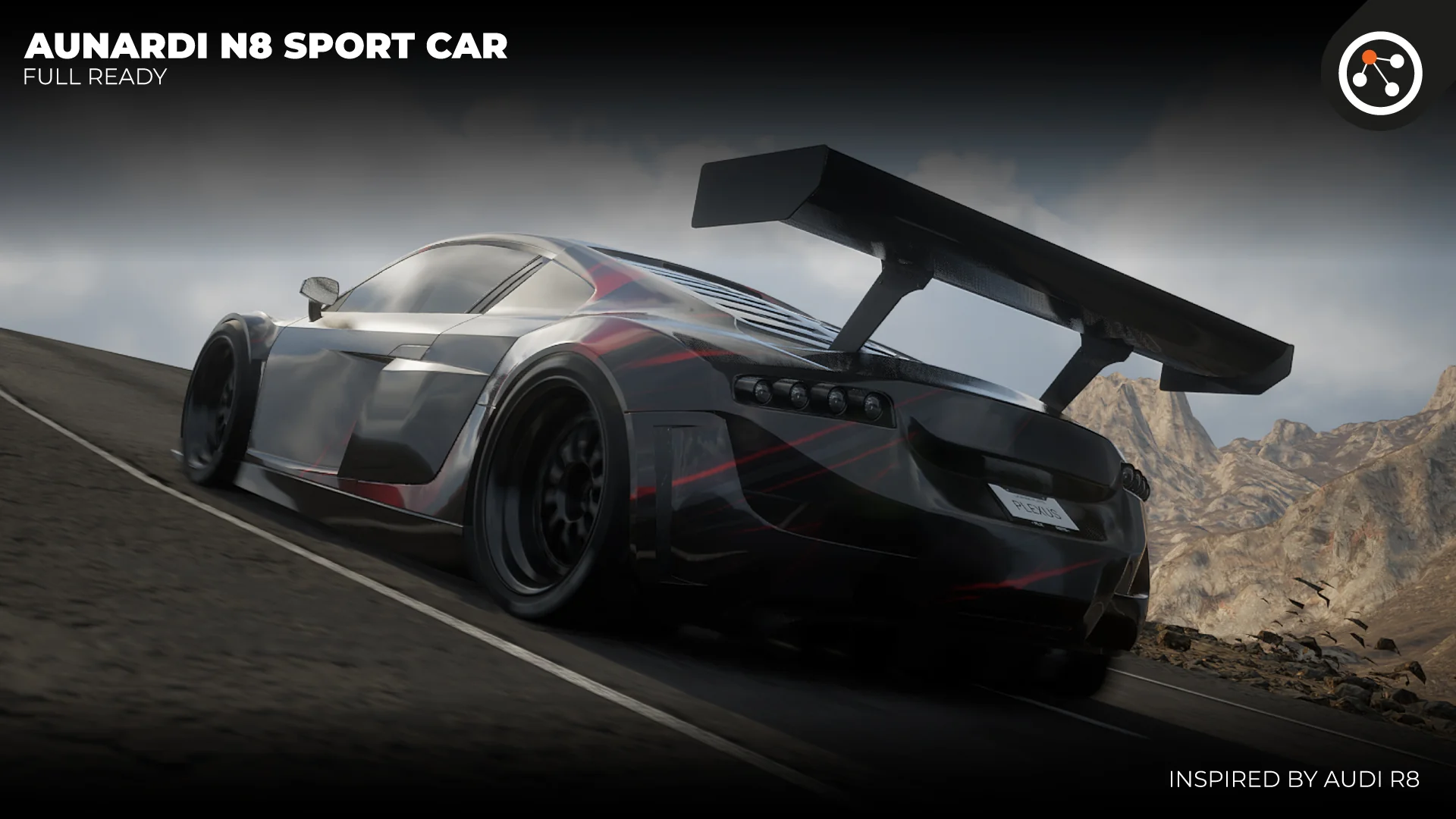
Deploying the drivable platform into an active Unreal Engine 5 project begins with a consolidated implementation footprint. The vehicle operates from a single core blueprint, which contains the mechanical behavior, visual bindings, and state transitions needed to control the car immediately upon placement. Control schemes are mapped to keyboard and mouse inputs, establishing direct handling for steering, acceleration, and braking without demanding elaborate input reconfiguration scripts.
Physics recovery is solved out of the box through a dedicated flip car feature. When collisions, track debris, or aggressive cornering cause the chassis to invert, triggering the flip system resets vehicle orientation cleanly onto its tires. This eliminates common physics dead-ends in testing environments or gameplay sessions. Exterior lights are pre-configured to toggle into active states, enabling immediate transitions between brightly lit test environments and darker race scenarios.
Multiplayer Synchronization and Aunardi Passenger Roles
Network replication is integrated directly into the mechanics of the vehicle, bypassing the common hurdle of converting single-player driving logic for online servers. State changes, wheel rotations, speed indicators, and positioning data replicate reliably between host instances and connected clients. This networked framework supports concurrent vehicle interactions without positional desynchronization.
Cabin occupancy extends beyond a lone driver. The blueprint includes a complete driver and passenger system, allowing multiple player pawns to board the same vehicle instance. The passenger system tracks seating logic natively across the network, synchronizing entry, ride-along camera positions, and passenger states. For project managers looking to implement gameplay constraints, an integrated fuel system is present and can be toggled on or off depending on whether the game requires resource management or purely arcade-style laps.
Aunardi Cockpit Readouts and Display Controls
Driver instrumentation accommodates both immersive first-person setups and third-person racing layouts. The vehicle provides dual speedometers: an integrated interior dashboard display embedded within the model geometry and a screen-space head-up display (HUD). Drivers can switch their speed readout unit between KMH and MPH on the fly to suit local racing standards or user preferences.
Speedometer styling is adaptable, featuring changeable digital colors that allow the readouts to match the dashboard aesthetics or user selection. The HUD contains a dedicated, toggleable HUD rear-view mirror to track trailing opponents without looking backward. If an interface-free cockpit view or clean cinematics are preferred, the entire HUD system can be switched off through a single toggle function.
Aunardi Visual FX, Exhaust Profiles, and Surface Dynamics
Acoustic output uses Unreal Engine 5.3+ Metasound assets for engine audio, generating adaptive sound curves that respond dynamically to throttle pressure and gear states. Complementary audio design covers tire scrub, wheel slide effects, and exhaust backfire SFX, generating cohesive acoustic feedback across distinct road conditions.
Visual effects pair closely with audio triggers. Exhaust emitters produce smoke and combustion VFX under heavy throttle, while tire friction produces visible surface smoke. Ground skidmarks utilize surface validation logic: the skidmark VFX and SFX suppress mark generation while the tires are off the ground, ensuring that airborne jumps do not paint floating tire decals across empty air. Heavy braking events trigger an emissive heat glow effect across the brake disks, visualizing thermal buildup inside the wheel wells. For stylized or arcade presentations, a toggleable stylized trailing effect inspired by modern street racing titles spawns vivid white and red trails behind the rear quarter panels as the vehicle accelerates.
Styling Systems, Wheel Sets, and Bonus Race Track Props
Visual customization is managed through a runtime menu equipped with auto-save and load serialization. Players can cycle vehicle aesthetics and store modifications between sessions. The vehicle exterior includes car paint materials alongside three distinct pre-configured skins. Individual body components and wheels can be painted separately via the styling menu to generate custom color blocking.
Exterior accessories and silhouettes can be altered quickly:
Spoiler visibility toggles dynamically to strip down or accentuate the rear aerodynamics.
Two editable number plates (white and yellow plate variants) support custom alphanumeric plate text configured directly inside the menu.
Tire setups include two different sport tire materials paired with high-quality wheels, supplemented by a bonus high-quality sport wheel set gift asset.
Visual staging is bolstered by additional environment assets packed alongside the vehicle. The package includes bonus race track props to establish course borders, an animated text material for digital signage, and a dedicated sharpen post-process material to refine overall edge clarity and scene sharpness.
Camera Perspective Suite and Drive-Feel Tuning
Perspective handling combines responsive chases with dynamic cinematic shifts. The main third-person driving camera incorporates smooth zoom in and out behaviors, accompanied by a speed perspective effect that expands the field of view under acceleration to enhance the sensation of velocity. An auto-centering feature pulls the lens back to alignment behind the vehicle vector once manual orbit inputs cease.
In-cockpit perspectives place the viewer behind the wheel with full line of sight across the interior speedometer. Transitioning between angles is handled smoothly, with fluid crossing cameras moving between side profiles, corner viewpoints, and the interior dashboard. Whether navigating tight corners in cockpit mode or orchestrating high-speed overtakes from chase views, the multi-camera array provides steady orientation and immediate visual context across all driving situations.
 Cars & Trucks
 Cars & Trucks
 Cars & Trucks