"0341a2901a4ae9aa"{"id":"25001","slug":"simple-procedural-walk","title":"Simple Procedural Walk","category":"Engine Tools","engine":"5.3","assetVersion":"Engine version: 5.3","engineVersion":"","tag":"Engine Tools","accent":"blue","visual":"animation","summary":"Simple Procedural Walk gives skeletal meshes a real-time walking cycle without relying on pre-recorded animation. It is strongest on robotic or insectoid characters, with mechs also supported, while organic characters are left to motion-capture style movement.","platform":"Unreal Engine","publishedAt":"2026-04-18T15:47:18.000Z","updatedAt":"2026-04-20T06:12:34.000Z","sourceNotes":[],"fileContents":[],"compatibility":["Unreal Engine","Engine version: 5.3"],"featuredImage":{"alt":"Simple Procedural Walk","src":"https://3dcghub.com/wp-content/uploads/2026/04/3f2c1025b72b_a9e4b4f7-6fe2-488e-872a-1cc50cd404eb.webp"},"hasDownloadLink":true,"downloads":0,"terms":[{"taxonomy":"category","slug":"engine-tools-tools-and-plugins","name":"Engine Tools"},{"taxonomy":"post_tag","slug":"animation","name":"Animation"},{"taxonomy":"post_tag","slug":"characters","name":"Characters"},{"taxonomy":"post_tag","slug":"unreal-engine-5","name":"Unreal Engine 5"}],"galleryImages":[{"src":"https://3dcghub.com/wp-content/uploads/2026/04/7e35e4faf23b_9a302460-044b-4060-97dd-56c145a3c636.webp","alt":"Simple Procedural Walk"},{"src":"https://3dcghub.com/wp-content/uploads/2026/04/cfc036b76a83_a30b2a21-6b38-4dd4-aaac-91b7447f3752.webp","alt":"Simple Procedural Walk"},{"src":"https://3dcghub.com/wp-content/uploads/2026/04/96d6c94e8f98_1de849c3-8461-469c-b4a7-7c5be2542ff5.webp","alt":"Simple Procedural Walk"},{"src":"https://3dcghub.com/wp-content/uploads/2026/04/5b2259ba19a2_141d12db-0515-47e4-9ff0-a6e756c3c04c.webp","alt":"Simple Procedural Walk"},{"src":"https://3dcghub.com/wp-content/uploads/2026/04/ec9056f50071_39563c00-ba08-4e36-aea3-5b7d3f80f667.webp","alt":"Simple Procedural Walk"},{"src":"https://3dcghub.com/wp-content/uploads/2026/04/33c2ca031d0e_51171b11-3389-49ee-ad55-c2782113eda4.webp","alt":"Simple Procedural Walk"},{"src":"https://3dcghub.com/wp-content/uploads/2026/04/c2678a74cace_94945fa4-bf34-4d8e-824c-b1d0b7d0ba2d.webp","alt":"Simple Procedural Walk"},{"src":"https://3dcghub.com/wp-content/uploads/2026/04/ad9a45131191_ac9477f6-64d1-47c2-a623-a5d3f2a9021c.webp","alt":"Simple Procedural Walk"},{"src":"https://3dcghub.com/wp-content/uploads/2026/04/22d0d9ea536f_fc7e7286-9c93-4a56-822c-6af493ba0b6b.webp","alt":"Simple Procedural Walk"}],"accessPanel":{"kind":"resource","title":"Access this resource","eyebrow":"Free Download","message":"Log in or create a free account to start your download.","fileName":"Plugins.7z","safetyNote":"All resources are 100% manually reviewed to eliminate all risks.","actionLabel":"Download Free","resourceType":"Resource archive"},"contentHtml":"\u003ch2\u003eWalking motion without a prebuilt cycle\u003c/h2\u003e\u003cp\u003eSimple Procedural Walk turns a character with no animations into something that appears to move on its own. The plugin computes the walk cycle in real time, so the character does not need a pre-recorded animation asset to start moving. That changes the way a scene is assembled: instead of matching a character to a fixed loop, the motion is generated as the character moves.\u003c/p\u003e\u003cp\u003eThe effect is aimed at skeletal meshes that need believable walking behavior without a hand-authored cycle. Legs and feet adapt to the surrounding movement, which helps the walk feel tied to the scene rather than locked into a repeating clip. The result is most relevant when the character needs to react to motion changes as it travels.\u003c/p\u003e\u003ch2\u003eWhere the plugin fits best\u003c/h2\u003e\u003cp\u003eThe clearest fit is for robotic or insectoid characters. Those forms are called out as the main target, and the plugin can also be used in other scenarios. Bipeds such as mechs are included in that wider range, so it can still suit non-organic walkers that follow a mechanical or stylized shape.\u003c/p\u003e\u003cp\u003eAt the same time, it is not intended for organic characters such as humans or dogs. Their motion is generally better handled with data coming from motion capture, which places this plugin in a narrower but more focused lane. That makes the strongest use cases easier to identify: characters that should walk convincingly without relying on human-style animation data.\u003c/p\u003e\u003cp\u003eThe tags attached to the plugin line up with that focus as well: insect, spider, procedural, robot, walk, movement, and character. Those terms describe the kind of motion and creature design it is meant to support, rather than a broad all-purpose animation system.\u003c/p\u003e\u003ch2\u003eControl Rig and the current workflow\u003c/h2\u003e\u003cp\u003eA newer option lets you drive the animations with Control Rig if you prefer that path. The setup is presented as something you can follow through a guide, which gives teams another way to approach the same procedural walk behavior. That makes the plugin relevant not only as a standalone motion system, but also as part of a Control Rig-based workflow.\u003c/p\u003e\u003cp\u003eThe plugin is accompanied by trailer video material, tutorial videos, and documentation, which points to a setup process that benefits from a careful read before use. Procedural animation takes a little effort to establish, and the motion usually needs constant tweaking before it feels right. That is not framed as a quick one-click solution; it is a system that rewards adjustment.\u003c/p\u003e\u003cp\u003eA good understanding of how meshes need to be set up is also important. The plugin depends on characters being prepared in a way that works smoothly with its procedural logic, so mesh setup is part of the implementation rather than an afterthought. For teams that already know how their meshes need to behave, that is a workable starting point. For anyone new to procedural walking, the guidance material matters.\u003c/p\u003e\u003ch2\u003eVersion, demo project, and what to expect before use\u003c/h2\u003e\u003cp\u003eThe current version is 1.7.0, dated Nov 14th, 2025. A demo project is available for versions greater than or equal to 4.27, which places the plugin in the context of an Unreal Engine workflow without needing a prebuilt walk library. That compatibility note is one of the most concrete signals about where the plugin sits in a project pipeline.\u003c/p\u003e\u003cp\u003eThe key takeaway is practical: this is not a passive animation pack, but a procedural walking tool that expects proper setup and ongoing refinement. It gives characters a real-time walk cycle, works best on robotic and insect-like forms, supports mechs, and now includes a Control Rig option. Teams evaluating it should plan around mesh preparation, documentation, and tuning time, because those steps are part of making the motion work well.\u003c/p\u003e\n\n\u003ch2\u003eRelated Resources Worth Checking\u003c/h2\u003e\n\u003cul\u003e\n\u003cli\u003e\u003ca href=\"https://3dcghub.com/advanced-unreal-engine-5-multiplayer-gameplay-programming/\" title=\"Advanced Unreal Engine 5 Multiplayer Gameplay Programming\"\u003eAdvanced Unreal Engine 5 Multiplayer Gameplay Programming\u003c/a\u003e\u003c/li\u003e\n\u003cli\u003e\u003ca href=\"https://3dcghub.com/niagara-beginners-to-advanced-in-unreal-engine-5/\" title=\"Niagara Beginners to advanced in Unreal Engine 5\"\u003eNiagara Beginners to advanced in Unreal Engine 5\u003c/a\u003e\u003c/li\u003e\n\u003cli\u003e\u003ca href=\"https://3dcghub.com/create-zelda-like-skills-with-c-in-unreal-engine-5-2/\" title=\"Create Zelda-like skills with C++ in unreal engine 5\"\u003eCreate Zelda-like skills with C++ in unreal engine 5\u003c/a\u003e\u003c/li\u003e\n\u003cli\u003e\u003ca href=\"https://3dcghub.com/main-menus-beginner-class-unreal-engine-5/\" title=\"Main Menus Beginner Class – Unreal Engine 5\"\u003eMain Menus Beginner Class – Unreal Engine 5\u003c/a\u003e\u003c/li\u003e\n\u003cli\u003e\u003ca href=\"https://3dcghub.com/create-zelda-like-skills-with-c-in-unreal-engine-5/\" title=\"Create Zelda-like skills with C++ in unreal engine 5\"\u003eCreate Zelda-like skills with C++ in unreal engine 5\u003c/a\u003e\u003c/li\u003e\n\u003c/ul\u003e\n\n\u003ch2\u003eAsset Gallery\u003c/h2\u003e","contentTextLength":4060,"navigation":{"current":2369,"total":4017,"previous":{"id":"25015","slug":"stylized-eye-material","title":"Stylized Eye Material","category":"Eyes","platform":"Unreal Engine","updatedAt":"2026-04-20T06:12:34.000Z"},"next":{"id":"24988","slug":"tornado-generator-niagara-fluids","title":"Tornado Generator - Niagara Fluids","category":"Smoke","platform":"Unreal Engine","updatedAt":"2026-04-20T06:12:34.000Z"}},"relatedResources":[{"id":"14610","slug":"simple-tree-generator","title":"Simple Tree Generator","category":"Engine Tools","engine":"5.6 - 5.8","assetVersion":"Asset Version: 1.1","engineVersion":"Engine version: 5.6 - 5.8","tag":"Engine Tools","accent":"blue","visual":"audio","summary":"Simple Tree Generator is a powerful tool designed specifically for Unreal Engine 5. It enables developers to procedurally create diverse trees and bushes with just a few clicks.","platform":"Unreal Engine","publishedAt":"2026-03-11T18:36:43.000Z","updatedAt":"2026-09-17T02:13:52.813Z","sourceNotes":[],"fileContents":[],"compatibility":["Unreal Engine","Asset Version: 1.1","Engine version: 5.6 - 5.8"],"featuredImage":{"alt":"Simple Tree Generator","src":"https://3dcghub.com/wp-content/uploads/2026/03/4e3b784d-7198-46b5-a343-a73957e40875.webp"},"hasDownloadLink":true,"downloads":0},{"id":"15266","slug":"global-world-optimization-framework-pro-max-high-performance-for-large-worlds","title":"Global World Optimization Framework PRO MAX - High Performance for Large Worlds","category":"Procedural Systems","engine":"1.0.5 - 1.3","assetVersion":"Engine version: 5.3,5.6","engineVersion":"Asset Version:1.0.5 - 1.3","tag":"Procedural Systems","accent":"blue","visual":"animation","summary":"Manage thousands of actors and millions of objects with the Global World Optimization Framework PRO MAX. This system ensures high FPS and persistent world states for large-scale projects.","platform":"Unreal Engine","publishedAt":"2026-03-12T08:27:50.000Z","updatedAt":"2026-07-11T05:24:34.488Z","sourceNotes":[],"fileContents":[],"compatibility":["Unreal Engine","Engine version: 5.3,5.6","Asset Version:1.0.5 - 1.3"],"featuredImage":{"alt":"Global World Optimization Framework PRO MAX - High Performance for Large Worlds","src":"https://3dcghub.com/wp-content/uploads/2026/03/e6a4ffeb-2e66-4d5c-a559-94a10f521a84.webp"},"hasDownloadLink":true,"downloads":0},{"id":"15301","slug":"procedural-fps-recoil-system","title":"Procedural FPS Recoil System","category":"Procedural Systems","engine":"2025.3.0","assetVersion":"Engine version: 5.6 - 5.7","engineVersion":"Asset Version:2025.3.0","tag":"Procedural Systems","accent":"blue","visual":"audio","summary":"Improve your game's combat with the Procedural FPS Recoil System. This tool offers smooth, customizable recoil animations for any weapon type while saving memory and development time.","platform":"Unreal Engine","publishedAt":"2026-03-12T08:33:53.000Z","updatedAt":"2026-07-05T06:16:23.079Z","sourceNotes":[],"fileContents":[],"compatibility":["Unreal Engine","Engine version: 5.6 - 5.7","Asset Version:2025.3.0"],"featuredImage":{"alt":"Procedural FPS Recoil System","src":"https://3dcghub.com/wp-content/uploads/2026/03/7bb95269-1ed4-43fe-aaa3-4282f29a6582.webp"},"hasDownloadLink":true,"downloads":3}]}
Engine Tools
Simple Procedural Walk
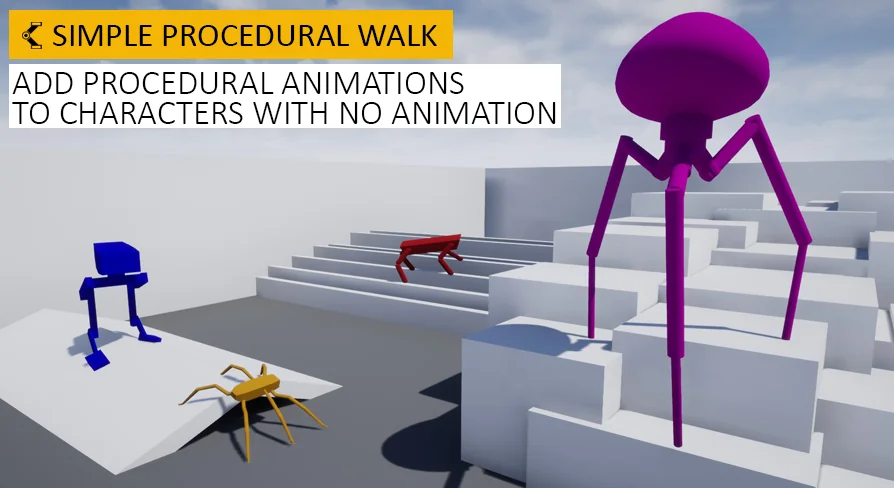
Simple Procedural Walk gives skeletal meshes a real-time walking cycle without relying on pre-recorded animation. It is strongest on robotic or insectoid characters, with mechs also supported, while organic characters are left to motion-capture style movement.
Simple Procedural Walk turns a character with no animations into something that appears to move on its own. The plugin computes the walk cycle in real time, so the character does not need a pre-recorded animation asset to start moving. That changes the way a scene is assembled: instead of matching a character to a fixed loop, the motion is generated as the character moves.
The effect is aimed at skeletal meshes that need believable walking behavior without a hand-authored cycle. Legs and feet adapt to the surrounding movement, which helps the walk feel tied to the scene rather than locked into a repeating clip. The result is most relevant when the character needs to react to motion changes as it travels.
Where the plugin fits best
The clearest fit is for robotic or insectoid characters. Those forms are called out as the main target, and the plugin can also be used in other scenarios. Bipeds such as mechs are included in that wider range, so it can still suit non-organic walkers that follow a mechanical or stylized shape.
At the same time, it is not intended for organic characters such as humans or dogs. Their motion is generally better handled with data coming from motion capture, which places this plugin in a narrower but more focused lane. That makes the strongest use cases easier to identify: characters that should walk convincingly without relying on human-style animation data.
The tags attached to the plugin line up with that focus as well: insect, spider, procedural, robot, walk, movement, and character. Those terms describe the kind of motion and creature design it is meant to support, rather than a broad all-purpose animation system.
Control Rig and the current workflow
A newer option lets you drive the animations with Control Rig if you prefer that path. The setup is presented as something you can follow through a guide, which gives teams another way to approach the same procedural walk behavior. That makes the plugin relevant not only as a standalone motion system, but also as part of a Control Rig-based workflow.
The plugin is accompanied by trailer video material, tutorial videos, and documentation, which points to a setup process that benefits from a careful read before use. Procedural animation takes a little effort to establish, and the motion usually needs constant tweaking before it feels right. That is not framed as a quick one-click solution; it is a system that rewards adjustment.
A good understanding of how meshes need to be set up is also important. The plugin depends on characters being prepared in a way that works smoothly with its procedural logic, so mesh setup is part of the implementation rather than an afterthought. For teams that already know how their meshes need to behave, that is a workable starting point. For anyone new to procedural walking, the guidance material matters.
Version, demo project, and what to expect before use
The current version is 1.7.0, dated Nov 14th, 2025. A demo project is available for versions greater than or equal to 4.27, which places the plugin in the context of an Unreal Engine workflow without needing a prebuilt walk library. That compatibility note is one of the most concrete signals about where the plugin sits in a project pipeline.
The key takeaway is practical: this is not a passive animation pack, but a procedural walking tool that expects proper setup and ongoing refinement. It gives characters a real-time walk cycle, works best on robotic and insect-like forms, supports mechs, and now includes a Control Rig option. Teams evaluating it should plan around mesh preparation, documentation, and tuning time, because those steps are part of making the motion work well.
 Engine Tools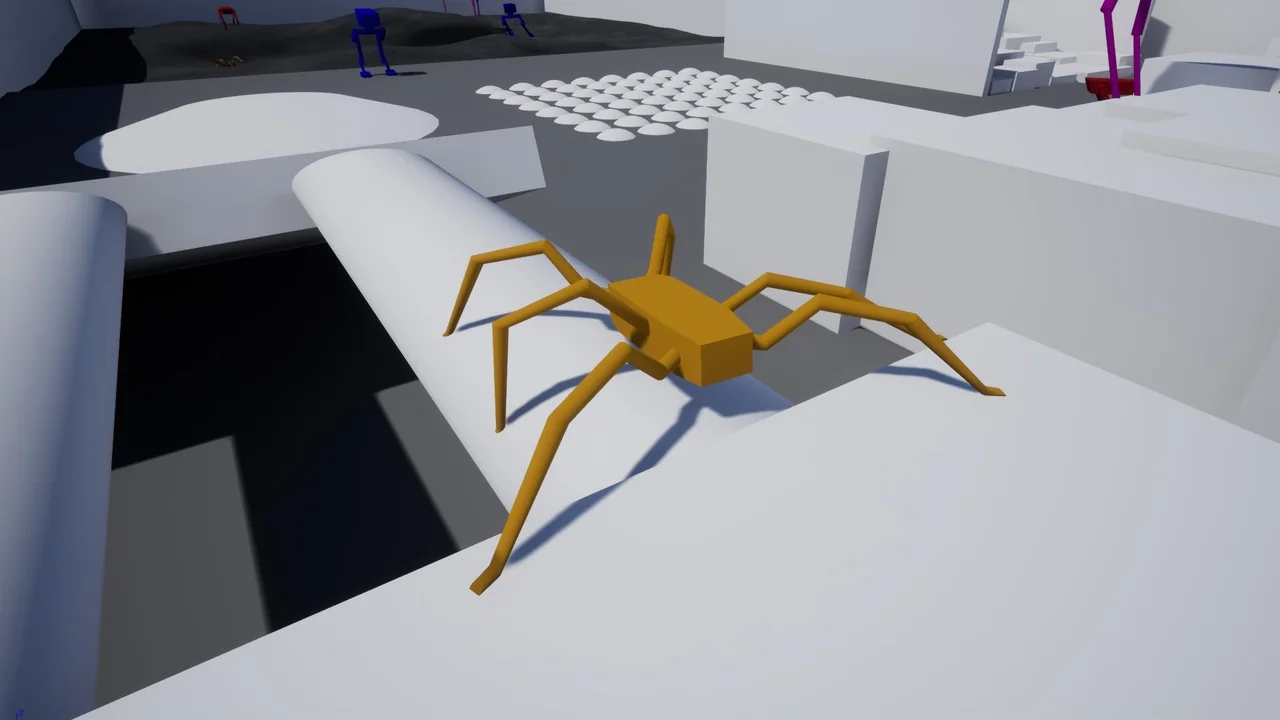
 Engine Tools
 Procedural Systems
 Procedural Systems