"f813c18d2170b1f6"{"id":"24590","slug":"create-zelda-like-skills-with-c-in-unreal-engine-5","title":"Create Zelda-like skills with C++ in unreal engine 5","category":"Unreal Engine","engine":"Video language: English","assetVersion":"Video language: English","engineVersion":"File content: video + supporting files + English subtitles","tag":"Unreal Engine","accent":"blue","visual":"character","summary":"This Unreal Engine 5 course focuses on a skill framework and locomotion state handling in C++, with five gameplay skills, stamina states, and supporting UI. It also covers communication between C++ and Blueprint for third-person puzzle projects.","platform":"Unreal Engine","publishedAt":"2026-04-15T14:06:48.000Z","updatedAt":"2026-04-20T06:12:43.000Z","sourceNotes":[],"fileContents":[],"compatibility":["Unreal Engine","Video language: English","File content: video + supporting files + English subtitles"],"featuredImage":{"alt":"Create Zelda-like skills with C++ in unreal engine 5","src":"https://3dcghub.com/wp-content/uploads/2026/04/4a5e864b1691_6210843_6075-1.webp"},"hasDownloadLink":true,"downloads":0,"terms":[{"taxonomy":"category","slug":"tutoriallibrary-unrealengine","name":"Unreal Engine"},{"taxonomy":"post_tag","slug":"environment","name":"Environment"},{"taxonomy":"post_tag","slug":"game-systems","name":"Game Systems"},{"taxonomy":"post_tag","slug":"unreal-engine-5","name":"Unreal Engine 5"}],"galleryImages":[],"accessPanel":{"kind":"video-resource","title":"Access this video resource","eyebrow":"Free Download","message":"Log in or create a free account to start your download.","fileName":"Control Rig for Unreal Engine 5.7z","safetyNote":"All resources are 100% manually reviewed to eliminate all risks.","actionLabel":"Download Free","resourceType":"Video package"},"contentHtml":"\u003ch2\u003eSkill behavior and movement states in a third-person project\u003c/h2\u003e\n\u003cp\u003eThis Unreal Engine 5 course centers on the parts of a game that players feel immediately: movement, stamina, and skills that change how a character interacts with the world. It walks through designing skill and locomotion management in C++, then connects that work to Blueprint so gameplay logic can move cleanly between code and visual scripting.\u003c/p\u003e\n\u003cp\u003eThe project focus fits a Zelda-like third-person puzzle game, where abilities and traversal states matter just as much as the level layout. Sprint, gliding, exhaustion, and normal movement are all part of the state handling, so the character can shift between different modes instead of staying in one fixed control setup.\u003c/p\u003e \u003ch2\u003eThe skill framework and the five abilities\u003c/h2\u003e\n\u003cp\u003eA major part of the course is a skill framework that handles multiple abilities in one system. That is the practical layer a team would use when a project needs abilities to stay organized instead of being scattered across separate scripts. The course includes five skills creation, with remote bomb, magnesis, ice actor, and stasis skill among the abilities listed.\u003c/p\u003e\n\u003cp\u003eThat mix makes the workflow easy to picture in an actual game project. One ability may trigger an object interaction, another may affect movement, and another may change how the player solves a puzzle space. The important part is not a single isolated effect, but the structure that lets several skills live under one management setup.\u003c/p\u003e\n\u003cp\u003eThe course also includes skill selection, which matters when a player needs to switch between abilities during play. In practice, that means the project is not treating skills as one-off events; it is treating them as a system the player can access and change through gameplay.\u003c/p\u003e \u003ch2\u003eLocomotion management and stamina handling\u003c/h2\u003e\n\u003cp\u003eMovement is handled as a state system rather than a single walk cycle. The listed states include sprint, gliding, exhausted, and normal, all tied to a stamina system. That makes the locomotion layer relevant to puzzle play as well as traversal, since abilities and movement both affect how the character gets through a scene.\u003c/p\u003e\n\u003cp\u003eFor a project like this, locomotion management sits near the core of the player controller flow. Sprinting and gliding change how the player crosses space, while exhaustion gives the system a limiting state that can affect pacing. Because stamina is part of the setup, the movement model is not just cosmetic; it supports the rhythm of ability use and exploration.\u003c/p\u003e\n\u003cp\u003eThe course starts from project setup and basic locomotion states, then moves into the skill management framework. That sequence matters in production, since movement and state handling usually need to be in place before ability systems can be tested in a stable way.\u003c/p\u003e \u003ch2\u003eMechanical actors and interface handling\u003c/h2\u003e\n\u003cp\u003eBeyond the character, the course covers other gameplay mechanical actors. The named examples include wind tunnel, pressure plate, pickable object, and breakable wall. These are the kinds of world interactions that help a third-person puzzle game feel connected rather than isolated around the player character alone.\u003c/p\u003e\n\u003cp\u003eA robust and neat UI system is also part of the training, and it is tied to multiple gameplay mechanical actors as well as skill selection. That places the interface work alongside the gameplay logic instead of treating it as a separate afterthought. In a production workflow, this is useful when the same project needs both action feedback and interaction prompts to remain readable.\u003c/p\u003e\n\u003cp\u003eBecause the course also covers communication between C++ and Blueprint, the gameplay pieces can be split between systems in a way that fits a real team pipeline. Code can manage the core logic while Blueprint handles parts of the project that benefit from quick iteration and visual setup.\u003c/p\u003e \u003ch2\u003eWhere this fits in a real workflow\u003c/h2\u003e\n\u003cp\u003eThis is an intermediate course with a workload of 8h 10m, published on Jan 26, 2025. That makes it a fit for learners who already know some C++ and want to apply it to a game project rather than study programming in the abstract.\u003c/p\u003e\n\u003cp\u003eThe target audience is explicit: learners who want to build a project with multiple skills, learners who want to apply C++ knowledge to a game project, and learners who want to create a zelder-like third-person puzzle game. Those goals line up with the course structure, which moves from setup and locomotion into the skill framework, then into five skills, gameplay actors, and a bonus section.\u003c/p\u003e\n\u003cp\u003eFor production use, the value is in the sequence. A team working on a third-person puzzle prototype would start with movement states, add a skill management layer, create abilities, and then connect world mechanics and UI so the project can be played as a complete loop. The course keeps those pieces in the same workflow instead of treating them as unrelated topics.\u003c/p\u003e\n\u003cp\u003eAs a practical takeaway, this is a C++-heavy Unreal Engine 5 training path for teams or learners who need character movement, ability switching, puzzle interactions, and Blueprint communication to live in one organized gameplay system.\u003c/p\u003e\n\n\u003ch2\u003eExplore Similar Assets\u003c/h2\u003e\n\u003cul\u003e\n\u003cli\u003e\u003ca href=\"https://3dcghub.com/make-a-2d-action-platformer-in-unreal-engine-5/\" title=\"Make a 2D Action Platformer in Unreal Engine 5\"\u003eMake a 2D Action Platformer in Unreal Engine 5\u003c/a\u003e\u003c/li\u003e\n\u003cli\u003e\u003ca href=\"https://3dcghub.com/master-unreal-engine-5-advanced-door-systems-blueprints/\" title=\"Master Unreal Engine 5 Advanced Door Systems Blueprints\"\u003eMaster Unreal Engine 5 Advanced Door Systems Blueprints\u003c/a\u003e\u003c/li\u003e\n\u003cli\u003e\u003ca href=\"https://3dcghub.com/the-ultimate-2d-top-down-unreal-engine-course/\" title=\"The Ultimate 2D Top Down Unreal Engine Course\"\u003eThe Ultimate 2D Top Down Unreal Engine Course\u003c/a\u003e\u003c/li\u003e\n\u003cli\u003e\u003ca href=\"https://3dcghub.com/unreal-engine-5-c-make-your-own-action-combat-game/\" title=\"Unreal Engine 5 C++: Make Your Own Action Combat Game\"\u003eUnreal Engine 5 C++: Make Your Own Action Combat Game\u003c/a\u003e\u003c/li\u003e\n\u003cli\u003e\u003ca href=\"https://3dcghub.com/unreal-engine-5-for-beginners-create-your-first-game/\" title=\"Unreal Engine 5 for Beginners – Create your first game\"\u003eUnreal Engine 5 for Beginners – Create your first game\u003c/a\u003e\u003c/li\u003e\n\u003c/ul\u003e","contentTextLength":5353,"navigation":{"current":1959,"total":3651,"previous":{"id":"24560","slug":"unreal-engine-5-c-advanced-action-rpg","title":"Unreal Engine 5 C++: Advanced Action RPG","category":"Unreal Engine","platform":"Unreal Engine","updatedAt":"2026-04-20T06:12:44.000Z"},"next":{"id":"24581","slug":"make-a-2d-action-platformer-in-unreal-engine-5","title":"Make a 2D Action Platformer in Unreal Engine 5","category":"Unreal Engine","platform":"Unreal Engine","updatedAt":"2026-04-20T06:12:43.000Z"}},"relatedResources":[{"id":"24587","slug":"create-zelda-like-skills-with-c-in-unreal-engine-5-2","title":"Create Zelda-like skills with C++ in unreal engine 5","category":"Unreal Engine","engine":"Video language: English","assetVersion":"Video language: English","engineVersion":"File content: video + supporting files + English subtitles","tag":"Unreal Engine","accent":"blue","visual":"animation","summary":"This Unreal Engine 5 C++ course focuses on the problem of keeping skills, movement states, and interactable scene actors in one working system. It walks through a Zelda-like setup with named abilities, stamina-based locomotion, and blueprint communication.","platform":"Unreal Engine","publishedAt":"2026-04-15T14:07:16.000Z","updatedAt":"2026-04-20T06:12:42.000Z","sourceNotes":[],"fileContents":[],"compatibility":["Unreal Engine","Video language: English","File content: video + supporting files + English subtitles"],"featuredImage":{"alt":"Create Zelda-like skills with C++ in unreal engine 5","src":"https://3dcghub.com/wp-content/uploads/2026/04/4a5e864b1691_6210843_6075.webp"},"hasDownloadLink":true,"downloads":0},{"id":"1001157","slug":"unreal-engine-5-create-and-publish-a-3d-action-mobile-game","title":"Unreal Engine 5: Create and Publish a 3D Action Mobile Game","category":"Unreal Engine","engine":"File Content: video + English subtitles","assetVersion":"Video Language: English","engineVersion":"File Content: video + English subtitles","tag":"Unreal Engine","accent":"blue","visual":"mech","summary":"Learn to create a Sekiro-like melee combat framework, build advanced AI, optimize performance, and publish to Google Play using Unreal Engine 5.","platform":"Unreal Engine","publishedAt":"2026-09-11T01:53:32.696Z","updatedAt":"2026-09-11T01:53:32.696Z","sourceNotes":[],"fileContents":[],"compatibility":["Unreal Engine","Video Language: English","File Content: video + English subtitles"],"featuredImage":{"alt":"Unreal Engine 5: Create and Publish a 3D Action Mobile Game","src":"/wp-content/uploads/published/2026/09/145b4cf1b3c1-4900408-8371-2-4eb752900c.webp"},"hasDownloadLink":true,"downloads":0},{"id":"24568","slug":"unreal-engine-5-for-beginners-create-your-first-game","title":"Unreal Engine 5 for Beginners - Create your first game","category":"Unreal Engine","engine":"Video language: English","assetVersion":"Video language: English","engineVersion":"File content: video + supporting files + English subtitles","tag":"Unreal Engine","accent":"blue","visual":"city","summary":"This beginner course walks through Unreal Engine 5 basics, then moves into Blueprints, character animation, UI widgets, and the steps needed to create a real 3D game. It is aimed at beginner game developers who want a practical starting point.","platform":"Unreal Engine","publishedAt":"2026-04-15T13:30:22.000Z","updatedAt":"2026-04-20T06:12:44.000Z","sourceNotes":[],"fileContents":[],"compatibility":["Unreal Engine","Video language: English","File content: video + supporting files + English subtitles"],"featuredImage":{"alt":"Unreal Engine 5 for Beginners - Create your first game","src":"https://3dcghub.com/wp-content/uploads/2026/04/d35b769681b1_5098972_a916_5.webp"},"hasDownloadLink":true,"downloads":0}]}
Unreal Engine
Create Zelda-like skills with C++ in unreal engine 5
This Unreal Engine 5 course focuses on a skill framework and locomotion state handling in C++, with five gameplay skills, stamina states, and supporting UI. It also covers communication between C++ and Blueprint for third-person puzzle projects.
Category:Unreal EnginePlatform: Unreal EngineVideo language: EnglishFile content: video + supporting files + English subtitlesPublished: Apr 15, 2026Updated: Apr 20, 2026
Unreal Engine
Resource overview
Skill behavior and movement states in a third-person project
This Unreal Engine 5 course centers on the parts of a game that players feel immediately: movement, stamina, and skills that change how a character interacts with the world. It walks through designing skill and locomotion management in C++, then connects that work to Blueprint so gameplay logic can move cleanly between code and visual scripting.
The project focus fits a Zelda-like third-person puzzle game, where abilities and traversal states matter just as much as the level layout. Sprint, gliding, exhaustion, and normal movement are all part of the state handling, so the character can shift between different modes instead of staying in one fixed control setup.
The skill framework and the five abilities
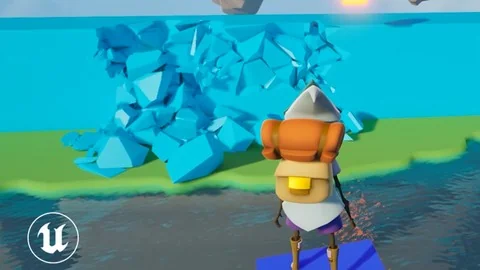
A major part of the course is a skill framework that handles multiple abilities in one system. That is the practical layer a team would use when a project needs abilities to stay organized instead of being scattered across separate scripts. The course includes five skills creation, with remote bomb, magnesis, ice actor, and stasis skill among the abilities listed.
That mix makes the workflow easy to picture in an actual game project. One ability may trigger an object interaction, another may affect movement, and another may change how the player solves a puzzle space. The important part is not a single isolated effect, but the structure that lets several skills live under one management setup.
The course also includes skill selection, which matters when a player needs to switch between abilities during play. In practice, that means the project is not treating skills as one-off events; it is treating them as a system the player can access and change through gameplay.
Locomotion management and stamina handling
Movement is handled as a state system rather than a single walk cycle. The listed states include sprint, gliding, exhausted, and normal, all tied to a stamina system. That makes the locomotion layer relevant to puzzle play as well as traversal, since abilities and movement both affect how the character gets through a scene.
For a project like this, locomotion management sits near the core of the player controller flow. Sprinting and gliding change how the player crosses space, while exhaustion gives the system a limiting state that can affect pacing. Because stamina is part of the setup, the movement model is not just cosmetic; it supports the rhythm of ability use and exploration.
The course starts from project setup and basic locomotion states, then moves into the skill management framework. That sequence matters in production, since movement and state handling usually need to be in place before ability systems can be tested in a stable way.
Mechanical actors and interface handling
Beyond the character, the course covers other gameplay mechanical actors. The named examples include wind tunnel, pressure plate, pickable object, and breakable wall. These are the kinds of world interactions that help a third-person puzzle game feel connected rather than isolated around the player character alone.
A robust and neat UI system is also part of the training, and it is tied to multiple gameplay mechanical actors as well as skill selection. That places the interface work alongside the gameplay logic instead of treating it as a separate afterthought. In a production workflow, this is useful when the same project needs both action feedback and interaction prompts to remain readable.
Because the course also covers communication between C++ and Blueprint, the gameplay pieces can be split between systems in a way that fits a real team pipeline. Code can manage the core logic while Blueprint handles parts of the project that benefit from quick iteration and visual setup.
Where this fits in a real workflow
This is an intermediate course with a workload of 8h 10m, published on Jan 26, 2025. That makes it a fit for learners who already know some C++ and want to apply it to a game project rather than study programming in the abstract.
The target audience is explicit: learners who want to build a project with multiple skills, learners who want to apply C++ knowledge to a game project, and learners who want to create a zelder-like third-person puzzle game. Those goals line up with the course structure, which moves from setup and locomotion into the skill framework, then into five skills, gameplay actors, and a bonus section.
For production use, the value is in the sequence. A team working on a third-person puzzle prototype would start with movement states, add a skill management layer, create abilities, and then connect world mechanics and UI so the project can be played as a complete loop. The course keeps those pieces in the same workflow instead of treating them as unrelated topics.
As a practical takeaway, this is a C++-heavy Unreal Engine 5 training path for teams or learners who need character movement, ability switching, puzzle interactions, and Blueprint communication to live in one organized gameplay system.
 Unreal Engine
 Unreal Engine
 Unreal Engine
 Unreal Engine