"f813c18d2170b1f6"{"id":"24560","slug":"unreal-engine-5-c-advanced-action-rpg","title":"Unreal Engine 5 C++: Advanced Action RPG","category":"Unreal Engine","engine":"Video language: English","assetVersion":"Video language: English","engineVersion":"File content: video + supporting files + English subtitles","tag":"Unreal Engine","accent":"blue","visual":"animation","summary":"An intermediate Unreal Engine 5 C++ course focused on advanced RPG combat, Gameplay Ability System work, and the systems that support responsive melee gameplay. It moves from hero setup and combo design into enemy AI, reactions, special abilities, UI, and g...","platform":"Unreal Engine","publishedAt":"2026-04-15T13:14:09.000Z","updatedAt":"2026-04-20T06:12:44.000Z","sourceNotes":[],"fileContents":[],"compatibility":["Unreal Engine","Video language: English","File content: video + supporting files + English subtitles"],"featuredImage":{"alt":"Unreal Engine 5 C++: Advanced Action RPG","src":"https://3dcghub.com/wp-content/uploads/2026/04/30646bfd2e0c_5743852_e253_15.webp"},"hasDownloadLink":true,"downloads":6,"terms":[{"taxonomy":"category","slug":"tutoriallibrary-unrealengine","name":"Unreal Engine"},{"taxonomy":"post_tag","slug":"environment","name":"Environment"},{"taxonomy":"post_tag","slug":"game-systems","name":"Game Systems"},{"taxonomy":"post_tag","slug":"unreal-engine-5","name":"Unreal Engine 5"}],"galleryImages":[],"accessPanel":{"kind":"video-resource","title":"Access this video resource","eyebrow":"Free Download","message":"Log in or create a free account to start your download.","fileName":"unreal-engine-5-advanced-action-rpg.7z","safetyNote":"All resources are 100% manually reviewed to eliminate all risks.","actionLabel":"Download Free","resourceType":"Video package"},"contentHtml":"\u003ch2\u003eCombat systems that have to work together\u003c/h2\u003e \u003cp\u003eCreating an action RPG in Unreal Engine 5 means more than wiring up attacks. The hero, enemies, abilities, reactions, and UI all need to speak the same language, especially when the combat loop depends on timing, cooldowns, hit responses, and readable feedback. This Unreal Engine 5 C++ course focuses on that exact workflow through the Gameplay Ability System, with C++ driving the pieces that keep advanced RPG combat organized.\u003c/p\u003e \u003cp\u003eThe training is listed at an intermediate level and runs for 44h 13m, so it is aimed at learners who want time to move through a full combat-oriented project rather than a narrow feature demo. The curriculum follows a practical path: set up the hero character, build melee combat, connect abilities, add enemy types, then finish with widgets and game mode work. That structure makes it useful for anyone trying to shape a combat-heavy prototype into something more coherent and extendable.\u003c/p\u003e \u003ch2\u003eHero setup and melee combo flow\u003c/h2\u003e \u003cp\u003eThe early part of the project starts with the hero character, then moves straight into a melee combo system. Light and heavy attacks are both part of the combat loop, which gives the character more than a single attack pattern to repeat. From there, hero combat expands into a fuller set of actions that can be tied into the rest of the gameplay logic.\u003c/p\u003e \u003cp\u003eSeveral combat responses are also part of the hero side of the project. Directional hit react and rolling add movement-based reactions when the character is under pressure, while melee block and parry give the player defensive options instead of only trading blows. The course also includes special weapon abilities and a rage ability with cost and cooldown, so the hero does not rely only on basic attacks. That combination is useful for projects that need a combat loop with attack variety, defense timing, and ability-driven decisions in one place.\u003c/p\u003e \u003ch2\u003eGameplay Ability System work in the middle of the project\u003c/h2\u003e \u003cp\u003eThe Gameplay Ability System is one of the central systems here, and it is used to create the RPG combat experience rather than sitting off to the side as a separate feature. That means abilities are not treated as isolated extras. They are part of the way combat is organized, including the special weapon abilities and the rage ability with its cost and cooldown.\u003c/p\u003e \u003cp\u003eBecause the course uses C++, the focus stays on code that can be extended and kept readable. The target audience explicitly includes learners who want to level up their C++ skills and write clean, professional, extendable code. For projects that need combat logic to stay maintainable as more attacks and abilities are added, that emphasis matters. It also makes the material relevant for teams or solo developers who want a structure they can keep building on after the core melee loop is in place.\u003c/p\u003e \u003ch2\u003eEnemy AI, ranged threats, and boss encounters\u003c/h2\u003e \u003cp\u003eEnemy behavior is not treated as a simple follow target-and-attack setup. The course includes advanced enemy AI using custom BTTask, BTTDecorator, and BTService work, along with the Environment Query System for more advanced AI behaviors. Those pieces point to behavior logic that can respond to the state of the fight instead of following one flat path.\u003c/p\u003e \u003cp\u003eThe enemy side also extends beyond a basic melee opponent. A ranged enemy is included, along with a boss enemy, which gives the project different combat pressures to solve. A ranged opponent changes spacing and timing, while a boss enemy usually pushes the combat loop to handle more complex reactions and ability use. Because the AI tools named here include behavior tree tasks, decorators, services, and EQS, the material fits projects that want combat encounters to feel varied without relying on a single enemy pattern.\u003c/p\u003e \u003ch2\u003eUI feedback, survival mode, and the project flow\u003c/h2\u003e \u003cp\u003eThe final part of the course brings the combat systems into the player-facing layer. A robust UI notify system is included, along with in-game widgets, so combat actions can be reflected in the interface rather than hidden in code alone. That matters in an action RPG where the player needs to understand what is happening during a fight, especially when attacks, reactions, blocks, parries, and abilities all overlap.\u003c/p\u003e \u003cp\u003eThe curriculum also reaches a survival game mode before closing with a completion segment. The full sequence runs from introduction and hero setup through melee combo system, hero combat, enemy AI, hero combat abilities, ranged enemy, boss enemy, hero special abilities, survival game mode, and in-game widgets. That progression gives the project a clear path from character setup to a complete combat loop, which makes it a strong fit for an Unreal Engine 5 production that needs a structured action RPG foundation rather than isolated mechanics.\u003c/p\u003e \u003ch2\u003eWhere this fits best\u003c/h2\u003e \u003cp\u003eThis material fits learners who want to build an action RPG project, improve their C++ skills, and work with code that stays practical as combat systems grow. It is especially relevant when the goal is to connect melee attacks, ability logic, AI behavior, and user feedback into one playable loop. For teams or solo developers working on a combat-heavy Unreal Engine 5 project, it offers a direct path through the systems that shape an advanced RPG encounter.\u003c/p\u003e\n\n\u003ch2\u003eMore From The Same Workflow\u003c/h2\u003e\n\u003cul\u003e\n\u003cli\u003e\u003ca href=\"https://3dcghub.com/unreal-engine-5-one-course-solution-for-niagara-vfx/\" title=\"Unreal Engine 5: One Course Solution For Niagara VFX\"\u003eUnreal Engine 5: One Course Solution For Niagara VFX\u003c/a\u003e\u003c/li\u003e\n\u003cli\u003e\u003ca href=\"https://3dcghub.com/make-a-2d-platformer-in-unreal-engine-5-c/\" title=\"Make a 2D platformer in Unreal engine 5 C++\"\u003eMake a 2D platformer in Unreal engine 5 C++\u003c/a\u003e\u003c/li\u003e\n\u003cli\u003e\u003ca href=\"https://3dcghub.com/embergen-volumetric-unreal-engine-5/\" title=\"EmberGen Volumetric \u0026amp;amp; Unreal Engine 5\"\u003eEmberGen Volumetric \u0026amp; Unreal Engine 5\u003c/a\u003e\u003c/li\u003e\n\u003cli\u003e\u003ca href=\"https://3dcghub.com/ambient-fx-in-unreal-engine/\" title=\"Ambient Fx in Unreal Engine\"\u003eAmbient Fx in Unreal Engine\u003c/a\u003e\u003c/li\u003e\n\u003cli\u003e\u003ca href=\"https://3dcghub.com/rodinbridge-unreal-engine-add-on/\" title=\"RodinBridge – Unreal Engine Add-on\"\u003eRodinBridge – Unreal Engine Add-on\u003c/a\u003e\u003c/li\u003e\n\u003c/ul\u003e","contentTextLength":5492,"navigation":{"current":1958,"total":3651,"previous":{"id":"24563","slug":"unreal-engine-5-one-course-solution-for-material","title":"Unreal Engine 5: One Course Solution For Material","category":"Unreal Engine","platform":"Unreal Engine","updatedAt":"2026-04-20T06:12:44.000Z"},"next":{"id":"24590","slug":"create-zelda-like-skills-with-c-in-unreal-engine-5","title":"Create Zelda-like skills with C++ in unreal engine 5","category":"Unreal Engine","platform":"Unreal Engine","updatedAt":"2026-04-20T06:12:43.000Z"}},"relatedResources":[{"id":"24581","slug":"make-a-2d-action-platformer-in-unreal-engine-5","title":"Make a 2D Action Platformer in Unreal Engine 5","category":"Unreal Engine","engine":"Video language: English","assetVersion":"Video language: English","engineVersion":"File content: video + supporting files + English subtitles","tag":"Unreal Engine","accent":"blue","visual":"audio","summary":"A side-scrolling action game in Unreal Engine 5 needs responsive movement, readable enemy behavior, and levels that support fast platforming. This training walks through that workflow with Paper 2D, from basics and Blueprints to combat, AI, UI, and level cr...","platform":"Unreal Engine","publishedAt":"2026-04-15T13:51:52.000Z","updatedAt":"2026-04-20T06:12:43.000Z","sourceNotes":[],"fileContents":[],"compatibility":["Unreal Engine","Video language: English","File content: video + supporting files + English subtitles"],"featuredImage":{"alt":"Make a 2D Action Platformer in Unreal Engine 5","src":"https://3dcghub.com/wp-content/uploads/2026/04/269b76c038ae_5706222_3889.webp"},"hasDownloadLink":true,"downloads":1},{"id":"24572","slug":"unreal-engine-5-c-make-your-own-action-combat-game","title":"Unreal Engine 5 C++: Make Your Own Action Combat Game","category":"Unreal Engine","engine":"Video language: English","assetVersion":"Video language: English","engineVersion":"File content: video + supporting files + English subtitles","tag":"Unreal Engine","accent":"blue","visual":"mech","summary":"This Unreal Engine 5 C++ course walks through a combat-game build from setup and character movement to lock-on, player combat, stats, and enemy behaviour. It also covers interfaces, design patterns, and debugging practices for a cleaner C++ workflow.","platform":"Unreal Engine","publishedAt":"2026-04-15T13:39:57.000Z","updatedAt":"2026-04-20T06:12:44.000Z","sourceNotes":[],"fileContents":[],"compatibility":["Unreal Engine","Video language: English","File content: video + supporting files + English subtitles"],"featuredImage":{"alt":"Unreal Engine 5 C++: Make Your Own Action Combat Game","src":"https://3dcghub.com/wp-content/uploads/2026/04/1832d3b2ca64_6079077_9a3c.webp"},"hasDownloadLink":true,"downloads":0},{"id":"1000749","slug":"unreal-engine-5-6-build-an-action-rpg-using-lyra-framework","title":"Unreal Engine 5.6 - Build an Action RPG using Lyra Framework","category":"Unreal Engine","engine":"File Content: video + English subtitles","assetVersion":"Video Language: English","engineVersion":"File Content: video + English subtitles","tag":"Unreal Engine","accent":"blue","visual":"mech","summary":"Build a complete Action RPG in Unreal Engine 5.6 using the Lyra Framework. Create melee, archer, and magic abilities, enemy AI with State Trees, and automated l","platform":"Unreal Engine","publishedAt":"2026-07-27T13:40:29.223Z","updatedAt":"2026-07-27T13:40:29.223Z","sourceNotes":[],"fileContents":[],"compatibility":["Unreal Engine","Video Language: English","File Content: video + English subtitles"],"featuredImage":{"alt":"Unreal Engine 5.6 - Build an Action RPG using Lyra Framework","src":"/wp-content/uploads/published/2026/07/be02053c81e1-6801271-d252-3-f82b10130c.webp"},"hasDownloadLink":true,"downloads":0}]}
Unreal Engine
Unreal Engine 5 C++: Advanced Action RPG
An intermediate Unreal Engine 5 C++ course focused on advanced RPG combat, Gameplay Ability System work, and the systems that support responsive melee gameplay. It moves from hero setup and combo design into enemy AI, reactions, special abilities, UI, and g...
Category:Unreal EnginePlatform: Unreal EngineVideo language: EnglishFile content: video + supporting files + English subtitlesPublished: Apr 15, 2026Updated: Apr 20, 2026
Unreal Engine
Resource overview
Combat systems that have to work together
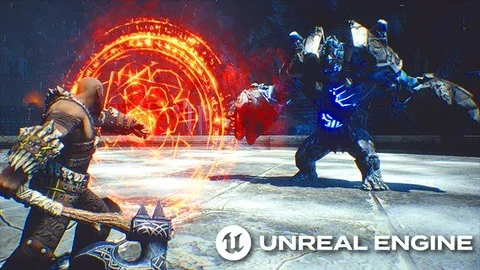
Creating an action RPG in Unreal Engine 5 means more than wiring up attacks. The hero, enemies, abilities, reactions, and UI all need to speak the same language, especially when the combat loop depends on timing, cooldowns, hit responses, and readable feedback. This Unreal Engine 5 C++ course focuses on that exact workflow through the Gameplay Ability System, with C++ driving the pieces that keep advanced RPG combat organized.
The training is listed at an intermediate level and runs for 44h 13m, so it is aimed at learners who want time to move through a full combat-oriented project rather than a narrow feature demo. The curriculum follows a practical path: set up the hero character, build melee combat, connect abilities, add enemy types, then finish with widgets and game mode work. That structure makes it useful for anyone trying to shape a combat-heavy prototype into something more coherent and extendable.
Hero setup and melee combo flow
The early part of the project starts with the hero character, then moves straight into a melee combo system. Light and heavy attacks are both part of the combat loop, which gives the character more than a single attack pattern to repeat. From there, hero combat expands into a fuller set of actions that can be tied into the rest of the gameplay logic.
Several combat responses are also part of the hero side of the project. Directional hit react and rolling add movement-based reactions when the character is under pressure, while melee block and parry give the player defensive options instead of only trading blows. The course also includes special weapon abilities and a rage ability with cost and cooldown, so the hero does not rely only on basic attacks. That combination is useful for projects that need a combat loop with attack variety, defense timing, and ability-driven decisions in one place.
Gameplay Ability System work in the middle of the project
The Gameplay Ability System is one of the central systems here, and it is used to create the RPG combat experience rather than sitting off to the side as a separate feature. That means abilities are not treated as isolated extras. They are part of the way combat is organized, including the special weapon abilities and the rage ability with its cost and cooldown.
Because the course uses C++, the focus stays on code that can be extended and kept readable. The target audience explicitly includes learners who want to level up their C++ skills and write clean, professional, extendable code. For projects that need combat logic to stay maintainable as more attacks and abilities are added, that emphasis matters. It also makes the material relevant for teams or solo developers who want a structure they can keep building on after the core melee loop is in place.
Enemy AI, ranged threats, and boss encounters
Enemy behavior is not treated as a simple follow target-and-attack setup. The course includes advanced enemy AI using custom BTTask, BTTDecorator, and BTService work, along with the Environment Query System for more advanced AI behaviors. Those pieces point to behavior logic that can respond to the state of the fight instead of following one flat path.
The enemy side also extends beyond a basic melee opponent. A ranged enemy is included, along with a boss enemy, which gives the project different combat pressures to solve. A ranged opponent changes spacing and timing, while a boss enemy usually pushes the combat loop to handle more complex reactions and ability use. Because the AI tools named here include behavior tree tasks, decorators, services, and EQS, the material fits projects that want combat encounters to feel varied without relying on a single enemy pattern.
UI feedback, survival mode, and the project flow
The final part of the course brings the combat systems into the player-facing layer. A robust UI notify system is included, along with in-game widgets, so combat actions can be reflected in the interface rather than hidden in code alone. That matters in an action RPG where the player needs to understand what is happening during a fight, especially when attacks, reactions, blocks, parries, and abilities all overlap.
The curriculum also reaches a survival game mode before closing with a completion segment. The full sequence runs from introduction and hero setup through melee combo system, hero combat, enemy AI, hero combat abilities, ranged enemy, boss enemy, hero special abilities, survival game mode, and in-game widgets. That progression gives the project a clear path from character setup to a complete combat loop, which makes it a strong fit for an Unreal Engine 5 production that needs a structured action RPG foundation rather than isolated mechanics.
Where this fits best
This material fits learners who want to build an action RPG project, improve their C++ skills, and work with code that stays practical as combat systems grow. It is especially relevant when the goal is to connect melee attacks, ability logic, AI behavior, and user feedback into one playable loop. For teams or solo developers working on a combat-heavy Unreal Engine 5 project, it offers a direct path through the systems that shape an advanced RPG encounter.
 Unreal Engine
 Unreal Engine
 Unreal Engine
 Unreal Engine