"c14ff6bd758dadb1"{"id":"1001064","slug":"post-apocalyptic-desert","title":"Post Apocalyptic Desert","category":"Apocalyptic / Post-apocalyptic","engine":"4.26+,5.0+","assetVersion":"","engineVersion":"Engine Version: 4.26+,5.0+","tag":"Apocalyptic","accent":"blue","visual":"mech","summary":"Post Apocalyptic Desert is a Unreal Engine desert environment with a drivable vehicle, extensive props and foliage, advanced materials, plus Nanite/Lumen suppor","platform":"Unreal Engine","publishedAt":"2026-09-03T15:10:50.530Z","updatedAt":"2026-09-03T15:10:50.530Z","sourceNotes":[],"fileContents":[],"compatibility":["Unreal Engine","Engine Version: 4.26+,5.0+"],"featuredImage":{"alt":"Post Apocalyptic Desert","src":"/wp-content/uploads/published/2026/09/c03aaff5c58e-a4df247e-4355-4450-95e8-7efd4f43611d-aba4e12f2c.webp"},"hasDownloadLink":true,"downloads":0,"terms":[{"taxonomy":"category","slug":"apocalyptic-post-apocalyptic","name":"Apocalyptic / Post-apocalyptic"}],"galleryImages":[{"src":"/wp-content/uploads/published/2026/09/b7c6e175b28e-94299ab9-52e9-4108-bc9a-332976f2dd79-e8ffa354f2.webp","alt":"Post Apocalyptic Desert"},{"src":"/wp-content/uploads/published/2026/09/f5d64294e575-7d7b53fb-af5b-44a9-8320-45f2581825e8-2857fbada0.webp","alt":"Post Apocalyptic Desert"},{"src":"/wp-content/uploads/published/2026/09/0f54cc598148-017cba79-ec9d-4fa0-8afc-a8cfb33018d7-91bce68ee5.webp","alt":"Post Apocalyptic Desert"},{"src":"/wp-content/uploads/published/2026/09/4a7a786a83ae-92dc0f9e-ae9e-498f-b66d-ab6c2d18fa19-ac5364d1a7.webp","alt":"Post Apocalyptic Desert"},{"src":"/wp-content/uploads/published/2026/09/7602ec5d7c10-04c49562-3c31-4d20-9911-d00d1a6b1093-268d1675bf.webp","alt":"Post Apocalyptic Desert"},{"src":"/wp-content/uploads/published/2026/09/7ef015235422-eb4e8bc9-220b-45f5-8047-3eb70944fd1d-6beddf7da5.webp","alt":"Post Apocalyptic Desert"},{"src":"/wp-content/uploads/published/2026/09/bd6713313ea2-5a138d57-d8c7-4051-b10d-082ac52abcb7-b9b6d11bdf.webp","alt":"Post Apocalyptic Desert"},{"src":"/wp-content/uploads/published/2026/09/c8d3aea78f07-fbab75ee-ede3-49f1-988a-a75445cdfb30-52037d4662.webp","alt":"Post Apocalyptic Desert"},{"src":"/wp-content/uploads/published/2026/09/2b619b021972-7a2abf2b-5a37-4a7a-af6c-de3ee0c63e49-edd3eab84a.webp","alt":"Post Apocalyptic Desert"},{"src":"/wp-content/uploads/published/2026/09/e91649bc74fc-af397d94-13e3-4912-9d7a-1b9fe443170f-6fbef4f276.webp","alt":"Post Apocalyptic Desert"}],"accessPanel":{"kind":"resource","title":"Download this resource","eyebrow":"Free Download","message":"Log in or create a free account to start your download.","fileName":"PostApocalypticDesert.7z","safetyNote":"Resources are manually reviewed before listing to improve quality and reduce obvious risks.","actionLabel":"Download Free","resourceType":"Resource archive"},"contentHtml":"\u003cp\u003eA desert that once supported human traffic leaves behind more than bare dunes. It leaves fuel stops, diners, buildings in various states of collapse, and vehicles parked or wrecked along what used to be a highway. Post Apocalyptic Desert is an Unreal Engine environment created around those remnants. It includes a large amount of props, several sets of foliage assets, materials with terrain-related features, and a vehicle that can be driven through the scene.\u003c/p\u003e\u003cp\u003eThe setting favors roadside abandonment. Station, Gas, Diner, Building, Landscape, Car, Vehicle, Metal, Foliage, and Level are all associated with the project, which places the desert near former service points and travel infrastructure rather than in an untouched stretch of sand.\u003c/p\u003e\u003ch2\u003eProps and foliage for a ruined roadside\u003c/h2\u003e\u003cp\u003eAn environment that has to read as post-apocalyptic needs enough objects to fill the spaces a player can see. This one responds with a large amount of props. Those props cover the kind of objects that would normally sit around a station, a diner, or an abandoned building, and they give a level designer something to distribute across roads, yards, and building facades. The sets of foliage assets work alongside the hard-surface props. Dry plants, bushes, and similar growth soften the edges of the construction and make the scene feel less like a clean diorama and more like an area where nature has started taking back the ground.\u003c/p\u003e\u003ch2\u003eLandscape materials with interactive touches\u003c/h2\u003e\u003cp\u003eGround shading is not the only part of the terrain setup. The project includes materials with three useful behaviors: adaptive landscape tessellation, interactive foliage, and dirt blending. The tessellation supports a more detailed landscape surface, interactive foliage lets vegetation react to nearby movement, and dirt blending adds a layer of grime that can tie objects and ground together. Together, these material features make contact with the desert feel less manufactured, whether the camera stays still or the player pushes through bushes and dirt in a vehicle.\u003c/p\u003e\u003ch2\u003eStatic or dynamic lighting depending on the scene\u003c/h2\u003e\u003cp\u003ePost Apocalyptic Desert is not locked into one lighting method. The project uses dynamic or static lighting depending on what the scene needs. Dynamic lighting helps when moving objects and vehicles play a central role, since light and shadow respond to the changing scene. Static lighting remains available for setups where controlled shadows and fixed light sources produce the intended mood. This switch matters in a post-apocalyptic setting, where the time of day and light quality affect whether an abandoned area feels hostile, quiet, or dangerous. The vehicle also ties into this decision because driving through the desert makes dynamic light more relevant during gameplay or cinematics.\u003c/p\u003e\u003ch2\u003eAbandoned car variations through a blueprint\u003c/h2\u003e\u003cp\u003eThe vehicle support goes beyond the included drivable car. A planned update adds new car assets and a blueprint that allows the project to generate different abandoned car variations. That changes how the environment treats leftover vehicles. With a blueprint-based generator, a studio can populate a road or gas station area with abandoned cars that do not share the exact same look. The wrecked vehicles can instead be produced with enough variation to feel like separate incidents, which supports the layered history the environment suggests. The same logic that makes the main car driveable extends to the opposite end of the timeline: vehicles that broke down, crashed, or were left behind by the people who used to live and drive through the desert.\u003c/p\u003e\u003ch2\u003eNanite and Lumen support inside Unreal Engine\u003c/h2\u003e\u003cp\u003eThe rendering side is set up for modern Unreal Engine workflows. Post Apocalyptic Desert supports Nanite and Lumen, the engine's high-density geometry and global illumination systems. Dense prop-heavy areas benefit from Nanite's geometry handling, while Lumen carries indirect lighting through buildings, vehicle husks, and the open desert. Documentation for both systems is available, so the recommended settings and workflow do not have to be guessed when the asset is brought into a project.\u003c/p\u003e\u003cp\u003eThe desert environment is built to be put into motion. A large prop and foliage set gives the scene its populated look, the material setup continues that look in the ground and plant interaction, and the lighting can adapt between static and dynamic approaches. With the drivable vehicle for active exploration and an upcoming blueprint path for generating abandoned car variations, the project addresses the two forms a car can take in a post-apocalyptic world: one that still runs and many that no longer do.\u003c/p\u003e\n\n\u003ch2\u003eRelated Resources Worth Checking\u003c/h2\u003e\n\u003cul\u003e\n\u003cli\u003e\u003ca href=\"https://3dcghub.com/polygon-apocalypse-wasteland/\" title=\"POLYGON - Apocalypse Wasteland\"\u003ePOLYGON - Apocalypse Wasteland\u003c/a\u003e\u003c/li\u003e\n\u003cli\u003e\u003ca href=\"https://3dcghub.com/airport-terminal-interior/\" title=\"Airport Terminal Interior\"\u003eAirport Terminal Interior\u003c/a\u003e\u003c/li\u003e\n\u003cli\u003e\u003ca href=\"https://3dcghub.com/realistic-ivy-plants/\" title=\"Realistic IVY Plants\"\u003eRealistic IVY Plants\u003c/a\u003e\u003c/li\u003e\n\u003cli\u003e\u003ca href=\"https://3dcghub.com/post-apocalyptic-district/\" title=\"Post Apocalyptic District\"\u003ePost Apocalyptic District\u003c/a\u003e\u003c/li\u003e\n\u003cli\u003e\u003ca href=\"https://3dcghub.com/swampy-industrial-zone/\" title=\"Swampy industrial zone\"\u003eSwampy industrial zone\u003c/a\u003e\u003c/li\u003e\n\u003c/ul\u003e","contentTextLength":4795,"navigation":{"current":766,"total":3719,"previous":{"id":"1001065","slug":"raptor-dinosaur-animated","title":"Raptor Dinosaur Animated","category":"Animals","platform":"Unreal Engine","updatedAt":"2026-09-03T16:02:56.829Z"},"next":{"id":"1001063","slug":"physics-collision-sound","title":"Physics Collision Sound","category":"Gameplay Features","platform":"Unreal Engine","updatedAt":"2026-09-03T13:17:54.533Z"}},"relatedResources":[{"id":"1001563","slug":"train-wreck-refuge","title":"Train Wreck Refuge","category":"Apocalyptic / Post-apocalyptic","engine":"4.26+,5.0+","assetVersion":"","engineVersion":"Engine Version: 4.26+,5.0+","tag":"Apocalyptic","accent":"blue","visual":"mech","summary":"Explore the Train Wreck Refuge environment, featuring socialist-style trains, handmade foliage LODs, master materials, and UE5 Lumen support.","platform":"Unreal Engine","publishedAt":"2026-10-10T03:54:08.294Z","updatedAt":"2026-10-10T03:54:08.294Z","sourceNotes":[],"fileContents":[],"compatibility":["Unreal Engine","Engine Version: 4.26+,5.0+"],"featuredImage":{"alt":"Train Wreck Refuge","src":"/wp-content/uploads/published/2026/10/fffa6a954d31-2d5d3ba2-eb7c-4bce-8984-8b40eb7555c0-d8ce7e3344.webp"},"hasDownloadLink":true,"downloads":0},{"id":"1001489","slug":"surroundead-survival-game-assets-bundle","title":"SurrounDead - Survival Game Assets (Bundle)","category":"Apocalyptic / Post-apocalyptic","engine":"4.21+,5.0+","assetVersion":"","engineVersion":"Engine Version: 4.21+,5.0+","tag":"Apocalyptic","accent":"blue","visual":"mech","summary":"Explore the SurrounDead bundle featuring over 1500 modular stylized assets, 570 handpainted diffuse textures, and Blueprints for Unreal Engine survival games.","platform":"Unreal Engine","publishedAt":"2026-10-08T10:04:09.253Z","updatedAt":"2026-10-08T10:04:09.253Z","sourceNotes":[],"fileContents":[],"compatibility":["Unreal Engine","Engine Version: 4.21+,5.0+"],"featuredImage":{"alt":"SurrounDead - Survival Game Assets (Bundle)","src":"/wp-content/uploads/published/2026/10/12e47d0b93c1-2a14e76d-be60-4525-bb61-6612d88c2d6e-68763433b5.webp"},"hasDownloadLink":true,"downloads":2},{"id":"1001765","slug":"survivor-s-safe-house","title":"Survivor's Safe House","category":"Apocalyptic / Post-apocalyptic","engine":"4.22+,5.0+","assetVersion":"","engineVersion":"Engine Version: 4.22+,5.0+","tag":"Apocalyptic","accent":"blue","visual":"mech","summary":"An in-depth look at Survivor's Safe House in Unreal Engine, exploring its 167 modular meshes, master materials, channel packed textures, and scene setup.","platform":"Unreal Engine","publishedAt":"2026-10-20T03:10:21.705Z","updatedAt":"2026-10-20T03:10:21.705Z","sourceNotes":[],"fileContents":[],"compatibility":["Unreal Engine","Engine Version: 4.22+,5.0+"],"featuredImage":{"alt":"Survivor's Safe House","src":"/wp-content/uploads/published/2026/10/ccd114180bc6-e974da61-62a5-4a94-8a91-1029fa12de74-866d35023a.webp"},"hasDownloadLink":true,"downloads":0}]}
Apocalyptic
Post Apocalyptic Desert
Post Apocalyptic Desert is a Unreal Engine desert environment with a drivable vehicle, extensive props and foliage, advanced materials, plus Nanite/Lumen suppor
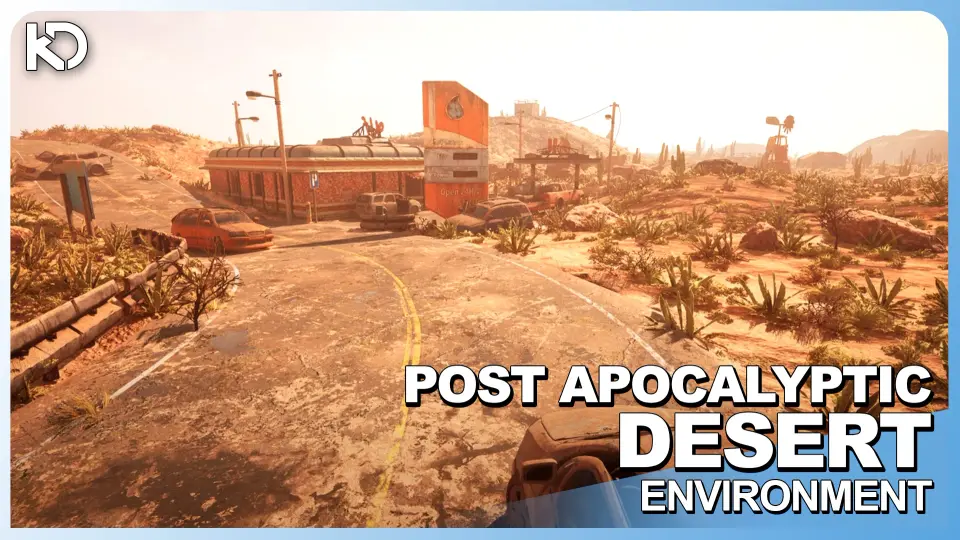
A desert that once supported human traffic leaves behind more than bare dunes. It leaves fuel stops, diners, buildings in various states of collapse, and vehicles parked or wrecked along what used to be a highway. Post Apocalyptic Desert is an Unreal Engine environment created around those remnants. It includes a large amount of props, several sets of foliage assets, materials with terrain-related features, and a vehicle that can be driven through the scene.
The setting favors roadside abandonment. Station, Gas, Diner, Building, Landscape, Car, Vehicle, Metal, Foliage, and Level are all associated with the project, which places the desert near former service points and travel infrastructure rather than in an untouched stretch of sand.
Props and foliage for a ruined roadside
An environment that has to read as post-apocalyptic needs enough objects to fill the spaces a player can see. This one responds with a large amount of props. Those props cover the kind of objects that would normally sit around a station, a diner, or an abandoned building, and they give a level designer something to distribute across roads, yards, and building facades. The sets of foliage assets work alongside the hard-surface props. Dry plants, bushes, and similar growth soften the edges of the construction and make the scene feel less like a clean diorama and more like an area where nature has started taking back the ground.
Landscape materials with interactive touches
Ground shading is not the only part of the terrain setup. The project includes materials with three useful behaviors: adaptive landscape tessellation, interactive foliage, and dirt blending. The tessellation supports a more detailed landscape surface, interactive foliage lets vegetation react to nearby movement, and dirt blending adds a layer of grime that can tie objects and ground together. Together, these material features make contact with the desert feel less manufactured, whether the camera stays still or the player pushes through bushes and dirt in a vehicle.
Static or dynamic lighting depending on the scene
Post Apocalyptic Desert is not locked into one lighting method. The project uses dynamic or static lighting depending on what the scene needs. Dynamic lighting helps when moving objects and vehicles play a central role, since light and shadow respond to the changing scene. Static lighting remains available for setups where controlled shadows and fixed light sources produce the intended mood. This switch matters in a post-apocalyptic setting, where the time of day and light quality affect whether an abandoned area feels hostile, quiet, or dangerous. The vehicle also ties into this decision because driving through the desert makes dynamic light more relevant during gameplay or cinematics.
Abandoned car variations through a blueprint
The vehicle support goes beyond the included drivable car. A planned update adds new car assets and a blueprint that allows the project to generate different abandoned car variations. That changes how the environment treats leftover vehicles. With a blueprint-based generator, a studio can populate a road or gas station area with abandoned cars that do not share the exact same look. The wrecked vehicles can instead be produced with enough variation to feel like separate incidents, which supports the layered history the environment suggests. The same logic that makes the main car driveable extends to the opposite end of the timeline: vehicles that broke down, crashed, or were left behind by the people who used to live and drive through the desert.
Nanite and Lumen support inside Unreal Engine
The rendering side is set up for modern Unreal Engine workflows. Post Apocalyptic Desert supports Nanite and Lumen, the engine's high-density geometry and global illumination systems. Dense prop-heavy areas benefit from Nanite's geometry handling, while Lumen carries indirect lighting through buildings, vehicle husks, and the open desert. Documentation for both systems is available, so the recommended settings and workflow do not have to be guessed when the asset is brought into a project.
The desert environment is built to be put into motion. A large prop and foliage set gives the scene its populated look, the material setup continues that look in the ground and plant interaction, and the lighting can adapt between static and dynamic approaches. With the drivable vehicle for active exploration and an upcoming blueprint path for generating abandoned car variations, the project addresses the two forms a car can take in a post-apocalyptic world: one that still runs and many that no longer do.
 Apocalyptic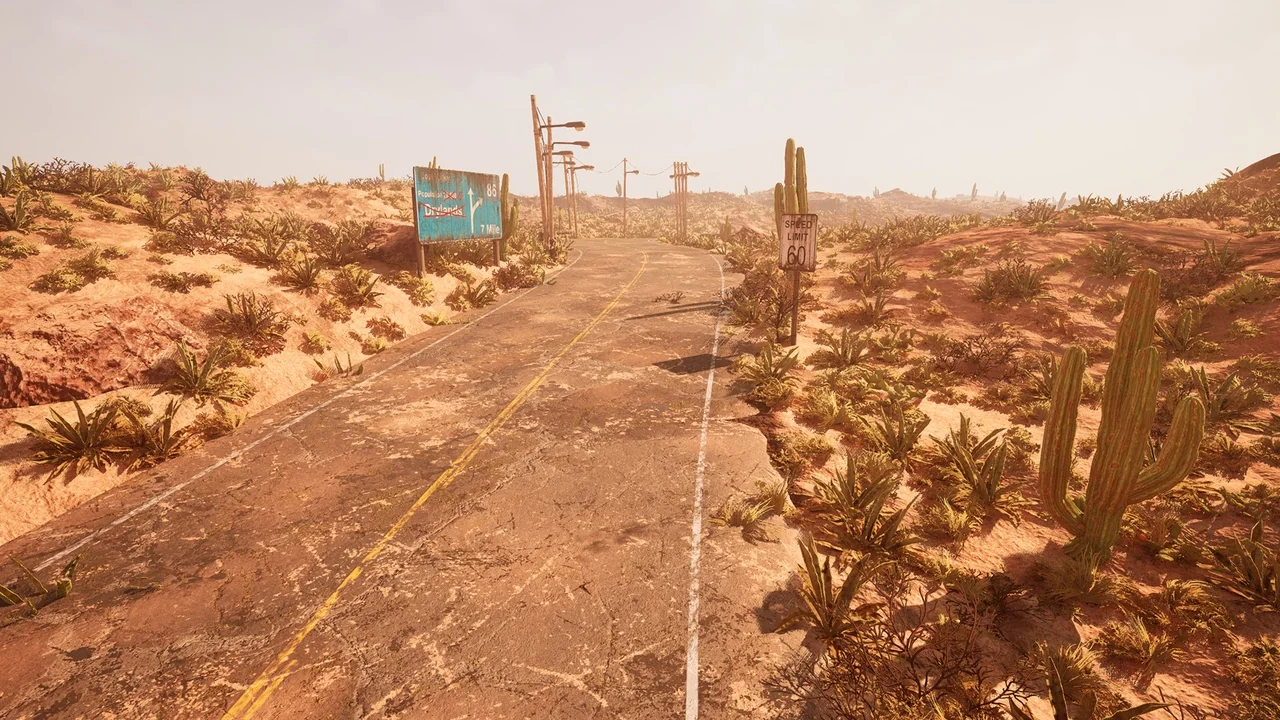
 Apocalyptic
 Apocalyptic
 Apocalyptic