"c14ff6bd758dadb1"{"id":"1001765","slug":"survivor-s-safe-house","title":"Survivor's Safe House","category":"Apocalyptic / Post-apocalyptic","engine":"4.22+,5.0+","assetVersion":"","engineVersion":"Engine Version: 4.22+,5.0+","tag":"Apocalyptic","accent":"blue","visual":"mech","summary":"An in-depth look at Survivor's Safe House in Unreal Engine, exploring its 167 modular meshes, master materials, channel packed textures, and scene setup.","platform":"Unreal Engine","publishedAt":"2026-10-20T03:10:21.705Z","updatedAt":"2026-10-20T03:10:21.705Z","sourceNotes":[],"fileContents":[],"compatibility":["Unreal Engine","Engine Version: 4.22+,5.0+"],"featuredImage":{"alt":"Survivor's Safe House","src":"/wp-content/uploads/published/2026/10/ccd114180bc6-e974da61-62a5-4a94-8a91-1029fa12de74-866d35023a.webp"},"hasDownloadLink":true,"downloads":0,"terms":[{"taxonomy":"category","slug":"apocalyptic-post-apocalyptic","name":"Apocalyptic / Post-apocalyptic"}],"galleryImages":[{"src":"/wp-content/uploads/published/2026/10/b237e14abbb8-9ab558f5-7390-42ec-91ee-aa3429b8dad1-6a5e434f0b.webp","alt":"Survivor's Safe House"},{"src":"/wp-content/uploads/published/2026/10/cf09f7d5d26a-925420e2-81ba-4834-9094-ccb1109e11cf-8cd245536c.webp","alt":"Survivor's Safe House"},{"src":"/wp-content/uploads/published/2026/10/84a48dc33d24-0a6a7914-545f-4870-b56b-9bee468a525b-12de6a84b6.webp","alt":"Survivor's Safe House"},{"src":"/wp-content/uploads/published/2026/10/8eaa050e6b75-6ac839e5-8ac9-4419-84a1-98215a21b083-756df43fcf.webp","alt":"Survivor's Safe House"},{"src":"/wp-content/uploads/published/2026/10/dbb89a5c218c-4012ffc1-590a-4ad0-970d-e227fefe3f07-e484cc88cd.webp","alt":"Survivor's Safe House"},{"src":"/wp-content/uploads/published/2026/10/2d3abe8e05ec-e6fc5e4c-90fa-4e4e-9dfe-cf8819557e58-ba51934111.webp","alt":"Survivor's Safe House"}],"accessPanel":{"kind":"resource","title":"Download this resource","eyebrow":"Free Download","message":"Log in or create a free account to start your download.","fileName":"Content.7z","safetyNote":"Resources are manually reviewed before listing to improve quality and reduce obvious risks.","actionLabel":"Download Free","resourceType":"Resource archive"},"contentHtml":"\u003cp\u003eA survival redoubt relies on immediate visual storytelling: barricaded entrances, improvised workbenches, stacked storage crates, and utility tools organized under hard-angled, low-key lighting. Survivor's Safe House translates this setting into Unreal Engine through an integrated environment containing all pictured structural elements, individual props, maps, and shaders configured for real-time performance.\u003c/p\u003e \u003ch2\u003eModular Assembly and Layouts in Survivor's Safe House\u003c/h2\u003e\n\u003cp\u003eThe interior architecture relies on modular construction, allowing structural surfaces to snap together, tile, and reconfigure into alternate room footprints. Instead of locking level designers into a single static room, the structural elements can assemble into a cramped basement shelter, a sprawling mechanics' workshop, an abandoned garage depot, or a multi-room residential fallback point.\u003c/p\u003e \u003cp\u003eWall sections, floor surfaces, and boundary components align cleanly along standard grid increments. This modular approach preserves edge alignment across seams, preventing light leaks during precomputed baking passes and maintaining consistent geometry when dynamic directional lights or localized point lights cast hard shadows. Level designers can carve out custom sightlines, create natural chokepoints for combat encounters, or widen corridors to accommodate navigation meshes for artificial intelligence pathfinding.\u003c/p\u003e \u003cp\u003eBecause the environment targets realistic visual fidelity within a controlled memory budget, architectural geometries use clean low-poly topologies. Beveled silhouettes and chamfered edges convey structural weight without inflating polygon counts, ensuring that even large, assembled safe zones maintain stable framerates during heavy scene interaction.\u003c/p\u003e \u003ch2\u003eProp Density and Function Across 167 Meshes\u003c/h2\u003e\n\u003cp\u003ePopulating a believable survival setting requires a granular distribution of utility items, mechanical gear, and protective barriers. Survivor's Safe House provides 167 meshes spanning both structural components and set dressing, giving set dressers the exact physical vocabulary needed to build believable safe havens.\u003c/p\u003e \u003cp\u003eWorkbenches and toolkits serve as primary focal points within the asset library. Mechanics' tables, complete with hard-wearing work tops, provide anchoring points around which smaller hand tools, hardware containers, and maintenance instruments cluster. Staged storage units—including metal shelving, industrial lockers, and reinforced containers—allow designers to scale loot placements or narrative set pieces across varying elevations.\u003c/p\u003e \u003cp\u003eEvery individual prop retains physical scale and believable proportions, making them drop-in assets for character interaction. Because each mesh uses low-poly optimization principles, placing high quantities of clutter across a workbench or lining entire walls with storage racks will not choke the rendering pipeline. The meshes carry sufficient silhouette clarity to read immediately in both broad illumination and dense, night-time shadows characteristic of apocalyptic or horror staging.\u003c/p\u003e \u003ch2\u003eMaster Materials Setup and Channel Packed Textures\u003c/h2\u003e\n\u003cp\u003eAsset variety can quickly overwhelm engine overhead if every mesh calls an isolated shader. Survivor's Safe House avoids draw-call bloat by routing props and architectural modules through a centralized master materials setup. This structure dictates how surface parameters behave across all models, ensuring visual unity while reducing shader permutation compilation times.\u003c/p\u003e \u003cp\u003eMaterial instances derived from this master network give artists additional controls to adjust surface properties directly inside the engine viewport. Parameters governing surface wear, roughness intensity, and color tinting allow props to show distinct levels of aging, grime, or moisture without requiring unique base textures for every asset variant. A clean storage locker can quickly reflect heavy workshop use simply by tuning instance values.\u003c/p\u003e \u003cp\u003eMemory conservation extends directly to the texture pipeline through channel packing. The asset pack condenses grayscale masks—such as roughness, metalness, and ambient occlusion—into individual color channels of single texture maps. This minimizes the texture sampler count per material call and substantially decreases runtime memory consumption.\u003c/p\u003e \u003cp\u003eThe texture suite adheres strictly to physical-based rendering (PBR) standards, distributed across a tiered resolution profile that balances crisp surface fidelity against runtime VRAM constraints:\u003c/p\u003e\n\u003cul\u003e \u003cli\u003e\u003cstrong\u003e4k Resolution (16 maps):\u003c/strong\u003e Assigned to key architectural focal points and expansive surfaces requiring close-up surface definition.\u003c/li\u003e \u003cli\u003e\u003cstrong\u003e2k Resolution (155 maps):\u003c/strong\u003e The foundational baseline for the vast majority of props, work surfaces, toolkits, and modular parts.\u003c/li\u003e \u003cli\u003e\u003cstrong\u003e1k Resolution (1 map):\u003c/strong\u003e Allocated to compact utility components with smaller screen-space presence.\u003c/li\u003e \u003cli\u003e\u003cstrong\u003e256 Resolution (1 map):\u003c/strong\u003e Reserved for micro-elements, lookup references, or low-frequency masks.\u003c/li\u003e\n\u003c/ul\u003e \u003cp\u003eThis texture hierarchy ensures that objects under direct player inspection retain tactile roughness and micro-scratches, while peripheral items occupy minimal memory footprint.\u003c/p\u003e \u003ch2\u003ePost Process Grading, Custom Labels, and Scene Compatibility\u003c/h2\u003e\n\u003cp\u003eVisual mood in survival settings depends heavily on color science and light attenuation. Survivor's Safe House includes a realistic post process volume and a calibrated Look Up Table (LUT), dialing in contrast curves, shadow depth, and desaturated midtones suited for tense, apocalyptic, or horror-themed night environments. The included map demonstrates this grading immediately out of the box, offering a baseline exposure balance that developers can integrate into their existing world lighting schemes.\u003c/p\u003e \u003cp\u003eCommercial deployment often runs into clearance obstacles when environment clutter includes real-world branding. To remove legal risks, all graphics, safety warnings, and container labels across the toolkit and storage meshes are custom-designed by the studio. Games can enter production and distribution pipelines without requiring secondary legal reviews or asset sanitization passes.\u003c/p\u003e \u003cp\u003eFor projects expanding beyond isolated safe zones into wider semi-urban layouts, the pack shares structural compatibility with Meridian 1988: Cedar Point School - Modular Environment (VOL 57). Assets, proportions, and material hierarchies integrate seamlessly, allowing teams to construct interconnected post-collapse complexes that transition naturally from abandoned educational corridors into fortified safe houses.\u003c/p\u003e \u003ch2\u003ePractical Implementation\u003c/h2\u003e\n\u003cp\u003eSurvivor's Safe House provides development teams with a self-contained, game-ready environment that requires zero conversion steps. With 167 optimized meshes, an adaptable modular layout, channel-packed textures, and custom-authored branding, the environment functions equally well as a central player hub, a contested survival shelter, or an atmospheric narrative backdrop.\u003c/p\u003e\n\n\u003ch2\u003eExplore Similar Assets\u003c/h2\u003e\n\u003cul\u003e\n\u003cli\u003e\u003ca href=\"https://3dcghub.com/safe-house-vol-1-supplies-and-guns-nanite-and-low-poly/\" title=\"Safe House VOL.1 - Supplies and Guns (Nanite and Low Poly)\"\u003eSafe House VOL.1 - Supplies and Guns (Nanite and Low Poly)\u003c/a\u003e\u003c/li\u003e\n\u003cli\u003e\u003ca href=\"https://3dcghub.com/surroundead-survival-game-assets-bundle/\" title=\"SurrounDead - Survival Game Assets (Bundle)\"\u003eSurrounDead - Survival Game Assets (Bundle)\u003c/a\u003e\u003c/li\u003e\n\u003cli\u003e\u003ca href=\"https://3dcghub.com/train-wreck-refuge/\" title=\"Train Wreck Refuge\"\u003eTrain Wreck Refuge\u003c/a\u003e\u003c/li\u003e\n\u003cli\u003e\u003ca href=\"https://3dcghub.com/post-apocalyptic-desert/\" title=\"Post Apocalyptic Desert\"\u003ePost Apocalyptic Desert\u003c/a\u003e\u003c/li\u003e\n\u003cli\u003e\u003ca href=\"https://3dcghub.com/safe-house/\" title=\"Safe House\"\u003eSafe House\u003c/a\u003e\u003c/li\u003e\n\u003c/ul\u003e","contentTextLength":7039,"navigation":{"current":18,"total":3719,"previous":{"id":"1001766","slug":"the-aftermath-environment-medieval-village-medieval-village-witcher","title":"The Aftermath Environment ( Medieval Village Medieval Village Witcher )","category":"Medieval","platform":"Unreal Engine","updatedAt":"2026-10-20T03:11:51.807Z"},"next":{"id":"1001764","slug":"stylized-swamp-forest","title":"Stylized Swamp Forest","category":"Forest \u0026 Jungle","platform":"Unreal Engine","updatedAt":"2026-10-20T03:09:47.949Z"}},"relatedResources":[{"id":"1001470","slug":"safe-house-vol-1-supplies-and-guns-nanite-and-low-poly","title":"Safe House VOL.1 - Supplies and Guns (Nanite and Low Poly)","category":"Weapons \u0026 Combat","engine":"5.1+","assetVersion":"","engineVersion":"Engine Version: 5.1+","tag":"Weapons \u0026 Combat","accent":"blue","visual":"mech","summary":"Explore Safe House VOL.1 featuring 300 Nanite and low-poly meshes, 4K channel-packed textures, split gun parts, and Lumen support for Unreal Engine 5.0+.","platform":"Unreal Engine","publishedAt":"2026-10-08T08:22:20.673Z","updatedAt":"2026-10-08T08:22:20.673Z","sourceNotes":[],"fileContents":[],"compatibility":["Unreal Engine","Engine Version: 5.1+"],"featuredImage":{"alt":"Safe House VOL.1 - Supplies and Guns (Nanite and Low Poly)","src":"/wp-content/uploads/published/2026/10/cb7e2cff71a6-ed31c8e1-535f-4e34-ad4d-c1144503456a-cc5ad0c000.webp"},"hasDownloadLink":true,"downloads":0},{"id":"1001489","slug":"surroundead-survival-game-assets-bundle","title":"SurrounDead - Survival Game Assets (Bundle)","category":"Apocalyptic / Post-apocalyptic","engine":"4.21+,5.0+","assetVersion":"","engineVersion":"Engine Version: 4.21+,5.0+","tag":"Apocalyptic","accent":"blue","visual":"mech","summary":"Explore the SurrounDead bundle featuring over 1500 modular stylized assets, 570 handpainted diffuse textures, and Blueprints for Unreal Engine survival games.","platform":"Unreal Engine","publishedAt":"2026-10-08T10:04:09.253Z","updatedAt":"2026-10-08T10:04:09.253Z","sourceNotes":[],"fileContents":[],"compatibility":["Unreal Engine","Engine Version: 4.21+,5.0+"],"featuredImage":{"alt":"SurrounDead - Survival Game Assets (Bundle)","src":"/wp-content/uploads/published/2026/10/12e47d0b93c1-2a14e76d-be60-4525-bb61-6612d88c2d6e-68763433b5.webp"},"hasDownloadLink":true,"downloads":2},{"id":"1001563","slug":"train-wreck-refuge","title":"Train Wreck Refuge","category":"Apocalyptic / Post-apocalyptic","engine":"4.26+,5.0+","assetVersion":"","engineVersion":"Engine Version: 4.26+,5.0+","tag":"Apocalyptic","accent":"blue","visual":"mech","summary":"Explore the Train Wreck Refuge environment, featuring socialist-style trains, handmade foliage LODs, master materials, and UE5 Lumen support.","platform":"Unreal Engine","publishedAt":"2026-10-10T03:54:08.294Z","updatedAt":"2026-10-10T03:54:08.294Z","sourceNotes":[],"fileContents":[],"compatibility":["Unreal Engine","Engine Version: 4.26+,5.0+"],"featuredImage":{"alt":"Train Wreck Refuge","src":"/wp-content/uploads/published/2026/10/fffa6a954d31-2d5d3ba2-eb7c-4bce-8984-8b40eb7555c0-d8ce7e3344.webp"},"hasDownloadLink":true,"downloads":0}]}
Apocalyptic
Survivor's Safe House
An in-depth look at Survivor's Safe House in Unreal Engine, exploring its 167 modular meshes, master materials, channel packed textures, and scene setup.
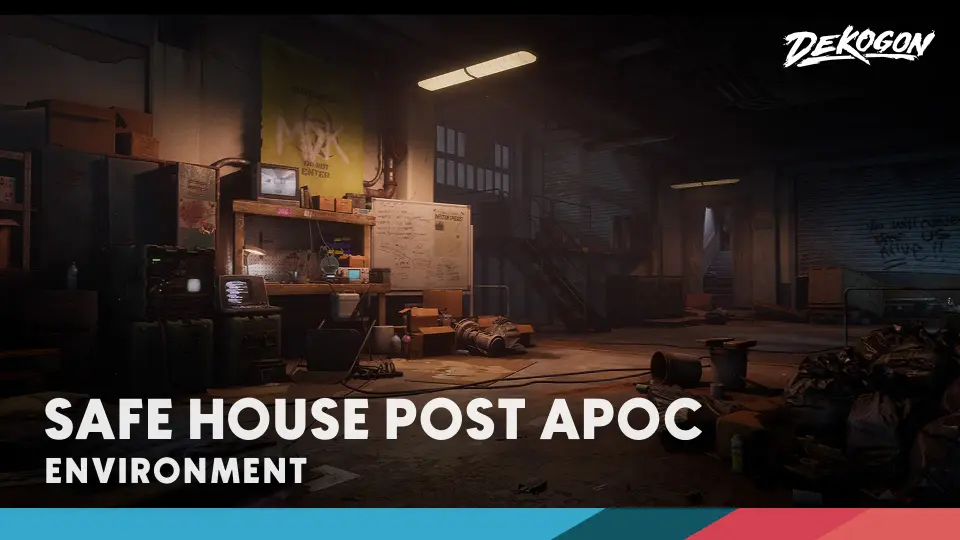
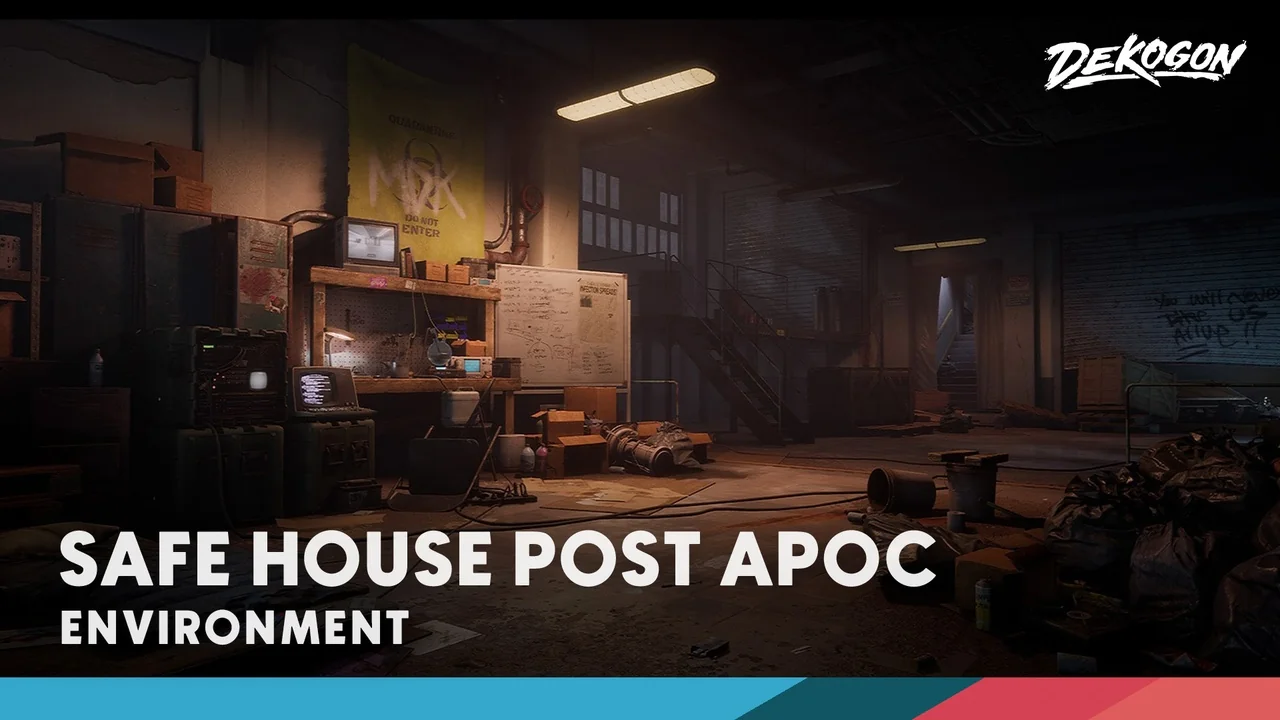
A survival redoubt relies on immediate visual storytelling: barricaded entrances, improvised workbenches, stacked storage crates, and utility tools organized under hard-angled, low-key lighting. Survivor's Safe House translates this setting into Unreal Engine through an integrated environment containing all pictured structural elements, individual props, maps, and shaders configured for real-time performance.
Modular Assembly and Layouts in Survivor's Safe House
The interior architecture relies on modular construction, allowing structural surfaces to snap together, tile, and reconfigure into alternate room footprints. Instead of locking level designers into a single static room, the structural elements can assemble into a cramped basement shelter, a sprawling mechanics' workshop, an abandoned garage depot, or a multi-room residential fallback point.
Wall sections, floor surfaces, and boundary components align cleanly along standard grid increments. This modular approach preserves edge alignment across seams, preventing light leaks during precomputed baking passes and maintaining consistent geometry when dynamic directional lights or localized point lights cast hard shadows. Level designers can carve out custom sightlines, create natural chokepoints for combat encounters, or widen corridors to accommodate navigation meshes for artificial intelligence pathfinding.
Because the environment targets realistic visual fidelity within a controlled memory budget, architectural geometries use clean low-poly topologies. Beveled silhouettes and chamfered edges convey structural weight without inflating polygon counts, ensuring that even large, assembled safe zones maintain stable framerates during heavy scene interaction.
Prop Density and Function Across 167 Meshes
Populating a believable survival setting requires a granular distribution of utility items, mechanical gear, and protective barriers. Survivor's Safe House provides 167 meshes spanning both structural components and set dressing, giving set dressers the exact physical vocabulary needed to build believable safe havens.
Workbenches and toolkits serve as primary focal points within the asset library. Mechanics' tables, complete with hard-wearing work tops, provide anchoring points around which smaller hand tools, hardware containers, and maintenance instruments cluster. Staged storage units—including metal shelving, industrial lockers, and reinforced containers—allow designers to scale loot placements or narrative set pieces across varying elevations.
Every individual prop retains physical scale and believable proportions, making them drop-in assets for character interaction. Because each mesh uses low-poly optimization principles, placing high quantities of clutter across a workbench or lining entire walls with storage racks will not choke the rendering pipeline. The meshes carry sufficient silhouette clarity to read immediately in both broad illumination and dense, night-time shadows characteristic of apocalyptic or horror staging.
Master Materials Setup and Channel Packed Textures
Asset variety can quickly overwhelm engine overhead if every mesh calls an isolated shader. Survivor's Safe House avoids draw-call bloat by routing props and architectural modules through a centralized master materials setup. This structure dictates how surface parameters behave across all models, ensuring visual unity while reducing shader permutation compilation times.
Material instances derived from this master network give artists additional controls to adjust surface properties directly inside the engine viewport. Parameters governing surface wear, roughness intensity, and color tinting allow props to show distinct levels of aging, grime, or moisture without requiring unique base textures for every asset variant. A clean storage locker can quickly reflect heavy workshop use simply by tuning instance values.
Memory conservation extends directly to the texture pipeline through channel packing. The asset pack condenses grayscale masks—such as roughness, metalness, and ambient occlusion—into individual color channels of single texture maps. This minimizes the texture sampler count per material call and substantially decreases runtime memory consumption.
The texture suite adheres strictly to physical-based rendering (PBR) standards, distributed across a tiered resolution profile that balances crisp surface fidelity against runtime VRAM constraints:
4k Resolution (16 maps): Assigned to key architectural focal points and expansive surfaces requiring close-up surface definition.
2k Resolution (155 maps): The foundational baseline for the vast majority of props, work surfaces, toolkits, and modular parts.
1k Resolution (1 map): Allocated to compact utility components with smaller screen-space presence.
256 Resolution (1 map): Reserved for micro-elements, lookup references, or low-frequency masks.
This texture hierarchy ensures that objects under direct player inspection retain tactile roughness and micro-scratches, while peripheral items occupy minimal memory footprint.
Post Process Grading, Custom Labels, and Scene Compatibility
Visual mood in survival settings depends heavily on color science and light attenuation. Survivor's Safe House includes a realistic post process volume and a calibrated Look Up Table (LUT), dialing in contrast curves, shadow depth, and desaturated midtones suited for tense, apocalyptic, or horror-themed night environments. The included map demonstrates this grading immediately out of the box, offering a baseline exposure balance that developers can integrate into their existing world lighting schemes.
Commercial deployment often runs into clearance obstacles when environment clutter includes real-world branding. To remove legal risks, all graphics, safety warnings, and container labels across the toolkit and storage meshes are custom-designed by the studio. Games can enter production and distribution pipelines without requiring secondary legal reviews or asset sanitization passes.
For projects expanding beyond isolated safe zones into wider semi-urban layouts, the pack shares structural compatibility with Meridian 1988: Cedar Point School - Modular Environment (VOL 57). Assets, proportions, and material hierarchies integrate seamlessly, allowing teams to construct interconnected post-collapse complexes that transition naturally from abandoned educational corridors into fortified safe houses.
Practical Implementation
Survivor's Safe House provides development teams with a self-contained, game-ready environment that requires zero conversion steps. With 167 optimized meshes, an adaptable modular layout, channel-packed textures, and custom-authored branding, the environment functions equally well as a central player hub, a contested survival shelter, or an atmospheric narrative backdrop.
 Apocalyptic
 Weapons & Combat
 Apocalyptic
 Apocalyptic