"7e6fc58c410f2894"{"id":"1000477","slug":"post-apocalyptic-district","title":"Post Apocalyptic District","category":"Apocalyptic / Post-apocalyptic","engine":"5.0+","assetVersion":"","engineVersion":"Engine Version: 5.0+","tag":"Apocalyptic","accent":"blue","visual":"mech","summary":"Post Apocalyptic District is a 4.2 sq km Unreal Engine 5.1+ environment pack with interiors, drivable vehicles, spline blueprints, World Partition, Nanite and L","platform":"Unreal Engine","publishedAt":"2026-07-11T19:02:34.820Z","updatedAt":"2026-07-11T19:02:34.820Z","sourceNotes":[],"fileContents":[],"compatibility":["Unreal Engine","Engine Version: 5.0+"],"featuredImage":{"alt":"Post Apocalyptic District","src":"/wp-content/uploads/published/2026/07/a9c378352540-509e121b-ee71-409e-8054-6614d9a36324-deae50f4bf.webp"},"hasDownloadLink":true,"downloads":1,"terms":[{"taxonomy":"category","slug":"apocalyptic-post-apocalyptic","name":"Apocalyptic / Post-apocalyptic"}],"galleryImages":[{"src":"/wp-content/uploads/published/2026/07/4c16899ba26d-3414a8dd-8a94-4d28-b519-0a65f52b6ed4-3381ec7ec6.webp","alt":"Post Apocalyptic District"},{"src":"/wp-content/uploads/published/2026/07/204f9df69169-a63db078-25d8-477e-8bca-558ae812e5d6-31c5ec98da.webp","alt":"Post Apocalyptic District"},{"src":"/wp-content/uploads/published/2026/07/73fde3d113a3-63a5979d-63b6-4a8d-af17-4db3c4e64c42-7247c570df.webp","alt":"Post Apocalyptic District"},{"src":"/wp-content/uploads/published/2026/07/5a3cc899d72d-bc2eda35-8d85-464b-a409-5ba2363984d5-ae3e65ddbc.webp","alt":"Post Apocalyptic District"},{"src":"/wp-content/uploads/published/2026/07/7e0ca096f278-d8872fa3-2bbf-444a-b43d-c18699f7aac8-ba21274d6f.webp","alt":"Post Apocalyptic District"},{"src":"/wp-content/uploads/published/2026/07/4c1d4df351a9-71dd89fa-844c-46f6-aaa1-d404e8b7284c-a4ebb66fc7.webp","alt":"Post Apocalyptic District"},{"src":"/wp-content/uploads/published/2026/07/939a08371a12-9cdb2461-d091-48ac-81a3-0ee8daebca68-e1a9984e32.webp","alt":"Post Apocalyptic District"},{"src":"/wp-content/uploads/published/2026/07/db02e89462a2-5fc9f98b-998a-43e0-a9db-1a772b36c5d6-0e5ca66b4c.webp","alt":"Post Apocalyptic District"},{"src":"/wp-content/uploads/published/2026/07/340eac54c0da-7ca306b5-43ae-49e7-b0b9-f2ab58610e1c-cf0e11c5c1.webp","alt":"Post Apocalyptic District"},{"src":"/wp-content/uploads/published/2026/07/0627532ca0fa-35aaec13-8de3-4e44-9d12-cfe3e4cbe72e-f5cae3ea93.webp","alt":"Post Apocalyptic District"}],"accessPanel":{"kind":"resource","title":"Download this resource","eyebrow":"Free Download","message":"Log in or create a free account to start your download.","fileName":"Content.7z","safetyNote":"Resources are manually reviewed before listing to improve quality and reduce obvious risks.","actionLabel":"Download Free","resourceType":"Resource archive"},"contentHtml":"\u003ch2\u003eA 4.2 Square Kilometer Wasteland Built for Exploration\u003c/h2\u003e\n\u003cp\u003ePost Apocalyptic District drops a team into a ruined, overgrown world spread across a 4.2 square kilometer environment. The scale is immediate: buildings with full interiors, furniture, and doors sit inside a landscape that uses World Partition to stream its pieces. That makes the pack practical for sequences where a camera moves through a cityscape, for survival gameplay where a player walks from one collapsed structure to another, and for cinematic establishing shots that need real geometry behind every wall rather than a painted backdrop.\u003c/p\u003e\n\u003cp\u003eThe tags attached to the product point straight at the visual register: decay, abandoned, overgrown, ruin, rubble, debris, broken. There is enough room for a forest to reclaim a block, for a road to split under ground shift, and for fences and power lines to sag across empty lots.\u003c/p\u003e \u003ch3\u003eInteriors, Furniture, and Tight Scene Composition\u003c/h3\u003e\n\u003cp\u003eThe buildings are not shells. They contain interiors and furniture, so a room can be shot or played through without dressing it from scratch. Doors are present and functional in the context of the example player logic. That gives a level designer ready-made spaces to stage a search, a standoff, or an ambush. Furniture and props sit inside the asset library alongside debris, so a single room can be dressed with lived-in clutter before the collapse and post-collapse rubble after it.\u003c/p\u003e\n\u003cp\u003eFor a cinematics team, the interiors mean a camera can move from a wide aerial down to a hallway without a seam. For a gameplay team, rooms become interactable spaces rather than locked geometry.\u003c/p\u003e \u003ch2\u003eDrivable Vehicles and the Chaos Vehicles Plugin\u003c/h2\u003e\n\u003cp\u003eThe environment ships with drivable vehicle blueprints. These are not static props placed for scale. The vehicles are driven through the example player logic, and the blueprints generate different colors and levels of damage results. That opens a clear creative path: a convoy can be staged with trucks at different states of decay, or a single vehicle can be shown degrading across a sequence of shots.\u003c/p\u003e\n\u003cp\u003eThe vehicles require the Chaos Vehicles Plugin, which is the standard Unreal Engine vehicle physics system. A team evaluating the pack should confirm that plugin is active in their project before building gameplay around driving sequences.\u003c/p\u003e\n\u003cp\u003eThe example player logic does not stop at vehicles. It also contains interaction logic for items and doors. This gives a starting point for a survivor-style game loop: open a door, search a shelf, enter a vehicle, drive to the next building.\u003c/p\u003e \u003ch3\u003eSpline Blueprints for Power Lines, Roads, and Fences\u003c/h3\u003e\n\u003cp\u003eLarge environments live or die by how quickly a level artist can lay down repetitive infrastructure. Post Apocalyptic District includes spline blueprints for power lines, roads, and fences. Splines let an artist draw a path across the landscape and have the mesh follow it, which is faster and more natural than placing individual segments by hand.\u003c/p\u003e\n\u003cp\u003eFor a 4.2 square kilometer map, that matters inside a project. A road can be traced along a valley, a power line can sag between poles over a ruined district, and a fence line can follow a property boundary without manual placement of every post.\u003c/p\u003e \u003ch2\u003eNature Assets and Advanced Rock Materials\u003c/h2\u003e\n\u003cp\u003eThe pack includes a nature set: different tree models with small and large versions, grass and fern models, and a large set of rock and stone assets. The trees use PivotPainter for wind, which means foliage can move with a directional gust rather than sitting static. An outdoor shot can have living, breathing vegetation even inside a dead world.\u003c/p\u003e\n\u003cp\u003eRock assets come with advanced rock materials. The broader material system in the pack supports moss, dirt, damage, and wetness layers, so a rock face can be dry on a ridge and wet near a streambed, or clean on a fresh break and mossy on a weathered surface. These layers give a texture artist direct control over how reclaimed by nature a surface looks.\u003c/p\u003e\n\u003cp\u003eThe combination of large and small tree versions, grass, ferns, and detailed rocks means a forest edge can be built with canopy, understory, and ground cover instead of one layer of trees.\u003c/p\u003e \u003ch3\u003eLandscape Material with Four Layers and Virtual Texturing\u003c/h3\u003e\n\u003cp\u003eThe example level uses World Partition and a landscape material with four different layers. The landscape material uses high-quality textures, distance-based macro details, slope support, virtual texturing support, and landscape grass.\u003c/p\u003e\n\u003cp\u003eDistance-based macro details mean the landscape can keep visual richness when viewed from far away, which is useful across a 4.2 square kilometer map. Slope support allows different surface treatment on steep ground versus flat ground, so a cliff face can read differently from a valley floor. Virtual texturing support helps manage memory overhead on a landscape this large. Landscape grass ties grass placement to the terrain layers, so green growth can follow the terrain naturally.\u003c/p\u003e \u003ch2\u003eMaterial Functions, Instances, and Editing Workflow\u003c/h2\u003e\n\u003cp\u003eVarious material layers in the pack are converted into material functions for easier editing, and assets use material instances. This is a workflow detail that affects how quickly a team can re-skin the environment.\u003c/p\u003e\n\u003cp\u003eA material function packages a layer, such as moss or wetness, into a reusable node. An artist can open that function, adjust the parameters, and see the change propagate to every material instance that uses it. If a director asks for a wetter, more overgrown look across the whole district, the change can be made in the function rather than across dozens of individual materials.\u003c/p\u003e\n\u003cp\u003eMaterial instances allow per-asset variation without breaking the shared base. A wall in one block can be more damaged than a wall in another, while both still draw from the same master material.\u003c/p\u003e \u003ch3\u003eUnreal Engine 5.1+, Nanite, and Lumen\u003c/h3\u003e\n\u003cp\u003eThe pack is built to utilize Nanite and Lumen, and the product supports Nanite and Lumen for Unreal Engine 5.1 and above. Nanite handles high-detail geometry at scale, which fits a 4.2 square kilometer environment dense with buildings, interiors, props, and debris. Lumen handles global illumination and reflections, which matters for interiors where light bounces through broken windows and for exteriors where overcast light rolls through an overgrown street.\u003c/p\u003e\n\u003cp\u003eA team working in Unreal Engine 5.1 or later can lean on these systems directly. A team on an earlier engine version should check the compatibility range, which runs from 4.21 through 4.27 and 5.0 through 5.8, before relying on Nanite and Lumen features.\u003c/p\u003e \u003ch2\u003eBundled Content and Tags\u003c/h2\u003e\n\u003cp\u003eThe pack already contains products like the Post Apocalyptic Rifle and vehicles. This means a gameplay prototype can start with a weapon and a vehicle already integrated into the scene, rather than pulling those pieces from separate packs and matching their scale and materials.\u003c/p\u003e\n\u003cp\u003eThe tags give a clear map of the creative territory: decay, furniture, post apocalyptic, landscape, abandoned, tree, overgrown, house, nature, level, cityscape, building, interior, survivor, rubble, ruin, blueprint, debris, broken, apocalyptic. A team shopping for a specific tone can use those tags to judge fit.\u003c/p\u003e \u003ch2\u003eEngine Compatibility and Networking Limit\u003c/h2\u003e\n\u003cp\u003eCompatibility extends across a wide range: 4.21 through 4.27 and 5.0 through 5.8. This makes the pack usable on both last-generation and current-generation Unreal projects.\u003c/p\u003e\n\u003cp\u003eOne firm technical note: the blueprints are not built with networking in mind. A team planning a multiplayer project will need to rework the interaction, vehicle, and spline logic themselves.\u003c/p\u003e \u003ch2\u003ePractical Fit for Teams and Creators\u003c/h2\u003e\n\u003cp\u003ePost Apocalyptic District is built for teams that need a large, explorable, and dressable wasteland without assembling one from scratch. The 4.2 square kilometer scale, combined with building interiors, drivable vehicle blueprints, spline-based infrastructure, and a full nature asset set, makes it a strong starting point for a survival game prototype, a cinematic short set in a ruined city, or an environment art portfolio piece.\u003c/p\u003e\n\u003cp\u003eThe strongest concrete takeaway: Nanite and Lumen support on Unreal Engine 5.1+, World Partition for a massive landscape, material functions for fast global look changes, and bundled weapons and vehicles to kickstart gameplay, with the clear caveat that multiplayer networking is out of scope for the included blueprints.\u003c/p\u003e\n\n\u003ch2\u003eExplore Similar Assets\u003c/h2\u003e\n\u003cul\u003e\n\u003cli\u003e\u003ca href=\"https://3dcghub.com/swampy-industrial-zone/\" title=\"Swampy industrial zone\"\u003eSwampy industrial zone\u003c/a\u003e\u003c/li\u003e\n\u003cli\u003e\u003ca href=\"https://3dcghub.com/polygon-apocalypse-wasteland/\" title=\"POLYGON - Apocalypse Wasteland\"\u003ePOLYGON - Apocalypse Wasteland\u003c/a\u003e\u003c/li\u003e\n\u003cli\u003e\u003ca href=\"https://3dcghub.com/realistic-ivy-plants/\" title=\"Realistic IVY Plants\"\u003eRealistic IVY Plants\u003c/a\u003e\u003c/li\u003e\n\u003cli\u003e\u003ca href=\"https://3dcghub.com/post-apocalypse-city/\" title=\"Post-apocalypse city\"\u003ePost-apocalypse city\u003c/a\u003e\u003c/li\u003e\n\u003cli\u003e\u003ca href=\"https://3dcghub.com/uscans-doors-01/\" title=\"Uscans Doors 01\"\u003eUscans Doors 01\u003c/a\u003e\u003c/li\u003e\n\u003c/ul\u003e","contentTextLength":8466,"navigation":{"current":1281,"total":3618,"previous":{"id":"1000479","slug":"roadside-vol-3-rural-props-nanite-and-low-poly-versions","title":"Roadside VOL.3 - Rural Props (Nanite and Low Poly Versions)","category":"Rocks \u0026 Stones","platform":"Unreal Engine","updatedAt":"2026-07-11T20:18:42.987Z"},"next":{"id":"1000476","slug":"old-style-pharmacist-laboratory","title":"Old Style Pharmacist Laboratory","category":"Historical","platform":"Unreal Engine","updatedAt":"2026-07-11T18:48:28.795Z"}},"relatedResources":[{"id":"1000107","slug":"swampy-industrial-zone","title":"Swampy industrial zone","category":"Apocalyptic / Post-apocalyptic","engine":"Engine Version: 5.0+","assetVersion":"Engine Version: 5.0+","engineVersion":"","tag":"Apocalyptic","accent":"blue","visual":"mech","summary":"A post-apocalyptic swamp environment with garages, depot, gas station, hangar, damaged vehicles, rail elements, and dense overgrown vegetation.","platform":"Unreal Engine","publishedAt":"2026-06-07T16:48:55.437Z","updatedAt":"2026-06-07T16:48:55.437Z","sourceNotes":[],"fileContents":[],"compatibility":["Unreal Engine","Engine Version: 5.0+"],"featuredImage":{"alt":"Swampy industrial zone","src":"/wp-content/uploads/published/2026/06/9726e82b8e3c-31543bf5-cb53-45ab-9ce1-27329425b583-4c404456d5.webp"},"hasDownloadLink":true,"downloads":2},{"id":"1001064","slug":"post-apocalyptic-desert","title":"Post Apocalyptic Desert","category":"Apocalyptic / Post-apocalyptic","engine":"4.26+,5.0+","assetVersion":"","engineVersion":"Engine Version: 4.26+,5.0+","tag":"Apocalyptic","accent":"blue","visual":"mech","summary":"Post Apocalyptic Desert is a Unreal Engine desert environment with a drivable vehicle, extensive props and foliage, advanced materials, plus Nanite/Lumen suppor","platform":"Unreal Engine","publishedAt":"2026-09-03T15:10:50.530Z","updatedAt":"2026-09-03T15:10:50.530Z","sourceNotes":[],"fileContents":[],"compatibility":["Unreal Engine","Engine Version: 4.26+,5.0+"],"featuredImage":{"alt":"Post Apocalyptic Desert","src":"/wp-content/uploads/published/2026/09/c03aaff5c58e-a4df247e-4355-4450-95e8-7efd4f43611d-aba4e12f2c.webp"},"hasDownloadLink":true,"downloads":0},{"id":"6888","slug":"polygon-apocalypse-wasteland","title":"POLYGON - Apocalypse Wasteland","category":"Apocalyptic / Post-apocalyptic","engine":"4.26+,5.0+","assetVersion":"Engine version: 4.26+,5.0+","engineVersion":"4.26","tag":"Apocalyptic","accent":"blue","visual":"city","summary":"Build a massive, stylized dystopian world with the POLYGON - Apocalypse Wasteland asset pack. Featuring modular weapons, unique vehicles, and rigged characters, it is perfect for any survival or action game.","platform":"Unreal Engine","publishedAt":"2026-02-20T15:54:20.000Z","updatedAt":"2026-04-19T15:56:06.000Z","sourceNotes":[],"fileContents":[],"compatibility":["Unreal Engine","Engine version: 4.26+,5.0+"],"featuredImage":{"alt":"POLYGON - Apocalypse Wasteland","src":"https://3dcghub.com/wp-content/uploads/2026/02/dcf73dc6-d3a9-4bc4-bc6d-026b632a6155.webp"},"hasDownloadLink":true,"downloads":2}]}
Apocalyptic
Post Apocalyptic District
Post Apocalyptic District is a 4.2 sq km Unreal Engine 5.1+ environment pack with interiors, drivable vehicles, spline blueprints, World Partition, Nanite and L
A 4.2 Square Kilometer Wasteland Built for Exploration
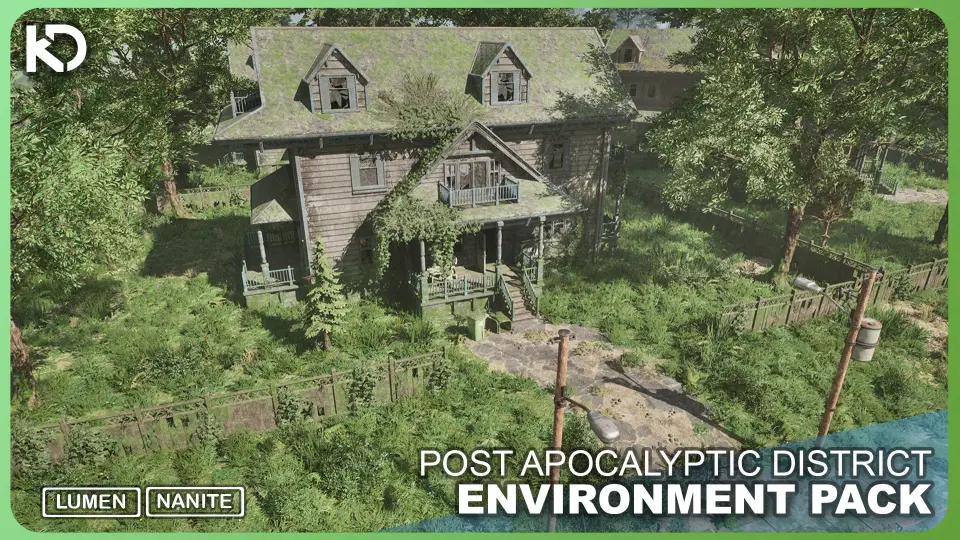
Post Apocalyptic District drops a team into a ruined, overgrown world spread across a 4.2 square kilometer environment. The scale is immediate: buildings with full interiors, furniture, and doors sit inside a landscape that uses World Partition to stream its pieces. That makes the pack practical for sequences where a camera moves through a cityscape, for survival gameplay where a player walks from one collapsed structure to another, and for cinematic establishing shots that need real geometry behind every wall rather than a painted backdrop.
The tags attached to the product point straight at the visual register: decay, abandoned, overgrown, ruin, rubble, debris, broken. There is enough room for a forest to reclaim a block, for a road to split under ground shift, and for fences and power lines to sag across empty lots.
Interiors, Furniture, and Tight Scene Composition
The buildings are not shells. They contain interiors and furniture, so a room can be shot or played through without dressing it from scratch. Doors are present and functional in the context of the example player logic. That gives a level designer ready-made spaces to stage a search, a standoff, or an ambush. Furniture and props sit inside the asset library alongside debris, so a single room can be dressed with lived-in clutter before the collapse and post-collapse rubble after it.
For a cinematics team, the interiors mean a camera can move from a wide aerial down to a hallway without a seam. For a gameplay team, rooms become interactable spaces rather than locked geometry.
Drivable Vehicles and the Chaos Vehicles Plugin
The environment ships with drivable vehicle blueprints. These are not static props placed for scale. The vehicles are driven through the example player logic, and the blueprints generate different colors and levels of damage results. That opens a clear creative path: a convoy can be staged with trucks at different states of decay, or a single vehicle can be shown degrading across a sequence of shots.
The vehicles require the Chaos Vehicles Plugin, which is the standard Unreal Engine vehicle physics system. A team evaluating the pack should confirm that plugin is active in their project before building gameplay around driving sequences.
The example player logic does not stop at vehicles. It also contains interaction logic for items and doors. This gives a starting point for a survivor-style game loop: open a door, search a shelf, enter a vehicle, drive to the next building.
Spline Blueprints for Power Lines, Roads, and Fences
Large environments live or die by how quickly a level artist can lay down repetitive infrastructure. Post Apocalyptic District includes spline blueprints for power lines, roads, and fences. Splines let an artist draw a path across the landscape and have the mesh follow it, which is faster and more natural than placing individual segments by hand.
For a 4.2 square kilometer map, that matters inside a project. A road can be traced along a valley, a power line can sag between poles over a ruined district, and a fence line can follow a property boundary without manual placement of every post.
Nature Assets and Advanced Rock Materials
The pack includes a nature set: different tree models with small and large versions, grass and fern models, and a large set of rock and stone assets. The trees use PivotPainter for wind, which means foliage can move with a directional gust rather than sitting static. An outdoor shot can have living, breathing vegetation even inside a dead world.
Rock assets come with advanced rock materials. The broader material system in the pack supports moss, dirt, damage, and wetness layers, so a rock face can be dry on a ridge and wet near a streambed, or clean on a fresh break and mossy on a weathered surface. These layers give a texture artist direct control over how reclaimed by nature a surface looks.
The combination of large and small tree versions, grass, ferns, and detailed rocks means a forest edge can be built with canopy, understory, and ground cover instead of one layer of trees.
Landscape Material with Four Layers and Virtual Texturing
The example level uses World Partition and a landscape material with four different layers. The landscape material uses high-quality textures, distance-based macro details, slope support, virtual texturing support, and landscape grass.
Distance-based macro details mean the landscape can keep visual richness when viewed from far away, which is useful across a 4.2 square kilometer map. Slope support allows different surface treatment on steep ground versus flat ground, so a cliff face can read differently from a valley floor. Virtual texturing support helps manage memory overhead on a landscape this large. Landscape grass ties grass placement to the terrain layers, so green growth can follow the terrain naturally.
Material Functions, Instances, and Editing Workflow
Various material layers in the pack are converted into material functions for easier editing, and assets use material instances. This is a workflow detail that affects how quickly a team can re-skin the environment.
A material function packages a layer, such as moss or wetness, into a reusable node. An artist can open that function, adjust the parameters, and see the change propagate to every material instance that uses it. If a director asks for a wetter, more overgrown look across the whole district, the change can be made in the function rather than across dozens of individual materials.
Material instances allow per-asset variation without breaking the shared base. A wall in one block can be more damaged than a wall in another, while both still draw from the same master material.
Unreal Engine 5.1+, Nanite, and Lumen
The pack is built to utilize Nanite and Lumen, and the product supports Nanite and Lumen for Unreal Engine 5.1 and above. Nanite handles high-detail geometry at scale, which fits a 4.2 square kilometer environment dense with buildings, interiors, props, and debris. Lumen handles global illumination and reflections, which matters for interiors where light bounces through broken windows and for exteriors where overcast light rolls through an overgrown street.
A team working in Unreal Engine 5.1 or later can lean on these systems directly. A team on an earlier engine version should check the compatibility range, which runs from 4.21 through 4.27 and 5.0 through 5.8, before relying on Nanite and Lumen features.
Bundled Content and Tags
The pack already contains products like the Post Apocalyptic Rifle and vehicles. This means a gameplay prototype can start with a weapon and a vehicle already integrated into the scene, rather than pulling those pieces from separate packs and matching their scale and materials.
The tags give a clear map of the creative territory: decay, furniture, post apocalyptic, landscape, abandoned, tree, overgrown, house, nature, level, cityscape, building, interior, survivor, rubble, ruin, blueprint, debris, broken, apocalyptic. A team shopping for a specific tone can use those tags to judge fit.
Engine Compatibility and Networking Limit
Compatibility extends across a wide range: 4.21 through 4.27 and 5.0 through 5.8. This makes the pack usable on both last-generation and current-generation Unreal projects.
One firm technical note: the blueprints are not built with networking in mind. A team planning a multiplayer project will need to rework the interaction, vehicle, and spline logic themselves.
Practical Fit for Teams and Creators
Post Apocalyptic District is built for teams that need a large, explorable, and dressable wasteland without assembling one from scratch. The 4.2 square kilometer scale, combined with building interiors, drivable vehicle blueprints, spline-based infrastructure, and a full nature asset set, makes it a strong starting point for a survival game prototype, a cinematic short set in a ruined city, or an environment art portfolio piece.
The strongest concrete takeaway: Nanite and Lumen support on Unreal Engine 5.1+, World Partition for a massive landscape, material functions for fast global look changes, and bundled weapons and vehicles to kickstart gameplay, with the clear caveat that multiplayer networking is out of scope for the included blueprints.
 Apocalyptic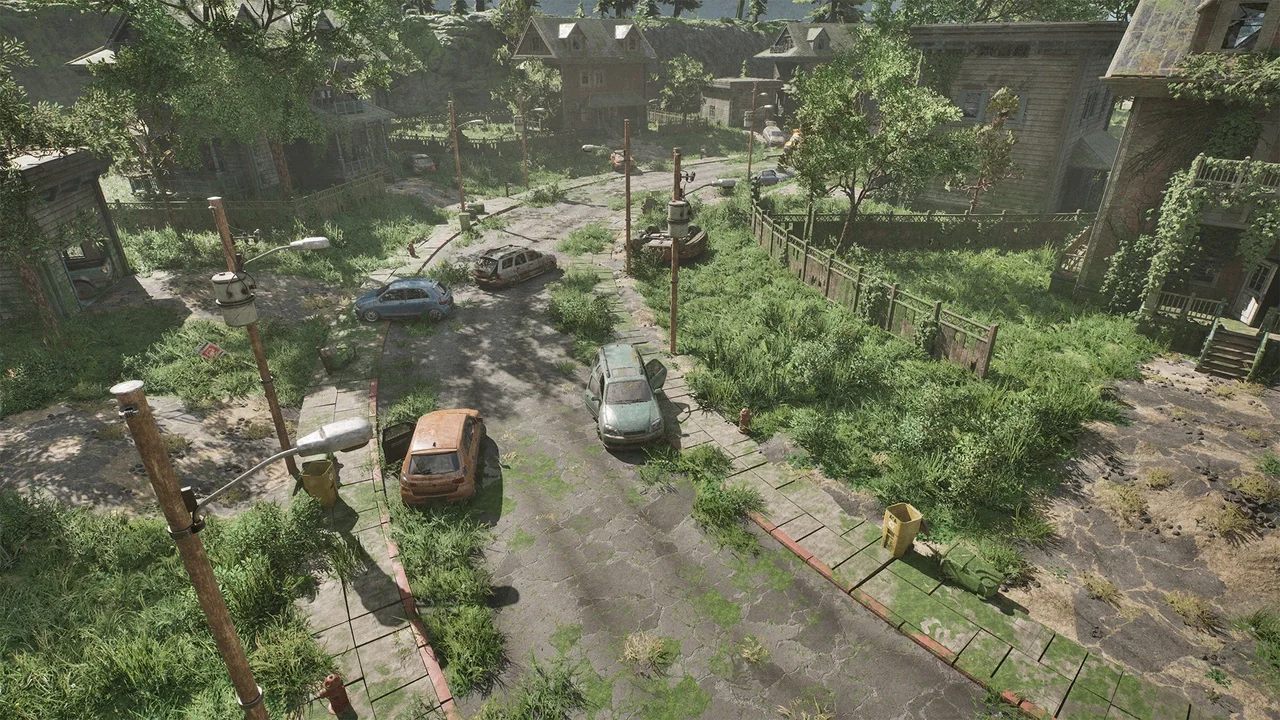
 Apocalyptic
 Apocalyptic
 Apocalyptic