"7e6fc58c410f2894"{"id":"1000476","slug":"old-style-pharmacist-laboratory","title":"Old Style Pharmacist Laboratory","category":"Historical","engine":"4.26+,5.0+","assetVersion":"","engineVersion":"Engine Version: 4.26+,5.0+","tag":"Historical","accent":"blue","visual":"mech","summary":"A 3D pharmacist laboratory asset with bookshelves, glassware, work tables, and building parts. Compatible with Unreal 4.11 through 5.2 for scene assembly.","platform":"Unreal Engine","publishedAt":"2026-07-11T18:48:28.795Z","updatedAt":"2026-07-11T18:48:28.795Z","sourceNotes":[],"fileContents":[],"compatibility":["Unreal Engine","Engine Version: 4.26+,5.0+"],"featuredImage":{"alt":"Old Style Pharmacist Laboratory","src":"/wp-content/uploads/published/2026/07/946ff98f4fc2-3e53db41-456c-476b-aa28-5877d070ffd0-00a4dd495f.webp"},"hasDownloadLink":true,"downloads":0,"terms":[{"taxonomy":"category","slug":"historical","name":"Historical"}],"galleryImages":[{"src":"/wp-content/uploads/published/2026/07/56e0837e1e18-fee13d37-0170-4f10-a0d0-32bb3ff020e0-8a04229ad8.webp","alt":"Old Style Pharmacist Laboratory"},{"src":"/wp-content/uploads/published/2026/07/f3cf486d6701-65b61eaa-cc3f-4a67-bf37-d7d9cc162cec-b848f485fb.webp","alt":"Old Style Pharmacist Laboratory"},{"src":"/wp-content/uploads/published/2026/07/a43152baa9df-18b5176b-ce19-4e21-bab5-94354192d250-728ca3bec2.webp","alt":"Old Style Pharmacist Laboratory"},{"src":"/wp-content/uploads/published/2026/07/38456d9b994f-aa7fbe21-e7e9-48c0-91ea-1600b1f9cc46-7d5d2aad73.webp","alt":"Old Style Pharmacist Laboratory"},{"src":"/wp-content/uploads/published/2026/07/5bb9f41f6026-94e1d599-0d32-4981-9102-3d8efd20eef7-cc63bc68ee.webp","alt":"Old Style Pharmacist Laboratory"},{"src":"/wp-content/uploads/published/2026/07/c3615d7df4e2-1570f3ed-3175-4651-b9af-27f82992be44-0b6a4f0695.webp","alt":"Old Style Pharmacist Laboratory"},{"src":"/wp-content/uploads/published/2026/07/7a7a27ed3140-cf826a46-d999-4197-afea-dcdbea1f121f-945835bc83.webp","alt":"Old Style Pharmacist Laboratory"},{"src":"/wp-content/uploads/published/2026/07/e15a0234cc48-fa0c1710-af94-453f-91d1-868e556603d1-3955028f6d.webp","alt":"Old Style Pharmacist Laboratory"},{"src":"/wp-content/uploads/published/2026/07/cc72b4a6e295-945e2bcc-498c-4d2b-b464-4409732fc012-3ba27066b5.webp","alt":"Old Style Pharmacist Laboratory"},{"src":"/wp-content/uploads/published/2026/07/3ddafe610f08-bea5f9df-49fd-4784-a1cd-694e585e92ff-f38df47934.webp","alt":"Old Style Pharmacist Laboratory"}],"accessPanel":{"kind":"resource","title":"Download this resource","eyebrow":"Free Download","message":"Log in or create a free account to start your download.","fileName":"Content.7z","safetyNote":"Resources are manually reviewed before listing to improve quality and reduce obvious risks.","actionLabel":"Download Free","resourceType":"Resource archive"},"contentHtml":"\u003cp\u003eWalk into a virtual apothecary and the first thing that grounds the space is the clutter of work tables, the rows of labeled jars, and the worn spines of reference books lining the shelves. The \u003cstrong\u003eOld Style Pharmacist Laboratory\u003c/strong\u003e Gives developers exactly that kind of environmental density. It provides meshes with assigned materials that construct an old laboratory as it existed in pharmacies, chemist stores, and universities. The set was built with the collaboration of working pharmacists, drawing on their memories and photographs, which gives the props a plausible specificity rather than a generic antique-shop feel. Laboratories similar to this one can still be found in some countries, though the real-world versions now carry more modern electric equipment.\u003c/p\u003e \u003ch2\u003eHistorical Fidelity Meets Scene Flexibility\u003c/h2\u003e \u003cp\u003eThe stated design goal was to make the laboratory look new and clean. That intent shapes how the props read in a rendered scene. The asset is not built as a ruined or abandoned space. Instead, it gives the impression of a working environment where equipment is maintained and surfaces are kept ready for use. This cleanliness matters because it allows the asset to serve as a controlled baseline. A developer can dress the scene down with overlaid grime decals, particle effects, or post-processing to push it toward disrepair, but the underlying geometry and materials start from a tidy state.\u003c/p\u003e \u003cp\u003eThat starting point also opens the asset to creative misuse. The description explicitly notes that while the models represent historical pharmacist equipment, some of them can also be repurposed for witchcraft, alchemy, or potion-making scenarios. A mortar and pestle, a human skull model, flasks arranged on a work table, and an open cooking area can shift quickly into a fantasy or occult context when relit and retextured. The asset gives teams the raw props to build that shift without modeling from scratch.\u003c/p\u003e \u003ch2\u003eProp Inventory and Laboratory Glassware\u003c/h2\u003e \u003cp\u003eThe asset provides a focused inventory of laboratory equipment rather than a broad architectural kit. The included meshes and materials cover bookshelves, books, and parchments, which establish the research-and-reference side of a pharmacist workspace. Work tables act as the central staging surfaces where the smaller props are arranged. An old scale provides a focal point for weighing ingredients.\u003c/p\u003e \u003cp\u003ePharmacist jars for plants and creams bring color and shelf presence to the scene. These containers imply prepared remedies and raw botanical materials, telling a stored visual story about what the pharmacist produces. Mortar and pestles appear as grinding tools, essential for compounded preparations.\u003c/p\u003e \u003cp\u003eA human skull model adds an anatomical reference prop, appropriate for a historical educational setting or, taken out of context, for darker thematic work. An open cooking area and oven provide the heat source for preparations requiring distillation or reduction. Basins and a glassware dryer handle the cleaning-side workflow of the laboratory, giving the environment a sense of daily routine rather than just display.\u003c/p\u003e \u003cp\u003eLaboratory glassware makes up a significant category of the included props. The asset provides a burette, a measure cylinder, flasks, and test tubes. These are the precision instruments that define a laboratory interior. When placed on the work tables or shelved, they give the scene an immediate functional identity.\u003c/p\u003e \u003ch3\u003eGlass and Translucent Materials in the Pharmacist Laboratory\u003c/h2\u003e \u003cp\u003eThe asset handles its see-through surfaces with two types of glass material and one translucent liquid material. The glass variants allow developers to differentiate between, for example, thick jar walls and thin flask walls. The translucent liquid material enables the contents of the glassware to read as actual substances rather than colored voids. For scene assembly, these materials mean that light passing through the vessels becomes part of the visual atmosphere of the laboratory.\u003c/p\u003e \u003ch2\u003eBuilding Parts and Scene Assembly\u003c/h2\u003e \u003cp\u003eBeyond the props, the asset includes a few simple building parts and their accompanying materials. These are the same components used to create the screenshots provided for the asset. This gives a clear indication of how the props are intended to be staged.\u003c/p\u003e \u003cp\u003eFor developers, the inclusion of these structural pieces means the asset can function as a contained diorama rather than just a scattered collection of props. Walls, floors, or other simple architectural elements provide the containment the laboratory needs to feel like an enclosed workspace. The building parts are not a full architectural kit, but they are sufficient to mock up the rooms and staging areas that show off the laboratory equipment in context.\u003c/p\u003e \u003ch2\u003eTechnical Pipeline and Compatibility Notes\u003c/h2\u003e \u003cp\u003eThe asset carries a stated compatibility range. It functions within Unreal Engine versions spanning from 4.11 through 4.27, and it also covers the 5.0 through 5.2 releases. This wide compatibility range means the asset was maintained and tested across major engine transitions.\u003c/p\u003e \u003cp\u003eFor teams already working in Unreal Engine 5, the asset slots into the 5.0–5.2 pipeline without requiring a backend fix. For those still maintaining projects in the later 4.x branch, the same asset can be brought into those environments. The materials are set up to function within these engine versions.\u003c/p\u003e \u003ch2\u003eTagging and Scene Context\u003c/h2\u003e \u003cp\u003eThe asset is tagged with Museum, Pharmacy, Level, Alchemist, and Laboratory. The tagging points to the intended contexts. Museum indicates the props are detailed enough for close-range viewing in curated exhibits. Pharmacy and Laboratory cover the historical realism use case. Level denotes the inclusion of the simple building parts sufficient for assembling a playable or walkthrough space. Alchemist confirms the noted secondary use for fantasy, potion-making, or occult scenes.\u003c/p\u003e \u003cp\u003eFor developers evaluating the pack, the practical application is clear. If a scene requires a detailed, historically grounded pharmacist workspace with ready-made glassware, work tables, and storage props, this asset provides that foundation. The inclusion of structural building parts to contain the props, combined with specific glass and liquid materials for the transparent vessels, makes it a functional scene-assembly tool rather than just a prop dump.\u003c/p\u003e\n\n\u003ch2\u003eContinue Browsing Similar Packs\u003c/h2\u003e\n\u003cul\u003e\n\u003cli\u003e\u003ca href=\"https://3dcghub.com/florence-cathedral-pack-cathedral-environment-cathedral-cathedral-church-old/\" title=\"Florence Cathedral Pack ( Cathedral Environment Cathedral Cathedral Church Old )\"\u003eFlorence Cathedral Pack ( Cathedral Environment Cathedral Cathedral Church Old )\u003c/a\u003e\u003c/li\u003e\n\u003cli\u003e\u003ca href=\"https://3dcghub.com/us-capitol-exterior-environment-building-exterior-usa-capitol/\" title=\"US Capitol Exterior Environment ( Building Exterior USA Capitol )\"\u003eUS Capitol Exterior Environment ( Building Exterior USA Capitol )\u003c/a\u003e\u003c/li\u003e\n\u003cli\u003e\u003ca href=\"https://3dcghub.com/church-cathedral-interior-environment-church-cathedral-interior-historical/\" title=\"Church / Cathedral Interior Environment ( Church Cathedral Interior Historical )\"\u003eChurch / Cathedral Interior Environment ( Church Cathedral Interior Historical )\u003c/a\u003e\u003c/li\u003e\n\u003cli\u003e\u003ca href=\"https://3dcghub.com/interior-toolkit/\" title=\"Interior Toolkit\"\u003eInterior Toolkit\u003c/a\u003e\u003c/li\u003e\n\u003cli\u003e\u003ca href=\"https://3dcghub.com/egypt-ruins-environment/\" title=\"Egypt Ruins Environment\"\u003eEgypt Ruins Environment\u003c/a\u003e\u003c/li\u003e\n\u003c/ul\u003e","contentTextLength":6595,"navigation":{"current":1282,"total":3618,"previous":{"id":"1000477","slug":"post-apocalyptic-district","title":"Post Apocalyptic District","category":"Apocalyptic / Post-apocalyptic","platform":"Unreal Engine","updatedAt":"2026-07-11T19:02:34.820Z"},"next":{"id":"1000475","slug":"old-hunters-manor","title":"Old Hunters Manor","category":"Fantasy","platform":"Unreal Engine","updatedAt":"2026-07-11T18:45:03.420Z"}},"relatedResources":[{"id":"1000976","slug":"asian-canal-environment-asian-canal-environment-asian-ancient-bridge-old-3d","title":"Asian Canal Environment (Asian Canal Environment Asian Ancient Bridge Old 3D )","category":"Historical","engine":"4.26+,5.0+","assetVersion":"","engineVersion":"Engine Version: 4.26+,5.0+","tag":"Historical","accent":"blue","visual":"city","summary":"Asian Canal Environment is an Unreal Engine pack with an Example Showcase Map and building/prop models for ancient Asian canal scenes, compatible with ULAT.","platform":"Unreal Engine","publishedAt":"2026-08-17T17:14:31.122Z","updatedAt":"2026-08-17T17:14:31.122Z","sourceNotes":[],"fileContents":[],"compatibility":["Unreal Engine","Engine Version: 4.26+,5.0+"],"featuredImage":{"alt":"Asian Canal Environment (Asian Canal Environment Asian Ancient Bridge Old 3D )","src":"/wp-content/uploads/published/2026/08/4e403f279309-a42f0ffe-5751-4412-ad9f-5795b68f275f-0bad43f902.webp"},"hasDownloadLink":true,"downloads":2},{"id":"1001530","slug":"laboratory-interior-studio-in-loft-style","title":"Laboratory Interior Studio in Loft Style","category":"Interior","engine":"4.23+,5.0+","assetVersion":"","engineVersion":"Engine Version: 4.23+,5.0+","tag":"Interior","accent":"blue","visual":"mech","summary":"Explore the Laboratory Interior Studio in Loft Style pack, featuring 370+ static meshes, 35 Blueprints, spline tools, decals, and master materials.","platform":"Unreal Engine","publishedAt":"2026-10-09T17:24:29.957Z","updatedAt":"2026-10-09T17:24:29.957Z","sourceNotes":[],"fileContents":[],"compatibility":["Unreal Engine","Engine Version: 4.23+,5.0+"],"featuredImage":{"alt":"Laboratory Interior Studio in Loft Style","src":"/wp-content/uploads/published/2026/10/4478225037e7-4bb5b192-bc18-4df5-a46a-9d191d846f42-e563108a1f.webp"},"hasDownloadLink":true,"downloads":0},{"id":"1000059","slug":"florence-cathedral-pack-cathedral-environment-cathedral-cathedral-church-old","title":"Florence Cathedral Pack ( Cathedral Environment Cathedral Cathedral Church Old )","category":"Historical","engine":"4.26+,5.0+","assetVersion":"","engineVersion":"4.26+,5.0+","tag":"Historical","accent":"blue","visual":"city","summary":"A cathedral environment pack with 257 unique meshes, a preassembled scene, and ULAT support for modular building and scene population.","platform":"Unreal Engine","publishedAt":"2026-05-26T17:01:35.352Z","updatedAt":"2026-05-26T17:01:35.352Z","sourceNotes":[],"fileContents":[],"compatibility":["Unreal Engine","Engine version: 4.26+,5.0+"],"featuredImage":{"alt":"Florence Cathedral Pack ( Cathedral Environment Cathedral Cathedral Church Old )","src":"/wp-content/uploads/published/2026/05/9911b881684a-9e488afd-d01b-4a84-9c9b-4c489052cb82-aa6a5ade77.webp"},"hasDownloadLink":true,"downloads":1}]}
Historical
Old Style Pharmacist Laboratory
A 3D pharmacist laboratory asset with bookshelves, glassware, work tables, and building parts. Compatible with Unreal 4.11 through 5.2 for scene assembly.
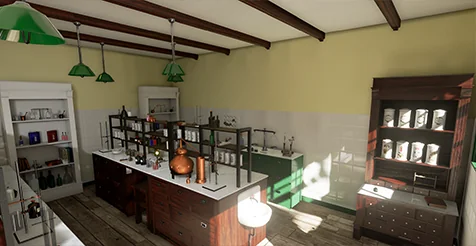
Walk into a virtual apothecary and the first thing that grounds the space is the clutter of work tables, the rows of labeled jars, and the worn spines of reference books lining the shelves. The Old Style Pharmacist Laboratory Gives developers exactly that kind of environmental density. It provides meshes with assigned materials that construct an old laboratory as it existed in pharmacies, chemist stores, and universities. The set was built with the collaboration of working pharmacists, drawing on their memories and photographs, which gives the props a plausible specificity rather than a generic antique-shop feel. Laboratories similar to this one can still be found in some countries, though the real-world versions now carry more modern electric equipment.
Historical Fidelity Meets Scene Flexibility
The stated design goal was to make the laboratory look new and clean. That intent shapes how the props read in a rendered scene. The asset is not built as a ruined or abandoned space. Instead, it gives the impression of a working environment where equipment is maintained and surfaces are kept ready for use. This cleanliness matters because it allows the asset to serve as a controlled baseline. A developer can dress the scene down with overlaid grime decals, particle effects, or post-processing to push it toward disrepair, but the underlying geometry and materials start from a tidy state.
That starting point also opens the asset to creative misuse. The description explicitly notes that while the models represent historical pharmacist equipment, some of them can also be repurposed for witchcraft, alchemy, or potion-making scenarios. A mortar and pestle, a human skull model, flasks arranged on a work table, and an open cooking area can shift quickly into a fantasy or occult context when relit and retextured. The asset gives teams the raw props to build that shift without modeling from scratch.
Prop Inventory and Laboratory Glassware
The asset provides a focused inventory of laboratory equipment rather than a broad architectural kit. The included meshes and materials cover bookshelves, books, and parchments, which establish the research-and-reference side of a pharmacist workspace. Work tables act as the central staging surfaces where the smaller props are arranged. An old scale provides a focal point for weighing ingredients.
Pharmacist jars for plants and creams bring color and shelf presence to the scene. These containers imply prepared remedies and raw botanical materials, telling a stored visual story about what the pharmacist produces. Mortar and pestles appear as grinding tools, essential for compounded preparations.
A human skull model adds an anatomical reference prop, appropriate for a historical educational setting or, taken out of context, for darker thematic work. An open cooking area and oven provide the heat source for preparations requiring distillation or reduction. Basins and a glassware dryer handle the cleaning-side workflow of the laboratory, giving the environment a sense of daily routine rather than just display.
Laboratory glassware makes up a significant category of the included props. The asset provides a burette, a measure cylinder, flasks, and test tubes. These are the precision instruments that define a laboratory interior. When placed on the work tables or shelved, they give the scene an immediate functional identity.
Glass and Translucent Materials in the Pharmacist Laboratory
The asset handles its see-through surfaces with two types of glass material and one translucent liquid material. The glass variants allow developers to differentiate between, for example, thick jar walls and thin flask walls. The translucent liquid material enables the contents of the glassware to read as actual substances rather than colored voids. For scene assembly, these materials mean that light passing through the vessels becomes part of the visual atmosphere of the laboratory.
Building Parts and Scene Assembly
Beyond the props, the asset includes a few simple building parts and their accompanying materials. These are the same components used to create the screenshots provided for the asset. This gives a clear indication of how the props are intended to be staged.
For developers, the inclusion of these structural pieces means the asset can function as a contained diorama rather than just a scattered collection of props. Walls, floors, or other simple architectural elements provide the containment the laboratory needs to feel like an enclosed workspace. The building parts are not a full architectural kit, but they are sufficient to mock up the rooms and staging areas that show off the laboratory equipment in context.
Technical Pipeline and Compatibility Notes
The asset carries a stated compatibility range. It functions within Unreal Engine versions spanning from 4.11 through 4.27, and it also covers the 5.0 through 5.2 releases. This wide compatibility range means the asset was maintained and tested across major engine transitions.
For teams already working in Unreal Engine 5, the asset slots into the 5.0–5.2 pipeline without requiring a backend fix. For those still maintaining projects in the later 4.x branch, the same asset can be brought into those environments. The materials are set up to function within these engine versions.
Tagging and Scene Context
The asset is tagged with Museum, Pharmacy, Level, Alchemist, and Laboratory. The tagging points to the intended contexts. Museum indicates the props are detailed enough for close-range viewing in curated exhibits. Pharmacy and Laboratory cover the historical realism use case. Level denotes the inclusion of the simple building parts sufficient for assembling a playable or walkthrough space. Alchemist confirms the noted secondary use for fantasy, potion-making, or occult scenes.
For developers evaluating the pack, the practical application is clear. If a scene requires a detailed, historically grounded pharmacist workspace with ready-made glassware, work tables, and storage props, this asset provides that foundation. The inclusion of structural building parts to contain the props, combined with specific glass and liquid materials for the transparent vessels, makes it a functional scene-assembly tool rather than just a prop dump.
 Historical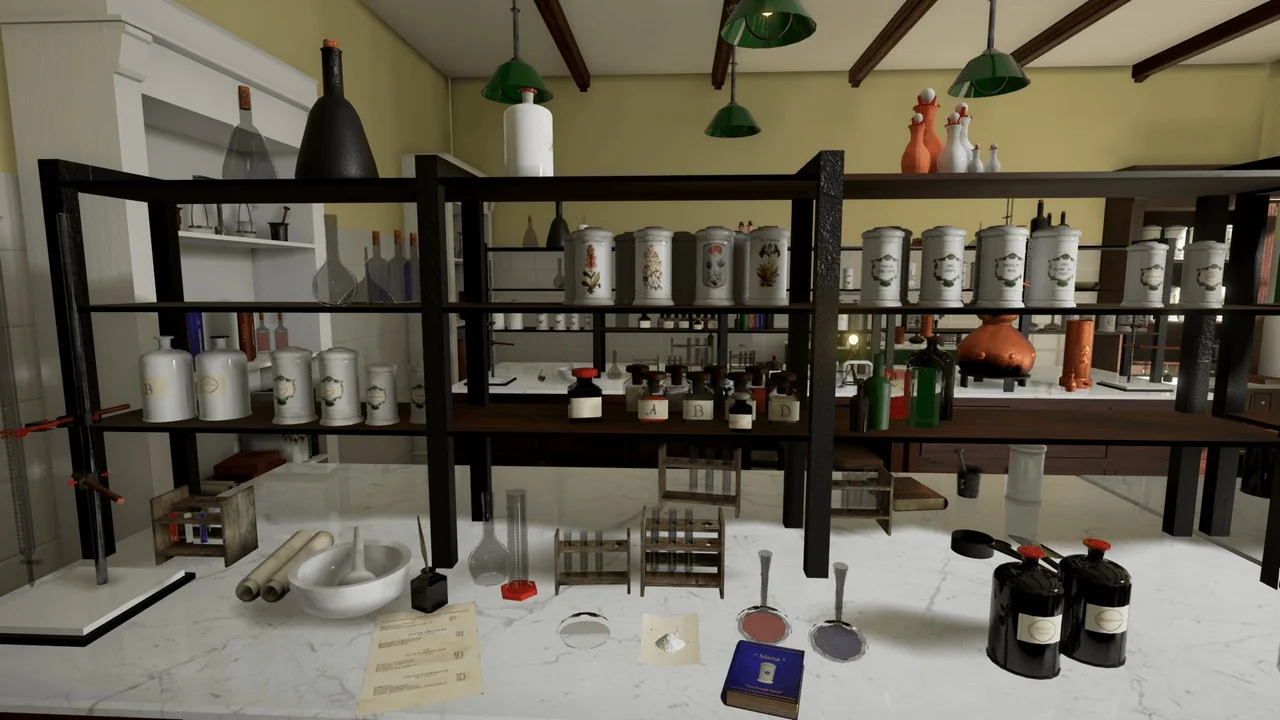
 Historical
 Interior
 Historical