"efaa631e936fd3ee"{"id":"1002147","slug":"portal-pack-niagara-vfx","title":"Portal Pack -Niagara VFX","category":"Variety","engine":"4.25+,5.0+","assetVersion":"","engineVersion":"Engine Version: 4.25+,5.0+","tag":"Variety","accent":"blue","visual":"mech","summary":"Examine the Portal Pack -Niagara VFX featuring 12 game-ready portal effects, 20 materials, 22 textures, and a demo level for fantasy and realistic scenes.","platform":"Unreal Engine","publishedAt":"2026-10-29T09:52:03.294Z","updatedAt":"2026-10-29T09:52:03.294Z","sourceNotes":[],"fileContents":[],"compatibility":["Unreal Engine","Engine Version: 4.25+,5.0+"],"featuredImage":{"alt":"Portal Pack -Niagara VFX","src":"/wp-content/uploads/published/2026/10/9bdb4a7c3eee-ca721d0e-6318-4d47-af38-2e8d1ecb0329-734e15e8e7.webp"},"hasDownloadLink":true,"downloads":0,"terms":[{"taxonomy":"category","slug":"variety-vfx","name":"Variety"}],"galleryImages":[{"src":"/wp-content/uploads/published/2026/10/49a97617ca1e-84428aaf-7f26-4aa6-a413-7da920426897-b5d4944cd6.webp","alt":"Portal Pack -Niagara VFX"},{"src":"/wp-content/uploads/published/2026/10/8362bf499396-f94976ef-9d1a-4092-a425-65bc06185fda-d5e4a2e8f7.webp","alt":"Portal Pack -Niagara VFX"},{"src":"/wp-content/uploads/published/2026/10/2c67cf61653b-9059a555-bda7-4af6-b213-287625601944-f0d8d47ac1.webp","alt":"Portal Pack -Niagara VFX"},{"src":"/wp-content/uploads/published/2026/10/2c21e9460fdb-938eb546-0f91-4ce7-9cd4-da730b81a4b0-2b068a154c.webp","alt":"Portal Pack -Niagara VFX"},{"src":"/wp-content/uploads/published/2026/10/d9fc938849c0-47ae11f8-e3b9-45f7-a563-8c231ad1416a-f792d89eb4.webp","alt":"Portal Pack -Niagara VFX"},{"src":"/wp-content/uploads/published/2026/10/7ea22eb9855d-0649f04a-58e8-4ad7-8929-8c18d2dabf6b-aaf38ef1c3.webp","alt":"Portal Pack -Niagara VFX"},{"src":"/wp-content/uploads/published/2026/10/8236431112a4-b19c6e9b-8bfc-468b-bf1e-51b0ad88ae3d-3c7fadf839.webp","alt":"Portal Pack -Niagara VFX"},{"src":"/wp-content/uploads/published/2026/10/f18bb5e7d4ff-35d9648e-afd7-40ff-ba9e-e1fb1e851df7-554dbea36b.webp","alt":"Portal Pack -Niagara VFX"},{"src":"/wp-content/uploads/published/2026/10/db86222c561f-3293b68e-e4e3-41b2-8668-e35f816bd5dc-729c0c2955.webp","alt":"Portal Pack -Niagara VFX"},{"src":"/wp-content/uploads/published/2026/10/2b9b2823b7f6-de41300d-bdaf-47de-9bc0-2d62babca1db-c17f866c3b.webp","alt":"Portal Pack -Niagara VFX"}],"accessPanel":{"kind":"resource","title":"Download this resource","eyebrow":"Free Download","message":"Log in or create a free account to start your download.","fileName":"Content.7z","safetyNote":"Resources are manually reviewed before listing to improve quality and reduce obvious risks.","actionLabel":"Download Free","resourceType":"Resource archive"},"contentHtml":"\u003ch2\u003eNiagara VFX Configurations and Spatial Gateways\u003c/h2\u003e\n\u003cp\u003eTransporting players across game environments requires visual cues that establish spatial logic, supernatural power, or advanced scientific displacement. Portal Pack -Niagara VFX focuses squarely on this transition mechanic by providing twelve distinct game-ready portal effects. Each system is authored within the Niagara framework, taking advantage of modern particle simulation pipelines to handle visual energy, swirling vortexes, and directional particle velocity without stalling real-time frame rates.\u003c/p\u003e\n\u003cp\u003eBecause the collection includes twelve separate variations, level designers do not have to rely on a single uniform gateway appearance across an entire game world. A fantasy realm can employ ancient, unstable dimensional tears, while a cleaner, controlled sci-fi environment can integrate structured teleportation hubs. The underlying Niagara particle structures ensure that rotation speeds, particle density, and boundary definitions remain crisp whether the viewer is observing the threshold from afar or moving directly through the center of the aperture.\u003c/p\u003e \u003ch2\u003eMaterial Architecture and Texture Distribution Across Portals and Pads\u003c/h2\u003e\n\u003cp\u003eParticle emissions alone rarely create a convincing portal without solid shader support. This package backs its twelve dynamic effects with a foundation of 20 materials and 22 textures, striking a balance between unique surface responses and shared visual memory. The texture pool provides the mask shapes, noise maps, and energetic gradients required to drive distortion, emissive light channels, and rim falloff within the particle fields.\u003c/p\u003e\n\u003cp\u003eIn addition to vertical vortices, the set incorporates pad elements. Ground pads ground the visual effect in physical architecture, giving the energetic currents a clear point of origin on the floor or terrain. These base surfaces use the included material collection to project light rings, arcane runes, or mechanical docking plates beneath the swirling particle volumes. Having 20 dedicated materials ensures that the thresholds do not look like flat, billboarding sprites; they show depth, refraction, and surface variance across their dynamic planes.\u003c/p\u003e \u003ch2\u003eEvaluating Staging in the Example DemoLevel\u003c/h2\u003e\n\u003cp\u003eReviewing particle interactions inside an isolated viewport often obscures how effects respond to actual level lighting, scale, and background geometry. The pack includes one example DemoLevel specifically to address this issue. Loading the demo map allows developers to view all twelve portal variants in a fully configured scene environment, making it straightforward to check draw distance, light bloom intensity, and relative player scale before migrating assets into an active production branch.\u003c/p\u003e\n\u003cp\u003eThe demo level serves as an immediate reference for optimal placement and orientation. Seeing the portals alongside their corresponding pad setups clarifies how the developer intended the ground elements to anchor the vertical Niagara particle systems. This pre-assembled space also provides an easy testing ground for performance profiling, allowing technical artists to inspect GPU particle overhead, shader complexity passes, and material instancing under realistic camera movement.\u003c/p\u003e \u003ch2\u003eBalancing Fantasy Themes with Realistic Level Architecture\u003c/h2\u003e\n\u003cp\u003eVisual style often dictates how an effect must be shaded, and the pack specifically addresses this stylistic breadth by supporting both fantasy and realistic visual aesthetics. A fantasy setting often calls for soft ethereal wisps, drifting embers, and mystical runic patterns. In contrast, a realistic or near-future simulation demands controlled energy fields, tight electromagnetic arcs, and precise boundary confinement.\u003c/p\u003e\n\u003cp\u003eBecause the pack spans both artistic poles, the materials and textures provide room to swing between magical gateways and high-tech teleportation terminals. Level designers building volumetric arenas, sprawling dungeons, or compact arena maps can select variations that match the narrative tone of the surrounding structures without needing to rebuild particle logic from scratch. When paired with volumetric systems or modern pathfinding frameworks—such as LCM 3D Navigation AI for volumetric navigation in Unreal Engine 5—these portals provide reliable waypoints for both player navigation and complex artificial intelligence pathing routines.\u003c/p\u003e \u003ch2\u003ePipeline Placement and Implementation Scope\u003c/h2\u003e\n\u003cp\u003eIntegrating environmental VFX into a production schedule is typically a tug-of-war between visual impact and shader performance. With twelve game-ready portals, 20 materials, 22 textures, and an example demo map, this asset collection is suited for titles requiring distinct, ready-to-deploy transit points. The collection eliminates the need to construct multi-layered Niagara emitters and coordinate scrolling UV shaders from empty project files, delivering fully formed spatial anomalies ready for level integration.\u003c/p\u003e\n\n\u003ch2\u003eRelated Resources Worth Checking\u003c/h2\u003e\n\u003cul\u003e\n\u003cli\u003e\u003ca href=\"https://3dcghub.com/vfx-attack-trails/\" title=\"VFX Attack Trails\"\u003eVFX Attack Trails\u003c/a\u003e\u003c/li\u003e\n\u003cli\u003e\u003ca href=\"https://3dcghub.com/butterfly-particles/\" title=\"Butterfly Particles\"\u003eButterfly Particles\u003c/a\u003e\u003c/li\u003e\n\u003cli\u003e\u003ca href=\"https://3dcghub.com/attack-animals-vfx/\" title=\"Attack Animals VFX\"\u003eAttack Animals VFX\u003c/a\u003e\u003c/li\u003e\n\u003cli\u003e\u003ca href=\"https://3dcghub.com/slime-vfx-2/\" title=\"Slime VFX\"\u003eSlime VFX\u003c/a\u003e\u003c/li\u003e\n\u003cli\u003e\u003ca href=\"https://3dcghub.com/energy-weapon-vfx-pack/\" title=\"Energy weapon VFX Pack\"\u003eEnergy weapon VFX Pack\u003c/a\u003e\u003c/li\u003e\n\u003c/ul\u003e","contentTextLength":5032,"navigation":{"current":137,"total":4209,"previous":{"id":"1002148","slug":"portal-pack-teleport-blueprint-vfx","title":"Portal Pack / Teleport Blueprint / VFX","category":"Gameplay Features","platform":"Unreal Engine","updatedAt":"2026-10-29T09:52:41.232Z"},"next":{"id":"1002146","slug":"poly-new-york-city-modular","title":"POLY - New York City Modular","category":"Cities","platform":"Unreal Engine","updatedAt":"2026-10-29T09:51:20.654Z"}},"relatedResources":[{"id":"1002283","slug":"stylized-vfx-minipack","title":"Stylized Vfx Minipack","category":"Variety","engine":"4.26+,5.0+","assetVersion":"","engineVersion":"Engine Version: 4.26+,5.0+","tag":"Variety","accent":"blue","visual":"mech","summary":"A close look at the Stylized Vfx Minipack, detailing its 25 Niagara systems, pickup effects, burst states, hit impacts, and torch Blueprints.","platform":"Unreal Engine","publishedAt":"2026-10-29T17:02:34.482Z","updatedAt":"2026-10-29T17:02:34.482Z","sourceNotes":[],"fileContents":[],"compatibility":["Unreal Engine","Engine Version: 4.26+,5.0+"],"featuredImage":{"alt":"Stylized Vfx Minipack","src":"/wp-content/uploads/published/2026/10/cdc6833df901-6ea2efd6-0434-49a6-b72f-3df5190b595a-062781cfcc.webp"},"hasDownloadLink":true,"downloads":0},{"id":"1002278","slug":"niagara-realistic-starter-vfx-pack","title":"Niagara Realistic Starter VFX Pack","category":"Variety","engine":"4.25+,5.0+","assetVersion":"","engineVersion":"Engine Version: 4.25+,5.0+","tag":"Variety","accent":"blue","visual":"mech","summary":"Examine the Niagara Realistic Starter VFX Pack, featuring 148 particle systems, transform-based scaling, and comprehensive environmental and combat effects.","platform":"Unreal Engine","publishedAt":"2026-10-29T16:36:27.991Z","updatedAt":"2026-10-29T16:36:27.991Z","sourceNotes":[],"fileContents":[],"compatibility":["Unreal Engine","Engine Version: 4.25+,5.0+"],"featuredImage":{"alt":"Niagara Realistic Starter VFX Pack","src":"/wp-content/uploads/published/2026/10/926adaa76d87-2c37688c-2dc0-4683-8cf4-d600fcea15d4-f5feac6fed.webp"},"hasDownloadLink":true,"downloads":0},{"id":"1002258","slug":"vfx-impacts","title":"VFX Impacts","category":"Variety","engine":"4.26+,5.0+","assetVersion":"","engineVersion":"Engine Version: 4.26+,5.0+","tag":"Variety","accent":"blue","visual":"mech","summary":"VFX Impacts delivers 18 surface impact effects with large and small variations, physical material controls, Niagara updates, muzzle flash, and bullet tracers.","platform":"Unreal Engine","publishedAt":"2026-10-29T16:17:47.297Z","updatedAt":"2026-10-29T16:17:47.297Z","sourceNotes":[],"fileContents":[],"compatibility":["Unreal Engine","Engine Version: 4.26+,5.0+"],"featuredImage":{"alt":"VFX Impacts","src":"/wp-content/uploads/published/2026/10/02c0c5ed4c4a-b83babab-98dc-4341-9b51-5002afcc482a-1b70a67735.webp"},"hasDownloadLink":true,"downloads":0}]}
Variety
Portal Pack -Niagara VFX
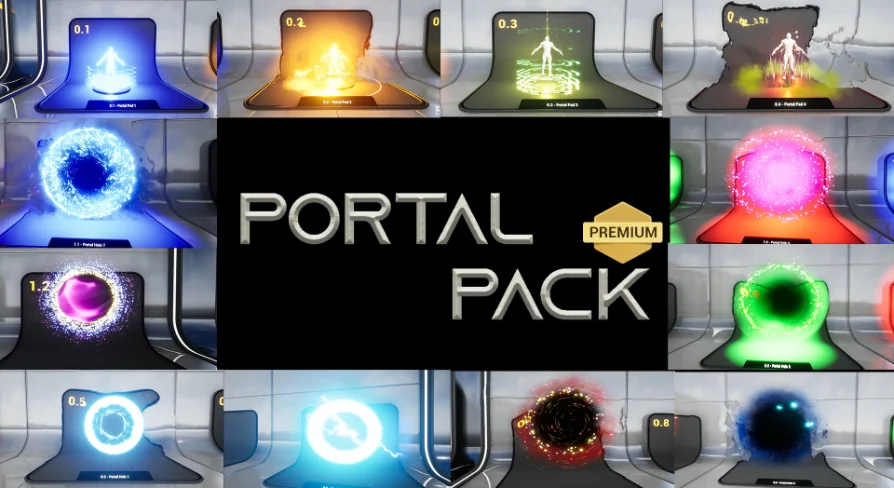
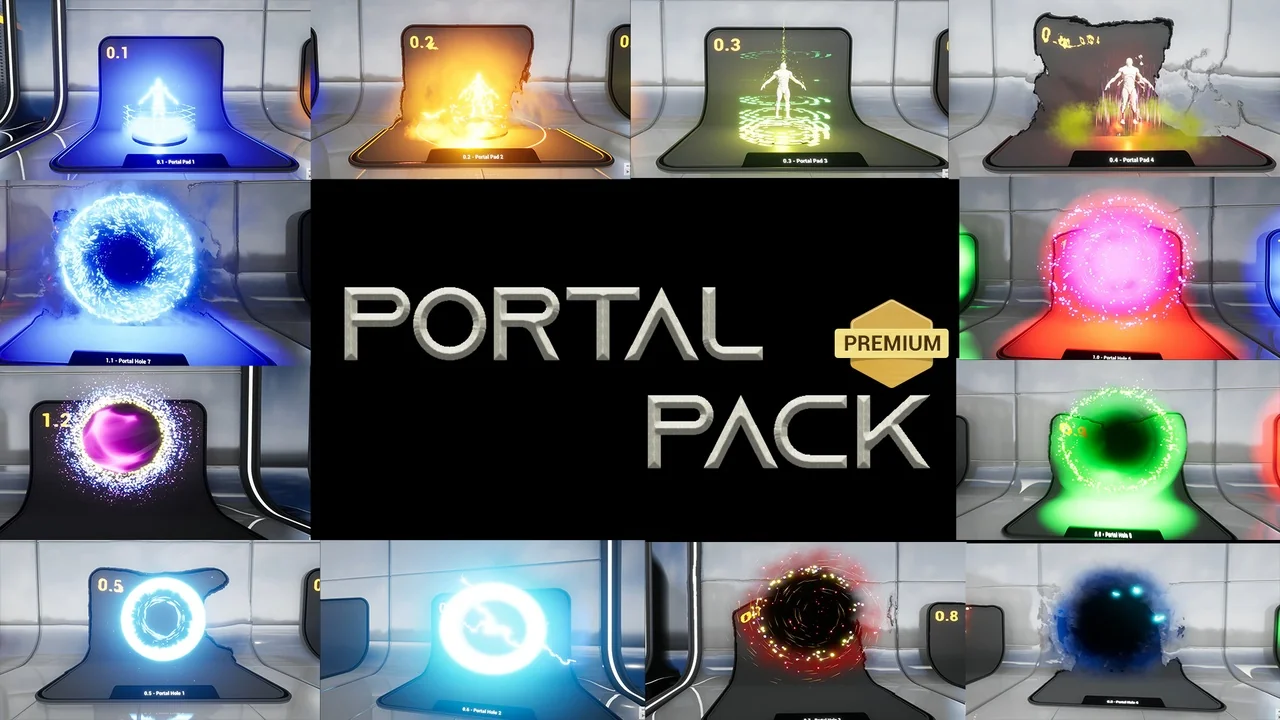
Examine the Portal Pack -Niagara VFX featuring 12 game-ready portal effects, 20 materials, 22 textures, and a demo level for fantasy and realistic scenes.
Category:Unreal Engine,VarietyPlatform: Unreal EngineEngine Version: 4.25+,5.0+Published: Oct 29, 2026
Variety
Resource overview
Niagara VFX Configurations and Spatial Gateways
Transporting players across game environments requires visual cues that establish spatial logic, supernatural power, or advanced scientific displacement. Portal Pack -Niagara VFX focuses squarely on this transition mechanic by providing twelve distinct game-ready portal effects. Each system is authored within the Niagara framework, taking advantage of modern particle simulation pipelines to handle visual energy, swirling vortexes, and directional particle velocity without stalling real-time frame rates.
Because the collection includes twelve separate variations, level designers do not have to rely on a single uniform gateway appearance across an entire game world. A fantasy realm can employ ancient, unstable dimensional tears, while a cleaner, controlled sci-fi environment can integrate structured teleportation hubs. The underlying Niagara particle structures ensure that rotation speeds, particle density, and boundary definitions remain crisp whether the viewer is observing the threshold from afar or moving directly through the center of the aperture.
Material Architecture and Texture Distribution Across Portals and Pads
Particle emissions alone rarely create a convincing portal without solid shader support. This package backs its twelve dynamic effects with a foundation of 20 materials and 22 textures, striking a balance between unique surface responses and shared visual memory. The texture pool provides the mask shapes, noise maps, and energetic gradients required to drive distortion, emissive light channels, and rim falloff within the particle fields.
In addition to vertical vortices, the set incorporates pad elements. Ground pads ground the visual effect in physical architecture, giving the energetic currents a clear point of origin on the floor or terrain. These base surfaces use the included material collection to project light rings, arcane runes, or mechanical docking plates beneath the swirling particle volumes. Having 20 dedicated materials ensures that the thresholds do not look like flat, billboarding sprites; they show depth, refraction, and surface variance across their dynamic planes.
Evaluating Staging in the Example DemoLevel
Reviewing particle interactions inside an isolated viewport often obscures how effects respond to actual level lighting, scale, and background geometry. The pack includes one example DemoLevel specifically to address this issue. Loading the demo map allows developers to view all twelve portal variants in a fully configured scene environment, making it straightforward to check draw distance, light bloom intensity, and relative player scale before migrating assets into an active production branch.
The demo level serves as an immediate reference for optimal placement and orientation. Seeing the portals alongside their corresponding pad setups clarifies how the developer intended the ground elements to anchor the vertical Niagara particle systems. This pre-assembled space also provides an easy testing ground for performance profiling, allowing technical artists to inspect GPU particle overhead, shader complexity passes, and material instancing under realistic camera movement.
Balancing Fantasy Themes with Realistic Level Architecture
Visual style often dictates how an effect must be shaded, and the pack specifically addresses this stylistic breadth by supporting both fantasy and realistic visual aesthetics. A fantasy setting often calls for soft ethereal wisps, drifting embers, and mystical runic patterns. In contrast, a realistic or near-future simulation demands controlled energy fields, tight electromagnetic arcs, and precise boundary confinement.
Because the pack spans both artistic poles, the materials and textures provide room to swing between magical gateways and high-tech teleportation terminals. Level designers building volumetric arenas, sprawling dungeons, or compact arena maps can select variations that match the narrative tone of the surrounding structures without needing to rebuild particle logic from scratch. When paired with volumetric systems or modern pathfinding frameworks—such as LCM 3D Navigation AI for volumetric navigation in Unreal Engine 5—these portals provide reliable waypoints for both player navigation and complex artificial intelligence pathing routines.
Pipeline Placement and Implementation Scope
Integrating environmental VFX into a production schedule is typically a tug-of-war between visual impact and shader performance. With twelve game-ready portals, 20 materials, 22 textures, and an example demo map, this asset collection is suited for titles requiring distinct, ready-to-deploy transit points. The collection eliminates the need to construct multi-layered Niagara emitters and coordinate scrolling UV shaders from empty project files, delivering fully formed spatial anomalies ready for level integration.
 Variety
 Variety
 Variety
 Variety