"efaa631e936fd3ee"{"id":"1002278","slug":"niagara-realistic-starter-vfx-pack","title":"Niagara Realistic Starter VFX Pack","category":"Variety","engine":"4.25+,5.0+","assetVersion":"","engineVersion":"Engine Version: 4.25+,5.0+","tag":"Variety","accent":"blue","visual":"mech","summary":"Examine the Niagara Realistic Starter VFX Pack, featuring 148 particle systems, transform-based scaling, and comprehensive environmental and combat effects.","platform":"Unreal Engine","publishedAt":"2026-10-29T16:36:27.991Z","updatedAt":"2026-10-29T16:36:27.991Z","sourceNotes":[],"fileContents":[],"compatibility":["Unreal Engine","Engine Version: 4.25+,5.0+"],"featuredImage":{"alt":"Niagara Realistic Starter VFX Pack","src":"/wp-content/uploads/published/2026/10/926adaa76d87-2c37688c-2dc0-4683-8cf4-d600fcea15d4-f5feac6fed.webp"},"hasDownloadLink":true,"downloads":0,"terms":[{"taxonomy":"category","slug":"variety-vfx","name":"Variety"}],"galleryImages":[{"src":"/wp-content/uploads/published/2026/10/91b221e024f2-ad09d55d-9605-4de0-ac91-6b8bb43a1b08-69dc49975e.webp","alt":"Niagara Realistic Starter VFX Pack"},{"src":"/wp-content/uploads/published/2026/10/49f9aaefb210-33b56deb-454f-4d57-a012-6dd60eaac75a-b1276472f1.webp","alt":"Niagara Realistic Starter VFX Pack"},{"src":"/wp-content/uploads/published/2026/10/e74c2ed47ca8-fee7a7a8-a67b-4c0f-96b4-b0e7185e2176-689bd227a9.webp","alt":"Niagara Realistic Starter VFX Pack"},{"src":"/wp-content/uploads/published/2026/10/34c5caa48f22-f88f7734-40f7-4688-a82a-832aded3ff67-513542d02d.webp","alt":"Niagara Realistic Starter VFX Pack"},{"src":"/wp-content/uploads/published/2026/10/6a92dda4b8e2-7fa4b3d5-4519-4378-8cb5-0ed4f5c39091-9c6a644186.webp","alt":"Niagara Realistic Starter VFX Pack"},{"src":"/wp-content/uploads/published/2026/10/250a01aa9eb2-6f42b9a3-ac8c-4ccd-ab07-8b4946cfe66f-ad1c5d0d77.webp","alt":"Niagara Realistic Starter VFX Pack"},{"src":"/wp-content/uploads/published/2026/10/74c8a25b90e2-ae387c10-af16-443e-be0c-84032f73e9ee-e622f20322.webp","alt":"Niagara Realistic Starter VFX Pack"},{"src":"/wp-content/uploads/published/2026/10/5e95a50b2cea-c7cc2670-c4ac-42a3-a568-92e31732bc8b-3e793c3e1c.webp","alt":"Niagara Realistic Starter VFX Pack"},{"src":"/wp-content/uploads/published/2026/10/9a79582c97d0-0cfdcf1d-fa3c-46f8-9caa-48898c04c2a6-ec1449e5fe.webp","alt":"Niagara Realistic Starter VFX Pack"},{"src":"/wp-content/uploads/published/2026/10/8e7cb5497781-ff6ed53d-0f5a-472c-a402-d4732cd34ad5-c10fbfffdf.webp","alt":"Niagara Realistic Starter VFX Pack"}],"accessPanel":{"kind":"resource","title":"Download this resource","eyebrow":"Free Download","message":"Log in or create a free account to start your download.","fileName":"Content.7z","safetyNote":"Resources are manually reviewed before listing to improve quality and reduce obvious risks.","actionLabel":"Download Free","resourceType":"Resource archive"},"contentHtml":"\u003ch2\u003eEstablishing Scene Feedback in Early Production\u003c/h2\u003e\u003cp\u003eDropping particle emitters into an unlit blockout level immediately changes how collision, movement, and timing feel during gameplay testing. When a projectile strikes a test mesh, a clean impact burst tells the player whether the trace registered long before custom audio or bespoke animation passes exist. The Niagara Realistic Starter VFX Pack addresses this phase of development by assembling 148 unique effects into a single baseline resource intended to streamline early production setups and rapid mechanical prototyping.\u003c/p\u003e\u003cp\u003eThe collection brings together newly developed particles alongside elements from two previous releases—Realistic Starter VFX Pack and Realistic Starter VFX Pack v2—completely rebuilt for the Niagara System. Transitioning these systems from legacy Cascade setups into Niagara standardizes the emitter logic across the entire library. Instead of managing deprecated particle formats alongside newer visual scripts, developers work within a unified Niagara framework that integrates cleanly into modern Unreal project hierarchies.\u003c/p\u003e\u003ch2\u003eCombustion, Impact, and Combat Particle Types\u003c/h2\u003e\u003cp\u003eThe combat-oriented simulations in the collection span direct weapon events and broad destructive hazards. Basic ballistic interactions include dedicated muzzle flash sprites, gunfire shoot effects, spark bursts, and projectile impacts designed to trigger against world surfaces. These small-scale interactions give weapon firing cycles appropriate frame-by-frame visual markers, helping developers synchronize fire rates, hitscan checks, and recoil timing.\u003c/p\u003e\u003cp\u003eFor heavier tactical interactions and explosive damage radius verification, the library includes broader fire and blast presets:\u003c/p\u003e\u003cul\u003e\u003cli\u003e\u003cstrong\u003eExplosion and Grenade Detonations:\u003c/strong\u003e Rapid shockwave expansions paired with smoke trails and flying debris to delineate instant blast radiuses.\u003c/li\u003e\u003cli\u003e\u003cstrong\u003eMolotov and Flamethrower Streams:\u003c/strong\u003e Sustained burning volumes that leave lingering flame patches, useful for testing area-denial gameplay mechanics.\u003c/li\u003e\u003cli\u003e\u003cstrong\u003eDestruction and Flying Sparks:\u003c/strong\u003e Structural breakup cues that communicate damage states on hit surfaces or prop meshes.\u003c/li\u003e\u003cli\u003e\u003cstrong\u003eFlesh and Liquid Ballistics:\u003c/strong\u003e Blood splatter simulations to mark direct character hits and damage thresholds.\u003c/li\u003e\u003cli\u003e\u003cstrong\u003eHazardous Liquids:\u003c/strong\u003e Caustic acid pools and molten lava emitters suited for environmental traps or fantasy combat zones.\u003c/li\u003e\u003c/ul\u003e\u003cp\u003eBy offering distinct profiles for high-velocity sparks, directional flame projection, and expanding spherical detonations, the pack allows different damage archetypes to remain visually distinct during chaotic playtests.\u003c/p\u003e\u003ch2\u003eAtmospheric Simulation and Ambient Environmental Systems\u003c/h2\u003e\u003cp\u003eBeyond offensive combat feedback, the library covers passive atmosphere and world-building effects. Emitter sets representing natural weather patterns allow developers to test lighting conditions, volumetric fog interactions, and sightline visibility across varying outdoor environments. Atmospheric presets include rainfall grids, falling snow, drifting dust motes, rising chimney smoke, and steam vents escaping from simulated pipes or ground fissures.\u003c/p\u003e\u003cp\u003eHigh-energy weather events are also represented. Turbulent tornado funnels provide massive rotational force visualizers, while erratic lightning strikes deliver fast-decay, high-intensity illumination spikes across a level. For aquatic settings, the pack moves past simple surface planes, supplying moving water streams, waterfall volumes, floating bubbles, and even ambient schooling fish particles. These elements turn flat fluid geometry into readable, active zones without requiring teams to write custom fluid shaders or skeletal fish rigs during early design sprints.\u003c/p\u003e\u003cp\u003eElectrical hazards round out the non-combat environmental tools. Sparking circuits and erratic electric arcs can be snapped to industrial geometry, doorway frames, or disabled machinery to communicate live wiring and environmental hazards during traversal sequences.\u003c/p\u003e\u003ch2\u003eThe Easy Scale System and Local Emitter Management\u003c/h2\u003e\u003cp\u003eOne structural challenge when adapting visual effects across diverse projects is mesh proportion. An explosion scaled for a tabletop miniature game breaks immersion if dragged into a wide-open terrain map without parameter adjustments. The pack addresses this through an integrated Easy Scale System applied directly across the particle assets.\u003c/p\u003e\u003cp\u003eUnder this system, scaling an effect does not require modifying individual velocity, size-over-life, or collision modules within the Niagara editor stack. Instead, developers can adjust the scale attributes directly from the Transform menu in the viewport or level hierarchy. The simulation parameters read the parent transform data and propagate proportional values down into the emitter chains.\u003c/p\u003e\u003cp\u003eIn specific configurations where external forces drive particle paths—such as turbulent wind, gravity wells, or localized drag—the emitter may require turning on the Local Emitter toggle. Activating local space calculation ensures that applied forces calculate relative to the emitter origin rather than world space coordinates, preserving the intended motion curves and particle density regardless of the asset’s placement angle or scale factor.\u003c/p\u003e\u003ch2\u003eAsset Footprint and Technical Organization\u003c/h2\u003e\u003cp\u003eTo support its 148 unique effects, the library is constructed on an underlying base of 97 materials and 93 textures. This shared asset foundation keeps memory consumption structured, as multiple effects draw from standardized sprite atlases, noise textures, and distortion maps rather than introducing isolated, single-use materials for every emitter variant.\u003c/p\u003e\u003cp\u003eThe package also incorporates 12 unique meshes to handle shaped emissions, debris chunks, and procedural collision targets, alongside 1 central Blueprint configured to demonstrate or execute system behaviors. This controlled asset footprint allows the pack to function as a compact, drop-in utility library across prototyping greyboxes or broader production stages.\u003c/p\u003e\u003ch2\u003eRelationship to Wider Simulation Libraries\u003c/h2\u003e\u003cp\u003eThe Niagara Realistic Starter VFX Pack sits at the core of a broader continuum of specialized simulation releases. While this specific mega pack standardizes fundamental realistic elements into the Niagara architecture, specialized needs can branch outward into adjacent thematic tools. Related libraries in this lineage include dedicated releases such as the Water Starter VFX Pack, Blood Starter VFX Pack, Destructible Props, and the multi-part All Explosion Pack volumes (Vol 1, Vol 2, and Vol 3).\u003c/p\u003e\u003cp\u003eProjects targeting specialized settings can similarly bridge these realistic baseline particles with dedicated vehicle catastrophe packs like Rocket VFX and Plane Crash VFX, or shift stylistic directions toward futuristic projects through the Niagara Sci-Fi Starter VFX Pack. For teams working strictly with grounded modern or historical aesthetics, Niagara Realistic Starter VFX Pack 2 provides direct expansion room.\u003c/p\u003e\u003cp\u003eBy unifying 148 standard environmental, combat, and fluid simulations into the Niagara System with direct Transform menu scaling, the pack provides a dependable visual baseline that clarifies early gameplay development long before final art passes begin.\u003c/p\u003e\n\n\u003ch2\u003eExplore Similar Assets\u003c/h2\u003e\n\u003cul\u003e\n\u003cli\u003e\u003ca href=\"https://3dcghub.com/vfx-impacts/\" title=\"VFX Impacts\"\u003eVFX Impacts\u003c/a\u003e\u003c/li\u003e\n\u003cli\u003e\u003ca href=\"https://3dcghub.com/rock-fall-niagara-with-sound/\" title=\"Rock Fall Niagara with Sound\"\u003eRock Fall Niagara with Sound\u003c/a\u003e\u003c/li\u003e\n\u003cli\u003e\u003ca href=\"https://3dcghub.com/portal-pack-niagara-vfx/\" title=\"Portal Pack -Niagara VFX\"\u003ePortal Pack -Niagara VFX\u003c/a\u003e\u003c/li\u003e\n\u003cli\u003e\u003ca href=\"https://3dcghub.com/vfx-attack-trails/\" title=\"VFX Attack Trails\"\u003eVFX Attack Trails\u003c/a\u003e\u003c/li\u003e\n\u003cli\u003e\u003ca href=\"https://3dcghub.com/butterfly-particles/\" title=\"Butterfly Particles\"\u003eButterfly Particles\u003c/a\u003e\u003c/li\u003e\n\u003c/ul\u003e","contentTextLength":7300,"navigation":{"current":7,"total":4209,"previous":{"id":"1002279","slug":"samurai","title":"SAMURAI","category":"Characters \u0026 Creatures","platform":"Unreal Engine","updatedAt":"2026-10-29T16:37:21.426Z"},"next":{"id":"1002277","slug":"nanite-sand-dunes","title":"NANITE SAND DUNES","category":"Desert","platform":"Unreal Engine","updatedAt":"2026-10-29T16:34:25.435Z"}},"relatedResources":[{"id":"1002283","slug":"stylized-vfx-minipack","title":"Stylized Vfx Minipack","category":"Variety","engine":"4.26+,5.0+","assetVersion":"","engineVersion":"Engine Version: 4.26+,5.0+","tag":"Variety","accent":"blue","visual":"mech","summary":"A close look at the Stylized Vfx Minipack, detailing its 25 Niagara systems, pickup effects, burst states, hit impacts, and torch Blueprints.","platform":"Unreal Engine","publishedAt":"2026-10-29T17:02:34.482Z","updatedAt":"2026-10-29T17:02:34.482Z","sourceNotes":[],"fileContents":[],"compatibility":["Unreal Engine","Engine Version: 4.26+,5.0+"],"featuredImage":{"alt":"Stylized Vfx Minipack","src":"/wp-content/uploads/published/2026/10/cdc6833df901-6ea2efd6-0434-49a6-b72f-3df5190b595a-062781cfcc.webp"},"hasDownloadLink":true,"downloads":0},{"id":"1002258","slug":"vfx-impacts","title":"VFX Impacts","category":"Variety","engine":"4.26+,5.0+","assetVersion":"","engineVersion":"Engine Version: 4.26+,5.0+","tag":"Variety","accent":"blue","visual":"mech","summary":"VFX Impacts delivers 18 surface impact effects with large and small variations, physical material controls, Niagara updates, muzzle flash, and bullet tracers.","platform":"Unreal Engine","publishedAt":"2026-10-29T16:17:47.297Z","updatedAt":"2026-10-29T16:17:47.297Z","sourceNotes":[],"fileContents":[],"compatibility":["Unreal Engine","Engine Version: 4.26+,5.0+"],"featuredImage":{"alt":"VFX Impacts","src":"/wp-content/uploads/published/2026/10/02c0c5ed4c4a-b83babab-98dc-4341-9b51-5002afcc482a-1b70a67735.webp"},"hasDownloadLink":true,"downloads":0},{"id":"1002176","slug":"rock-fall-niagara-with-sound","title":"Rock Fall Niagara with Sound","category":"Variety","engine":"4.27,5.0+","assetVersion":"","engineVersion":"Engine Version: 4.27,5.0+","tag":"Variety","accent":"blue","visual":"mech","summary":"Create dynamic rock falls, collapsing bricks, and smoke with Rock Fall Niagara with Sound, featuring nine Blueprints and editable 3D audio locations.","platform":"Unreal Engine","publishedAt":"2026-10-29T13:47:24.372Z","updatedAt":"2026-10-29T13:47:24.372Z","sourceNotes":[],"fileContents":[],"compatibility":["Unreal Engine","Engine Version: 4.27,5.0+"],"featuredImage":{"alt":"Rock Fall Niagara with Sound","src":"/wp-content/uploads/published/2026/10/3e9066e67b43-6aca240a-1c6e-4f03-8d0e-9b596ff11850-3b01658ba4.webp"},"hasDownloadLink":true,"downloads":0}]}
Variety
Niagara Realistic Starter VFX Pack
Examine the Niagara Realistic Starter VFX Pack, featuring 148 particle systems, transform-based scaling, and comprehensive environmental and combat effects.
Category:Unreal Engine,VarietyPlatform: Unreal EngineEngine Version: 4.25+,5.0+Published: Oct 29, 2026
Variety
Resource overview
Establishing Scene Feedback in Early Production
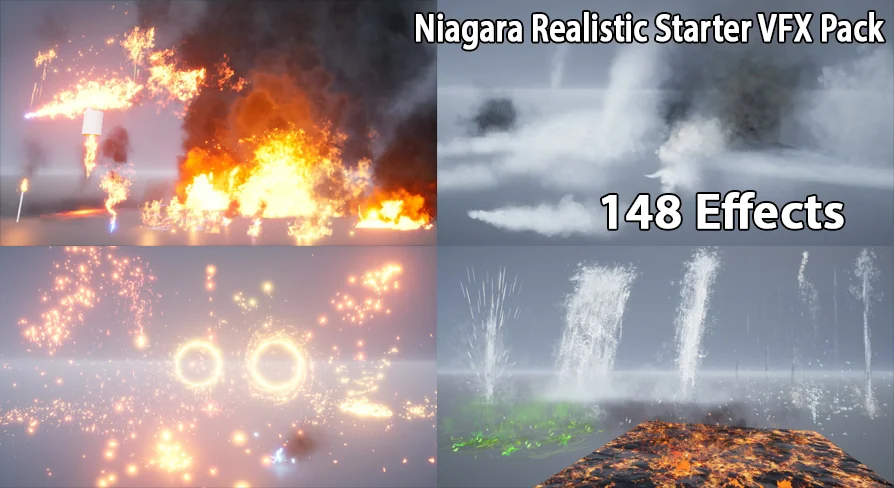
Dropping particle emitters into an unlit blockout level immediately changes how collision, movement, and timing feel during gameplay testing. When a projectile strikes a test mesh, a clean impact burst tells the player whether the trace registered long before custom audio or bespoke animation passes exist. The Niagara Realistic Starter VFX Pack addresses this phase of development by assembling 148 unique effects into a single baseline resource intended to streamline early production setups and rapid mechanical prototyping.
The collection brings together newly developed particles alongside elements from two previous releases—Realistic Starter VFX Pack and Realistic Starter VFX Pack v2—completely rebuilt for the Niagara System. Transitioning these systems from legacy Cascade setups into Niagara standardizes the emitter logic across the entire library. Instead of managing deprecated particle formats alongside newer visual scripts, developers work within a unified Niagara framework that integrates cleanly into modern Unreal project hierarchies.
Combustion, Impact, and Combat Particle Types
The combat-oriented simulations in the collection span direct weapon events and broad destructive hazards. Basic ballistic interactions include dedicated muzzle flash sprites, gunfire shoot effects, spark bursts, and projectile impacts designed to trigger against world surfaces. These small-scale interactions give weapon firing cycles appropriate frame-by-frame visual markers, helping developers synchronize fire rates, hitscan checks, and recoil timing.
For heavier tactical interactions and explosive damage radius verification, the library includes broader fire and blast presets:
Explosion and Grenade Detonations: Rapid shockwave expansions paired with smoke trails and flying debris to delineate instant blast radiuses.
Molotov and Flamethrower Streams: Sustained burning volumes that leave lingering flame patches, useful for testing area-denial gameplay mechanics.
Destruction and Flying Sparks: Structural breakup cues that communicate damage states on hit surfaces or prop meshes.
Flesh and Liquid Ballistics: Blood splatter simulations to mark direct character hits and damage thresholds.
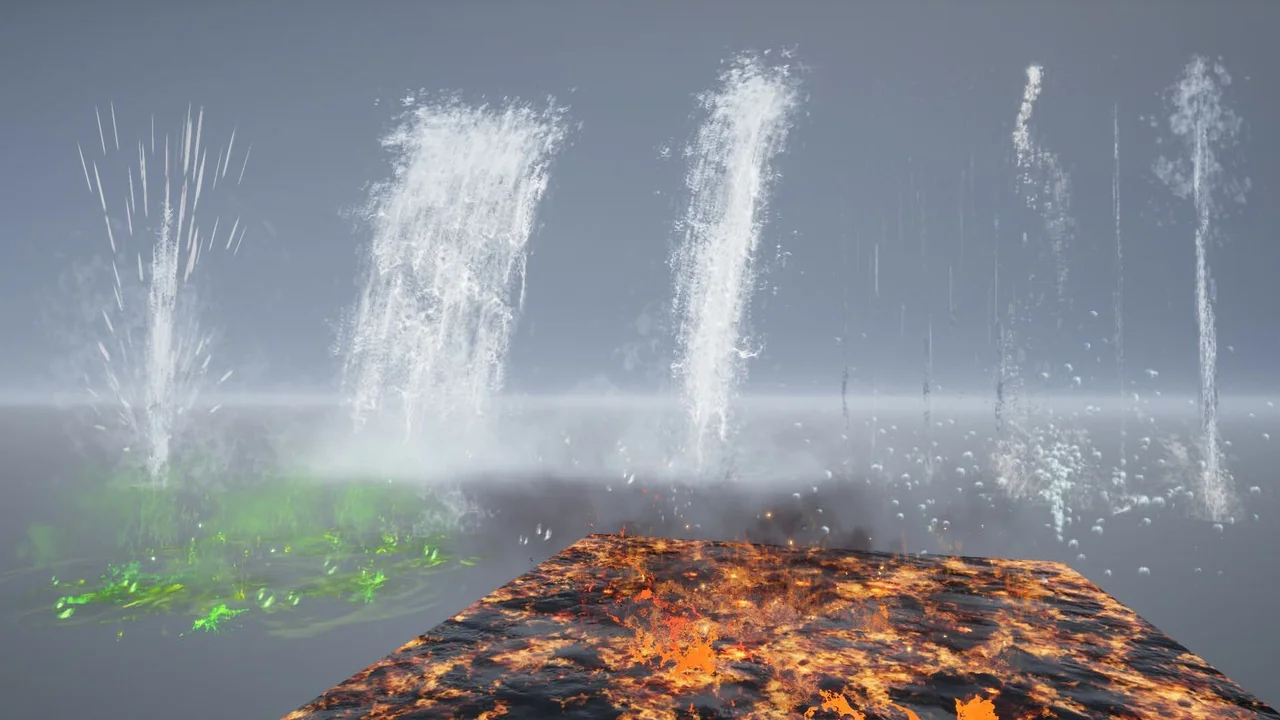
Hazardous Liquids: Caustic acid pools and molten lava emitters suited for environmental traps or fantasy combat zones.
By offering distinct profiles for high-velocity sparks, directional flame projection, and expanding spherical detonations, the pack allows different damage archetypes to remain visually distinct during chaotic playtests.
Atmospheric Simulation and Ambient Environmental Systems
Beyond offensive combat feedback, the library covers passive atmosphere and world-building effects. Emitter sets representing natural weather patterns allow developers to test lighting conditions, volumetric fog interactions, and sightline visibility across varying outdoor environments. Atmospheric presets include rainfall grids, falling snow, drifting dust motes, rising chimney smoke, and steam vents escaping from simulated pipes or ground fissures.
High-energy weather events are also represented. Turbulent tornado funnels provide massive rotational force visualizers, while erratic lightning strikes deliver fast-decay, high-intensity illumination spikes across a level. For aquatic settings, the pack moves past simple surface planes, supplying moving water streams, waterfall volumes, floating bubbles, and even ambient schooling fish particles. These elements turn flat fluid geometry into readable, active zones without requiring teams to write custom fluid shaders or skeletal fish rigs during early design sprints.
Electrical hazards round out the non-combat environmental tools. Sparking circuits and erratic electric arcs can be snapped to industrial geometry, doorway frames, or disabled machinery to communicate live wiring and environmental hazards during traversal sequences.
The Easy Scale System and Local Emitter Management
One structural challenge when adapting visual effects across diverse projects is mesh proportion. An explosion scaled for a tabletop miniature game breaks immersion if dragged into a wide-open terrain map without parameter adjustments. The pack addresses this through an integrated Easy Scale System applied directly across the particle assets.
Under this system, scaling an effect does not require modifying individual velocity, size-over-life, or collision modules within the Niagara editor stack. Instead, developers can adjust the scale attributes directly from the Transform menu in the viewport or level hierarchy. The simulation parameters read the parent transform data and propagate proportional values down into the emitter chains.
In specific configurations where external forces drive particle paths—such as turbulent wind, gravity wells, or localized drag—the emitter may require turning on the Local Emitter toggle. Activating local space calculation ensures that applied forces calculate relative to the emitter origin rather than world space coordinates, preserving the intended motion curves and particle density regardless of the asset’s placement angle or scale factor.
Asset Footprint and Technical Organization
To support its 148 unique effects, the library is constructed on an underlying base of 97 materials and 93 textures. This shared asset foundation keeps memory consumption structured, as multiple effects draw from standardized sprite atlases, noise textures, and distortion maps rather than introducing isolated, single-use materials for every emitter variant.
The package also incorporates 12 unique meshes to handle shaped emissions, debris chunks, and procedural collision targets, alongside 1 central Blueprint configured to demonstrate or execute system behaviors. This controlled asset footprint allows the pack to function as a compact, drop-in utility library across prototyping greyboxes or broader production stages.
Relationship to Wider Simulation Libraries
The Niagara Realistic Starter VFX Pack sits at the core of a broader continuum of specialized simulation releases. While this specific mega pack standardizes fundamental realistic elements into the Niagara architecture, specialized needs can branch outward into adjacent thematic tools. Related libraries in this lineage include dedicated releases such as the Water Starter VFX Pack, Blood Starter VFX Pack, Destructible Props, and the multi-part All Explosion Pack volumes (Vol 1, Vol 2, and Vol 3).
Projects targeting specialized settings can similarly bridge these realistic baseline particles with dedicated vehicle catastrophe packs like Rocket VFX and Plane Crash VFX, or shift stylistic directions toward futuristic projects through the Niagara Sci-Fi Starter VFX Pack. For teams working strictly with grounded modern or historical aesthetics, Niagara Realistic Starter VFX Pack 2 provides direct expansion room.
By unifying 148 standard environmental, combat, and fluid simulations into the Niagara System with direct Transform menu scaling, the pack provides a dependable visual baseline that clarifies early gameplay development long before final art passes begin.
 Variety
 Variety
 Variety
 Variety