"efaa631e936fd3ee"{"id":"1002176","slug":"rock-fall-niagara-with-sound","title":"Rock Fall Niagara with Sound","category":"Variety","engine":"4.27,5.0+","assetVersion":"","engineVersion":"Engine Version: 4.27,5.0+","tag":"Variety","accent":"blue","visual":"mech","summary":"Create dynamic rock falls, collapsing bricks, and smoke with Rock Fall Niagara with Sound, featuring nine Blueprints and editable 3D audio locations.","platform":"Unreal Engine","publishedAt":"2026-10-29T13:47:24.372Z","updatedAt":"2026-10-29T13:47:24.372Z","sourceNotes":[],"fileContents":[],"compatibility":["Unreal Engine","Engine Version: 4.27,5.0+"],"featuredImage":{"alt":"Rock Fall Niagara with Sound","src":"/wp-content/uploads/published/2026/10/3e9066e67b43-6aca240a-1c6e-4f03-8d0e-9b596ff11850-3b01658ba4.webp"},"hasDownloadLink":true,"downloads":0,"terms":[{"taxonomy":"category","slug":"variety-vfx","name":"Variety"}],"galleryImages":[{"src":"/wp-content/uploads/published/2026/10/a649f058b6a4-268e7a9f-23e2-423b-bdc3-29f5263f5ff4-29b38163b5.webp","alt":"Rock Fall Niagara with Sound"},{"src":"/wp-content/uploads/published/2026/10/613262545b1e-977b861d-c595-4cb1-b455-d201c1d1d2e7-a8de06d576.webp","alt":"Rock Fall Niagara with Sound"},{"src":"/wp-content/uploads/published/2026/10/38e4b789a76b-e75dfd1e-d5f6-4d5c-9662-fa96b6f519a5-c18e7a0f05.webp","alt":"Rock Fall Niagara with Sound"},{"src":"/wp-content/uploads/published/2026/10/b6b0682aac24-571345e6-ad3e-4c4a-8714-6080c4826347-8dd2503ebf.webp","alt":"Rock Fall Niagara with Sound"},{"src":"/wp-content/uploads/published/2026/10/8549c1d2b281-f63ad86a-e6af-4b10-9e2e-269cb12b3f78-ed82c819e0.webp","alt":"Rock Fall Niagara with Sound"},{"src":"/wp-content/uploads/published/2026/10/813ad8f77cc5-ee8bae7d-3867-4521-9e0b-3dd6d0bd1c2d-7268f03f09.webp","alt":"Rock Fall Niagara with Sound"},{"src":"/wp-content/uploads/published/2026/10/b9c8acd2dde8-a2f3b7e2-95db-4459-9fd4-0a0765381e70-8f2721379f.webp","alt":"Rock Fall Niagara with Sound"},{"src":"/wp-content/uploads/published/2026/10/d0c875ab77c6-28bb9043-c0e7-4996-94fc-ab8ae1549def-7414b08ed6.webp","alt":"Rock Fall Niagara with Sound"},{"src":"/wp-content/uploads/published/2026/10/5c5e152313ce-3a0a82f3-b6c1-4a0d-a46c-19f92c468836-323f0a969a.webp","alt":"Rock Fall Niagara with Sound"},{"src":"/wp-content/uploads/published/2026/10/095322ac68ec-e9595f28-6b63-4e15-b56b-fbe229507436-c4791038c7.webp","alt":"Rock Fall Niagara with Sound"}],"accessPanel":{"kind":"resource","title":"Download this resource","eyebrow":"Free Download","message":"Log in or create a free account to start your download.","fileName":"Rock Fall Niagara with Sound.7z","safetyNote":"Resources are manually reviewed before listing to improve quality and reduce obvious risks.","actionLabel":"Download Free","resourceType":"Resource archive"},"contentHtml":"\u003cp\u003eSubterranean tunnels, weathered cliff faces, and fractured stone ruins rely heavily on sudden environmental shifts to convey danger and age. When a ceiling buckles or a precipice breaks away, the event demands more than a simple particle spray; it requires mass, tumbling weight, trailing dust, and immediate acoustic response. Rock Fall Niagara with Sound addresses these demanding scene conditions by delivering an integrated setup where particle simulation and spatialized audio function as a unified hazard system.\u003c/p\u003e \u003ch2\u003eSetting Up Environmental Collapse in Dynamic Spaces\u003c/h2\u003e\n\u003cp\u003eCrumbling architecture and natural rockslides often pose a challenge in level design because static meshes cannot convey impending structural failure. In high-tension sequences—such as an underground cavern undergoing an earthquake, an ancient tomb triggering an escape sequence, or an industrial brick facade disintegrating under artillery fire—visuals must communicate physical volume. This package provides both natural stone elements and man-made brick variants, allowing designers to stage collapses in pristine geological settings as well as crumbling architectural ruins.\u003c/p\u003e\n\u003cp\u003eBecause the visual presentation incorporates dense debris alongside tumbling primary objects, an individual trigger can represent either a sudden minor tremor or a devastating structural failure. The presence of stone and brick options makes it straightforward to adapt the effect to different scene typologies without rebuilding the foundational particle behavior from scratch.\u003c/p\u003e \u003ch2\u003eLayering Niagara Rocks Effects and Smoke Groups\u003c/h2\u003e\n\u003cp\u003eA convincing rock fall relies on distinct visual stages: the initial break, the tumbling descent of larger masses, the scattering of smaller fragments, and the lingering atmosphere stirred up by the impact. To capture this complexity, the system allows creators to customize six groups of Niagara rocks effects alongside six groups of Niagara smoke effects simultaneously.\u003c/p\u003e\n\u003cp\u003eSplitting the simulation into six discrete rock groups makes it possible to calibrate variety across the falling debris. Large, heavy chunks can be given distinct behaviors while mid-sized rubble and fine gravel disperse across wider trajectories. Working in parallel with these stone layers, the six groups of smoke and dust effects introduce air displacement and impact plumes. As falling stones hit the ground or collide along vertical surfaces, the corresponding dust groups billow outward, occluding the player's vision and reinforcing the perceived weight of the falling objects.\u003c/p\u003e\n\u003cp\u003eManaging both rocks and smoke across twelve total visual groups ensures that dense collapses do not look like uniform, repeating particle loops. Instead, developers can balance heavy foreground impacts with subtler background dust layers to match the scale of the environment.\u003c/p\u003e \u003ch2\u003eSpatial Immersion Through Editable 3D Sound Locations\u003c/h2\u003e\n\u003cp\u003eAudio is vital when simulating massive stone movements, particularly when debris falls from locations outside the player’s immediate field of view. A rumble overhead should build anticipation before any visual geometry enters the camera frame, and ground impacts must register distinctly in the audio mix where the debris actually lands. Rock Fall Niagara with Sound incorporates an editable 3D sound location effect specifically to address directional audio realism.\u003c/p\u003e\n\u003cp\u003eThe system lets users position up to six sound spawn locations per effect directly within the game space. Rather than forcing all acoustic feedback through a single root transform, audio events can be distributed along the path of the collapse. One 3D sound location can be placed high up on a cavern ceiling to trigger initial snaps and grinding friction, intermediate points can play secondary tumbling cues along a rock face, and lower points can fire bass-heavy impact sounds as boulders slam into the floor.\u003c/p\u003e\n\u003cp\u003eConfiguring up to six sound locations per instance dramatically enhances player immersion. The directional cues allow players to track the origin and trajectory of the hazard through positional audio alone, making sudden cave-ins and falling architectural masonry feel physically present within the environment.\u003c/p\u003e \u003ch2\u003eDeploying the Effect Through Nine Blueprints\u003c/h2\u003e\n\u003cp\u003eImplementing multi-component VFX systems across large maps can quickly become tedious if particle systems, collisions, and audio cues must be wired together manually for every encounter. To streamline this workflow, the falling rock effect is managed through nine provided Blueprints.\u003c/p\u003e\n\u003cp\u003eThese Blueprints serve as complete, self-contained functional units. Placing the falling rock effect simply requires selecting one of the nine setups and adjusting the parameters to suit the scene. Within a chosen Blueprint, developers can adjust the six Niagara rock groups, the six Niagara smoke groups, and the six sound groups concurrently. This unified approach eliminates the need to cross-reference disconnected audio cues and particle emitters across disparate project folders.\u003c/p\u003e\n\u003cp\u003eWhether an encounter requires a narrow vertical drop down a maintenance shaft or an expansive rockslide spilling down a mountain path, selecting and configuring one of the Blueprints centralizes the entire setup. The consolidated interface allows for rapid iteration during level blockout and technical art dressing phases.\u003c/p\u003e \u003ch2\u003ePractical Fit Across Production Roles\u003c/h2\u003e\n\u003cp\u003eEnvironment artists, technical designers, and gameplay programmers all benefit from an integrated hazard asset that handles visual debris and audio triggers in tandem. Environment artists gain the visual flexibility of interchanging rock, stone, and brick materials with matching dust plumes that ground the effect naturally into level geometry. Gameplay programmers and level designers obtain modular hazard volumes that deploy rapidly via Blueprints without requiring custom scripting for audio-visual synchronization.\u003c/p\u003e\n\u003cp\u003eBecause the package cleanly couples six rock layers, six dust layers, and six spatial audio emitters into dedicated Blueprint containers, it serves teams aiming to add impactful, physically grounded environmental events without incurring the development overhead of authoring complex Niagara and audio relationships by hand.\u003c/p\u003e\n\n\u003ch2\u003eExplore Similar Assets\u003c/h2\u003e\n\u003cul\u003e\n\u003cli\u003e\u003ca href=\"https://3dcghub.com/attack-animals-vfx/\" title=\"Attack Animals VFX\"\u003eAttack Animals VFX\u003c/a\u003e\u003c/li\u003e\n\u003cli\u003e\u003ca href=\"https://3dcghub.com/comic-sound-effect-fx/\" title=\"Comic Sound Effect FX\"\u003eComic Sound Effect FX\u003c/a\u003e\u003c/li\u003e\n\u003cli\u003e\u003ca href=\"https://3dcghub.com/fireworks-with-sounds/\" title=\"Fireworks With Sounds\"\u003eFireworks With Sounds\u003c/a\u003e\u003c/li\u003e\n\u003cli\u003e\u003ca href=\"https://3dcghub.com/portal-pack-niagara-vfx/\" title=\"Portal Pack -Niagara VFX\"\u003ePortal Pack -Niagara VFX\u003c/a\u003e\u003c/li\u003e\n\u003cli\u003e\u003ca href=\"https://3dcghub.com/character-body-fx-vol-3/\" title=\"Character Body FX Vol. 3\"\u003eCharacter Body FX Vol. 3\u003c/a\u003e\u003c/li\u003e\n\u003c/ul\u003e","contentTextLength":6319,"navigation":{"current":109,"total":4209,"previous":{"id":"1002177","slug":"rog-creatures-mammoth","title":"ROG Creatures: Mammoth","category":"Animals","platform":"Unreal Engine","updatedAt":"2026-10-29T14:18:52.336Z"},"next":{"id":"1002175","slug":"rapier-anim-set-2","title":"Rapier Anim Set","category":"Combat","platform":"Unreal Engine","updatedAt":"2026-10-29T12:03:40.588Z"}},"relatedResources":[{"id":"1001047","slug":"attack-animals-vfx","title":"Attack Animals VFX","category":"Variety","engine":"4.27,5.0+","assetVersion":"","engineVersion":"Engine Version: 4.27,5.0+","tag":"Variety","accent":"blue","visual":"mech","summary":"Game-ready low poly attack animal VFX pack with 10 creatures, vertex animation, player attack blueprints, Niagara particles, materials, textures, and sound for","platform":"Unreal Engine","publishedAt":"2026-08-27T15:30:48.707Z","updatedAt":"2026-08-27T15:30:48.707Z","sourceNotes":[],"fileContents":[],"compatibility":["Unreal Engine","Engine Version: 4.27,5.0+"],"featuredImage":{"alt":"Attack Animals VFX","src":"/wp-content/uploads/published/2026/08/6850d22e9255-d195760b-5936-47e2-9cd6-1669125d2f34-19a7ef6a7a.webp"},"hasDownloadLink":true,"downloads":3},{"id":"1000576","slug":"comic-sound-effect-fx","title":"Comic Sound Effect FX","category":"Variety","engine":"4.27,5.0+","assetVersion":"","engineVersion":"Engine Version: 4.27,5.0+","tag":"Variety","accent":"blue","visual":"mech","summary":"Comic Sound Effect FX is a stylized Niagara particle system for Unreal Engine that cycles through flipbooks of 4 to 9 images for comic, emoji, and speech visual","platform":"Unreal Engine","publishedAt":"2026-07-16T23:07:30.522Z","updatedAt":"2026-07-16T23:07:30.522Z","sourceNotes":[],"fileContents":[],"compatibility":["Audio","Engine Version: 4.27,5.0+"],"featuredImage":{"alt":"Comic Sound Effect FX","src":"/wp-content/uploads/published/2026/07/b4623734105d-b517b0bd-41fa-4d2d-bef8-32deaa61fc1d-df6bc6975a.webp"},"hasDownloadLink":true,"downloads":2},{"id":"17119","slug":"fireworks-with-sounds","title":"Fireworks With Sounds","category":"Variety","engine":"5.0+","assetVersion":"Engine version: 5.0+","engineVersion":"4.27","tag":"Variety","accent":"blue","visual":"animation","summary":"Enhance your projects with Fireworks With Sounds, a versatile asset pack featuring multiple firework types and integrated audio. This resource includes customizable textures and realistic smoke effects for immersive displays.","platform":"Unreal Engine","publishedAt":"2026-03-13T13:42:14.000Z","updatedAt":"2026-04-19T15:43:37.000Z","sourceNotes":[],"fileContents":[],"compatibility":["Unreal Engine","Engine version: 5.0+"],"featuredImage":{"alt":"Fireworks With Sounds","src":"https://3dcghub.com/wp-content/uploads/2026/03/f7b56aff-163e-4013-9d33-8dcf50648082.webp"},"hasDownloadLink":true,"downloads":0}]}
Variety
Rock Fall Niagara with Sound
Create dynamic rock falls, collapsing bricks, and smoke with Rock Fall Niagara with Sound, featuring nine Blueprints and editable 3D audio locations.
Category:Unreal Engine,VarietyPlatform: Unreal EngineEngine Version: 4.27,5.0+Published: Oct 29, 2026
Variety
Resource overview
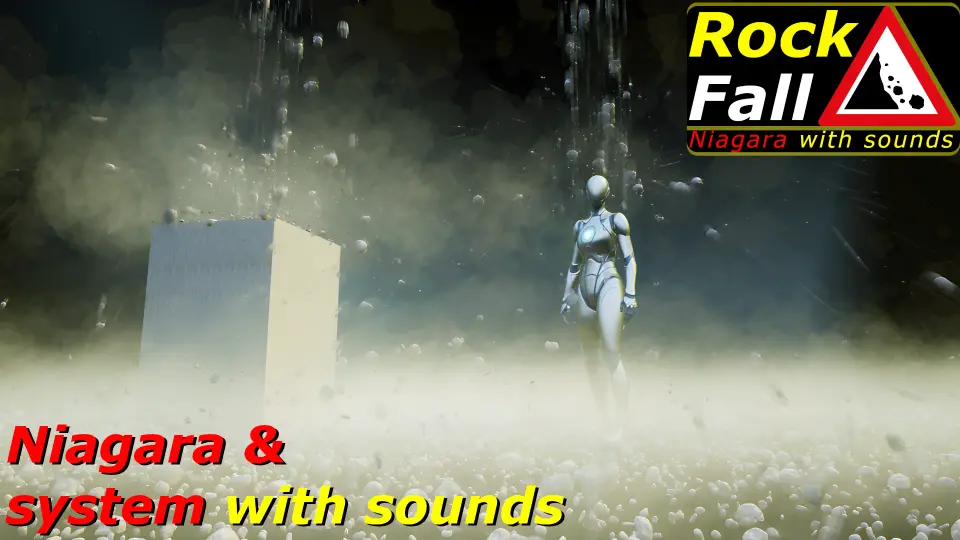
Subterranean tunnels, weathered cliff faces, and fractured stone ruins rely heavily on sudden environmental shifts to convey danger and age. When a ceiling buckles or a precipice breaks away, the event demands more than a simple particle spray; it requires mass, tumbling weight, trailing dust, and immediate acoustic response. Rock Fall Niagara with Sound addresses these demanding scene conditions by delivering an integrated setup where particle simulation and spatialized audio function as a unified hazard system.
Setting Up Environmental Collapse in Dynamic Spaces
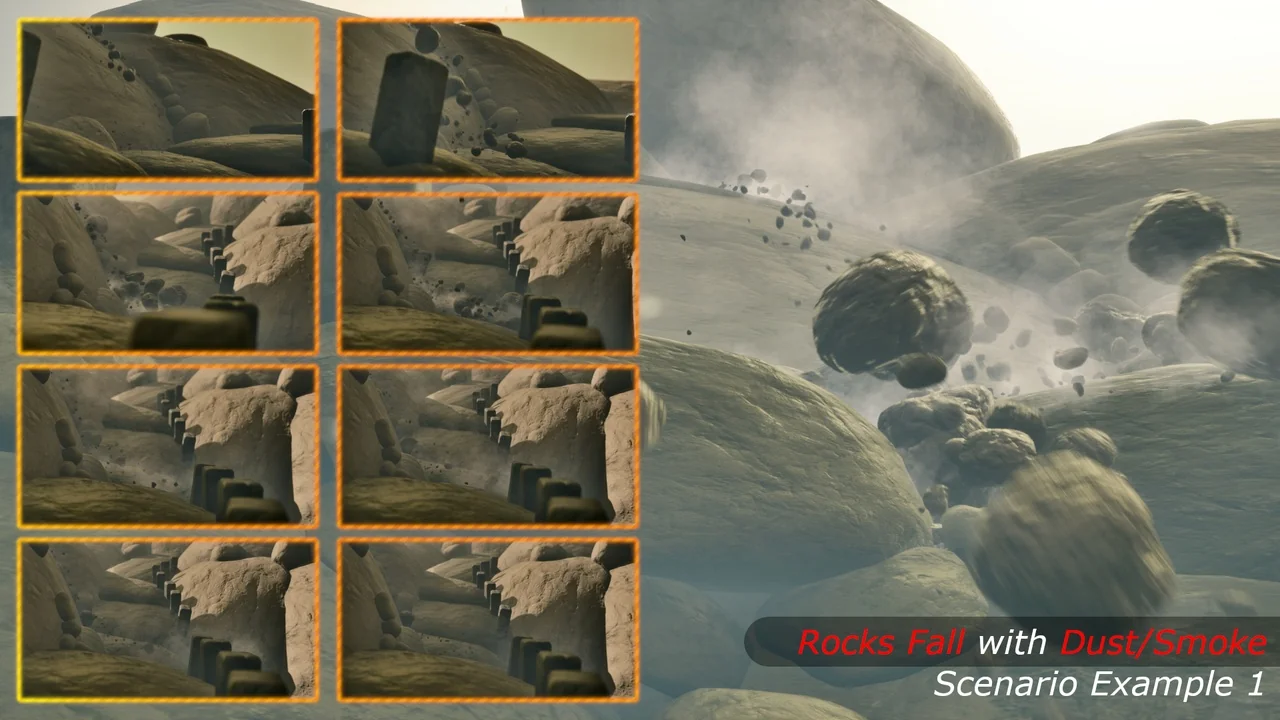
Crumbling architecture and natural rockslides often pose a challenge in level design because static meshes cannot convey impending structural failure. In high-tension sequences—such as an underground cavern undergoing an earthquake, an ancient tomb triggering an escape sequence, or an industrial brick facade disintegrating under artillery fire—visuals must communicate physical volume. This package provides both natural stone elements and man-made brick variants, allowing designers to stage collapses in pristine geological settings as well as crumbling architectural ruins.
Because the visual presentation incorporates dense debris alongside tumbling primary objects, an individual trigger can represent either a sudden minor tremor or a devastating structural failure. The presence of stone and brick options makes it straightforward to adapt the effect to different scene typologies without rebuilding the foundational particle behavior from scratch.
Layering Niagara Rocks Effects and Smoke Groups
A convincing rock fall relies on distinct visual stages: the initial break, the tumbling descent of larger masses, the scattering of smaller fragments, and the lingering atmosphere stirred up by the impact. To capture this complexity, the system allows creators to customize six groups of Niagara rocks effects alongside six groups of Niagara smoke effects simultaneously.
Splitting the simulation into six discrete rock groups makes it possible to calibrate variety across the falling debris. Large, heavy chunks can be given distinct behaviors while mid-sized rubble and fine gravel disperse across wider trajectories. Working in parallel with these stone layers, the six groups of smoke and dust effects introduce air displacement and impact plumes. As falling stones hit the ground or collide along vertical surfaces, the corresponding dust groups billow outward, occluding the player's vision and reinforcing the perceived weight of the falling objects.
Managing both rocks and smoke across twelve total visual groups ensures that dense collapses do not look like uniform, repeating particle loops. Instead, developers can balance heavy foreground impacts with subtler background dust layers to match the scale of the environment.
Spatial Immersion Through Editable 3D Sound Locations
Audio is vital when simulating massive stone movements, particularly when debris falls from locations outside the player’s immediate field of view. A rumble overhead should build anticipation before any visual geometry enters the camera frame, and ground impacts must register distinctly in the audio mix where the debris actually lands. Rock Fall Niagara with Sound incorporates an editable 3D sound location effect specifically to address directional audio realism.
The system lets users position up to six sound spawn locations per effect directly within the game space. Rather than forcing all acoustic feedback through a single root transform, audio events can be distributed along the path of the collapse. One 3D sound location can be placed high up on a cavern ceiling to trigger initial snaps and grinding friction, intermediate points can play secondary tumbling cues along a rock face, and lower points can fire bass-heavy impact sounds as boulders slam into the floor.
Configuring up to six sound locations per instance dramatically enhances player immersion. The directional cues allow players to track the origin and trajectory of the hazard through positional audio alone, making sudden cave-ins and falling architectural masonry feel physically present within the environment.
Deploying the Effect Through Nine Blueprints
Implementing multi-component VFX systems across large maps can quickly become tedious if particle systems, collisions, and audio cues must be wired together manually for every encounter. To streamline this workflow, the falling rock effect is managed through nine provided Blueprints.
These Blueprints serve as complete, self-contained functional units. Placing the falling rock effect simply requires selecting one of the nine setups and adjusting the parameters to suit the scene. Within a chosen Blueprint, developers can adjust the six Niagara rock groups, the six Niagara smoke groups, and the six sound groups concurrently. This unified approach eliminates the need to cross-reference disconnected audio cues and particle emitters across disparate project folders.
Whether an encounter requires a narrow vertical drop down a maintenance shaft or an expansive rockslide spilling down a mountain path, selecting and configuring one of the Blueprints centralizes the entire setup. The consolidated interface allows for rapid iteration during level blockout and technical art dressing phases.
Practical Fit Across Production Roles
Environment artists, technical designers, and gameplay programmers all benefit from an integrated hazard asset that handles visual debris and audio triggers in tandem. Environment artists gain the visual flexibility of interchanging rock, stone, and brick materials with matching dust plumes that ground the effect naturally into level geometry. Gameplay programmers and level designers obtain modular hazard volumes that deploy rapidly via Blueprints without requiring custom scripting for audio-visual synchronization.
Because the package cleanly couples six rock layers, six dust layers, and six spatial audio emitters into dedicated Blueprint containers, it serves teams aiming to add impactful, physically grounded environmental events without incurring the development overhead of authoring complex Niagara and audio relationships by hand.
 Variety
 Variety
 Variety
 Variety