Energy weapon VFX Pack
Energy weapon VFX Pack provides 20 Niagara energy trajectories and 20 muzzle effects for Unreal Engine, supporting Unreal 4.25–4.27 and 5.0–5.7 with free parame
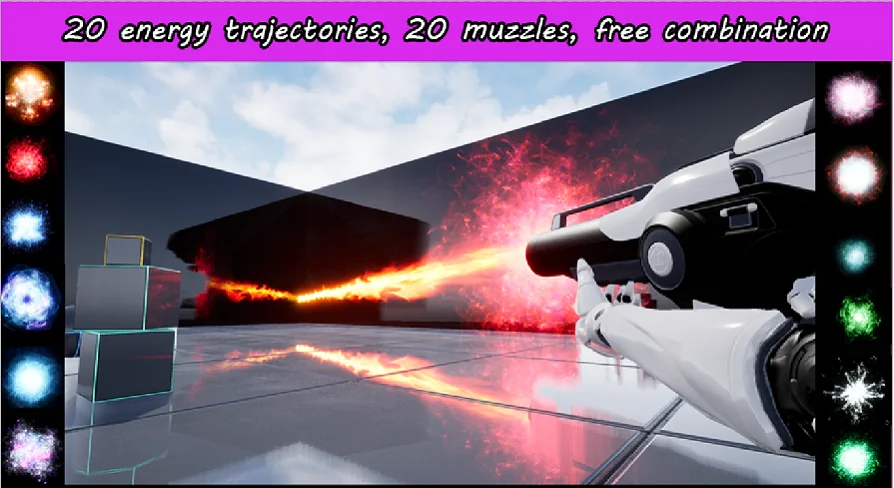 Variety
Resource overview
Populating a shooter or sci-fi combat project with distinct weapon fire means solving two problems at once: every gun needs a convincing muzzle event, and every projectile needs a readable energy trail that holds up in motion. Energy weapon VFX Pack approaches both needs as a single system. Twenty energy trajectories and twenty muzzle effects are included, built on Unreal Engine's Niagara framework, and the two sets are meant to be combined freely.
The pack states an explicit invitation to treat these effects as a starting point rather than a fixed library. With exposed parameters, artists can generate countless kinds of trajectories from the twenty base presets, pushing each one toward a distinct visual identity without reaching for entirely new assets.
Building energy trajectories from twenty base presets
Unreal's Niagara particle system exposes a wide range of parameters that drive emission, color, lifetime, velocity, and force behavior. For an energy trajectory, those parameters determine whether a fired shot reads as a tight bolt, a crackling arc, a dispersing plasma streak, or something else entirely. A pack of twenty distinct trajectory effects gives artists an immediate library of finished looks that can be evaluated in context.
None of these trajectories are locked behind fixed aesthetics. Because Niagara properties are exposed for adjustment, each trajectory preset can serve as a seed for new variations. Velocity ramps, particle counts, size curves, or color gradients can be pushed in different directions. A single preset that originally reads as a fast, narrow lance can be slowed down, fattened, and shifted in color through parameter edits, becoming a new trajectory without the artist building the effect from scratch.
That leaves a trajectory system where the twenty included effects function as practical starting points. Artists can iterate quickly, previewing how energy fire reads against different environments and lighting conditions. Since every variation derives from a shared Niagara base, swapping trajectories between weapons or tuning them to match a specific combat tempo stays efficient.
Because the trajectories are energy effects, they fit naturally into sci-fi projects, futuristic shooter combat, magic-tech weapon systems, or any scene where projectile fire needs to feel charged and volatile. The visual language of energy trajectories compresses motion and glow into a readable shape that communicates speed and threat to the player.
Pairing muzzle flashes with trajectory variations
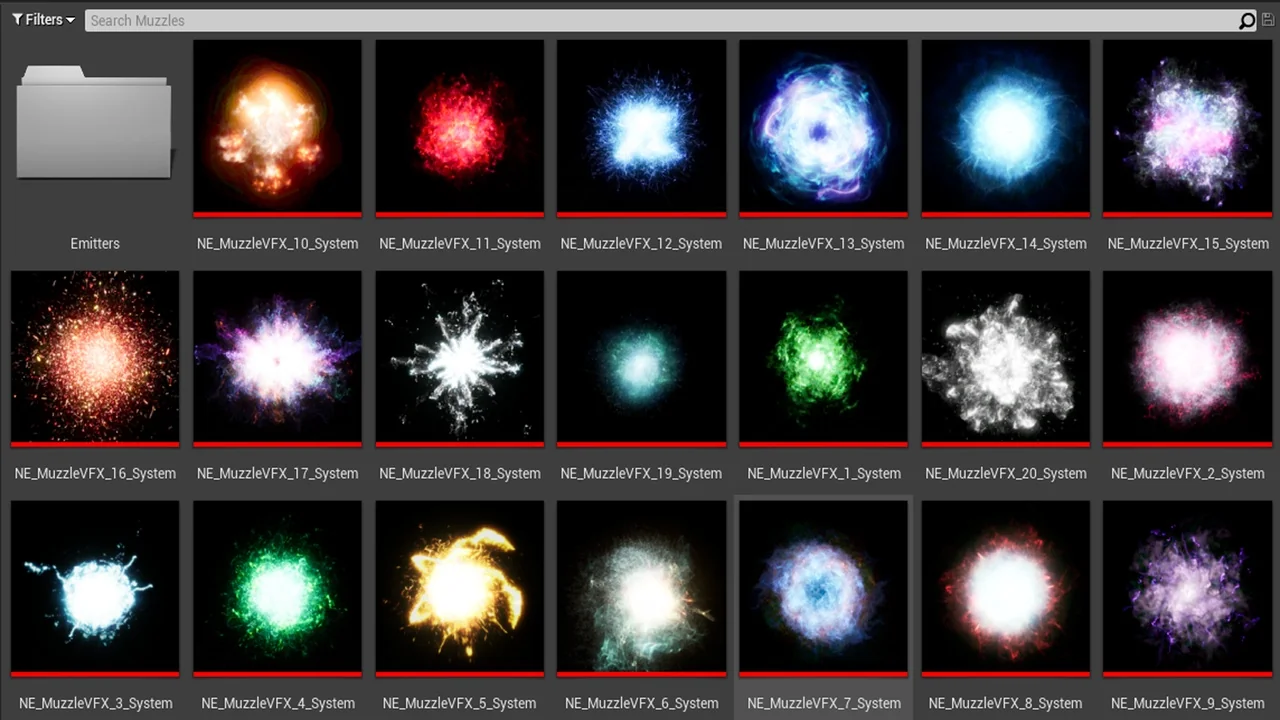
Each time a weapon fires, the muzzle moment does most of the visual communication. A strong muzzle flash sells the power behind a shot, gives the player immediate feedback on trigger pull, and establishes the energy signature that the trajectory then carries forward. Twenty separate muzzle effects are provided, giving artists freedom to match different weapon sizes and fire types.
These muzzles are not bound to specific trajectories. Free combination is a core quality of the pack, meaning a particular muzzle effect can be paired with a trajectory of the artist's choosing, and specific color or energy properties can be aligned visually across the firing moment and the projectile path.
Scenes that feature multiple weapon types benefit from this flexibility. A sidearm might use a compact muzzle snap paired with a tight trajectory, while a heavy mounted energy weapon can combine a large muzzle burst with a thicker, more persistent trajectory. The choice belongs to the scene's needs rather than to a rigid one-to-one pairing.
Niagara makes this kind of combination practical because effects can be modular and independent. Separating muzzle from trajectory means that tuning one does not break the other, and the twenty-plus-twenty structure creates a grid of possible pairings. Pushing parameters further multiplies those combinations, since each trajectory itself can be spun into countless visual variations.
This separation also supports workflow clarity. A combat designer can prototype weapon feel rapidly by swapping muzzles and trajectories independently, evaluating how each combination reads in gameplay. Final art polish can happen later, with specific parameter values locked once the desired firing identity is achieved.
Working across Unreal Engine 4.25 through 5.7
The pack is compatible with Unreal Engine 4.25 through 4.27, along with 5.0 through 5.7. For teams shipping on Unreal Engine 4, Niagara support in the 4.25 to 4.27 range is mature enough that energy effects of this complexity are practical and performant for production use.
Projects already on Unreal Engine 5 can integrate the pack across every major release from 5.0 forward, including version 5.7. Long-running productions that began on Unreal Engine 4 and are migrating to Unreal Engine 5 can continue using these effects through the transition without requiring a separate pack or a rework of weapon visual effects.
Niagara itself remains the common thread across the supported versions. The tag set for the pack places Niagara alongside muzzle, energy, and weapon descriptors, which locates the asset firmly within Unreal Engine's modern particle workflow rather than a legacy system. Artists working in Niagara can incorporate these effects into existing weapon systems, gameplay ability pipelines, or combat prototypes without re-tooling.
Where energy weapon effects fit in a production pipeline
In a live combat scene, weapon effects are experienced in fractions of a second. The muzzle flash reads on trigger pull, the trajectory communicates shot direction, and the visual language of each shot tells the player what kind of weapon was fired. Energy effects in particular carry a distinct advantage: their glow, color, and motion can be pushed beyond realistic ballistics into stylized or fantastical territory.
For science fiction combat, energy weapon fire remains a core staple. Plasma rifles, charged particle beams, arc weapons, and futuristic sidearms all share a need for glowing trajectories that read clearly during gameplay. The muzzle and trajectory pairing in this pack directly serves those weapon archetypes, and the ability to build new trajectories from parameters means weaponpecies can diverge visually without requiring an entirely new effect pack for each gun type.
Because Niagara effects can be controlled by gameplay data, including charge time, fire rate, or projectile speed, trajectories built from these presets can respond to weapon behavior in real time. A weapon that charges before firing can visualize that build through parameter changes that affect the trajectory or muzzle without changing the underlying effect template. This connects the visual system to game design at an implementation level.
For teams working on multiplayer shooters or combat-focused scenes, performance consistency across many simultaneous firing events matters. A pack that emphasizes free combination and parameter-driven variation allows artists to control effect complexity per weapon class, keeping lightweight effects on high fire-rate weapons and heavier visual treatment on charged or single-shot energy arms.
The trajectory and muzzle sets also support prototyping during pre-production. Designers can drop combinations into test scenes, evaluate readability against background lighting and environment colors, and establish which trajectory shapes communicate shot direction most clearly from the player's perspective. Those decisions can be locked before final art polish, reducing the chance of late-stage reworking.
Generating countless trajectory kinds through parameters
The explicit promise of the pack is that imagination becomes the limiting factor, not the asset count. Twenty trajectories and twenty muzzles form the foundation, but parameters open the door to countless variations.
For an energy trajectory, parameter edits can shift the base preset into something visually distinct. Adjusting emission rates changes how dense or sparse a trail appears. Color curves re-color the energy signature. Lifetime values control how long particles persist along the path. Force modules can add turbulence, curve the trail, or break it into branching fragments. Each of these edits operates on an already-finished effect.
Because muzzle effects are equally open to parameter tuning, a paired set can be adjusted together. The muzzle color at fire can be matched to the trajectory color, or intentionally contrasted for emphasis. Size and burst intensity at the muzzle can be scaled to align with trajectory thickness. That leaves a coherent visual language per weapon, assembled from shared presets and tuned through exposed values.
This approach keeps the pack small in raw asset count while remaining broad in practical output. A team does not need hundreds of fixed effects to cover a diverse weapon roster. Twenty trajectory presets and twenty muzzle presets, combined and tuned through Niagara parameters, cover a wide range of weapon visual identities.
A practical weapon VFX starting point
Energy weapon VFX Pack fits into the layer of production where gameplay feel and visual identity converge. It supplies finished, Niagara-based energy effects that can be dropped into weapon systems immediately, then tuned to match specific gameplay context.
For combat prototypes, vertical slices, or full productions running on Unreal Engine 4.25 through 5.7, the pack provides a trajectory and muzzle foundation that can grow with the project's needs. Parameter access in Niagara makes that growth practical, and the free combination of muzzles and trajectories gives combat and effects artists the flexibility to differentiate weapons without leaving the pack's framework.
More From The Same Workflow
Resource screenshots
6 curated preview images
Download this resource
Log in or create a free account to start your download.
Resources are manually reviewed before listing to improve quality and reduce obvious risks.
Related resources
 Variety
Stylized VFX Pack
Variety
 Variety
Ring Aura VFX
Variety
 Variety
Absorption FX
Variety