"7e6fc58c410f2894"{"id":"1000470","slug":"molecules-and-organisms-vfx","title":"Molecules and Organisms VFX","category":"Variety","engine":"4.26+,5.0+","assetVersion":"","engineVersion":"Engine Version: 4.26+,5.0+","tag":"Variety","accent":"blue","visual":"mech","summary":"A Niagara-driven VFX pack of 35 static meshes, blueprint animations, and sci-fi organic effects for building medical, molecular, and biological Unreal Engine sc","platform":"Unreal Engine","publishedAt":"2026-07-11T18:04:56.784Z","updatedAt":"2026-07-11T18:04:56.784Z","sourceNotes":[],"fileContents":[],"compatibility":["Unreal Engine","Engine Version: 4.26+,5.0+"],"featuredImage":{"alt":"Molecules and Organisms VFX","src":"/wp-content/uploads/published/2026/07/ab98a75954b2-279e3997-4d81-4a2d-acab-460d37d34da7-00f4ac9c4f.webp"},"hasDownloadLink":true,"downloads":0,"terms":[{"taxonomy":"category","slug":"variety-vfx","name":"Variety"}],"galleryImages":[{"src":"/wp-content/uploads/published/2026/07/f348cb80b469-9d61509a-646f-4808-bf75-ee0d21efaa0f-b0d21c1972.webp","alt":"Molecules and Organisms VFX"},{"src":"/wp-content/uploads/published/2026/07/039a1bb04ba1-d09e25fa-285c-4957-a871-f6c4b6eb517b-259cae4af9.webp","alt":"Molecules and Organisms VFX"},{"src":"/wp-content/uploads/published/2026/07/02b158c1a1cc-0ab9cdd0-c2a9-4b00-ac5a-bcccdbf5cd3b-8cf321db69.webp","alt":"Molecules and Organisms VFX"},{"src":"/wp-content/uploads/published/2026/07/c1a7b5c03123-d35ec150-60dd-4a76-aaea-9dd38f26f810-d1d505ce18.webp","alt":"Molecules and Organisms VFX"},{"src":"/wp-content/uploads/published/2026/07/9678a65823d2-432a419b-d3c8-4935-ac0f-757505547677-5c53233f57.webp","alt":"Molecules and Organisms VFX"},{"src":"/wp-content/uploads/published/2026/07/20ddcd0c02b1-5c006843-9ac1-42b5-8456-7d811a953a2d-06a514d5a9.webp","alt":"Molecules and Organisms VFX"},{"src":"/wp-content/uploads/published/2026/07/49ab946271a0-dd696b8b-acd7-482a-bfe1-72f48099e3e3-2124532567.webp","alt":"Molecules and Organisms VFX"},{"src":"/wp-content/uploads/published/2026/07/d5bf32e1943a-ff7816ac-23d0-4ddc-b016-eb728bc75b03-4ac356bb10.webp","alt":"Molecules and Organisms VFX"},{"src":"/wp-content/uploads/published/2026/07/cb36a3f5b2cc-2b68b059-869c-44ca-99da-a53c83a76948-9e12ed922a.webp","alt":"Molecules and Organisms VFX"},{"src":"/wp-content/uploads/published/2026/07/9ec238d3ba64-ca82760c-031e-476f-96c5-ad67831a5c86-cf1442c50d.webp","alt":"Molecules and Organisms VFX"}],"accessPanel":{"kind":"resource","title":"Download this resource","eyebrow":"Free Download","message":"Log in or create a free account to start your download.","fileName":"Content.7z","safetyNote":"Resources are manually reviewed before listing to improve quality and reduce obvious risks.","actionLabel":"Download Free","resourceType":"Resource archive"},"contentHtml":"\u003ch2\u003eBuilding sci-fi biology and medical laboratories\u003c/h2\u003e\u003cp\u003eMolecules and Organisms VFX positions itself as a toolkit for scenes that lean into microscopic or biological imagination. The package can generate interesting science-fiction environments, with a specific callout for biological or medical settings. Artists developing sequences inside research facilities, alien containment chambers, or diagnostic visualization rooms can pull from the same collection of meshes, effects, and blueprint logic without assembling each system from scratch.\u003c/p\u003e\u003cp\u003eThe tag list reinforces that functional identity: Laser, Niagara, Medical, Organic, Molecular, DNA, Cell, Bacteria. Those keywords map directly onto the kind of visuals the pack provides—beam emissions, floating organic structures, chaotic particle dispersals, and ring-based scans that suggest analysis or infection.\u003c/p\u003e\u003ch2\u003eTwo maps that separate reference from finished production\u003c/h2\u003e\u003cp\u003eThe pack includes two maps, each serving a distinct role in a developer's workflow.\u003c/p\u003e\u003cp\u003e\u003cstrong\u003eMap_Display\u003c/strong\u003e Functions as a catalog and guide. It shows all relevant models, use cases, and tutorials in one space. Developers can open this map to preview how individual meshes behave, how materials respond, and how Niagara effects integrate before pulling anything into a custom level.\u003c/p\u003e\u003cp\u003e\u003cstrong\u003eMap_Application\u003c/strong\u003e Is a conceptual scene built entirely from resources within this bundle. Every model placed in that scene is included in the package, which means what you see in the conceptual screenshots represents what you can reconstruct directly. The last three marketplace images for this asset are screenshots pulled from Map_Application, giving a concrete preview of how the pieces combine.\u003c/p\u003e\u003ch2\u003eBlueprint animations for drones and linked structures\u003c/h2\u003e\u003cp\u003eThe package includes two main blueprint animation systems, each with a set of demonstrated cases.\u003c/p\u003e\u003cp\u003e\u003cstrong\u003eBP_Link\u003c/strong\u003e Comes with 10+ cases showing how linked structures can be animated or triggered. This blueprint likely drives the visual behavior of connected molecular chains, bonded structures, or analytical laser links between points.\u003c/p\u003e\u003cp\u003e\u003cstrong\u003eBP_Drone\u003c/strong\u003e And \u003cstrong\u003eBP_D_Target\u003c/strong\u003e Together provide 5+ cases. These imply a drone-style actor moving toward or scanning a target, potentially useful for cinematic sequences where medical drones or scanning devices are inspecting a molecular structure.\u003c/p\u003e\u003cp\u003eBy packaging these as blueprints with multiple cases, the creator gives developers a configurable starting point. Rather than binding animations to a single scripted sequence, the system exposes variations that can be referenced or modified.\u003c/p\u003e\u003ch2\u003eMaterial layering across conversion, grid, and scan modes\u003c/h2\u003e\u003cp\u003eThree main materials anchor the visual pipeline: M_Convert, M_Grid, and M_Scan. Each name implies a distinct visual mode—morphing or transforming between states, overlaying a grid for structural reads, and applying scanning effects for analytical or security-camera aesthetics.\u003c/p\u003e\u003cp\u003eBase materials expand the toolkit with 20+ material instances, while the main materials provide 15+ instances. This layered structure allows artists to quickly shift the visual tone of molecules and organisms without reworking shader logic. The same mesh can read as scanned, gridded, or converted depending on which instance is applied.\u003c/p\u003e\u003ch2\u003eNiagara effect categories shaping scene behavior\u003c/h2\u003e\u003cp\u003eThe pack groups Niagara effects into six major categories, each with a specific visual function.\u003c/p\u003e\u003cul\u003e\u003cli\u003e\u003cstrong\u003eFX_Beam (2+)\u003c/strong\u003e—emission-style beam effects, potentially for laser links or scanning projections\u003c/li\u003e\u003cli\u003e\u003cstrong\u003eFX_Chaos (8+)\u003c/strong\u003e—particle disruption or disassembly visuals\u003c/li\u003e\u003cli\u003e\u003cstrong\u003eFalling (2+)\u003c/strong\u003e—gravity-driven particle descent\u003c/li\u003e\u003cli\u003e\u003cstrong\u003eFX_Float (3+)\u003c/strong\u003e—ambient floating motion for suspended particles\u003c/li\u003e\u003cli\u003e\u003cstrong\u003eFX_Link (3+)\u003c/strong\u003e—connection effects between points or structures\u003c/li\u003e\u003cli\u003e\u003cstrong\u003eFX_Ring (4+)\u003c/strong\u003e—ring-based emanation effects for scans, pulses, or containment boundaries\u003c/li\u003e\u003c/ul\u003e\u003cp\u003eFX_Chaos carries the largest count, which suggests the pack places emphasis on dispersion and breakdown moments. FX_Ring at 4+ effects opens options for rhythmic pulse patterns, security scans, or containment field visuals.\u003c/p\u003e\u003ch2\u003e35 static meshes divided across molecules, organisms, and decorations\u003c/h2\u003e\u003cp\u003eThe static mesh library contains 35 meshes organized into three functional groups.\u003c/p\u003e\u003cul\u003e\u003cli\u003e\u003cstrong\u003eDecoration (6)\u003c/strong\u003e—environmental detailing elements, specifically mentioned as serving conceptual scenarios\u003c/li\u003e\u003cli\u003e\u003cstrong\u003eMolecule (27)\u003c/strong\u003e—the core geometry for molecular structures\u003c/li\u003e\u003cli\u003e\u003cstrong\u003eOrganism (8)\u003c/strong\u003e—biological structures suggesting cells, bacteria, or macro-scale organic forms\u003c/li\u003e\u003c/ul\u003e\u003cp\u003eThe molecule category dominates the mesh count, giving artists a wide variety of configurations when building bonded chains, crystalline lattices, or dense particle clouds. With 27 options, scenes can avoid the look of repeated geometry across different molecular structures.\u003c/p\u003e\u003ch2\u003eCompatibility and practical positioning\u003c/h2\u003e\u003cp\u003eMolecules and Organisms VFX supports Unreal Engine versions 4.26 through 4.27 and 5.0 through 5.4. This spans late Unreal 4 releases into the current Unreal 5 lifecycle, making the pack usable across older ongoing projects and new-generation builds.\u003c/p\u003e\u003cp\u003eDevelopers working on medical visualization, sci-fi laboratory cinematics, or gameplay sequences involving biological systems can treat this package as a complete construction kit. The combination of 35 meshes, 22+ effect variations across six Niagara categories, two blueprint animation systems, and a layered material pipeline provides the raw components needed to assemble those environments without starting from empty levels.\u003c/p\u003e\n\n\u003ch2\u003eMore From The Same Workflow\u003c/h2\u003e\n\u003cul\u003e\n\u003cli\u003e\u003ca href=\"https://3dcghub.com/microscopic-organisms/\" title=\"Microscopic Organisms\"\u003eMicroscopic Organisms\u003c/a\u003e\u003c/li\u003e\n\u003cli\u003e\u003ca href=\"https://3dcghub.com/arcs-and-sparks/\" title=\"Arcs and Sparks\"\u003eArcs and Sparks\u003c/a\u003e\u003c/li\u003e\n\u003cli\u003e\u003ca href=\"https://3dcghub.com/500-ultimate-luts-pack-post-processing-filters/\" title=\"500+ Ultimate LUTs Pack - Post-Processing Filters\"\u003e500+ Ultimate LUTs Pack - Post-Processing Filters\u003c/a\u003e\u003c/li\u003e\n\u003cli\u003e\u003ca href=\"https://3dcghub.com/convolution-bloom-kernels-pack/\" title=\"Convolution Bloom Kernels Pack\"\u003eConvolution Bloom Kernels Pack\u003c/a\u003e\u003c/li\u003e\n\u003cli\u003e\u003ca href=\"https://3dcghub.com/flying-vehicle-fx/\" title=\"Flying Vehicle FX\"\u003eFlying Vehicle FX\u003c/a\u003e\u003c/li\u003e\n\u003c/ul\u003e","contentTextLength":5573,"navigation":{"current":1288,"total":3618,"previous":{"id":"1000471","slug":"ocean-environment-pack","title":"Ocean Environment Pack","category":"Aquatic","platform":"Unreal Engine","updatedAt":"2026-07-11T18:13:59.324Z"},"next":{"id":"1000469","slug":"mega-candles-pack","title":"Mega Candles Pack","category":"Tools, Objects \u0026 Decor","platform":"Unreal Engine","updatedAt":"2026-07-11T18:01:12.561Z"}},"relatedResources":[{"id":"17212","slug":"microscopic-organisms","title":"Microscopic Organisms","category":"Variety","engine":"4.26+,5.0+","assetVersion":"Engine version: 4.26+,5.0+","engineVersion":"4.25","tag":"Variety","accent":"blue","visual":"luts","summary":"Enhance your projects with 20 of the most common real-life microorganisms. These Niagara-based particle systems provide realistic visual effects for scientific and biological scenes.","platform":"Unreal Engine","publishedAt":"2026-03-13T13:59:33.000Z","updatedAt":"2026-04-19T15:43:35.000Z","sourceNotes":[],"fileContents":[],"compatibility":["Unreal Engine","Engine version: 4.26+,5.0+"],"featuredImage":{"alt":"Microscopic Organisms","src":"https://3dcghub.com/wp-content/uploads/2026/03/9258ac9a-562b-4924-aa20-0161f9e5f53d.webp"},"hasDownloadLink":true,"downloads":0},{"id":"1001047","slug":"attack-animals-vfx","title":"Attack Animals VFX","category":"Variety","engine":"4.27,5.0+","assetVersion":"","engineVersion":"Engine Version: 4.27,5.0+","tag":"Variety","accent":"blue","visual":"mech","summary":"Game-ready low poly attack animal VFX pack with 10 creatures, vertex animation, player attack blueprints, Niagara particles, materials, textures, and sound for","platform":"Unreal Engine","publishedAt":"2026-08-27T15:30:48.707Z","updatedAt":"2026-08-27T15:30:48.707Z","sourceNotes":[],"fileContents":[],"compatibility":["Unreal Engine","Engine Version: 4.27,5.0+"],"featuredImage":{"alt":"Attack Animals VFX","src":"/wp-content/uploads/published/2026/08/6850d22e9255-d195760b-5936-47e2-9cd6-1669125d2f34-19a7ef6a7a.webp"},"hasDownloadLink":true,"downloads":3},{"id":"1000776","slug":"slime-vfx-2","title":"Slime VFX","category":"Variety","engine":"4.27,5.0+","assetVersion":"","engineVersion":"Engine Version: 4.27,5.0+","tag":"Variety","accent":"blue","visual":"mech","summary":"Five unique slime VFX effects plus a slime decal built in Unreal Engine Niagara with controllable parameters, drag-and-drop ready for game-ready projects.","platform":"Unreal Engine","publishedAt":"2026-07-28T18:10:15.879Z","updatedAt":"2026-07-28T18:10:15.879Z","sourceNotes":[],"fileContents":[],"compatibility":["Unreal Engine","Engine Version: 4.27,5.0+"],"featuredImage":{"alt":"Slime VFX","src":"/wp-content/uploads/published/2026/07/da5a47581944-e9974b07-480c-482e-bfe2-7d679288a657-f2c75b7c0f.webp"},"hasDownloadLink":true,"downloads":3}]}
Variety
Molecules and Organisms VFX
A Niagara-driven VFX pack of 35 static meshes, blueprint animations, and sci-fi organic effects for building medical, molecular, and biological Unreal Engine sc
Molecules and Organisms VFX positions itself as a toolkit for scenes that lean into microscopic or biological imagination. The package can generate interesting science-fiction environments, with a specific callout for biological or medical settings. Artists developing sequences inside research facilities, alien containment chambers, or diagnostic visualization rooms can pull from the same collection of meshes, effects, and blueprint logic without assembling each system from scratch.
The tag list reinforces that functional identity: Laser, Niagara, Medical, Organic, Molecular, DNA, Cell, Bacteria. Those keywords map directly onto the kind of visuals the pack provides—beam emissions, floating organic structures, chaotic particle dispersals, and ring-based scans that suggest analysis or infection.
Two maps that separate reference from finished production
The pack includes two maps, each serving a distinct role in a developer's workflow.
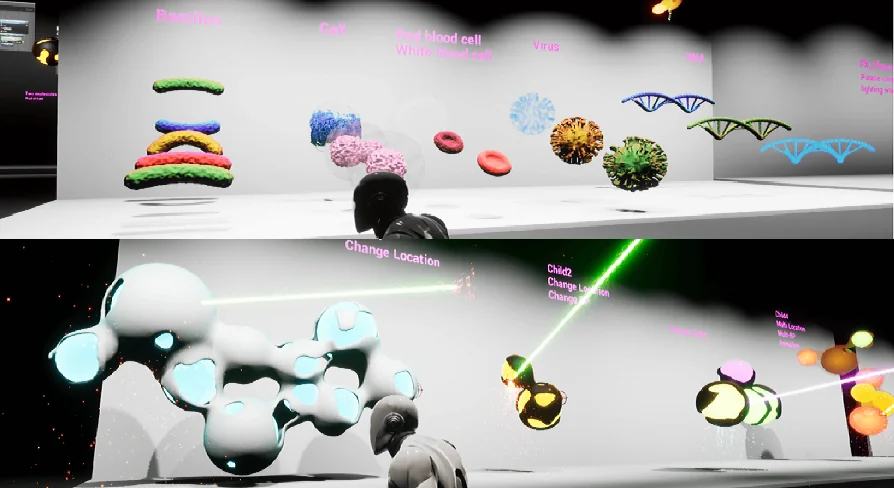
Map_Display Functions as a catalog and guide. It shows all relevant models, use cases, and tutorials in one space. Developers can open this map to preview how individual meshes behave, how materials respond, and how Niagara effects integrate before pulling anything into a custom level.
Map_Application Is a conceptual scene built entirely from resources within this bundle. Every model placed in that scene is included in the package, which means what you see in the conceptual screenshots represents what you can reconstruct directly. The last three marketplace images for this asset are screenshots pulled from Map_Application, giving a concrete preview of how the pieces combine.
Blueprint animations for drones and linked structures
The package includes two main blueprint animation systems, each with a set of demonstrated cases.
BP_Link Comes with 10+ cases showing how linked structures can be animated or triggered. This blueprint likely drives the visual behavior of connected molecular chains, bonded structures, or analytical laser links between points.
BP_Drone And BP_D_Target Together provide 5+ cases. These imply a drone-style actor moving toward or scanning a target, potentially useful for cinematic sequences where medical drones or scanning devices are inspecting a molecular structure.
By packaging these as blueprints with multiple cases, the creator gives developers a configurable starting point. Rather than binding animations to a single scripted sequence, the system exposes variations that can be referenced or modified.
Material layering across conversion, grid, and scan modes
Three main materials anchor the visual pipeline: M_Convert, M_Grid, and M_Scan. Each name implies a distinct visual mode—morphing or transforming between states, overlaying a grid for structural reads, and applying scanning effects for analytical or security-camera aesthetics.
Base materials expand the toolkit with 20+ material instances, while the main materials provide 15+ instances. This layered structure allows artists to quickly shift the visual tone of molecules and organisms without reworking shader logic. The same mesh can read as scanned, gridded, or converted depending on which instance is applied.
Niagara effect categories shaping scene behavior
The pack groups Niagara effects into six major categories, each with a specific visual function.
FX_Beam (2+)—emission-style beam effects, potentially for laser links or scanning projections
FX_Chaos (8+)—particle disruption or disassembly visuals
Falling (2+)—gravity-driven particle descent
FX_Float (3+)—ambient floating motion for suspended particles
FX_Link (3+)—connection effects between points or structures
FX_Ring (4+)—ring-based emanation effects for scans, pulses, or containment boundaries
FX_Chaos carries the largest count, which suggests the pack places emphasis on dispersion and breakdown moments. FX_Ring at 4+ effects opens options for rhythmic pulse patterns, security scans, or containment field visuals.
35 static meshes divided across molecules, organisms, and decorations
The static mesh library contains 35 meshes organized into three functional groups.
Decoration (6)—environmental detailing elements, specifically mentioned as serving conceptual scenarios
Molecule (27)—the core geometry for molecular structures
Organism (8)—biological structures suggesting cells, bacteria, or macro-scale organic forms
The molecule category dominates the mesh count, giving artists a wide variety of configurations when building bonded chains, crystalline lattices, or dense particle clouds. With 27 options, scenes can avoid the look of repeated geometry across different molecular structures.
Compatibility and practical positioning
Molecules and Organisms VFX supports Unreal Engine versions 4.26 through 4.27 and 5.0 through 5.4. This spans late Unreal 4 releases into the current Unreal 5 lifecycle, making the pack usable across older ongoing projects and new-generation builds.
Developers working on medical visualization, sci-fi laboratory cinematics, or gameplay sequences involving biological systems can treat this package as a complete construction kit. The combination of 35 meshes, 22+ effect variations across six Niagara categories, two blueprint animation systems, and a layered material pipeline provides the raw components needed to assemble those environments without starting from empty levels.
 Variety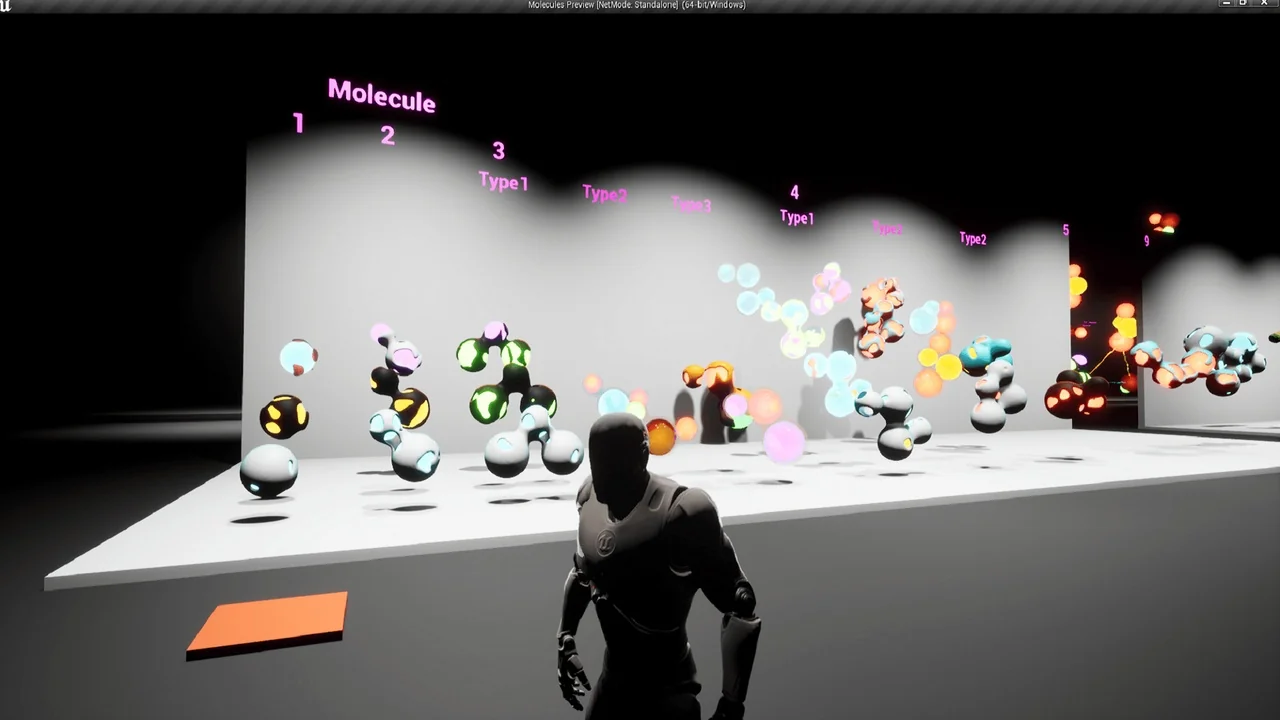
 Variety
 Variety
 Variety