"031373f479d9561a"{"id":"28427","slug":"500-ultimate-luts-pack-post-processing-filters","title":"500+ Ultimate LUTs Pack - Post-Processing Filters","category":"Variety","engine":"4.26+,5.0+","assetVersion":"Engine version: 4.26+,5.0+","engineVersion":"","tag":"Variety","accent":"blue","visual":"luts","summary":"500+ Ultimate LUTs Pack - Post-Processing Filters centers on quick color grading with a wide range of preset looks. The collection covers warm, dramatic, vintage, cinematic, and correction-focused LUT groups that can be applied in only a few clicks.","platform":"Unreal Engine","publishedAt":"2026-05-15T16:25:21.000Z","updatedAt":"2026-05-15T16:51:07.000Z","sourceNotes":[],"fileContents":[],"compatibility":["Unreal Engine","Engine version: 4.26+,5.0+"],"featuredImage":{"alt":"500+ Ultimate LUTs Pack - Post-Processing Filters","src":"https://3dcghub.com/wp-content/uploads/2026/05/0f800e413d24_9e5acf1b-7c72-4a81-a7ea-a91a846cc9be.webp"},"hasDownloadLink":true,"downloads":0,"terms":[{"taxonomy":"category","slug":"variety-vfx","name":"Variety"},{"taxonomy":"post_tag","slug":"characters","name":"Characters"},{"taxonomy":"post_tag","slug":"environment","name":"Environment"},{"taxonomy":"post_tag","slug":"vfx","name":"VFX"}],"galleryImages":[{"src":"https://3dcghub.com/wp-content/uploads/2026/05/3798f86ce6ff_3c6dac0b-9e96-4e18-bec4-7893ed3fbb2b.webp","alt":"500+ Ultimate LUTs Pack - Post-Processing Filters"},{"src":"https://3dcghub.com/wp-content/uploads/2026/05/45c5fa889eea_c60422e7-e05d-4d1e-a8f3-1723bd8d2b88.webp","alt":"500+ Ultimate LUTs Pack - Post-Processing Filters"},{"src":"https://3dcghub.com/wp-content/uploads/2026/05/b7f993351cb9_805c5e15-6ba6-46f4-ad3a-d22b6df9ba2f.webp","alt":"500+ Ultimate LUTs Pack - Post-Processing Filters"},{"src":"https://3dcghub.com/wp-content/uploads/2026/05/3e4b8ce25073_0ac2437e-4968-40fd-81cd-f6aa55d08768.webp","alt":"500+ Ultimate LUTs Pack - Post-Processing Filters"},{"src":"https://3dcghub.com/wp-content/uploads/2026/05/366aa11ffdde_46555f9a-c731-4e90-9a4c-aec3dc713c21.webp","alt":"500+ Ultimate LUTs Pack - Post-Processing Filters"},{"src":"https://3dcghub.com/wp-content/uploads/2026/05/d57264ebc6af_d55fac5c-3f16-49ae-8029-9bb8a982c088.webp","alt":"500+ Ultimate LUTs Pack - Post-Processing Filters"},{"src":"https://3dcghub.com/wp-content/uploads/2026/05/2a546eeb4b6a_f339de41-5b15-46d6-8a25-2743929659ce.webp","alt":"500+ Ultimate LUTs Pack - Post-Processing Filters"},{"src":"https://3dcghub.com/wp-content/uploads/2026/05/913c3e7a69e7_94cbcb2a-1c18-4065-8161-9b8daf0b8c78.webp","alt":"500+ Ultimate LUTs Pack - Post-Processing Filters"},{"src":"https://3dcghub.com/wp-content/uploads/2026/05/01f0dc940ed7_be742b6e-67f3-499a-a948-7e94dde04872.webp","alt":"500+ Ultimate LUTs Pack - Post-Processing Filters"},{"src":"https://3dcghub.com/wp-content/uploads/2026/05/8c885b4512d0_ea61366f-8634-4227-8729-91d352d618f8.webp","alt":"500+ Ultimate LUTs Pack - Post-Processing Filters"}],"accessPanel":{"kind":"resource","title":"Access this resource","eyebrow":"Free Download","message":"Log in or create a free account to start your download.","fileName":"Content.7z","safetyNote":"All resources are 100% manually reviewed to eliminate all risks.","actionLabel":"Download Free","resourceType":"Resource archive"},"contentHtml":"\u003cp\u003eThe core of \u003cstrong\u003e500+ Ultimate LUTs Pack - Post-Processing Filters\u003c/strong\u003e Is a broad set of color-grading LUT collections aimed at getting a project to a cinematic look quickly. The package is presented as a way to create film-grade color with only a few clicks, while also giving enough variety to move away from repeating the same effects across different images, scenes, and game visuals.\u003c/p\u003e \u003cp\u003eThe package is made up of named LUT groups instead of one visual direction. That matters immediately in practice, because the collection is split between mood-driven looks, environment-oriented looks, and correction-focused sets. Instead of pushing one fixed style, it offers multiple categories that can be used to shift tone, refine color, or apply a more stylized treatment in a very direct way.\u003c/p\u003e \u003ch2\u003eWhat is included in the 500+ Ultimate LUTs Pack\u003c/h2\u003e\n\u003cp\u003eThe package includes the following LUT groups:\u003c/p\u003e\n\u003cul\u003e\n\u003cli\u003e50 Warm LUTs Pack\u003c/li\u003e\n\u003cli\u003e50 Skyfall LUTs Pack\u003c/li\u003e\n\u003cli\u003e50 Landscape LUTs Pack\u003c/li\u003e\n\u003cli\u003e50 Hollywood LUTs Pack\u003c/li\u003e\n\u003cli\u003e50 Drama LUTs Pack\u003c/li\u003e\n\u003cli\u003e50 Color Correction LUTs Pack\u003c/li\u003e\n\u003cli\u003e50 Cinematic Film LUTs Pack\u003c/li\u003e\n\u003cli\u003e20 Vintage Film LUTs Pack\u003c/li\u003e\n\u003cli\u003e20 Vaporwave LUTs Pack\u003c/li\u003e\n\u003cli\u003e20 Pro Film LUTs Pack\u003c/li\u003e\n\u003cli\u003e20 Nostalgia LUTs Pack\u003c/li\u003e\n\u003cli\u003e20 Coffee LUTs Pack\u003c/li\u003e\n\u003cli\u003e20 City LUTs Pack\u003c/li\u003e\n\u003cli\u003e20 Cinematic Vibes LUTs Pack\u003c/li\u003e\n\u003cli\u003e20 Autumn Vibes LUTs Pack\u003c/li\u003e\n\u003c/ul\u003e \u003cp\u003eThis structure gives the pack a practical spread. Some groups point to broad grading goals such as \u003cem\u003eColor Correction\u003c/em\u003e, \u003cem\u003ePro Film\u003c/em\u003e, and \u003cem\u003eCinematic Film\u003c/em\u003e. Others are more mood- or palette-led, including \u003cem\u003eWarm\u003c/em\u003e, \u003cem\u003eDrama\u003c/em\u003e, \u003cem\u003eNostalgia\u003c/em\u003e, \u003cem\u003eCoffee\u003c/em\u003e, and \u003cem\u003eAutumn Vibes\u003c/em\u003e. A third set leans into place or atmosphere, with names such as \u003cem\u003eSkyfall\u003c/em\u003e, \u003cem\u003eLandscape\u003c/em\u003e, and \u003cem\u003eCity\u003c/em\u003e. There is also room for more overt stylization through packs like \u003cem\u003eVaporwave\u003c/em\u003e And \u003cem\u003eHollywood\u003c/em\u003e.\u003c/p\u003e \u003cp\u003eBecause the groups are clearly separated, setup and use can start from the desired result rather than from technical trial and error. If the task is straightforward correction, the correction-oriented packs give an obvious starting point. If the goal is a stronger mood shift, the more expressive groups offer a different route. That organization supports quick decision-making, which fits the package’s emphasis on getting results fast.\u003c/p\u003e \u003ch2\u003eColor Correction and Cinematic Film LUTs in day-to-day workflow\u003c/h2\u003e\n\u003cp\u003eThe package is framed around speed. It is meant to help create an amazing cinematic film grade with only a few clicks, and it is also described as simple to use when adding effects to photos. That combination points to a workflow where LUT application is not treated as a slow, heavily manual process. Instead, the pack is positioned for quick grading passes that can produce strong visual change almost immediately.\u003c/p\u003e \u003cp\u003eFor implementation, the most relevant detail is not a software checklist or technical specification, but the intended behavior of the LUTs themselves. These are color-grading LUTs created to produce beautiful cinematic film tones for projects. Each LUT has been crafted to look good across a wide variety of scenes, which suggests that the collection is not limited to one narrow subject type. In practical use, that means the pack is intended to be useful when moving between different scene setups while still preserving a polished, film-oriented finish.\u003c/p\u003e \u003cp\u003eThe package also states that, in many instances, a great result can be achieved in an instant. That makes the LUTs useful for two closely related tasks. The first is rapid first-pass grading, where the main need is to establish a compelling tone quickly. The second is visual variation, where the same base image or scene can be tested under different moods without rebuilding a grade from scratch. The emphasis stays on immediate application rather than prolonged adjustment.\u003c/p\u003e \u003cp\u003eThere is also a clear role for game work. The pack can be used to color-correct games quickly and professionally. That places it not only in a photo or cinematic image context, but also in a broader real-time visual workflow where color treatment needs to be efficient and consistent. The wording does not go into engine-specific implementation, so the strongest verified point is simply that the LUTs are intended to support game color correction as part of a professional visual pass.\u003c/p\u003e \u003ch2\u003eWarm, Skyfall, Landscape, and Drama looks\u003c/h2\u003e\n\u003cp\u003eThe named packs give a good sense of the creative spread inside the collection. \u003cstrong\u003eWarm LUTs\u003c/strong\u003e And \u003cstrong\u003eAutumn Vibes LUTs\u003c/strong\u003e Suggest a direction anchored in richer, more inviting color. \u003cstrong\u003eDrama LUTs\u003c/strong\u003e Point toward a heavier tonal shift, while \u003cstrong\u003eSkyfall LUTs\u003c/strong\u003e And \u003cstrong\u003eLandscape LUTs\u003c/strong\u003e Imply looks that can reshape outdoor or wide-scene presentation through grading.\u003c/p\u003e \u003cp\u003eEven without breaking down the individual color response of each LUT, the names establish how the collection can be navigated. A creator looking for subtle atmosphere might begin with Warm, Coffee, or Nostalgia. A project needing stronger cinematic intensity can move toward Drama, Hollywood, or Cinematic Film. A more stylized or distinct palette shift can come from Vaporwave. This is where the pack’s scale becomes useful: it supports experimentation without forcing every project into the same recurring treatment.\u003c/p\u003e \u003cp\u003eThe package directly addresses that repetition problem. It asks whether the user is tired of adding the same effects over and over, then positions the collection as a way to create more unique results. Applied to real workflow, that means the value of the pack is not just speed, but variation. Since the sets are grouped by visual identity, it becomes easier to test different moods on the same material and arrive at a look that feels less routine.\u003c/p\u003e \u003ch2\u003ePhotos, projects, and games under the same grading approach\u003c/h2\u003e\n\u003cp\u003eOne of the more useful aspects of the package is how broadly its intended use is described. It can add effects to photos, create cinematic film tones for projects, and color-correct games quickly and professionally. Those are different kinds of output, but they share the same need: controlled color treatment that changes mood and finish without requiring the user to rebuild a grade every time.\u003c/p\u003e \u003cp\u003eFor photos, the appeal is direct. Within a few clicks, the pack is meant to add striking effects and create looks that feel distinct enough to stand out. For larger projects, the wording shifts toward cinematic film tones, which places the collection in a more cohesive visual role rather than just a one-off filter effect. For games, the focus returns to correction and speed, suggesting a practical grading toolset rather than a purely decorative one.\u003c/p\u003e \u003cp\u003eThe tags attached to the package reinforce that broad visual range. Terms such as \u003cem\u003eFilter\u003c/em\u003e, \u003cem\u003ePost\u003c/em\u003e, \u003cem\u003eVisual\u003c/em\u003e, \u003cem\u003eColorful\u003c/em\u003e, \u003cem\u003eEffect\u003c/em\u003e, \u003cem\u003eFilm\u003c/em\u003e, \u003cem\u003eCinematic\u003c/em\u003e, \u003cem\u003eColor\u003c/em\u003e, \u003cem\u003eGrading\u003c/em\u003e, \u003cem\u003eCinematography\u003c/em\u003e, \u003cem\u003eScifi\u003c/em\u003e, \u003cem\u003eHorror\u003c/em\u003e, and \u003cem\u003eRealistic\u003c/em\u003e Place the LUTs in a wide stylistic field. The pack is not locked to one genre mood. It can be approached as a flexible grading library for multiple visual directions, as long as the goal remains post-processing through LUT-based color work.\u003c/p\u003e \u003ch2\u003eThe role of Cinematic Vibes, Vintage Film, and Pro Film\u003c/h2\u003e\n\u003cp\u003eSeveral of the included packs speak very directly to film-style treatment. \u003cstrong\u003eCinematic Film LUTs\u003c/strong\u003e, \u003cstrong\u003eCinematic Vibes LUTs\u003c/strong\u003e, \u003cstrong\u003eVintage Film LUTs\u003c/strong\u003e, and \u003cstrong\u003ePro Film LUTs\u003c/strong\u003e All point to grading choices that lean into a film-oriented finish, but with slightly different emphases implied by their names. Some suggest a classic or aged character, others a more polished or generalized cinematic result.\u003c/p\u003e \u003cp\u003eThat is useful when the target is not simple correction but visual identity. A creator can start from a film-minded set when the image needs stronger atmosphere, then compare that against Hollywood, Drama, or Nostalgia alternatives to decide whether the final result should feel more glossy, more emotional, or more retro. The pack’s structure encourages this kind of practical comparison because the categories are already separated into recognizable stylistic families.\u003c/p\u003e \u003cp\u003eThere is one important boundary to keep in mind. Content shown in the images is not included in the product and is only there for demonstration purposes. The package is the LUT collection itself. For production work, that keeps attention on what the resource actually provides: a large bank of post-processing color looks and correction options meant to speed up grading across photos, projects, and games.\u003c/p\u003e \u003cp\u003eUsed as intended, the pack is set up to handle fast cinematic grading, quick visual variation, and straightforward game color correction through a large set of clearly named LUT groups.\u003c/p\u003e\n\n\u003ch2\u003eRelated Resources Worth Checking\u003c/h2\u003e\n\u003cul\u003e\n\u003cli\u003e\u003ca href=\"https://3dcghub.com/volcano-land-environment-w-terrain-scatter-tool-exterior-natural-vfx/\" title=\"Volcano Land Environment w/ Terrain Scatter Tool (Exterior, Natural, VFX)\"\u003eVolcano Land Environment w/ Terrain Scatter Tool (Exterior, Natural, VFX)\u003c/a\u003e\u003c/li\u003e\n\u003cli\u003e\u003ca href=\"https://3dcghub.com/mixed-magic-3-spell-vfx-pack/\" title=\"Mixed Magic 3 – Spell VFX Pack\"\u003eMixed Magic 3 – Spell VFX Pack\u003c/a\u003e\u003c/li\u003e\n\u003cli\u003e\u003ca href=\"https://3dcghub.com/swarms-vfx/\" title=\"Swarms VFX\"\u003eSwarms VFX\u003c/a\u003e\u003c/li\u003e\n\u003cli\u003e\u003ca href=\"https://3dcghub.com/topdown-hd-character-pack-animated-2d-pixel-characters/\" title=\"TopDown HD Character pack – Animated 2D Pixel Characters\"\u003eTopDown HD Character pack – Animated 2D Pixel Characters\u003c/a\u003e\u003c/li\u003e\n\u003cli\u003e\u003ca href=\"https://3dcghub.com/ue5-character-absorb-vfx/\" title=\"UE5 Character Absorb VFX\"\u003eUE5 Character Absorb VFX\u003c/a\u003e\u003c/li\u003e\n\u003c/ul\u003e","contentTextLength":8588,"navigation":{"current":1369,"total":3223,"previous":{"id":"28474","slug":"ancient-cathedral-environment-ancient-cathedral-ancient-dungeon-cathedral-3d","title":"Ancient Cathedral Environment ( Ancient Cathedral Ancient Dungeon Cathedral 3D )","category":"Temple","platform":"Unreal Engine","updatedAt":"2026-05-15T17:03:39.000Z"},"next":{"id":"28434","slug":"1900s-office-1900s-1900th-office-officed-workspace-workspace","title":"1900s Office ( 1900s 1900th Office Officed Workspace Workspace )","category":"Industrial","platform":"Unreal Engine","updatedAt":"2026-05-15T16:50:42.000Z"}},"relatedResources":[{"id":"16965","slug":"ultimate-scan-effects-and-screen-effects","title":"Ultimate Scan Effects and Screen Effects","category":"Transition","engine":"5.1+","assetVersion":"Engine version: 5.1+","engineVersion":"5.1","tag":"Transition","accent":"blue","visual":"character","summary":"Enhance your gaming visuals with over 20 distinctive scan effects and advanced post-processing materials. This package includes blueprint integration and object highlighting systems for professional environment design.","platform":"Unreal Engine","publishedAt":"2026-03-12T18:18:56.000Z","updatedAt":"2026-04-19T15:43:40.000Z","sourceNotes":[],"fileContents":[],"compatibility":["Unreal Engine","Engine version: 5.1+"],"featuredImage":{"alt":"Ultimate Scan Effects and Screen Effects","src":"https://3dcghub.com/wp-content/uploads/2026/03/07aa1530-ea1a-422b-a1b1-39644cfa57ee.webp"},"hasDownloadLink":true,"downloads":1},{"id":"1000805","slug":"color-grade-50-luts","title":"Color Grade - 50 LUTs","category":"Variety","engine":"4.26+,5.0+","assetVersion":"","engineVersion":"Engine Version: 4.26+,5.0+","tag":"Variety","accent":"blue","visual":"luts","summary":"A professionally handcrafted pack of 50 LUTs for elevating lighting and post-process workflows, adding cinematic, realistic, and stylized atmosphere to environm","platform":"Unreal Engine","publishedAt":"2026-07-31T03:35:22.549Z","updatedAt":"2026-07-31T03:35:22.549Z","sourceNotes":[],"fileContents":[],"compatibility":["Unreal Engine","Engine Version: 4.26+,5.0+"],"featuredImage":{"alt":"Color Grade - 50 LUTs","src":"/wp-content/uploads/published/2026/07/b52c3f1c055e-4f6a72a8-3a42-49db-ab88-7dabfe104570-d8237b49d5.webp"},"hasDownloadLink":true,"downloads":1},{"id":"17185","slug":"lightning-electricity-vfx-pack","title":"Lightning / Electricity VFX Pack","category":"Variety","engine":"4.26+,5.0+","assetVersion":"Engine version: 4.26+,5.0+","engineVersion":"4.24","tag":"Variety","accent":"blue","visual":"city","summary":"Enhance your project with the Lightning / Electricity VFX Pack, a versatile collection of Niagara effects ranging from electric arcs to storms. This pack includes turnkey examples and VR-optimized maps for high-performance development.","platform":"Unreal Engine","publishedAt":"2026-03-13T13:55:56.000Z","updatedAt":"2026-04-19T15:43:36.000Z","sourceNotes":[],"fileContents":[],"compatibility":["Unreal Engine","Engine version: 4.26+,5.0+"],"featuredImage":{"alt":"Lightning / Electricity VFX Pack","src":"https://3dcghub.com/wp-content/uploads/2026/03/7fdd3a51-39bb-4954-9f95-8abd86e3500c.webp"},"hasDownloadLink":true,"downloads":1}]}
Variety
500+ Ultimate LUTs Pack - Post-Processing Filters
500+ Ultimate LUTs Pack - Post-Processing Filters centers on quick color grading with a wide range of preset looks. The collection covers warm, dramatic, vintage, cinematic, and correction-focused LUT groups that can be applied in only a few clicks.
Category:Unreal Engine,VarietyPlatform: Unreal EngineEngine version: 4.26+,5.0+Published: May 15, 2026
Variety
Resource overview
The core of 500+ Ultimate LUTs Pack - Post-Processing Filters Is a broad set of color-grading LUT collections aimed at getting a project to a cinematic look quickly. The package is presented as a way to create film-grade color with only a few clicks, while also giving enough variety to move away from repeating the same effects across different images, scenes, and game visuals.
The package is made up of named LUT groups instead of one visual direction. That matters immediately in practice, because the collection is split between mood-driven looks, environment-oriented looks, and correction-focused sets. Instead of pushing one fixed style, it offers multiple categories that can be used to shift tone, refine color, or apply a more stylized treatment in a very direct way.
What is included in the 500+ Ultimate LUTs Pack
The package includes the following LUT groups:
50 Warm LUTs Pack
50 Skyfall LUTs Pack
50 Landscape LUTs Pack
50 Hollywood LUTs Pack
50 Drama LUTs Pack
50 Color Correction LUTs Pack
50 Cinematic Film LUTs Pack
20 Vintage Film LUTs Pack
20 Vaporwave LUTs Pack
20 Pro Film LUTs Pack
20 Nostalgia LUTs Pack
20 Coffee LUTs Pack
20 City LUTs Pack
20 Cinematic Vibes LUTs Pack
20 Autumn Vibes LUTs Pack
This structure gives the pack a practical spread. Some groups point to broad grading goals such as Color Correction, Pro Film, and Cinematic Film. Others are more mood- or palette-led, including Warm, Drama, Nostalgia, Coffee, and Autumn Vibes. A third set leans into place or atmosphere, with names such as Skyfall, Landscape, and City. There is also room for more overt stylization through packs like Vaporwave And Hollywood.
Because the groups are clearly separated, setup and use can start from the desired result rather than from technical trial and error. If the task is straightforward correction, the correction-oriented packs give an obvious starting point. If the goal is a stronger mood shift, the more expressive groups offer a different route. That organization supports quick decision-making, which fits the package’s emphasis on getting results fast.
Color Correction and Cinematic Film LUTs in day-to-day workflow
The package is framed around speed. It is meant to help create an amazing cinematic film grade with only a few clicks, and it is also described as simple to use when adding effects to photos. That combination points to a workflow where LUT application is not treated as a slow, heavily manual process. Instead, the pack is positioned for quick grading passes that can produce strong visual change almost immediately.
For implementation, the most relevant detail is not a software checklist or technical specification, but the intended behavior of the LUTs themselves. These are color-grading LUTs created to produce beautiful cinematic film tones for projects. Each LUT has been crafted to look good across a wide variety of scenes, which suggests that the collection is not limited to one narrow subject type. In practical use, that means the pack is intended to be useful when moving between different scene setups while still preserving a polished, film-oriented finish.
The package also states that, in many instances, a great result can be achieved in an instant. That makes the LUTs useful for two closely related tasks. The first is rapid first-pass grading, where the main need is to establish a compelling tone quickly. The second is visual variation, where the same base image or scene can be tested under different moods without rebuilding a grade from scratch. The emphasis stays on immediate application rather than prolonged adjustment.
There is also a clear role for game work. The pack can be used to color-correct games quickly and professionally. That places it not only in a photo or cinematic image context, but also in a broader real-time visual workflow where color treatment needs to be efficient and consistent. The wording does not go into engine-specific implementation, so the strongest verified point is simply that the LUTs are intended to support game color correction as part of a professional visual pass.
Warm, Skyfall, Landscape, and Drama looks
The named packs give a good sense of the creative spread inside the collection. Warm LUTs And Autumn Vibes LUTs Suggest a direction anchored in richer, more inviting color. Drama LUTs Point toward a heavier tonal shift, while Skyfall LUTs And Landscape LUTs Imply looks that can reshape outdoor or wide-scene presentation through grading.
Even without breaking down the individual color response of each LUT, the names establish how the collection can be navigated. A creator looking for subtle atmosphere might begin with Warm, Coffee, or Nostalgia. A project needing stronger cinematic intensity can move toward Drama, Hollywood, or Cinematic Film. A more stylized or distinct palette shift can come from Vaporwave. This is where the pack’s scale becomes useful: it supports experimentation without forcing every project into the same recurring treatment.
The package directly addresses that repetition problem. It asks whether the user is tired of adding the same effects over and over, then positions the collection as a way to create more unique results. Applied to real workflow, that means the value of the pack is not just speed, but variation. Since the sets are grouped by visual identity, it becomes easier to test different moods on the same material and arrive at a look that feels less routine.
Photos, projects, and games under the same grading approach
One of the more useful aspects of the package is how broadly its intended use is described. It can add effects to photos, create cinematic film tones for projects, and color-correct games quickly and professionally. Those are different kinds of output, but they share the same need: controlled color treatment that changes mood and finish without requiring the user to rebuild a grade every time.
For photos, the appeal is direct. Within a few clicks, the pack is meant to add striking effects and create looks that feel distinct enough to stand out. For larger projects, the wording shifts toward cinematic film tones, which places the collection in a more cohesive visual role rather than just a one-off filter effect. For games, the focus returns to correction and speed, suggesting a practical grading toolset rather than a purely decorative one.
The tags attached to the package reinforce that broad visual range. Terms such as Filter, Post, Visual, Colorful, Effect, Film, Cinematic, Color, Grading, Cinematography, Scifi, Horror, and Realistic Place the LUTs in a wide stylistic field. The pack is not locked to one genre mood. It can be approached as a flexible grading library for multiple visual directions, as long as the goal remains post-processing through LUT-based color work.
The role of Cinematic Vibes, Vintage Film, and Pro Film
Several of the included packs speak very directly to film-style treatment. Cinematic Film LUTs, Cinematic Vibes LUTs, Vintage Film LUTs, and Pro Film LUTs All point to grading choices that lean into a film-oriented finish, but with slightly different emphases implied by their names. Some suggest a classic or aged character, others a more polished or generalized cinematic result.
That is useful when the target is not simple correction but visual identity. A creator can start from a film-minded set when the image needs stronger atmosphere, then compare that against Hollywood, Drama, or Nostalgia alternatives to decide whether the final result should feel more glossy, more emotional, or more retro. The pack’s structure encourages this kind of practical comparison because the categories are already separated into recognizable stylistic families.
There is one important boundary to keep in mind. Content shown in the images is not included in the product and is only there for demonstration purposes. The package is the LUT collection itself. For production work, that keeps attention on what the resource actually provides: a large bank of post-processing color looks and correction options meant to speed up grading across photos, projects, and games.
Used as intended, the pack is set up to handle fast cinematic grading, quick visual variation, and straightforward game color correction through a large set of clearly named LUT groups.
 Variety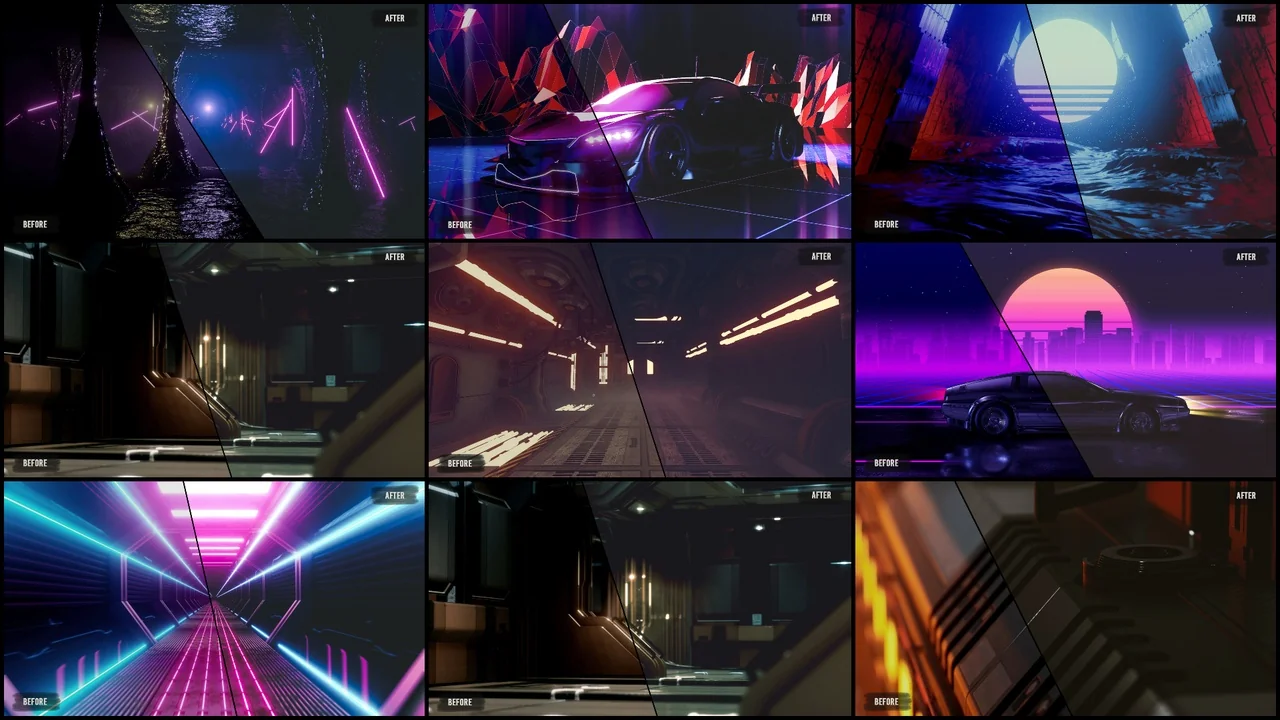
 Transition
 Variety
 Variety