"7e6fc58c410f2894"{"id":"1000471","slug":"ocean-environment-pack","title":"Ocean Environment Pack","category":"Aquatic","engine":"4.26+,5.0+","assetVersion":"","engineVersion":"Engine Version: 4.26+,5.0+","tag":"Aquatic","accent":"blue","visual":"city","summary":"A AAA-grade underwater environment built around dynamic depth lighting, spline-driven creature animation, and camera-attached particle effects for VR and mobile","platform":"Unreal Engine","publishedAt":"2026-07-11T18:13:59.324Z","updatedAt":"2026-07-11T18:13:59.324Z","sourceNotes":[],"fileContents":[],"compatibility":["Unreal Engine","Engine Version: 4.26+,5.0+"],"featuredImage":{"alt":"Ocean Environment Pack","src":"/wp-content/uploads/published/2026/07/2d0f500d6871-71936409-2cb0-4c8e-ad5c-3326000318b3-5a052adf0a.webp"},"hasDownloadLink":true,"downloads":1,"terms":[{"taxonomy":"category","slug":"aquatic","name":"Aquatic"}],"galleryImages":[{"src":"/wp-content/uploads/published/2026/07/124ab841f7d1-b8ebac65-55f6-421a-978a-5be16d008fa6-134295b307.webp","alt":"Ocean Environment Pack"},{"src":"/wp-content/uploads/published/2026/07/98e4b764d978-f82f9b75-7717-412e-8e1b-806e2307505c-c8abdd6522.webp","alt":"Ocean Environment Pack"},{"src":"/wp-content/uploads/published/2026/07/f3e17484510c-5a72ff88-a93a-44b9-9749-2b5e5f1799f0-036c5f5df9.webp","alt":"Ocean Environment Pack"},{"src":"/wp-content/uploads/published/2026/07/84b266443cf9-e49bcc6a-8142-4f84-ae3d-e34319226110-b25094c1d0.webp","alt":"Ocean Environment Pack"},{"src":"/wp-content/uploads/published/2026/07/13c6c172264f-ff48c352-7268-463c-b20c-21041b73022a-29bfd7cf13.webp","alt":"Ocean Environment Pack"},{"src":"/wp-content/uploads/published/2026/07/faf6160c63c3-95642c3c-cf42-40b0-903c-e2f822307a9f-5b038f1c13.webp","alt":"Ocean Environment Pack"},{"src":"/wp-content/uploads/published/2026/07/59b5a4112655-5a7d5c8d-0647-4dac-9a0a-0409a94cce38-11ebe0e67b.webp","alt":"Ocean Environment Pack"},{"src":"/wp-content/uploads/published/2026/07/84c0a1529665-dd7f6a3f-83b5-4996-afc0-c19cf5fc336b-c81e92f27d.webp","alt":"Ocean Environment Pack"},{"src":"/wp-content/uploads/published/2026/07/deb29136732b-326be563-f793-488c-a943-9c2f75ef6e80-8b513c82b4.webp","alt":"Ocean Environment Pack"},{"src":"/wp-content/uploads/published/2026/07/7f6ef82b005b-71172a22-0fed-4628-b8fe-af740eb415fd-6fbd00f6d6.webp","alt":"Ocean Environment Pack"}],"accessPanel":{"kind":"resource","title":"Download this resource","eyebrow":"Free Download","message":"Log in or create a free account to start your download.","fileName":"Content.7z","safetyNote":"Resources are manually reviewed before listing to improve quality and reduce obvious risks.","actionLabel":"Download Free","resourceType":"Resource archive"},"contentHtml":"\u003cp\u003eThe \u003cstrong\u003eOcean Environment Pack\u003c/strong\u003e Is structured around a set of interdependent blueprints and material systems that function together as a cohesive underwater scene. Rather than providing disconnected meshes or isolated effects, the package combines three primary blueprint systems—deep sea lighting, spline-based movement, and camera-attached dust motes—with a collection of particle effects and customizable landscape materials. This design gives artists the structural foundation necessary to build high-performance aquatic environments across desktop, VR, and mobile platforms.\u003c/p\u003e\u003ch2\u003eDeep Sea Lighting Blueprint: Static Volumetric and Dynamic Mobile Setups\u003c/h2\u003e\u003cp\u003eBy default, the environment uses static lighting and volumetric fog to drive shallow and deep sea lighting effects. On desktop or VR targets where volumetric fog is possible, artists can work with this default setup to achieve smooth depth transitions.\u003c/p\u003e\u003cp\u003eOn mobile platforms, however, volumetric fog is not available, so the pack uses a \u003cstrong\u003eDynamic Deep Sea Lighting Blueprint\u003c/strong\u003e To handle lighting instead. The blueprint lets the developer control fog color, fog thickness, and depth, while dynamically adjusting these properties in response to the player's height in the world. As the player descends, the lighting shifts to simulate the transition from shallow, sunlight-affected water to deep ocean conditions. This is a gameplay-driven lighting solution: the depth variable is tied to player position, not just an edited material parameter.\u003c/p\u003e\u003ch2\u003eOcean Spline System Blueprint: Controlling Creature Paths and Animation\u003c/h2\u003e\u003cp\u003eCreatures in the scene are animated and moved using the \u003cstrong\u003eOcean Spline System Blueprint\u003c/strong\u003e. Rather than relying on individual AI controllers or static placement, the system lets the creator define the path, mesh, movement speed, and material assignments for each creature. Animation speed and intensity can be modified directly from the spline system.\u003c/p\u003e\u003cp\u003ePerformance is a core driver of this setup. Every creature is animated using the \u003cstrong\u003eVertex Animation tool\u003c/strong\u003e, which keeps animation playback efficient by working on the vertex level rather than through complex skeletal evaluations. This approach allows the scene to accommodate a large number of creatures while still providing adjustable animation intensity through the spline controls.\u003c/p\u003e\u003ch2\u003eOcean Dust Mote Blueprint: Camera-Attached World-Space Particles\u003c/h2\u003e\u003cp\u003eUnderwater dust motes are handled by the \u003cstrong\u003eOcean Dust Mote Blueprint\u003c/strong\u003e, which is a targeted performance solution. The blueprint attaches a dust-mote emitter directly to the camera, ensuring that the visual effect is always present where the viewer is looking.\u003c/p\u003e\u003cp\u003eImportantly, the motes are spawned in world space, not relative to the camera. This separation is what prevents the need for track-wide emitter placement—because the motes exist in the world but the emitter itself moves with the camera, the effect maintains spatial consistency across the scene without requiring individual emitters scattered throughout the level. This design approach significantly boosts performance by consolidating a potentially costly effect into a single, player-bound emitter.\u003c/p\u003e\u003ch2\u003ePerformance-Optimized Fish and Realistic Underwater Particles\u003c/h2\u003e\u003cp\u003eBeyond the main blueprints, the pack includes scene effects built specifically for density and visual life. Artists can display hundreds of fish on screen simultaneously using particle-based fish, which are optimized to keep frame rates stable even at high visual density.\u003c/p\u003e\u003cp\u003eAdditional particle effects include realistic bubbles, descending and drifting through the water column to add atmosphere. The pack combines these bubbles with caustic sunlight, god rays, and swaying plant life to create an environment where water feels actively lit and filled with subtle motion, rather than presenting a static backdrop.\u003c/p\u003e\u003ch2\u003eLandscape Materials and Rock Surface Variations\u003c/h2\u003e\u003cp\u003eFor terrain shaping, the pack includes landscape materials that support world displacement and bump offset. These material properties allow terrain surfaces to be painted with detailed surface information across large areas, providing both macro geometry adjustments through displacement and micro surface detail through bump mapping.\u003c/p\u003e\u003cp\u003eRock materials come in three distinct variations: \u003cstrong\u003eBare\u003c/strong\u003e, \u003cstrong\u003eSandy\u003c/strong\u003e, and \u003cstrong\u003eVery Sandy\u003c/strong\u003e. Sand is procedurally placed on the rock material instances rather than manually applied or textured into the base mesh. This procedural placement means that the same rock asset can be used in different proximity-to-sand conditions without requiring unique mesh variants for each surface type.\u003c/p\u003e\u003ch2\u003eCustomizable Material Instances for Creatures, Plants, and Environment\u003c/h2\u003e\u003cp\u003eEvery material instance in the pack can be customized. This includes creatures, plants, and environmental assets, giving the developer direct control over the look and feel of each element without altering the underlying mesh or animation setup.\u003c/p\u003e\u003cp\u003eThis customization capability means that while the spline system controls path and movement, the visual identity of each creature—its color, texture variation, and surface properties—can be adjusted independently. The same applies to the materials assigned to plants and the procedural rock and landscape surfaces. Each scene element can be tuned to fit the specific artistic direction of the project.\u003c/p\u003e\u003ch2\u003ePlatform Fit and Project Application\u003c/h2\u003e\u003cp\u003eThe Ocean Environment Pack is optimized for VR and includes shader support for both Android and iOS. The dual lighting approach—volumetric for desktop and dynamic blueprint for mobile—provides a practical method for maintaining visual quality across the performance spectrum.\u003c/p\u003e\u003cp\u003eFor developers building aquatic scenes, the pack covers the primary technical demands of underwater environments: depth-based atmospheric transitions, large-scale creature movement, particle-based scene density, and detailed surfacing materials. The combination of spline-driven vertex animation and camera-attached particle logic is specifically built to support scenes where high visual density must be balanced with stable performance.\u003c/p\u003e\n\n\u003ch2\u003eRelated Resources Worth Checking\u003c/h2\u003e\n\u003cul\u003e\n\u003cli\u003e\u003ca href=\"https://3dcghub.com/ocean-monster-fish-pack-part-2-underwater-creatures-fish-low-poly-11/\" title=\"Ocean Monster Fish Pack - Part 2 - Underwater Creatures - Fish low poly - #11\"\u003eOcean Monster Fish Pack - Part 2 - Underwater Creatures - Fish low poly - #11\u003c/a\u003e\u003c/li\u003e\n\u003cli\u003e\u003ca href=\"https://3dcghub.com/ship-frigate/\" title=\"Ship Frigate\"\u003eShip Frigate\u003c/a\u003e\u003c/li\u003e\n\u003cli\u003e\u003ca href=\"https://3dcghub.com/coastal-wetland-and-railroad-bridge/\" title=\"Coastal Wetland \u0026amp; Railroad Bridge\"\u003eCoastal Wetland \u0026amp; Railroad Bridge\u003c/a\u003e\u003c/li\u003e\n\u003cli\u003e\u003ca href=\"https://3dcghub.com/underwater-sunken-ship-environment-underwater-sunken-ship-ship-underwater/\" title=\"Underwater Sunken Ship Environment ( Underwater Sunken Ship Ship Underwater )\"\u003eUnderwater Sunken Ship Environment ( Underwater Sunken Ship Ship Underwater )\u003c/a\u003e\u003c/li\u003e\n\u003cli\u003e\u003ca href=\"https://3dcghub.com/ships-graveyard/\" title=\"Ships Graveyard\"\u003eShips Graveyard\u003c/a\u003e\u003c/li\u003e\n\u003c/ul\u003e","contentTextLength":6270,"navigation":{"current":1287,"total":3618,"previous":{"id":"1000472","slug":"ocean-floor-environment","title":"Ocean Floor Environment","category":"Aquatic","platform":"Unreal Engine","updatedAt":"2026-07-11T18:23:23.992Z"},"next":{"id":"1000470","slug":"molecules-and-organisms-vfx","title":"Molecules and Organisms VFX","category":"Variety","platform":"Unreal Engine","updatedAt":"2026-07-11T18:04:56.784Z"}},"relatedResources":[{"id":"1000473","slug":"ocean-floor-pack-high-quality-environment","title":"Ocean Floor Pack / High Quality Environment","category":"Aquatic","engine":"4.26+,5.0+","assetVersion":"","engineVersion":"Engine Version: 4.26+,5.0+","tag":"Aquatic","accent":"blue","visual":"city","summary":"PBR underwater environment pack with modular props, custom adjustable materials, Lumen and raytracing support for Unreal Engine 4.26 through 5.7.","platform":"Unreal Engine","publishedAt":"2026-07-11T18:33:09.820Z","updatedAt":"2026-07-11T18:33:09.820Z","sourceNotes":[],"fileContents":[],"compatibility":["Unreal Engine","Engine Version: 4.26+,5.0+"],"featuredImage":{"alt":"Ocean Floor Pack / High Quality Environment","src":"/wp-content/uploads/published/2026/07/4e02d86d2636-0273b0a2-336d-44f8-bbd7-01a49baf6909-8dc01e3fcc.webp"},"hasDownloadLink":true,"downloads":0},{"id":"1000472","slug":"ocean-floor-environment","title":"Ocean Floor Environment","category":"Aquatic","engine":"4.26+,5.0+","assetVersion":"","engineVersion":"Engine Version: 4.26+,5.0+","tag":"Aquatic","accent":"blue","visual":"city","summary":"Underwater environment with tessellated rocks, paintable vegetation, parallax terrain, skeletal eel animations, and particle-based fish schools built for Unreal","platform":"Unreal Engine","publishedAt":"2026-07-11T18:23:23.992Z","updatedAt":"2026-07-11T18:23:23.992Z","sourceNotes":[],"fileContents":[],"compatibility":["Unreal Engine","Engine Version: 4.26+,5.0+"],"featuredImage":{"alt":"Ocean Floor Environment","src":"/wp-content/uploads/published/2026/07/5585cf498eb1-57cb393f-cf6a-4c31-98a0-038a19e471e6-fbf4795892.webp"},"hasDownloadLink":true,"downloads":0},{"id":"1001071","slug":"underwater-world-modular-underwater-stylized-underwater-ocean-sea","title":"Underwater World - Modular Underwater - Stylized Underwater - Ocean - Sea","category":"Aquatic","engine":"5.1+","assetVersion":"","engineVersion":"Engine Version: 5.1+","tag":"Aquatic","accent":"blue","visual":"mech","summary":"Stylized underwater environment kit with modular pieces, color-adjustable foliage, coral blueprints, ocean floor material, and VFX for JRPG/MMO worlds.","platform":"Unreal Engine","publishedAt":"2026-09-03T17:16:49.746Z","updatedAt":"2026-09-03T17:16:49.746Z","sourceNotes":[],"fileContents":[],"compatibility":["Unreal Engine","Engine Version: 5.1+"],"featuredImage":{"alt":"Underwater World - Modular Underwater - Stylized Underwater - Ocean - Sea","src":"/wp-content/uploads/published/2026/09/d13197e9332c-b95e10df-a732-4a72-b4b9-db379972cb8f-da5ad2b3cf.webp"},"hasDownloadLink":true,"downloads":1}]}
Aquatic
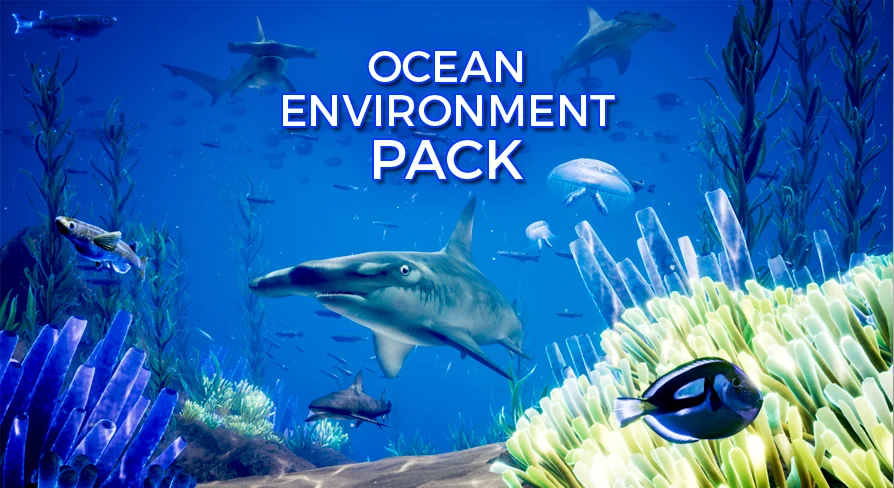
Ocean Environment Pack
A AAA-grade underwater environment built around dynamic depth lighting, spline-driven creature animation, and camera-attached particle effects for VR and mobile
The Ocean Environment Pack Is structured around a set of interdependent blueprints and material systems that function together as a cohesive underwater scene. Rather than providing disconnected meshes or isolated effects, the package combines three primary blueprint systems—deep sea lighting, spline-based movement, and camera-attached dust motes—with a collection of particle effects and customizable landscape materials. This design gives artists the structural foundation necessary to build high-performance aquatic environments across desktop, VR, and mobile platforms.
Deep Sea Lighting Blueprint: Static Volumetric and Dynamic Mobile Setups
By default, the environment uses static lighting and volumetric fog to drive shallow and deep sea lighting effects. On desktop or VR targets where volumetric fog is possible, artists can work with this default setup to achieve smooth depth transitions.
On mobile platforms, however, volumetric fog is not available, so the pack uses a Dynamic Deep Sea Lighting Blueprint To handle lighting instead. The blueprint lets the developer control fog color, fog thickness, and depth, while dynamically adjusting these properties in response to the player's height in the world. As the player descends, the lighting shifts to simulate the transition from shallow, sunlight-affected water to deep ocean conditions. This is a gameplay-driven lighting solution: the depth variable is tied to player position, not just an edited material parameter.
Ocean Spline System Blueprint: Controlling Creature Paths and Animation
Creatures in the scene are animated and moved using the Ocean Spline System Blueprint. Rather than relying on individual AI controllers or static placement, the system lets the creator define the path, mesh, movement speed, and material assignments for each creature. Animation speed and intensity can be modified directly from the spline system.
Performance is a core driver of this setup. Every creature is animated using the Vertex Animation tool, which keeps animation playback efficient by working on the vertex level rather than through complex skeletal evaluations. This approach allows the scene to accommodate a large number of creatures while still providing adjustable animation intensity through the spline controls.
Underwater dust motes are handled by the Ocean Dust Mote Blueprint, which is a targeted performance solution. The blueprint attaches a dust-mote emitter directly to the camera, ensuring that the visual effect is always present where the viewer is looking.
Importantly, the motes are spawned in world space, not relative to the camera. This separation is what prevents the need for track-wide emitter placement—because the motes exist in the world but the emitter itself moves with the camera, the effect maintains spatial consistency across the scene without requiring individual emitters scattered throughout the level. This design approach significantly boosts performance by consolidating a potentially costly effect into a single, player-bound emitter.
Performance-Optimized Fish and Realistic Underwater Particles
Beyond the main blueprints, the pack includes scene effects built specifically for density and visual life. Artists can display hundreds of fish on screen simultaneously using particle-based fish, which are optimized to keep frame rates stable even at high visual density.
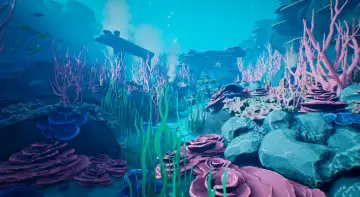
Additional particle effects include realistic bubbles, descending and drifting through the water column to add atmosphere. The pack combines these bubbles with caustic sunlight, god rays, and swaying plant life to create an environment where water feels actively lit and filled with subtle motion, rather than presenting a static backdrop.
Landscape Materials and Rock Surface Variations
For terrain shaping, the pack includes landscape materials that support world displacement and bump offset. These material properties allow terrain surfaces to be painted with detailed surface information across large areas, providing both macro geometry adjustments through displacement and micro surface detail through bump mapping.
Rock materials come in three distinct variations: Bare, Sandy, and Very Sandy. Sand is procedurally placed on the rock material instances rather than manually applied or textured into the base mesh. This procedural placement means that the same rock asset can be used in different proximity-to-sand conditions without requiring unique mesh variants for each surface type.
Customizable Material Instances for Creatures, Plants, and Environment
Every material instance in the pack can be customized. This includes creatures, plants, and environmental assets, giving the developer direct control over the look and feel of each element without altering the underlying mesh or animation setup.
This customization capability means that while the spline system controls path and movement, the visual identity of each creature—its color, texture variation, and surface properties—can be adjusted independently. The same applies to the materials assigned to plants and the procedural rock and landscape surfaces. Each scene element can be tuned to fit the specific artistic direction of the project.
Platform Fit and Project Application
The Ocean Environment Pack is optimized for VR and includes shader support for both Android and iOS. The dual lighting approach—volumetric for desktop and dynamic blueprint for mobile—provides a practical method for maintaining visual quality across the performance spectrum.
For developers building aquatic scenes, the pack covers the primary technical demands of underwater environments: depth-based atmospheric transitions, large-scale creature movement, particle-based scene density, and detailed surfacing materials. The combination of spline-driven vertex animation and camera-attached particle logic is specifically built to support scenes where high visual density must be balanced with stable performance.
 Aquatic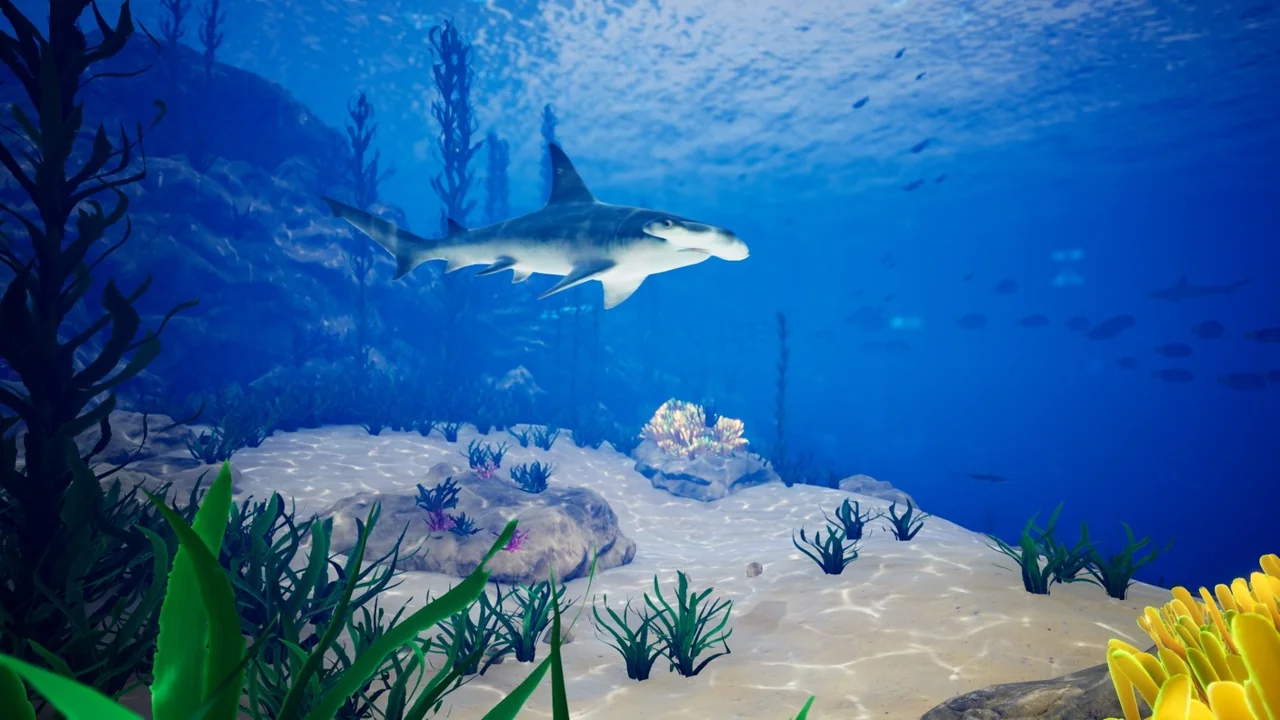
 Aquatic
 Aquatic
 Aquatic