"7e6fc58c410f2894"{"id":"1000472","slug":"ocean-floor-environment","title":"Ocean Floor Environment","category":"Aquatic","engine":"4.26+,5.0+","assetVersion":"","engineVersion":"Engine Version: 4.26+,5.0+","tag":"Aquatic","accent":"blue","visual":"city","summary":"Underwater environment with tessellated rocks, paintable vegetation, parallax terrain, skeletal eel animations, and particle-based fish schools built for Unreal","platform":"Unreal Engine","publishedAt":"2026-07-11T18:23:23.992Z","updatedAt":"2026-07-11T18:23:23.992Z","sourceNotes":[],"fileContents":[],"compatibility":["Unreal Engine","Engine Version: 4.26+,5.0+"],"featuredImage":{"alt":"Ocean Floor Environment","src":"/wp-content/uploads/published/2026/07/5585cf498eb1-57cb393f-cf6a-4c31-98a0-038a19e471e6-fbf4795892.webp"},"hasDownloadLink":true,"downloads":0,"terms":[{"taxonomy":"category","slug":"aquatic","name":"Aquatic"}],"galleryImages":[{"src":"/wp-content/uploads/published/2026/07/dd57f1c3935b-59228171-6d9b-4ee1-9c85-11517aeb51fc-c30eb82a67.webp","alt":"Ocean Floor Environment"},{"src":"/wp-content/uploads/published/2026/07/6ea930dd4b16-cc99420a-aed2-4375-96cd-17747dabaa30-ee48fbf590.webp","alt":"Ocean Floor Environment"},{"src":"/wp-content/uploads/published/2026/07/6a737ffa9223-7b987d35-7b0e-4ec5-bd70-bbcc21991d44-c671121a52.webp","alt":"Ocean Floor Environment"},{"src":"/wp-content/uploads/published/2026/07/60cb4af95d4f-add12b89-a565-4620-a2f5-5f04fa2e22de-063c3628dc.webp","alt":"Ocean Floor Environment"},{"src":"/wp-content/uploads/published/2026/07/20b4bdc8817e-1d08bfd5-e55d-4530-aa8e-23cd690f3c17-8cd7eb1d12.webp","alt":"Ocean Floor Environment"},{"src":"/wp-content/uploads/published/2026/07/80b7f3355f00-05eca6cd-fdd3-4fc3-8bb9-662d86c0e753-bccf371d91.webp","alt":"Ocean Floor Environment"},{"src":"/wp-content/uploads/published/2026/07/a20c3e83b910-0159a666-0e8e-4f46-9c22-a5b48f574d3c-102f2af17f.webp","alt":"Ocean Floor Environment"},{"src":"/wp-content/uploads/published/2026/07/69818b51bbc9-28bb0dd0-c518-4b59-b177-52e7dba6539a-5d70ec7db0.webp","alt":"Ocean Floor Environment"},{"src":"/wp-content/uploads/published/2026/07/50f7e52f817a-83faf7e3-b393-48b2-a708-a1aab46aa5f3-4e21acb5f5.webp","alt":"Ocean Floor Environment"},{"src":"/wp-content/uploads/published/2026/07/919e46515864-0f3f2125-d913-4233-9ca1-599c7c70282e-bffc283c38.webp","alt":"Ocean Floor Environment"}],"accessPanel":{"kind":"resource","title":"Download this resource","eyebrow":"Free Download","message":"Log in or create a free account to start your download.","fileName":"Content.7z","safetyNote":"Resources are manually reviewed before listing to improve quality and reduce obvious risks.","actionLabel":"Download Free","resourceType":"Resource archive"},"contentHtml":"\u003cp\u003eBuilding believable underwater scenes in a game engine requires assets that go beyond static meshes. The depth of an ocean floor comes from layered materials, surface displacement, ambient occlusion, and life moving through the water. \u003cstrong\u003eOcean Floor Environment\u003c/strong\u003e Addresses these needs for Unreal Engine projects by combining tessellated rock formations, a multi-layered terrain material, wreckage props with grime controls, and animated marine life.\u003c/p\u003e\u003ch2\u003eRock meshes with tessellation and sand layering\u003c/h2\u003e\u003cp\u003eThe package includes five rock meshes, each based on displacement and tessellation. Rather than relying on baked normal maps alone, these surface definitions shift dynamically based on camera and geometry. This approach provides smoother silhouettes and more natural surface variation across the environment. Each rock also comes with a material instance, allowing developers to control the amount of sand sitting on the surface. This means the same rock mesh can be used in a heavily silted area or much cleaner rocky outcropping without duplicating assets.\u003c/p\u003e\u003ch2\u003eTwo-layer terrain material and texture sampler management\u003c/h2\u003e\u003cp\u003eThe terrain material uses parallax mapping to simulate depth across the ground surface. Parallax helps the ocean floor feel like an actual surface with substance, rather than a flat plane with a color map. The terrain is structured into two material layers, providing flexibility for blending different ground types across the level.\u003c/p\u003e\u003cp\u003eA key technical consideration with the terrain material is sampler count. The material operates on only 6 out of the available 16 texture samplers within the engine. This sampler efficiency is critical for performance and compatibility. By staying well under the sampler limit, the terrain material leaves room for other complex material operations or features within the scene.\u003c/p\u003e\u003ch2\u003ePaintable vegetation and instanced wreckage materials\u003c/h2\u003e\u003cp\u003ePopulating the ocean floor with plant life relies on Unreal Engine's vegetation tools. All vegetation included in the environment is paintable, allowing developers to manually place, distribute, and scatter plant meshes across a landscape or mesh surface. This workflow gives direct, visual control over environmental density.\u003c/p\u003e\u003cp\u003eThe environment also features major set pieces in the form of a plane and submarine wreckage. Both of these assets utilize instanced materials. This setup exposes parameters for adjusting the accumulation of algae and sand. Being able to dial in these values per instance means a portion of the plane closer to the sand bed can look much more heavily encrusted than a portion sitting higher in the water column.\u003c/p\u003e\u003ch2\u003eAnimated marine life: Eel skeletal mesh and fish particle systems\u003c/h2\u003e\u003cp\u003eAdding movement to the environment, the package includes an eel as a skeletal mesh. The eel comes equipped with three animations, allowing for varied movement patterns within a scene.\u003c/p\u003e\u003cp\u003eFish schools in the environment are handled through Unreal Engine's particle system. This approach treats immense populations of small fish as a particle effect rather than individually simulating hundreds of skeletal meshes. Using particle systems for schools is a highly efficient way to simulate dense, moving marine life without incurring the overhead of complex AI or heavy skeletal animation calculations for each individual entity.\u003c/p\u003e\u003ch2\u003eDistance field ambient occlusion for the demo scene\u003c/h2\u003e\u003cp\u003eTo achieve the intended visual fidelity, the demo scene recommends enabling Distance Field Ambient Occlusion (DFAO). This setting is accessed through the engine settings. DFAO calculates ambient occlusion dynamically using mesh distance fields. For an underwater environment, this is particularly relevant for the deep crevices, rock arrangements, and sunken wreckage.\u003c/p\u003e\u003cp\u003eEnabling this feature provides more grounded, realistic contact shadows and helps ground the wreckage and rock meshes into the terrain. The creator points this out specifically as a step for improving the visual look of the provided demo scene, meaning the best visual results rely on this specific engine feature being active.\u003c/p\u003e\u003ch2\u003ePutting the ocean floor together in Unreal Engine\u003c/h2\u003e\u003cp\u003eFrom an implementation standpoint, this asset package covers several technical pillars of environment design. The displacement and tessellation on the rocks provide high-fidelity surface details. The terrain's low sampler count keeps the environment optimized. The instanced materials on the wreckage handle asset storytelling by visualizing decay. The paintable vegetation and particle-based life fill the space with movement.\u003c/p\u003e\u003cp\u003eWhen planning to use this package, the main implementation hurdle revolves around enabling Distance Field Ambient Occlusion to match the intended visual quality. Developers working with Unreal Engine versions across the 4.x lineage up through early 5.x builds can utilize these assets. Combining the enabled ambient occlusion, the sand-blended rock instances, and the particle fish schools results in a dynamic, underwater level ready for expansion.\u003c/p\u003e\n\n\u003ch2\u003eExplore Similar Assets\u003c/h2\u003e\n\u003cul\u003e\n\u003cli\u003e\u003ca href=\"https://3dcghub.com/ocean-environment-pack/\" title=\"Ocean Environment Pack\"\u003eOcean Environment Pack\u003c/a\u003e\u003c/li\u003e\n\u003cli\u003e\u003ca href=\"https://3dcghub.com/ship-frigate/\" title=\"Ship Frigate\"\u003eShip Frigate\u003c/a\u003e\u003c/li\u003e\n\u003cli\u003e\u003ca href=\"https://3dcghub.com/coastal-wetland-and-railroad-bridge/\" title=\"Coastal Wetland \u0026amp; Railroad Bridge\"\u003eCoastal Wetland \u0026amp; Railroad Bridge\u003c/a\u003e\u003c/li\u003e\n\u003cli\u003e\u003ca href=\"https://3dcghub.com/underwater-sunken-ship-environment-underwater-sunken-ship-ship-underwater/\" title=\"Underwater Sunken Ship Environment ( Underwater Sunken Ship Ship Underwater )\"\u003eUnderwater Sunken Ship Environment ( Underwater Sunken Ship Ship Underwater )\u003c/a\u003e\u003c/li\u003e\n\u003cli\u003e\u003ca href=\"https://3dcghub.com/ships-graveyard/\" title=\"Ships Graveyard\"\u003eShips Graveyard\u003c/a\u003e\u003c/li\u003e\n\u003c/ul\u003e","contentTextLength":5173,"navigation":{"current":1286,"total":3618,"previous":{"id":"1000473","slug":"ocean-floor-pack-high-quality-environment","title":"Ocean Floor Pack / High Quality Environment","category":"Aquatic","platform":"Unreal Engine","updatedAt":"2026-07-11T18:33:09.820Z"},"next":{"id":"1000471","slug":"ocean-environment-pack","title":"Ocean Environment Pack","category":"Aquatic","platform":"Unreal Engine","updatedAt":"2026-07-11T18:13:59.324Z"}},"relatedResources":[{"id":"1000473","slug":"ocean-floor-pack-high-quality-environment","title":"Ocean Floor Pack / High Quality Environment","category":"Aquatic","engine":"4.26+,5.0+","assetVersion":"","engineVersion":"Engine Version: 4.26+,5.0+","tag":"Aquatic","accent":"blue","visual":"city","summary":"PBR underwater environment pack with modular props, custom adjustable materials, Lumen and raytracing support for Unreal Engine 4.26 through 5.7.","platform":"Unreal Engine","publishedAt":"2026-07-11T18:33:09.820Z","updatedAt":"2026-07-11T18:33:09.820Z","sourceNotes":[],"fileContents":[],"compatibility":["Unreal Engine","Engine Version: 4.26+,5.0+"],"featuredImage":{"alt":"Ocean Floor Pack / High Quality Environment","src":"/wp-content/uploads/published/2026/07/4e02d86d2636-0273b0a2-336d-44f8-bbd7-01a49baf6909-8dc01e3fcc.webp"},"hasDownloadLink":true,"downloads":0},{"id":"1001071","slug":"underwater-world-modular-underwater-stylized-underwater-ocean-sea","title":"Underwater World - Modular Underwater - Stylized Underwater - Ocean - Sea","category":"Aquatic","engine":"5.1+","assetVersion":"","engineVersion":"Engine Version: 5.1+","tag":"Aquatic","accent":"blue","visual":"mech","summary":"Stylized underwater environment kit with modular pieces, color-adjustable foliage, coral blueprints, ocean floor material, and VFX for JRPG/MMO worlds.","platform":"Unreal Engine","publishedAt":"2026-09-03T17:16:49.746Z","updatedAt":"2026-09-03T17:16:49.746Z","sourceNotes":[],"fileContents":[],"compatibility":["Unreal Engine","Engine Version: 5.1+"],"featuredImage":{"alt":"Underwater World - Modular Underwater - Stylized Underwater - Ocean - Sea","src":"/wp-content/uploads/published/2026/09/d13197e9332c-b95e10df-a732-4a72-b4b9-db379972cb8f-da5ad2b3cf.webp"},"hasDownloadLink":true,"downloads":1},{"id":"1000471","slug":"ocean-environment-pack","title":"Ocean Environment Pack","category":"Aquatic","engine":"4.26+,5.0+","assetVersion":"","engineVersion":"Engine Version: 4.26+,5.0+","tag":"Aquatic","accent":"blue","visual":"city","summary":"A AAA-grade underwater environment built around dynamic depth lighting, spline-driven creature animation, and camera-attached particle effects for VR and mobile","platform":"Unreal Engine","publishedAt":"2026-07-11T18:13:59.324Z","updatedAt":"2026-07-11T18:13:59.324Z","sourceNotes":[],"fileContents":[],"compatibility":["Unreal Engine","Engine Version: 4.26+,5.0+"],"featuredImage":{"alt":"Ocean Environment Pack","src":"/wp-content/uploads/published/2026/07/2d0f500d6871-71936409-2cb0-4c8e-ad5c-3326000318b3-5a052adf0a.webp"},"hasDownloadLink":true,"downloads":1}]}
Aquatic
Ocean Floor Environment
Underwater environment with tessellated rocks, paintable vegetation, parallax terrain, skeletal eel animations, and particle-based fish schools built for Unreal
Building believable underwater scenes in a game engine requires assets that go beyond static meshes. The depth of an ocean floor comes from layered materials, surface displacement, ambient occlusion, and life moving through the water. Ocean Floor Environment Addresses these needs for Unreal Engine projects by combining tessellated rock formations, a multi-layered terrain material, wreckage props with grime controls, and animated marine life.
Rock meshes with tessellation and sand layering
The package includes five rock meshes, each based on displacement and tessellation. Rather than relying on baked normal maps alone, these surface definitions shift dynamically based on camera and geometry. This approach provides smoother silhouettes and more natural surface variation across the environment. Each rock also comes with a material instance, allowing developers to control the amount of sand sitting on the surface. This means the same rock mesh can be used in a heavily silted area or much cleaner rocky outcropping without duplicating assets.
Two-layer terrain material and texture sampler management
The terrain material uses parallax mapping to simulate depth across the ground surface. Parallax helps the ocean floor feel like an actual surface with substance, rather than a flat plane with a color map. The terrain is structured into two material layers, providing flexibility for blending different ground types across the level.
A key technical consideration with the terrain material is sampler count. The material operates on only 6 out of the available 16 texture samplers within the engine. This sampler efficiency is critical for performance and compatibility. By staying well under the sampler limit, the terrain material leaves room for other complex material operations or features within the scene.
Paintable vegetation and instanced wreckage materials
Populating the ocean floor with plant life relies on Unreal Engine's vegetation tools. All vegetation included in the environment is paintable, allowing developers to manually place, distribute, and scatter plant meshes across a landscape or mesh surface. This workflow gives direct, visual control over environmental density.
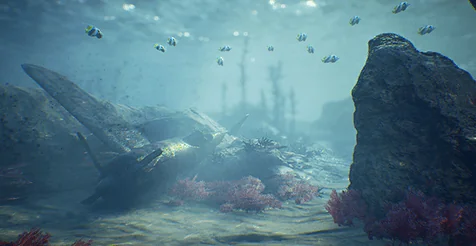
The environment also features major set pieces in the form of a plane and submarine wreckage. Both of these assets utilize instanced materials. This setup exposes parameters for adjusting the accumulation of algae and sand. Being able to dial in these values per instance means a portion of the plane closer to the sand bed can look much more heavily encrusted than a portion sitting higher in the water column.
Animated marine life: Eel skeletal mesh and fish particle systems
Adding movement to the environment, the package includes an eel as a skeletal mesh. The eel comes equipped with three animations, allowing for varied movement patterns within a scene.
Fish schools in the environment are handled through Unreal Engine's particle system. This approach treats immense populations of small fish as a particle effect rather than individually simulating hundreds of skeletal meshes. Using particle systems for schools is a highly efficient way to simulate dense, moving marine life without incurring the overhead of complex AI or heavy skeletal animation calculations for each individual entity.
Distance field ambient occlusion for the demo scene
To achieve the intended visual fidelity, the demo scene recommends enabling Distance Field Ambient Occlusion (DFAO). This setting is accessed through the engine settings. DFAO calculates ambient occlusion dynamically using mesh distance fields. For an underwater environment, this is particularly relevant for the deep crevices, rock arrangements, and sunken wreckage.
Enabling this feature provides more grounded, realistic contact shadows and helps ground the wreckage and rock meshes into the terrain. The creator points this out specifically as a step for improving the visual look of the provided demo scene, meaning the best visual results rely on this specific engine feature being active.
Putting the ocean floor together in Unreal Engine
From an implementation standpoint, this asset package covers several technical pillars of environment design. The displacement and tessellation on the rocks provide high-fidelity surface details. The terrain's low sampler count keeps the environment optimized. The instanced materials on the wreckage handle asset storytelling by visualizing decay. The paintable vegetation and particle-based life fill the space with movement.
When planning to use this package, the main implementation hurdle revolves around enabling Distance Field Ambient Occlusion to match the intended visual quality. Developers working with Unreal Engine versions across the 4.x lineage up through early 5.x builds can utilize these assets. Combining the enabled ambient occlusion, the sand-blended rock instances, and the particle fish schools results in a dynamic, underwater level ready for expansion.
 Aquatic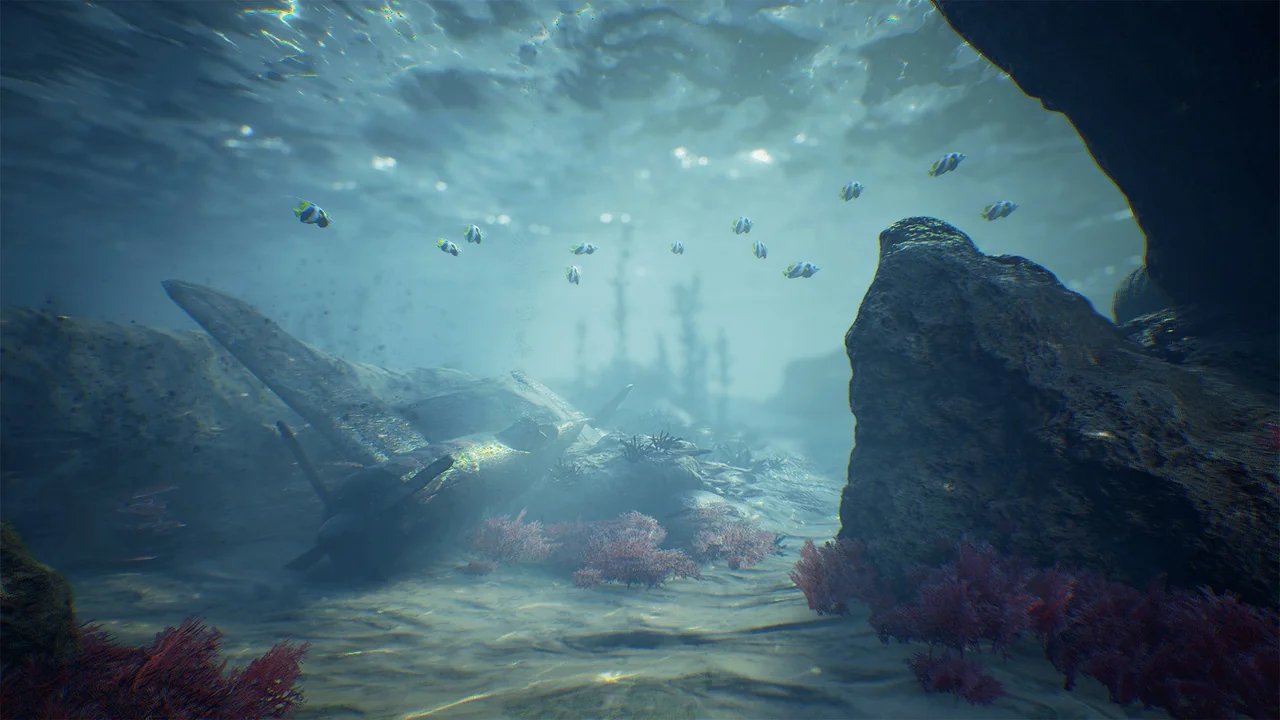
 Aquatic
 Aquatic
 Aquatic