"7b46a695175d8694"{"id":"1000356","slug":"coastal-wetland-and-railroad-bridge","title":"Coastal Wetland \u0026 Railroad Bridge","category":"Aquatic","engine":"5.3+","assetVersion":"","engineVersion":"Engine Version: 5.3+","tag":"Aquatic","accent":"blue","visual":"mech","summary":"Implement a realistic, photogrammetry-based coastal wetland environment featuring an advanced spline system for routing railways, bridges, and pipelines.","platform":"Unreal Engine","publishedAt":"2026-07-05T12:53:33.383Z","updatedAt":"2026-07-05T12:53:33.383Z","sourceNotes":[],"fileContents":[],"compatibility":["Unreal Engine","Engine Version: 5.3+"],"featuredImage":{"alt":"Coastal Wetland \u0026 Railroad Bridge","src":"/wp-content/uploads/published/2026/07/04370a897459-9be3dda6-52ea-43d6-88b7-1976103d39a3-220ada14e5.webp"},"hasDownloadLink":true,"downloads":0,"terms":[{"taxonomy":"category","slug":"aquatic","name":"Aquatic"}],"galleryImages":[{"src":"/wp-content/uploads/published/2026/07/4061c86879de-b04516a8-7b23-4b48-9b2a-5d929436b5d7-3027dd9f46.webp","alt":"Coastal Wetland \u0026 Railroad Bridge"},{"src":"/wp-content/uploads/published/2026/07/c052d2d1a314-2c25cf12-b714-4507-8c4f-e29ac9e5fec5-d4f188d28e.webp","alt":"Coastal Wetland \u0026 Railroad Bridge"},{"src":"/wp-content/uploads/published/2026/07/3db6348eed6e-6c4139c7-2e42-4e75-842a-2cf0e7625fbd-6da4e383d4.webp","alt":"Coastal Wetland \u0026 Railroad Bridge"},{"src":"/wp-content/uploads/published/2026/07/203efda27ab3-a55600e7-64ba-4e26-8282-db1e55631ab9-830fcd6f6b.webp","alt":"Coastal Wetland \u0026 Railroad Bridge"},{"src":"/wp-content/uploads/published/2026/07/c71e8a919abc-1cba90d4-0123-43b6-9f3a-5ee07d37302a-0bbb2b9cce.webp","alt":"Coastal Wetland \u0026 Railroad Bridge"},{"src":"/wp-content/uploads/published/2026/07/f3cb094f93a7-75154935-4935-4fa2-b977-2b1c796efad3-3bbb596814.webp","alt":"Coastal Wetland \u0026 Railroad Bridge"},{"src":"/wp-content/uploads/published/2026/07/3fc72e108956-8b712da2-e091-4c7b-b612-56d98eb2b279-141ad53141.webp","alt":"Coastal Wetland \u0026 Railroad Bridge"},{"src":"/wp-content/uploads/published/2026/07/449196d360ad-93dae180-6127-4b9d-a00d-b4551ea637f2-5908e4e856.webp","alt":"Coastal Wetland \u0026 Railroad Bridge"},{"src":"/wp-content/uploads/published/2026/07/54bbb9bb171e-bb738634-43ff-401d-a8b2-a2896c18d55a-1e53a432b3.webp","alt":"Coastal Wetland \u0026 Railroad Bridge"}],"accessPanel":{"kind":"resource","title":"Download this resource","eyebrow":"Free Download","message":"Log in or create a free account to start your download.","fileName":"Coastal Wetland \u0026 Railroad Bridge.7z","safetyNote":"Resources are manually reviewed before listing to improve quality and reduce obvious risks.","actionLabel":"Download Free","resourceType":"Resource archive"},"contentHtml":"\u003ch2\u003eInitial Project Configuration and Plugin Dependencies\u003c/h2\u003e\n\u003cp\u003eIntegrating the Coastal Wetland \u0026 Railroad Bridge into a production pipeline requires careful attention to project-level settings to ensure the environment loads correctly. When opening the main level, developers may encounter loading issues if the package is treated strictly as a standard asset pack. To avoid missing dependencies and map errors, it is highly recommended to download the package as an entire, standalone project rather than migrating it into an existing framework prematurely.\u003c/p\u003e\n\u003cp\u003eBefore launching the example levels, a specific suite of Unreal Engine plugins must be enabled to support the environment's terrain, water, and lighting features. The required plugins include \u003cstrong\u003eHDRIBackdrop\u003c/strong\u003e, \u003cstrong\u003eLandmass\u003c/strong\u003e, \u003cstrong\u003eSunPosition\u003c/strong\u003e, \u003cstrong\u003eGPULightmass\u003c/strong\u003e, \u003cstrong\u003eWater\u003c/strong\u003e, and \u003cstrong\u003eShallowWater\u003c/strong\u003e. Activating these modules is non-negotiable for proper level initialization. The Water and ShallowWater plugins are particularly critical, as they drive the fluid surfaces where the environment's central river meets the sea. Similarly, Landmass handles the underlying terrain manipulation required for the swamp and coastal areas, while HDRIBackdrop, SunPosition, and GPULightmass form the backbone of the project's lighting architecture.\u003c/p\u003e\n\u003ch2\u003eLighting Setup and Auto Exposure Tuning\u003c/h2\u003e\n\u003cp\u003eOnce the project files are successfully loaded and the dependencies are active, the rendering pipeline must be configured to match the intended environmental design. The Coastal Wetland \u0026 Railroad Bridge relies entirely on dynamic lighting to illuminate its scenes, utilizing advanced engine features to achieve its realistic visual quality.\u003c/p\u003e\n\u003cp\u003eFor the lighting to calculate accurately across the complex photogrammetry meshes and modular infrastructure, developers must enable both Distance Field Meshes and Screen Space Global Illumination (SSGI). Distance Field Meshes provide the necessary occlusion and dynamic shadowing required for dense areas like the fishing docks and elevated railway tracks, while SSGI ensures that bounce lighting behaves naturally when reflecting off the polluted water surfaces and concrete bridge undersides.\u003c/p\u003e\n\u003cp\u003eA critical adjustment is required within the engine's camera settings to render the example levels correctly. Developers must navigate to the Auto Exposure Settings and check the box labeled \"Extend Default Luminance Range.\" Skipping this step will result in incorrect exposure ranges across the example maps, leading to blown-out highlights in the sky or crushed, pitch-black shadows beneath the concrete structures. Extending the luminance range allows the auto-exposure system to properly meter the stark contrast between the bright coastal skies and the shadowed, murky swamp areas.\u003c/p\u003e\n\u003ch2\u003eSpline Mechanics for Railroads and Concrete Bridges\u003c/h2\u003e\n\u003cp\u003eThe core structural element of this environment is an advanced spline system designed to generate continuous industrial architecture across the polluted coastal zone. Rather than relying solely on static mesh placement, developers can use these splines to draw infrastructure directly across the terrain and water surfaces, bending and routing the old railway as it snakes along the coastline.\u003c/p\u003e\n\u003cp\u003eThe spline tools are highly versatile, supporting the construction of various track and bridge types. Users can route standard railroads through the swamp, elevate pathways using heavy concrete box girder bridges, and implement functional-looking lift bridges over the deeper waterways. This flexibility allows for rapid iteration when designing the layout of the coastal transport network.\u003c/p\u003e\n\u003cp\u003eBeyond the railway itself, the spline system extends to supporting secondary industrial elements. Level designers can drag out lines of utility poles alongside the tracks or route winding gas pipelines through the muddy banks and dock areas. A defining feature of this system is its snapping capability. Individual splines can snap together seamlessly, allowing developers to connect different infrastructure lines, merge railway tracks, and generate complex structural intersections without manually aligning individual vertices.\u003c/p\u003e\n\u003ch2\u003eEnvironmental Theming and Photogrammetry\u003c/h2\u003e\n\u003cp\u003eThematically, the assets are built to construct a degraded, polluted coastal zone. The modular pieces and photogrammetry-based meshes come together to form realistic industrial sectors situated in swamps or alongside fishing docks. By utilizing the required Water plugins, the environment accurately represents a transitional ecosystem where a murky river empties out into the sea.\u003c/p\u003e\n\u003cp\u003eThe inclusion of photogrammetry ensures that the natural and man-made elements maintain a high degree of surface realism. The muddy banks, coastal debris, and weathered concrete blend together to create a cohesive atmosphere of an abandoned or heavily polluted railway line. The modular nature of the pack allows these realistic pieces to be reconfigured into various dockland, swamp, or deep-water level layouts depending on the needs of the project.\u003c/p\u003e\n\u003ch2\u003eTexel Density and VR Readiness\u003c/h2\u003e\n\u003cp\u003eTo ensure the photogrammetry and modular meshes hold up under close scrutiny, the assets are optimized and configured by default for First-Person and Virtual Reality (VR) applications. The developer has standardized the texture resolution across the entire package, establishing a strict, unified texel ratio of 10.24 pixels per meter (ppm) for all included assets.\u003c/p\u003e\n\u003cp\u003eMaintaining a consistent 10.24ppm ensures that when a VR player or first-person camera approaches the concrete box girder bridges, rusted gas pipelines, or wooden fishing dock elements, the surface details remain sharp and uniform. This deliberate approach to texel density prevents immersion-breaking resolution drops. Whether the camera is viewing a distant lift bridge or inspecting the immediate ground surface of the polluted swamp, the texture quality remains consistent, providing a stable and realistic visual experience tailored specifically for immersive viewpoints.\u003c/p\u003e\n\n\u003ch2\u003eContinue Browsing Similar Packs\u003c/h2\u003e\n\u003cul\u003e\n\u003cli\u003e\u003ca href=\"https://3dcghub.com/underwater-sunken-ship-environment-underwater-sunken-ship-ship-underwater/\" title=\"Underwater Sunken Ship Environment ( Underwater Sunken Ship Ship Underwater )\"\u003eUnderwater Sunken Ship Environment ( Underwater Sunken Ship Ship Underwater )\u003c/a\u003e\u003c/li\u003e\n\u003cli\u003e\u003ca href=\"https://3dcghub.com/ship-frigate/\" title=\"Ship Frigate\"\u003eShip Frigate\u003c/a\u003e\u003c/li\u003e\n\u003cli\u003e\u003ca href=\"https://3dcghub.com/ships-graveyard/\" title=\"Ships Graveyard\"\u003eShips Graveyard\u003c/a\u003e\u003c/li\u003e\n\u003cli\u003e\u003ca href=\"https://3dcghub.com/victorian-train-station-and-railroad-modular-set/\" title=\"Victorian Train Station and Railroad Modular Set\"\u003eVictorian Train Station and Railroad Modular Set\u003c/a\u003e\u003c/li\u003e\n\u003cli\u003e\u003ca href=\"https://3dcghub.com/wooden-bridges-optimized/\" title=\"Wooden Bridges Optimized\"\u003eWooden Bridges Optimized\u003c/a\u003e\u003c/li\u003e\n\u003c/ul\u003e","contentTextLength":6156,"navigation":{"current":1265,"total":3481,"previous":{"id":"1000357","slug":"fantasy-girls-pack","title":"Fantasy Girls Pack","category":"Characters \u0026 Creatures","platform":"Unreal Engine","updatedAt":"2026-07-05T13:25:36.860Z"},"next":{"id":"1000355","slug":"baroque-cathedral-environment-baroque-cathedral-church-dome-column-throne","title":"Baroque Cathedral Environment ( Baroque Cathedral Church Dome Column Throne )","category":"Temple","platform":"Unreal Engine","updatedAt":"2026-07-05T11:15:26.093Z"}},"relatedResources":[{"id":"1001071","slug":"underwater-world-modular-underwater-stylized-underwater-ocean-sea","title":"Underwater World - Modular Underwater - Stylized Underwater - Ocean - Sea","category":"Aquatic","engine":"5.1+","assetVersion":"","engineVersion":"Engine Version: 5.1+","tag":"Aquatic","accent":"blue","visual":"mech","summary":"Stylized underwater environment kit with modular pieces, color-adjustable foliage, coral blueprints, ocean floor material, and VFX for JRPG/MMO worlds.","platform":"Unreal Engine","publishedAt":"2026-09-03T17:16:49.746Z","updatedAt":"2026-09-03T17:16:49.746Z","sourceNotes":[],"fileContents":[],"compatibility":["Unreal Engine","Engine Version: 5.1+"],"featuredImage":{"alt":"Underwater World - Modular Underwater - Stylized Underwater - Ocean - Sea","src":"/wp-content/uploads/published/2026/09/d13197e9332c-b95e10df-a732-4a72-b4b9-db379972cb8f-da5ad2b3cf.webp"},"hasDownloadLink":true,"downloads":1},{"id":"1000336","slug":"ship-frigate","title":"Ship Frigate","category":"Aquatic","engine":"5.3+","assetVersion":"","engineVersion":"Engine Version: 5.3+","tag":"Aquatic","accent":"blue","visual":"mech","summary":"A fully rigged and interactive Ship Frigate featuring dynamic sails, visual damage systems, customizable materials, and integrated naval combat controls.","platform":"Unreal Engine","publishedAt":"2026-07-05T08:02:41.528Z","updatedAt":"2026-07-05T08:02:41.528Z","sourceNotes":[],"fileContents":[],"compatibility":["Unreal Engine","Engine Version: 5.3+"],"featuredImage":{"alt":"Ship Frigate","src":"/wp-content/uploads/published/2026/07/4a7ca810fce9-9aad7754-ee73-448d-9888-97f2da89e13b-de358fcf9a.webp"},"hasDownloadLink":true,"downloads":3},{"id":"6967","slug":"underwater-sunken-ship-environment-underwater-sunken-ship-ship-underwater","title":"Underwater Sunken Ship Environment ( Underwater Sunken Ship Ship Underwater )","category":"Aquatic","engine":"5.0+","assetVersion":"Engine version: 5.0+","engineVersion":"5.0","tag":"Aquatic","accent":"blue","visual":"city","summary":"Discover a comprehensive collection of over 180 unique meshes designed to create stunning deep-sea shipwrecks and aquatic landscapes in Unreal Engine.","platform":"Unreal Engine","publishedAt":"2026-02-20T16:27:06.000Z","updatedAt":"2026-04-19T15:56:05.000Z","sourceNotes":[],"fileContents":[],"compatibility":["Unreal Engine","Engine version: 5.0+"],"featuredImage":{"alt":"Underwater Sunken Ship Environment ( Underwater Sunken Ship Ship Underwater )","src":"https://3dcghub.com/wp-content/uploads/2026/02/b368d4dd-d265-4c54-b07d-0669fe9e71e2.webp"},"hasDownloadLink":true,"downloads":0}]}
Aquatic
Coastal Wetland & Railroad Bridge
Implement a realistic, photogrammetry-based coastal wetland environment featuring an advanced spline system for routing railways, bridges, and pipelines.
Initial Project Configuration and Plugin Dependencies
Integrating the Coastal Wetland & Railroad Bridge into a production pipeline requires careful attention to project-level settings to ensure the environment loads correctly. When opening the main level, developers may encounter loading issues if the package is treated strictly as a standard asset pack. To avoid missing dependencies and map errors, it is highly recommended to download the package as an entire, standalone project rather than migrating it into an existing framework prematurely.
Before launching the example levels, a specific suite of Unreal Engine plugins must be enabled to support the environment's terrain, water, and lighting features. The required plugins include HDRIBackdrop, Landmass, SunPosition, GPULightmass, Water, and ShallowWater. Activating these modules is non-negotiable for proper level initialization. The Water and ShallowWater plugins are particularly critical, as they drive the fluid surfaces where the environment's central river meets the sea. Similarly, Landmass handles the underlying terrain manipulation required for the swamp and coastal areas, while HDRIBackdrop, SunPosition, and GPULightmass form the backbone of the project's lighting architecture.
Lighting Setup and Auto Exposure Tuning
Once the project files are successfully loaded and the dependencies are active, the rendering pipeline must be configured to match the intended environmental design. The Coastal Wetland & Railroad Bridge relies entirely on dynamic lighting to illuminate its scenes, utilizing advanced engine features to achieve its realistic visual quality.
For the lighting to calculate accurately across the complex photogrammetry meshes and modular infrastructure, developers must enable both Distance Field Meshes and Screen Space Global Illumination (SSGI). Distance Field Meshes provide the necessary occlusion and dynamic shadowing required for dense areas like the fishing docks and elevated railway tracks, while SSGI ensures that bounce lighting behaves naturally when reflecting off the polluted water surfaces and concrete bridge undersides.
A critical adjustment is required within the engine's camera settings to render the example levels correctly. Developers must navigate to the Auto Exposure Settings and check the box labeled "Extend Default Luminance Range." Skipping this step will result in incorrect exposure ranges across the example maps, leading to blown-out highlights in the sky or crushed, pitch-black shadows beneath the concrete structures. Extending the luminance range allows the auto-exposure system to properly meter the stark contrast between the bright coastal skies and the shadowed, murky swamp areas.
Spline Mechanics for Railroads and Concrete Bridges
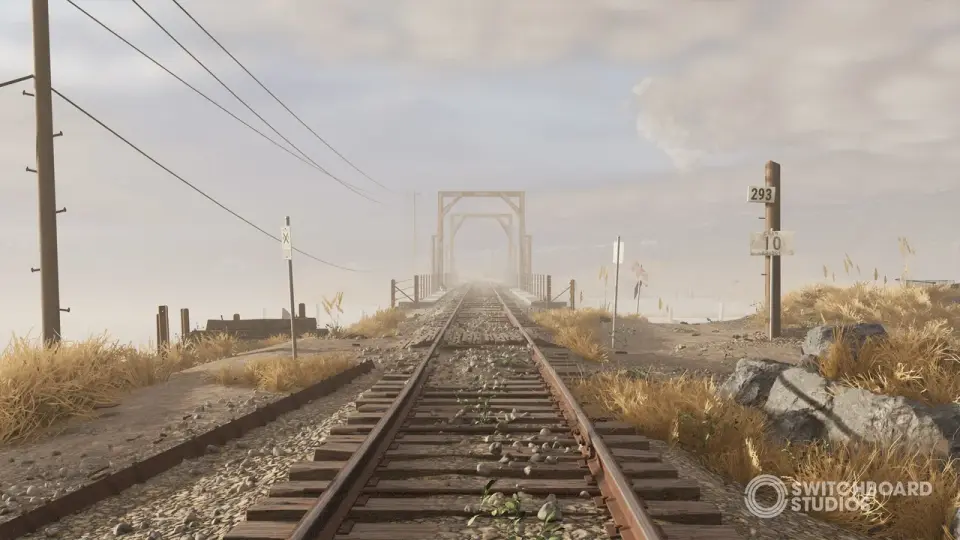
The core structural element of this environment is an advanced spline system designed to generate continuous industrial architecture across the polluted coastal zone. Rather than relying solely on static mesh placement, developers can use these splines to draw infrastructure directly across the terrain and water surfaces, bending and routing the old railway as it snakes along the coastline.
The spline tools are highly versatile, supporting the construction of various track and bridge types. Users can route standard railroads through the swamp, elevate pathways using heavy concrete box girder bridges, and implement functional-looking lift bridges over the deeper waterways. This flexibility allows for rapid iteration when designing the layout of the coastal transport network.
Beyond the railway itself, the spline system extends to supporting secondary industrial elements. Level designers can drag out lines of utility poles alongside the tracks or route winding gas pipelines through the muddy banks and dock areas. A defining feature of this system is its snapping capability. Individual splines can snap together seamlessly, allowing developers to connect different infrastructure lines, merge railway tracks, and generate complex structural intersections without manually aligning individual vertices.
Environmental Theming and Photogrammetry
Thematically, the assets are built to construct a degraded, polluted coastal zone. The modular pieces and photogrammetry-based meshes come together to form realistic industrial sectors situated in swamps or alongside fishing docks. By utilizing the required Water plugins, the environment accurately represents a transitional ecosystem where a murky river empties out into the sea.
The inclusion of photogrammetry ensures that the natural and man-made elements maintain a high degree of surface realism. The muddy banks, coastal debris, and weathered concrete blend together to create a cohesive atmosphere of an abandoned or heavily polluted railway line. The modular nature of the pack allows these realistic pieces to be reconfigured into various dockland, swamp, or deep-water level layouts depending on the needs of the project.
Texel Density and VR Readiness
To ensure the photogrammetry and modular meshes hold up under close scrutiny, the assets are optimized and configured by default for First-Person and Virtual Reality (VR) applications. The developer has standardized the texture resolution across the entire package, establishing a strict, unified texel ratio of 10.24 pixels per meter (ppm) for all included assets.
Maintaining a consistent 10.24ppm ensures that when a VR player or first-person camera approaches the concrete box girder bridges, rusted gas pipelines, or wooden fishing dock elements, the surface details remain sharp and uniform. This deliberate approach to texel density prevents immersion-breaking resolution drops. Whether the camera is viewing a distant lift bridge or inspecting the immediate ground surface of the polluted swamp, the texture quality remains consistent, providing a stable and realistic visual experience tailored specifically for immersive viewpoints.
 Aquatic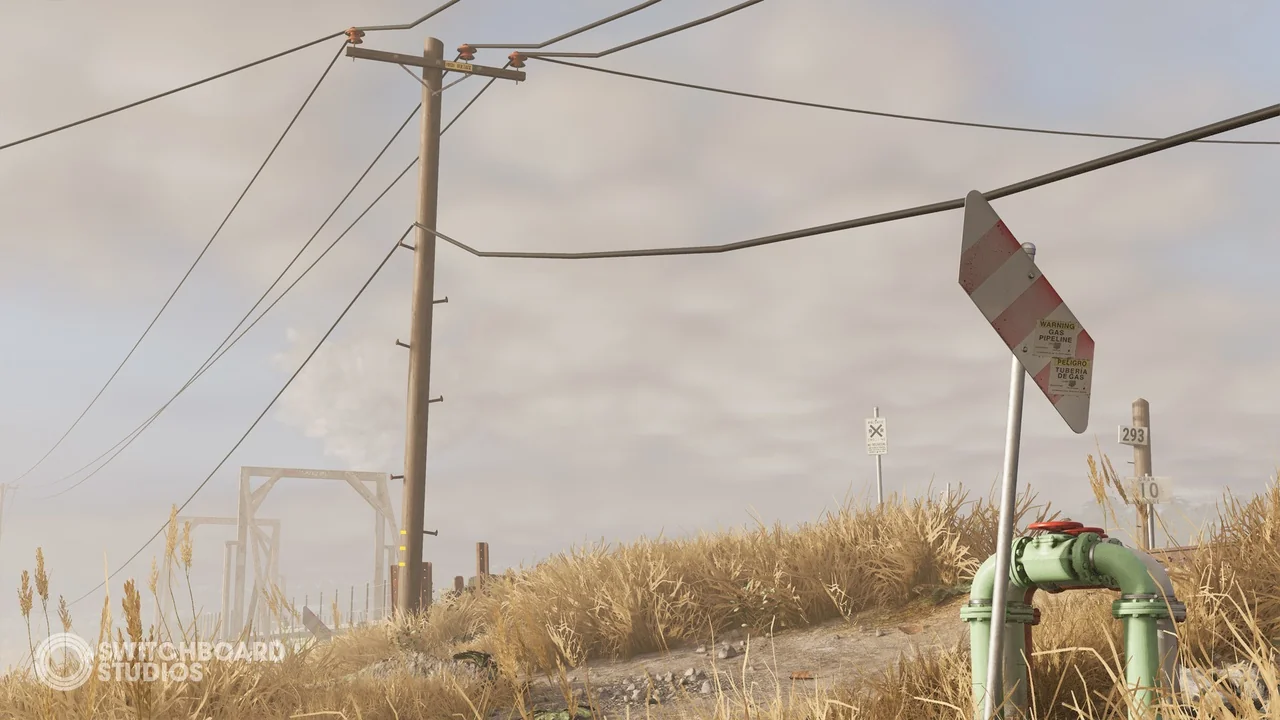
 Aquatic
 Aquatic
 Aquatic