"efaa631e936fd3ee"{"id":"1002146","slug":"poly-new-york-city-modular","title":"POLY - New York City Modular","category":"Cities","engine":"4.24+,5.0+","assetVersion":"","engineVersion":"Engine Version: 4.24+,5.0+","tag":"Cities","accent":"blue","visual":"city","summary":"A modular low-poly urban kit featuring 387 models, 268 build elements, 119 props, and a single 1024x1024 texture atlas with over 2000 color variations.","platform":"Unreal Engine","publishedAt":"2026-10-29T09:51:20.654Z","updatedAt":"2026-10-29T09:51:20.654Z","sourceNotes":[],"fileContents":[],"compatibility":["Unreal Engine","Engine Version: 4.24+,5.0+"],"featuredImage":{"alt":"POLY - New York City Modular","src":"/wp-content/uploads/published/2026/10/ff5d96aa3bd7-1d521ee0-ff0f-4651-9561-ce8b02d724e4-a1e00aa5b8.webp"},"hasDownloadLink":true,"downloads":0,"terms":[{"taxonomy":"category","slug":"cities","name":"Cities"}],"galleryImages":[{"src":"/wp-content/uploads/published/2026/10/5c532b2875a9-404a0402-870b-4e5b-ad9b-fc65c70aff9f-892dbd865b.webp","alt":"POLY - New York City Modular"},{"src":"/wp-content/uploads/published/2026/10/8815b68bbce8-2b686fa3-1ca5-45a3-a928-3072d02e9806-947df7b6bd.webp","alt":"POLY - New York City Modular"},{"src":"/wp-content/uploads/published/2026/10/4e73a54febfc-f0b66ceb-fe8f-428b-a62f-37384087b1fa-25956244b9.webp","alt":"POLY - New York City Modular"},{"src":"/wp-content/uploads/published/2026/10/73837cb9f720-a147b1da-adcf-416b-bc9e-3c23f578ccd1-7d35478fbc.webp","alt":"POLY - New York City Modular"},{"src":"/wp-content/uploads/published/2026/10/5f2784a941ac-7db25989-bf3e-47fe-9991-3705ec6c9ea0-1d7c651333.webp","alt":"POLY - New York City Modular"},{"src":"/wp-content/uploads/published/2026/10/8dd42ad0d421-c8e9d525-49fe-48e7-b81c-dfbf9db71d8b-d4ad762277.webp","alt":"POLY - New York City Modular"},{"src":"/wp-content/uploads/published/2026/10/91679c9304a1-15877326-7eb0-4c89-b7cc-818a7e826328-55407b2098.webp","alt":"POLY - New York City Modular"},{"src":"/wp-content/uploads/published/2026/10/200cfafedbf7-ac47be8d-7b0a-4351-8a38-e039c62daaa3-2f94fa222c.webp","alt":"POLY - New York City Modular"},{"src":"/wp-content/uploads/published/2026/10/774998b40357-883d4ba4-98bc-4ffb-a05e-6d5c2a1136b5-d8e8f473e0.webp","alt":"POLY - New York City Modular"}],"accessPanel":{"kind":"resource","title":"Download this resource","eyebrow":"Free Download","message":"Log in or create a free account to start your download.","fileName":"POLY - New York City Modular.7z","safetyNote":"Resources are manually reviewed before listing to improve quality and reduce obvious risks.","actionLabel":"Download Free","resourceType":"Resource archive"},"contentHtml":"\u003ch2\u003eDeploying POLY - New York City Modular in an Engine Pipeline\u003c/h2\u003e\u003cp\u003eIntegrating a modular low-poly cityscape begins with asset footprint and draw-call management. POLY - New York City Modular approaches environment construction through extreme texture consolidation. The entire collection of 387 model variations references a single 1024x1024 pixel texture map. This single-atlas architecture allows hundreds of structural pieces and environmental dressing objects to share material instances directly in the engine viewport, minimizing state changes and draw calls across complex scenes.\u003c/p\u003e\u003cp\u003eBecause the kit includes more than 2,000 color variations mapped across this unified 1024x1024 texture, material setup does not require building independent shader networks or baking individual albedo maps for every building facade. Bringing the kit into an active project workspace involves assigning the shared texture palette across the meshes. Instancing modular pieces across a grid becomes immediate, giving level designers a direct path to block out sprawling metropolitan districts without incurring texture memory overhead.\u003c/p\u003e\u003ch2\u003eConstructing Multi-Level Layouts with 268 Build Elements\u003c/h2\u003e\u003cp\u003eUrban blockout workflows depend on pieces that snap, stack, and align predictably. The kit supplies 268 distinct build elements designed specifically for assembling structural shells and vertical city centers. These components include individual modular blocks, multi-story facades, rooflines, and foundational pieces capable of producing everything from compact suburban houses to expansive industrial factories and towering skyscrapers.\u003c/p\u003e\u003cp\u003eConstructing a multi-level city requires vertical flexibility. Rather than limiting assembly to uniform street grids, the 268 build elements permit layered urban tiers. Highways, overpasses, elevated building foundations, and sunken transit routes can be assembled by combining varied wall sections and building footprints. Designers can build low-rise warehouse zones using factory components on lower terrain tiers, then transition upward toward high-density skyscraper districts with stepped roof lines and distinct mid-rise structures. Because these architectural modules share matching dimensions and stylistic geometry, they assemble cleanly into diverse building silhouettes without showing unaligned seams.\u003c/p\u003e\u003ch2\u003eDetailing Ground Planes and Infrastructure with 119 City Props\u003c/h2\u003e\u003cp\u003eOnce structural masses define the urban layout, the remaining spaces require environmental dressing to establish scale and purpose. POLY - New York City Modular provides 119 city props configured to support ground-level and roadside infrastructure. These objects supply the secondary visual detail needed to turn bare architectural geometry into an active metropolitan center.\u003c/p\u003e\u003cp\u003eThe props cover exterior installations, street fixtures, and utility objects that articulate building perimeters and transit channels. Placing these items along curbs, building setbacks, alleyways, and factory yards helps break up long geometric spans produced by large modular wall segments. Because the props pull from the same single texture as the primary structures, level dressers can scatter hundreds of dressing objects throughout a scene while maintaining material cohesion and low rendering overhead across both exterior street grids and dense industrial compounds.\u003c/p\u003e\u003ch2\u003eManaging Geometric Density Across Varied Camera Viewpoints\u003c/h2\u003e\u003cp\u003eLow-poly exterior environments often face trade-offs between tight close-up detail and broad sweeping horizons. POLY - New York City Modular balances these requirements across a polygon spectrum running from a minimum count of 20 polygons up to a maximum of 15,000 polygons on complex assets. This range reflects the diverse roles models serve across a large-scale metropolitan environment.\u003c/p\u003e\u003cul\u003e\u003cli\u003e\u003cstrong\u003eLow-complexity geometry (down to 20 polygons):\u003c/strong\u003e Reserved for small ground props, simple structural connectors, and basic street elements that populate scenes in massive quantities without inflating vertex counts.\u003c/li\u003e\u003cli\u003e\u003cstrong\u003eMid-complexity modules:\u003c/strong\u003e Applied to standard building segments, factory walls, houses, and repeatable architectural elements that form the bulk of city streets.\u003c/li\u003e\u003cli\u003e\u003cstrong\u003eHigh-complexity assemblies (up to 15,000 polygons):\u003c/strong\u003e Dedicated to intricate architectural structures, dense multi-tiered building assemblies, and major focal-point skyscrapers featuring ornate roof equipment or layered structural geometry.\u003c/li\u003e\u003c/ul\u003e\u003cp\u003eThis polygon spread directly supports multiple gameplay perspectives. In first-person and third-person perspectives, players interact closely with street-level props and building bases, where the higher polygon allocations provide distinct geometric silhouettes rather than flat planes. When shifting to high-angle strategy cameras, isometric perspectives, or top-down city-building modes, the clean low-poly edges maintain readability against distant horizon lines without visual noise or excessive geometry degradation.\u003c/p\u003e\u003ch2\u003eCross-Pack Styling and Production Integration\u003c/h2\u003e\u003cp\u003eConsistency is essential when combining assets from different kits into a single production. POLY - New York City Modular is built in a polygon visual style designed specifically to combine with other stylized resource packs. It shares aesthetic parity and direct compatibility with collections such as POLY - Mega Survival Tools, allowing developers to integrate specialized gear, gameplay props, and structural elements into urban post-apocalyptic, survival, or action settings without stylistic clashes.\u003c/p\u003e\u003cp\u003eThe kit acts as a functional base for both early prototyping phases and complete production worlds. During pre-production, its 380-plus models let teams rapidly assemble testing environments to test player scale, navigation speed, vehicle physics, and camera occlusions in a three-dimensional metropolis. As production moves toward final level design, the combination of 268 build elements, 119 props, multi-level structural potential, and more than 2,000 color variations provides the depth needed to build complete low-poly cities ready for deployment.\u003c/p\u003e\n\n\u003ch2\u003eMore From The Same Workflow\u003c/h2\u003e\n\u003cul\u003e\n\u003cli\u003e\u003ca href=\"https://3dcghub.com/downtown-city-pack/\" title=\"Downtown - City Pack\"\u003eDowntown - City Pack\u003c/a\u003e\u003c/li\u003e\n\u003cli\u003e\u003ca href=\"https://3dcghub.com/suburbs-vol-13-roof-antennas-nanite-and-low-poly/\" title=\"Suburbs VOL.13 - Roof Antennas (Nanite and Low Poly)\"\u003eSuburbs VOL.13 - Roof Antennas (Nanite and Low Poly)\u003c/a\u003e\u003c/li\u003e\n\u003cli\u003e\u003ca href=\"https://3dcghub.com/signage-vol-2-town-and-city-nanite-and-low-poly/\" title=\"Signage VOL.2 - Town and City (Nanite and Low Poly)\"\u003eSignage VOL.2 - Town and City (Nanite and Low Poly)\u003c/a\u003e\u003c/li\u003e\n\u003cli\u003e\u003ca href=\"https://3dcghub.com/nyc-new-york-city/\" title=\"NYC | New York City\"\u003eNYC | New York City\u003c/a\u003e\u003c/li\u003e\n\u003cli\u003e\u003ca href=\"https://3dcghub.com/modern-buildings-pack/\" title=\"Modern Buildings Pack\"\u003eModern Buildings Pack\u003c/a\u003e\u003c/li\u003e\n\u003c/ul\u003e","contentTextLength":6228,"navigation":{"current":138,"total":4209,"previous":{"id":"1002147","slug":"portal-pack-niagara-vfx","title":"Portal Pack -Niagara VFX","category":"Variety","platform":"Unreal Engine","updatedAt":"2026-10-29T09:52:03.294Z"},"next":{"id":"1002145","slug":"police-radio-vol-1","title":"Police Radio Vol.1","category":"Sound Effects","platform":"Unreal Engine","updatedAt":"2026-10-29T09:50:37.560Z"}},"relatedResources":[{"id":"1001051","slug":"downtown-city-pack","title":"Downtown - City Pack","category":"Cities","engine":"5.0+","assetVersion":"","engineVersion":"Engine Version: 5.0+","tag":"Cities","accent":"blue","visual":"city","summary":"A New York-inspired downtown city pack for Unreal Engine with procedural blueprints, modular buildings, and full material control. Build large realistic city ar","platform":"Unreal Engine","publishedAt":"2026-08-30T13:33:33.587Z","updatedAt":"2026-08-30T13:33:33.587Z","sourceNotes":[],"fileContents":[],"compatibility":["Unreal Engine","Engine Version: 5.0+"],"featuredImage":{"alt":"Downtown - City Pack","src":"/wp-content/uploads/published/2026/08/685353b03547-dc374a9e-8c93-4d7a-918e-65ffdf2e8558-22b7bd467c.webp"},"hasDownloadLink":true,"downloads":1},{"id":"1000485","slug":"suburbs-vol-13-roof-antennas-nanite-and-low-poly","title":"Suburbs VOL.13 - Roof Antennas (Nanite and Low Poly)","category":"Cities","engine":"5.1+","assetVersion":"","engineVersion":"Engine Version: 5.1+","tag":"Cities","accent":"blue","visual":"mech","summary":"Roof Antennas asset pack featuring 52 Nanite and low poly meshes, 4K textures, channel-packed maps, and Lumen support for Unreal Engine 5.1–5.8.","platform":"Unreal Engine","publishedAt":"2026-07-12T06:42:31.146Z","updatedAt":"2026-07-12T06:42:31.146Z","sourceNotes":[],"fileContents":[],"compatibility":["Unreal Engine","Engine Version: 5.1+"],"featuredImage":{"alt":"Suburbs VOL.13 - Roof Antennas (Nanite and Low Poly)","src":"/wp-content/uploads/published/2026/07/c46d93fa27de-4d02617a-5b0b-49e8-a072-88429d966f84-360ab59254.webp"},"hasDownloadLink":true,"downloads":0},{"id":"1000024","slug":"signage-vol-2-town-and-city-nanite-and-low-poly","title":"Signage VOL.2 - Town and City (Nanite and Low Poly)","category":"Cities","engine":"5.1+","assetVersion":"","engineVersion":"5.1+","tag":"Cities","accent":"blue","visual":"city","summary":"A city signage collection for Unreal Engine with 230 meshes, Nanite and low poly versions, 4K textures, tint controls, and Lumen support.","platform":"Unreal Engine","publishedAt":"2026-05-20T12:08:20.801Z","updatedAt":"2026-05-20T12:08:20.801Z","sourceNotes":[],"fileContents":[],"compatibility":["Unreal Engine","Engine version: 5.1+"],"featuredImage":{"alt":"Signage VOL.2 - Town and City (Nanite and Low Poly)","src":"/wp-content/uploads/published/2026/05/5dae48205fe5-4cfef502-1be5-4a89-bab8-b50cc0a5fc66-d5fee08561.webp"},"hasDownloadLink":true,"downloads":0}]}
Cities
POLY - New York City Modular
A modular low-poly urban kit featuring 387 models, 268 build elements, 119 props, and a single 1024x1024 texture atlas with over 2000 color variations.
Category:Unreal Engine,CitiesPlatform: Unreal EngineEngine Version: 4.24+,5.0+Published: Oct 29, 2026
Cities
Resource overview
Deploying POLY - New York City Modular in an Engine Pipeline
Integrating a modular low-poly cityscape begins with asset footprint and draw-call management. POLY - New York City Modular approaches environment construction through extreme texture consolidation. The entire collection of 387 model variations references a single 1024x1024 pixel texture map. This single-atlas architecture allows hundreds of structural pieces and environmental dressing objects to share material instances directly in the engine viewport, minimizing state changes and draw calls across complex scenes.
Because the kit includes more than 2,000 color variations mapped across this unified 1024x1024 texture, material setup does not require building independent shader networks or baking individual albedo maps for every building facade. Bringing the kit into an active project workspace involves assigning the shared texture palette across the meshes. Instancing modular pieces across a grid becomes immediate, giving level designers a direct path to block out sprawling metropolitan districts without incurring texture memory overhead.
Constructing Multi-Level Layouts with 268 Build Elements
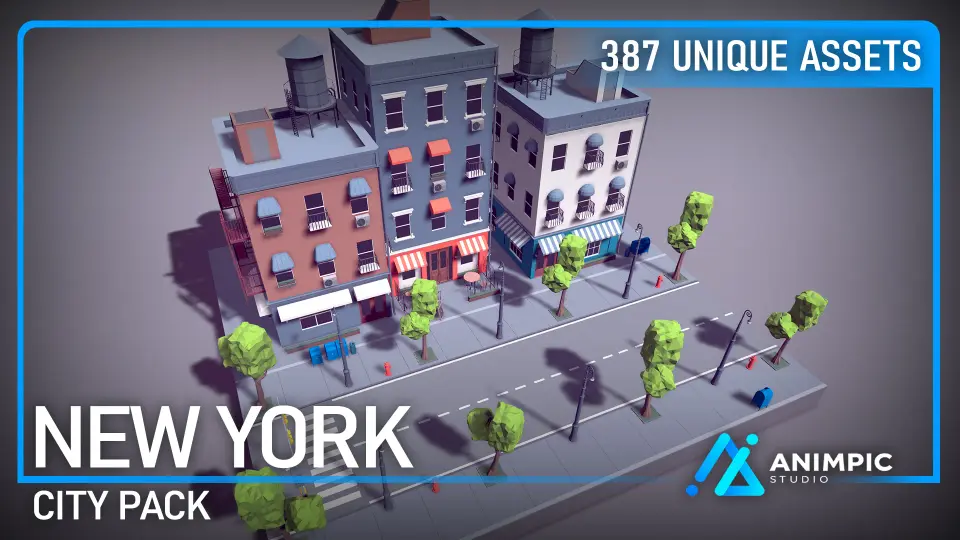
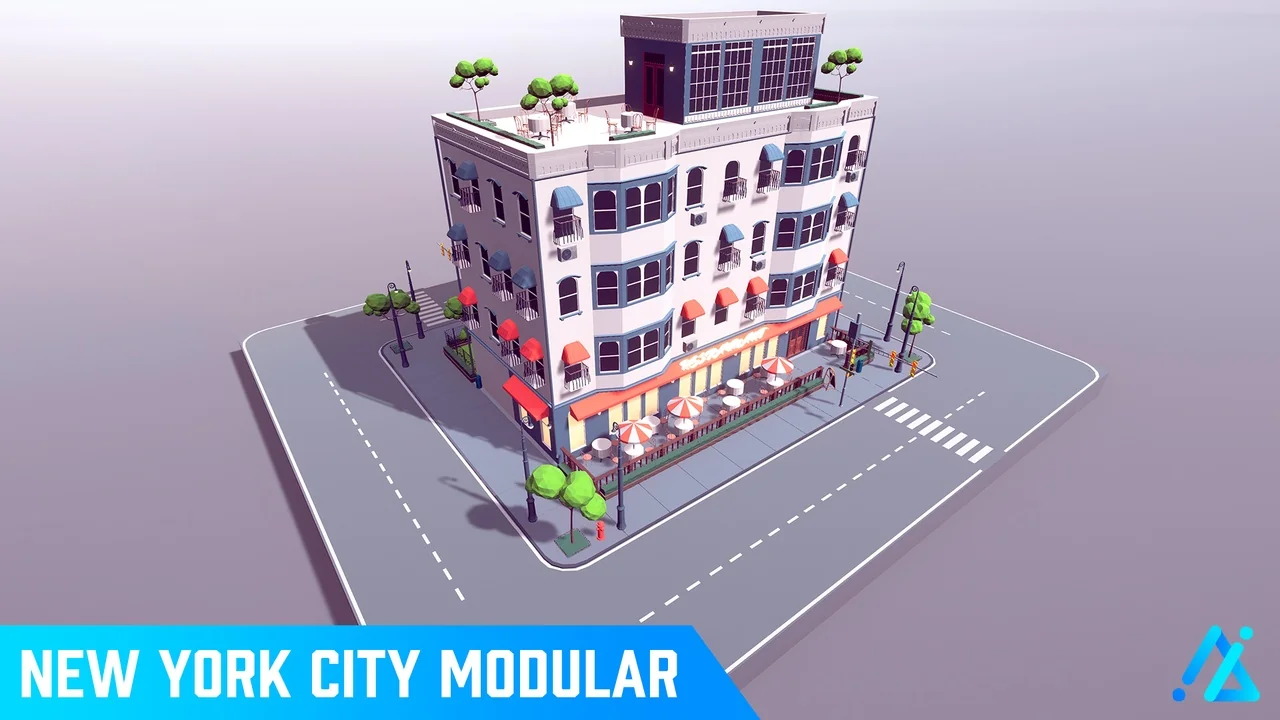
Urban blockout workflows depend on pieces that snap, stack, and align predictably. The kit supplies 268 distinct build elements designed specifically for assembling structural shells and vertical city centers. These components include individual modular blocks, multi-story facades, rooflines, and foundational pieces capable of producing everything from compact suburban houses to expansive industrial factories and towering skyscrapers.
Constructing a multi-level city requires vertical flexibility. Rather than limiting assembly to uniform street grids, the 268 build elements permit layered urban tiers. Highways, overpasses, elevated building foundations, and sunken transit routes can be assembled by combining varied wall sections and building footprints. Designers can build low-rise warehouse zones using factory components on lower terrain tiers, then transition upward toward high-density skyscraper districts with stepped roof lines and distinct mid-rise structures. Because these architectural modules share matching dimensions and stylistic geometry, they assemble cleanly into diverse building silhouettes without showing unaligned seams.
Detailing Ground Planes and Infrastructure with 119 City Props
Once structural masses define the urban layout, the remaining spaces require environmental dressing to establish scale and purpose. POLY - New York City Modular provides 119 city props configured to support ground-level and roadside infrastructure. These objects supply the secondary visual detail needed to turn bare architectural geometry into an active metropolitan center.
The props cover exterior installations, street fixtures, and utility objects that articulate building perimeters and transit channels. Placing these items along curbs, building setbacks, alleyways, and factory yards helps break up long geometric spans produced by large modular wall segments. Because the props pull from the same single texture as the primary structures, level dressers can scatter hundreds of dressing objects throughout a scene while maintaining material cohesion and low rendering overhead across both exterior street grids and dense industrial compounds.
Managing Geometric Density Across Varied Camera Viewpoints
Low-poly exterior environments often face trade-offs between tight close-up detail and broad sweeping horizons. POLY - New York City Modular balances these requirements across a polygon spectrum running from a minimum count of 20 polygons up to a maximum of 15,000 polygons on complex assets. This range reflects the diverse roles models serve across a large-scale metropolitan environment.
Low-complexity geometry (down to 20 polygons): Reserved for small ground props, simple structural connectors, and basic street elements that populate scenes in massive quantities without inflating vertex counts.
Mid-complexity modules: Applied to standard building segments, factory walls, houses, and repeatable architectural elements that form the bulk of city streets.
High-complexity assemblies (up to 15,000 polygons): Dedicated to intricate architectural structures, dense multi-tiered building assemblies, and major focal-point skyscrapers featuring ornate roof equipment or layered structural geometry.
This polygon spread directly supports multiple gameplay perspectives. In first-person and third-person perspectives, players interact closely with street-level props and building bases, where the higher polygon allocations provide distinct geometric silhouettes rather than flat planes. When shifting to high-angle strategy cameras, isometric perspectives, or top-down city-building modes, the clean low-poly edges maintain readability against distant horizon lines without visual noise or excessive geometry degradation.
Cross-Pack Styling and Production Integration
Consistency is essential when combining assets from different kits into a single production. POLY - New York City Modular is built in a polygon visual style designed specifically to combine with other stylized resource packs. It shares aesthetic parity and direct compatibility with collections such as POLY - Mega Survival Tools, allowing developers to integrate specialized gear, gameplay props, and structural elements into urban post-apocalyptic, survival, or action settings without stylistic clashes.
The kit acts as a functional base for both early prototyping phases and complete production worlds. During pre-production, its 380-plus models let teams rapidly assemble testing environments to test player scale, navigation speed, vehicle physics, and camera occlusions in a three-dimensional metropolis. As production moves toward final level design, the combination of 268 build elements, 119 props, multi-level structural potential, and more than 2,000 color variations provides the depth needed to build complete low-poly cities ready for deployment.
 Cities
 Cities
 Cities
 Cities