"0341a2901a4ae9aa"{"id":"1000738","slug":"modern-buildings-pack","title":"Modern Buildings Pack","category":"Cities","engine":"5.1+","assetVersion":"","engineVersion":"Engine Version: 5.1+","tag":"Cities","accent":"blue","visual":"mech","summary":"Forty low-poly modular Unreal Engine buildings built from Blueprints, using only six textures and seven UV channels for flexible architectural variation.","platform":"Unreal Engine","publishedAt":"2026-07-27T03:51:02.594Z","updatedAt":"2026-07-27T03:51:02.594Z","sourceNotes":[],"fileContents":[],"compatibility":["Unreal Engine","Engine Version: 5.1+"],"featuredImage":{"alt":"Modern Buildings Pack","src":"/wp-content/uploads/published/2026/07/a22bba4f460a-e55e5dd3-97bb-4f15-a3f7-7c989b9eab20-361f9a7460.webp"},"hasDownloadLink":true,"downloads":2,"terms":[{"taxonomy":"category","slug":"cities","name":"Cities"}],"galleryImages":[{"src":"/wp-content/uploads/published/2026/07/d8533db2f547-9dac78fc-d631-4209-add3-b369a4ae7551-8f5d949660.webp","alt":"Modern Buildings Pack"},{"src":"/wp-content/uploads/published/2026/07/b5d52c0c43a0-a2a26afa-b552-4f43-a4a0-b23135621c9c-8f9bc312da.webp","alt":"Modern Buildings Pack"},{"src":"/wp-content/uploads/published/2026/07/0f47257cb9f8-5529f990-2f85-455a-b053-c8dfd5521ca5-e20a54abd5.webp","alt":"Modern Buildings Pack"},{"src":"/wp-content/uploads/published/2026/07/85a9208799eb-b907ddf2-c6f8-4e6e-b41b-307988836545-34987fc8de.webp","alt":"Modern Buildings Pack"},{"src":"/wp-content/uploads/published/2026/07/3682d4138ae6-ef878184-8f13-4b40-a8c7-cd3235896b79-5d6648bf78.webp","alt":"Modern Buildings Pack"},{"src":"/wp-content/uploads/published/2026/07/cf4d15756b31-dafc11e5-0de1-4250-bc8d-9ccf53787efc-711db4dc74.webp","alt":"Modern Buildings Pack"},{"src":"/wp-content/uploads/published/2026/07/056e1c4007e1-80309cf0-a4ba-4c12-a414-bdec77c4a6b5-5a4e9ae46e.webp","alt":"Modern Buildings Pack"},{"src":"/wp-content/uploads/published/2026/07/e9a483d73f17-bc4f2a2c-6391-48e0-9c19-994ca51229b9-44798247a8.webp","alt":"Modern Buildings Pack"},{"src":"/wp-content/uploads/published/2026/07/47d076c9b7f2-65b7add6-1d40-4a04-98e5-d5084d5cf524-e89a9d5695.webp","alt":"Modern Buildings Pack"},{"src":"/wp-content/uploads/published/2026/07/15831cfa09e4-83e30df3-7fc5-4762-94a4-c550896a89cf-d14c80ebb8.webp","alt":"Modern Buildings Pack"}],"accessPanel":{"kind":"resource","title":"Download this resource","eyebrow":"Free Download","message":"Log in or create a free account to start your download.","fileName":"Content.7z","safetyNote":"Resources are manually reviewed before listing to improve quality and reduce obvious risks.","actionLabel":"Download Free","resourceType":"Resource archive"},"contentHtml":"\u003cp\u003eDrop a Blueprint into an Unreal Engine level and the structure assembles itself from modular low-poly pieces before you touch a single settings panel. That behavior sits at the center of this collection. The parameters exposed in the Details panel let a level designer shift building height, assign materials, and switch between seven architectural styles without leaving the viewport. The focus is on producing attractive skylines quickly, using minimal texture memory, and keeping frame cost low.\u003c/p\u003e\n\n\u003ch2\u003eForty Buildings Built from a Master Blueprint\u003c/h2\u003e\n\u003cp\u003eEach of the 40 buildings ships as a child Blueprint descending from a shared Master Blueprint. The master handles construction logic, pulling from a library of modular low-poly pieces. Because every building inherits from the same parent, the exposed parameters remain consistent across the set, making bulk edits predictable.\u003c/p\u003e\n\n\u003cp\u003eWorking with these Blueprints requires no manual module placement. A drag-and-drop motion into the level creates the full structure. From that point, the selected building offers a small set of controls. Height adjusts to fit the scene. Materials apply broadly. Architectural style changes by selecting among seven predefined UV layouts, giving each base building several distinct appearances.\u003c/p\u003e\n\n\u003ch2\u003eSeven UV Channels Driving Architectural Variation\u003c/h2\u003e\n\u003cp\u003eThe stylistic range relies on Unreal Engine's support for eight UV channels. One channel is reserved for lightmaps. The remaining seven channels each store a different UV layout, and selecting a layout swaps the window pattern and architectural detailing presented on the structure's surface. This approach adds an additional layer of richness without introducing new texture files.\u003c/p\u003e\n\n\u003cp\u003eAll window styles and architectural details live in a single atlas texture. Switching UV channels changes which region of that atlas the building samples, so the perceived style shifts while the underlying texture set stays constant. The seven layouts mean a single base form can read as seven different buildings depending on the parameter chosen.\u003c/p\u003e\n\n\u003ch2\u003eA Six-Texture Set for All Forty Buildings\u003c/h2\u003e\n\u003cp\u003eThis is where the pack deviates sharply from conventional environment releases. Instead of dozens of individual texture maps distributed across a large asset set, every building here draws from one shared texture group of six files:\u003c/p\u003e\n\n\u003cul\u003e\n \u003cli\u003e1 normal map\u003c/li\u003e\n \u003cli\u003e3 channel-packed RGBA masks\u003c/li\u003e\n \u003cli\u003e2 textures dedicated to roof objects\u003c/li\u003e\n\u003c/ul\u003e\n\n\u003cp\u003eAll color and style variations emerge from different combinations of the three channel-packed masks rather than from additional image files. Material Instances blend these masks to produce varied surface treatments, keeping the texture footprint flat regardless of how many buildings populate a city.\u003c/p\u003e\n\n\u003cp\u003eBeyond the included material options, two Master Materials—\u003cem\u003eSimple\u003c/em\u003e and \u003cem\u003eComplex\u003c/em\u003e—allow custom color schemes. Level designers can work from the provided materials or derive their own to match a specific art direction.\u003c/p\u003e\n\n\u003ch2\u003eRoof Objects and Distance-Dependent Read\u003c/h2\u003e\n\u003cp\u003eThe buildings carry a deliberately minimal surface treatment. The structures read well at medium and long distances, making them suitable for semi-realistic skylines or realistic city backdrops where the camera maintains separation from the architecture. Examined at close range, the simplicity becomes apparent and the forms may not hold up to scrutiny.\u003c/p\u003e\n\n\u003cp\u003eRoof objects follow the same philosophy with an even leaner setup. They use a single base color texture without normal or additional PBR maps. Their function is to imply rooftop complexity from afar rather than deliver believable detail up close. The low polygon count on these rooftop pieces keeps cost negligible while still filling the silhouette gap that plain building tops would otherwise leave.\u003c/p\u003e\n\n\u003cp\u003eNo nighttime configuration is included in the pack, so scenes requiring lit windows after dark would need a separate solution outside this set.\u003c/p\u003e\n\n\u003ch2\u003eScene Types and Compatibility Notes\u003c/h2\u003e\n\u003cp\u003eThe asset set aligns with projects that need populated cityscapes without heavy texture overhead. Game levels requiring distant skylines, flyover sequences, or background city geometry benefit from the parameterized height and style controls. The low-poly nature and single texture group also make the buildings suitable for mobile or performance-constrained environments where memory bandwidth is a factor.\u003c/p\u003e\n\n\u003cp\u003eThe collection carries tags indicating its modular, low-poly, Blueprint-based architecture focus, placing it within the city building and prop category. Based on existing tool pairings, the buildings are compatible with \u003cem\u003eGrid Terrain Generator\u003c/em\u003e, indicating the set can be slotted into terrain-driven city layouts where generated ground forms dictate building placement.\u003c/p\u003e\n\n\u003ch3\u003eWho Benefits Most from This Pack\u003c/h3\u003e\n\u003cp\u003eTeams building large-scale urban scenes who need visual variety without multiplying texture draw calls will get the strongest use from this release. The combination of Blueprint-driven construction, seven UV-channel styles, and a flat six-texture footprint makes the set practical for projects where skylines must look diverse and remain inexpensive to render.\u003c/p\u003e\n\n\u003ch2\u003eExplore Similar Assets\u003c/h2\u003e\n\u003cul\u003e\n\u003cli\u003e\u003ca href=\"https://3dcghub.com/modern-city-downtown-megapack-modern-city-downtown-building-usa-town-street/\" title=\"Modern City Downtown Megapack ( Modern City Downtown Building USA Town Street )\"\u003eModern City Downtown Megapack ( Modern City Downtown Building USA Town Street )\u003c/a\u003e\u003c/li\u003e\n\u003cli\u003e\u003ca href=\"https://3dcghub.com/modern-city-bundle/\" title=\"Modern City Bundle\"\u003eModern City Bundle\u003c/a\u003e\u003c/li\u003e\n\u003cli\u003e\u003ca href=\"https://3dcghub.com/brushify-urban-buildings-pack/\" title=\"Brushify - Urban Buildings Pack\"\u003eBrushify - Urban Buildings Pack\u003c/a\u003e\u003c/li\u003e\n\u003cli\u003e\u003ca href=\"https://3dcghub.com/urban-background-buildings-vol-1/\" title=\"Urban Background Buildings - VOL.1\"\u003eUrban Background Buildings - VOL.1\u003c/a\u003e\u003c/li\u003e\n\u003cli\u003e\u003ca href=\"https://3dcghub.com/modular-prison/\" title=\"Modular Prison\"\u003eModular Prison\u003c/a\u003e\u003c/li\u003e\n\u003c/ul\u003e","contentTextLength":5270,"navigation":{"current":1427,"total":4017,"previous":{"id":"1000739","slug":"modular-battlefield-warzone-battlefield-warzone-desert-desert-town","title":"Modular Battlefield / Warzone (Battlefield, Warzone, Desert, Desert Town)","category":"Desert","platform":"Unreal Engine","updatedAt":"2026-07-27T08:32:11.840Z"},"next":{"id":"1000737","slug":"graveyard-cemetery-graveyard-cemetery-horror-cemetery-horror-graveyard","title":"Graveyard, Cemetery (Graveyard, Cemetery, Horror Cemetery, Horror Graveyard)","category":"Horror","platform":"Unreal Engine","updatedAt":"2026-07-27T03:45:34.317Z"}},"relatedResources":[{"id":"4359","slug":"modern-city-bundle","title":"Modern City Bundle","category":"Cities","engine":"4.26+,5.0+","assetVersion":"Engine version: 4.26+,5.0+","engineVersion":"4.22","tag":"Cities","accent":"blue","visual":"city","summary":"Build stunning urban landscapes with the Modern City Bundle. Featuring modular streets, high-fidelity buildings, and optimized performance for game developers.","platform":"Unreal Engine","publishedAt":"2026-02-13T07:35:02.000Z","updatedAt":"2026-04-19T15:57:10.000Z","sourceNotes":[],"fileContents":[],"compatibility":["Unreal Engine"],"featuredImage":{"alt":"Modern City Bundle","src":"https://3dcghub.com/wp-content/uploads/2026/02/a7d454cd-1b52-4514-9950-d39304d96783.webp"},"hasDownloadLink":true,"downloads":5},{"id":"7224","slug":"modern-city-downtown-megapack-modern-city-downtown-building-usa-town-street","title":"Modern City Downtown Megapack ( Modern City Downtown Building USA Town Street )","category":"Cities","engine":"4.26+,5.0+","assetVersion":"Engine version: 4.26+,5.0+","engineVersion":"4.19","tag":"Cities","accent":"blue","visual":"city","summary":"Create stunning, high-fidelity urban environments with this comprehensive modular megacollection. It features over 350 unique models, detailed interiors, and advanced level design tools for professional creators.","platform":"Unreal Engine","publishedAt":"2026-02-20T18:17:02.000Z","updatedAt":"2026-04-19T15:56:02.000Z","sourceNotes":[],"fileContents":[],"compatibility":["Unreal Engine","Engine version: 4.26+,5.0+"],"featuredImage":{"alt":"Modern City Downtown Megapack ( Modern City Downtown Building USA Town Street )","src":"https://3dcghub.com/wp-content/uploads/2026/02/ed834a7f-d138-4d89-837b-61a72700df67.webp"},"hasDownloadLink":true,"downloads":1},{"id":"1000175","slug":"urban-background-buildings-vol-1","title":"Urban Background Buildings - VOL.1","category":"Cities","engine":"4.26+,5.0+","assetVersion":"","engineVersion":"Engine Version: 4.26+,5.0+","tag":"Cities","accent":"blue","visual":"mech","summary":"Urban Background Buildings - VOL.1 delivers 13 optimized Unreal Engine building meshes with LODs, modular variations, master materials, and day-night setups.","platform":"Unreal Engine","publishedAt":"2026-06-20T06:26:44.634Z","updatedAt":"2026-06-20T06:26:44.634Z","sourceNotes":[],"fileContents":[],"compatibility":["Unreal Engine","Engine Version: 4.26+,5.0+"],"featuredImage":{"alt":"Urban Background Buildings - VOL.1","src":"/wp-content/uploads/published/2026/06/3c89a5e06c22-fa4e818b-3b25-41d4-bc56-1aa6085390a6-bfe9eb3f57.webp"},"hasDownloadLink":true,"downloads":0}]}
Cities
Modern Buildings Pack
Forty low-poly modular Unreal Engine buildings built from Blueprints, using only six textures and seven UV channels for flexible architectural variation.
Drop a Blueprint into an Unreal Engine level and the structure assembles itself from modular low-poly pieces before you touch a single settings panel. That behavior sits at the center of this collection. The parameters exposed in the Details panel let a level designer shift building height, assign materials, and switch between seven architectural styles without leaving the viewport. The focus is on producing attractive skylines quickly, using minimal texture memory, and keeping frame cost low.
Forty Buildings Built from a Master Blueprint
Each of the 40 buildings ships as a child Blueprint descending from a shared Master Blueprint. The master handles construction logic, pulling from a library of modular low-poly pieces. Because every building inherits from the same parent, the exposed parameters remain consistent across the set, making bulk edits predictable.
Working with these Blueprints requires no manual module placement. A drag-and-drop motion into the level creates the full structure. From that point, the selected building offers a small set of controls. Height adjusts to fit the scene. Materials apply broadly. Architectural style changes by selecting among seven predefined UV layouts, giving each base building several distinct appearances.
Seven UV Channels Driving Architectural Variation
The stylistic range relies on Unreal Engine's support for eight UV channels. One channel is reserved for lightmaps. The remaining seven channels each store a different UV layout, and selecting a layout swaps the window pattern and architectural detailing presented on the structure's surface. This approach adds an additional layer of richness without introducing new texture files.
All window styles and architectural details live in a single atlas texture. Switching UV channels changes which region of that atlas the building samples, so the perceived style shifts while the underlying texture set stays constant. The seven layouts mean a single base form can read as seven different buildings depending on the parameter chosen.
A Six-Texture Set for All Forty Buildings
This is where the pack deviates sharply from conventional environment releases. Instead of dozens of individual texture maps distributed across a large asset set, every building here draws from one shared texture group of six files:
1 normal map
3 channel-packed RGBA masks
2 textures dedicated to roof objects
All color and style variations emerge from different combinations of the three channel-packed masks rather than from additional image files. Material Instances blend these masks to produce varied surface treatments, keeping the texture footprint flat regardless of how many buildings populate a city.
Beyond the included material options, two Master Materials—Simple and Complex—allow custom color schemes. Level designers can work from the provided materials or derive their own to match a specific art direction.
Roof Objects and Distance-Dependent Read
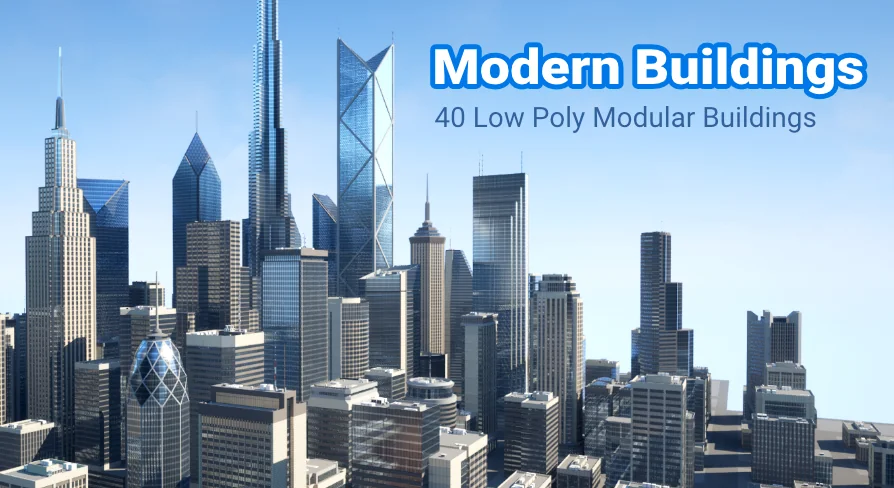
The buildings carry a deliberately minimal surface treatment. The structures read well at medium and long distances, making them suitable for semi-realistic skylines or realistic city backdrops where the camera maintains separation from the architecture. Examined at close range, the simplicity becomes apparent and the forms may not hold up to scrutiny.
Roof objects follow the same philosophy with an even leaner setup. They use a single base color texture without normal or additional PBR maps. Their function is to imply rooftop complexity from afar rather than deliver believable detail up close. The low polygon count on these rooftop pieces keeps cost negligible while still filling the silhouette gap that plain building tops would otherwise leave.
No nighttime configuration is included in the pack, so scenes requiring lit windows after dark would need a separate solution outside this set.
Scene Types and Compatibility Notes
The asset set aligns with projects that need populated cityscapes without heavy texture overhead. Game levels requiring distant skylines, flyover sequences, or background city geometry benefit from the parameterized height and style controls. The low-poly nature and single texture group also make the buildings suitable for mobile or performance-constrained environments where memory bandwidth is a factor.
The collection carries tags indicating its modular, low-poly, Blueprint-based architecture focus, placing it within the city building and prop category. Based on existing tool pairings, the buildings are compatible with Grid Terrain Generator, indicating the set can be slotted into terrain-driven city layouts where generated ground forms dictate building placement.
Who Benefits Most from This Pack
Teams building large-scale urban scenes who need visual variety without multiplying texture draw calls will get the strongest use from this release. The combination of Blueprint-driven construction, seven UV-channel styles, and a flat six-texture footprint makes the set practical for projects where skylines must look diverse and remain inexpensive to render.
 Cities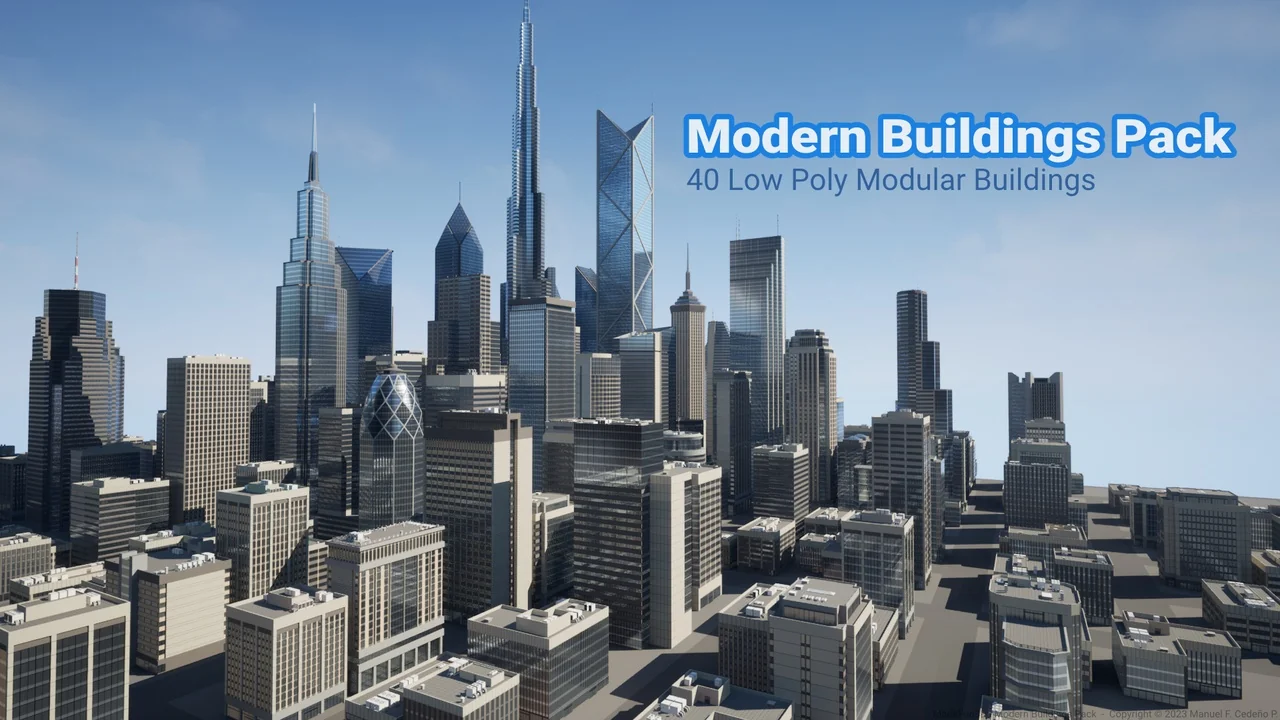
 Cities
 Cities
 Cities