"0341a2901a4ae9aa"{"id":"1000739","slug":"modular-battlefield-warzone-battlefield-warzone-desert-desert-town","title":"Modular Battlefield / Warzone (Battlefield, Warzone, Desert, Desert Town)","category":"Desert","engine":"5.4+","assetVersion":"","engineVersion":"Engine Version: 5.4+","tag":"Desert","accent":"blue","visual":"mech","summary":"Modular desert battlefield kit for UE5.4+ with 259 meshes, fully enterable buildings, furnished interiors, nanite landscapes, and Lumen support for shooter envi","platform":"Unreal Engine","publishedAt":"2026-07-27T08:32:11.840Z","updatedAt":"2026-07-27T08:32:11.840Z","sourceNotes":[],"fileContents":[],"compatibility":["Unreal Engine","Engine Version: 5.4+"],"featuredImage":{"alt":"Modular Battlefield / Warzone (Battlefield, Warzone, Desert, Desert Town)","src":"/wp-content/uploads/published/2026/07/c7d40c7e98ab-ee3f282d-de11-459b-ba2e-b8dca190ee45-2d9e87dae2.webp"},"hasDownloadLink":true,"downloads":2,"terms":[{"taxonomy":"category","slug":"desert","name":"Desert"}],"galleryImages":[{"src":"/wp-content/uploads/published/2026/07/7a58fda36b10-83d0fdef-1956-4333-9957-d0a580ec7265-e9bf564e6d.webp","alt":"Modular Battlefield / Warzone (Battlefield, Warzone, Desert, Desert Town)"},{"src":"/wp-content/uploads/published/2026/07/8381f374057d-4acf53d4-5197-473d-ac43-cdb153fcbd2d-3b5e8c58d2.webp","alt":"Modular Battlefield / Warzone (Battlefield, Warzone, Desert, Desert Town)"},{"src":"/wp-content/uploads/published/2026/07/11514ef820b6-fa14c223-6f36-45e9-8974-3e339f9fc7b0-e1e205ccba.webp","alt":"Modular Battlefield / Warzone (Battlefield, Warzone, Desert, Desert Town)"},{"src":"/wp-content/uploads/published/2026/07/0429a9ca05f5-2d616583-34be-4a47-88f0-bfecda23f17a-32d4030556.webp","alt":"Modular Battlefield / Warzone (Battlefield, Warzone, Desert, Desert Town)"},{"src":"/wp-content/uploads/published/2026/07/ae32753d7849-545f3f74-5f5f-424a-b134-f78105ecaa46-2bf9972bf6.webp","alt":"Modular Battlefield / Warzone (Battlefield, Warzone, Desert, Desert Town)"},{"src":"/wp-content/uploads/published/2026/07/4c7b6975ac99-43e9484d-78d0-4a38-a6e8-bd56af2cb7a8-5720374382.webp","alt":"Modular Battlefield / Warzone (Battlefield, Warzone, Desert, Desert Town)"},{"src":"/wp-content/uploads/published/2026/07/873c6dba11b0-fbafdf04-980c-4582-806e-7f9db9e5c9c0-5c95e107c1.webp","alt":"Modular Battlefield / Warzone (Battlefield, Warzone, Desert, Desert Town)"},{"src":"/wp-content/uploads/published/2026/07/c547939a4490-708530d6-d9a2-42d2-bfec-54b84182810a-6a47d8b00b.webp","alt":"Modular Battlefield / Warzone (Battlefield, Warzone, Desert, Desert Town)"},{"src":"/wp-content/uploads/published/2026/07/4da8bd210eb4-3f1654f0-d228-433e-ad59-60755ea40eaf-52322552d2.webp","alt":"Modular Battlefield / Warzone (Battlefield, Warzone, Desert, Desert Town)"},{"src":"/wp-content/uploads/published/2026/07/eb5e4cfa4204-676280b1-3f31-4c7b-b84e-7aef5fbd13de-e8aa1e264b.webp","alt":"Modular Battlefield / Warzone (Battlefield, Warzone, Desert, Desert Town)"}],"accessPanel":{"kind":"resource","title":"Download this resource","eyebrow":"Free Download","message":"Log in or create a free account to start your download.","fileName":"Content.7z","safetyNote":"Resources are manually reviewed before listing to improve quality and reduce obvious risks.","actionLabel":"Download Free","resourceType":"Resource archive"},"contentHtml":"\u003cp\u003eBuilding a believable Middle Eastern or arid military combat zone in Unreal Engine has always required a dense collection of enterable structures, furnished rooms, and terrain that fits the region. \u003cem\u003eModular Battlefield / Warzone\u003c/em\u003e positions itself as an A-to-Z construction kit aimed specifically at shooter games, covering outposts, villages, towns, camps, and destroyed buildings across a desert biome.\u003c/p\u003e\n\n\u003ch2\u003eWhat the Warzone Megapack Brings to a Shooter Level\u003c/h2\u003e\n\u003cp\u003eThe product is labeled a \u003cem\u003eWarzone Megapack\u003c/em\u003e, an all-in-one battlefield kit targeted at shooter projects. The scope is geared toward building outposts, cities, and towns rather than dropping a single static diorama into a scene. Every building in the kit is fully enterable and fully furnished, so designers can push interior combat or exploration spaces without having to piece together their own furniture sets or wall-fill props from scratch.\u003c/p\u003e\n\n\u003cp\u003eTag coverage across the pack points to a Middle Eastern and Arabic aesthetic: \u003cem\u003eArabia\u003c/em\u003e, \u003cem\u003eOutpost\u003c/em\u003e, \u003cem\u003ePostapocalyptic\u003c/em\u003e, \u003cem\u003eBase\u003c/em\u003e, \u003cem\u003eVillage\u003c/em\u003e, \u003cem\u003eArabic\u003c/em\u003e, \u003cem\u003eModern\u003c/em\u003e, \u003cem\u003eTown\u003c/em\u003e, \u003cem\u003eDesert\u003c/em\u003e, \u003cem\u003eHouse\u003c/em\u003e, \u003cem\u003eMiddle\u003c/em\u003e, \u003cem\u003eEastern\u003c/em\u003e, \u003cem\u003eMilitary\u003c/em\u003e, \u003cem\u003eCity\u003c/em\u003e, \u003cem\u003eCliff\u003c/em\u003e, \u003cem\u003eArid\u003c/em\u003e, \u003cem\u003eCamp\u003c/em\u003e, \u003cem\u003eWood\u003c/em\u003e, \u003cem\u003eDestroyed\u003c/em\u003e, and \u003cem\u003eStructure\u003c/em\u003e. That spread suggests the kit can cover intact villages on one end and postapocalyptic or destroyed variants on the other, all within a single arid environment setting.\u003c/p\u003e\n\n\u003ch2\u003eHow Modular Construction Shapes Scene Layout\u003c/h2\u003e\n\u003cp\u003eThe kit is fully modular. Working from a library of 259 meshes, a designer can assemble outposts, towns, and cities part by part instead of relying on prebuilt hero pieces. The mesh count is stated plainly: 259 meshes for constructing new environments. This kind of part-based workflow lets level artists block out compounds, streets, and building clusters with reusable wall sections, structural pieces, and interior props, then swap in destroyed or weathered variants where the tone of the level calls for it.\u003c/p\u003e\n\n\u003cp\u003eFull interiors are part of the modular system, not a separate add-on. The interiors are described as complete, giving artists a range of assets to personalize individual spaces. In practical level design terms, that means a building placed in a town block can serve as an enterable combat space or loot interior rather than a sealed shell—without requiring a second interior-specific purchase or a custom prop set.\u003c/p\u003e\n\n\u003ch2\u003eSetting Up the Project Before Opening the Level\u003c/h2\u003e\n\u003cp\u003eTo get the level running as intended, three preparation steps are required before opening it:\u003c/p\u003e\n\n\u003cul\u003e\n \u003cli\u003eEnable the \u003cstrong\u003eEnable Virtual Texture Support\u003c/strong\u003e setting in Project Settings.\u003c/li\u003e\n \u003cli\u003eEnable the \u003cstrong\u003eHDRI Backdrop\u003c/strong\u003e Plugin.\u003c/li\u003e\n \u003cli\u003eRestart the project.\u003c/li\u003e\n\u003c/ul\u003e\n\n\u003cp\u003eVirtual Texture support affects how large landscape and surface textures stream and sample in-engine, which matters for an asset line that includes desert biomes and Nanite landscapes. The HDRI Backdrop Plugin is tied to the project’s HDRI lighting and backdrop setup, so it needs to be active for the environment to render with the intended lighting backplate. Restarting after enabling both ensures the settings take effect before the level loads.\u003c/p\u003e\n\n\u003cp\u003eSkipping these steps is the most common reason a kit shaped by Lumen, Nanite, and Virtual Textures fails to look correct on first open. Getting the project settings sorted first avoids visual breakage later.\u003c/p\u003e\n\n\u003ch2\u003eUnreal Engine 5.4, Lumen, and Nanite Integration\u003c/h2\u003e\n\u003cp\u003eThe map was built specifically for Unreal Engine 5.4 and above. It uses Lumen for real-time global illumination, Local Fog Volumes for atmosphere, and Nanite landscapes for high-detail terrain rendering. The combination is aimed at enhancing both visuals and performance, with Nanite landscapes handling dense geometry without the traditional LOD cost and Local Fog Volumes allowing scene-level atmosphere control without relying on fully bespoke particle systems.\u003c/p\u003e\n\n\u003cp\u003eCompatibility extends beyond 5.4 specifically. The product supports Lumen for Unreal Engine 5.0 and above, and Nanite for Unreal Engine 5.0 and above. That means projects still on earlier Unreal Engine 5 releases can use the lighting and geometry features the kit depends on, though the included map itself is authored against 5.4 behavior.\u003c/p\u003e\n\n\u003ch2\u003eDesert Landscape and Biome Construction\u003c/h2\u003e\n\u003cp\u003eLandscape work is handled inside the pack. Desert biome assets are provided so designers can quickly build out their own arid terrain rather than importing a separate landscape toolset. The tag set lists \u003cem\u003eCliff\u003c/em\u003e and \u003cem\u003eArid\u003c/em\u003e alongside \u003cem\u003eDesert\u003c/em\u003e, pointing to terrain features that fit rocky outcrops and dry ground formations typical of Middle Eastern warzone environments.\u003c/p\u003e\n\n\u003cp\u003eThe Nanite landscape approach means the terrain meshes can carry more geometric detail than traditional landscape systems, which is useful for cliffs, dunes, eroded ground, and broken urban edges where silhouette detail sells a warzone feel. Pairing Nanite landscapes with Lumen lighting means the desert surface responds dynamically to changes in light direction, time of day, and interior spill from buildings.\u003c/p\u003e\n\n\u003ch2\u003eWho Benefits Most from This Kit\u003c/h2\u003e\n\u003cp\u003eLevel designers and environment artists working on shooter projects in Unreal Engine get the most direct value from the pack. The modular structure, enterable buildings, and furnished interiors solve a specific problem: creating combat-scaled interior and exterior spaces across a town, outpost, or city without assembling every prop from scratch. Teams that need a Middle Eastern or Arabic desert aesthetic—covering everything from intact villages to destroyed and postapocalyptic structures—get that range inside a single 259-mesh kit built for Unreal Engine 5.4, with Lumen and Nanite support available from Unreal Engine 5.0 onward.\u003c/p\u003e\n\n\u003ch2\u003eMore From The Same Workflow\u003c/h2\u003e\n\u003cul\u003e\n\u003cli\u003e\u003ca href=\"https://3dcghub.com/post-apocalyptic-desert-environment-post-desert-apocalyptic-wild-desert-3d/\" title=\"Post Apocalyptic Desert Environment ( Post Desert Apocalyptic Wild Desert 3D )\"\u003ePost Apocalyptic Desert Environment ( Post Desert Apocalyptic Wild Desert 3D )\u003c/a\u003e\u003c/li\u003e\n\u003cli\u003e\u003ca href=\"https://3dcghub.com/lidar-desert-landscape/\" title=\"LiDAR DESERT LANDSCAPE\"\u003eLiDAR DESERT LANDSCAPE\u003c/a\u003e\u003c/li\u003e\n\u003cli\u003e\u003ca href=\"https://3dcghub.com/landscape-procedural-desert-sandstorm/\" title=\"Landscape Procedural Desert - Sandstorm\"\u003eLandscape Procedural Desert - Sandstorm\u003c/a\u003e\u003c/li\u003e\n\u003cli\u003e\u003ca href=\"https://3dcghub.com/desert-gas-station/\" title=\"Desert Gas Station\"\u003eDesert Gas Station\u003c/a\u003e\u003c/li\u003e\n\u003cli\u003e\u003ca href=\"https://3dcghub.com/ancient-desert-ruins-environment-w-map-generator-pcg/\" title=\"Ancient Desert Ruins Environment w/ Map Generator PCG\"\u003eAncient Desert Ruins Environment w/ Map Generator PCG\u003c/a\u003e\u003c/li\u003e\n\u003c/ul\u003e","contentTextLength":5815,"navigation":{"current":1426,"total":4017,"previous":{"id":"1000740","slug":"modular-warehouse-warehouse-industrial-warehouse-hangar-factory-warehouse","title":"Modular Warehouse (Warehouse, Industrial Warehouse, Hangar, Factory, Warehouse)","category":"Industrial","platform":"Unity","updatedAt":"2026-07-27T08:45:52.949Z"},"next":{"id":"1000738","slug":"modern-buildings-pack","title":"Modern Buildings Pack","category":"Cities","platform":"Unreal Engine","updatedAt":"2026-07-27T03:51:02.594Z"}},"relatedResources":[{"id":"1001580","slug":"imidera-the-desert-empire","title":"Imidera - The Desert Empire","category":"Desert","engine":"5.4+","assetVersion":"","engineVersion":"Engine Version: 5.4+","tag":"Desert","accent":"blue","visual":"mech","summary":"A detailed technical review of Imidera - The Desert Empire modular 3D environment kit for Unreal Engine 5 and UEFN, featuring 283 PBR meshes and Lumen support.","platform":"Unreal Engine","publishedAt":"2026-10-10T08:52:31.309Z","updatedAt":"2026-10-10T08:52:31.309Z","sourceNotes":[],"fileContents":[],"compatibility":["Unreal Engine","Engine Version: 5.4+"],"featuredImage":{"alt":"Imidera - The Desert Empire","src":"/wp-content/uploads/published/2026/10/eb61b5901d47-1137da06-fb7a-458d-a862-a452464ce520-a38a50a6ed.webp"},"hasDownloadLink":true,"downloads":0},{"id":"1000231","slug":"landscape-procedural-desert-sandstorm","title":"Landscape Procedural Desert - Sandstorm","category":"Desert","engine":"5.0+","assetVersion":"","engineVersion":"Engine Version: 5.0+","tag":"Desert","accent":"blue","visual":"city","summary":"Generate massive open-world desert landscapes in under 10 minutes using a 12-layer auto-material, procedural foliage spawners, and player-attached sandstorm VFX","platform":"Unreal Engine","publishedAt":"2026-06-28T07:21:47.532Z","updatedAt":"2026-06-28T07:21:47.532Z","sourceNotes":[],"fileContents":[],"compatibility":["Unreal Engine","Engine Version: 5.0+"],"featuredImage":{"alt":"Landscape Procedural Desert - Sandstorm","src":"/wp-content/uploads/published/2026/06/a73f7d583dbc-1031ec2f-55e0-4db1-b4d5-a7a312b642f3-e5533e3ac9.webp"},"hasDownloadLink":true,"downloads":1},{"id":"7683","slug":"desert-gas-station","title":"Desert Gas Station","category":"Desert","engine":"5.0+","assetVersion":"Engine version: 5.0+","engineVersion":"5.0","tag":"Desert","accent":"blue","visual":"city","summary":"A detailed modular environment featuring a desert gas station with realistic terrain and dynamic lighting. It is perfect for creators looking for production-ready assets.","platform":"Unreal Engine","publishedAt":"2026-02-21T17:22:17.000Z","updatedAt":"2026-04-19T15:55:56.000Z","sourceNotes":[],"fileContents":[],"compatibility":["Unreal Engine","Engine version: 5.0+"],"featuredImage":{"alt":"Desert Gas Station","src":"https://3dcghub.com/wp-content/uploads/2026/02/4004bce0-d7e8-4bb8-88d5-eaf6d55240e9.webp"},"hasDownloadLink":true,"downloads":2}]}
Modular desert battlefield kit for UE5.4+ with 259 meshes, fully enterable buildings, furnished interiors, nanite landscapes, and Lumen support for shooter envi
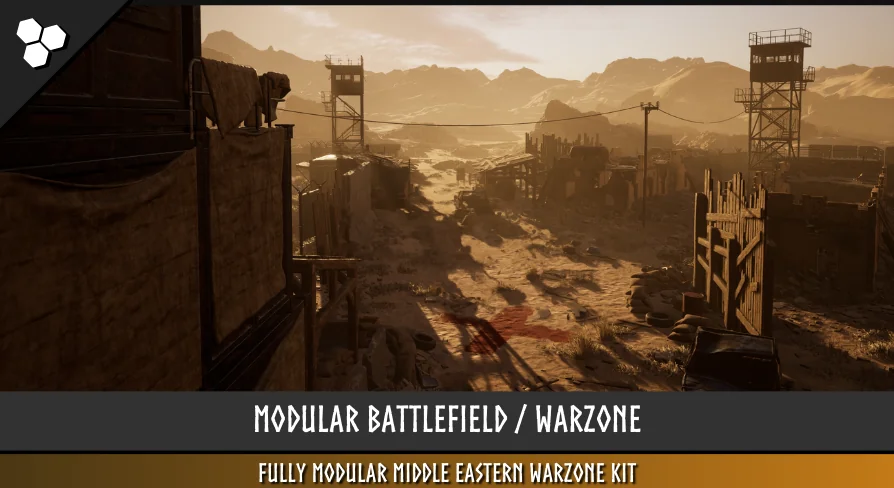
Building a believable Middle Eastern or arid military combat zone in Unreal Engine has always required a dense collection of enterable structures, furnished rooms, and terrain that fits the region. Modular Battlefield / Warzone positions itself as an A-to-Z construction kit aimed specifically at shooter games, covering outposts, villages, towns, camps, and destroyed buildings across a desert biome.
What the Warzone Megapack Brings to a Shooter Level
The product is labeled a Warzone Megapack, an all-in-one battlefield kit targeted at shooter projects. The scope is geared toward building outposts, cities, and towns rather than dropping a single static diorama into a scene. Every building in the kit is fully enterable and fully furnished, so designers can push interior combat or exploration spaces without having to piece together their own furniture sets or wall-fill props from scratch.
Tag coverage across the pack points to a Middle Eastern and Arabic aesthetic: Arabia, Outpost, Postapocalyptic, Base, Village, Arabic, Modern, Town, Desert, House, Middle, Eastern, Military, City, Cliff, Arid, Camp, Wood, Destroyed, and Structure. That spread suggests the kit can cover intact villages on one end and postapocalyptic or destroyed variants on the other, all within a single arid environment setting.
How Modular Construction Shapes Scene Layout
The kit is fully modular. Working from a library of 259 meshes, a designer can assemble outposts, towns, and cities part by part instead of relying on prebuilt hero pieces. The mesh count is stated plainly: 259 meshes for constructing new environments. This kind of part-based workflow lets level artists block out compounds, streets, and building clusters with reusable wall sections, structural pieces, and interior props, then swap in destroyed or weathered variants where the tone of the level calls for it.
Full interiors are part of the modular system, not a separate add-on. The interiors are described as complete, giving artists a range of assets to personalize individual spaces. In practical level design terms, that means a building placed in a town block can serve as an enterable combat space or loot interior rather than a sealed shell—without requiring a second interior-specific purchase or a custom prop set.
Setting Up the Project Before Opening the Level
To get the level running as intended, three preparation steps are required before opening it:
Enable the Enable Virtual Texture Support setting in Project Settings.
Enable the HDRI Backdrop Plugin.
Restart the project.
Virtual Texture support affects how large landscape and surface textures stream and sample in-engine, which matters for an asset line that includes desert biomes and Nanite landscapes. The HDRI Backdrop Plugin is tied to the project’s HDRI lighting and backdrop setup, so it needs to be active for the environment to render with the intended lighting backplate. Restarting after enabling both ensures the settings take effect before the level loads.
Skipping these steps is the most common reason a kit shaped by Lumen, Nanite, and Virtual Textures fails to look correct on first open. Getting the project settings sorted first avoids visual breakage later.
Unreal Engine 5.4, Lumen, and Nanite Integration
The map was built specifically for Unreal Engine 5.4 and above. It uses Lumen for real-time global illumination, Local Fog Volumes for atmosphere, and Nanite landscapes for high-detail terrain rendering. The combination is aimed at enhancing both visuals and performance, with Nanite landscapes handling dense geometry without the traditional LOD cost and Local Fog Volumes allowing scene-level atmosphere control without relying on fully bespoke particle systems.
Compatibility extends beyond 5.4 specifically. The product supports Lumen for Unreal Engine 5.0 and above, and Nanite for Unreal Engine 5.0 and above. That means projects still on earlier Unreal Engine 5 releases can use the lighting and geometry features the kit depends on, though the included map itself is authored against 5.4 behavior.
Desert Landscape and Biome Construction
Landscape work is handled inside the pack. Desert biome assets are provided so designers can quickly build out their own arid terrain rather than importing a separate landscape toolset. The tag set lists Cliff and Arid alongside Desert, pointing to terrain features that fit rocky outcrops and dry ground formations typical of Middle Eastern warzone environments.
The Nanite landscape approach means the terrain meshes can carry more geometric detail than traditional landscape systems, which is useful for cliffs, dunes, eroded ground, and broken urban edges where silhouette detail sells a warzone feel. Pairing Nanite landscapes with Lumen lighting means the desert surface responds dynamically to changes in light direction, time of day, and interior spill from buildings.
Who Benefits Most from This Kit
Level designers and environment artists working on shooter projects in Unreal Engine get the most direct value from the pack. The modular structure, enterable buildings, and furnished interiors solve a specific problem: creating combat-scaled interior and exterior spaces across a town, outpost, or city without assembling every prop from scratch. Teams that need a Middle Eastern or Arabic desert aesthetic—covering everything from intact villages to destroyed and postapocalyptic structures—get that range inside a single 259-mesh kit built for Unreal Engine 5.4, with Lumen and Nanite support available from Unreal Engine 5.0 onward.
 Desert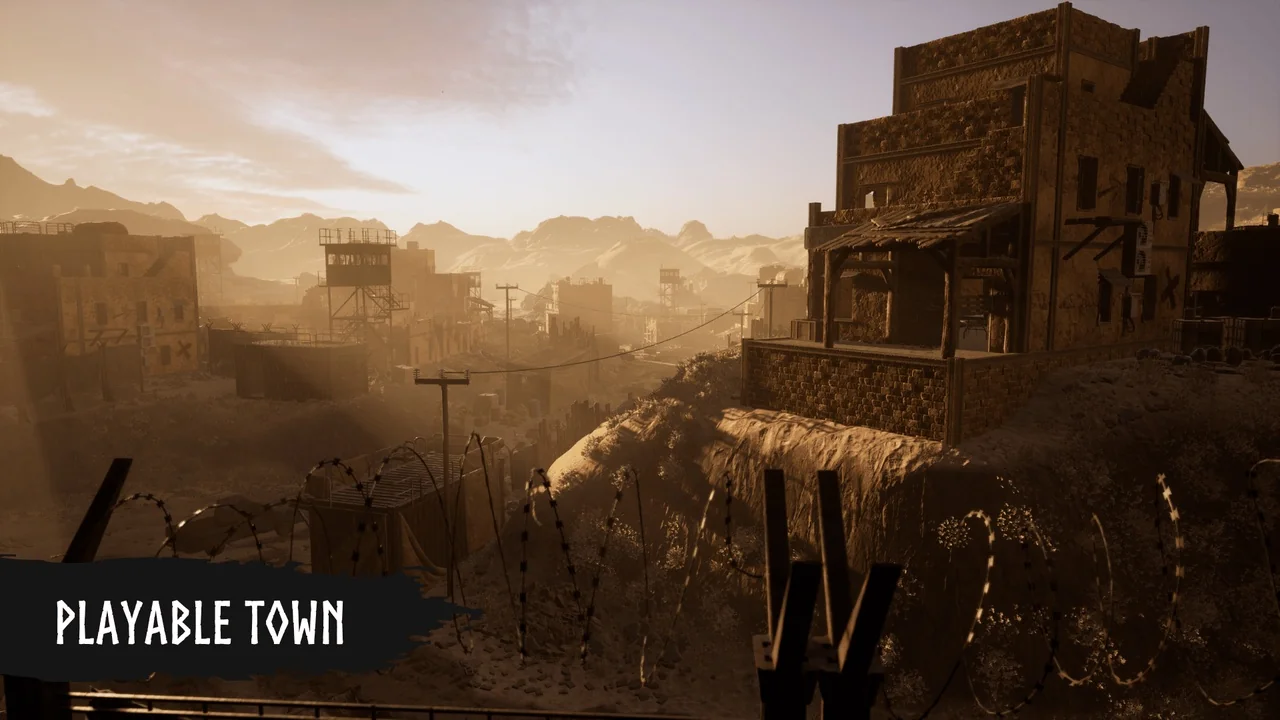
 Desert
 Desert
 Desert