"1a0e4ac4dc71d030"{"id":"1000175","slug":"urban-background-buildings-vol-1","title":"Urban Background Buildings - VOL.1","category":"Cities","engine":"4.26+,5.0+","assetVersion":"","engineVersion":"Engine Version: 4.26+,5.0+","tag":"Cities","accent":"blue","visual":"mech","summary":"Urban Background Buildings - VOL.1 delivers 13 optimized Unreal Engine building meshes with LODs, modular variations, master materials, and day-night setups.","platform":"Unreal Engine","publishedAt":"2026-06-20T06:26:44.634Z","updatedAt":"2026-06-20T06:26:44.634Z","sourceNotes":[],"fileContents":[],"compatibility":["Unreal Engine","Engine Version: 4.26+,5.0+"],"featuredImage":{"alt":"Urban Background Buildings - VOL.1","src":"/wp-content/uploads/published/2026/06/3c89a5e06c22-fa4e818b-3b25-41d4-bc56-1aa6085390a6-bfe9eb3f57.webp"},"hasDownloadLink":true,"downloads":0,"terms":[{"taxonomy":"category","slug":"cities","name":"Cities"}],"galleryImages":[{"src":"/wp-content/uploads/published/2026/06/0507519c7a9c-6043447b-47c4-4bd5-a5ee-ab23723e1844-b3262ddaee.webp","alt":"Urban Background Buildings - VOL.1"},{"src":"/wp-content/uploads/published/2026/06/40e299cdf2e6-10449c48-32c7-476b-900a-e629eda1568b-8f7335c1a6.webp","alt":"Urban Background Buildings - VOL.1"},{"src":"/wp-content/uploads/published/2026/06/3be18760b176-66aee78f-05eb-4b32-9826-dc70bc798aca-c93f1a0882.webp","alt":"Urban Background Buildings - VOL.1"},{"src":"/wp-content/uploads/published/2026/06/2a605e1fdd0a-e741c59d-77ae-489d-8f15-66cd2cc921de-8518c3a32d.webp","alt":"Urban Background Buildings - VOL.1"},{"src":"/wp-content/uploads/published/2026/06/f78b93bf07ff-a951dae2-be54-46c5-9eea-41baeb337940-f4c921ff37.webp","alt":"Urban Background Buildings - VOL.1"},{"src":"/wp-content/uploads/published/2026/06/3645de5d15d9-bbad0f74-bc41-4100-a788-a5bc486c45fa-c3f6cec806.webp","alt":"Urban Background Buildings - VOL.1"},{"src":"/wp-content/uploads/published/2026/06/bbc6157bce40-b24ed06f-7ed8-4b5f-a0b0-b3f32a651941-ad07167617.webp","alt":"Urban Background Buildings - VOL.1"},{"src":"/wp-content/uploads/published/2026/06/720524877b9d-74d48948-ab44-45a5-bd57-516a92d2887a-e417c512d0.webp","alt":"Urban Background Buildings - VOL.1"},{"src":"/wp-content/uploads/published/2026/06/0d8ae7ded6ec-c98df5b7-892d-4381-a9d2-e05210fa04d1-06d630afe9.webp","alt":"Urban Background Buildings - VOL.1"},{"src":"/wp-content/uploads/published/2026/06/e90170762cb9-5240ba99-f43e-481b-8f68-68cda1c48f60-69f77cd3d6.webp","alt":"Urban Background Buildings - VOL.1"}],"accessPanel":{"kind":"resource","title":"Download this resource","eyebrow":"Free Download","message":"Log in or create a free account to start your download.","fileName":"Content.7z","safetyNote":"Resources are manually reviewed before listing to improve quality and reduce obvious risks.","actionLabel":"Download Free","resourceType":"Resource archive"},"contentHtml":"\u003cp\u003eCity scenes rarely rely on hero architecture alone. The streets, apartment blocks, towers, industrial shapes, and distant skylines behind the focal point do a huge amount of work in making an environment feel complete. \u003cstrong\u003eUrban Background Buildings - VOL.1\u003c/strong\u003e Fits directly into that part of production. It is a collection created in Unreal Engine that includes all pictured assets, maps, and materials, with a clear emphasis on realistic AAA-quality visuals, style, and budget.\u003c/p\u003e\n\u003cp\u003eThe package centers on urban structures that support scene depth rather than only front-and-center showcase assets. That makes it especially relevant when a project needs believable midground buildings, far background silhouettes, and enough variation to avoid a repeated skyline. The included assets are optimized for games, and the set combines finished building meshes with material systems and modular components that help extend what can be built from the base content.\u003c/p\u003e \u003ch2\u003eUrban Background Buildings - VOL.1 in a city-building workflow\u003c/h2\u003e\n\u003cp\u003eThe core of the set is its 13 optimized building meshes. These are intended for midground building use, while each building also includes far background building LODs. In production terms, that gives the pack a defined role: it helps bridge the gap between detailed foreground environments and the distant city layer that fills out the horizon or neighboring blocks.\u003c/p\u003e\n\u003cp\u003eThat balance is important in urban scenes. Midground assets need enough presence to hold up in wider shots, while far background elements need to maintain the impression of scale without carrying the same cost as closer geometry. By covering both of those needs inside the same collection, the set supports a more continuous city backdrop rather than forcing a project to mix unrelated solutions for nearby and distant architecture.\u003c/p\u003e\n\u003cp\u003eThe tags associated with the set point in the same direction. Business, building, tower, urban, skyscraper, industrial, city, apartment, window, and construction all suggest a broad but coherent city vocabulary. This is not framed as a single-purpose landmark pack. It reads as a practical background building library for assembling larger metropolitan spaces with a realistic look.\u003c/p\u003e \u003ch2\u003e13 optimized building meshes with far background LODs\u003c/h2\u003e\n\u003cp\u003eThe strongest production-facing detail here is the combination of optimized building meshes and dedicated far background LODs for each one. Optimization matters most when city scenes begin to stack density across multiple blocks, and that is exactly where background architecture tends to multiply quickly. A set like this is useful because it is not just about having urban models to place in a level; it is about having urban models prepared to sit in the parts of a scene where quantity and distance become major concerns.\u003c/p\u003e\n\u003cp\u003eEach of the 13 building meshes contributes to that layered use. In one pass, they can populate the middle distance of a street, district, or skyline view. In another, their far background LODs can carry the larger silhouette of the city beyond the playable space or focal shot area. That makes the set suitable for environments that need readable architecture from many angles and at several scales of visibility.\u003c/p\u003e\n\u003cp\u003eThe models are also described as fully detailed from all sides. That matters for background buildings more than it first appears. Structures used beyond the immediate foreground are often seen from elevated views, street-level movement, side angles, and long panoramic shots. A building that only works from one direction can limit layout options. Full detail on all sides gives more freedom when arranging blocks, intersections, skylines, or perimeter areas around the main playable zone.\u003c/p\u003e \u003ch2\u003eModular parts for height changes and building variation\u003c/h2\u003e\n\u003cp\u003eOne of the more flexible pieces of the set is its modular construction. It includes modular parts that allow users to create their own heights and variations across all buildings. That shifts the pack away from being a fixed collection of static silhouettes and toward something more adaptable for layout work.\u003c/p\u003e\n\u003cp\u003eIn practice, modular height changes are especially useful in city building because repetition becomes obvious very quickly. Even a strong set of base meshes can start to look patterned if every roofline, floor count, and vertical proportion stays the same across a block. Modular parts give room to push a building taller, shorten another, or vary neighboring forms so the skyline reads with more natural irregularity.\u003c/p\u003e\n\u003cp\u003eThis also helps when matching architecture to different city zones inside a single project. Apartment-lined stretches, denser business areas, industrial edges, and construction-heavy sections can all benefit from variations in height and arrangement. The set’s tags reflect that kind of spread, and the modular system supports it without requiring every variation to come from an entirely separate asset.\u003c/p\u003e\n\u003cp\u003eBecause the buildings are intended for midground and background use, this kind of modular flexibility can be more valuable than extreme bespoke detailing. The priority becomes shaping a believable city mass with enough diversity in profile and spacing, while maintaining consistency in visual quality. The pack’s structure appears to support exactly that approach.\u003c/p\u003e \u003ch2\u003eMaster material setup, day and night settings, and channel-packed maps\u003c/h2\u003e\n\u003cp\u003eThe package is not limited to meshes alone. It includes a master material setup that controls the majority of the assets, along with day and night time settings and material instances. That means the pack contributes not just geometry, but also a material workflow that helps keep a broad building set manageable inside Unreal Engine.\u003c/p\u003e\n\u003cp\u003eA shared material setup is useful in any environment pack, but it becomes especially important in background architecture where many assets need to stay visually consistent without becoming tedious to manage one by one. If most of the set is driven through a master material framework, adjustments can be made in a more unified way across a larger slice of the city.\u003c/p\u003e\n\u003cp\u003eAdditional controls for roughness, albedo, normals, and more deepen that flexibility. Those controls are not presented as abstract technical extras; they directly affect how buildings sit in lighting, how surfaces read at distance, and how much variation can be introduced without rebuilding assets. Roughness can alter the feel of windows, painted surfaces, or weathered elements. Albedo changes can help break repetition or tune a district toward a specific look. Normal-related control supports the perceived surface definition that helps architecture read from different view distances.\u003c/p\u003e\n\u003cp\u003eThe maps also use channel-packed Roughness, Metalness, and Ambient Occlusion. That is a practical detail for environment production because it points to an efficient texture setup rather than a loose collection of materials with no shared structure. For teams or individual artists building game scenes, that kind of organization can make the pack easier to integrate into established Unreal workflows.\u003c/p\u003e\n\u003cp\u003eThe inclusion of day and night settings gives the buildings another layer of utility. Urban backgrounds often need to work across multiple lighting scenarios, and a city that holds up in daylight may need a different material feel after dark. Having day and night material instances and settings already present helps the set move across those scene conditions without requiring a ground-up rebuild of the visual setup.\u003c/p\u003e \u003ch2\u003eRealistic AAA quality visuals with game-ready constraints\u003c/h2\u003e\n\u003cp\u003eThe stated visual target is realistic AAA quality in visuals, style, and budget. That combination defines the pack’s intent clearly. It aims for a high-end realistic look, but it is also framed with production constraints in mind rather than purely as a cinematic-only collection. The fact that it is optimized for games reinforces that balance.\u003c/p\u003e\n\u003cp\u003eThat makes the set fit naturally into real-time urban projects where the city beyond the focal area still needs to look convincing. Background architecture often carries a lot of the environment’s realism because it establishes scale and context. If those distant and mid-distance buildings feel weak, the entire city can lose credibility. A pack that focuses on realistic presentation while remaining optimized is useful precisely because it supports those high-coverage areas of a level.\u003c/p\u003e\n\u003cp\u003eThe package also includes a test dynamic lighting scene. This is a practical addition because lighting is one of the fastest ways to judge whether background buildings are reading correctly. In a city environment, the same structure may need to work under direct sun, cloudy ambient light, dusk tones, or a night setup. A test scene focused on dynamic lighting gives a working context for evaluating how the models and materials behave under changing illumination.\u003c/p\u003e\n\u003cp\u003eAnother notable point is that all branding and labels are custom made by the studio, and the set is described as free of legal issues. For urban environment work, signage and branded surface details can quickly become a complication. Custom-made branding removes that concern while still allowing buildings to carry the visual cues that help city backgrounds feel finished rather than blank.\u003c/p\u003e \u003ch2\u003eTexture sizes and where this set fits best\u003c/h2\u003e\n\u003cp\u003eThe texture breakdown is specific: 2048 textures [77], 1024 textures [2], 512 textures [1], 256 textures [1], and 128 textures [4]. That distribution suggests the set puts most of its texture weight into 2048 assets, with smaller counts at the lower sizes. For a background building collection, that gives a clearer picture of how the material and surface detail budget is allocated across the pack.\u003c/p\u003e\n\u003cp\u003eAs a whole, Urban Background Buildings - VOL.1 suits projects that need believable urban massing rather than just a few isolated showcase structures. Its strongest place in a workflow is the construction of midground city blocks, distant building layers, and skyline support for realistic game environments in Unreal Engine. The 13 optimized meshes establish the base vocabulary, the modular parts expand variety, the master material setup keeps control centralized, and the day and night settings help the same buildings function across different lighting states.\u003c/p\u003e\n\u003cp\u003eFor teams and artists shaping apartment zones, business districts, industrial edges, or mixed urban backdrops, this set looks most useful when the task is to fill space convincingly while keeping the city cohesive. The practical takeaway is simple: if a project needs realistic urban background architecture with modular height variation, shared material control, and game-oriented optimization, this pack is aimed squarely at that job.\u003c/p\u003e\n\n\u003ch2\u003eContinue Browsing Similar Packs\u003c/h2\u003e\n\u003cul\u003e\n\u003cli\u003e\u003ca href=\"https://3dcghub.com/brushify-urban-buildings-pack/\" title=\"Brushify - Urban Buildings Pack\"\u003eBrushify - Urban Buildings Pack\u003c/a\u003e\u003c/li\u003e\n\u003cli\u003e\u003ca href=\"https://3dcghub.com/modern-city-downtown-megapack-modern-city-downtown-building-usa-town-street/\" title=\"Modern City Downtown Megapack ( Modern City Downtown Building USA Town Street )\"\u003eModern City Downtown Megapack ( Modern City Downtown Building USA Town Street )\u003c/a\u003e\u003c/li\u003e\n\u003cli\u003e\u003ca href=\"https://3dcghub.com/vista-buildings/\" title=\"Vista Buildings\"\u003eVista Buildings\u003c/a\u003e\u003c/li\u003e\n\u003cli\u003e\u003ca href=\"https://3dcghub.com/poly-town-city-modular/\" title=\"POLY - Town City Modular\"\u003ePOLY - Town City Modular\u003c/a\u003e\u003c/li\u003e\n\u003cli\u003e\u003ca href=\"https://3dcghub.com/modular-post-soviet-building/\" title=\"Modular Post Soviet Building\"\u003eModular Post Soviet Building\u003c/a\u003e\u003c/li\u003e\n\u003c/ul\u003e","contentTextLength":10830,"navigation":{"current":1126,"total":3200,"previous":{"id":"1000176","slug":"uscans-doors-01","title":"Uscans Doors 01","category":"Apocalyptic / Post-apocalyptic","platform":"Unreal Engine","updatedAt":"2026-06-20T07:03:51.520Z"},"next":{"id":"1000174","slug":"make-short-films-in-unreal-engine-5-with-metahumans","title":"Make Short Films in Unreal Engine 5 with Metahumans","category":"Unreal Engine","platform":"Unreal Engine","updatedAt":"2026-06-20T05:25:11.411Z"}},"relatedResources":[{"id":"7047","slug":"brushify-urban-buildings-pack","title":"Brushify - Urban Buildings Pack","category":"Cities","engine":"5.1+","assetVersion":"Engine version: 5.1+","engineVersion":"4.24","tag":"Cities","accent":"blue","visual":"city","summary":"The Brushify - Urban Buildings Pack is a professional modular system designed for rapid city creation. It features optimized prefabs, advanced materials, and a complete playable level.","platform":"Unreal Engine","publishedAt":"2026-02-20T17:20:17.000Z","updatedAt":"2026-04-19T15:56:04.000Z","sourceNotes":[],"fileContents":[],"compatibility":["Unreal Engine"],"featuredImage":{"alt":"Brushify - Urban Buildings Pack","src":"https://3dcghub.com/wp-content/uploads/2026/02/bdee9f1c-eaa0-48d9-ae74-60f362a886e6.webp"},"hasDownloadLink":true,"downloads":0},{"id":"7243","slug":"modular-post-soviet-building","title":"Modular Post Soviet Building","category":"Cities","engine":"4.26+,5.0+","assetVersion":"Engine version: 4.26+,5.0+","engineVersion":"4.18","tag":"Cities","accent":"blue","visual":"city","summary":"Create authentic Eastern European environments with this comprehensive modular building kit. It features interactive doors, interior meshes, and a variety of urban props for realistic scene dressing.","platform":"Unreal Engine","publishedAt":"2026-02-20T19:05:34.000Z","updatedAt":"2026-04-19T15:56:02.000Z","sourceNotes":[],"fileContents":[],"compatibility":["Unreal Engine","Engine version: 4.26+,5.0+"],"featuredImage":{"alt":"Modular Post Soviet Building","src":"https://3dcghub.com/wp-content/uploads/2026/02/60a0c4dd-8057-4ef8-8ca7-ec24fddf6756.webp"},"hasDownloadLink":true,"downloads":1},{"id":"7299","slug":"poly-town-city-modular","title":"POLY - Town City Modular","category":"Cities","engine":"4.26+,5.0+","assetVersion":"Engine version: 4.26+,5.0+","engineVersion":"4.24","tag":"Cities","accent":"blue","visual":"city","summary":"Build expansive and visually striking urban environments with the POLY - Town City Modular asset pack. This collection offers nearly 600 modular pieces, ranging from buildings to vehicles, perfect for stylized game projects.","platform":"Unreal Engine","publishedAt":"2026-02-21T12:24:18.000Z","updatedAt":"2026-04-19T15:56:01.000Z","sourceNotes":[],"fileContents":[],"compatibility":["Unreal Engine","Engine version: 4.26+,5.0+"],"featuredImage":{"alt":"POLY - Town City Modular","src":"https://3dcghub.com/wp-content/uploads/2026/02/36816de8-f25b-4ab2-b475-4aafa559f5d0.webp"},"hasDownloadLink":true,"downloads":1}]}
Cities
Urban Background Buildings - VOL.1
Urban Background Buildings - VOL.1 delivers 13 optimized Unreal Engine building meshes with LODs, modular variations, master materials, and day-night setups.
Category:Unreal Engine, CitiesPlatform: Unreal EngineEngine Version: 4.26+,5.0+Published: Jun 20, 2026
Cities
Resource overview
City scenes rarely rely on hero architecture alone. The streets, apartment blocks, towers, industrial shapes, and distant skylines behind the focal point do a huge amount of work in making an environment feel complete. Urban Background Buildings - VOL.1 Fits directly into that part of production. It is a collection created in Unreal Engine that includes all pictured assets, maps, and materials, with a clear emphasis on realistic AAA-quality visuals, style, and budget.
The package centers on urban structures that support scene depth rather than only front-and-center showcase assets. That makes it especially relevant when a project needs believable midground buildings, far background silhouettes, and enough variation to avoid a repeated skyline. The included assets are optimized for games, and the set combines finished building meshes with material systems and modular components that help extend what can be built from the base content.
Urban Background Buildings - VOL.1 in a city-building workflow
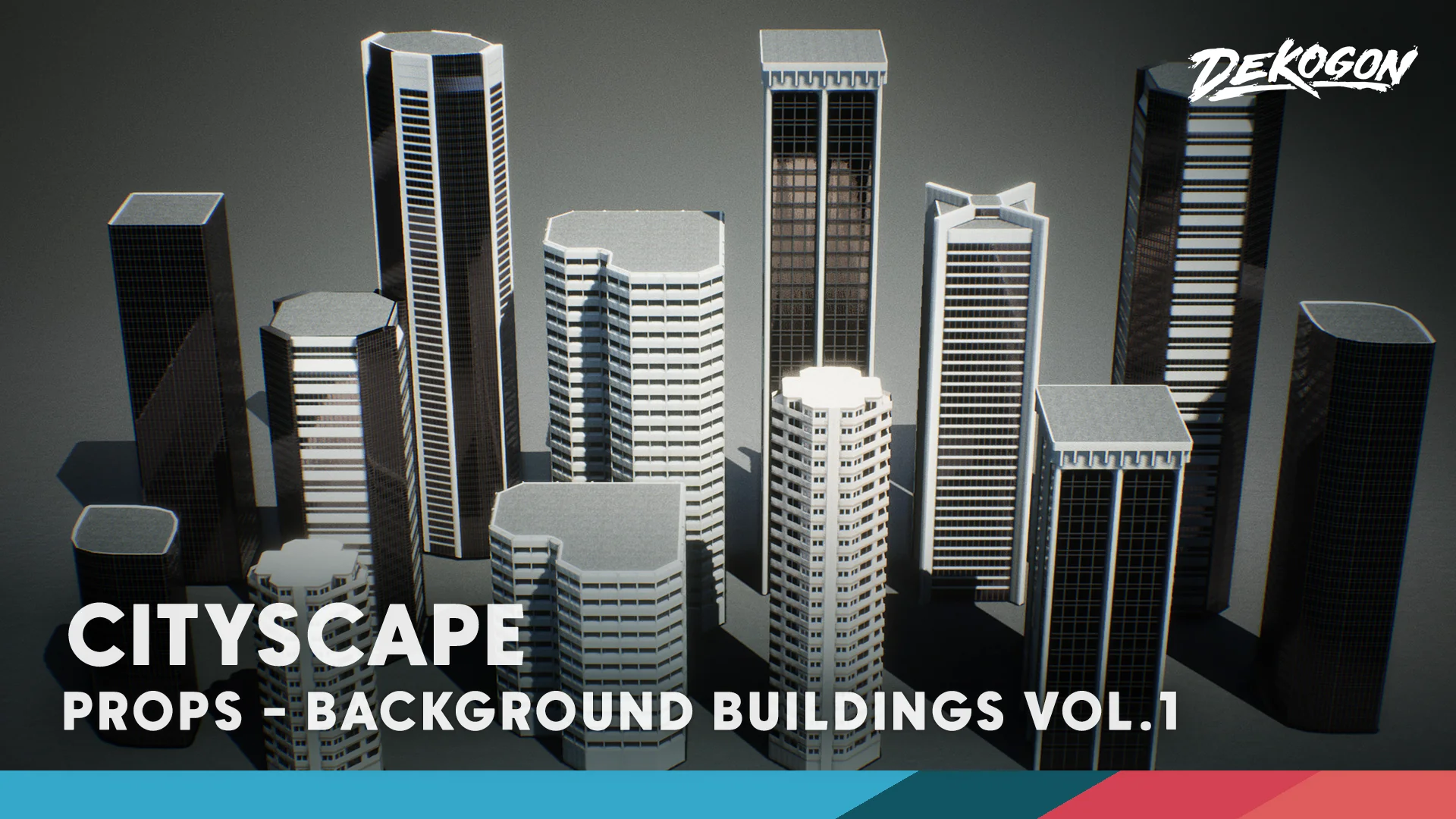
The core of the set is its 13 optimized building meshes. These are intended for midground building use, while each building also includes far background building LODs. In production terms, that gives the pack a defined role: it helps bridge the gap between detailed foreground environments and the distant city layer that fills out the horizon or neighboring blocks.
That balance is important in urban scenes. Midground assets need enough presence to hold up in wider shots, while far background elements need to maintain the impression of scale without carrying the same cost as closer geometry. By covering both of those needs inside the same collection, the set supports a more continuous city backdrop rather than forcing a project to mix unrelated solutions for nearby and distant architecture.
The tags associated with the set point in the same direction. Business, building, tower, urban, skyscraper, industrial, city, apartment, window, and construction all suggest a broad but coherent city vocabulary. This is not framed as a single-purpose landmark pack. It reads as a practical background building library for assembling larger metropolitan spaces with a realistic look.
13 optimized building meshes with far background LODs
The strongest production-facing detail here is the combination of optimized building meshes and dedicated far background LODs for each one. Optimization matters most when city scenes begin to stack density across multiple blocks, and that is exactly where background architecture tends to multiply quickly. A set like this is useful because it is not just about having urban models to place in a level; it is about having urban models prepared to sit in the parts of a scene where quantity and distance become major concerns.
Each of the 13 building meshes contributes to that layered use. In one pass, they can populate the middle distance of a street, district, or skyline view. In another, their far background LODs can carry the larger silhouette of the city beyond the playable space or focal shot area. That makes the set suitable for environments that need readable architecture from many angles and at several scales of visibility.
The models are also described as fully detailed from all sides. That matters for background buildings more than it first appears. Structures used beyond the immediate foreground are often seen from elevated views, street-level movement, side angles, and long panoramic shots. A building that only works from one direction can limit layout options. Full detail on all sides gives more freedom when arranging blocks, intersections, skylines, or perimeter areas around the main playable zone.
Modular parts for height changes and building variation
One of the more flexible pieces of the set is its modular construction. It includes modular parts that allow users to create their own heights and variations across all buildings. That shifts the pack away from being a fixed collection of static silhouettes and toward something more adaptable for layout work.
In practice, modular height changes are especially useful in city building because repetition becomes obvious very quickly. Even a strong set of base meshes can start to look patterned if every roofline, floor count, and vertical proportion stays the same across a block. Modular parts give room to push a building taller, shorten another, or vary neighboring forms so the skyline reads with more natural irregularity.
This also helps when matching architecture to different city zones inside a single project. Apartment-lined stretches, denser business areas, industrial edges, and construction-heavy sections can all benefit from variations in height and arrangement. The set’s tags reflect that kind of spread, and the modular system supports it without requiring every variation to come from an entirely separate asset.
Because the buildings are intended for midground and background use, this kind of modular flexibility can be more valuable than extreme bespoke detailing. The priority becomes shaping a believable city mass with enough diversity in profile and spacing, while maintaining consistency in visual quality. The pack’s structure appears to support exactly that approach.
Master material setup, day and night settings, and channel-packed maps
The package is not limited to meshes alone. It includes a master material setup that controls the majority of the assets, along with day and night time settings and material instances. That means the pack contributes not just geometry, but also a material workflow that helps keep a broad building set manageable inside Unreal Engine.
A shared material setup is useful in any environment pack, but it becomes especially important in background architecture where many assets need to stay visually consistent without becoming tedious to manage one by one. If most of the set is driven through a master material framework, adjustments can be made in a more unified way across a larger slice of the city.
Additional controls for roughness, albedo, normals, and more deepen that flexibility. Those controls are not presented as abstract technical extras; they directly affect how buildings sit in lighting, how surfaces read at distance, and how much variation can be introduced without rebuilding assets. Roughness can alter the feel of windows, painted surfaces, or weathered elements. Albedo changes can help break repetition or tune a district toward a specific look. Normal-related control supports the perceived surface definition that helps architecture read from different view distances.
The maps also use channel-packed Roughness, Metalness, and Ambient Occlusion. That is a practical detail for environment production because it points to an efficient texture setup rather than a loose collection of materials with no shared structure. For teams or individual artists building game scenes, that kind of organization can make the pack easier to integrate into established Unreal workflows.
The inclusion of day and night settings gives the buildings another layer of utility. Urban backgrounds often need to work across multiple lighting scenarios, and a city that holds up in daylight may need a different material feel after dark. Having day and night material instances and settings already present helps the set move across those scene conditions without requiring a ground-up rebuild of the visual setup.
Realistic AAA quality visuals with game-ready constraints
The stated visual target is realistic AAA quality in visuals, style, and budget. That combination defines the pack’s intent clearly. It aims for a high-end realistic look, but it is also framed with production constraints in mind rather than purely as a cinematic-only collection. The fact that it is optimized for games reinforces that balance.
That makes the set fit naturally into real-time urban projects where the city beyond the focal area still needs to look convincing. Background architecture often carries a lot of the environment’s realism because it establishes scale and context. If those distant and mid-distance buildings feel weak, the entire city can lose credibility. A pack that focuses on realistic presentation while remaining optimized is useful precisely because it supports those high-coverage areas of a level.
The package also includes a test dynamic lighting scene. This is a practical addition because lighting is one of the fastest ways to judge whether background buildings are reading correctly. In a city environment, the same structure may need to work under direct sun, cloudy ambient light, dusk tones, or a night setup. A test scene focused on dynamic lighting gives a working context for evaluating how the models and materials behave under changing illumination.
Another notable point is that all branding and labels are custom made by the studio, and the set is described as free of legal issues. For urban environment work, signage and branded surface details can quickly become a complication. Custom-made branding removes that concern while still allowing buildings to carry the visual cues that help city backgrounds feel finished rather than blank.
Texture sizes and where this set fits best
The texture breakdown is specific: 2048 textures [77], 1024 textures [2], 512 textures [1], 256 textures [1], and 128 textures [4]. That distribution suggests the set puts most of its texture weight into 2048 assets, with smaller counts at the lower sizes. For a background building collection, that gives a clearer picture of how the material and surface detail budget is allocated across the pack.
As a whole, Urban Background Buildings - VOL.1 suits projects that need believable urban massing rather than just a few isolated showcase structures. Its strongest place in a workflow is the construction of midground city blocks, distant building layers, and skyline support for realistic game environments in Unreal Engine. The 13 optimized meshes establish the base vocabulary, the modular parts expand variety, the master material setup keeps control centralized, and the day and night settings help the same buildings function across different lighting states.
For teams and artists shaping apartment zones, business districts, industrial edges, or mixed urban backdrops, this set looks most useful when the task is to fill space convincingly while keeping the city cohesive. The practical takeaway is simple: if a project needs realistic urban background architecture with modular height variation, shared material control, and game-oriented optimization, this pack is aimed squarely at that job.
 Cities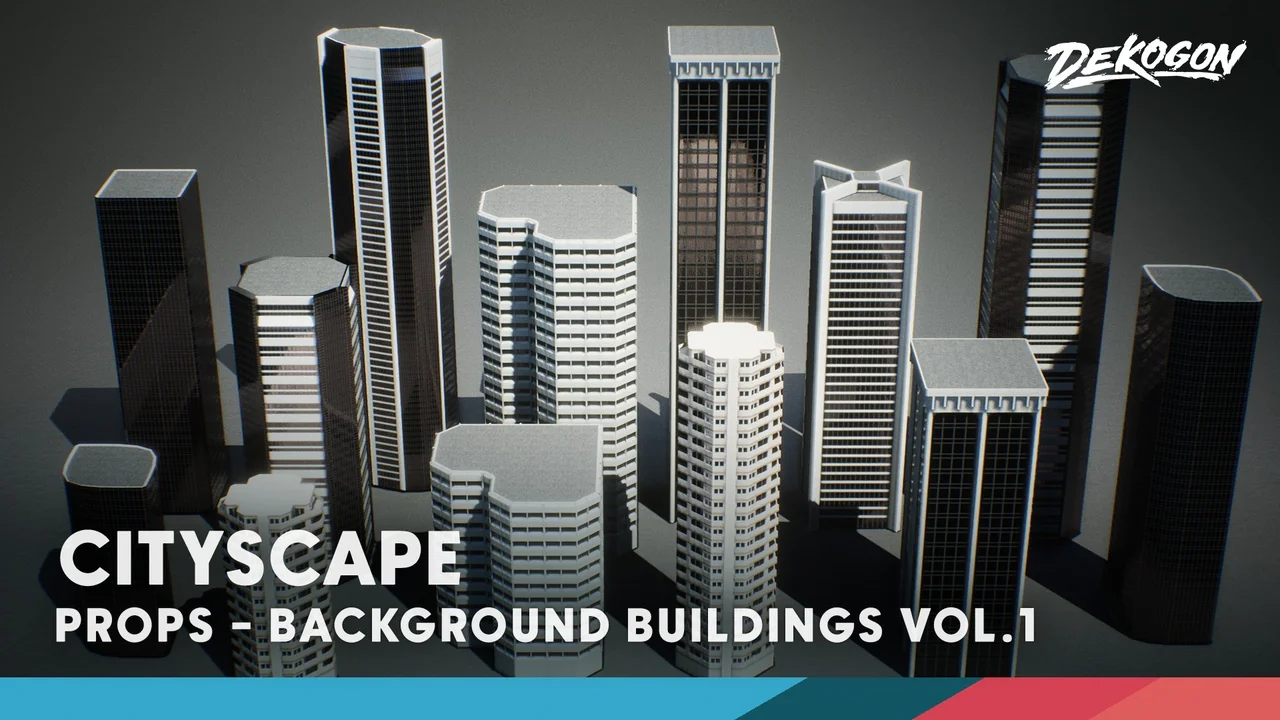
 Cities
 Cities
 Cities