"efaa631e936fd3ee"{"id":"1002148","slug":"portal-pack-teleport-blueprint-vfx","title":"Portal Pack / Teleport Blueprint / VFX","category":"Gameplay Features","engine":"4.26+,5.0+","assetVersion":"","engineVersion":"Engine Version: 4.26+,5.0+","tag":"Gameplay Features","accent":"blue","visual":"mech","summary":"Explore the Portal Pack / Teleport Blueprint / VFX asset, featuring Niagara effects, interactive Blueprint teleportation, and Windows x64 demo testing.","platform":"Unreal Engine","publishedAt":"2026-10-29T09:52:41.232Z","updatedAt":"2026-10-29T09:52:41.232Z","sourceNotes":[],"fileContents":[],"compatibility":["Unreal Engine","Engine Version: 4.26+,5.0+"],"featuredImage":{"alt":"Portal Pack / Teleport Blueprint / VFX","src":"/wp-content/uploads/published/2026/10/3ed953fb85b7-bbc314a8-8cb1-4314-92d9-b415b7bafdd1-0597e5afee.webp"},"hasDownloadLink":true,"downloads":0,"terms":[{"taxonomy":"category","slug":"gameplay-features","name":"Gameplay Features"}],"galleryImages":[{"src":"/wp-content/uploads/published/2026/10/6f64ca4f12cb-c435059b-24c3-4da5-9049-e18c0b5db18b-aa6960c6f7.webp","alt":"Portal Pack / Teleport Blueprint / VFX"},{"src":"/wp-content/uploads/published/2026/10/e79997a86d95-8abcced4-a176-4517-ba83-9c647445a3fd-ea1ea3b160.webp","alt":"Portal Pack / Teleport Blueprint / VFX"},{"src":"/wp-content/uploads/published/2026/10/911710698f17-843bc2b9-b015-4286-98e4-65ac6d661387-d95a011a88.webp","alt":"Portal Pack / Teleport Blueprint / VFX"},{"src":"/wp-content/uploads/published/2026/10/b8a8001da9c3-fc5a8047-4823-4430-a694-77f75611b0d6-ebb111800b.webp","alt":"Portal Pack / Teleport Blueprint / VFX"},{"src":"/wp-content/uploads/published/2026/10/6ecdcbe884dc-4093e6b9-f2d2-462c-ba0c-44ae7de72480-6a63a1437d.webp","alt":"Portal Pack / Teleport Blueprint / VFX"},{"src":"/wp-content/uploads/published/2026/10/d1c05732dabf-6f3849b1-b094-4eee-9cea-2add56faa2cb-8e4b10933e.webp","alt":"Portal Pack / Teleport Blueprint / VFX"},{"src":"/wp-content/uploads/published/2026/10/2a1ced744428-3081db91-818c-43d8-9213-9fc4cf17a24a-6ea4d6528d.webp","alt":"Portal Pack / Teleport Blueprint / VFX"}],"accessPanel":{"kind":"resource","title":"Download this resource","eyebrow":"Free Download","message":"Log in or create a free account to start your download.","fileName":"Content.7z","safetyNote":"Resources are manually reviewed before listing to improve quality and reduce obvious risks.","actionLabel":"Download Free","resourceType":"Resource archive"},"contentHtml":"\u003ch2\u003eStaging Space and Galaxy Traversal Points\u003c/h2\u003e\u003cp\u003eSci-fi installations, planetary outposts, and interstellar waypoints regularly demand seamless spatial transitions. Moving a player character across vast distances or between closed interior levels requires both reliable logic and a clear visual cue. The Portal Pack / Teleport Blueprint / VFX targets these exact points of transit, providing a cohesive blend of Niagara particle simulations, custom gate meshes, and Blueprint-driven relocation mechanics.\u003c/p\u003e\u003cp\u003eInstead of relying on hard screen cuts or standard loading interruptions, level designers can anchor traversal around physical gateway fixtures. Themes of deep space and swirling galaxy phenomena are central to the visual presentation. When an exploratory corridor or an experimental chamber leads into an active gate, the presence of distinct celestial energy immediately signals that a spatial rift is open for interaction.\u003c/p\u003e\u003cp\u003eThe package bridges the gap between aesthetic environmental assets and mechanical gameplay logic. Rather than leaving particle artists to engineer relocation code or forcing technical designers to hand-craft particle emitters, the components arrive pre-connected. This allows interactive jump points, wormholes, and transit pads to function as plug-and-play set pieces within level geometry.\u003c/p\u003e\u003ch2\u003eHigh Quality Niagara VFX for Gateway Surfaces\u003c/h2\u003e\u003cp\u003eParticle movement defines the identity of any transit portal. Within this collection, visual effects are assembled using the Niagara framework, yielding high quality particle behavior capable of handling complex flow fields, volumetric motion, and dense visual layering. The visual design leans heavily into celestial imagery, creating energy barriers that emulate swirling galaxies, event horizons, and localized cosmic distortions.\u003c/p\u003e\u003cp\u003eNiagara effects provide essential visual feedback for players approaching an active threshold. By balancing edge turbulence, inward gravitational pull, and central core density, the gate VFX communicates active states cleanly. Players can clearly tell where the threshold sits in three-dimensional space, preventing disorienting clipping or accidental triggering before they make deliberate contact with the portal plane.\u003c/p\u003e\u003cp\u003eBecause the VFX is built inside modern particle pipelines, it maintains visual clarity across diverse lighting schemes. Whether placed inside an artificially illuminated subterranean bunker or suspended outside an orbital dock against dark starfields, the luminous space patterns hold their contrast and read instantly as functional travel portals.\u003c/p\u003e\u003ch2\u003eTeleport Blueprint Script Structure and Behavior\u003c/h2\u003e\u003cp\u003eBehind the particle systems sits a functional Teleport Blueprint, responsible for the underlying script logic that handles actor movement. Visuals alone cannot execute travel; the Blueprint acts as the brain, detecting collision events, calculating target coordinates, and relocating the player or dynamic objects without breaking gameplay continuity.\u003c/p\u003e\u003cp\u003eThe script handles coordinate remapping between the entry gate and the destination point. When an actor breaches the collision boundary of the gateway, the Blueprint executes the spatial translation, instantly updating world transform parameters while maintaining orientation stability. This ensures that a player stepping through a gate does not experience camera snapping, unpredictable physics velocity spikes, or floor clipping upon arrival at the exit site.\u003c/p\u003e\u003cp\u003eScripted logic also manages activation timing. The Blueprint works hand-in-glove with the Niagara VFX components, ensuring particle emitters trigger, pulse, or idle in sync with the operational state of the teleport sequence. By binding visual emitters directly to the transit script, state changes—such as activating a dormant gateway or cycling between destinations—remain visually aligned with what the logic executes under the hood.\u003c/p\u003e\u003ch2\u003eVerification Inside the Windows x64 Demo Project\u003c/h2\u003e\u003cp\u003eEvaluating interactive assets before dropping them into an existing production branch saves substantial setup time. This package includes a dedicated Demo Project compiled for Windows x64 systems, allowing creators to inspect runtime performance, visual fidelity, and script responsiveness in a packaged environment.\u003c/p\u003e\u003cp\u003eRunning the standalone Windows x64 build provides direct confirmation of how the collision boundaries behave under normal movement speeds, how camera transitions interact with particle meshes, and how the Niagara VFX handles real-time scene rendering. Testing within a compiled application helps eliminate guesswork regarding frame rates, draw calls, and script latency before assets are migrated into a larger game project.\u003c/p\u003e\u003cp\u003eComplementing the executable demo, technical documentation and video demonstrations outline the recommended setup flow. These reference materials walk through node hierarchies, parameter exposes within the Teleport Blueprint, and optimal placement practices for gateway actors. For collaborative development teams, community Discord access provides a direct line for technical troubleshooting, workflow tips, and implementation discussions alongside fellow developers.\u003c/p\u003e\u003ch2\u003eIntegrating Portals into the 4 IN 1 Modular Research Facility\u003c/h2\u003e\u003cp\u003eLevel coherence depends on matching thematic architecture with interactive props. The Portal Pack / Teleport Blueprint / VFX is explicitly built for compatibility with the 4 IN 1 Modular Research Facility / Mega Bundle 2025. This compatibility ensures that the structural framing, gate proportions, and materials align directly with modern laboratory, containment, and sci-fi facility modules.\u003c/p\u003e\u003cp\u003eWithin the narrative setting of an advanced research facility, portals naturally act as the centerpiece for experimental laboratories, quarantine zones, or spatial research chambers. Because the gate meshes and visual scales coordinate with the Modular Research Facility kit, artists can seat the teleport structures inside testing rooms, airlocks, and central rotunda halls without manual rescaling or mesh kitbashing.\u003c/p\u003e\u003cp\u003eThis tight fit simplifies complex level layouts. In multi-wing facilities where different research bays represent entirely different biomes or security tiers, dropping in matching teleport gates allows seamless traversal between disconnected modular wings without requiring miles of connecting corridors or elevator shafts.\u003c/p\u003e\u003ch2\u003eDevelopers and Pipelines Suited for Teleport Gate Integration\u003c/h2\u003e\u003cp\u003eGame developers, technical artists, and level designers building science-fiction or speculative adventure games benefit most from this setup. Building custom relocation logic from scratch often leads to edge-case bugs—such as actors triggering overlaps repeatedly, falling out of world bounds, or losing momentum abruptly. By relying on a tested Teleport Blueprint linked to Niagara particle emitters, teams can bypass weeks of basic logic troubleshooting.\u003c/p\u003e\u003cp\u003eSolo creators and small indie teams working under tight deadlines will find the combination of a Windows x64 demo, clear documentation, and video breakdowns invaluable for rapid prototyping. Instead of dividing focus between particle math and relocation scripting, production can immediately shift to level pacing, puzzle design, and world construction.\u003c/p\u003e\n\n\u003ch2\u003eRelated Resources Worth Checking\u003c/h2\u003e\n\u003cul\u003e\n\u003cli\u003e\u003ca href=\"https://3dcghub.com/next-gen-destruction-toolkit/\" title=\"Next Gen Destruction Toolkit\"\u003eNext Gen Destruction Toolkit\u003c/a\u003e\u003c/li\u003e\n\u003cli\u003e\u003ca href=\"https://3dcghub.com/teleportation-and-portal/\" title=\"Teleportation and Portal\"\u003eTeleportation and Portal\u003c/a\u003e\u003c/li\u003e\n\u003cli\u003e\u003ca href=\"https://3dcghub.com/dot-matrix-shader-pack/\" title=\"Dot Matrix Shader Pack\"\u003eDot Matrix Shader Pack\u003c/a\u003e\u003c/li\u003e\n\u003cli\u003e\u003ca href=\"https://3dcghub.com/line-of-sight-dynamic-mesh/\" title=\"Line Of Sight. Dynamic mesh.\"\u003eLine Of Sight. Dynamic mesh.\u003c/a\u003e\u003c/li\u003e\n\u003cli\u003e\u003ca href=\"https://3dcghub.com/portals-vfx-pack-interactions/\" title=\"Portals VFX pack (+ interactions)\"\u003ePortals VFX pack (+ interactions)\u003c/a\u003e\u003c/li\u003e\n\u003c/ul\u003e","contentTextLength":7373,"navigation":{"current":136,"total":4209,"previous":{"id":"1002149","slug":"portalify-advanced-level-streaming-supported-portal-system","title":"Portalify - Advanced Level Streaming Supported Portal System","category":"Procedural Systems","platform":"Unreal Engine","updatedAt":"2026-10-29T09:53:31.822Z"},"next":{"id":"1002147","slug":"portal-pack-niagara-vfx","title":"Portal Pack -Niagara VFX","category":"Variety","platform":"Unreal Engine","updatedAt":"2026-10-29T09:52:03.294Z"}},"relatedResources":[{"id":"1001004","slug":"next-gen-destruction-toolkit","title":"Next Gen Destruction Toolkit","category":"Gameplay Features","engine":"5.3+","assetVersion":"","engineVersion":"Engine Version: 5.3+","tag":"Gameplay Features","accent":"blue","visual":"mech","summary":"A UE5 Chaos Destruction framework using data assets, surface-driven VFX and sound, with 15 Blueprints and 14 Niagara systems. Built for Nanite/Lumen.","platform":"Unreal Engine","publishedAt":"2026-08-22T10:54:47.045Z","updatedAt":"2026-08-22T10:54:47.045Z","sourceNotes":[],"fileContents":[],"compatibility":["Unreal Engine","Engine Version: 5.3+"],"featuredImage":{"alt":"Next Gen Destruction Toolkit","src":"/wp-content/uploads/published/2026/08/ae98b282cc03-ed3bc7a2-1533-4764-9cea-bf9d64a790d8-8eb923473f.webp"},"hasDownloadLink":true,"downloads":5},{"id":"27841","slug":"teleportation-and-portal","title":"Teleportation and Portal","category":"Gameplay Features","engine":"5.0+","assetVersion":"Engine version: 5.0+","engineVersion":"4.22","tag":"Gameplay Features","accent":"blue","visual":"mech","summary":"Teleportation and Portal centers on one clear job: moving characters through portals without manual friction. Its strongest practical angle is online multiplayer, with a replicated, customizable, and automatic setup backed by Blueprint, Niagara, particles,...","platform":"Unreal Engine","publishedAt":"2026-04-29T10:56:20.000Z","updatedAt":"2026-04-29T10:56:21.000Z","sourceNotes":[],"fileContents":[],"compatibility":["Unreal Engine","Engine version: 5.0+"],"featuredImage":{"alt":"Teleportation and Portal","src":"https://3dcghub.com/wp-content/uploads/2026/04/b75b5cbdd2e1_e4771e4d-77b5-48e2-8b4f-31654a1f53e7.webp"},"hasDownloadLink":true,"downloads":0},{"id":"10738","slug":"dot-matrix-shader-pack","title":"Dot Matrix Shader Pack","category":"Gameplay Features","engine":"5.0+","assetVersion":"Engine version: 5.0+","engineVersion":"5.0","tag":"Gameplay Features","accent":"blue","visual":"animation","summary":"Create authentic digital displays with the Dot Matrix Shader Pack. This toolkit includes blueprints, materials, and textures for building unique LED matrix designs and retro-style screens.","platform":"Unreal Engine","publishedAt":"2026-03-03T16:04:32.000Z","updatedAt":"2026-04-19T15:49:56.000Z","sourceNotes":[],"fileContents":[],"compatibility":["Unreal Engine","Engine version: 5.0+"],"featuredImage":{"alt":"Dot Matrix Shader Pack","src":"https://3dcghub.com/wp-content/uploads/2026/03/c4066241-a2cd-49d7-9f19-646a1ec883f5.webp"},"hasDownloadLink":true,"downloads":0}]}
Gameplay Features
Portal Pack / Teleport Blueprint / VFX
Explore the Portal Pack / Teleport Blueprint / VFX asset, featuring Niagara effects, interactive Blueprint teleportation, and Windows x64 demo testing.
Sci-fi installations, planetary outposts, and interstellar waypoints regularly demand seamless spatial transitions. Moving a player character across vast distances or between closed interior levels requires both reliable logic and a clear visual cue. The Portal Pack / Teleport Blueprint / VFX targets these exact points of transit, providing a cohesive blend of Niagara particle simulations, custom gate meshes, and Blueprint-driven relocation mechanics.
Instead of relying on hard screen cuts or standard loading interruptions, level designers can anchor traversal around physical gateway fixtures. Themes of deep space and swirling galaxy phenomena are central to the visual presentation. When an exploratory corridor or an experimental chamber leads into an active gate, the presence of distinct celestial energy immediately signals that a spatial rift is open for interaction.
The package bridges the gap between aesthetic environmental assets and mechanical gameplay logic. Rather than leaving particle artists to engineer relocation code or forcing technical designers to hand-craft particle emitters, the components arrive pre-connected. This allows interactive jump points, wormholes, and transit pads to function as plug-and-play set pieces within level geometry.
High Quality Niagara VFX for Gateway Surfaces
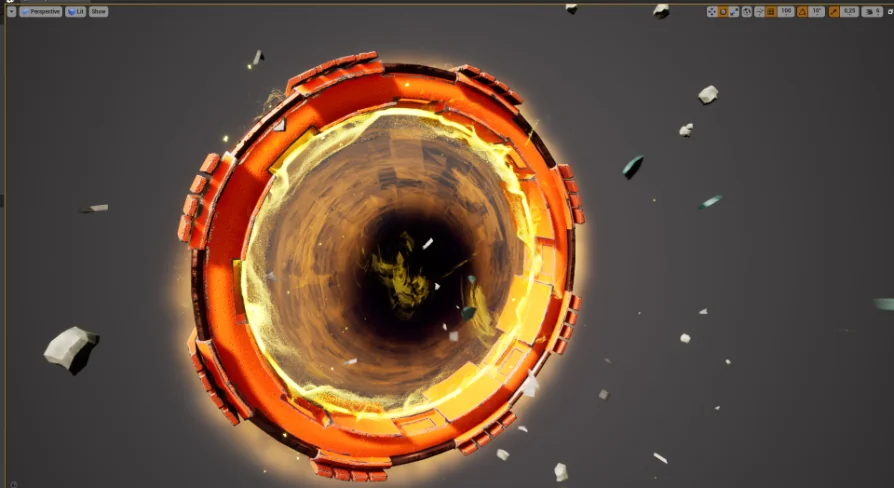
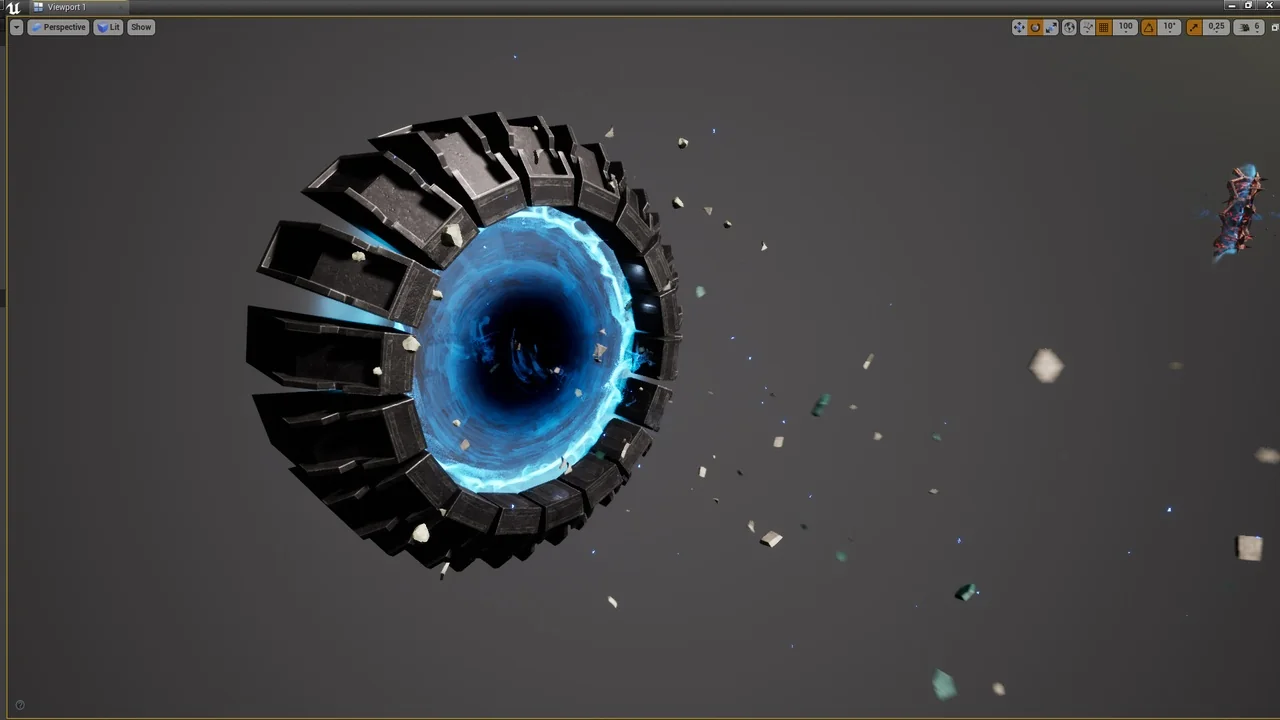
Particle movement defines the identity of any transit portal. Within this collection, visual effects are assembled using the Niagara framework, yielding high quality particle behavior capable of handling complex flow fields, volumetric motion, and dense visual layering. The visual design leans heavily into celestial imagery, creating energy barriers that emulate swirling galaxies, event horizons, and localized cosmic distortions.
Niagara effects provide essential visual feedback for players approaching an active threshold. By balancing edge turbulence, inward gravitational pull, and central core density, the gate VFX communicates active states cleanly. Players can clearly tell where the threshold sits in three-dimensional space, preventing disorienting clipping or accidental triggering before they make deliberate contact with the portal plane.
Because the VFX is built inside modern particle pipelines, it maintains visual clarity across diverse lighting schemes. Whether placed inside an artificially illuminated subterranean bunker or suspended outside an orbital dock against dark starfields, the luminous space patterns hold their contrast and read instantly as functional travel portals.
Teleport Blueprint Script Structure and Behavior
Behind the particle systems sits a functional Teleport Blueprint, responsible for the underlying script logic that handles actor movement. Visuals alone cannot execute travel; the Blueprint acts as the brain, detecting collision events, calculating target coordinates, and relocating the player or dynamic objects without breaking gameplay continuity.
The script handles coordinate remapping between the entry gate and the destination point. When an actor breaches the collision boundary of the gateway, the Blueprint executes the spatial translation, instantly updating world transform parameters while maintaining orientation stability. This ensures that a player stepping through a gate does not experience camera snapping, unpredictable physics velocity spikes, or floor clipping upon arrival at the exit site.
Scripted logic also manages activation timing. The Blueprint works hand-in-glove with the Niagara VFX components, ensuring particle emitters trigger, pulse, or idle in sync with the operational state of the teleport sequence. By binding visual emitters directly to the transit script, state changes—such as activating a dormant gateway or cycling between destinations—remain visually aligned with what the logic executes under the hood.
Verification Inside the Windows x64 Demo Project
Evaluating interactive assets before dropping them into an existing production branch saves substantial setup time. This package includes a dedicated Demo Project compiled for Windows x64 systems, allowing creators to inspect runtime performance, visual fidelity, and script responsiveness in a packaged environment.
Running the standalone Windows x64 build provides direct confirmation of how the collision boundaries behave under normal movement speeds, how camera transitions interact with particle meshes, and how the Niagara VFX handles real-time scene rendering. Testing within a compiled application helps eliminate guesswork regarding frame rates, draw calls, and script latency before assets are migrated into a larger game project.
Complementing the executable demo, technical documentation and video demonstrations outline the recommended setup flow. These reference materials walk through node hierarchies, parameter exposes within the Teleport Blueprint, and optimal placement practices for gateway actors. For collaborative development teams, community Discord access provides a direct line for technical troubleshooting, workflow tips, and implementation discussions alongside fellow developers.
Integrating Portals into the 4 IN 1 Modular Research Facility
Level coherence depends on matching thematic architecture with interactive props. The Portal Pack / Teleport Blueprint / VFX is explicitly built for compatibility with the 4 IN 1 Modular Research Facility / Mega Bundle 2025. This compatibility ensures that the structural framing, gate proportions, and materials align directly with modern laboratory, containment, and sci-fi facility modules.
Within the narrative setting of an advanced research facility, portals naturally act as the centerpiece for experimental laboratories, quarantine zones, or spatial research chambers. Because the gate meshes and visual scales coordinate with the Modular Research Facility kit, artists can seat the teleport structures inside testing rooms, airlocks, and central rotunda halls without manual rescaling or mesh kitbashing.
This tight fit simplifies complex level layouts. In multi-wing facilities where different research bays represent entirely different biomes or security tiers, dropping in matching teleport gates allows seamless traversal between disconnected modular wings without requiring miles of connecting corridors or elevator shafts.
Developers and Pipelines Suited for Teleport Gate Integration
Game developers, technical artists, and level designers building science-fiction or speculative adventure games benefit most from this setup. Building custom relocation logic from scratch often leads to edge-case bugs—such as actors triggering overlaps repeatedly, falling out of world bounds, or losing momentum abruptly. By relying on a tested Teleport Blueprint linked to Niagara particle emitters, teams can bypass weeks of basic logic troubleshooting.
Solo creators and small indie teams working under tight deadlines will find the combination of a Windows x64 demo, clear documentation, and video breakdowns invaluable for rapid prototyping. Instead of dividing focus between particle math and relocation scripting, production can immediately shift to level pacing, puzzle design, and world construction.
 Gameplay Features
 Gameplay Features
 Gameplay Features
 Gameplay Features