"7b46a695175d8694"{"id":"1001488","slug":"octopus-backpack-procedural-tentacles-for-grabbing-throwing-and-movement","title":"Octopus Backpack – Procedural Tentacles for Grabbing, Throwing and Movement","category":"Gameplay Features","engine":"5.4","assetVersion":"Asset Version: 1.0","engineVersion":"Engine Version: 5.4","tag":"Gameplay Features","accent":"blue","visual":"mech","summary":"Add boneless procedural tentacles to Unreal Engine characters for IK-driven grabbing, throwing, and physical static mesh latching mechanics.","platform":"Unreal Engine","publishedAt":"2026-10-08T09:28:15.308Z","updatedAt":"2026-10-08T09:28:15.308Z","sourceNotes":[],"fileContents":[],"compatibility":["Unreal Engine","Asset Version: 1.0","Engine Version: 5.4"],"featuredImage":{"alt":"Octopus Backpack – Procedural Tentacles for Grabbing, Throwing and Movement","src":"/wp-content/uploads/published/2026/10/1b31ff364b34-d14674a5-b458-4be6-8681-88388ee2906a-ba62b7d57b.webp"},"hasDownloadLink":true,"downloads":1,"terms":[{"taxonomy":"category","slug":"gameplay-features-tools-and-plugins","name":"Gameplay Features"}],"galleryImages":[{"src":"/wp-content/uploads/published/2026/10/1daf854c0d19-f848ffb7-e63a-430e-b374-ed219584a4d8-11b159f207.webp","alt":"Octopus Backpack – Procedural Tentacles for Grabbing, Throwing and Movement"},{"src":"/wp-content/uploads/published/2026/10/4d951e025938-afc30f66-93f7-427f-88f9-b3135aa9056d-a0364d916e.webp","alt":"Octopus Backpack – Procedural Tentacles for Grabbing, Throwing and Movement"},{"src":"/wp-content/uploads/published/2026/10/7a0fd8e8cd4f-d09f5f94-af13-48d8-b216-a70be72a8d08-b84a663dfe.webp","alt":"Octopus Backpack – Procedural Tentacles for Grabbing, Throwing and Movement"},{"src":"/wp-content/uploads/published/2026/10/c703be85eb52-647e175c-acbd-44eb-88b5-09aa0ca70351-0b06b81367.webp","alt":"Octopus Backpack – Procedural Tentacles for Grabbing, Throwing and Movement"},{"src":"/wp-content/uploads/published/2026/10/6f4806d59be7-cb368caa-d0e6-43e5-98a4-4dd5a6284888-9734e00b7c.webp","alt":"Octopus Backpack – Procedural Tentacles for Grabbing, Throwing and Movement"},{"src":"/wp-content/uploads/published/2026/10/5f4480ca720f-1637dc0f-af0d-4a66-bccb-49a8e7deaa2c-8f0f165aaa.webp","alt":"Octopus Backpack – Procedural Tentacles for Grabbing, Throwing and Movement"},{"src":"/wp-content/uploads/published/2026/10/39812a789ea1-e5101fe8-6b7e-46cc-80ec-3f2df63f0aed-2c10d03b77.webp","alt":"Octopus Backpack – Procedural Tentacles for Grabbing, Throwing and Movement"},{"src":"/wp-content/uploads/published/2026/10/ab3e9529ff51-68cb4e9d-0f18-41ef-9eb9-dc9f937a017e-e24e58e7d3.webp","alt":"Octopus Backpack – Procedural Tentacles for Grabbing, Throwing and Movement"},{"src":"/wp-content/uploads/published/2026/10/83fc85143d51-e41bcd8e-903a-4857-bdf7-ede6271cd104-4cc373e39a.webp","alt":"Octopus Backpack – Procedural Tentacles for Grabbing, Throwing and Movement"},{"src":"/wp-content/uploads/published/2026/10/53e74a3ab2ec-d47ed91f-6283-476c-93e1-7705e86dceae-90463f80a8.webp","alt":"Octopus Backpack – Procedural Tentacles for Grabbing, Throwing and Movement"}],"accessPanel":{"kind":"resource","title":"Download this resource","eyebrow":"Free Download","message":"Log in or create a free account to start your download.","fileName":"Octopus Backpack – Procedural Tentacles for Grabbing, Throwing and Movement.7z","safetyNote":"Resources are manually reviewed before listing to improve quality and reduce obvious risks.","actionLabel":"Download Free","resourceType":"Resource archive"},"contentHtml":"\u003ch2\u003eIntegrating the Procedural Tentacles with Character Attachments\u003c/h2\u003e\n\u003cp\u003eEquipping a player character with the mechanical apparatus begins at the mesh level, anchoring the backpack fixture directly to the character rig. Rather than driving tentacle motion through traditional multi-bone skeletal hierarchies, the limbs utilize boneless procedural animation. This structure produces fluid, organic deformation across mechanical joints and metallic surfaces without requiring hand-keyed animation tracks or bloated skeletal rigs.\u003c/p\u003e\n\u003cp\u003eSetup within Unreal Engine relies on standard Blueprint and Animation Blueprint workflows, making the apparatus compatible with humanoid foundations such as the standard Epic Skeleton. Because the tentacles calculate motion procedurally during play, they eliminate the need to blend between fixed grab or locomotion cycles, allowing the limbs to respond dynamically to moving actors and changing terrain heights.\u003c/p\u003e \u003ch2\u003eInverse Kinematics and Autonomous Grabbing Dynamics\u003c/h2\u003e\n\u003cp\u003eManipulation tasks are handled through autonomous spatial checks paired with inverse kinematics. The tentacle claws employ IK solvers to ensure precise contact points whenever approaching interactable items. As objects enter range, the limb calculates proximity, evaluates surrounding obstacles, and picks an optimal contact vector rather than snapping awkwardly along a fixed trajectory.\u003c/p\u003e\n\u003cp\u003eObstacle avoidance is built into the calculation loop. Limbs bend around intervening level geometry and can actively entangle with surfaces or objects to yield convincing, heavy physical interactions. Once contact is established, the claws lock onto non-static objects, enabling the character to lift, transport, and throw items across combat or puzzle scenarios. The manipulation logic gives robotic loadouts practical utility beyond visual flair, turning environmental props into throwables or handheld cover.\u003c/p\u003e \u003ch2\u003eStatic Mesh Latching and Physics-Based Reach Constraints\u003c/h2\u003e\n\u003cp\u003eLocomotion expands significantly when tentacles interact with static world geometry. The limbs detect solid anchor points and latch directly onto static meshes, allowing characters to pull themselves toward ledges, scale architectural barriers, or stabilize during high-speed traversal. This mechanical mobility fits directly into action, cyberpunk, and steampunk settings where verticality dictates combat encounters.\u003c/p\u003e\n\u003cp\u003eMovement freedom remains tethered to rigid physical limits. The system calculates maximum tentacle extension, preventing the character from latching or climbing beyond the true reach of the limbs. If an anchor point lies outside the arm's physical range, the grasp fails, ensuring traversal mechanics stay anchored in spatial logic rather than turning into unrestricted flight or arbitrary wall-climbing.\u003c/p\u003e \u003ch2\u003eVisual Customization and Mesh Interaction Compatibility\u003c/h2\u003e\n\u003cp\u003eAdjusting the visual tone of the mechanical attachment involves tweaking modular gameplay effects and styling parameters. Particle and energy behaviors can be introduced or modified to match gritty industrial hardware, sleek sci-fi aesthetics, or high-tech combat chassis. Integration with Niagara allows developers to layer custom particle emissions, sparks, or claw impacts directly onto the procedural motion passes.\u003c/p\u003e\n\u003cp\u003eEnvironmental compatibility extends to complex asset pipelines, including systems like Interact With Any Mesh PRO EVO for managing foliage, static mesh, and PCG interactions. This ensures the procedural claws react properly when reaching into dense foliage or navigating procedurally generated level layouts without clipping through terrain elements or failing trace checks.\u003c/p\u003e \u003ch2\u003eFramerate Targets, Substepping, and Take Recorder Limitations\u003c/h2\u003e\n\u003cp\u003eThe system builds its interaction routines entirely on native Unreal Engine functions without relying on external, proprietary physics calculation libraries. Because physics evaluation plays an active role in resolving limb position and collision feedback, simulation stability depends on runtime performance. A target framerate of at least 40 FPS is recommended to keep limb movement smooth, responsive, and free of unnatural jitter.\u003c/p\u003e\n\u003cp\u003eIn projects operating beneath the 40 FPS threshold, developers can enable Unreal Engine's physical substepping to maintain consistent mathematical ticks across limb segments. Developers building cinematic sequences should note that Take Recorder may not render animations generated by this procedural plugin correctly, making real-time gameplay capture or custom playback setups the preferred path for recording sequences.\u003c/p\u003e \u003ch2\u003ePipeline Maintenance and Project Support\u003c/h2\u003e\n\u003cp\u003eBuilt by a team with more than seven years of Unreal Engine development experience and previous projects featured in Epic Games Showcases, the toolset receives regular updates that incorporate community feature requests. Direct assistance is maintained through a dedicated Discord server, providing an active troubleshooting hub for setting up claw IK, tuning throw velocities, or adjusting reach limits across custom player archetypes.\u003c/p\u003e\n\n\u003ch2\u003eContinue Browsing Similar Packs\u003c/h2\u003e\n\u003cul\u003e\n\u003cli\u003e\u003ca href=\"https://3dcghub.com/advanced-third-person-camera/\" title=\"Advanced Third Person Camera\"\u003eAdvanced Third Person Camera\u003c/a\u003e\u003c/li\u003e\n\u003cli\u003e\u003ca href=\"https://3dcghub.com/flex-partition-optimization-system/\" title=\"Flex Partition - Optimization System\"\u003eFlex Partition - Optimization System\u003c/a\u003e\u003c/li\u003e\n\u003cli\u003e\u003ca href=\"https://3dcghub.com/ultimate-gameplay-camera/\" title=\"Ultimate Gameplay Camera\"\u003eUltimate Gameplay Camera\u003c/a\u003e\u003c/li\u003e\n\u003cli\u003e\u003ca href=\"https://3dcghub.com/kinematic-tentacles/\" title=\"Kinematic Tentacles\"\u003eKinematic Tentacles\u003c/a\u003e\u003c/li\u003e\n\u003cli\u003e\u003ca href=\"https://3dcghub.com/simple-procedural-walk/\" title=\"Simple Procedural Walk\"\u003eSimple Procedural Walk\u003c/a\u003e\u003c/li\u003e\n\u003c/ul\u003e","contentTextLength":5180,"navigation":{"current":59,"total":3481,"previous":{"id":"1001489","slug":"surroundead-survival-game-assets-bundle","title":"SurrounDead - Survival Game Assets (Bundle)","category":"Apocalyptic / Post-apocalyptic","platform":"Unreal Engine","updatedAt":"2026-10-08T10:04:09.253Z"},"next":{"id":"1001487","slug":"multiplayer-basics","title":"Multiplayer Basics","category":"Network \u0026 Multiplayer","platform":"Unreal Engine","updatedAt":"2026-10-08T09:22:21.300Z"}},"relatedResources":[{"id":"28457","slug":"advanced-third-person-camera","title":"Advanced Third Person Camera","category":"Gameplay Features","engine":"5.3 - 5.4","assetVersion":"Engine version: 5.3 - 5.4","engineVersion":"Asset Version:1.2.10 - 1.2.11","tag":"Gameplay Features","accent":"blue","visual":"mech","summary":"Third-person gameplay often breaks down when the camera cannot keep up with terrain, tight interiors, or fast character movement. Advanced Third Person Camera focuses on that problem with configurable camera modes, trigger-based switching, collision handlin...","platform":"Unreal Engine","publishedAt":"2026-05-15T16:49:49.000Z","updatedAt":"2026-05-15T16:49:52.000Z","sourceNotes":[],"fileContents":[],"compatibility":["Unreal Engine","Engine version: 5.3 - 5.4","Asset Version: 1.2.10 - 1.2.11"],"featuredImage":{"alt":"Advanced Third Person Camera","src":"https://3dcghub.com/wp-content/uploads/2026/05/8bd06e0f2f37_1e3ea3e5-774b-47e8-a130-b698a8cfa596.webp"},"hasDownloadLink":true,"downloads":0},{"id":"15012","slug":"flex-partition-optimization-system","title":"Flex Partition - Optimization System","category":"Gameplay Features","engine":"5.5","assetVersion":"Engine version: 5.5","engineVersion":"Asset Version:1.7","tag":"Gameplay Features","accent":"blue","visual":"luts","summary":"Flex Partition - Optimization System offers a sophisticated way to manage runtime and procedural actors using spatial hash grids. It prevents frame spikes through rate-limited streaming while maintaining actor states during activation cycles.","platform":"Unreal Engine","publishedAt":"2026-03-12T07:25:29.000Z","updatedAt":"2026-04-19T15:45:37.000Z","sourceNotes":[],"fileContents":[],"compatibility":["Unreal Engine","Engine version: 5.5","Asset Version: 1.7"],"featuredImage":{"alt":"Flex Partition - Optimization System","src":"https://3dcghub.com/wp-content/uploads/2026/03/df6dfa1a-d220-474e-a529-dd86fc919bf8.webp"},"hasDownloadLink":true,"downloads":0},{"id":"15108","slug":"ultimate-gameplay-camera","title":"Ultimate Gameplay Camera","category":"Gameplay Features","engine":"5.3 - 5.5","assetVersion":"Engine version: 5.3 - 5.5","engineVersion":"Asset Version:1.3","tag":"Gameplay Features","accent":"blue","visual":"audio","summary":"The Ultimate Gameplay Camera provides a professional-grade, dynamic third-person camera system for Unreal Engine. It features smooth movement, multiplayer replication, and extensive customization options without requiring C++ knowledge.","platform":"Unreal Engine","publishedAt":"2026-03-12T07:52:43.000Z","updatedAt":"2026-04-19T15:45:35.000Z","sourceNotes":[],"fileContents":[],"compatibility":["Unreal Engine","Engine version: 5.3 - 5.5","Asset Version: 1.3"],"featuredImage":{"alt":"Ultimate Gameplay Camera","src":"https://3dcghub.com/wp-content/uploads/2026/03/89e2406f-10ab-4f8a-97aa-fa74ad5bc513.webp"},"hasDownloadLink":true,"downloads":0}]}
Gameplay Features
Octopus Backpack – Procedural Tentacles for Grabbing, Throwing and Movement
Add boneless procedural tentacles to Unreal Engine characters for IK-driven grabbing, throwing, and physical static mesh latching mechanics.
Integrating the Procedural Tentacles with Character Attachments
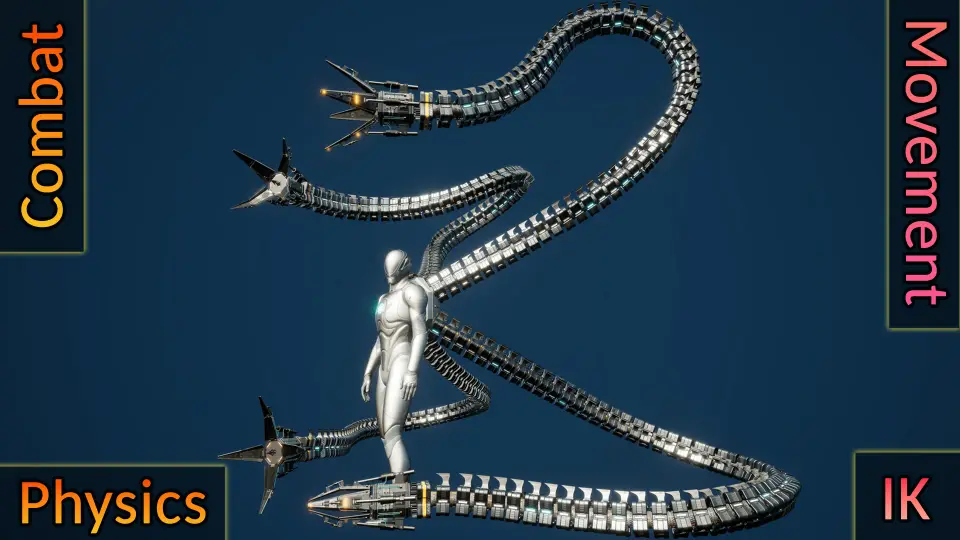
Equipping a player character with the mechanical apparatus begins at the mesh level, anchoring the backpack fixture directly to the character rig. Rather than driving tentacle motion through traditional multi-bone skeletal hierarchies, the limbs utilize boneless procedural animation. This structure produces fluid, organic deformation across mechanical joints and metallic surfaces without requiring hand-keyed animation tracks or bloated skeletal rigs.
Setup within Unreal Engine relies on standard Blueprint and Animation Blueprint workflows, making the apparatus compatible with humanoid foundations such as the standard Epic Skeleton. Because the tentacles calculate motion procedurally during play, they eliminate the need to blend between fixed grab or locomotion cycles, allowing the limbs to respond dynamically to moving actors and changing terrain heights.
Inverse Kinematics and Autonomous Grabbing Dynamics
Manipulation tasks are handled through autonomous spatial checks paired with inverse kinematics. The tentacle claws employ IK solvers to ensure precise contact points whenever approaching interactable items. As objects enter range, the limb calculates proximity, evaluates surrounding obstacles, and picks an optimal contact vector rather than snapping awkwardly along a fixed trajectory.
Obstacle avoidance is built into the calculation loop. Limbs bend around intervening level geometry and can actively entangle with surfaces or objects to yield convincing, heavy physical interactions. Once contact is established, the claws lock onto non-static objects, enabling the character to lift, transport, and throw items across combat or puzzle scenarios. The manipulation logic gives robotic loadouts practical utility beyond visual flair, turning environmental props into throwables or handheld cover.
Static Mesh Latching and Physics-Based Reach Constraints
Locomotion expands significantly when tentacles interact with static world geometry. The limbs detect solid anchor points and latch directly onto static meshes, allowing characters to pull themselves toward ledges, scale architectural barriers, or stabilize during high-speed traversal. This mechanical mobility fits directly into action, cyberpunk, and steampunk settings where verticality dictates combat encounters.
Movement freedom remains tethered to rigid physical limits. The system calculates maximum tentacle extension, preventing the character from latching or climbing beyond the true reach of the limbs. If an anchor point lies outside the arm's physical range, the grasp fails, ensuring traversal mechanics stay anchored in spatial logic rather than turning into unrestricted flight or arbitrary wall-climbing.
Visual Customization and Mesh Interaction Compatibility
Adjusting the visual tone of the mechanical attachment involves tweaking modular gameplay effects and styling parameters. Particle and energy behaviors can be introduced or modified to match gritty industrial hardware, sleek sci-fi aesthetics, or high-tech combat chassis. Integration with Niagara allows developers to layer custom particle emissions, sparks, or claw impacts directly onto the procedural motion passes.
Environmental compatibility extends to complex asset pipelines, including systems like Interact With Any Mesh PRO EVO for managing foliage, static mesh, and PCG interactions. This ensures the procedural claws react properly when reaching into dense foliage or navigating procedurally generated level layouts without clipping through terrain elements or failing trace checks.
Framerate Targets, Substepping, and Take Recorder Limitations
The system builds its interaction routines entirely on native Unreal Engine functions without relying on external, proprietary physics calculation libraries. Because physics evaluation plays an active role in resolving limb position and collision feedback, simulation stability depends on runtime performance. A target framerate of at least 40 FPS is recommended to keep limb movement smooth, responsive, and free of unnatural jitter.
In projects operating beneath the 40 FPS threshold, developers can enable Unreal Engine's physical substepping to maintain consistent mathematical ticks across limb segments. Developers building cinematic sequences should note that Take Recorder may not render animations generated by this procedural plugin correctly, making real-time gameplay capture or custom playback setups the preferred path for recording sequences.
Pipeline Maintenance and Project Support
Built by a team with more than seven years of Unreal Engine development experience and previous projects featured in Epic Games Showcases, the toolset receives regular updates that incorporate community feature requests. Direct assistance is maintained through a dedicated Discord server, providing an active troubleshooting hub for setting up claw IK, tuning throw velocities, or adjusting reach limits across custom player archetypes.
 Gameplay Features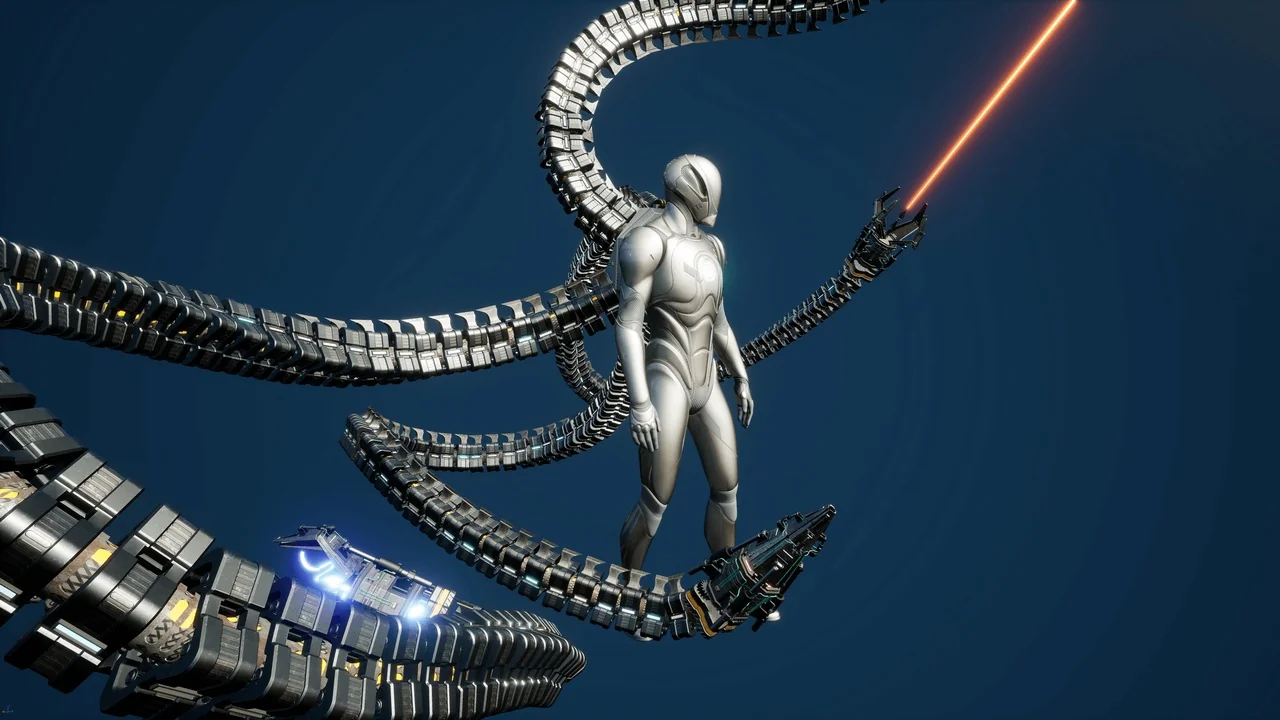
 Gameplay Features
 Gameplay Features
 Gameplay Features