"7b46a695175d8694"{"id":"1001487","slug":"multiplayer-basics","title":"Multiplayer Basics","category":"Network \u0026 Multiplayer","engine":"4.27+,5.0+","assetVersion":"","engineVersion":"Engine Version: 4.27+,5.0+","tag":"Network","accent":"blue","visual":"mech","summary":"Explore Multiplayer Basics, an Unreal Engine template featuring replicated health, hunger, stamina, melee, ragdoll physics, and session setup.","platform":"Unreal Engine","publishedAt":"2026-10-08T09:22:21.300Z","updatedAt":"2026-10-08T09:22:21.300Z","sourceNotes":[],"fileContents":[],"compatibility":["Unreal Engine","Engine Version: 4.27+,5.0+"],"featuredImage":{"alt":"Multiplayer Basics","src":"/wp-content/uploads/published/2026/10/93469427f34f-97f96bc8-b258-4365-b1c0-30a04d814a4e-0b5be7ea7b.webp"},"hasDownloadLink":true,"downloads":0,"terms":[{"taxonomy":"category","slug":"network-and-multiplayer","name":"Network \u0026 Multiplayer"}],"galleryImages":[{"src":"/wp-content/uploads/published/2026/10/fd1d8053c614-026b938a-1bb9-406b-84cd-495233d657cf-65875de970.webp","alt":"Multiplayer Basics"},{"src":"/wp-content/uploads/published/2026/10/5d9e1200196b-5415c5e0-119a-49b1-bbf5-a8192809a304-fe17e2f302.webp","alt":"Multiplayer Basics"},{"src":"/wp-content/uploads/published/2026/10/3c0314befee6-9ac46b1c-e155-41d7-be31-aac5513ff54d-0e46b111c4.webp","alt":"Multiplayer Basics"},{"src":"/wp-content/uploads/published/2026/10/5a80155f8a6b-6667fb87-9389-4b61-beab-b1cdd2cf125c-2a26adf8e4.webp","alt":"Multiplayer Basics"},{"src":"/wp-content/uploads/published/2026/10/667f05fe2cee-8167fb39-7c70-4874-b819-04fa0005d2cc-dfad395ead.webp","alt":"Multiplayer Basics"},{"src":"/wp-content/uploads/published/2026/10/b855240c2dcd-043e8fbb-d757-4bc3-be28-6c2e01a70bbf-0dcc97fd43.webp","alt":"Multiplayer Basics"},{"src":"/wp-content/uploads/published/2026/10/17e93d3377a0-a79078d2-7c6c-449c-a521-a7fc2724eb0b-8be9ba7634.webp","alt":"Multiplayer Basics"},{"src":"/wp-content/uploads/published/2026/10/5e907c236fea-7b0014fe-07a4-456c-a5c9-fd22d62fce50-b01a2e2f4a.webp","alt":"Multiplayer Basics"},{"src":"/wp-content/uploads/published/2026/10/327124ee47a4-267b3235-c1e8-4791-a1c7-46cf2429795e-5b70d1cf9d.webp","alt":"Multiplayer Basics"},{"src":"/wp-content/uploads/published/2026/10/880623afb202-501ae2a7-c603-49e4-8ff8-a3ea43dd3254-58b000298e.webp","alt":"Multiplayer Basics"}],"accessPanel":{"kind":"resource","title":"Download this resource","eyebrow":"Free Download","message":"Log in or create a free account to start your download.","fileName":"Multiplayer Basics.7z","safetyNote":"Resources are manually reviewed before listing to improve quality and reduce obvious risks.","actionLabel":"Download Free","resourceType":"Resource archive"},"contentHtml":"\u003ch2\u003eEstablishing Networked Survival Spaces with Multiplayer Basics\u003c/h2\u003e\n\u003cp\u003ePrototyping an interactive online project usually requires weeks of foundational networking before any visible gameplay takes shape. Multiplayer Basics addresses that initial hurdle by assembling standard survival and action mechanics inside a unified Unreal Engine template. Whether configuring a desolate wilderness where characters fight exposure and each other or designing small-scale arena brawls on uneven terrain, the framework provides the functional architecture needed to get multiple players moving, fighting, and tracking vital statistics across a live session.\u003c/p\u003e\n\u003cp\u003eThe template establishes an immediate user flow starting at the main menu, which includes ready-to-run functionality to host a game, search and join active sessions, or exit to desktop. Once players enter a map, the character setup takes over with built-in networking. Support for both keyboard and mouse controls alongside gamepad controllers guarantees that basic input routing is accounted for straight away, allowing developers to focus on level design, pacing, and visual polish rather than recreating standard player controllers.\u003c/p\u003e \u003ch2\u003eThe Health Component and Replicated Survival Statistics\u003c/h2\u003e\n\u003cp\u003eAt the center of the template's mechanical loop is a suite of survival-oriented character components designed to handle vital resources automatically over the network. The Health Component handles receiving damage, managing player vitality, and coordinating state changes when durability runs out. Working directly alongside it, the Hunger/Thirst Component provides continuous depletion over time, introducing persistent resource pressure typical of open-world survival simulations.\u003c/p\u003e\n\u003cp\u003eStamina management operates as another vital pillar within this system. The Stamina Component governs player exertion, featuring configurable depletion and passive regeneration. This resource is closely tied to physical actions: sprinting drains stamina, and executing attacks drains stamina, meaning players cannot endlessly dash across maps or spam strikes without pausing for recovery. Data synchronization across the server and connected clients relies on blueprint interfaces. By routing updates through interfaces, the architecture passes information cleanly across network boundaries without creating rigid cross-blueprint entanglements.\u003c/p\u003e \u003ch2\u003eDynamic Locomotion, Melee Systems, and Ragdoll Responses\u003c/h2\u003e\n\u003cp\u003eGrounding player avatars visually is just as critical as managing their numerical stats. Multiplayer Basics incorporates a dedicated leg and foot inverse kinematics (IK) system designed specifically for navigating slopes, ramps, and staircases. Instead of character feet floating unnaturally over angled surfaces or clipping through steps, the IK adjustments adapt the skeletal pose to match the geometry directly underfoot, stabilizing character presentation throughout varied terrain.\u003c/p\u003e\n\u003cp\u003eWhen players close distance, the melee system governs physical encounters. Punches and strikes allow players to directly inflict damage on one another, pulling from the Stamina Component for cost calculations while feeding impact data into the opposing character's Health Component. Physical feedback is further accentuated by an obstacle-triggered ragdoll setup. When a player collides forcefully with obstacles in the environment, the character transitions into ragdoll physics, adding immediate kinetic consequence to navigation mistakes or physical impacts.\u003c/p\u003e \u003ch2\u003eCheckpoints, Screen Notifications, and the Respawn System\u003c/h2\u003e\n\u003cp\u003ePlayer failure states are handled systematically through connected death and reset loops. When damage accumulated through the Health Component reduces character health to zero, player death triggers automatically. Instead of forcing players back to an empty main menu or stalling the match, the built-in respawn system takes control. The system identifies the player's last recorded checkpoint and spawns a fresh character instance populated with new, reset baseline stats so gameplay can resume without hitching.\u003c/p\u003e\n\u003cp\u003eTo keep participants informed of their current standing, the project features a modular notification system. This UI tool pushes custom text alerts directly to the player's screen. Within the default project flow, it communicates checkpoint discoveries so players know their progress has been logged, but the underlying text delivery system can be repurposed for other localized gameplay messages across the viewport. The project also maintains compatibility with Progress Bar Icons for tracking on-screen status readouts.\u003c/p\u003e \u003ch2\u003eBlueprint Structure and AdvancedSteamSessions Integration\u003c/h2\u003e\n\u003cp\u003eUnder the hood, Multiplayer Basics is packaged across 38 Blueprints, accompanied by 19 static meshes and 10 materials to illustrate practical application. Every core function inside the blueprint graphs includes detailed commenting to explain its logic and data flow, making it straightforward to inspect how server RPCs, client interface calls, and component events interact. Included documentation and video references covering general introduction and gameplay features provide guidance through the layout.\u003c/p\u003e\n\u003cp\u003eOperating the session architecture requires the third-party AdvancedSession and AdvancedSteamSessions plugins, which supply the underlying session discovery and hosting hooks used by the main menu. The template supports a broad spectrum of Unreal Engine releases, spanning versions 4.26, 4.27, 5.0, 5.1, 5.2, 5.3, and 5.7 on Windows. While starting from the template as a clean slate offers the fastest route to a working multiplayer prototype, importing its features into pre-existing projects requires careful integration of its components, interfaces, and collision channels.\u003c/p\u003e\n\n\u003ch2\u003eMore From The Same Workflow\u003c/h2\u003e\n\u003cul\u003e\n\u003cli\u003e\u003ca href=\"https://3dcghub.com/multiplayer-tps-basic/\" title=\"Multiplayer TPS Basic\"\u003eMultiplayer TPS Basic\u003c/a\u003e\u003c/li\u003e\n\u003cli\u003e\u003ca href=\"https://3dcghub.com/multiplayer-blueprint-lobby-solution-template-by-kekdot/\" title=\"Multiplayer Blueprint Lobby Solution - Template - By Kekdot\"\u003eMultiplayer Blueprint Lobby Solution - Template - By Kekdot\u003c/a\u003e\u003c/li\u003e\n\u003cli\u003e\u003ca href=\"https://3dcghub.com/basic-multiplayer-melee-combat-system/\" title=\"Basic Multiplayer Melee Combat System\"\u003eBasic Multiplayer Melee Combat System\u003c/a\u003e\u003c/li\u003e\n\u003cli\u003e\u003ca href=\"https://3dcghub.com/multiplayer-horror-bodycam/\" title=\"Multiplayer Horror Bodycam\"\u003eMultiplayer Horror Bodycam\u003c/a\u003e\u003c/li\u003e\n\u003cli\u003e\u003ca href=\"https://3dcghub.com/fps-multiplayer-template-3-5/\" title=\"FPS Multiplayer Template 3.5\"\u003eFPS Multiplayer Template 3.5\u003c/a\u003e\u003c/li\u003e\n\u003c/ul\u003e","contentTextLength":5909,"navigation":{"current":60,"total":3481,"previous":{"id":"1001488","slug":"octopus-backpack-procedural-tentacles-for-grabbing-throwing-and-movement","title":"Octopus Backpack – Procedural Tentacles for Grabbing, Throwing and Movement","category":"Gameplay Features","platform":"Unreal Engine","updatedAt":"2026-10-08T09:28:15.308Z"},"next":{"id":"1001486","slug":"motorbike-shop-environment-motorbike-shop-environment-motorbik-shop-motor","title":"Motorbike Shop Environment ( Motorbike Shop Environment Motorbik Shop Motor )","category":"Commercial","platform":"Unreal Engine","updatedAt":"2026-10-08T09:18:51.100Z"}},"relatedResources":[{"id":"11239","slug":"multiplayer-tps-basic","title":"Multiplayer TPS Basic","category":"Network \u0026 Multiplayer","engine":"5.0+","assetVersion":"Engine version: 5.0+","engineVersion":"4.15","tag":"Network","accent":"blue","visual":"animation","summary":"Multiplayer TPS Basic provides a foundational kit for creating online cooperative third-person shooters. It features intelligent AI that shares player weaponry and interactive crates for loadout management.","platform":"Unreal Engine","publishedAt":"2026-03-04T17:13:23.000Z","updatedAt":"2026-04-19T15:48:14.000Z","sourceNotes":[],"fileContents":[],"compatibility":["Unreal Engine","Engine version: 5.0+"],"featuredImage":{"alt":"Multiplayer TPS Basic","src":"https://3dcghub.com/wp-content/uploads/2026/03/856e363a-e9e8-470e-b806-9a65acd66ce4.webp"},"hasDownloadLink":true,"downloads":1},{"id":"1000657","slug":"multiplayer-blueprint-lobby-solution-template-by-kekdot","title":"Multiplayer Blueprint Lobby Solution - Template - By Kekdot","category":"Network \u0026 Multiplayer","engine":"5.3+","assetVersion":"","engineVersion":"Engine Version: 5.3+","tag":"Network","accent":"blue","visual":"luts","summary":"The MBLS template is a 100% Blueprint multiplayer lobby foundation for Unreal Engine, with server browser, chat, settings, character customization, and data-dri","platform":"Unreal Engine","publishedAt":"2026-07-21T20:17:43.082Z","updatedAt":"2026-07-21T20:17:43.082Z","sourceNotes":[],"fileContents":[],"compatibility":["Unreal Engine","Engine Version: 5.3+"],"featuredImage":{"alt":"Multiplayer Blueprint Lobby Solution - Template - By Kekdot","src":"/wp-content/uploads/published/2026/07/2aaa9d7b3fdd-d9a2d1e1-e1ad-4f4b-96a9-4c0245b7e2ed-5a79d3f3f4.webp"},"hasDownloadLink":true,"downloads":1},{"id":"1001247","slug":"basic-multiplayer-melee-combat-system","title":"Basic Multiplayer Melee Combat System","category":"Fighting","engine":"5.0+","assetVersion":"","engineVersion":"Engine Version: 5.0+","tag":"Fighting","accent":"blue","visual":"mech","summary":"A technical look at the Basic Multiplayer Melee Combat System, featuring modular actor components, hit scan tracing, lock-on targeting, and 3v3 bot support.","platform":"Unreal Engine","publishedAt":"2026-09-23T15:24:40.286Z","updatedAt":"2026-09-23T15:24:40.286Z","sourceNotes":[],"fileContents":[],"compatibility":["Unreal Engine","Engine Version: 5.0+"],"featuredImage":{"alt":"Basic Multiplayer Melee Combat System","src":"/wp-content/uploads/published/2026/09/035e110571a9-f0a9ce02-9dce-45fd-b0a4-670e3182aabb-234ab47290.webp"},"hasDownloadLink":true,"downloads":1}]}
Network
Multiplayer Basics
Explore Multiplayer Basics, an Unreal Engine template featuring replicated health, hunger, stamina, melee, ragdoll physics, and session setup.
Establishing Networked Survival Spaces with Multiplayer Basics
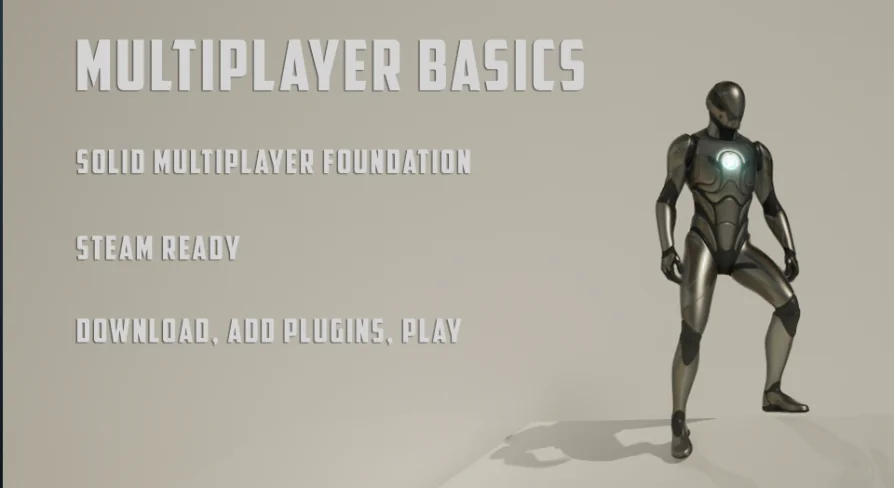
Prototyping an interactive online project usually requires weeks of foundational networking before any visible gameplay takes shape. Multiplayer Basics addresses that initial hurdle by assembling standard survival and action mechanics inside a unified Unreal Engine template. Whether configuring a desolate wilderness where characters fight exposure and each other or designing small-scale arena brawls on uneven terrain, the framework provides the functional architecture needed to get multiple players moving, fighting, and tracking vital statistics across a live session.
The template establishes an immediate user flow starting at the main menu, which includes ready-to-run functionality to host a game, search and join active sessions, or exit to desktop. Once players enter a map, the character setup takes over with built-in networking. Support for both keyboard and mouse controls alongside gamepad controllers guarantees that basic input routing is accounted for straight away, allowing developers to focus on level design, pacing, and visual polish rather than recreating standard player controllers.
The Health Component and Replicated Survival Statistics
At the center of the template's mechanical loop is a suite of survival-oriented character components designed to handle vital resources automatically over the network. The Health Component handles receiving damage, managing player vitality, and coordinating state changes when durability runs out. Working directly alongside it, the Hunger/Thirst Component provides continuous depletion over time, introducing persistent resource pressure typical of open-world survival simulations.
Stamina management operates as another vital pillar within this system. The Stamina Component governs player exertion, featuring configurable depletion and passive regeneration. This resource is closely tied to physical actions: sprinting drains stamina, and executing attacks drains stamina, meaning players cannot endlessly dash across maps or spam strikes without pausing for recovery. Data synchronization across the server and connected clients relies on blueprint interfaces. By routing updates through interfaces, the architecture passes information cleanly across network boundaries without creating rigid cross-blueprint entanglements.
Dynamic Locomotion, Melee Systems, and Ragdoll Responses
Grounding player avatars visually is just as critical as managing their numerical stats. Multiplayer Basics incorporates a dedicated leg and foot inverse kinematics (IK) system designed specifically for navigating slopes, ramps, and staircases. Instead of character feet floating unnaturally over angled surfaces or clipping through steps, the IK adjustments adapt the skeletal pose to match the geometry directly underfoot, stabilizing character presentation throughout varied terrain.
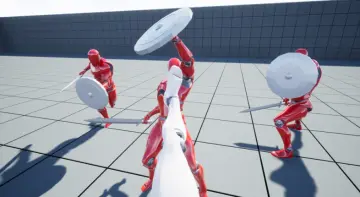
When players close distance, the melee system governs physical encounters. Punches and strikes allow players to directly inflict damage on one another, pulling from the Stamina Component for cost calculations while feeding impact data into the opposing character's Health Component. Physical feedback is further accentuated by an obstacle-triggered ragdoll setup. When a player collides forcefully with obstacles in the environment, the character transitions into ragdoll physics, adding immediate kinetic consequence to navigation mistakes or physical impacts.
Checkpoints, Screen Notifications, and the Respawn System
Player failure states are handled systematically through connected death and reset loops. When damage accumulated through the Health Component reduces character health to zero, player death triggers automatically. Instead of forcing players back to an empty main menu or stalling the match, the built-in respawn system takes control. The system identifies the player's last recorded checkpoint and spawns a fresh character instance populated with new, reset baseline stats so gameplay can resume without hitching.
To keep participants informed of their current standing, the project features a modular notification system. This UI tool pushes custom text alerts directly to the player's screen. Within the default project flow, it communicates checkpoint discoveries so players know their progress has been logged, but the underlying text delivery system can be repurposed for other localized gameplay messages across the viewport. The project also maintains compatibility with Progress Bar Icons for tracking on-screen status readouts.
Blueprint Structure and AdvancedSteamSessions Integration
Under the hood, Multiplayer Basics is packaged across 38 Blueprints, accompanied by 19 static meshes and 10 materials to illustrate practical application. Every core function inside the blueprint graphs includes detailed commenting to explain its logic and data flow, making it straightforward to inspect how server RPCs, client interface calls, and component events interact. Included documentation and video references covering general introduction and gameplay features provide guidance through the layout.
Operating the session architecture requires the third-party AdvancedSession and AdvancedSteamSessions plugins, which supply the underlying session discovery and hosting hooks used by the main menu. The template supports a broad spectrum of Unreal Engine releases, spanning versions 4.26, 4.27, 5.0, 5.1, 5.2, 5.3, and 5.7 on Windows. While starting from the template as a clean slate offers the fastest route to a working multiplayer prototype, importing its features into pre-existing projects requires careful integration of its components, interfaces, and collision channels.
 Network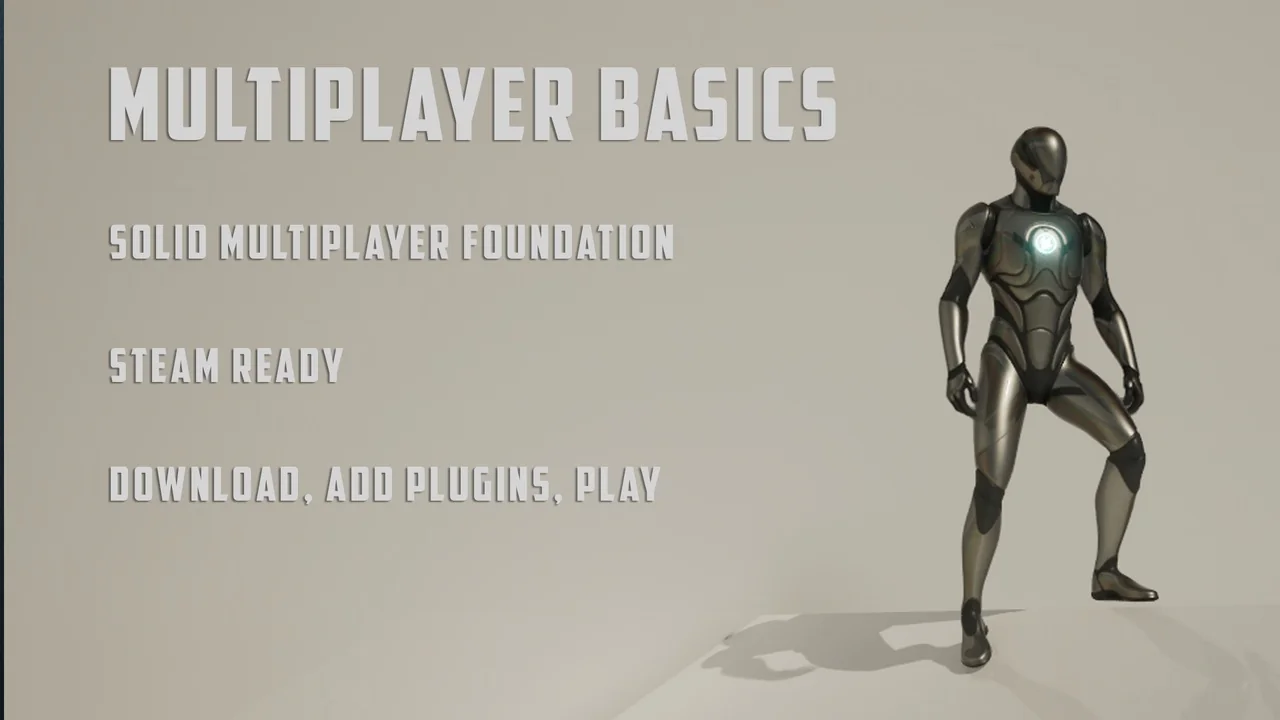
 Network
 Network
 Fighting