"5da73d49ff33a5b1"{"id":"1002394","slug":"nun-girl-modular","title":"Nun Girl Modular","category":"Humans","engine":"4.26+,5.0+","assetVersion":"","engineVersion":"Engine Version: 4.26+,5.0+","tag":"Humans","accent":"blue","visual":"mech","summary":"Examine the technical layout, skeleton setup, modular clothing parts, and 4K PBR textures of the Nun Girl Modular real-time character model.","platform":"Unreal Engine","indexPolicy":"index","publishedAt":"2026-11-10T04:21:06.414Z","updatedAt":"2026-11-10T04:21:06.414Z","sourceNotes":[],"fileContents":[],"compatibility":["Unreal Engine","Engine Version: 4.26+,5.0+"],"featuredImage":{"alt":"Nun Girl Modular","src":"/wp-content/uploads/published/2026/11/0fd1be5a48c1-7d16b0ab-ce7e-4e64-b786-700d4ff73aaa-57498a1b2b.webp"},"hasDownloadLink":true,"downloads":0,"terms":[{"taxonomy":"category","slug":"humans","name":"Humans"}],"galleryImages":[{"src":"/wp-content/uploads/published/2026/11/4ebb78897816-defe362e-69c7-477f-8011-87962149d7bf-91a4e6ad42.webp","alt":"Nun Girl Modular"},{"src":"/wp-content/uploads/published/2026/11/ff465febd7b3-f4d27388-fc0b-4c8b-adba-2342750d2180-e3952745de.webp","alt":"Nun Girl Modular"},{"src":"/wp-content/uploads/published/2026/11/13de45058caf-862cd048-c8ab-40e6-9226-944c582f5a0c-7e751998c4.webp","alt":"Nun Girl Modular"},{"src":"/wp-content/uploads/published/2026/11/8295ed1fa17f-80900e6b-e2b0-4e9d-a289-db8eb7f942a2-19748f49c4.webp","alt":"Nun Girl Modular"},{"src":"/wp-content/uploads/published/2026/11/a2b3a2af4982-675c4b6d-72de-4bf3-9f4b-05d60507cf2c-49834c5d98.webp","alt":"Nun Girl Modular"},{"src":"/wp-content/uploads/published/2026/11/75aecbb7c2ac-59c38e93-29f9-4725-92f7-4ae74a6f2701-13a8fe2c2c.webp","alt":"Nun Girl Modular"},{"src":"/wp-content/uploads/published/2026/11/632d52c8d3fd-51bafd51-323e-4c4d-b635-e221e1fdfc4d-e30c070749.webp","alt":"Nun Girl Modular"},{"src":"/wp-content/uploads/published/2026/11/fedf87b94622-13de4f8a-718d-4fc9-a5b1-8cd8b09baf0e-220850e648.webp","alt":"Nun Girl Modular"},{"src":"/wp-content/uploads/published/2026/11/1bca91cd42bd-5af652b7-881c-40f2-9361-d7c10115a718-da47891070.webp","alt":"Nun Girl Modular"},{"src":"/wp-content/uploads/published/2026/11/2e2a842fdb18-5e325095-fb8b-40d3-9d32-56baf4943293-a13879669b.webp","alt":"Nun Girl Modular"}],"accessPanel":{"kind":"resource","title":"Get this resource","eyebrow":"Free resource","message":"Download this resource in your browser.","fileName":"Content.7z","safetyNote":"Resources are manually reviewed before listing to improve quality and reduce obvious risks.","actionLabel":"Get this resource","resourceType":"Resource archive","versions":[]},"contentHtml":"\u003cp\u003eIntegrating real-time humanoid characters requires clean base topology, dependable skeletal skinning, and non-destructive clothing options. Nun Girl Modular approaches these production requirements with a fully realized geometry stack, total separation between character anatomy and outer garments, and dedicated support for real-time performance capture workflows.\u003c/p\u003e \u003ch2\u003eDeconstructing the Nun Girl Modular Character Rig and Base Mesh\u003c/h2\u003e\n\u003cp\u003eThe core geometry of the model sits at an optimized mid-density profile, measuring 49,215 triangles and 42,134 vertices. Instead of relying on a fragmented torso or partial geometry cutouts under clothing layers, the underlying body mesh is fully intact. Having complete geometry beneath the habit and robes eliminates edge seam artifacts when garments shift during high-movement actions or dynamic locomotion states. The intact base mesh also allows developers to strip away clothing items without leaving open geometry gaps across the torso or limbs.\u003c/p\u003e\n\u003cp\u003eTexture mapping across the physical body features extensive variations across two separate foundational skin tones, comprising light and dark baselines. Surface mapping incorporates multiple sub-configurations including bare skin, standard socks, and full-length sock layouts. These configurations are prepared in both censored and uncensored texture formats, allowing project teams to adhere to specific rating guidelines or production boundaries without re-painting UV layouts. Morph targets built into the head mesh include human and elf ear options, facilitating quick switches between realistic historical styling and stylized fantasy archetypes through simple blend parameter adjustments.\u003c/p\u003e \u003ch2\u003eSkeletal Hierarchy and Secondary Joint Articulation\u003c/h2\u003e\n\u003cp\u003eSkeletal binding relies on the standard Epic Skeleton and Humanoid configuration, allowing straightforward animation retargeting inside Unreal Engine and Unity. Characters rigged to this standard hierarchy can directly absorb existing motion libraries, combat choreography, and custom locomotion packs without requiring tedious bone-mapping adjustments. The primary skeletal structure was authored in Maya, meaning standard FBX exchanges preserve joint axes and weight paint distributions when imported into digital content creation suites such as Blender, Cinema 4D, or 3ds Max.\u003c/p\u003e\n\u003cp\u003eBeyond the primary limbs and spine, the skeleton incorporates dedicated secondary bones designed to articulate independent mesh components. Dedicated deformation joints are weight-painted to the hair strands, the brim and veil of the hat, individual eye meshes, outer clothing panels, and breast areas. In Unreal Engine 4, dynamic cloth simulation can be applied directly to the lower robe panels and habit fabric, allowing character velocity and wind actors to drive authentic motion instead of relying solely on baked keyframes.\u003c/p\u003e \u003ch2\u003eAssembling the Modular Nun Wardrobe and Hair Configurations\u003c/h2\u003e\n\u003cp\u003eModularity dictates how every outward layer is handled across the mesh hierarchy. Outer costume components, including the large liturgical hat and decorative chest cross, operate as isolated elements that can be hidden, swapped, or stripped away cleanly. The outfit structure allows developers to move between fully dressed ecclesiastical figures, simplified cloth sets, or stripped-down character representations suited for casual, medieval, or fantasy scenarios.\u003c/p\u003e\n\u003cp\u003eHair is arranged into three distinct base styles, accompanied by three matching variants tailored specifically to clear headwear bounds:\u003c/p\u003e\n\u003cul\u003e \u003cli\u003eBun with no Bangs, exposing the full forehead and temple geometry.\u003c/li\u003e \u003cli\u003eBun with Bangs version 1, introducing layered front fringe styling.\u003c/li\u003e \u003cli\u003eBun with Bangs version 2, providing an alternate cut and separation across the brow.\u003c/li\u003e \u003cli\u003eHat-fitted variations for all three bun styles, compressed to prevent geometry clipping against the interior geometry of the nun's cowl.\u003c/li\u003e\n\u003c/ul\u003e\n\u003cp\u003eThis separation prevents visual penetration between strands and stiff fabrics while preserving silhouette depth. In broader wardrobe management setups, the character maintains dimensional compatibility with the Roxy rigged NSFW female base character, enabling cross-asset clothing experiments when assembling larger casts of stylized women.\u003c/p\u003e \u003ch2\u003ePBR Shading, MatID Control, and 4K Texture Architecture\u003c/h2\u003e\n\u003cp\u003eSurface shading relies on a standardized Metallic/Roughness Physically Based Rendering (PBR) pipeline. All surface detail is partitioned across six distinct material domains: Head, Body, Clothes, Teeth, Hair, and Eyes. Segmenting textures into these logical material groups maintains high visual density across close-up cinematic shots while keeping dynamic character elements isolated for independent engine calls.\u003c/p\u003e\n\u003cp\u003eTextures are authored at 4K resolution and include complete channel maps: albedo, normal, metallic, roughness, opacity, and designated matID maps. Within Unreal Engine 4, the inclusion of matID masks enables instant palette manipulation via Material Instances. Rather than altering raw albedo files in external graphic software, artists can isolate specific cloth trim regions, jewelry metals, or fabric bands to dynamically recolor habits or secondary dress elements directly in the viewport.\u003c/p\u003e \u003ch2\u003eFacial Animation Pipelines and Performance Capture\u003c/h2\u003e\n\u003cp\u003eInteractive projects requiring conversational dialogue or broadcast animation leverage the character's built-in facial morph framework. The head geometry comes pre-configured with Apple Blendshapes, matching the tracking standards used by Live Link Face. This allows creators to drive real-time facial performance capture straight from compatible mobile hardware and camera tracking rigs.\u003c/p\u003e\n\u003cp\u003eThese blendshapes translate continuous emotional variations, nuanced mouth shapes, and subtle eye blinks during spoken dialogue or live streaming. Virtual YouTubers, narrative game developers, and cinematic animators can route streaming motion tracking directly to the facial blend controllers without authoring bespoke facial rigs. Because the asset deliberately ships without pre-packaged gameplay Blueprints, technical artists retain total architectural freedom to connect the mesh, material instances, and face tracking graphs into their own custom interaction and animation framework.\u003c/p\u003e\n\n\u003ch2\u003eExplore Similar Assets\u003c/h2\u003e\n\u003cul\u003e\n\u003cli\u003e\u003ca href=\"https://3dcghub.com/anime-girl-cleric/\" rel=\"noopener noreferrer\"\u003eAnime Girl Cleric\u003c/a\u003e\u003c/li\u003e\n\u003cli\u003e\u003ca href=\"https://3dcghub.com/xiao-jue-asian-girl/\" rel=\"noopener noreferrer\"\u003eXiao Jue - Asian Girl\u003c/a\u003e\u003c/li\u003e\n\u003cli\u003e\u003ca href=\"https://3dcghub.com/assassin-girl-modular/\" rel=\"noopener noreferrer\"\u003eAssassin Girl Modular\u003c/a\u003e\u003c/li\u003e\n\u003cli\u003e\u003ca href=\"https://3dcghub.com/survivor-girl-1-modular/\" rel=\"noopener noreferrer\"\u003eSurvivor Girl 1 (Modular)\u003c/a\u003e\u003c/li\u003e\n\u003cli\u003e\u003ca href=\"https://3dcghub.com/modular-elf-archer-girl/\" rel=\"noopener noreferrer\"\u003eModular Elf Archer Girl\u003c/a\u003e\u003c/li\u003e\n\u003c/ul\u003e","contentTextLength":6331,"navigation":{"current":26,"total":4340,"previous":{"id":"1002395","slug":"oni-samurai","title":"Oni Samurai","category":"Characters \u0026 Creatures","platform":"Unreal Engine","updatedAt":"2026-11-10T04:21:55.542Z"},"next":{"id":"1002393","slug":"novice-girl","title":"Novice Girl","category":"Characters \u0026 Creatures","platform":"Unreal Engine","updatedAt":"2026-11-10T04:18:53.597Z"}},"relatedResources":[{"id":"1002406","slug":"death-archer-girl-morgana","title":"Death Archer Girl Morgana","category":"Humans","engine":"4.24+,5.0+","assetVersion":"","engineVersion":"Engine Version: 4.24+,5.0+","tag":"Humans","accent":"blue","visual":"mech","summary":"Death Archer Girl Morgana is a modular, fully rigged UE5 character with 52 ARKit blendshapes, MatID color swaps, 4K textures and a bow for dark fantasy scenes.","platform":"Unreal Engine","indexPolicy":"index","publishedAt":"2026-11-10T12:02:23.586Z","updatedAt":"2026-11-10T12:02:23.586Z","sourceNotes":[],"fileContents":[],"compatibility":["Unreal Engine","Engine Version: 4.24+,5.0+"],"featuredImage":{"alt":"Death Archer Girl Morgana","src":"/wp-content/uploads/published/2026/11/ea8636dbb6df-2816da73-8314-4654-b908-7327f7cfd95e-bbd131ee7b.webp"},"hasDownloadLink":true,"downloads":0},{"id":"1002405","slug":"samurai-girl-tomoe","title":"Samurai Girl Tomoe","category":"Humans","engine":"4.19+,5.0+","assetVersion":"","engineVersion":"Engine Version: 4.19+,5.0+","tag":"Humans","accent":"blue","visual":"mech","summary":"Modular 3D warrior character Samurai Girl Tomoe featuring 52 ARKit blendshapes, 4K packed textures, and an Epic Skeleton rig for action games.","platform":"Unreal Engine","indexPolicy":"index","publishedAt":"2026-11-10T07:07:18.175Z","updatedAt":"2026-11-10T07:07:18.175Z","sourceNotes":[],"fileContents":[],"compatibility":["Unreal Engine","Engine Version: 4.19+,5.0+"],"featuredImage":{"alt":"Samurai Girl Tomoe","src":"/wp-content/uploads/published/2026/11/5c46690700c0-95be6877-7081-4ad3-b57c-fd636373f3cb-40e5943225.webp"},"hasDownloadLink":true,"downloads":0},{"id":"1002403","slug":"customizable-school-girls","title":"Customizable School Girls","category":"Humans","engine":"4.19+,5.0+","assetVersion":"","engineVersion":"Engine Version: 4.19+,5.0+","tag":"Humans","accent":"blue","visual":"mech","summary":"Explore Customizable School Girls, a modular 3D character featuring 4K PBR textures, Live Link blendshapes, cloth simulation, and Epic Skeleton rigging.","platform":"Unreal Engine","indexPolicy":"index","publishedAt":"2026-11-10T05:14:18.764Z","updatedAt":"2026-11-10T05:14:18.764Z","sourceNotes":[],"fileContents":[],"compatibility":["Unreal Engine","Engine Version: 4.19+,5.0+"],"featuredImage":{"alt":"Customizable School Girls","src":"/wp-content/uploads/published/2026/11/e27de06de645-c3c2e3d3-1425-47ac-a056-100d6670b067-63cb3abe64.webp"},"hasDownloadLink":true,"downloads":0}]}
Humans
Nun Girl Modular
Examine the technical layout, skeleton setup, modular clothing parts, and 4K PBR textures of the Nun Girl Modular real-time character model.
Category:Unreal Engine,HumansPlatform: Unreal EngineEngine Version: 4.26+,5.0+Published: Nov 10, 2026
Humans
Resource overview
Integrating real-time humanoid characters requires clean base topology, dependable skeletal skinning, and non-destructive clothing options. Nun Girl Modular approaches these production requirements with a fully realized geometry stack, total separation between character anatomy and outer garments, and dedicated support for real-time performance capture workflows.
Deconstructing the Nun Girl Modular Character Rig and Base Mesh
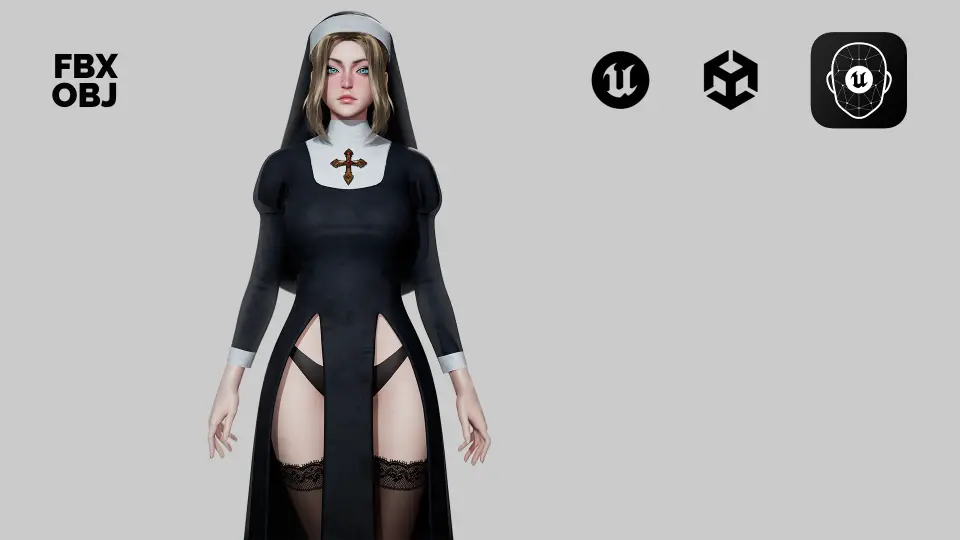
The core geometry of the model sits at an optimized mid-density profile, measuring 49,215 triangles and 42,134 vertices. Instead of relying on a fragmented torso or partial geometry cutouts under clothing layers, the underlying body mesh is fully intact. Having complete geometry beneath the habit and robes eliminates edge seam artifacts when garments shift during high-movement actions or dynamic locomotion states. The intact base mesh also allows developers to strip away clothing items without leaving open geometry gaps across the torso or limbs.
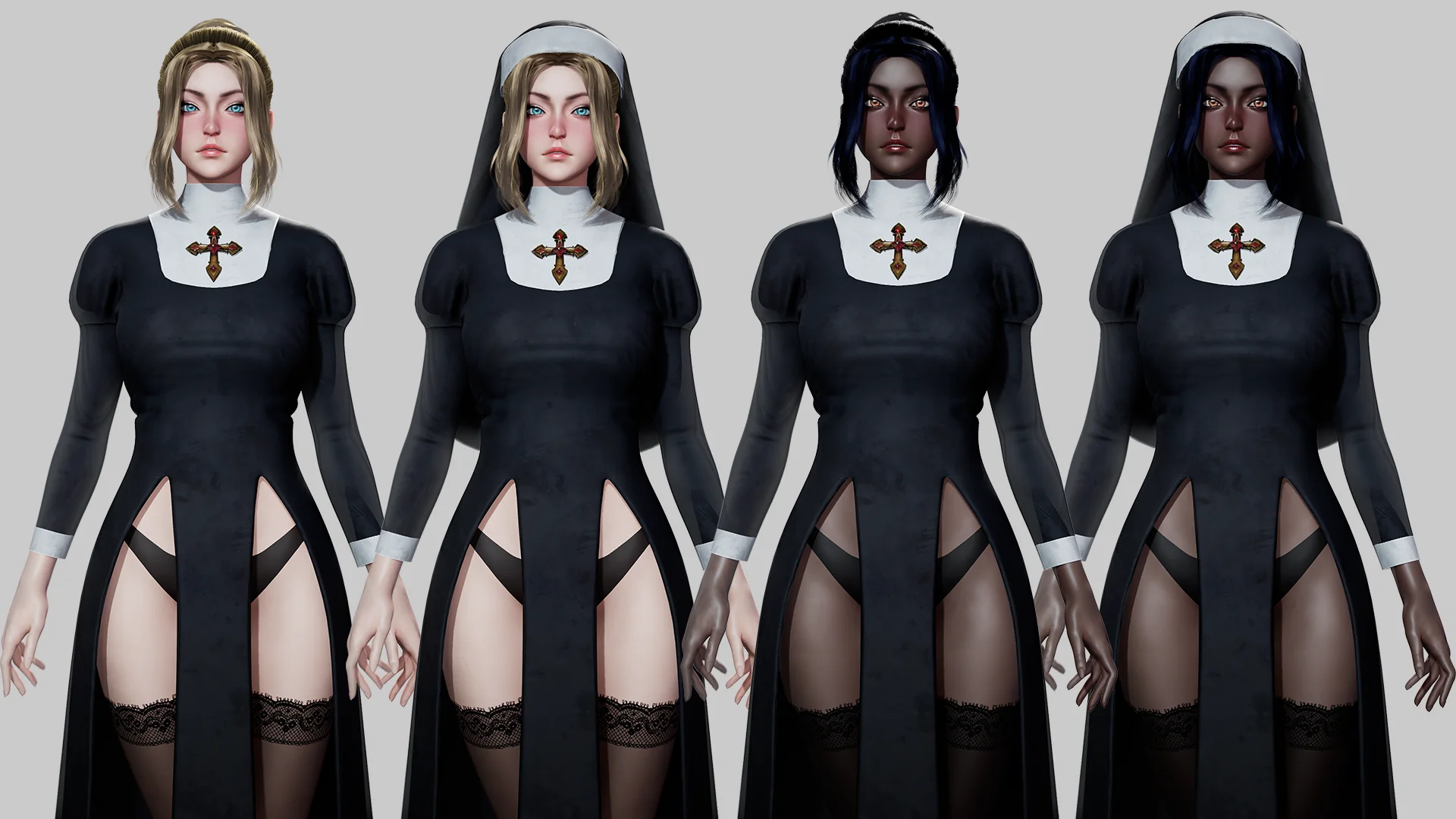
Texture mapping across the physical body features extensive variations across two separate foundational skin tones, comprising light and dark baselines. Surface mapping incorporates multiple sub-configurations including bare skin, standard socks, and full-length sock layouts. These configurations are prepared in both censored and uncensored texture formats, allowing project teams to adhere to specific rating guidelines or production boundaries without re-painting UV layouts. Morph targets built into the head mesh include human and elf ear options, facilitating quick switches between realistic historical styling and stylized fantasy archetypes through simple blend parameter adjustments.
Skeletal Hierarchy and Secondary Joint Articulation
Skeletal binding relies on the standard Epic Skeleton and Humanoid configuration, allowing straightforward animation retargeting inside Unreal Engine and Unity. Characters rigged to this standard hierarchy can directly absorb existing motion libraries, combat choreography, and custom locomotion packs without requiring tedious bone-mapping adjustments. The primary skeletal structure was authored in Maya, meaning standard FBX exchanges preserve joint axes and weight paint distributions when imported into digital content creation suites such as Blender, Cinema 4D, or 3ds Max.
Beyond the primary limbs and spine, the skeleton incorporates dedicated secondary bones designed to articulate independent mesh components. Dedicated deformation joints are weight-painted to the hair strands, the brim and veil of the hat, individual eye meshes, outer clothing panels, and breast areas. In Unreal Engine 4, dynamic cloth simulation can be applied directly to the lower robe panels and habit fabric, allowing character velocity and wind actors to drive authentic motion instead of relying solely on baked keyframes.
Assembling the Modular Nun Wardrobe and Hair Configurations
Modularity dictates how every outward layer is handled across the mesh hierarchy. Outer costume components, including the large liturgical hat and decorative chest cross, operate as isolated elements that can be hidden, swapped, or stripped away cleanly. The outfit structure allows developers to move between fully dressed ecclesiastical figures, simplified cloth sets, or stripped-down character representations suited for casual, medieval, or fantasy scenarios.
Hair is arranged into three distinct base styles, accompanied by three matching variants tailored specifically to clear headwear bounds:
Bun with no Bangs, exposing the full forehead and temple geometry.
Bun with Bangs version 1, introducing layered front fringe styling.
Bun with Bangs version 2, providing an alternate cut and separation across the brow.
Hat-fitted variations for all three bun styles, compressed to prevent geometry clipping against the interior geometry of the nun's cowl.
This separation prevents visual penetration between strands and stiff fabrics while preserving silhouette depth. In broader wardrobe management setups, the character maintains dimensional compatibility with the Roxy rigged NSFW female base character, enabling cross-asset clothing experiments when assembling larger casts of stylized women.
PBR Shading, MatID Control, and 4K Texture Architecture
Surface shading relies on a standardized Metallic/Roughness Physically Based Rendering (PBR) pipeline. All surface detail is partitioned across six distinct material domains: Head, Body, Clothes, Teeth, Hair, and Eyes. Segmenting textures into these logical material groups maintains high visual density across close-up cinematic shots while keeping dynamic character elements isolated for independent engine calls.
Textures are authored at 4K resolution and include complete channel maps: albedo, normal, metallic, roughness, opacity, and designated matID maps. Within Unreal Engine 4, the inclusion of matID masks enables instant palette manipulation via Material Instances. Rather than altering raw albedo files in external graphic software, artists can isolate specific cloth trim regions, jewelry metals, or fabric bands to dynamically recolor habits or secondary dress elements directly in the viewport.
Facial Animation Pipelines and Performance Capture
Interactive projects requiring conversational dialogue or broadcast animation leverage the character's built-in facial morph framework. The head geometry comes pre-configured with Apple Blendshapes, matching the tracking standards used by Live Link Face. This allows creators to drive real-time facial performance capture straight from compatible mobile hardware and camera tracking rigs.
These blendshapes translate continuous emotional variations, nuanced mouth shapes, and subtle eye blinks during spoken dialogue or live streaming. Virtual YouTubers, narrative game developers, and cinematic animators can route streaming motion tracking directly to the facial blend controllers without authoring bespoke facial rigs. Because the asset deliberately ships without pre-packaged gameplay Blueprints, technical artists retain total architectural freedom to connect the mesh, material instances, and face tracking graphs into their own custom interaction and animation framework.
 Humans
 Humans
 Humans
 Humans