"fb5ea1e7d1b41445"{"id":"1002405","slug":"samurai-girl-tomoe","title":"Samurai Girl Tomoe","category":"Humans","engine":"4.19+,5.0+","assetVersion":"","engineVersion":"Engine Version: 4.19+,5.0+","tag":"Humans","accent":"blue","visual":"mech","summary":"Modular 3D warrior character Samurai Girl Tomoe featuring 52 ARKit blendshapes, 4K packed textures, and an Epic Skeleton rig for action games.","platform":"Unreal Engine","indexPolicy":"index","publishedAt":"2026-11-10T07:07:18.175Z","updatedAt":"2026-11-10T07:07:18.175Z","sourceNotes":[],"fileContents":[],"compatibility":["Unreal Engine","Engine Version: 4.19+,5.0+"],"featuredImage":{"alt":"Samurai Girl Tomoe","src":"/wp-content/uploads/published/2026/11/5c46690700c0-95be6877-7081-4ad3-b57c-fd636373f3cb-40e5943225.webp"},"hasDownloadLink":true,"downloads":0,"terms":[{"taxonomy":"category","slug":"humans","name":"Humans"}],"galleryImages":[{"src":"/wp-content/uploads/published/2026/11/583122a521f4-8138a99c-d49c-4511-8c8b-02ce7deeff52-c52b409a3f.webp","alt":"Samurai Girl Tomoe"},{"src":"/wp-content/uploads/published/2026/11/3c6809bcfe4b-ac8b0d02-c29f-412f-b56f-1be42f2093f2-35f3963e60.webp","alt":"Samurai Girl Tomoe"},{"src":"/wp-content/uploads/published/2026/11/b8e5740f994f-292569d0-a00d-4335-b6cf-80ceb1a0cae7-028f12d268.webp","alt":"Samurai Girl Tomoe"},{"src":"/wp-content/uploads/published/2026/11/2ae0d1f76b39-bbb4ee37-c900-49b5-bfef-ecab9ad52792-888482c3a8.webp","alt":"Samurai Girl Tomoe"},{"src":"/wp-content/uploads/published/2026/11/2c096a980b72-9b2a824c-a1c5-494e-8d6e-f802c0224c18-ac420e3d20.webp","alt":"Samurai Girl Tomoe"},{"src":"/wp-content/uploads/published/2026/11/5e29199a4242-51550f2e-612d-4fba-89d9-40ca1dd2e492-f11d1070a3.webp","alt":"Samurai Girl Tomoe"},{"src":"/wp-content/uploads/published/2026/11/93cc94367dac-37572197-4793-4c09-abfd-ebc8a4950dbf-11f2b32f34.webp","alt":"Samurai Girl Tomoe"},{"src":"/wp-content/uploads/published/2026/11/ebe153fb5bf3-20775fdd-e88a-41d7-8216-e5ce1f8c5cce-42c0e10315.webp","alt":"Samurai Girl Tomoe"},{"src":"/wp-content/uploads/published/2026/11/4ccd196753c7-a28fe47a-62c8-4470-85f7-cf999cc2da7a-ab833c88d3.webp","alt":"Samurai Girl Tomoe"},{"src":"/wp-content/uploads/published/2026/11/a7124e86fa7a-665617ae-8ac9-4d4f-911b-b83eb3a9f71d-bc87d2905c.webp","alt":"Samurai Girl Tomoe"}],"accessPanel":{"kind":"resource","title":"Get this resource","eyebrow":"Free resource","message":"Download this resource in your browser.","fileName":"Content.7z","safetyNote":"Resources are manually reviewed before listing to improve quality and reduce obvious risks.","actionLabel":"Get this resource","resourceType":"Resource archive","versions":[]},"contentHtml":"\u003cp\u003eFast-paced melee combat games, stylized role-playing adventures, and interactive live-streaming setups require character models that balance visual polish with technical adaptability. Samurai Girl Tomoe delivers a stylized warrior aesthetic designed specifically for these production environments. Rendered originally in Marmoset Toolbag 3, the character merges traditional samurai gear with clean, expressive proportions suited for real-time engines.\u003c/p\u003e \u003ch2\u003eFitting Samurai Girl Tomoe into Action and Role-Playing Combat\u003c/h2\u003e \u003cp\u003eAction titles rely heavily on clean retargeting and broad animation support. The underlying skeleton of Samurai Girl Tomoe is built directly on the UE4 Mannequin bone hierarchy. Because the core bone layout remains unmodified, importing existing motion data or standard third-person animation libraries requires minimal setup. The character has been verified across an extensive assortment of locomotion systems and combat animsets, including Advanced Locomotion System v4 (ALSv4), Lyra Starter Game, Close Combat: Swordsman, Valley of the Ancient, and standard third-person templates.\u003c/p\u003e \u003cp\u003eInteraction-heavy combat libraries also translate smoothly. Tests with Female Interactions Animations, Mocap Library data, ARLS with Horse Animset, and the Succubus AnimSet demonstrate the rig's ability to maintain joint stability through complex choreography. The base rig was constructed natively inside Maya without external plugins. While it does not include custom FK/IK manipulation controls for manual keyframing, it features supplementary bones specifically placed to drive secondary motion on hair and costume components. Any weaponry, such as the sword visible in preview renders, is solely decorative context for the visual theme and is not included within the asset files, leaving designers free to attach custom weapon sets to the hand sockets.\u003c/p\u003e \u003ch2\u003eTomoe's Modular Mesh Anatomy and Clipping Control\u003c/h2\u003e \u003cp\u003eCharacter customization and clothing swaps often introduce severe intersection problems when meshes deform during attack swings or acrobatic evasions. The geometry of Samurai Girl Tomoe directly addresses this pipeline bottleneck through segmented modeling. The mesh totals 36,902 faces, 69,996 triangles, and 39,855 vertices, built without a baked Level of Detail (LOD) system. To prevent underlying skin from penetrating through armor or fabric layers during motion, the body underneath is cleanly sliced into discrete sections.\u003c/p\u003e \u003cp\u003eDevelopers can selectively deactivate body pieces concealed beneath garments, instantly removing clipping artifacts while lowering the active polygon count during gameplay. For outfits requiring bare skin, the complete full-body mesh is present beneath the armor. The body texture features censored undergarment coverage; adult anatomical features are neither modeled, rigged, nor given morph targets. The package includes separated meshes configured for Unreal Engine's Master Pose Component and Leader Pose Component pipelines, facilitating modular equipment switching. Built-in body morphs also grant direct control over proportions, providing adjustable sliders for breast size, butt volume, nail length, and knee shaping.\u003c/p\u003e \u003ch2\u003eFacial Performance and Live Capture on the Tomoe Rig\u003c/h2\u003e \u003cp\u003eBeyond traditional gameplay animations, real-time facial capture has become essential for cutscenes, virtual avatars, and interactive streaming. Samurai Girl Tomoe includes 52 calibrated Apple blendshapes, configured specifically for tracking through tools such as Live Link Face in Unreal Engine 5. This calibration allows the face to reproduce subtle phonetic movements, brow shifts, eye blinks, and asymmetrical expressions without requiring manual shape authoring.\u003c/p\u003e \u003cp\u003eThis facial setup broadens the character's functional utility well outside standard offline games. Production teams can deploy the model as a VTuber avatar, integrate it into VRChat or MMD pipelines, or feed direct optical tracking through FaceWare and facial motion capture software. Because the blendshapes align with standard Apple ARKit definitions, developers can stream real-time facial performance from mobile devices directly onto the character mesh inside Unreal Engine without manual node remapping.\u003c/p\u003e \u003ch2\u003eMaterial ID Shading and 4K Texture Architecture\u003c/h2\u003e \u003cp\u003eVisual customization is supported by a comprehensive texturing pipeline organized across eight distinct texture sets: Body, Head, Teeth, Hair, Eyes, Lashes, Clothes, and Armor. Each set is delivered with 4K packed textures containing BaseColor, Normal, Roughness, Metallic, Ambient Occlusion, Opacity, and Emissive channels where applicable. Texture packing keeps memory overhead predictable and optimizes draw call management during active gameplay scenes.\u003c/p\u003e \u003cp\u003eColor grading and palette variations do not require manual repainting inside third-party texture editors. Material ID maps are included for the skin, eyes, hair, and individual outfit parts. In Unreal Engine, these maps feed directly into bundled Material Instances, allowing developers to isolate and tint specific color regions independently. This system makes it straightforward to generate alternate team colors, enemy variants, or customizable player palettes directly in the engine viewport without generating duplicate texture assets.\u003c/p\u003e \u003ch2\u003eUnreal Engine Setup, Animation Retargeting, and Pipeline Fit\u003c/h2\u003e \u003cp\u003eFor Unreal Engine developers operating on version 4.19 or later, the project integrates immediately with existing third-person logic. Standard third-person animations are bundled alongside a built-in wind simulation setup made for the character's hair. While the asset includes additional secondary bones for loose hair and armor flaps, pre-built physics assets and gameplay Blueprints are not included. Implementing dynamic secondary physics is recommended through plugins such as KawaiiPhysics, which bind naturally to the extended bone hierarchy to generate procedural cloth and hair reactions.\u003c/p\u003e \u003cp\u003eWhile Maya, Unreal Engine, and Unity serve as the primary supported environments, FBX exports enable the geometry and bone hierarchies to import into external tools like Blender, though rig interpretation outside the primary engines depends on host-software support. Independent studios developing fast-paced anime fighting games, stylized action RPGs, or live-streamers requiring a responsive, expression-ready combatant will find Samurai Girl Tomoe directly suited to rapid character deployment.\u003c/p\u003e\n\n\u003ch2\u003eExplore Similar Assets\u003c/h2\u003e\n\u003cul\u003e\n\u003cli\u003e\u003ca href=\"https://3dcghub.com/customizable-school-girls/\" rel=\"noopener noreferrer\"\u003eCustomizable School Girls\u003c/a\u003e\u003c/li\u003e\n\u003cli\u003e\u003ca href=\"https://3dcghub.com/nun-girl-modular/\" rel=\"noopener noreferrer\"\u003eNun Girl Modular\u003c/a\u003e\u003c/li\u003e\n\u003cli\u003e\u003ca href=\"https://3dcghub.com/anime-girl-cleric/\" rel=\"noopener noreferrer\"\u003eAnime Girl Cleric\u003c/a\u003e\u003c/li\u003e\n\u003cli\u003e\u003ca href=\"https://3dcghub.com/xiao-jue-asian-girl/\" rel=\"noopener noreferrer\"\u003eXiao Jue - Asian Girl\u003c/a\u003e\u003c/li\u003e\n\u003cli\u003e\u003ca href=\"https://3dcghub.com/assassin-girl-modular/\" rel=\"noopener noreferrer\"\u003eAssassin Girl Modular\u003c/a\u003e\u003c/li\u003e\n\u003c/ul\u003e","contentTextLength":6531,"navigation":{"current":14,"total":4340,"previous":{"id":"1002406","slug":"death-archer-girl-morgana","title":"Death Archer Girl Morgana","category":"Humans","platform":"Unreal Engine","updatedAt":"2026-11-10T12:02:23.586Z"},"next":{"id":"1002404","slug":"cyberpunk-girl-3","title":"Cyberpunk Girl 3","category":"Humans","platform":"Unreal Engine","updatedAt":"2026-11-10T07:05:56.554Z"}},"relatedResources":[{"id":"1002406","slug":"death-archer-girl-morgana","title":"Death Archer Girl Morgana","category":"Humans","engine":"4.24+,5.0+","assetVersion":"","engineVersion":"Engine Version: 4.24+,5.0+","tag":"Humans","accent":"blue","visual":"mech","summary":"Death Archer Girl Morgana is a modular, fully rigged UE5 character with 52 ARKit blendshapes, MatID color swaps, 4K textures and a bow for dark fantasy scenes.","platform":"Unreal Engine","indexPolicy":"index","publishedAt":"2026-11-10T12:02:23.586Z","updatedAt":"2026-11-10T12:02:23.586Z","sourceNotes":[],"fileContents":[],"compatibility":["Unreal Engine","Engine Version: 4.24+,5.0+"],"featuredImage":{"alt":"Death Archer Girl Morgana","src":"/wp-content/uploads/published/2026/11/ea8636dbb6df-2816da73-8314-4654-b908-7327f7cfd95e-bbd131ee7b.webp"},"hasDownloadLink":true,"downloads":0},{"id":"1002403","slug":"customizable-school-girls","title":"Customizable School Girls","category":"Humans","engine":"4.19+,5.0+","assetVersion":"","engineVersion":"Engine Version: 4.19+,5.0+","tag":"Humans","accent":"blue","visual":"mech","summary":"Explore Customizable School Girls, a modular 3D character featuring 4K PBR textures, Live Link blendshapes, cloth simulation, and Epic Skeleton rigging.","platform":"Unreal Engine","indexPolicy":"index","publishedAt":"2026-11-10T05:14:18.764Z","updatedAt":"2026-11-10T05:14:18.764Z","sourceNotes":[],"fileContents":[],"compatibility":["Unreal Engine","Engine Version: 4.19+,5.0+"],"featuredImage":{"alt":"Customizable School Girls","src":"/wp-content/uploads/published/2026/11/e27de06de645-c3c2e3d3-1425-47ac-a056-100d6670b067-63cb3abe64.webp"},"hasDownloadLink":true,"downloads":0},{"id":"1002394","slug":"nun-girl-modular","title":"Nun Girl Modular","category":"Humans","engine":"4.26+,5.0+","assetVersion":"","engineVersion":"Engine Version: 4.26+,5.0+","tag":"Humans","accent":"blue","visual":"mech","summary":"Examine the technical layout, skeleton setup, modular clothing parts, and 4K PBR textures of the Nun Girl Modular real-time character model.","platform":"Unreal Engine","indexPolicy":"index","publishedAt":"2026-11-10T04:21:06.414Z","updatedAt":"2026-11-10T04:21:06.414Z","sourceNotes":[],"fileContents":[],"compatibility":["Unreal Engine","Engine Version: 4.26+,5.0+"],"featuredImage":{"alt":"Nun Girl Modular","src":"/wp-content/uploads/published/2026/11/0fd1be5a48c1-7d16b0ab-ce7e-4e64-b786-700d4ff73aaa-57498a1b2b.webp"},"hasDownloadLink":true,"downloads":0}]}
Humans
Samurai Girl Tomoe
Modular 3D warrior character Samurai Girl Tomoe featuring 52 ARKit blendshapes, 4K packed textures, and an Epic Skeleton rig for action games.
Category:Unreal Engine,HumansPlatform: Unreal EngineEngine Version: 4.19+,5.0+Published: Nov 10, 2026
Humans
Resource overview
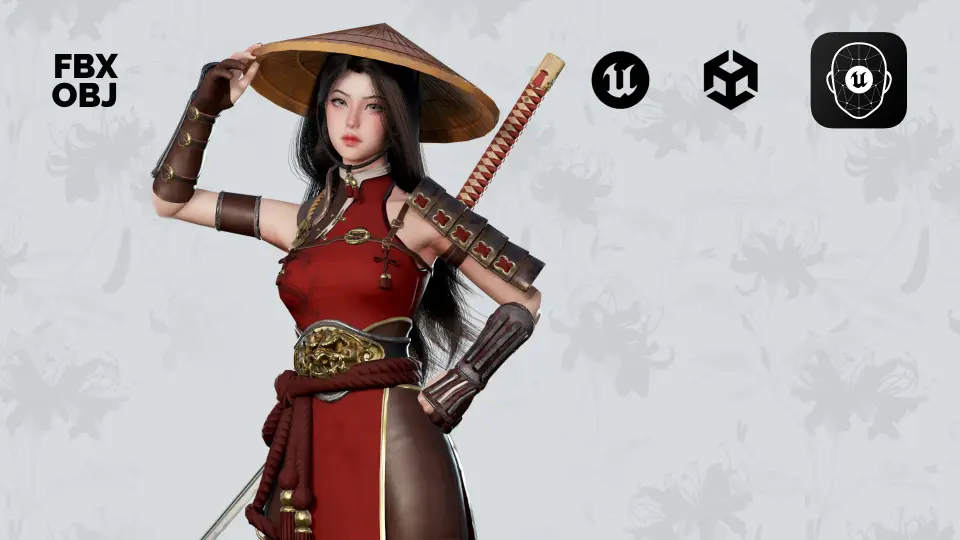
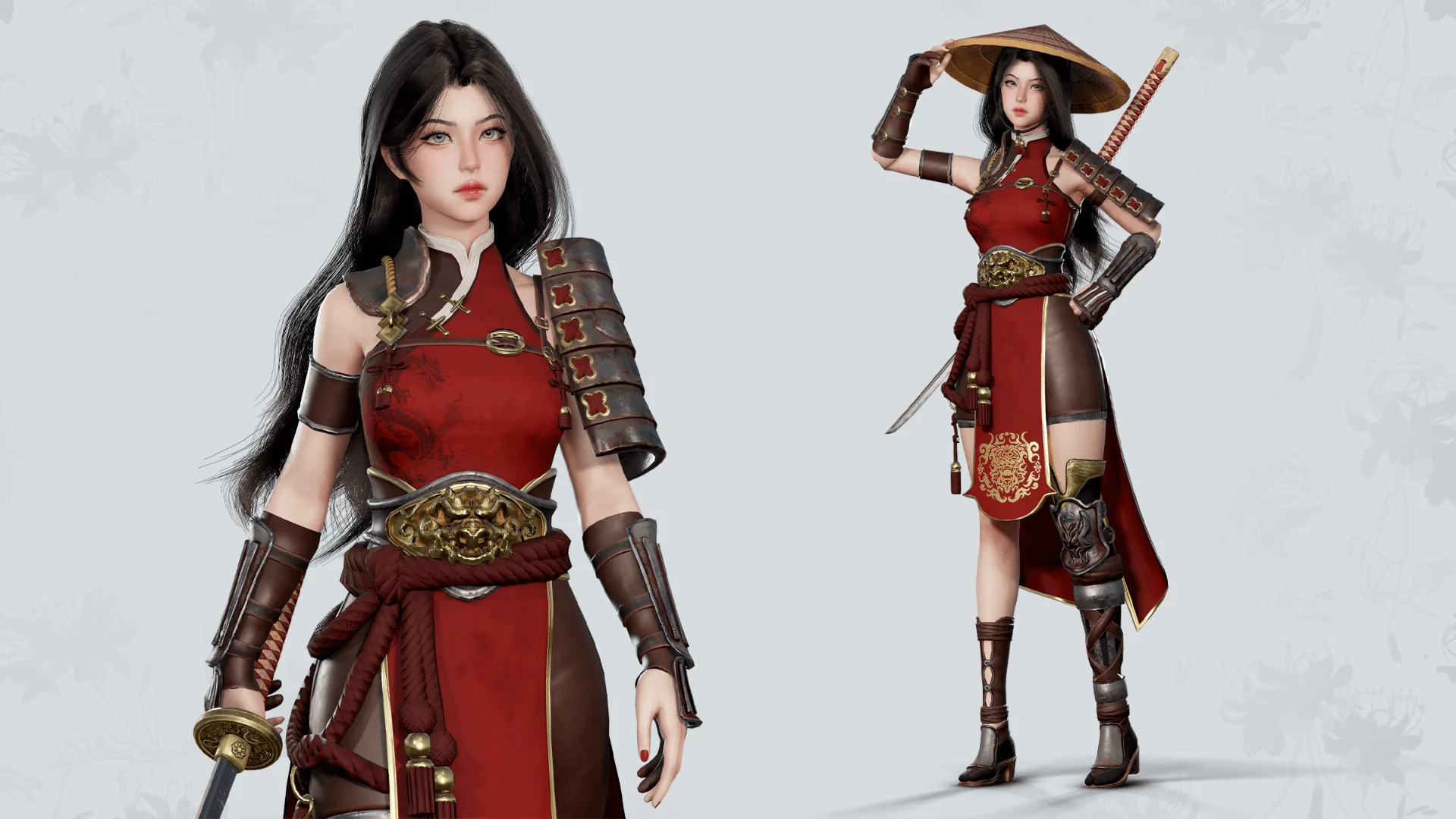
Fast-paced melee combat games, stylized role-playing adventures, and interactive live-streaming setups require character models that balance visual polish with technical adaptability. Samurai Girl Tomoe delivers a stylized warrior aesthetic designed specifically for these production environments. Rendered originally in Marmoset Toolbag 3, the character merges traditional samurai gear with clean, expressive proportions suited for real-time engines.
Fitting Samurai Girl Tomoe into Action and Role-Playing Combat
Action titles rely heavily on clean retargeting and broad animation support. The underlying skeleton of Samurai Girl Tomoe is built directly on the UE4 Mannequin bone hierarchy. Because the core bone layout remains unmodified, importing existing motion data or standard third-person animation libraries requires minimal setup. The character has been verified across an extensive assortment of locomotion systems and combat animsets, including Advanced Locomotion System v4 (ALSv4), Lyra Starter Game, Close Combat: Swordsman, Valley of the Ancient, and standard third-person templates.
Interaction-heavy combat libraries also translate smoothly. Tests with Female Interactions Animations, Mocap Library data, ARLS with Horse Animset, and the Succubus AnimSet demonstrate the rig's ability to maintain joint stability through complex choreography. The base rig was constructed natively inside Maya without external plugins. While it does not include custom FK/IK manipulation controls for manual keyframing, it features supplementary bones specifically placed to drive secondary motion on hair and costume components. Any weaponry, such as the sword visible in preview renders, is solely decorative context for the visual theme and is not included within the asset files, leaving designers free to attach custom weapon sets to the hand sockets.
Tomoe's Modular Mesh Anatomy and Clipping Control
Character customization and clothing swaps often introduce severe intersection problems when meshes deform during attack swings or acrobatic evasions. The geometry of Samurai Girl Tomoe directly addresses this pipeline bottleneck through segmented modeling. The mesh totals 36,902 faces, 69,996 triangles, and 39,855 vertices, built without a baked Level of Detail (LOD) system. To prevent underlying skin from penetrating through armor or fabric layers during motion, the body underneath is cleanly sliced into discrete sections.
Developers can selectively deactivate body pieces concealed beneath garments, instantly removing clipping artifacts while lowering the active polygon count during gameplay. For outfits requiring bare skin, the complete full-body mesh is present beneath the armor. The body texture features censored undergarment coverage; adult anatomical features are neither modeled, rigged, nor given morph targets. The package includes separated meshes configured for Unreal Engine's Master Pose Component and Leader Pose Component pipelines, facilitating modular equipment switching. Built-in body morphs also grant direct control over proportions, providing adjustable sliders for breast size, butt volume, nail length, and knee shaping.
Facial Performance and Live Capture on the Tomoe Rig
Beyond traditional gameplay animations, real-time facial capture has become essential for cutscenes, virtual avatars, and interactive streaming. Samurai Girl Tomoe includes 52 calibrated Apple blendshapes, configured specifically for tracking through tools such as Live Link Face in Unreal Engine 5. This calibration allows the face to reproduce subtle phonetic movements, brow shifts, eye blinks, and asymmetrical expressions without requiring manual shape authoring.
This facial setup broadens the character's functional utility well outside standard offline games. Production teams can deploy the model as a VTuber avatar, integrate it into VRChat or MMD pipelines, or feed direct optical tracking through FaceWare and facial motion capture software. Because the blendshapes align with standard Apple ARKit definitions, developers can stream real-time facial performance from mobile devices directly onto the character mesh inside Unreal Engine without manual node remapping.
Material ID Shading and 4K Texture Architecture
Visual customization is supported by a comprehensive texturing pipeline organized across eight distinct texture sets: Body, Head, Teeth, Hair, Eyes, Lashes, Clothes, and Armor. Each set is delivered with 4K packed textures containing BaseColor, Normal, Roughness, Metallic, Ambient Occlusion, Opacity, and Emissive channels where applicable. Texture packing keeps memory overhead predictable and optimizes draw call management during active gameplay scenes.
Color grading and palette variations do not require manual repainting inside third-party texture editors. Material ID maps are included for the skin, eyes, hair, and individual outfit parts. In Unreal Engine, these maps feed directly into bundled Material Instances, allowing developers to isolate and tint specific color regions independently. This system makes it straightforward to generate alternate team colors, enemy variants, or customizable player palettes directly in the engine viewport without generating duplicate texture assets.
Unreal Engine Setup, Animation Retargeting, and Pipeline Fit
For Unreal Engine developers operating on version 4.19 or later, the project integrates immediately with existing third-person logic. Standard third-person animations are bundled alongside a built-in wind simulation setup made for the character's hair. While the asset includes additional secondary bones for loose hair and armor flaps, pre-built physics assets and gameplay Blueprints are not included. Implementing dynamic secondary physics is recommended through plugins such as KawaiiPhysics, which bind naturally to the extended bone hierarchy to generate procedural cloth and hair reactions.
While Maya, Unreal Engine, and Unity serve as the primary supported environments, FBX exports enable the geometry and bone hierarchies to import into external tools like Blender, though rig interpretation outside the primary engines depends on host-software support. Independent studios developing fast-paced anime fighting games, stylized action RPGs, or live-streamers requiring a responsive, expression-ready combatant will find Samurai Girl Tomoe directly suited to rapid character deployment.
 Humans
 Humans
 Humans
 Humans