"fb5ea1e7d1b41445"{"id":"1002403","slug":"customizable-school-girls","title":"Customizable School Girls","category":"Humans","engine":"4.19+,5.0+","assetVersion":"","engineVersion":"Engine Version: 4.19+,5.0+","tag":"Humans","accent":"blue","visual":"mech","summary":"Explore Customizable School Girls, a modular 3D character featuring 4K PBR textures, Live Link blendshapes, cloth simulation, and Epic Skeleton rigging.","platform":"Unreal Engine","indexPolicy":"index","publishedAt":"2026-11-10T05:14:18.764Z","updatedAt":"2026-11-10T05:14:18.764Z","sourceNotes":[],"fileContents":[],"compatibility":["Unreal Engine","Engine Version: 4.19+,5.0+"],"featuredImage":{"alt":"Customizable School Girls","src":"/wp-content/uploads/published/2026/11/e27de06de645-c3c2e3d3-1425-47ac-a056-100d6670b067-63cb3abe64.webp"},"hasDownloadLink":true,"downloads":0,"terms":[{"taxonomy":"category","slug":"humans","name":"Humans"}],"galleryImages":[{"src":"/wp-content/uploads/published/2026/11/3b93edfb35b0-267ac79f-dc0c-405a-a249-93f614dfcb42-1d7670415d.webp","alt":"Customizable School Girls"},{"src":"/wp-content/uploads/published/2026/11/5c50a4d51f57-d488e3f9-9260-49f0-8606-1740924bb3ed-2290d3e304.webp","alt":"Customizable School Girls"},{"src":"/wp-content/uploads/published/2026/11/c21478a6ce8f-decd0993-6b6f-41af-9a6f-6fa5fe1c888d-b1c01e0261.webp","alt":"Customizable School Girls"},{"src":"/wp-content/uploads/published/2026/11/a2b44cfbe038-dbb0b572-4faa-467b-b972-1208230c5b94-c07446b464.webp","alt":"Customizable School Girls"},{"src":"/wp-content/uploads/published/2026/11/6d900b29397d-74fe8a55-ee5c-4a64-badb-71ea114f10f1-d27da38133.webp","alt":"Customizable School Girls"},{"src":"/wp-content/uploads/published/2026/11/26334527150d-1a8bd782-b936-4df6-9836-df9ef70abebc-6659059b55.webp","alt":"Customizable School Girls"},{"src":"/wp-content/uploads/published/2026/11/c9cbafb767ea-17c84d9f-f7b9-4fe5-b8da-7120f085d6c7-a34637431b.webp","alt":"Customizable School Girls"},{"src":"/wp-content/uploads/published/2026/11/93f083102457-225310f9-e199-4c57-affa-c6e648243c95-ee671f5ee2.webp","alt":"Customizable School Girls"},{"src":"/wp-content/uploads/published/2026/11/63ce0b8b02c6-acc664b3-7a17-4a1c-bc23-1e1895b3bd26-5a27e01471.webp","alt":"Customizable School Girls"},{"src":"/wp-content/uploads/published/2026/11/2e117f05fe81-4ddfb2e3-5205-4d8d-b9da-c257efb4beb5-9b98779900.webp","alt":"Customizable School Girls"}],"accessPanel":{"kind":"resource","title":"Get this resource","eyebrow":"Free resource","message":"Download this resource in your browser.","fileName":"Content.7z","safetyNote":"Resources are manually reviewed before listing to improve quality and reduce obvious risks.","actionLabel":"Get this resource","resourceType":"Resource archive","versions":[]},"contentHtml":"\u003cp\u003ePopulating dynamic student rosters or modern classroom sequences often stalls when character models are locked into rigid, single-mesh outfits or lack unified skeletal standards. Customizable School Girls provides a flexible, component-based foundation built to address modular character variety without sacrificing consistent skeleton hierarchies across project scenes. By keeping individual clothing items distinct from the underlying anatomy, artists and technical animators can reconfigure attire, swap hair designs, and balance polycounts across multiple active characters.\u003c/p\u003e\u003cp\u003eThe geometry balances detail with real-time performance. With a standard configuration totaling 36,403 faces, 61,044 triangles, and 37,068 vertices, the character mesh remains light enough for crowded campus environments while retaining sufficient density for close-up conversational cameras. Because clothing pieces and hair elements can be toggled independently, the actual triangle density scales directly with the specific combination of elements assembled on screen.\u003c/p\u003e\u003ch2\u003eCustomizable Mesh Architecture and Full-Body Modularity\u003c/h2\u003e\u003cp\u003eStandardizing character generation across classroom or campus settings typically requires swappable clothing systems that avoid surface clipping while allowing partial outfit removal. Customizable School Girls resolves this challenge by shipping complete anatomical geometry beneath the uniform instead of relying on geometry cutouts.\u003c/p\u003e\u003cp\u003eEvery garment exists as an independent mesh element, letting creators freely strip away, attach, or exchange pieces depending on the requirements of an interaction. The underlying torso and limbs include a fully modeled body base, which is provided in a censored format across several distinct skin and legwear map setups. Skin textures support options for bare legs, short socks, and full-length over-the-knee socks. Because the full base mesh is maintained underneath the uniform layers, projects avoid unsightly gaps or missing backfaces when clothes shift during physical movement or when alternate wardrobe combinations expose different portions of the body. The core asset structure also maintains cross-compatibility with the Roxy rigged female base character format, allowing artists working across related setups to share anatomical components or adapt existing modular pieces without restructuring vertex groups.\u003c/p\u003e\u003ch2\u003eRigging Dynamics for Epic Skeleton and Unity Humanoid\u003c/h2\u003e\u003cp\u003eEngine pipelines demand dependable retargeting pathways so studio teams do not have to recreate distinct animation libraries for each character variation.\u003c/p\u003e\u003cp\u003eThe character is fully rigged to the standard Epic Skeleton, enabling direct retargeting in Unreal Engine as well as standard Humanoid retargeting within Unity. Beyond the core torso and limb deformation hierarchy, the skeletal structure extends secondary deformation bones into specialized areas. Rigged nodes are implemented directly within the eyes, hair, and breasts, granting animators manual control over subtle secondary bounces, look-at offsets, and wind reaction dynamics. While the character pack does not ship with pre-built gameplay or animation Blueprints, the conformity to standard humanoid bone naming conventions guarantees seamless compatibility with standard movement controllers, state machines, and marketplace animation sequences. Developers can plug the skeletal mesh directly into their established character controller assets and assign standard locational, idle, or combat blends immediately.\u003c/p\u003e\u003ch2\u003eSchool Character Facial Animation and Live Link Integration\u003c/h2\u003e\u003cp\u003eDialogue delivery and narrative sequences require expressive, reliable facial controls that integrate smoothly into modern capture setups without requiring custom bone rigging passes.\u003c/p\u003e\u003cp\u003eFor live streaming, cinematics, and interactive conversational animation, the head mesh incorporates dedicated morph targets and blendshapes suited to Apple Live Link Face tracking. Animators can drive real-time facial motion capture directly from supported mobile capture devices, translating brow twitches, mouth movements, and eye blinks onto the character in real time. The integration of full blendshape arrays also empowers narrative designers who hand-author conversation states, speech lip-sync tracks, and emotional mood transitions. Whether generating an animated sequence using recorded performance curves or blending facial expressions through code during dialogue branches, the built-in shape keys provide high-fidelity mimicry for interactive scenarios.\u003c/p\u003e\u003ch2\u003ePBR Texture Sets and MatID Swapping\u003c/h2\u003e\u003cp\u003eVisual differentiation across recurring student characters is critical to prevent campus scenes from feeling copy-pasted or visually repetitive.\u003c/p\u003e\u003cp\u003eThe surfacing workflow uses physically based rendering metallic and roughness maps authored at 4K resolution. The pack divides its surface properties into nine discrete texture sets: Body, Head, Shirt_01, Shirt_02, Skirt, Shoes, Teeth, Hair, and Eyes. Every channel needed for accurate light interaction is accounted for, including normal, metallic, roughness, albedo, opacity, and dedicated matID textures. Unreal Engine 4 material instances leverage these matID maps to allow granular, instant color adjustments across every segment of the uniform, skin, and accessories. Developers can modify the exact hue, saturation, and roughness parameters of school skirts, neckties, collars, or trims without opening external texturing software or repainting base albedo maps.\u003c/p\u003e\u003ch2\u003eHair Configurations and In-Engine Cloth Simulation\u003c/h2\u003e\u003cp\u003eStylistic variety relies heavily on distinct silhouettes, particularly across anime-inspired, modern Asian, and stylized school environments.\u003c/p\u003e\u003cp\u003eCustomizable School Girls ships with eight separate hairstyle variations designed to diversify character casts. The hairstyles encompass loose flow, two short hair iterations, and high ponytails, with each of those four core silhouettes also available in an alternate variant featuring frontal bangs:\u003c/p\u003e\u003cul\u003e\u003cli\u003eLoose\u003c/li\u003e\u003cli\u003eHair_Short_v1\u003c/li\u003e\u003cli\u003eHair_Short_v2\u003c/li\u003e\u003cli\u003ePonytail\u003c/li\u003e\u003cli\u003eLoose with Bangs\u003c/li\u003e\u003cli\u003eHair_Short_v1 with Bangs\u003c/li\u003e\u003cli\u003eHair_Short_v2 with Bangs\u003c/li\u003e\u003cli\u003ePonytail with Bangs\u003c/li\u003e\u003c/ul\u003e\u003cp\u003eTo enhance realism during dynamic character movement, the clothing elements come prepared for cloth simulation within Unreal Engine 4. The skirts and loose uniform fabrics utilize native physics setups, reacting dynamically to directional running velocity, sudden stops, jumping animations, and ambient environment wind vectors. Instead of relying solely on baked skinning weights that can cause uniform skirts to bend unnaturally against thighs, real-time cloth simulation ensures the fabric drapes and settles with believable physical weight during rapid cinematic or gameplay actions.\u003c/p\u003e\u003ch2\u003eProduction Workflow Deployment\u003c/h2\u003e\u003cp\u003ePopulating stylized modern schools or urban environments demands a character pipeline that minimizes draw calls while preserving visual diversity. By separating garments from a complete base anatomy, integrating native cloth simulation, and incorporating Live Link facial capture, this asset provides a balanced technical framework. It allows teams to populate interactive dialogue trees, background student groups, or direct player characters within standard Unreal Engine and Unity humanoid pipelines.\u003c/p\u003e\n\n\u003ch2\u003eRelated Resources Worth Checking\u003c/h2\u003e\n\u003cul\u003e\n\u003cli\u003e\u003ca href=\"https://3dcghub.com/nun-girl-modular/\" rel=\"noopener noreferrer\"\u003eNun Girl Modular\u003c/a\u003e\u003c/li\u003e\n\u003cli\u003e\u003ca href=\"https://3dcghub.com/anime-girl-cleric/\" rel=\"noopener noreferrer\"\u003eAnime Girl Cleric\u003c/a\u003e\u003c/li\u003e\n\u003cli\u003e\u003ca href=\"https://3dcghub.com/xiao-jue-asian-girl/\" rel=\"noopener noreferrer\"\u003eXiao Jue - Asian Girl\u003c/a\u003e\u003c/li\u003e\n\u003cli\u003e\u003ca href=\"https://3dcghub.com/assassin-girl-modular/\" rel=\"noopener noreferrer\"\u003eAssassin Girl Modular\u003c/a\u003e\u003c/li\u003e\n\u003cli\u003e\u003ca href=\"https://3dcghub.com/survivor-girl-1-modular/\" rel=\"noopener noreferrer\"\u003eSurvivor Girl 1 (Modular)\u003c/a\u003e\u003c/li\u003e\n\u003c/ul\u003e","contentTextLength":7340,"navigation":{"current":16,"total":4340,"previous":{"id":"1002404","slug":"cyberpunk-girl-3","title":"Cyberpunk Girl 3","category":"Humans","platform":"Unreal Engine","updatedAt":"2026-11-10T07:05:56.554Z"},"next":{"id":"1002402","slug":"g2-mercenaries","title":"G2: Mercenaries","category":"Humans","platform":"Unreal Engine","updatedAt":"2026-11-10T04:54:18.684Z"}},"relatedResources":[{"id":"1002406","slug":"death-archer-girl-morgana","title":"Death Archer Girl Morgana","category":"Humans","engine":"4.24+,5.0+","assetVersion":"","engineVersion":"Engine Version: 4.24+,5.0+","tag":"Humans","accent":"blue","visual":"mech","summary":"Death Archer Girl Morgana is a modular, fully rigged UE5 character with 52 ARKit blendshapes, MatID color swaps, 4K textures and a bow for dark fantasy scenes.","platform":"Unreal Engine","indexPolicy":"index","publishedAt":"2026-11-10T12:02:23.586Z","updatedAt":"2026-11-10T12:02:23.586Z","sourceNotes":[],"fileContents":[],"compatibility":["Unreal Engine","Engine Version: 4.24+,5.0+"],"featuredImage":{"alt":"Death Archer Girl Morgana","src":"/wp-content/uploads/published/2026/11/ea8636dbb6df-2816da73-8314-4654-b908-7327f7cfd95e-bbd131ee7b.webp"},"hasDownloadLink":true,"downloads":0},{"id":"1002405","slug":"samurai-girl-tomoe","title":"Samurai Girl Tomoe","category":"Humans","engine":"4.19+,5.0+","assetVersion":"","engineVersion":"Engine Version: 4.19+,5.0+","tag":"Humans","accent":"blue","visual":"mech","summary":"Modular 3D warrior character Samurai Girl Tomoe featuring 52 ARKit blendshapes, 4K packed textures, and an Epic Skeleton rig for action games.","platform":"Unreal Engine","indexPolicy":"index","publishedAt":"2026-11-10T07:07:18.175Z","updatedAt":"2026-11-10T07:07:18.175Z","sourceNotes":[],"fileContents":[],"compatibility":["Unreal Engine","Engine Version: 4.19+,5.0+"],"featuredImage":{"alt":"Samurai Girl Tomoe","src":"/wp-content/uploads/published/2026/11/5c46690700c0-95be6877-7081-4ad3-b57c-fd636373f3cb-40e5943225.webp"},"hasDownloadLink":true,"downloads":0},{"id":"1002394","slug":"nun-girl-modular","title":"Nun Girl Modular","category":"Humans","engine":"4.26+,5.0+","assetVersion":"","engineVersion":"Engine Version: 4.26+,5.0+","tag":"Humans","accent":"blue","visual":"mech","summary":"Examine the technical layout, skeleton setup, modular clothing parts, and 4K PBR textures of the Nun Girl Modular real-time character model.","platform":"Unreal Engine","indexPolicy":"index","publishedAt":"2026-11-10T04:21:06.414Z","updatedAt":"2026-11-10T04:21:06.414Z","sourceNotes":[],"fileContents":[],"compatibility":["Unreal Engine","Engine Version: 4.26+,5.0+"],"featuredImage":{"alt":"Nun Girl Modular","src":"/wp-content/uploads/published/2026/11/0fd1be5a48c1-7d16b0ab-ce7e-4e64-b786-700d4ff73aaa-57498a1b2b.webp"},"hasDownloadLink":true,"downloads":0}]}
Humans
Customizable School Girls
Explore Customizable School Girls, a modular 3D character featuring 4K PBR textures, Live Link blendshapes, cloth simulation, and Epic Skeleton rigging.
Category:Unreal Engine,HumansPlatform: Unreal EngineEngine Version: 4.19+,5.0+Published: Nov 10, 2026
Humans
Resource overview
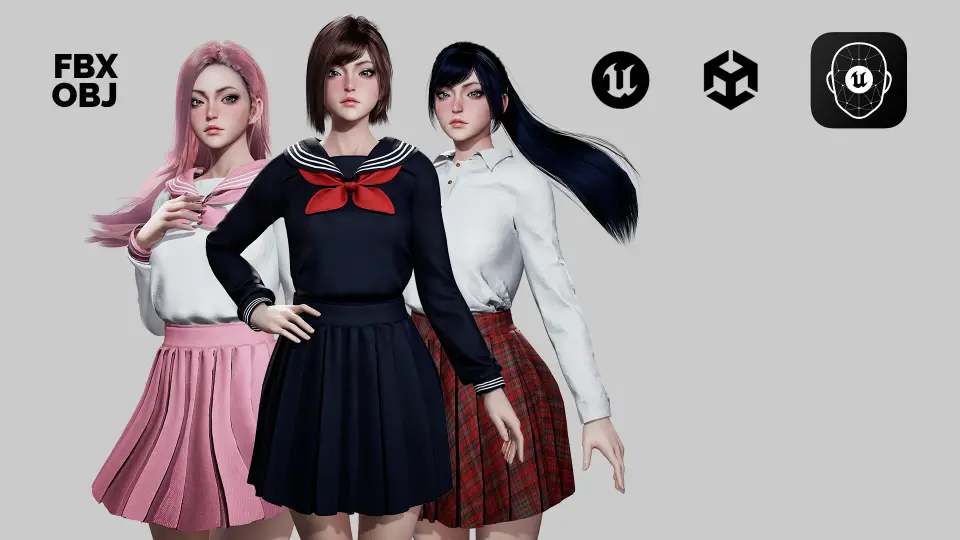
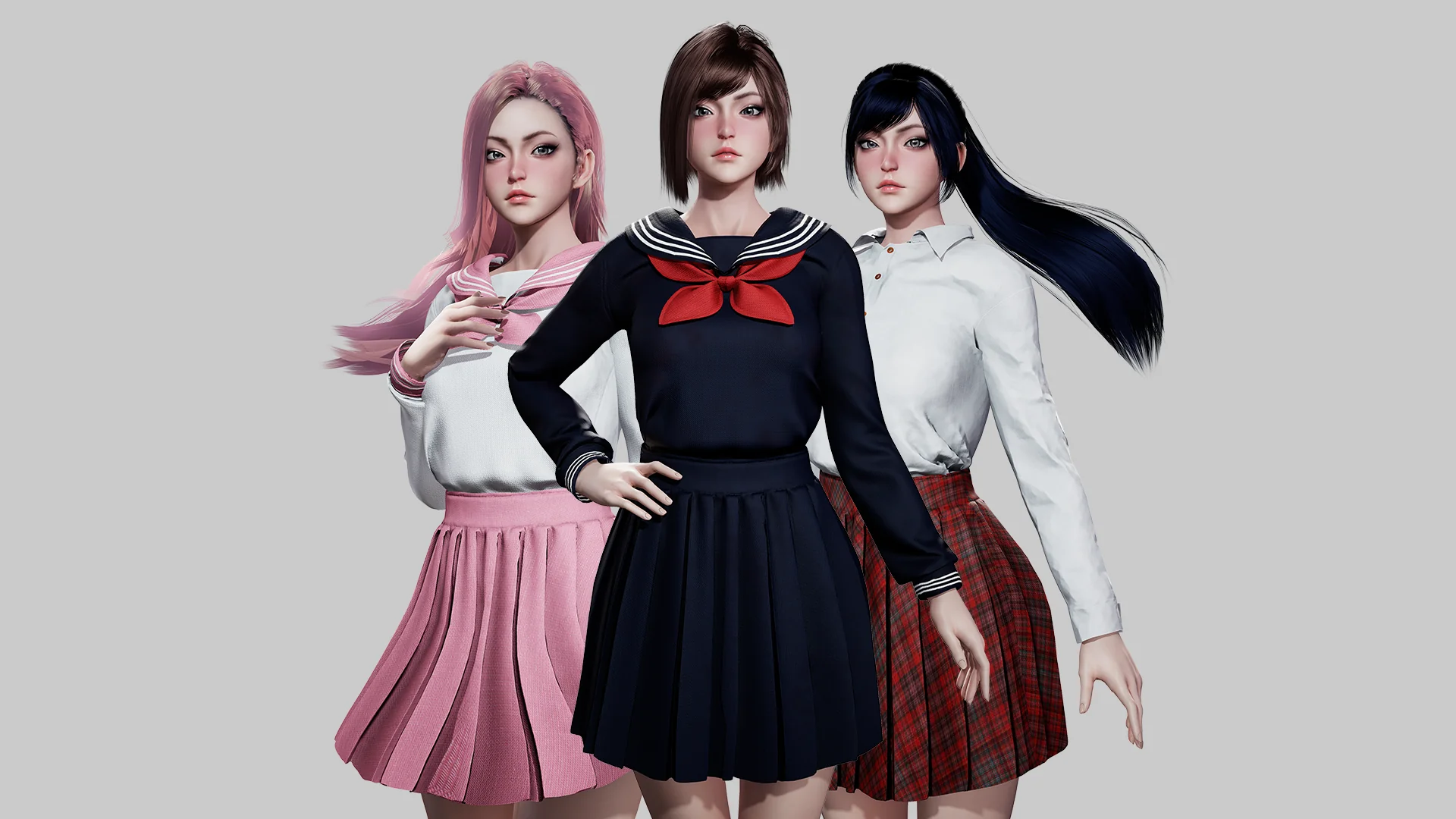
Populating dynamic student rosters or modern classroom sequences often stalls when character models are locked into rigid, single-mesh outfits or lack unified skeletal standards. Customizable School Girls provides a flexible, component-based foundation built to address modular character variety without sacrificing consistent skeleton hierarchies across project scenes. By keeping individual clothing items distinct from the underlying anatomy, artists and technical animators can reconfigure attire, swap hair designs, and balance polycounts across multiple active characters.
The geometry balances detail with real-time performance. With a standard configuration totaling 36,403 faces, 61,044 triangles, and 37,068 vertices, the character mesh remains light enough for crowded campus environments while retaining sufficient density for close-up conversational cameras. Because clothing pieces and hair elements can be toggled independently, the actual triangle density scales directly with the specific combination of elements assembled on screen.
Customizable Mesh Architecture and Full-Body Modularity
Standardizing character generation across classroom or campus settings typically requires swappable clothing systems that avoid surface clipping while allowing partial outfit removal. Customizable School Girls resolves this challenge by shipping complete anatomical geometry beneath the uniform instead of relying on geometry cutouts.
Every garment exists as an independent mesh element, letting creators freely strip away, attach, or exchange pieces depending on the requirements of an interaction. The underlying torso and limbs include a fully modeled body base, which is provided in a censored format across several distinct skin and legwear map setups. Skin textures support options for bare legs, short socks, and full-length over-the-knee socks. Because the full base mesh is maintained underneath the uniform layers, projects avoid unsightly gaps or missing backfaces when clothes shift during physical movement or when alternate wardrobe combinations expose different portions of the body. The core asset structure also maintains cross-compatibility with the Roxy rigged female base character format, allowing artists working across related setups to share anatomical components or adapt existing modular pieces without restructuring vertex groups.
Rigging Dynamics for Epic Skeleton and Unity Humanoid
Engine pipelines demand dependable retargeting pathways so studio teams do not have to recreate distinct animation libraries for each character variation.
The character is fully rigged to the standard Epic Skeleton, enabling direct retargeting in Unreal Engine as well as standard Humanoid retargeting within Unity. Beyond the core torso and limb deformation hierarchy, the skeletal structure extends secondary deformation bones into specialized areas. Rigged nodes are implemented directly within the eyes, hair, and breasts, granting animators manual control over subtle secondary bounces, look-at offsets, and wind reaction dynamics. While the character pack does not ship with pre-built gameplay or animation Blueprints, the conformity to standard humanoid bone naming conventions guarantees seamless compatibility with standard movement controllers, state machines, and marketplace animation sequences. Developers can plug the skeletal mesh directly into their established character controller assets and assign standard locational, idle, or combat blends immediately.
School Character Facial Animation and Live Link Integration
Dialogue delivery and narrative sequences require expressive, reliable facial controls that integrate smoothly into modern capture setups without requiring custom bone rigging passes.
For live streaming, cinematics, and interactive conversational animation, the head mesh incorporates dedicated morph targets and blendshapes suited to Apple Live Link Face tracking. Animators can drive real-time facial motion capture directly from supported mobile capture devices, translating brow twitches, mouth movements, and eye blinks onto the character in real time. The integration of full blendshape arrays also empowers narrative designers who hand-author conversation states, speech lip-sync tracks, and emotional mood transitions. Whether generating an animated sequence using recorded performance curves or blending facial expressions through code during dialogue branches, the built-in shape keys provide high-fidelity mimicry for interactive scenarios.
PBR Texture Sets and MatID Swapping
Visual differentiation across recurring student characters is critical to prevent campus scenes from feeling copy-pasted or visually repetitive.
The surfacing workflow uses physically based rendering metallic and roughness maps authored at 4K resolution. The pack divides its surface properties into nine discrete texture sets: Body, Head, Shirt_01, Shirt_02, Skirt, Shoes, Teeth, Hair, and Eyes. Every channel needed for accurate light interaction is accounted for, including normal, metallic, roughness, albedo, opacity, and dedicated matID textures. Unreal Engine 4 material instances leverage these matID maps to allow granular, instant color adjustments across every segment of the uniform, skin, and accessories. Developers can modify the exact hue, saturation, and roughness parameters of school skirts, neckties, collars, or trims without opening external texturing software or repainting base albedo maps.
Hair Configurations and In-Engine Cloth Simulation
Stylistic variety relies heavily on distinct silhouettes, particularly across anime-inspired, modern Asian, and stylized school environments.
Customizable School Girls ships with eight separate hairstyle variations designed to diversify character casts. The hairstyles encompass loose flow, two short hair iterations, and high ponytails, with each of those four core silhouettes also available in an alternate variant featuring frontal bangs:
Loose
Hair_Short_v1
Hair_Short_v2
Ponytail
Loose with Bangs
Hair_Short_v1 with Bangs
Hair_Short_v2 with Bangs
Ponytail with Bangs
To enhance realism during dynamic character movement, the clothing elements come prepared for cloth simulation within Unreal Engine 4. The skirts and loose uniform fabrics utilize native physics setups, reacting dynamically to directional running velocity, sudden stops, jumping animations, and ambient environment wind vectors. Instead of relying solely on baked skinning weights that can cause uniform skirts to bend unnaturally against thighs, real-time cloth simulation ensures the fabric drapes and settles with believable physical weight during rapid cinematic or gameplay actions.
Production Workflow Deployment
Populating stylized modern schools or urban environments demands a character pipeline that minimizes draw calls while preserving visual diversity. By separating garments from a complete base anatomy, integrating native cloth simulation, and incorporating Live Link facial capture, this asset provides a balanced technical framework. It allows teams to populate interactive dialogue trees, background student groups, or direct player characters within standard Unreal Engine and Unity humanoid pipelines.
 Humans
 Humans
 Humans
 Humans