"fb5ea1e7d1b41445"{"id":"1002404","slug":"cyberpunk-girl-3","title":"Cyberpunk Girl 3","category":"Humans","engine":"4.21+,5.0+","assetVersion":"","engineVersion":"Engine Version: 4.21+,5.0+","tag":"Humans","accent":"blue","visual":"mech","summary":"Technical analysis of Cyberpunk Girl 3, detailing its 117k-poly Epic Skeleton mesh, blendshapes, and 10 distinct 4K PBR texture sets.","platform":"Unreal Engine","indexPolicy":"index","publishedAt":"2026-11-10T07:05:56.554Z","updatedAt":"2026-11-10T07:05:56.554Z","sourceNotes":[],"fileContents":[],"compatibility":["Unreal Engine","Engine Version: 4.21+,5.0+"],"featuredImage":{"alt":"Cyberpunk Girl 3","src":"/wp-content/uploads/published/2026/11/325781f155f4-0cb142f2-a25a-4947-8f51-f10d94102102-5667058425.webp"},"hasDownloadLink":true,"downloads":0,"terms":[{"taxonomy":"category","slug":"humans","name":"Humans"}],"galleryImages":[{"src":"/wp-content/uploads/published/2026/11/7d55aa792c8e-9143ec21-9a9d-46c9-b399-93a6750e7582-f5c5eef9a2.webp","alt":"Cyberpunk Girl 3"},{"src":"/wp-content/uploads/published/2026/11/9d70bd4dcb04-a4dae53f-40f3-4529-98b4-4f55712a937f-073df7fc70.webp","alt":"Cyberpunk Girl 3"},{"src":"/wp-content/uploads/published/2026/11/bfa3718d8c3f-3c5e12f5-ff67-4341-b51a-f0800429c368-dc7ef43bee.webp","alt":"Cyberpunk Girl 3"},{"src":"/wp-content/uploads/published/2026/11/48da1809003c-65a132ca-d4d8-4e39-9c47-bbc591e0d0a5-ac995e6e73.webp","alt":"Cyberpunk Girl 3"},{"src":"/wp-content/uploads/published/2026/11/cd26f3c4d4b5-5135a610-103a-4b7f-9955-facecbd87a5c-e3c293c3c4.webp","alt":"Cyberpunk Girl 3"},{"src":"/wp-content/uploads/published/2026/11/26142ae3cf36-2b89a6c4-8660-43cd-ab6a-4ba33899f467-723f8bfe9a.webp","alt":"Cyberpunk Girl 3"},{"src":"/wp-content/uploads/published/2026/11/47092c4bab6e-2796d26f-e694-4770-9795-0c7c87c65d03-7f3847077b.webp","alt":"Cyberpunk Girl 3"},{"src":"/wp-content/uploads/published/2026/11/f271bc66aee2-3bd72a04-9945-4bb4-a9a0-6f9426fdfe17-0c9471ae07.webp","alt":"Cyberpunk Girl 3"},{"src":"/wp-content/uploads/published/2026/11/981f16b3a118-96da8e08-10cb-4945-b7b3-d8943d701ecc-f398521d93.webp","alt":"Cyberpunk Girl 3"}],"accessPanel":{"kind":"resource","title":"Get this resource","eyebrow":"Free resource","message":"Download this resource in your browser.","fileName":"Content.7z","safetyNote":"Resources are manually reviewed before listing to improve quality and reduce obvious risks.","actionLabel":"Get this resource","resourceType":"Resource archive","versions":[]},"contentHtml":"\u003cp\u003eIntegrating Cyberpunk Girl 3 into an active development pipeline begins at the rigging and material assignment stages. Because the asset is delivered cleanly as a standalone character mesh without bundled animation sequences or pre-built gameplay logic, the integration process focuses directly on retargeting motions and wiring up its material slots. The model serves as a base character designed to adapt into existing motion systems and custom animation blueprints, particularly those running on standard humanoid animation frameworks.\u003c/p\u003e \u003ch2\u003eIntegrating Cyberpunk Girl 3 into Unreal Engine Pipelines\u003c/h2\u003e\n\u003cp\u003eInitial setup relies on standard skeleton remapping. The model comes pre-rigged to the Epic Skeleton standard, allowing developers to direct pre-existing locomotion systems, combat anims, and additive motion libraries directly onto the character without intermediate joint modifications. This native alignment with the Unreal Engine humanoid standard minimizes the setup time typically spent mapping bone orientations or correcting joint roll issues.\u003c/p\u003e\n\u003cp\u003eWhile the character contains no native animations, the underlying joint structure is built to accept retargeted motion pools immediately. Utilizing the standard Epic Skeleton hierarchy ensures that root motion, pelvic offsets, finger articulation, and foot-ground alignment map predictably across standard runtime rigs. For developers aiming to incorporate the asset into third-person action setups or cinematic sequencers, the primary mechanical task is simply creating a compatible character blueprint and assigning an existing animation blueprint instance to drive movement.\u003c/p\u003e \u003ch2\u003eSkeletal Rigging, Humanoid Retargeting, and Blendshapes\u003c/h2\u003e\n\u003cp\u003eMotion execution goes beyond basic limb and torso rotation through the inclusion of integrated blendshapes. Facial morph targets allow developers to inject dynamic facial animation, dialogue lip-sync curves, and reactive emotional states onto the character mesh. These morph shapes operate concurrently alongside the skeletal joints, providing distinct deformation channels for expression management that do not interfere with standard neck, jaw, or head-look mechanics.\u003c/p\u003e\n\u003cp\u003eBy keeping facial deformation driven through blendshapes while the body relies on the Epic Skeleton humanoid structure, the asset maintains a modular separation between skeletal locomotion and expressiveness. Technical animators can layer facial curves inside an animation montage or sequencer track while streaming combat movements to the main bone tree. This makes the mesh adaptable across realistic dialogue sequences, stylized role-playing game cutscenes, and fast-paced sci-fi gameplay where responsive visual feedback is required.\u003c/p\u003e \u003ch2\u003eMesh Proportions and Real-Time Geometry in Cyberpunk Girl 3\u003c/h2\u003e\n\u003cp\u003eThe geometric footprint of Cyberpunk Girl 3 is balanced for modern real-time performance. Built to a real-world scale, the character stands at an explicit height of 175 cm, matching standard human environmental metrics, doorframes, weapon grip offsets, and third-person camera collision profiles. This standardized dimension prevents the need for global scale transforms that can sometimes disrupt socket attachments, inverse kinematics calculations, or physics-driven ragdoll behavior.\u003c/p\u003e\n\u003cp\u003eStructurally, the character mesh contains the following geometric measurements:\u003c/p\u003e\n\u003cul\u003e \u003cli\u003e\u003cstrong\u003eTriangles:\u003c/strong\u003e 117,547\u003c/li\u003e \u003cli\u003e\u003cstrong\u003eVertices:\u003c/strong\u003e 67,499\u003c/li\u003e \u003cli\u003e\u003cstrong\u003eFaces:\u003c/strong\u003e 59,406\u003c/li\u003e\n\u003c/ul\u003e\n\u003cp\u003eThis polygon budget places the asset squarely in the category of detailed, game-ready characters. The triangle distribution concentrates detail where close-up deformation matters most—across the facial features, articulated joints, detailed footwear, and layered apparel. At over 117,000 triangles, the mesh retains silhouetted geometric depth on curved surfaces without requiring excessive tessellation at runtime, making it well-suited for sci-fi adventures, tactical RPGs, and stylized realistic productions.\u003c/p\u003e \u003ch2\u003ePBR Material Construction Across Ten Dedicated Texture Sets\u003c/h2\u003e\n\u003cp\u003eShading is handled through a physically based rendering workflow using the standard metallic and roughness paradigm. Cyberpunk Girl 3 divides its surface mapping across ten distinct texture sets, providing targeted visual fidelity and localized material properties for every structural component. All map sets are generated at 4K resolution, supplying high-frequency surface detail that holds up during close camera interactions.\u003c/p\u003e\n\u003cp\u003eThe ten distinct texture categories cover the full anatomy, gear, and clothing layers:\u003c/p\u003e\n\u003cul\u003e \u003cli\u003e\u003cstrong\u003eFace:\u003c/strong\u003e Dedicated skin pores, tone variation, and facial roughness properties.\u003c/li\u003e \u003cli\u003e\u003cstrong\u003eHair:\u003c/strong\u003e Anisotropic-ready surface definitions for specialized hair shading passes.\u003c/li\u003e \u003cli\u003e\u003cstrong\u003eLashes and Brows:\u003c/strong\u003e Alpha-tested transparency maps for precise facial hair framing.\u003c/li\u003e \u003cli\u003e\u003cstrong\u003eEyes:\u003c/strong\u003e Isolated sclera, iris depth, and corneal reflection values.\u003c/li\u003e \u003cli\u003e\u003cstrong\u003eTeeth:\u003c/strong\u003e Distinct oral cavity shading independent of facial skin tone.\u003c/li\u003e \u003cli\u003e\u003cstrong\u003eJacket:\u003c/strong\u003e Heavy outer-layer fabric and hardware definition.\u003c/li\u003e \u003cli\u003e\u003cstrong\u003ePants:\u003c/strong\u003e Detailed textile weaving, seam work, and structural folds.\u003c/li\u003e \u003cli\u003e\u003cstrong\u003eSneakers:\u003c/strong\u003e Layered rubber, synthetic paneling, and tread textures.\u003c/li\u003e \u003cli\u003e\u003cstrong\u003eArms:\u003c/strong\u003e Extended skin texturing and anatomical surface maps.\u003c/li\u003e \u003cli\u003e\u003cstrong\u003eAccessories:\u003c/strong\u003e Hard-surface detailing for secondary sci-fi accents and decorative elements.\u003c/li\u003e\n\u003c/ul\u003e\n\u003cp\u003eEach set supplies five core channels: Albedo (Base Color), Normal, Metallic, Roughness, and Ambient Occlusion (AO). Separating the clothing, accessories, and anatomical components into distinct texture sets allows technical artists to optimize shader instances individually. For example, hair and eye materials can utilize specialized shading models within the engine, while the jacket and sneakers leverage standard opaque PBR shaders with heightened metallic and roughness contrasts.\u003c/p\u003e \u003ch2\u003ePipeline Integration Without Native Blueprints or Pre-Baked Motion\u003c/h2\u003e\n\u003cp\u003eBecause Cyberpunk Girl 3 does not include pre-built gameplay scripts, runtime logic, or out-of-the-box Blueprints, it fits cleanly into existing production pipelines without creating class inheritance bloat or unused asset clutter. Studios with established character movement systems can import the asset purely as art data—a rigged skeletal mesh accompanied by its texture library and morph targets.\u003c/p\u003e\n\u003cp\u003eCompatibility with Cyberpunk Girl 2 assets also ensures that developers managing multi-character rosters within the same visual universe can maintain aesthetic and technical parity across their projects. Whether hooked into a custom animation blueprint for fluid combat transitions, combined with procedural inverse kinematics solvers, or set up for scripted narrative cutscenes, the model functions as a reliable, predictable humanoid asset ready to receive custom real-time scripting.\u003c/p\u003e\n\n\u003ch2\u003eExplore Similar Assets\u003c/h2\u003e\n\u003cul\u003e\n\u003cli\u003e\u003ca href=\"https://3dcghub.com/cyberpunk-street-girl/\" rel=\"noopener noreferrer\"\u003eCyberpunk Street Girl\u003c/a\u003e\u003c/li\u003e\n\u003cli\u003e\u003ca href=\"https://3dcghub.com/customizable-school-girls/\" rel=\"noopener noreferrer\"\u003eCustomizable School Girls\u003c/a\u003e\u003c/li\u003e\n\u003cli\u003e\u003ca href=\"https://3dcghub.com/nun-girl-modular/\" rel=\"noopener noreferrer\"\u003eNun Girl Modular\u003c/a\u003e\u003c/li\u003e\n\u003cli\u003e\u003ca href=\"https://3dcghub.com/mechanic-girl/\" rel=\"noopener noreferrer\"\u003eMechanic Girl\u003c/a\u003e\u003c/li\u003e\n\u003cli\u003e\u003ca href=\"https://3dcghub.com/egypt-girl/\" rel=\"noopener noreferrer\"\u003eEgypt Girl\u003c/a\u003e\u003c/li\u003e\n\u003c/ul\u003e","contentTextLength":6724,"navigation":{"current":15,"total":4340,"previous":{"id":"1002405","slug":"samurai-girl-tomoe","title":"Samurai Girl Tomoe","category":"Humans","platform":"Unreal Engine","updatedAt":"2026-11-10T07:07:18.175Z"},"next":{"id":"1002403","slug":"customizable-school-girls","title":"Customizable School Girls","category":"Humans","platform":"Unreal Engine","updatedAt":"2026-11-10T05:14:18.764Z"}},"relatedResources":[{"id":"1002085","slug":"cyberpunk-street-girl","title":"Cyberpunk Street Girl","category":"Humans","engine":"4.26+,5.0+","assetVersion":"","engineVersion":"Engine Version: 4.26+,5.0+","tag":"Humans","accent":"blue","visual":"mech","summary":"A close look at Cyberpunk Street Girl, covering tactical mecha design, facial morph targets, animation blueprints, and machete combat setups.","platform":"Unreal Engine","indexPolicy":"index","publishedAt":"2026-10-26T15:54:43.180Z","updatedAt":"2026-10-26T15:54:43.180Z","sourceNotes":[],"fileContents":[],"compatibility":["Unreal Engine","Engine Version: 4.26+,5.0+"],"featuredImage":{"alt":"Cyberpunk Street Girl","src":"/wp-content/uploads/published/2026/10/1c1d8b4faa07-a7516b3d-3943-49da-b88a-f4733eb42462-808cc40316.webp"},"hasDownloadLink":true,"downloads":1},{"id":"1002406","slug":"death-archer-girl-morgana","title":"Death Archer Girl Morgana","category":"Humans","engine":"4.24+,5.0+","assetVersion":"","engineVersion":"Engine Version: 4.24+,5.0+","tag":"Humans","accent":"blue","visual":"mech","summary":"Death Archer Girl Morgana is a modular, fully rigged UE5 character with 52 ARKit blendshapes, MatID color swaps, 4K textures and a bow for dark fantasy scenes.","platform":"Unreal Engine","indexPolicy":"index","publishedAt":"2026-11-10T12:02:23.586Z","updatedAt":"2026-11-10T12:02:23.586Z","sourceNotes":[],"fileContents":[],"compatibility":["Unreal Engine","Engine Version: 4.24+,5.0+"],"featuredImage":{"alt":"Death Archer Girl Morgana","src":"/wp-content/uploads/published/2026/11/ea8636dbb6df-2816da73-8314-4654-b908-7327f7cfd95e-bbd131ee7b.webp"},"hasDownloadLink":true,"downloads":0},{"id":"1002405","slug":"samurai-girl-tomoe","title":"Samurai Girl Tomoe","category":"Humans","engine":"4.19+,5.0+","assetVersion":"","engineVersion":"Engine Version: 4.19+,5.0+","tag":"Humans","accent":"blue","visual":"mech","summary":"Modular 3D warrior character Samurai Girl Tomoe featuring 52 ARKit blendshapes, 4K packed textures, and an Epic Skeleton rig for action games.","platform":"Unreal Engine","indexPolicy":"index","publishedAt":"2026-11-10T07:07:18.175Z","updatedAt":"2026-11-10T07:07:18.175Z","sourceNotes":[],"fileContents":[],"compatibility":["Unreal Engine","Engine Version: 4.19+,5.0+"],"featuredImage":{"alt":"Samurai Girl Tomoe","src":"/wp-content/uploads/published/2026/11/5c46690700c0-95be6877-7081-4ad3-b57c-fd636373f3cb-40e5943225.webp"},"hasDownloadLink":true,"downloads":0}]}
Humans
Cyberpunk Girl 3
Technical analysis of Cyberpunk Girl 3, detailing its 117k-poly Epic Skeleton mesh, blendshapes, and 10 distinct 4K PBR texture sets.
Category:Unreal Engine,HumansPlatform: Unreal EngineEngine Version: 4.21+,5.0+Published: Nov 10, 2026
Humans
Resource overview
Integrating Cyberpunk Girl 3 into an active development pipeline begins at the rigging and material assignment stages. Because the asset is delivered cleanly as a standalone character mesh without bundled animation sequences or pre-built gameplay logic, the integration process focuses directly on retargeting motions and wiring up its material slots. The model serves as a base character designed to adapt into existing motion systems and custom animation blueprints, particularly those running on standard humanoid animation frameworks.
Integrating Cyberpunk Girl 3 into Unreal Engine Pipelines
Initial setup relies on standard skeleton remapping. The model comes pre-rigged to the Epic Skeleton standard, allowing developers to direct pre-existing locomotion systems, combat anims, and additive motion libraries directly onto the character without intermediate joint modifications. This native alignment with the Unreal Engine humanoid standard minimizes the setup time typically spent mapping bone orientations or correcting joint roll issues.
While the character contains no native animations, the underlying joint structure is built to accept retargeted motion pools immediately. Utilizing the standard Epic Skeleton hierarchy ensures that root motion, pelvic offsets, finger articulation, and foot-ground alignment map predictably across standard runtime rigs. For developers aiming to incorporate the asset into third-person action setups or cinematic sequencers, the primary mechanical task is simply creating a compatible character blueprint and assigning an existing animation blueprint instance to drive movement.
Skeletal Rigging, Humanoid Retargeting, and Blendshapes
Motion execution goes beyond basic limb and torso rotation through the inclusion of integrated blendshapes. Facial morph targets allow developers to inject dynamic facial animation, dialogue lip-sync curves, and reactive emotional states onto the character mesh. These morph shapes operate concurrently alongside the skeletal joints, providing distinct deformation channels for expression management that do not interfere with standard neck, jaw, or head-look mechanics.
By keeping facial deformation driven through blendshapes while the body relies on the Epic Skeleton humanoid structure, the asset maintains a modular separation between skeletal locomotion and expressiveness. Technical animators can layer facial curves inside an animation montage or sequencer track while streaming combat movements to the main bone tree. This makes the mesh adaptable across realistic dialogue sequences, stylized role-playing game cutscenes, and fast-paced sci-fi gameplay where responsive visual feedback is required.
Mesh Proportions and Real-Time Geometry in Cyberpunk Girl 3
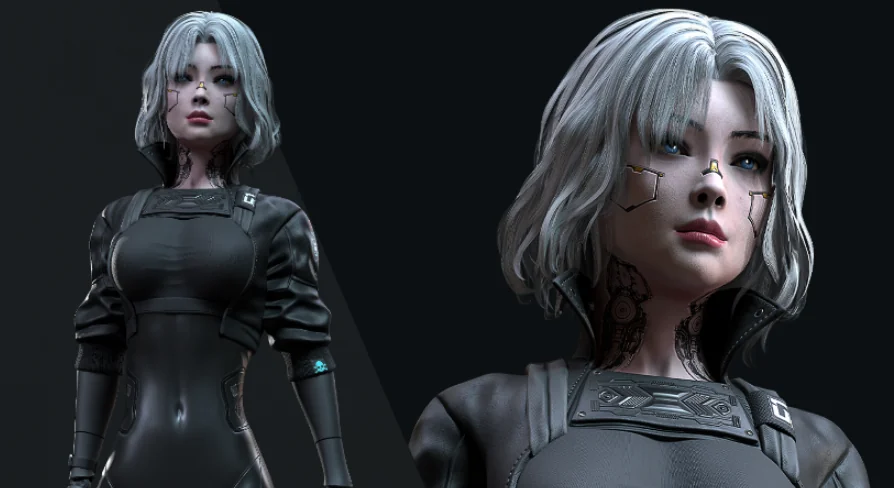
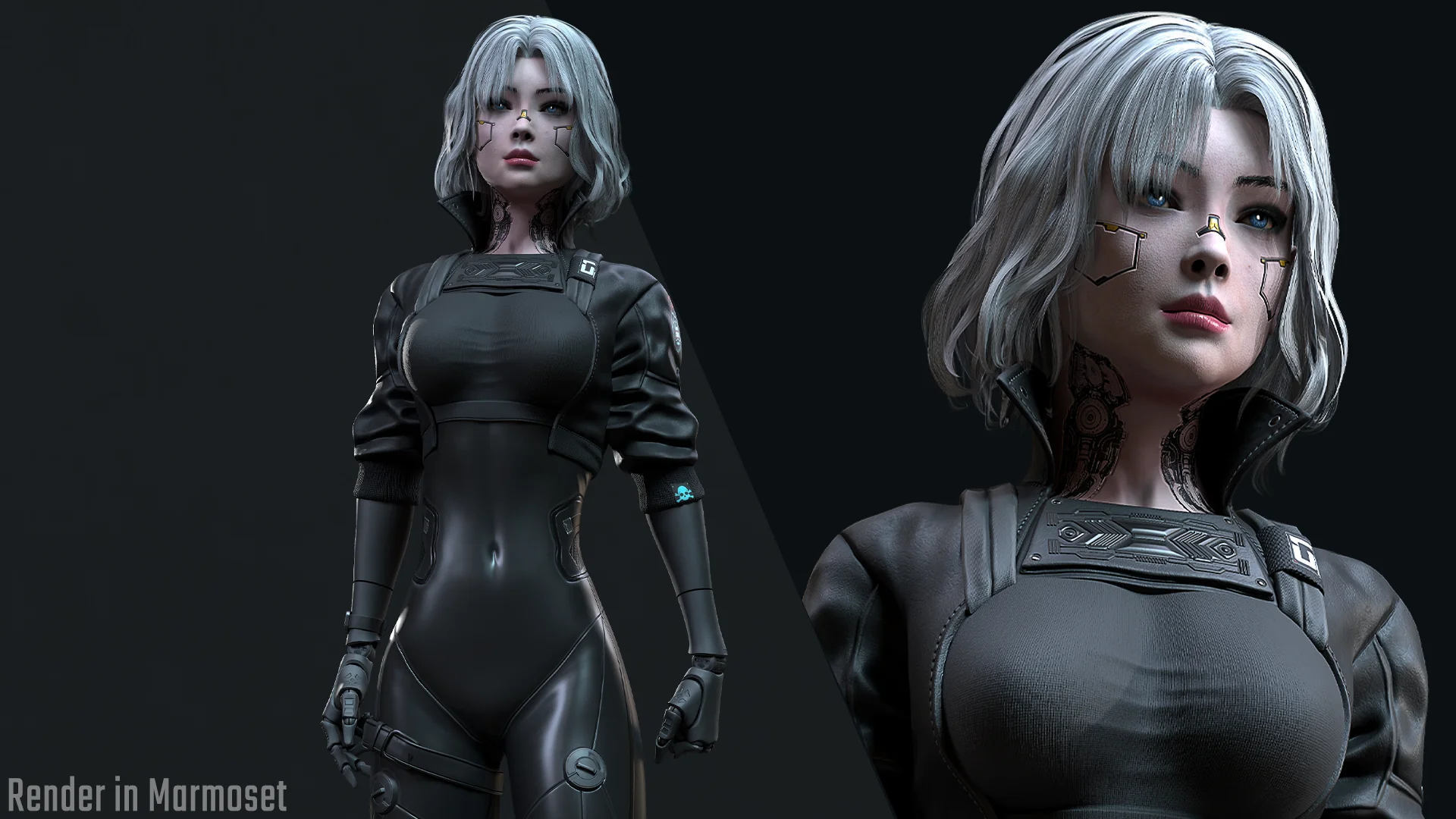
The geometric footprint of Cyberpunk Girl 3 is balanced for modern real-time performance. Built to a real-world scale, the character stands at an explicit height of 175 cm, matching standard human environmental metrics, doorframes, weapon grip offsets, and third-person camera collision profiles. This standardized dimension prevents the need for global scale transforms that can sometimes disrupt socket attachments, inverse kinematics calculations, or physics-driven ragdoll behavior.
Structurally, the character mesh contains the following geometric measurements:
Triangles: 117,547
Vertices: 67,499
Faces: 59,406
This polygon budget places the asset squarely in the category of detailed, game-ready characters. The triangle distribution concentrates detail where close-up deformation matters most—across the facial features, articulated joints, detailed footwear, and layered apparel. At over 117,000 triangles, the mesh retains silhouetted geometric depth on curved surfaces without requiring excessive tessellation at runtime, making it well-suited for sci-fi adventures, tactical RPGs, and stylized realistic productions.
PBR Material Construction Across Ten Dedicated Texture Sets
Shading is handled through a physically based rendering workflow using the standard metallic and roughness paradigm. Cyberpunk Girl 3 divides its surface mapping across ten distinct texture sets, providing targeted visual fidelity and localized material properties for every structural component. All map sets are generated at 4K resolution, supplying high-frequency surface detail that holds up during close camera interactions.
The ten distinct texture categories cover the full anatomy, gear, and clothing layers:
Face: Dedicated skin pores, tone variation, and facial roughness properties.
Hair: Anisotropic-ready surface definitions for specialized hair shading passes.
Lashes and Brows: Alpha-tested transparency maps for precise facial hair framing.
Eyes: Isolated sclera, iris depth, and corneal reflection values.
Teeth: Distinct oral cavity shading independent of facial skin tone.
Jacket: Heavy outer-layer fabric and hardware definition.
Pants: Detailed textile weaving, seam work, and structural folds.
Sneakers: Layered rubber, synthetic paneling, and tread textures.
Arms: Extended skin texturing and anatomical surface maps.
Accessories: Hard-surface detailing for secondary sci-fi accents and decorative elements.
Each set supplies five core channels: Albedo (Base Color), Normal, Metallic, Roughness, and Ambient Occlusion (AO). Separating the clothing, accessories, and anatomical components into distinct texture sets allows technical artists to optimize shader instances individually. For example, hair and eye materials can utilize specialized shading models within the engine, while the jacket and sneakers leverage standard opaque PBR shaders with heightened metallic and roughness contrasts.
Pipeline Integration Without Native Blueprints or Pre-Baked Motion
Because Cyberpunk Girl 3 does not include pre-built gameplay scripts, runtime logic, or out-of-the-box Blueprints, it fits cleanly into existing production pipelines without creating class inheritance bloat or unused asset clutter. Studios with established character movement systems can import the asset purely as art data—a rigged skeletal mesh accompanied by its texture library and morph targets.
Compatibility with Cyberpunk Girl 2 assets also ensures that developers managing multi-character rosters within the same visual universe can maintain aesthetic and technical parity across their projects. Whether hooked into a custom animation blueprint for fluid combat transitions, combined with procedural inverse kinematics solvers, or set up for scripted narrative cutscenes, the model functions as a reliable, predictable humanoid asset ready to receive custom real-time scripting.
 Humans
 Humans
 Humans
 Humans