"5da73d49ff33a5b1"{"id":"1002381","slug":"egypt-girl","title":"Egypt Girl","category":"Humans","engine":"4.26+,5.0+","assetVersion":"","engineVersion":"Engine Version: 4.26+,5.0+","tag":"Humans","accent":"blue","visual":"mech","summary":"Explore the technical setup of Egypt Girl, featuring an extended Epic Skeleton rig, Apple Blendshapes, 4K PBR textures, and modular cloth simulation.","platform":"Unreal Engine","indexPolicy":"index","publishedAt":"2026-11-10T03:58:19.424Z","updatedAt":"2026-11-10T03:58:19.424Z","sourceNotes":[],"fileContents":[],"compatibility":["Unreal Engine","Engine Version: 4.26+,5.0+"],"featuredImage":{"alt":"Egypt Girl","src":"/wp-content/uploads/published/2026/11/d3b18e656ad8-64602877-7f5b-43f4-8a47-c332072102b6-bba1453fd6.webp"},"hasDownloadLink":true,"downloads":0,"terms":[{"taxonomy":"category","slug":"humans","name":"Humans"}],"galleryImages":[{"src":"/wp-content/uploads/published/2026/11/7a5aa0b6be36-b0e25514-aca2-4eae-828e-3570ece6a158-324299ba81.webp","alt":"Egypt Girl"},{"src":"/wp-content/uploads/published/2026/11/9aab109c6c13-0e0fbf04-1437-405e-8a14-e613890e8bf7-f1579ab78b.webp","alt":"Egypt Girl"},{"src":"/wp-content/uploads/published/2026/11/4b367138627f-e18314c7-e558-4cee-8864-73ef886abff3-a808794487.webp","alt":"Egypt Girl"},{"src":"/wp-content/uploads/published/2026/11/e757227554f3-902516e2-1fda-4c76-a732-e507b146a356-0aed73c9c5.webp","alt":"Egypt Girl"},{"src":"/wp-content/uploads/published/2026/11/0edeab9d9ed5-670bac43-9cad-4be3-98fc-89b92e3e615b-0b16d29acd.webp","alt":"Egypt Girl"},{"src":"/wp-content/uploads/published/2026/11/e1e65f7fff88-6e0f76be-6ebd-47d8-8b71-1e7b238ac2ec-39fcd5fc05.webp","alt":"Egypt Girl"},{"src":"/wp-content/uploads/published/2026/11/0ffc27ef3b4b-88845db3-9774-4aab-a895-e24bab7e9b01-8631238568.webp","alt":"Egypt Girl"},{"src":"/wp-content/uploads/published/2026/11/fd0a38ac9e3f-8e71341b-9e79-4493-b7e9-9037fe0a8417-d16b50509d.webp","alt":"Egypt Girl"},{"src":"/wp-content/uploads/published/2026/11/32643efbb69c-8cfdc07e-75de-427b-8cdc-6b270326c794-f0101f69bd.webp","alt":"Egypt Girl"},{"src":"/wp-content/uploads/published/2026/11/3eab4ad4227b-bfbc7513-9777-4c06-b9fd-948f8e5cc92a-d27ac333b4.webp","alt":"Egypt Girl"}],"accessPanel":{"kind":"resource","title":"Get this resource","eyebrow":"Free resource","message":"Download this resource in your browser.","fileName":"Content.7z","safetyNote":"Resources are manually reviewed before listing to improve quality and reduce obvious risks.","actionLabel":"Get this resource","resourceType":"Resource archive","versions":[]},"contentHtml":"\u003ch2\u003eIntegrating Egypt Girl into the Unreal Engine Rig Hierarchy\u003c/h2\u003e\u003cp\u003eImporting the character into an existing project begins directly with the skeleton setup. The mesh is rigged against the standard Epic Skeleton, meaning retargeting existing animation libraries remains straightforward. While standard locomotion and combat sequences align with default humanoid hierarchies, the asset introduces a wide array of specialized bones to handle clothing, accessories, and secondary motion.\u003c/p\u003e\u003cp\u003eThe primary Epic Skeleton is supplemented with dedicated eye joints (eye_l, eye_r) and chest deformation points (breast_l, breast_r). Beyond foundational anatomy, jewelry and headwear rely on specialized chains: head_acs_l_01 through head_acs_l_04, head_acs_r_01 through head_acs_r_04, alongside dangling earrings managed via earring_l_01 through earring_l_03 and earring_r_01 through earring_r_03.\u003c/p\u003e\u003cp\u003eHair is similarly segmented into individual bone runs for independent sway and physics application. Front locks are driven by hair_front_l_01 to 04 and hair_front_r_01 to 04. Flanking sections use hair_side_l_01 through 05 and hair_side_r_01 through 05, while back locks utilize hair_back_side_l_01 to 04 and hair_back_side_r_01 to 04. Rear accessories feature back_acs_01 through 05.\u003c/p\u003e\u003cp\u003eBecause the package does not include pre-configured Blueprints, technical artists wire their own Animation Blueprints or state machines. Retargeting existing Unreal humanoid sequences applies cleanly to the core joints, leaving technical animators the freedom to drive the secondary chains through custom control rigs, physical animation, or dynamic spring nodes.\u003c/p\u003e\u003ch2\u003eFacial Capture and Morph Target Controls for Egypt Girl\u003c/h2\u003e\u003cp\u003eFacial articulation bypasses complex joint clusters in favor of a full blendshape framework. The character incorporates standard Apple Blendshapes, providing direct compatibility with the Live Link Face iOS application and equivalent face-tracking tools. This enables real-time facial performance capture suitable for live streaming setups, broadcast pipelines, and cinematic dialogue sequences.\u003c/p\u003e\u003cp\u003eBoth conversation animations and expressive micro-movements leverage these morph targets without requiring bespoke bone weight maps across the cheeks, lips, or brows. Additionally, anatomical flexibility extends to stylistic variations. A dedicated blendshape toggle swaps the character between human ears and elongated elf ears, allowing transitions between historical Egyptian aesthetics and stylized fantasy projects without swapping skeletal meshes or altering skinning weights.\u003c/p\u003e\u003ch2\u003eGarment Dynamics and Secondary Bone Structures\u003c/h2\u003e\u003cp\u003eDynamic costuming plays a prominent role in the visual presentation, particularly across the skirts, cloaks, and decorative sashes. To balance animation control against dynamic simulation, the package provides two distinct versions of the cloak and skirt.\u003c/p\u003e\u003cp\u003eOne setup isolates movement to body weighting, with the fabric rigged directly to the main humanoid skeletal mesh without extra deformation joints. This clean skinning ensures zero clipping during aggressive movements and eliminates simulation overhead in performance-critical gameplay scenarios.\u003c/p\u003e\u003cp\u003eThe alternative configuration deploys dedicated bone chains across the fabric. Belt adornments rely on gold_belt_01 through gold_belt_05. Front fabric panels utilize cloth_front_01 through 05, augmented by lateral chains cloth_front_l_01 through 06 and cloth_front_r_01 through 06. Flanking panels use cloth_side_l_01 through 06 and cloth_side_r_01 through 06, while trailing hemlines leverage cloth_back_01 through 06. Rear drapery relies on back_cloth_front, back_cloth_mid, back_cloth_l, and back_cloth_r. The cloak itself utilizes cloak_l_01 through 04 and cloak_r_01 through 04.\u003c/p\u003e\u003cp\u003eIn Unreal Engine 4 environments, native physics can be activated directly across these chains. Cloth simulation can also be applied across vertices, giving artists the choice between kinematic keyframing, rigid-body physics simulation, or native cloth solvers.\u003c/p\u003e\u003ch2\u003ePBR Texture Sets and MatID Customization\u003c/h2\u003e\u003cp\u003eShading utilizes a metallic and roughness PBR workflow, anchored by 4K texture maps across every major surface. Texture distributions encompass normal maps, metallic masks, roughness maps, albedo color passes, opacity masks, and matID layouts.\u003c/p\u003e\u003cp\u003eAssets are organized into eight distinct texture sets:\u003c/p\u003e\u003cul\u003e\u003cli\u003eBody\u003c/li\u003e\u003cli\u003eHead\u003c/li\u003e\u003cli\u003eClothes\u003c/li\u003e\u003cli\u003eGold\u003c/li\u003e\u003cli\u003eTeeth\u003c/li\u003e\u003cli\u003eHair\u003c/li\u003e\u003cli\u003eEyes\u003c/li\u003e\u003cli\u003eLashes\u003c/li\u003e\u003c/ul\u003e\u003cp\u003eSeparating these surfaces into independent texture sets preserves high texel density at close camera ranges, particularly across ornamental gold work, eye reflections, and facial skin details. The included matID maps interface directly with Material Instances. This arrangement lets artists change colors across individual garment layers, trim, and jewelry without needing external image-editing software to redraw albedo channels. Opacity channels handle layered hair strands and fine garment edges smoothly.\u003c/p\u003e\u003ch2\u003eModular Assembly and Mesh Completeness\u003c/h2\u003e\u003cp\u003eAt LOD 0, the character topology comprises 75,433 triangles and 75,270 vertices. The mesh is entirely modular, structured so that individual armor components, jewelry pieces, head accessories, or specific fabric segments can be added, hidden, or removed depending on production needs.\u003c/p\u003e\u003cp\u003eUnlike many game-ready outfits where unexposed geometry is discarded to reduce polygon counts, this model features a complete, uncut full-body mesh underneath the attire. The underlying anatomy is not culled into fragmented proxy geometry, ensuring that partial wardrobe stripping or customized costume layering can occur without exposing missing skin topology. For project compliance, the underlying body texture is censored.\u003c/p\u003e\u003cp\u003eAlso, the anatomical proportioning aligns with base character standards such as the Roxy rigged base mesh, easing wardrobe swapping and character cross-compatibility across custom character generation pipelines. With visual themes bridging ancient pharaonic motifs, Anubis-inspired fantasy armor, and desert nomad styling, the asset serves historical epics, medieval fantasy role-playing games, or stylized real-time production pipelines with minimal friction.\u003c/p\u003e\n\n\u003ch2\u003eMore From The Same Workflow\u003c/h2\u003e\n\u003cul\u003e\n\u003cli\u003e\u003ca href=\"https://3dcghub.com/anime-girl-cleric/\" rel=\"noopener noreferrer\"\u003eAnime Girl Cleric\u003c/a\u003e\u003c/li\u003e\n\u003cli\u003e\u003ca href=\"https://3dcghub.com/xiao-jue-asian-girl/\" rel=\"noopener noreferrer\"\u003eXiao Jue - Asian Girl\u003c/a\u003e\u003c/li\u003e\n\u003cli\u003e\u003ca href=\"https://3dcghub.com/assassin-girl-modular/\" rel=\"noopener noreferrer\"\u003eAssassin Girl Modular\u003c/a\u003e\u003c/li\u003e\n\u003cli\u003e\u003ca href=\"https://3dcghub.com/survivor-girl-1-modular/\" rel=\"noopener noreferrer\"\u003eSurvivor Girl 1 (Modular)\u003c/a\u003e\u003c/li\u003e\n\u003cli\u003e\u003ca href=\"https://3dcghub.com/modular-elf-archer-girl/\" rel=\"noopener noreferrer\"\u003eModular Elf Archer Girl\u003c/a\u003e\u003c/li\u003e\n\u003c/ul\u003e","contentTextLength":6252,"navigation":{"current":39,"total":4340,"previous":{"id":"1002382","slug":"elite-soldiers","title":"Elite Soldiers","category":"Characters \u0026 Creatures","platform":"Unreal Engine","updatedAt":"2026-11-10T04:00:01.844Z"},"next":{"id":"1002380","slug":"druid-werewolf","title":"Druid WereWolf","category":"Characters \u0026 Creatures","platform":"Unreal Engine","updatedAt":"2026-11-10T03:56:37.163Z"}},"relatedResources":[{"id":"1002406","slug":"death-archer-girl-morgana","title":"Death Archer Girl Morgana","category":"Humans","engine":"4.24+,5.0+","assetVersion":"","engineVersion":"Engine Version: 4.24+,5.0+","tag":"Humans","accent":"blue","visual":"mech","summary":"Death Archer Girl Morgana is a modular, fully rigged UE5 character with 52 ARKit blendshapes, MatID color swaps, 4K textures and a bow for dark fantasy scenes.","platform":"Unreal Engine","indexPolicy":"index","publishedAt":"2026-11-10T12:02:23.586Z","updatedAt":"2026-11-10T12:02:23.586Z","sourceNotes":[],"fileContents":[],"compatibility":["Unreal Engine","Engine Version: 4.24+,5.0+"],"featuredImage":{"alt":"Death Archer Girl Morgana","src":"/wp-content/uploads/published/2026/11/ea8636dbb6df-2816da73-8314-4654-b908-7327f7cfd95e-bbd131ee7b.webp"},"hasDownloadLink":true,"downloads":0},{"id":"1002405","slug":"samurai-girl-tomoe","title":"Samurai Girl Tomoe","category":"Humans","engine":"4.19+,5.0+","assetVersion":"","engineVersion":"Engine Version: 4.19+,5.0+","tag":"Humans","accent":"blue","visual":"mech","summary":"Modular 3D warrior character Samurai Girl Tomoe featuring 52 ARKit blendshapes, 4K packed textures, and an Epic Skeleton rig for action games.","platform":"Unreal Engine","indexPolicy":"index","publishedAt":"2026-11-10T07:07:18.175Z","updatedAt":"2026-11-10T07:07:18.175Z","sourceNotes":[],"fileContents":[],"compatibility":["Unreal Engine","Engine Version: 4.19+,5.0+"],"featuredImage":{"alt":"Samurai Girl Tomoe","src":"/wp-content/uploads/published/2026/11/5c46690700c0-95be6877-7081-4ad3-b57c-fd636373f3cb-40e5943225.webp"},"hasDownloadLink":true,"downloads":0},{"id":"1002404","slug":"cyberpunk-girl-3","title":"Cyberpunk Girl 3","category":"Humans","engine":"4.21+,5.0+","assetVersion":"","engineVersion":"Engine Version: 4.21+,5.0+","tag":"Humans","accent":"blue","visual":"mech","summary":"Technical analysis of Cyberpunk Girl 3, detailing its 117k-poly Epic Skeleton mesh, blendshapes, and 10 distinct 4K PBR texture sets.","platform":"Unreal Engine","indexPolicy":"index","publishedAt":"2026-11-10T07:05:56.554Z","updatedAt":"2026-11-10T07:05:56.554Z","sourceNotes":[],"fileContents":[],"compatibility":["Unreal Engine","Engine Version: 4.21+,5.0+"],"featuredImage":{"alt":"Cyberpunk Girl 3","src":"/wp-content/uploads/published/2026/11/325781f155f4-0cb142f2-a25a-4947-8f51-f10d94102102-5667058425.webp"},"hasDownloadLink":true,"downloads":0}]}
Humans
Egypt Girl
Explore the technical setup of Egypt Girl, featuring an extended Epic Skeleton rig, Apple Blendshapes, 4K PBR textures, and modular cloth simulation.
Category:Unreal Engine,HumansPlatform: Unreal EngineEngine Version: 4.26+,5.0+Published: Nov 10, 2026
Humans
Resource overview
Integrating Egypt Girl into the Unreal Engine Rig Hierarchy
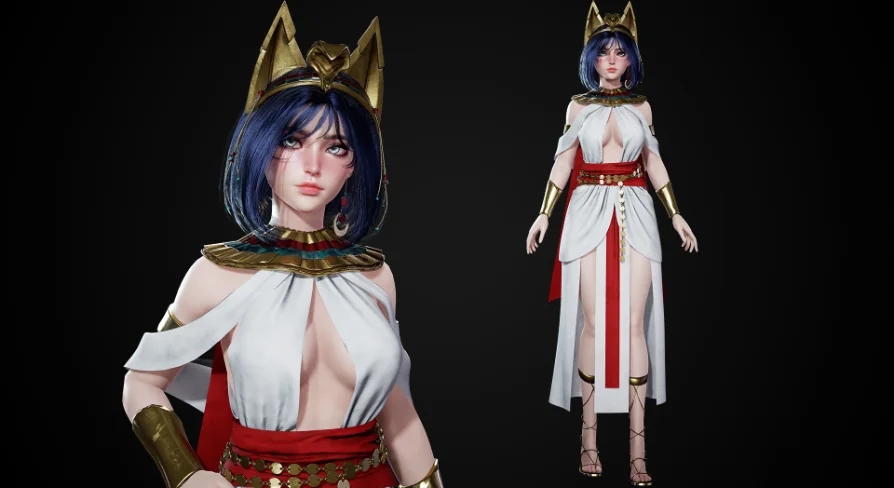
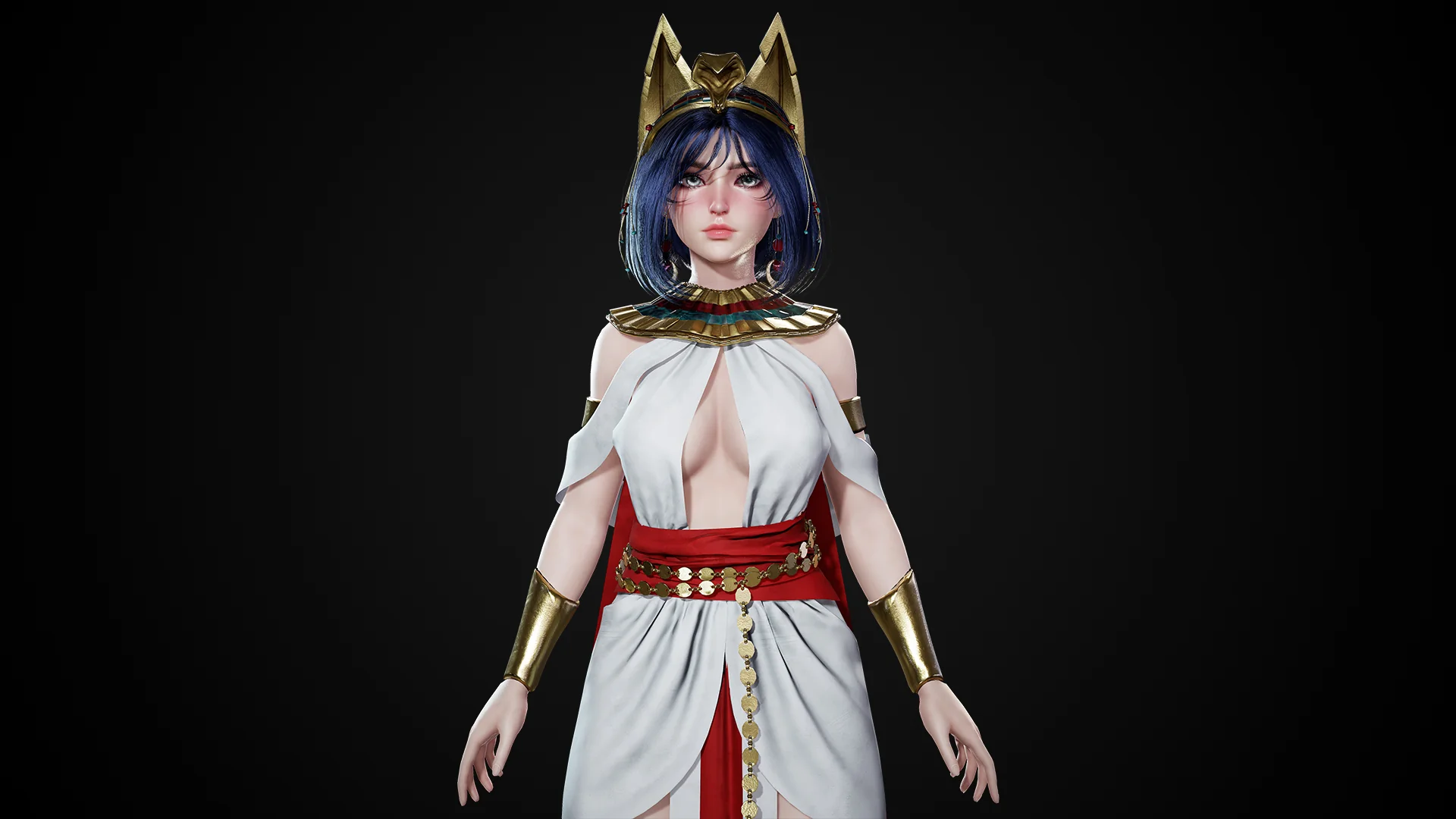
Importing the character into an existing project begins directly with the skeleton setup. The mesh is rigged against the standard Epic Skeleton, meaning retargeting existing animation libraries remains straightforward. While standard locomotion and combat sequences align with default humanoid hierarchies, the asset introduces a wide array of specialized bones to handle clothing, accessories, and secondary motion.
The primary Epic Skeleton is supplemented with dedicated eye joints (eye_l, eye_r) and chest deformation points (breast_l, breast_r). Beyond foundational anatomy, jewelry and headwear rely on specialized chains: head_acs_l_01 through head_acs_l_04, head_acs_r_01 through head_acs_r_04, alongside dangling earrings managed via earring_l_01 through earring_l_03 and earring_r_01 through earring_r_03.
Hair is similarly segmented into individual bone runs for independent sway and physics application. Front locks are driven by hair_front_l_01 to 04 and hair_front_r_01 to 04. Flanking sections use hair_side_l_01 through 05 and hair_side_r_01 through 05, while back locks utilize hair_back_side_l_01 to 04 and hair_back_side_r_01 to 04. Rear accessories feature back_acs_01 through 05.
Because the package does not include pre-configured Blueprints, technical artists wire their own Animation Blueprints or state machines. Retargeting existing Unreal humanoid sequences applies cleanly to the core joints, leaving technical animators the freedom to drive the secondary chains through custom control rigs, physical animation, or dynamic spring nodes.
Facial Capture and Morph Target Controls for Egypt Girl
Facial articulation bypasses complex joint clusters in favor of a full blendshape framework. The character incorporates standard Apple Blendshapes, providing direct compatibility with the Live Link Face iOS application and equivalent face-tracking tools. This enables real-time facial performance capture suitable for live streaming setups, broadcast pipelines, and cinematic dialogue sequences.
Both conversation animations and expressive micro-movements leverage these morph targets without requiring bespoke bone weight maps across the cheeks, lips, or brows. Additionally, anatomical flexibility extends to stylistic variations. A dedicated blendshape toggle swaps the character between human ears and elongated elf ears, allowing transitions between historical Egyptian aesthetics and stylized fantasy projects without swapping skeletal meshes or altering skinning weights.
Garment Dynamics and Secondary Bone Structures
Dynamic costuming plays a prominent role in the visual presentation, particularly across the skirts, cloaks, and decorative sashes. To balance animation control against dynamic simulation, the package provides two distinct versions of the cloak and skirt.
One setup isolates movement to body weighting, with the fabric rigged directly to the main humanoid skeletal mesh without extra deformation joints. This clean skinning ensures zero clipping during aggressive movements and eliminates simulation overhead in performance-critical gameplay scenarios.
The alternative configuration deploys dedicated bone chains across the fabric. Belt adornments rely on gold_belt_01 through gold_belt_05. Front fabric panels utilize cloth_front_01 through 05, augmented by lateral chains cloth_front_l_01 through 06 and cloth_front_r_01 through 06. Flanking panels use cloth_side_l_01 through 06 and cloth_side_r_01 through 06, while trailing hemlines leverage cloth_back_01 through 06. Rear drapery relies on back_cloth_front, back_cloth_mid, back_cloth_l, and back_cloth_r. The cloak itself utilizes cloak_l_01 through 04 and cloak_r_01 through 04.
In Unreal Engine 4 environments, native physics can be activated directly across these chains. Cloth simulation can also be applied across vertices, giving artists the choice between kinematic keyframing, rigid-body physics simulation, or native cloth solvers.
PBR Texture Sets and MatID Customization
Shading utilizes a metallic and roughness PBR workflow, anchored by 4K texture maps across every major surface. Texture distributions encompass normal maps, metallic masks, roughness maps, albedo color passes, opacity masks, and matID layouts.
Assets are organized into eight distinct texture sets:
Body
Head
Clothes
Gold
Teeth
Hair
Eyes
Lashes
Separating these surfaces into independent texture sets preserves high texel density at close camera ranges, particularly across ornamental gold work, eye reflections, and facial skin details. The included matID maps interface directly with Material Instances. This arrangement lets artists change colors across individual garment layers, trim, and jewelry without needing external image-editing software to redraw albedo channels. Opacity channels handle layered hair strands and fine garment edges smoothly.
Modular Assembly and Mesh Completeness
At LOD 0, the character topology comprises 75,433 triangles and 75,270 vertices. The mesh is entirely modular, structured so that individual armor components, jewelry pieces, head accessories, or specific fabric segments can be added, hidden, or removed depending on production needs.
Unlike many game-ready outfits where unexposed geometry is discarded to reduce polygon counts, this model features a complete, uncut full-body mesh underneath the attire. The underlying anatomy is not culled into fragmented proxy geometry, ensuring that partial wardrobe stripping or customized costume layering can occur without exposing missing skin topology. For project compliance, the underlying body texture is censored.
Also, the anatomical proportioning aligns with base character standards such as the Roxy rigged base mesh, easing wardrobe swapping and character cross-compatibility across custom character generation pipelines. With visual themes bridging ancient pharaonic motifs, Anubis-inspired fantasy armor, and desert nomad styling, the asset serves historical epics, medieval fantasy role-playing games, or stylized real-time production pipelines with minimal friction.
 Humans
 Humans
 Humans
 Humans