"1a0e4ac4dc71d030"{"id":"1000197","slug":"modular-elf-archer-girl","title":"Modular Elf Archer Girl","category":"Humans","engine":"4.26+,5.0+","assetVersion":"","engineVersion":"Engine Version: 4.26+,5.0+","tag":"Humans","accent":"blue","visual":"mech","summary":"A modular female elf archer character with Epic Skeleton rigging, facial blendshapes, 4K PBR textures, separated bow and arrow, and armor color variants.","platform":"Unreal Engine","publishedAt":"2026-06-23T11:13:13.917Z","updatedAt":"2026-06-23T11:13:13.917Z","sourceNotes":[],"fileContents":[],"compatibility":["Unreal Engine","Engine Version: 4.26+,5.0+"],"featuredImage":{"alt":"Modular Elf Archer Girl","src":"/wp-content/uploads/published/2026/06/be7f554506e0-1c33a7e5-3b94-42e5-b8f0-224995758e1d-f080b04b74.webp"},"hasDownloadLink":true,"downloads":1,"terms":[{"taxonomy":"category","slug":"humans","name":"Humans"}],"galleryImages":[{"src":"/wp-content/uploads/published/2026/06/575ec3559f7b-f52025cb-b9e6-4b7b-8e7a-de0356ed6ca2-409d211762.webp","alt":"Modular Elf Archer Girl"},{"src":"/wp-content/uploads/published/2026/06/7d5dbefc9a89-e48522d0-df42-425e-86c7-29c913de3d11-e45b118830.webp","alt":"Modular Elf Archer Girl"},{"src":"/wp-content/uploads/published/2026/06/e27a7d56cd2c-e83339f6-882e-456e-a616-41d4b250e7e4-eb1310bba6.webp","alt":"Modular Elf Archer Girl"},{"src":"/wp-content/uploads/published/2026/06/cca32e79591a-8b8f16cc-d3d5-425b-9ea1-00085dbcabef-da4504d606.webp","alt":"Modular Elf Archer Girl"},{"src":"/wp-content/uploads/published/2026/06/b092985b7489-4220868b-385c-491c-84e0-96b6913fc612-be9d223b86.webp","alt":"Modular Elf Archer Girl"},{"src":"/wp-content/uploads/published/2026/06/4aef4240cda5-bafb99bc-89c9-44e2-a4e7-051357110778-111d4c8aad.webp","alt":"Modular Elf Archer Girl"},{"src":"/wp-content/uploads/published/2026/06/8019ee72b9bb-b123feab-2eb5-4ee0-87eb-3cacbe2f1470-fe808535bd.webp","alt":"Modular Elf Archer Girl"},{"src":"/wp-content/uploads/published/2026/06/9c7d2717b777-28006373-a6bc-4887-af14-edc5b42ace46-6903307c31.webp","alt":"Modular Elf Archer Girl"},{"src":"/wp-content/uploads/published/2026/06/83fc00a8bbab-1cd0ce8b-d910-4204-bb70-c0a1f5a7f882-9597a30292.webp","alt":"Modular Elf Archer Girl"},{"src":"/wp-content/uploads/published/2026/06/96191eceeb5e-97ac8852-8330-4315-a136-9e3556e82a6e-98e20d80e6.webp","alt":"Modular Elf Archer Girl"}],"accessPanel":{"kind":"resource","title":"Download this resource","eyebrow":"Free Download","message":"Log in or create a free account to start your download.","fileName":"Content.7z","safetyNote":"Resources are manually reviewed before listing to improve quality and reduce obvious risks.","actionLabel":"Download Free","resourceType":"Resource archive"},"contentHtml":"\u003cp\u003eForest paths, medieval outposts, hunting grounds, and fantasy combat encounters all benefit from a character who already carries a clear role at a glance. Modular Elf Archer Girl arrives with that identity fully established: a realistic female elf archer whose silhouette, gear, and included bow-and-arrow setup make her a natural fit for ranger, hunter, and fantasy action scenes.\u003c/p\u003e\u003cp\u003eWhat gives the character more flexibility than a single locked look is the modular structure. Parts can be removed or added, which changes how heavily equipped the archer appears and lets the same base character move between cleaner hero presentation, more battle-ready looks, or stripped-back variations where armor is removed. A nude body is included, so armor does not have to define every use of the model. That opens space for costume changes, alternate styling, and different levels of protection depending on the scene being built.\u003c/p\u003e\u003cp\u003eThe resource also keeps its weapon elements separate. The bow and arrow are not fused into the character model, and both are included as static mesh and skeletal mesh. That matters when a project needs the weapon to behave in different ways across gameplay, animation, or presentation. In one setup the bow can sit as a static prop, while in another it can function as part of a more animated or character-driven arrangement.\u003c/p\u003e\u003ch2\u003eModular Elf Archer Girl in fantasy and medieval scenes\u003c/h2\u003e\u003cp\u003eThe strongest use case here is visual storytelling through role clarity. This is not a neutral background figure with a vague costume theme. It is an elf archer with fantasy and medieval tags, and that gives artists a direct path into scene construction. A woodland ambush, a watchful ranger on a cliff path, a hunter near a camp, or an archer standing in a fortified settlement all align naturally with the character’s identity.\u003c/p\u003e\u003cp\u003eBecause the model is completely modular, the same character can cover more than one scene function without needing to be treated as a fixed single outfit. Armor can be added for a more guarded and combat-ready impression, or removed when a lighter presentation works better. That flexibility is useful when a team wants visual continuity across multiple shots or gameplay contexts while still showing progression or variation. Instead of swapping to an entirely different character, the appearance can shift through removable parts.\u003c/p\u003e\u003cp\u003eArmor color variations also contribute to scene placement. Three armor color options are included: blue, brown, and red. Those are straightforward changes, but they are meaningful ones. Brown can lean into a grounded hunter or ranger feel, blue can push the character toward a cleaner or more stylized faction look, and red can introduce a more striking presence in combat-oriented scenes. Even when the model remains the same, color variation helps the character read differently depending on environment, lighting, and narrative role.\u003c/p\u003e\u003ch2\u003eEpic Skeleton rigging and a face set up for expression\u003c/h2\u003e\u003cp\u003eThe character is rigged with Epic Skeleton, which immediately places it in a production-friendly animation context for teams already working with that structure. The rig does not stop at the body. The face is rigged as well, and blendshapes are included alongside facial expressions. This combination adds a layer of performance value that goes beyond static renders or simple locomotion use.\u003c/p\u003e\u003cp\u003eFor developers, facial rigging and expressions make the character more adaptable in dialogue moments, close-up interactions, or short cinematic beats where an archer needs to react rather than only pose. For artists, those same elements support stronger stills and turntables because the face can carry emotion and intent instead of remaining neutral. An alert ranger, a focused hunter, or a guarded fantasy scout can all benefit from facial control.\u003c/p\u003e\u003cp\u003eThere is also a practical balance here between role specificity and animation flexibility. Since the character already fits an action-oriented archer profile, the body rig and separate weapon setup support movement-driven use, while the facial system supports presentation and character acting. That makes the model useful not just as a distant combat unit, but also as a more visible named character when a project needs one.\u003c/p\u003e\u003ch2\u003e4K PBR texture sets for body, armor, hair, and gear\u003c/h2\u003e\u003cp\u003eTexture support is broad and broken into multiple material areas rather than handled as a single undifferentiated surface. The character uses PBR textures in a metal/roughness workflow, with 4K maps that include normal, metallic, roughness, albedo, ambient occlusion, and opacity.\u003c/p\u003e\u003cp\u003eNine texture sets are included: Body, Head, Armor, Teeth, Hair, Bow, Quiver, Eyes, and Lashes. That separation is important for anyone building shots where material distinction carries much of the visual quality. Skin, hair, armor, and accessories do not need to read as one flattened surface treatment. The head and body are separated, the eyes and lashes receive their own attention, and gear such as the bow and quiver are treated as distinct texture domains.\u003c/p\u003e\u003cp\u003eInside a project, this gives artists clearer control over how the character sits inside a scene. The armor can maintain its own material response, the hair can stay visually separate from the face, and the bow does not have to inherit the same visual behavior as clothing or skin. For render work, that separation helps preserve readability. For interactive work, it helps keep the character organized by visible component rather than by a single broad material block.\u003c/p\u003e\u003cp\u003eThe opacity map inclusion is also notable in the context of elements like lashes and other details that benefit from cutout-style treatment. Combined with the dedicated texture sets, it supports the finer visual parts of the character rather than reducing everything to larger costume pieces.\u003c/p\u003e\u003ch2\u003eBow, arrow, quiver, and armor variations as interchangeable scene tools\u003c/h2\u003e\u003cp\u003eOne of the better aspects of this resource is that its accessories are not treated like afterthoughts. The bow and arrow are separated, and the quiver has its own texture set. That means the archer’s equipment is present not only as part of a costume idea, but as usable scene components with their own material attention.\u003c/p\u003e\u003cp\u003eFor environment staging, that has obvious benefits. A bow can remain with the character, or it can be treated more like a placed object in a static setup. The separation between character and gear supports different visual states: armed, partially equipped, or more at rest. Since the bow and arrow are included as both static mesh and skeletal mesh, they can fit projects that need either straightforward placement or a setup that connects more closely with animation.\u003c/p\u003e\u003cp\u003eThe modular armor works the same way at the outfit level. Instead of reading as one permanent shell, it becomes an interchangeable layer. That gives the resource some range across fantasy storytelling beats. A fully armored elf archer can work in a combat patrol or siege-related setup, while a lighter version can better suit stealth, scouting, or travel scenes. The included nude body broadens that range by making armor removal a real option rather than a hidden limitation.\u003c/p\u003e\u003ch2\u003ePolycount and where this elf archer fits best\u003c/h2\u003e\u003cp\u003eThe model has 36,159 faces, 67,922 tris, and 45,015 verts. Those numbers place the character in a clearly defined production space for teams that need concrete geometry information before committing to a character resource. Combined with the rigged body, rigged face, blendshapes, modular parts, and multiple texture sets, the asset is positioned as more than a simple decorative NPC.\u003c/p\u003e\u003cp\u003eIts best fit is in projects that want a recognizable female fantasy archer who can move between gameplay and presentation roles without losing visual identity. The character’s modular setup, facial controls, armor color options, and separated bow-and-arrow pieces make it especially useful for medieval fantasy scenes where one character may need several visual states instead of only one fixed appearance.\u003c/p\u003e\u003cp\u003eIf a project needs an elf ranger or hunter who can carry close-up shots, outfit variation, and weapon-based staging in the same package, Modular Elf Archer Girl covers that space with concrete, production-facing features beyond one static look.\u003c/p\u003e\n\n\u003ch2\u003eMore From The Same Workflow\u003c/h2\u003e\n\u003cul\u003e\n\u003cli\u003e\u003ca href=\"https://3dcghub.com/kitsune/\" title=\"Kitsune\"\u003eKitsune\u003c/a\u003e\u003c/li\u003e\n\u003cli\u003e\u003ca href=\"https://3dcghub.com/cat-girl-101/\" title=\"Cat girl 101\"\u003eCat girl 101\u003c/a\u003e\u003c/li\u003e\n\u003cli\u003e\u003ca href=\"https://3dcghub.com/base-girl-various-outfits/\" title=\"Base Girl - Various Outfits\"\u003eBase Girl - Various Outfits\u003c/a\u003e\u003c/li\u003e\n\u003cli\u003e\u003ca href=\"https://3dcghub.com/archer-girl/\" title=\"Archer Girl\"\u003eArcher Girl\u003c/a\u003e\u003c/li\u003e\n\u003cli\u003e\u003ca href=\"https://3dcghub.com/amazon-female-warrior-native-knight-realistic-girl-mmorpg-stylized-character/\" title=\"Amazon Female Warrior, Native Knight Realistic Girl MMORPG Stylized Character\"\u003eAmazon Female Warrior, Native Knight Realistic Girl MMORPG Stylized Character\u003c/a\u003e\u003c/li\u003e\n\u003c/ul\u003e","contentTextLength":8378,"navigation":{"current":1105,"total":3200,"previous":{"id":"1000198","slug":"monsters-wraith","title":"Monsters - Wraith","category":"Creatures \u0026 Monsters","platform":"Unreal Engine","updatedAt":"2026-06-23T11:17:03.690Z"},"next":{"id":"1000196","slug":"animating-in-unreal-engine","title":"Animating in Unreal Engine","category":"Unreal Engine","platform":"Unreal Engine","updatedAt":"2026-06-23T11:07:32.906Z"}},"relatedResources":[{"id":"1000717","slug":"xiao-jue-asian-girl","title":"Xiao Jue - Asian Girl","category":"Humans","engine":"4.26+,5.0+","assetVersion":"","engineVersion":"Engine Version: 4.26+,5.0+","tag":"Humans","accent":"blue","visual":"mech","summary":"Xiao Jue is a fully rigged, modular Asian girl character for Unity, Unreal, and Substance Painter, featuring 52 ARKit blendshapes, 4K textures, Epic Skeleton ri","platform":"Unreal Engine","publishedAt":"2026-07-24T12:37:39.846Z","updatedAt":"2026-07-24T12:37:39.846Z","sourceNotes":[],"fileContents":[],"compatibility":["Unreal Engine","Engine Version: 4.26+,5.0+"],"featuredImage":{"alt":"Xiao Jue - Asian Girl","src":"/wp-content/uploads/published/2026/07/ffa17768091c-29071cfa-7475-41d7-a8ee-0dae6795a052-b8ba4430a8.webp"},"hasDownloadLink":true,"downloads":5},{"id":"1000421","slug":"assassin-girl-modular","title":"Assassin Girl Modular","category":"Humans","engine":"4.27,5.0+","assetVersion":"","engineVersion":"Engine Version: 4.27,5.0+","tag":"Humans","accent":"blue","visual":"mech","summary":"Modular rigged female assassin character with Epic Skeleton, facial blendshapes, PBR 4K textures, and Unreal Engine physics. Includes dagger and multiple body t","platform":"Unreal Engine","publishedAt":"2026-07-09T20:16:25.138Z","updatedAt":"2026-07-09T20:16:25.138Z","sourceNotes":[],"fileContents":[],"compatibility":["Unreal Engine","Engine Version: 4.27,5.0+"],"featuredImage":{"alt":"Assassin Girl Modular","src":"/wp-content/uploads/published/2026/07/571d57f12c7f-2b2ffcf1-fa74-4d6a-81c3-00378fd516a0-1a49c79810.webp"},"hasDownloadLink":true,"downloads":3},{"id":"1000206","slug":"survivor-girl-1-modular","title":"Survivor Girl 1 (Modular)","category":"Humans","engine":"4.26+,5.0+","assetVersion":"","engineVersion":"Engine Version: 4.26+,5.0+","tag":"Humans","accent":"blue","visual":"mech","summary":"A fully rigged, modular female character model designed for apocalyptic survival games, featuring facial blendshapes, 4K PBR textures, and low-poly weapons.","platform":"Unreal Engine","publishedAt":"2026-06-23T19:35:44.835Z","updatedAt":"2026-06-23T19:35:44.835Z","sourceNotes":[],"fileContents":[],"compatibility":["Unreal Engine","Engine Version: 4.26+,5.0+"],"featuredImage":{"alt":"Survivor Girl 1 (Modular)","src":"/wp-content/uploads/published/2026/06/ea003c542fdd-d82dc264-87e2-40e6-a96c-2a4b916b4cb7-25e2910de6.webp"},"hasDownloadLink":true,"downloads":2}]}
Humans
Modular Elf Archer Girl
A modular female elf archer character with Epic Skeleton rigging, facial blendshapes, 4K PBR textures, separated bow and arrow, and armor color variants.
Category:Unreal Engine, HumansPlatform: Unreal EngineEngine Version: 4.26+,5.0+Published: Jun 23, 2026
Humans
Resource overview
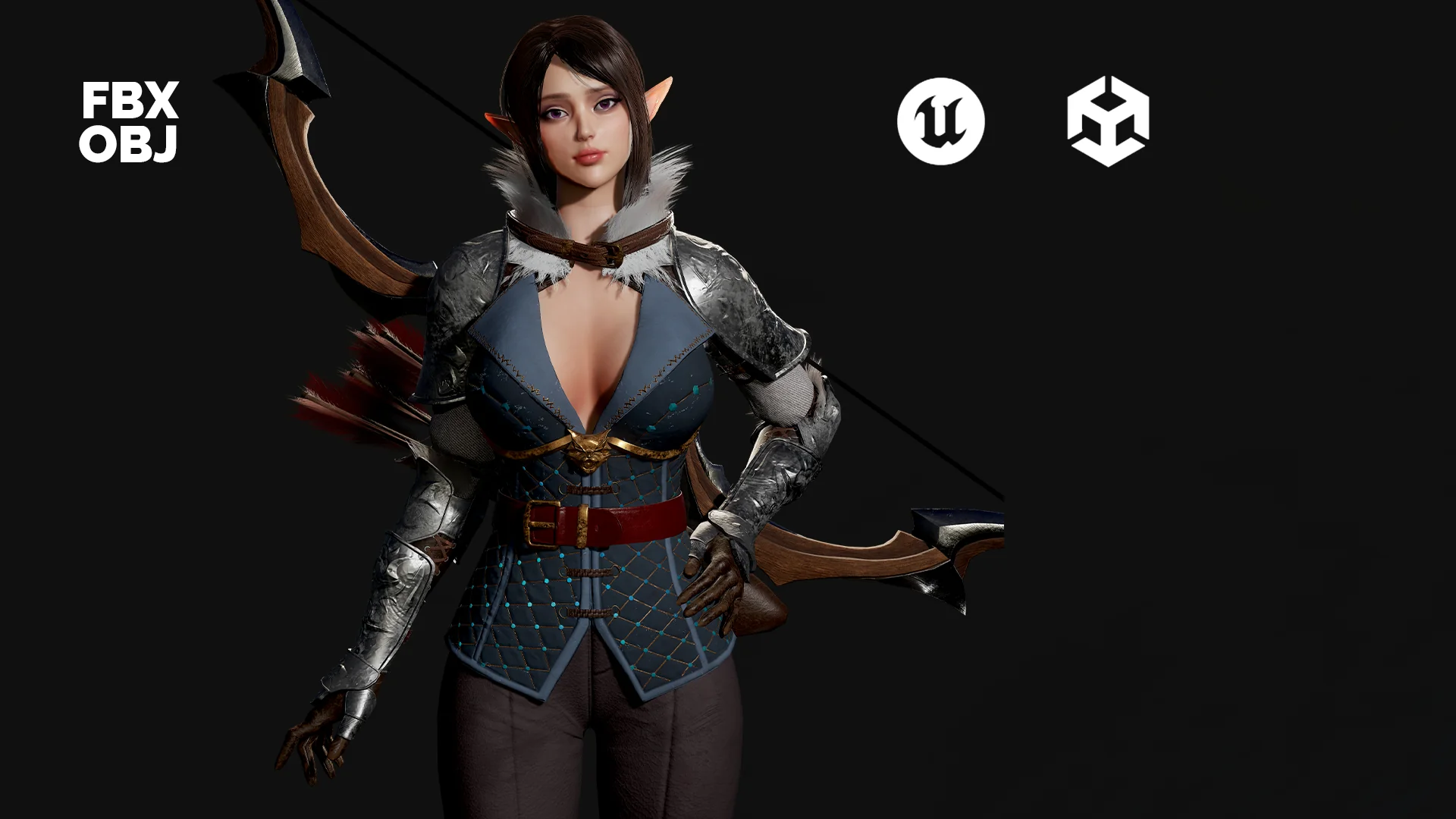
Forest paths, medieval outposts, hunting grounds, and fantasy combat encounters all benefit from a character who already carries a clear role at a glance. Modular Elf Archer Girl arrives with that identity fully established: a realistic female elf archer whose silhouette, gear, and included bow-and-arrow setup make her a natural fit for ranger, hunter, and fantasy action scenes.
What gives the character more flexibility than a single locked look is the modular structure. Parts can be removed or added, which changes how heavily equipped the archer appears and lets the same base character move between cleaner hero presentation, more battle-ready looks, or stripped-back variations where armor is removed. A nude body is included, so armor does not have to define every use of the model. That opens space for costume changes, alternate styling, and different levels of protection depending on the scene being built.
The resource also keeps its weapon elements separate. The bow and arrow are not fused into the character model, and both are included as static mesh and skeletal mesh. That matters when a project needs the weapon to behave in different ways across gameplay, animation, or presentation. In one setup the bow can sit as a static prop, while in another it can function as part of a more animated or character-driven arrangement.
Modular Elf Archer Girl in fantasy and medieval scenes
The strongest use case here is visual storytelling through role clarity. This is not a neutral background figure with a vague costume theme. It is an elf archer with fantasy and medieval tags, and that gives artists a direct path into scene construction. A woodland ambush, a watchful ranger on a cliff path, a hunter near a camp, or an archer standing in a fortified settlement all align naturally with the character’s identity.
Because the model is completely modular, the same character can cover more than one scene function without needing to be treated as a fixed single outfit. Armor can be added for a more guarded and combat-ready impression, or removed when a lighter presentation works better. That flexibility is useful when a team wants visual continuity across multiple shots or gameplay contexts while still showing progression or variation. Instead of swapping to an entirely different character, the appearance can shift through removable parts.
Armor color variations also contribute to scene placement. Three armor color options are included: blue, brown, and red. Those are straightforward changes, but they are meaningful ones. Brown can lean into a grounded hunter or ranger feel, blue can push the character toward a cleaner or more stylized faction look, and red can introduce a more striking presence in combat-oriented scenes. Even when the model remains the same, color variation helps the character read differently depending on environment, lighting, and narrative role.
Epic Skeleton rigging and a face set up for expression
The character is rigged with Epic Skeleton, which immediately places it in a production-friendly animation context for teams already working with that structure. The rig does not stop at the body. The face is rigged as well, and blendshapes are included alongside facial expressions. This combination adds a layer of performance value that goes beyond static renders or simple locomotion use.
For developers, facial rigging and expressions make the character more adaptable in dialogue moments, close-up interactions, or short cinematic beats where an archer needs to react rather than only pose. For artists, those same elements support stronger stills and turntables because the face can carry emotion and intent instead of remaining neutral. An alert ranger, a focused hunter, or a guarded fantasy scout can all benefit from facial control.
There is also a practical balance here between role specificity and animation flexibility. Since the character already fits an action-oriented archer profile, the body rig and separate weapon setup support movement-driven use, while the facial system supports presentation and character acting. That makes the model useful not just as a distant combat unit, but also as a more visible named character when a project needs one.
4K PBR texture sets for body, armor, hair, and gear
Texture support is broad and broken into multiple material areas rather than handled as a single undifferentiated surface. The character uses PBR textures in a metal/roughness workflow, with 4K maps that include normal, metallic, roughness, albedo, ambient occlusion, and opacity.
Nine texture sets are included: Body, Head, Armor, Teeth, Hair, Bow, Quiver, Eyes, and Lashes. That separation is important for anyone building shots where material distinction carries much of the visual quality. Skin, hair, armor, and accessories do not need to read as one flattened surface treatment. The head and body are separated, the eyes and lashes receive their own attention, and gear such as the bow and quiver are treated as distinct texture domains.
Inside a project, this gives artists clearer control over how the character sits inside a scene. The armor can maintain its own material response, the hair can stay visually separate from the face, and the bow does not have to inherit the same visual behavior as clothing or skin. For render work, that separation helps preserve readability. For interactive work, it helps keep the character organized by visible component rather than by a single broad material block.
The opacity map inclusion is also notable in the context of elements like lashes and other details that benefit from cutout-style treatment. Combined with the dedicated texture sets, it supports the finer visual parts of the character rather than reducing everything to larger costume pieces.
Bow, arrow, quiver, and armor variations as interchangeable scene tools
One of the better aspects of this resource is that its accessories are not treated like afterthoughts. The bow and arrow are separated, and the quiver has its own texture set. That means the archer’s equipment is present not only as part of a costume idea, but as usable scene components with their own material attention.
For environment staging, that has obvious benefits. A bow can remain with the character, or it can be treated more like a placed object in a static setup. The separation between character and gear supports different visual states: armed, partially equipped, or more at rest. Since the bow and arrow are included as both static mesh and skeletal mesh, they can fit projects that need either straightforward placement or a setup that connects more closely with animation.
The modular armor works the same way at the outfit level. Instead of reading as one permanent shell, it becomes an interchangeable layer. That gives the resource some range across fantasy storytelling beats. A fully armored elf archer can work in a combat patrol or siege-related setup, while a lighter version can better suit stealth, scouting, or travel scenes. The included nude body broadens that range by making armor removal a real option rather than a hidden limitation.
Polycount and where this elf archer fits best
The model has 36,159 faces, 67,922 tris, and 45,015 verts. Those numbers place the character in a clearly defined production space for teams that need concrete geometry information before committing to a character resource. Combined with the rigged body, rigged face, blendshapes, modular parts, and multiple texture sets, the asset is positioned as more than a simple decorative NPC.
Its best fit is in projects that want a recognizable female fantasy archer who can move between gameplay and presentation roles without losing visual identity. The character’s modular setup, facial controls, armor color options, and separated bow-and-arrow pieces make it especially useful for medieval fantasy scenes where one character may need several visual states instead of only one fixed appearance.
If a project needs an elf ranger or hunter who can carry close-up shots, outfit variation, and weapon-based staging in the same package, Modular Elf Archer Girl covers that space with concrete, production-facing features beyond one static look.
 Humans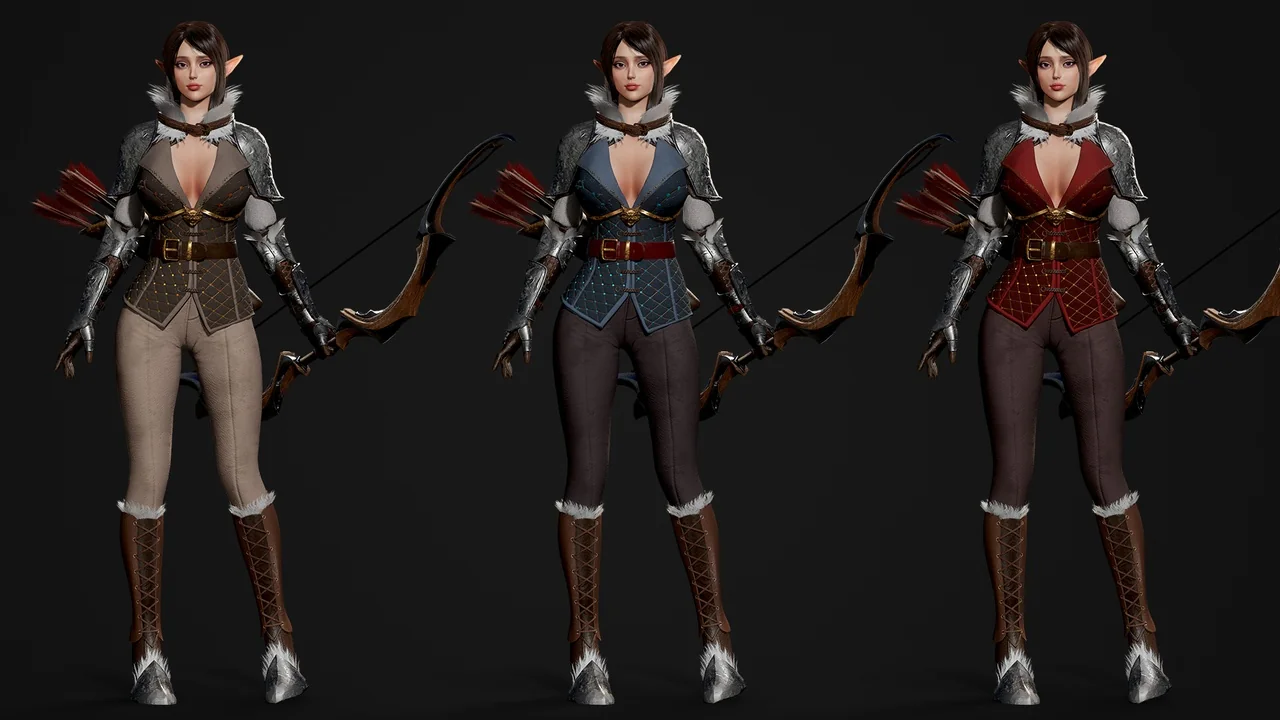
 Humans
 Humans
 Humans